The German national nosocomial infection surveillance system for neonates (NEO-KISS) is a surveillance system for healthcare associated infections in very low birthweight infants. It was established in the year 2000, first on the basis of voluntary participation and since 2006 on a mandatory basis.Reference Schwab, Gastmeier, Piening and Geffers 1 With NEO-KISS we have the notable situation of a nationwide surveillance system for healthcare-associated infections in neonates. NEO-KISS covers the most relevant nosocomial infections, namely primary bloodstream infection, pneumonia, and necrotizing enterocolitis, in all neonatal departments in Germany.
The intervention focused on healthcare-associated bloodstream infections, which are potentially lethal infections with elevated length of stay and costs.Reference Horbar, Carpenter and Badger 2 , Reference Payne, Carpenter, Badger, Horbar and Rogowski 3 In the past 2 decades, an increase of healthcare-related bloodstream infections was observed while the mortality of bloodstream infections decreased.Reference Verstraete, Boelens and De Coen 4 Very-low-birthweight infants have an increased risk for bloodstream infections—on the one hand due to biological factors like weak skin barrier,Reference Cartlidge 5 on the other hand due to the use of invasive devices on neonatal intensive care units.
Bloodstream infections are strongly associated with the use of central venous catheters.Reference Geffers, Gastmeier, Schwab, Groneberg, Rüden and Gastmeier 6 In German neonatal departments approximately 43% of the bloodstream infections in very-low-birthweight newborns are catheter-associated.Reference Leistner, Thürnagel, Schwab, Piening, Gastmeier and Geffers 7 The incidence of bloodstream infections in the years from 2007 to 2011 with 33,048 infants under surveillance and more than 121,000 observed patient-days was described for Germany with 4.7 per 1,000 patient-days (95% CI, 4.6–4.9).Reference Leistner, Piening, Gastmeier, Geffers and Schwab 8
Numerous studies were able to reduce bloodstream infections in very-low-birthweight patients effectively by implementing different evidence-based interventions simultaneously as so-called bundles.Reference Pronovost, Needham and Berenholtz 9 – Reference Kilbride, Wirtschafter, Powers and Sheehan 13 The main objective of this intervention was to improve patient safety in neonate infirmaries with bloodstream infection rates above the average by implementing an evidence-based bundle.
METHODS
Intervention and Study Design
We conducted a multicenter cohort study with a 2-year baseline (July 2007-June 2009), a 12-month intervention (July 2009-June 2010), and a 12-month postinterventional follow-up period (July 2010-June 2011). Between July 2009 and June 2010, each of the participating 32 neonatal departments implemented an evidence-based intervention bundle to reduce bloodstream infections. The intervention bundle comprised several teaching materials like lectures, scripts, case discussions, posters, and checklists to improve process and structural quality with regard to peripheral and central catheter management. The teaching materials addressed all healthcare workers on neonatal departments. The German National Reference Centre for Surveillance of Nosocomial Infections 14 created the material. It consists of (1) indications of hand hygiene, (2) checklists for dealing with venous catheters (strict indication for central line catheters, maximal barrier precautions, adequate skin disinfectant, daily check on injection site, daily evaluation on indication), and (3) management of parenteral medication (preparation, application). The intervention was based on a “train the trainer” principle. Our intervention aimed to train the local trainers (members of the local infection control teams). At the beginning of the intervention, the trainers were instructed by staff of the German National Reference Center for Surveillance of Nosocomial Infections. In the days after the 1-day course, the trainers were to offer the prepared lecture to the local staff of their neonatal departments. After 6 months, the trainers were to hold the lecture once again for the team to keep the topic in mind. They were allowed to emphasize special topics corresponding to the needs of their neonatal department.
NEO-KISS and Standardized Infection Ratio (SIR)
The surveillance of healthcare-associated infections on neonatology departments and intensive care units in NEO-KISS is patient-based. Participation is quasi-mandatory (surveillance is required for reimbursement) so that all newborns with very low birthweight (<1,500 g) are under surveillance in NEO-KISS in Germany. The surveillance stops when the infant surpasses a weight of 1,800 g, when the infant transfers to a non–intensive care area, or when the patient dies.
The SIR is calculated by the number of observed bloodstream infections divided by the number of expected bloodstream infections. The SIR calculation pools all German NEO-KISS patients with a birthweight from 500 g to 1,499 g in the reference database for a 5-year period and calculates the infection risks per patient-day for each birthweight group (in 50-gram steps). In a second step, these calculated risks are used together with a department’s patient population (birthweights and patient-days) to predict the number of infections for this population. Finally the number of observed infections is put in relation to the predicted number of infections; therefore, a SIR greater than 1 means that more infections were observed in the specific department than were expected according to its patient population.
According to the NEO-KISS-Protocol, 14 a patient-day with peripheral catheter was counted when a patient had a peripheral catheter for more than 12 hours and no central catheters at the same time (with central catheters including umbilical arterial and venous and flow-directed catheters).
Definition of Bloodstream Infections
NEO-KISS uses modified criteria from the Centers for Disease Control and Prevention for the definition of bloodstream infections. Only primary bloodstream infections were under surveillance. NEO-KISS distinguishes 3 different bloodstream infection forms. The first form is the clinical bloodstream infection without pathogen detection (attending physician begins appropriate antimicrobial therapy for sepsis for at least 5 days AND no pathogen was detected in the blood culture or no blood culture was performed AND no infection is diagnosed elsewhere, which could explain the symptoms). The second form is microbiologically confirmed bloodstream infections with pathogen detection in the blood culture other than coagulase-negative staphylococci. The third form is microbiologically confirmed bloodstream infection with coagulase-negative staphylococci. For more information, see BSI-data collection form for NEO-KISS (Supplement) and the NEO-KISS-Surveillance protocol. 14 The NEO-KISS definitions did not change over the study period.
Setting and Patients
Participating neonatal departments were selected on the basis of the frequency of bloodstream infections in very-low-birthweight infants collected in the year 2008. All neonatal departments in which the SIR was at least 10% higher than the national average (SIR ≥ 1.1) and that had at least 2 cases of bloodstream infection were invited to participate in the study. Of 192 neonatal departments in Germany, 53 met the criteria, Of these 53, a total of 52 wards were contacted, and 34 neonatal departments registered for the study. Two departments withdrew during the intervention time because of intern department remodeling.
Outcomes
The primary outcome was the frequency of bloodstream infections per 1,000 patient-days. Secondary outcomes were venous catheter–related blood stream infections per 1,000 venous catheter–days, in-hospital mortality, and the change in the venous catheter utilization rate.
Statistical Analysis
Neonates were included in the analysis by their month of admission to the neonatal department. In the descriptive analysis, number and percent or median and interquartile range were calculated. Differences between the 3 periods were tested by χ2 or Kruskal-Wallis test. In the multivariable analysis, segmented regression analysis of interrupted time series using generalized linear models was performed to estimate the association of the number of bloodstream infections with time, intervention, and other confounders. The method is described in detail elsewhere.Reference Wagner, Soumerai, Zhang and Ross-Degnan 15 Because observations within a neonatal department are not statistically independent owing to the same diagnostic policies (especially the frequency of microbiological blood culture tests) and preventive measures, adjusted incidence rate ratios with 95% confidence intervals (CIs) were estimated. They were based on generalized estimating equation models, which account for this clustering effect by using an exchangeable correlation structure. We used Poisson distribution in the models. The log number of risk days during each month was treated as an offset in the model. We calculated adjusted incidence rate ratios for the parameters of the segmented time series: trend/slope from July 2007, the change in level at start of intervention (July 2009), the change in trend/slope from July 2009, the change in level at the end of intervention (July 2010), the change in trend/slope from July 2010. The following parameters were considered as confounders in all models: birthweight (<500, 500–749, 750–999, 1,000–1,249, 1,250–1,499 gram), gestational age (≤26, 27-28, 29-30, ≥31weeks), sex, and delivery mode (vaginal, caesarean, emergency caesarean). The multivariable model building strategy was performed stepwise backward. From a full-segment regression model, nonsignificant time series parameters were excluded. The excluding criterion were the smallest χ2 value and P≥.05 in the type III score statistic. The quasi-likelihood information criterion as a modification of the Akaike information criterion was used as goodness-of-fit measure in the generalized estimating equation model. P<.05 was considered significant. All analyses were performed using SPSS (IBM) and SAS (SAS Institute).
RESULTS
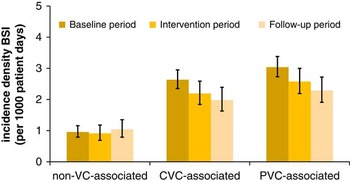
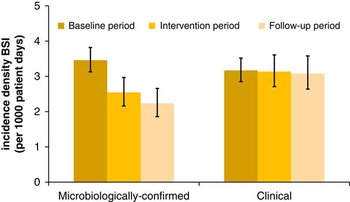
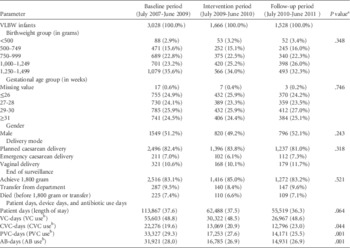
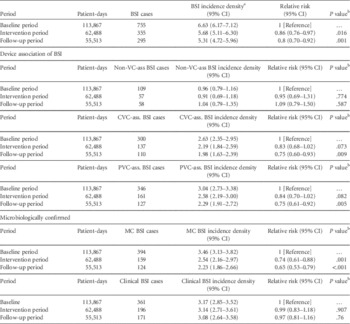
A total of 34 departments participated in the study and 32 reported data. In total, 6,222 very-low-birthweight infants with 231,868 patient-days and 1,405 cases of bloodstream infections were analyzed. Table 1 summarizes the characteristics of all patients at the participating neonatal departments before, during, and after the intervention. The total number of catheter-days changed little, whereas central venous catheter–days increased and peripheral venous catheter–days decreased. Throughout the entire study we observed a mean (interquartile range) number of 2 (0–12) central venous catheter–days per patient and 9 (4–14) peripheral venous catheter-days per patient. The median (interquartile range) patient stay at the neonatal wards was 33 (23–49) days. The incidence of bloodstream infections per 100 patients was 19.1% for the whole study period. It started at a value of 21.2% in the baseline period and decreased significantly to 16.2% after the intervention (P<.001). In the baseline period the incidence density of bloodstream infections was 6.63 bloodstream infections per 1,000 patient-days and decreased to 5.68 in the intervention period (relative risk, 0.86 [95% CI, 0.76–0.97]) and to 5.31 in the 1-year follow-up period (0.80 [0.70–0.92]) (Table 2). The rate ratio of catheter-related (central and peripheral) bloodstream infections was 0.76 (95% CI, 0.65–0.88; P<.001) between baseline and postintervention period. The risk decreased even more with regard to central line–associated bloodstream infections (relative risk, 0.64 [95% CI, 0.51–0.79]; P<.001). The intervention decreased the number of peripheral as well as central line–associated bloodstream infections but did not affect the non–device-related bloodstream infections (Figure 1). Focusing on the type of bloodstream infection, we observed a reduction in microbiologically confirmed bloodstream infections regardless of the pathogen, but the intervention did not affect the clinical bloodstream infection without detected pathogen (Figure 2).
Incidence density of bloodstream infections per 1,000 patient-days stratified by device association of the bloodstream infection (BSI) and study period. Data are from 6,222 very-low-birthweight infants treated in 32 German neonatal departments (July 2007 to June 2011). CVC, central venous catheter–associated BSI; non-VC, non–venous catheter–associated BSI; PVC, peripheral venous catheter–associated BSI; whiskers represent 95% confidence intervals.

Incidence density of bloodstream infections (BSIs) per 1,000 patient-days for microbiologically confirmed and clinical sepsis, stratified by study period (baseline: July 2007 to June 2009; intervention: July 2009 to June 2010; follow-up: July 2010 to June 2011). Data are from 6,222 very-low-birthweight infants treated in 32 German neonatal departments; whiskers represent the 95% confidence intervals.

Characteristics and Descriptive Statistics of 6,222 Very-Low-Birthweight (VLBW) Infants From 32 Neonatal Departments Stratified by Baseline, Intervention, and Follow-up Period

NOTE. Data are no. (%) unless otherwise indicated. AB, antibiotic; CVC, central venous catheter; PVC, peripheral venous catheter; VC, venous catheter.
a χ2 test or Kruskal-Wallis for patient-based data (patient- and device-days).
b Device use was calculated per 100 patient-days.
Data From 6,222 Very-Low-Birthweight Infants Treated in 32 German Neonatal Departments at Baseline (July 2007 to June 2009), Intervention (July 2009 to June 2010), and Follow-up Period (July 2010 to June 2011)

NOTE. BSI, bloodstream infection; CVC, central venous catheter; MC, microbiologically confirmed; PVC, peripheral venous catheter; VC, venous catheter;.
a Per 1,000 patient-days.
b Mid-p exact test.
We observed a nonsignificant decreasing trend in mortality from 7.3% in the baseline period to 5.0% in the intervention period and 4.9% in the follow-up period (relative risk, 0.66 [95% CI, 0.35–1.23]; P=.186).
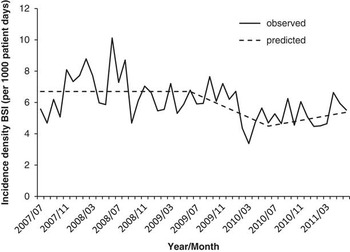
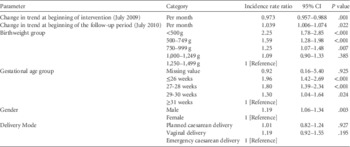
The results of the multivariable time series analysis show the change of slopes between the 3 periods for the frequency of bloodstream infections (Table 3 and Figure 3). We can see a decrease with the beginning of the intervention (incidence rate ratio, 0.97 [95% CI, 0.96–0.99]; P=.001) and an increase (1.04 [1.01–1.07]; P=.02) after the intervention during the transition to the postintervention period, respectively. In other words, compared with the baseline period (6.63 bloodstream infections per 1,000 patient-days), at the end of the intervention (June 2010) the predicted incidence density of bloodstream infections was 32.3% percent lower (4.49 bloodstream infections per 1,000 patient-days) and at the end of the follow-up period (June 2011) 19% percent lower (5.37 bloodstream infections per 1,000 patient-days). The pooled means of the 3 periods are presented in Table 2.
Observed and predicted monthly incidence density of bloodstream infections (BSIs). Data are from 6,222 very-low-birthweight infants from 32 neonatal departments in Germany (July 2007 to June 2011). The predicted incidence density of BSIs was estimated with multivariable segmented regression analysis of interrupted time series.

Results of the Multivariable Segmented Regression Analysis With Outcome Primary Bloodstream Infection, With Data Based on 6,222 Very-Low-Birthweight Infants of 32 Neonatal Departments in Germany During the Study Period (July 2007 to June 2011)

NOTE. For the calculation we used generalized estimating equations models using Poisson distribution and logarithmic transformed patient-days as offset parameter. The model accounts for cluster effects within an neonatal department and for the confounding parameters birthweight (<500, 500–749, 750–999, 1,000–1,249, 1,250–1,499 gram), gestational age (≤26, 27-28, 29-30, ≥31weeks), sex, and delivery mode (vaginal, caesarean delivery, emergency caesarean delivery).
DISCUSSION
We performed a large, multicenter trial to investigate the impact of an intervention bundle on the reduction of the occurrence of bloodstream infections in preterm neonates. This study shows that the implementation of evidence-based bundles is feasible and can reduce bloodstream infections in neonatal departments effectively. In the 12-month follow-up period (July 2010-June 2011) the bloodstream infection rate was 5.31 (95% CI, 4.72–5.96) per 1,000 patient-days. The follow-up infection rate was significantly lower than the rate at baseline with 6.63 (95% CI, 6.17–7.12) per 1,000 patient-days. The findings indicate that neonates in the follow-up period were exposed to a bloodstream infection risk of 0.8 (95% CI, 0.70–0.92) times the risk of the participants in the preintervention period. The evidence-based intervention bundle is inexpensive and contains simple components like catheter maintenance routines, catheter insertion practice, and hand hygiene compliance; it reduced the bloodstream infections as well as the mean (interquartile range) antibiotic days per each patient significantly from 7 (3–14) before the intervention to 6 (2–14) in the intervention period and 6 (2–13) in the follow-up period, respectively.
The focus of this intervention was on primary bloodstream infections. It remains uncertain whether the intervention modified the incidence of secondary bloodstream infections because these were not under surveillance. Another limitation of the study is that the results could be influenced by an improved healthcare system over the study period. Figure 3 shows the incidence density of bloodstream infections (per 1,000 patient-days) for the intervention group. In addition, Supplementary Figure 4 (appendix) presents the incidence density of bloodstream infections for those wards whose infection rate exceeded the average (SIR>1.1) but who did not participate in the study (control I) compared with the incidence density of all other neonatal wards with SIR lower than 1.1 (control II). If the healthcare system improved over the study period it influenced the bloodstream infection rate only a little (see control II). Another limitation is that we measured neither the adherence to the intervention bundle, nor the competency of the trainers, nor the participation rates for the training program in the participating facilities. Strengths are the surveillance period of 4 years, the multicentricity, and the large number of observed patient-days and cases of bloodstream infections.
The findings in Figure 1 indicate that the chosen intervention bundle was appropriate to reduce catheter-associated sepsis. However, the intervention did not affect the non–catheter-related bloodstream infections. Even though the proportion of bloodstream infections due to other causes, such as weak skin barrier or immature immune system, was low compared with catheter-associated bloodstream infections, further investigation should more strongly try to address these bloodstream infections. Focusing on the type of sepsis (Figure 2), the intervention reduced the microbiologically confirmed bloodstream infections regardless of the pathogens, but it did not reduce the clinical bloodstream infections without pathogen detection. Clinical sepsis is defined as “the attending physician beginning appropriate antimicrobial therapy for sepsis for at least 5 days.” This should encourage thinking about the indications for antimicrobial therapy and the appropriateness of the antimicrobial therapies. Nevertheless, the mean days on antibiotics per each patient decreased significantly over the study period. Between the 3 intervention periods, we saw a nonsignificant trend in mortality. Mortality decreased from 7.3% in period 1 to 5.0% and 4.9% in periods 2 and 3, respectively (relative risk, 0.66 [95% CI, 0.35–1.23]; P=.186).
In conclusion, with the implementation of an evidence-based bundle on neonatal intensive care units the rate of bloodstream infections can be reduced. Broad introduction of this simple and inexpensive intervention could effectively improve the safety of very-low-birthweight patients in intensive care units.
ACKNOWLEDGMENTS
We thank all the participating neonatal intensive care units for their effort and work.
Financial support. None reported.
Potential conflicts of interest. All authors report no conflicts of interest relevant to this article.
SUPPLEMENTARY MATERIAL
To view supplementary material for this article, please visit http://dx.doi.org/10.1017/ice.2016.72