This article begins at the intersection of two recent historiographical developments. On the one hand, Western historiography has tended to characterize the Portuguese in the Indian Ocean world as having fallen into thorough decline from the 1620s, and has also pondered endlessly over the reasons.Footnote 1 On the other, while historians continue to research the East between 1500 and 1800 in terms of European entities (Portuguese, English or Dutch) they fail to acknowledge that the vast majority of “Portuguese” were not soldiers or officials sent out to the Estado da Índia,Footnote 2 but rather dark-skinned mestiços who had never been to Portugal; people who, for example, appropriated certain items of Portuguese dress such as hats whilst neglecting others such as shoes, who were Christians not out of conviction but rather for the status it conferred. This was particularly true of what George Winius called the “Shadow Empire”, a vast but obscure umbra of Portuguese influence beyond Cape Comorin that for the most part operated outside the formal imperial mechanisms embodied by the Estado da Índia – a world, in other words, with little claim to having been forged by the “children of Albuquerque”.Footnote 3 William Dampier, for example, describing his visit to Lifao on Timor in 1699, remarked that the inhabitants were “chiefly a sort of Indians, of a copper-colour, with black lank Hair … speak Portugueze, and are of the Romish religion … They value themselves on the account of their Religion and descent from the Portugueze.” While Dampier noted “some thousands” of these “black Portuguese”, he saw only three of four “white Portuguese, of whom two were priests”.Footnote 4
Leonard Andaya has brilliantly introduced a way out of this historiographical impasse by positing the conceptual category of “the Portuguese tribe”, if primarily because in his opinion the Portuguese “tribe” functioned much as any other “tribe” (suku) in the Indonesian archipelago.Footnote 5 Andaya's new formulation has initiated a research trend on a society previously overlooked and little understood by Eurocentrist historians, though to be fair it was from time to time addressed by anthropologists and ethnologists. While Andaya has pursued his ideas across the archipelago and particularly in the Malay world, and scholars of the Netherlands Indies have worked on the mardijker population descended from Portuguese slaves in Batavia (later known as Indos and Indisch),Footnote 6 here I will pursue the Portuguese “tribe” in a part of the world yet unexplored by historians – mainland South-East Asia – an area hit by a diasporic wave of the Portuguese “tribe” following its eviction from Makassar in various stages during the 1660s by the Dutch.
DUTCH DESIGNS ON MAKASSAR, 1650–1667
Makassar became one of the primary port cities in Indonesia, particularly after Malay immigration there following the fall of Melaka to the Portuguese in 1511.Footnote 7 The city developed as a major collection and distribution point for spices, but also offered shipbuilding, the production of white and checked cotton cloth, and intensive cultivation of rice.Footnote 8 The Portuguese, who after all were more traders than active cultivators, and who by the seventeenth century were excluded by the Dutch from direct access to the rich trades of fine spices from the Moluccan archipelago, settled there and capitalized on Makassar's role of entrepôt. There they intermarried, often bringing in slaves from both Coromandel and East Africa. New ideas and technologies such as gunnery and the calendar are accredited to them. The community succeeded, invigorated by regular international trade with places as far afield as Macao and Canton (source of gold, silk, china root, sugar and cotton goods), Manila (important for its silver), Timor (for its sandalwood), Bima (for its sappanwood), Malacca and Coromandel (from which cloth was imported). By the mid-1620s, its numbers there were estimated by Henry Short (“Sihordt” in Dutch) at 500 souls,Footnote 9 a number which rose to as many as 3,000 after the fall of Portuguese Melaka to the Dutch in 1641, becoming widely known as the Portuguese “second Malacca”. Attempts to create a “second Malacca” in Solor apparently had not been so successful, with the Dutch under Willem van der Beeck reoccupying the old Dutch fort Henricus in February 1646.Footnote 10 The inhabitants of Portuguese Melaka probably were inspired by official voices in their decision where to move to. In 1638 none other than the Viceroy at Goa had heaped praise on the treatment awaiting the Portuguese in Makassar: “In all the Southern Archipelago there is no other ruler who protects the Portuguese with greater firmness and allows conversion to the Christian faith.”Footnote 11
In Makassar, the Portuguese were permitted to establish as many as four places of Christian worship according to the different congregations and religious orders. Still, they refrained from building a fortified trading post and, so as not to incite the ruler's envy, built modest bamboo and palm-roofed dwellings. A biography was written about one of the most brilliant and colourful members of this community, Francisco Vieira de Figueiredo (1624–1667), known in Makassarese records as Wehara, a merchant of long-distance commerce who created an extremely wide network of trade relations. These stretched from Timor and the Lesser Sunda islands, to the Dutch authorities in Batavia, with whom he was obliged to get along, to Macao and the Estado da Índia at Goa. The latter he repeatedly petitioned for personal recognition and ennoblement.Footnote 12
A vital source on Makassarese history in this period has been left us by Nicholas Gervaise, a would-be missionary for the Missions Etrangères de Paris, who returned to France to write, in uncertain conjunction with Louis Laneau, one-time Bishop of Métellopolis, the Histoire du royaume de Makassar, published in 1688. The text itself is far from objective: in the title of his work he emphasizes that it is a “particular account of the Arts and Cruelties used by the Batavians to establish themselves in, and exclude all other European Nations from that Country”. Gervaise himself probably never visited Sulawesi. Nevertheless, apart from indigenous accounts, namely the Sja'ir Perang Mengkasar (“The rhymed chronicle of the Makassar War”) by Entji'Am in and the Makasar chronicle of Gowa, it remains one of the fullest sources on this part of the world during the period.Footnote 13
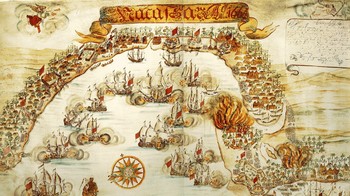
Fred Woldemar, Dutch attack on Makassar, 1660 (Bibliothèque Nationale de la France, Cartes, Y832)

Gervaise explains how the Dutch harboured designs on the trade of that port city from 1650, to the exclusion of the Portuguese residents. “This,” Gervaise goes on, “was a difficult enterprise, for the Portuguese were very well settled in the island; the King had a great value for them, and the People loved them extremely.”Footnote 14 The Dutch declared war on Makassar in 1653 and again in 1660, when Governor Maetsuyker sent a military fleet commanded by Johan van Dam to attack.Footnote 15 Short-lived peace treaties were signed, which included clauses stipulating that Sultan Hasanuddin should banish all the Portuguese and their followers and dependants from his dominions.Footnote 16 Andaya observes that “there was little indication by September 1661 that any … move of the Portuguese from Makasar was being undertaken.”Footnote 17 However, a preliminary wave of the Portuguese diaspora almost certainly left before or around that time. From the Annual Letter of Father Matias de Maya we learn that Father Miranda left Makassar in the Dutch vessel Wakende boey (“The Watchful Buoy”), arriving in Batavia on 28 August 1661. As passengers not prisoners, they were allowed to disembark and even were hosted in “some grand and stately (fermosas) houses almost in the heart of the city”, though they were obliged to be accompanied when going outside.Footnote 18 Accompanying Miranda was another Father, Manuel Soares, and perhaps also a lay brother, Francisco Rodrigues. On 6 September they left Batavia for Siam in the Dutch ship Enkhuizen.Footnote 19 The Italian Jesuit Tommaso Valguarnera wrote in Siam on 3 March 1664 that he met there two Fathers “displaced (desterrati) from their residence in Makassar”,Footnote 20 who were Fathers Miranda and (Jacobs contends, though I believe mistakenly) Macret (Mecret).Footnote 21 Other reliable sources suggest Macret headed for Cambodia.Footnote 22 I think it is more likely to have been Soares, who subsequently appears as author of a report of his “pastoral ministry”, which he dispatched to Giovanni Paolo Oliva, Jesuit General in Rome, from Tenasserim dated 18 December 1666.Footnote 23 In any case, the diaspora continued right through to 1668.
The Dutch then began to sow the seeds of general revolt in the newly conquered province of the Bugi princes. Together, in 1667, under Speelman, the Dutch succeeded in imposing the Treaty of Bungaya, which established the Netherlands' commercial and military hegemony. The Treaty singled out dispossession and expulsion of the Jesuits, on whom the Dutch placed blame for the failure of their mission to the Chinese Court. The Treaty was equally firm on the fate of the rest of the Portuguese population: not merely expelling the Portuguese but forbidding them return even for a “monsoon trade”. The stipulation proceeded: “and to the end they might have no means to drive a trade, that they should be confin'd to some village which should be assigned them, remote from any Trading Cities.”Footnote 24 The remnants of the Portuguese community were to be resettled in Borobasson, less of a village and more of a city “of the second order in Makassar”, if we go by the later traveller Albert Étienne de Montémont's description.Footnote 25 Dutch reports made after Figueiredo's departure stated that “there will remain here only three or four householders and a bunch of the rabble, who will also be difficult to dislodge, as Karaéng Sumanna says he cannot and will not banish them from his land.” We have testimony of the “rabble's” staying on in some of the names later recorded by Dutch officials in the quarters of cheap bamboo housing of the city: Rachel van de Westkust, Maria van Bengal et al. (Maria was a Roman Catholic name quintessential of the Portuguese world); also the de Souza family on which Joseph Conrad later modelled his novel An Outcast of the Islands.Footnote 26
THE FLIGHT OF THE PORTUGUESE “TRIBE” AND COTERMINOUS DISPLACEMENTS OF THE MAKASSARESE POPULATION
Portuguese imperial authorities hoped to attract voluntary Portuguese settlers by championing Mozambique and the Rios de Cuama as an African Eldorado, or African Brazil – in the words of one state memorandum “the one quarter (cantinho) from which all can be remedied”.Footnote 27 In reality, however, the economic situation there was unstable: the gold mines were closed and political instability accompanied the rise of Changamira, culminating in massacres of Portuguese at the fairs of Mocavanga and Manica. The ivory trade was the great (and only) hope. More importantly, however, official voices emanating from Lisbon were little heard so far from the only pronounced point of distribution, Goa. We must remember that no Portuguese relief whatsoever came from Goa to aid those abandoned in Makassar: the first vessel the Viceroy was able to muster, a galleon named the São Francisco, was sent only in January 1666.Footnote 28 In sum, official voices were little heard this far from Goa.
The Portuguese might well have gone from Makassar to Macao, had not the latter been in dire straits. As the Queen Regent Luisa of Medina Sidonia made clear in a letter of April 1662, it was “surrounded by enemies”, namely the Ching authorities who had seized seven Portuguese trading vessels in 1663, another six in 1666, and then went on to impose a tight blockade that was only relaxed in August 1667.Footnote 29 Figueiredo himself, despite being married to a Macanese, emigrated to Larantuca on the island of Flores, but not until April 1665 and only after ardent pleading with the Dutch authorities failed to save him his base on Makassar. A substantial population of Makassarese Portuguese moved with Figueiredo, marking a growth in importance and influence of that “centre of Portuguese energies” (centro de irradiação lusa).Footnote 30
Some voices suggested transplanting Portuguese Makassar to a similar Insulindian environment with strong latent trading possibilities. Bandermassin in Borneo was one such candidate, where Macanese came regularly to load pepper. In 1691, four vessels visited. It offered a way station to ships on longer hauls to the lucrative sandalwood resources of Timor and Flores.Footnote 31 Contemporaries familiar with the Indian Ocean world, such as François Martin, gave it thought but ultimately counselled against such a move: for him, these were remote archipelagos of the “Mer du Sud”, the inhabitants of which were tinged with “barbarity”. Reports to which he had access only served to confirm these prejudices.Footnote 32
There was also a precursor for flight to the Philippines, which happened in May 1606 following the fall to the VOC of the Portuguese town of Ambon.Footnote 33 Admiral Steven van der Haghen initially had guaranteed freedom of religion to the Catholic Portuguese. As elsewhere, however, the guarantee did not last long. The erosion of religious freedom seems to have been the trigger for this diaspora. An initial group – somewhat larger than the one that would follow – moved in two ships to Melaka in March 1605, under the leadership of the Portuguese governor. On the second occasion as many as 250 left Ambon.Footnote 34 The superior of the mission, Lorenzo Massonio, and his assistant, Andrea Pereira, could not take all the Jesuits and their converts in the ship placed at their disposal, so they took only the sick and made for Cebu as fast as they could. Luckily, Bishop Agurto had provided Cebu with a hospital a year or so earlier and asked the Jesuits to take charge of it. Here the exiles were housed, fed and cared for until they were well enough to move on. The Jesuits financed the operation partly from their own resources, partly by going to the wealthier citizens and asking each to endow a bed; i.e. to furnish a bed, with all its appurtenances such as pillows and sheets, and then to contribute what was needed for the food and medical care of its occupant.Footnote 35
At the time of the Makasserese troubles in the 1660s, however, the entente between Portugal and Spain had broken down, following the former's declaration of independence and the ensuing Portuguese Restoration War (Guerra da Restauração). Thus the Philippines were no longer an option for dispossessed Portuguese communities. In considering why diasporic flows of the Portuguese population ended up in Cambodia and Siam, we need to bear in mind the structure of the Eastern Church.Footnote 36 Although both Siam and Cambodia were under the jurisdiction of the Jesuit Province of Japan, which on occasion dispatched all the accoutrements needed for mass (hosts, vestments, missals, goblets etc.) to the struggling church in South-East Asia, both were dioceses that fell under the Malaccan bishopric's authority in a see that stretched from Pegu to China and embraced Solor, according to the apostolic bull “Pro Excellenti Praeeminentia” attributed on 4 February 1557.Footnote 37
Paulo da Costa, who led the diaspora to mainland South-East Asia, first appears as an important figure in Dutch documents concerned with the seizure of Malacca in 1641, in which he is described as “canon and archdeacon of the Cathedral, who has also been the Bishop's lieutenant and Vicar”.Footnote 38 On this occasion, da Costa had led one diaspora of Portuguese Asians from Malacca, via Goa (of which Malacca was a suffragan see), apparently to discuss the situation of his diocese, to Makassar, where the Diocese of Malacca had been transferred. Twenty years further down the line da Costa was still, in his own words, the latter's “archdeacon and governor”, although the Bishop had died in 1648 and the bishopric remained vacant, as the Vatican had not yet recognized Portugal's right to independence. Meanwhile, the archiepiscopal authorities in Goa had decided to transfer many of the Catholics in places like Maluku from the spiritual direction of the bishop of Malacca to that of Cochin, despite the huge distances involved and the decided improbability of any constructive dialogue.Footnote 39 As Governor of Malacca and one of the leaders of the Portuguese diaspora, however, Costa may have felt reassured that his title and hence leadership would remain intact after flight to mainland South-East Asia, which was part of the same see. We can also assume that those who went with da Costa, mirroring his own story, had probably themselves fled from Malacca to Makassar following the city's loss to the Dutch in 1641, rather than following the official Dutch repatriation process. The process involved yachts such as the Bredam being laid on, free of charge to ferry to Nagapattinam the Portuguese Ouvidor Geral (High Judge, or High Royal Magistrate), the Jesuits, the bishop Dom Luís de Melo, and other priests, and the principal citizens with their wives and children.Footnote 40 Finally, there is every likelihood that da Costa was influenced by the successes in the mission fields of Vietnam, described in the treatises of Cristoforo Borri, Relatione della nuova missione delli PP. della Compagnia di Giesu, al regno della Concincina (Rome, 1631) and Father Alexandre de Rhodes, Histoire du royaume de Tunquin (1650), as a “new Japan”.
The organization, journey and distribution of the diaspora remain largely unknown to us, though Seabra affirms that it was the ships of Francisco Vieira de Figueiredo that carried the Portuguese to Macau, Timor and Siam.Footnote 41 It is not even known how many members of the Portuguese “tribe” Father Germano Mecret, who led one prong of the Makassarese diaspora to Cambodia, took with him. But the instability of the Cambodian court was well known, and so numbers are certain to have been fewer than to neighbouring Siam.Footnote 42 In some ways, the country's political instability carried through to the life of the foreign communities there, with the Portuguese at one time standing accused of the murder of the Dutch personnel stationed there and two years later conspiring with the Cambodian ruler in the massacre of Chief Merchant Pieter de Regemortes and his retinue.Footnote 43 In any case, Louis Chevreuil reported seeing only one somewhat modest church in the Portuguese quarter in Cambodia, which stands poorly alongside the three, perhaps four Portuguese-run churches in Ayutthaya.Footnote 44
Despite what at first appears a coterminous phenomenon, the Portuguese diaspora from Makassar must be considered independently from a parallel exodus in considerable numbers of Muslim Makassarese to the Kingdom of Siam. The Dutch war in the East Indies, of course, did not just affect Portuguese communities, but the Makassarese more generally. As the Dutch promoted the Bugi prince, Arung Palakka, ruler of Bone, as de facto overlord of South Sulawesi, traditional political relationships were disrupted and new representatives were placed in positions of power. Many of the nobles of the Goa kingdom were unwilling to live under a ruler handpicked by their worst enemy, and resented the forced oath-taking which Arung Palakka demanded of them.Footnote 45 After 1669, “the trickle (of refugees) became a veritable flood”,Footnote 46 a phenomenon which continued due to protracted warfare for the entire course of the seventeenth century. Streams of Makassarese went to the western half of the archipelago, to Java, the east coast of Sumatra (Jami, Palembang) and Madura, others to Banten. One diaspora moved to the South-East Asian mainland.
The independence of the Makassarese diaspora from that of the Portuguese is clear from the fact that the Makassarese and Portuguese were fundamentally antagonistic: in the later insurrection in Ayutthaya in 1686, the Makassarese intention was, in the opinion of one first-hand observer, the Count of Forbin, to “annihilate all the Christians, Portuguese and Japanese, so that not one remains.”Footnote 47 Their independence is also evident from the way sources tell the tale of the diaspora. Gervaise, as he recounts one episode in his Histoire du royaume de Makassar, is concerned exclusively with the Makassarese diaspora and fails even to mention that of the Portuguese. The prince Daën Ma-Allé had lost his throne as a result of the Dutch rearrangement of the political landscape in the Celebes. Fearing his assassination, his advisors encouraged him to leave the kingdom altogether and take advantage of an offer which the King of Siam had made him several times of a place of retirement and employment in his dominions. Thus the prince embarked with “his wife, some servants, and about 60 Makassarese families also … out of the great esteem and love which they had for him, and desirous to be companions of his good or bad fortune”. They arrived in Siam in 1664, and were received extremely well, accepting a “fair House”, valuable presents given to his wife, and the title of Docja Pacdi, “which in Siam signified the Grand Treasurer of the Crown”. Moreover, the Siamese king distributed among those who had followed the prince
… a good Quantity of Land, more than was sufficient for their subsistence, gave them oxen to plough it, with orders to give the Prince the same respects as to himself, as also to pay him the same Tribute as they were to pay him were he their King in Makassar.Footnote 48
Yet commentators such as Gervaise go on to write of the Makassarese as having become a constant threat to the Siamese (“their great numbers are to be dreaded”), describing the cultural tensions that arose between the two societies, and denouncing the latter's “cruel and savage nature”.Footnote 49 The land grants and generous terms initially offered the displaced Makassarese were forgotten and, as a result of court intrigue and disaffection with Naraï's increasingly pro-Catholic, pro-French policy, relations quickly degenerated to the point that Daën Ma-Allé threw in his lot with a “revolt of the Moors” in 1686. The rebels proposed putting one of the king's two half-brothers on the throne and have him convert to Islam, although scholars have raised doubts as to whether either prince was aware of this proposition.Footnote 50 Chief Minister Phaulkon moved swiftly to suppress the uprising, rounding up Ayutthaya's European communities for military assistance and charging the Count of Forbin to put down insurrection in their quarter. Refusing to surrender on the King's terms, and too proud to supplicate for a pardon, events led to the extirpation of the entire community,Footnote 51 perhaps in two separate attacks.Footnote 52
We have, then, established the independence of the Portuguese from the Makassarese diaspora to Ayutthaya during the 1660s, despite their common trajectories in time and space. The question that now arises is whether the Portuguese were to implant themselves in Siam more successfully than the Makassarese. The historian Stuart Schwartz considers adaptability the primary feature of Portuguese history, but Ayutthaya presented them with a new milieu, one crucially distanced from an open seaboard where this “people of the sea” (povo do mar) would find themselves instantly disadvantaged.Footnote 53 How now would they fare?
PORTUGUESE IN THE KINGDOM OF SIAM PRIOR TO THE MAKASSARESE DIASPORA: A HISTORY OF MERCENARIES AND INTERLOPERS
Prior to the immigration of the Portuguese community from Makassar, Portuguese came to Siam as mercenaries, assisting the local kings ranged against the Burmese in the regional conflicts that raged from the 1530s until the 1560s. They were particularly thorough in their knowledge of firearms and cannonry. In Bocarro's account, for example, they came to the aid of the “Black Prince” King Naresuen, when he entered single combat with the Crown Prince of Burma in 1584.Footnote 54 They were rewarded with land grants, settling down to marry local women and pursue the life of trade. A number of them won the personal attention of the monarchs, as reported in local chronicles. Fernão Mendes Pinto's famous account Peregrinação … Em que conta de muytas e muyto estranhas cousas que vio & ouvio no regno da China (1614) describes the Portuguese as “much respected in this land”: they were given exemption from customs duties, generous pay packets from “the good king of Siam” and permission to build churches “where the name of the Portuguese God could be worshipped”.Footnote 55 Even the Siamese King Phra Song (r. 1629–1656) personally requested the Bishop of Melaka, Gonçalves da Silva, to send a priest to look after the Portuguese colony that had settled in his capital.Footnote 56 A religious mission was consequently established here from 1626 by the Castilian Father Pedro Morejón and António Francisco Cardim, who relocated after being forced to abandon the Japanese mission when anti-Christian policies there hardened in the 1620s. A number of Japanese converts accompanied these missions to Siam. However, the first Jesuit residence, established under Father Júlio Marguiço, lasted only until 1630, a temporary affair.Footnote 57
There are a couple of strikingly negative accounts of the Portuguese community in Ayutthaya during these years. The first concerns the circumstances surrounding the death of Mr. Benjamin Fary, head of the English factory in Siam, on 30 August 1616, an event which was ascribed to his “being poyssened and, as they think, by the Portuguese”. The tragedy was compounded by his second-in-command, John Johnson, giving “entertainment to the Portuguese, not to men of any credit or fashion, but to the worst and most lewd livers in Siam, to the discredit of the house and shame to our nation, for every day there are thirty or twenty Portuguese there … abusing themselves with drink and making everything in the house common to the Portuguese.”Footnote 58 The bitterness to this report reveals what was felt by jealous northern European arrivals in the Indian Ocean world of the Portuguese communities at the time, but it is very telling that the report was based on another report by a Dutchman who arrived from Siam on 7 October, and then was conveyed in a letter from John Browne at Pattani to the English Principal at Jambi later that month. On 28 May 1617, John Johnson and Richard Pitt wrote from the bar of Siam to John Browne at Pattani to say that this report was completely false and that the Dutch “seeketh by all means possible to hurt us by their lying, viperous, scorpion tongues. We are merchants,” Johnson and Pitt explain, and “having goods to sell, we sell them and do not examine their [i.e. the Portuguese] way of life. If we had not bought from the Portuguese and others, we should have been forced to do so as the Dutch have done, to take freight.”Footnote 59
A second report was made a little later by Jeremias van Vliet, Chief of the Dutch Factory of Siam between 1629 and 1634. In it he raises a number of petty conflicts and thefts perpetrated by local Portuguese on the Dutch trading community, which resulted in the Portuguese falling “into disgrace with the king and mandarins”. His verdict in 1634 was that there remained “only a few poor Portuguese, Mestizoes and Indian Christians … they will most probably not regain their former influence”.Footnote 60
The Dutch at this time were, of course, dogged political enemies to the Portuguese. Other factors spoke in favour of the Portuguese community in Siam and the external stimuli to their fortunes. It was well known that the Kingdom of Siam was keen to recruit manpower, that Portuguese trade with the subcontinent was increasing, and that the King of Siam was generous enough to grant the Macanese a considerable loan to pay off the costs of an expensive Portuguese embassy to China.Footnote 61 Ayutthaya had developed a reputation for hosting several foreign “nations”, including those of the Japanese, Malays, Dutch, English, Tonkinese, Chinese and Cochin-Chinese. M. de Chaumont, ambassador of the French king Louis XIV, counted more than twenty different nations, concluding that “There is no city in the Orient where one sees a greater number of foreign nations than in the capital city of Siam, and where one speaks so many different languages.”Footnote 62 The communities developed different specializations: the Dutch, for example, concentrating on developing their Logie, or “factory” (a trading station), whilst others went on to play an active role in military defence, for example the Japanese manning a personal guard in the King's palace. The Chinese served as officials of the state in different guises, often tax-farmers. Foreigners were allowed to enter the Siamese system of ranking based on “dignity marks” (sakdina) and to hold official titles.Footnote 63
“O CAMPO PORTUGUÊS”: THE PORTUGUESE QUARTER IN AYUTTHAYA IN THE WAKE OF THE MAKASSARESE DIASPORA
A social analysis of the Portuguese “tribe” in Ayutthaya might begin with an assessment of its size, although it is quite hard to summon reliable figures. Chaumont put the figure at “more than a thousand … mixed race, having been born of a Portuguese and a Siamese mother”, to be distinguished from “eight or nine true Portuguese families”.Footnote 64 The French Vicar Apostolic Lambert de la Motte, who arrived in Siam in 1662, speaks similarly of 1,500 Christians “collected from different nations”.Footnote 65 Simon de la Loubère in 1687–1688 puts the figure somewhat higher, at 4,000.Footnote 66 Other accounts, such as that of Gervaise, who towards the end of the seventeenth century also wrote a book entitled The Natural and Political history of the Kingdom of Siam, would seem to corroborate this second figure – he speaks of between 700 and 800 families.Footnote 67 The Persian manuscript Safina-yi Sulaymān suggests the highest figure of all, a figure of 5,000 or 6,000 people who primarily had been converted to the Christian religion,Footnote 68 though this figure also would have included the Japanese and Cochin-Chinese population.
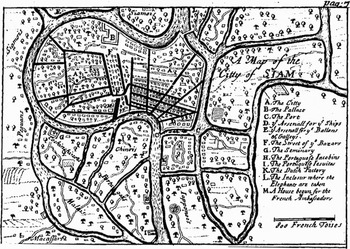
Plan of Ayutthaya. Simon de la Loubère, Du royaume de Siam, Paris, 1691. Illustration from the English edition, The Kingdom of Siam, London: Printed by F.L. for Tho. Horne, 1693, 2 vols. in 1.

Maps of this period such as that of Vincenzo Coronelli indicate a “Quartiere dei Portoghesi”, a distinct quarter to the south of the capital between the Chao Phraya river and the western canal, in an area known as the Mu Ban Potuget.Footnote 69 Jacques de Bourges, resident in Ayutthaya between 1662 and 1663, explains how the nature of the city – divided into several islands by canals that form the river – helped the development of each nation on an island or in a separate quarter, “so that there are few quarrels which are often caused by the mixture of nationalities who have natural antipathies.”Footnote 70 The land granted to these foreign communities however was outside and hence unprotected by the city walls, and right through to the second half of the seventeenth century generally were depicted as an undeveloped Arcadian landscape on plan-views of the city, for example in the early seventeenth-century anonymous oblique plan-view currently in the Rijksmuseum, Amsterdam, and even as late as J. J. Struys's Drie aanmerkelijke en seer rampspoedige Reysen, Amsterdam (1676). Later commentators describe the houses as being located away from the banks of the river and “generally built of Bambous, reed, planks and other ordinary stuff”.Footnote 71 They were decorated and could easily be adapted for the comfort of a visiting ambassador such as Siqueira, who was quite impressed with the “considerable cleanliness, with [the] rich carpets and ceilings draped in cloths of various colours”.Footnote 72
We do not know precisely what the juridical arrangements were between the Portuguese bandel and the Siamese authorities – extraterritorial rights were regarded as an “important concession … to which princes in these lands do not readily agree” – but at the entrance to the camp the Portuguese erected a cross upon which was “engraved the terms of the concession, as a permanent memorial of the rights acquired by the King of Portugal”. Diplomatic exchanges in 1616 included the right to inheritance without any duties or confiscations and justice in the king's courts rather than those of the local populace.Footnote 73
The “Portuguese” had a titular head of their community, known to the Portuguese as Capitão Mor da Bandel; like the “Moors”, Malays and Japanese, this head was someone described as being “elected with the King's approval and who governs in accordance with the customs of that particular country”.Footnote 74 In the Portuguese case, the post typically went to a churchman: Van Vliet speaks of “the vicar who has been appointed their chief by the governor”,Footnote 75 though the Capitão Mor at the time of Ambassador Siqueira's visit in 1684 was Francisco Barreto de Pinna, a seventy-year-old man living in “severe poverty” who stood accused of various crimes including failure to prosecute crimes, misusing his post for the sake of personal profit, and (according to the Portuguese from outside) allowing the post to fall under the control of the King's ministers. The de Pinnas had clearly fallen on hard times, for the family at one time had enjoyed Macanese citizenship. Francisco Barreto de Pinna (or Piña) himself had been a shipowner (and thus wealthy) who was put in charge of Siamese crown vessels, conducted international ventures, and at one time – according to Dutch records – made arrangements in Canton for their repair.Footnote 76 In 1684, the King of Siam was keen to expel Pinna, and Siqueira was forced to take him to Macao.Footnote 77 Siqueira was loath to leave the post unoccupied on his departure, principally out of worry for the fate of the orphans in the community, but also because there would no longer be a mechanism for civil justice.
Otherwise, the campo appears to have functioned something like a ghetto, at certain times restricting movement. During the court revolution of 1688 Robert Challe describes how “all the Portuguese were obliged to remain in a place that had been designated them, without being allowed to sally forth on pain of death”.Footnote 78 On this occasion, the Dutch Opperhoofd Pieter Van den Hoorn reported how the Portuguese, as a means to avoid arson and robbery, were quick to deposit their valuables, such as jewellery, gold and silver, in the VOC lodge, described as “a strong and excellent building … the windows protected with bars”.Footnote 79 On another, Van Vliet described how, in order to punish the Portuguese for acts of piracy committed on Dutch merchant vessels in Siam around 1628, the King kept the community confined “in strict captivity during three years and [they were made to] go about begging in the streets”.Footnote 80 But even when the Siamese King went “abroad” (i.e. left the capital), all the windows of the Dutch factory “had to be shut … and not the least noise to be heard”.Footnote 81
Laws and punishments, as might readily be concluded, were harsh, even concerning foreign communities. The “sacrilegious” theft of the ampulla of holy wafers from the Church of São Paulo was considered a “horrendous” crime, and the Phraklang, or Minister of Foreign Affairs in Siam, was not slow to pronounce a sentence that began with the amputation of the right hand of the guilty party, to be followed by flogging to death at the hands of the Portuguese community.Footnote 82 Capitão Mor de Pinna settled for cutting off the tips of two of his fingers, but according to Ambassador Siqueira's report this was not enough to satisfy the Siamese. Elsewhere, Siqueira urges the new head of the Portuguese bandel not to accept any post or title from the Thai royal house, because the King then treats them as his chattels, calling them “Negros … and punishing them as his slaves”.Footnote 83
At its peak in the 1620s, the Portuguese community was of a comparable size or perhaps a little larger than the Japanese Christian community of Ayutthaya. Given both the mixed composition of the missions established in Ayutthaya in the 1620s by the Castilian Father Pedro Morejón and António Francisco Cardim, who were accompanied by the Japanese Christian priest Brother Romão Nishi,Footnote 84 and the joint guard that together manned the two forts of Ayutthaya, the Portuguese and Japanese communities not only were very close to one another in proximity, but also in sympathy. Macanese missionaries continued to arrive at this mission together with waves of Japanese émigrés all the way to the second half of the seventeenth century, as was the case with a group brought by Bartolomeu da Costa and António Rodrigues, who arrived in 1634, when, as the Jesuit historian Marini proceeds, “the rage of that persecution in Japan barred the fathers [residing] there. … They found it convenient to move to countries near [to Japan].”Footnote 85
Within the Portuguese community, the Church was omnipresent. As an institution, it met both the religious and non-religious needs of the local community. There were during the 1660s three secular priests, four Jesuits, two Dominicans, two Augustinians and perhaps two Franciscans. The orders had individual churches. The Jesuits, favoured by the Portuguese Crown, appointed their first Superior, Thomas Valguarnera, in 1656, and ran the largest establishment, the Church of São Paulo, Paul being one of the role models of the Jesuit fathers. It was here that, prior to his marriage, the First Minister Constantine (or “Constance”) Phaulkon, who was of Greek origin, made a profession of faith in May 1682, which some accounts suggest took place in the presence of the Portuguese governor of Macao and friends.Footnote 86
The Jesuits also ran an educational establishment, the College of São Salvador, founded in 1656 from the proceeds of a successful Portuguese merchant and pilot who operated in the area, Sebastião André.Footnote 87 Initially it was a modest affair. In 1670, the school was run by four priests and one coadjutant. In 1671, as we learn from the Lettera Annua of Macao,Footnote 88 it became a Collegium, and later what Coronelli refers to on his map of 1686 as the Collegio delle Nationi. According to Father João Alvares's report (probably from the 1660s), which provides a historical sketch of Jesuit activities in South-East Asia, it was a French school for boys.Footnote 89 If it was anything like the Portuguese school in Makassar run by the Jesuit mission, its principal pedagogic purpose was to teach literacy, though the free primary school the Jesuits established in Cebu in the Philippines in 1595 offered a fuller syllabus, including instruction in Christian doctrine, reading, writing, arithmetic and deportment, with a course in grammar added somewhat later.Footnote 90 The college would have both lodged and functioned as a day-school for the sons of settlers of good standing and members of the court sufficiently open to a foreign education for their offspring.
The Dominican church São Domingo, oldest of the European churches in Siam, is visible on the late seventeenth-century Venetian mapmaker Vincenzo Coronelli's plan. The site was excavated in 1984 under the auspices of the Gulbenkian Foundation. The approximately 250 skeletons it yielded were scattered with lime so as to sterilize the immediate area from decomposing human remains and to prevent epidemics.Footnote 91 The Augustinians ran a chapel attached to the Dominican church, and shared the same living quarters.Footnote 92 It was two friars from this joint establishment, Estêvão de Sousa and Pedro Martyr, whom the King of Siam nominated to lead a Siamese embassy to Europe, much to the disapproval of Siqueira's embassy, who called them “odd and somewhat deranged men”. About de Sousa, the ambassador's secretary wrote: “Seems to behave more like a Siamese than a Portuguese. Instead of showing the qualities of a priest, he reveals himself to possess the free and distracted spirit of a layman, not yet fully following the norms of the Catholic Reform.”Footnote 93 This Augustinian chapel was probably one and the same as the Church of the Santíssimo Rosário confraternity, established by Father Luís do Rosário following the fall of Melaka in 1641, and perhaps an initial diasporic arrival of Portuguese population.Footnote 94 The parish was led in 1684 by a man for whom Siqueira had much respect, Friar Domingos de Santa Anna.
The negotiations Constance Phaulkon undertook in 1683 to marry a part-Portuguese, part-Japanese living in Ayutthaya, Maria Guyomar de Pinha, provide an interesting glimpse of the Portuguese community following the arrival of the diaspora.Footnote 95 Only sixteen years of age, her parents were Master Phanick and Ursula Yamada. Phanick was described as a “half-black, half-Bengali, half-Japanese” and quite poor. His wife, who had already been married to a Jesuit and had a child by him, claimed to be a granddaughter of the first Japanese baptized by St. Francis Xavier near Kagoshima in 1549. This, one of Phaulkon's biographers explains, bestowed a certain nobility on her family in the eyes of her peers.Footnote 96
Phaulkon's first thought toward taking a wife had been the daughter of a Spaniard from Manila who, when dishonoured by Phaulkon's rejection, proceeded to marry a black named Hilary “who is even now the choirmaster of the Dominican Fathers of the Portuguese camp”.Footnote 97 These stories suggest the eclectic racial make-up of the campo Português. It must have contained Indians, particularly from Coromandel, Africans, Makassarese and Japanese. Unfamiliar European visitors to Siam appear to have been unable to make knowledgeable and clear racial judgements about the denizens of this world. Forbin, for example, talks in the same breath of “Portuguese, mestizo or creoles of the Indies”,Footnote 98 while Kaempfer talks of “a Portuguese race begot on black women”.Footnote 99 As we saw from the description of Master Phanick, it is not clear whether “black” meant African or from the east coast of India. Iberian commentators on the scene preferred, understandably, to distinguish “Portuguese” from “Christians of the country”, although law-breakers such as Burot, who stole precious liturgical vessels from the Church of São Paulo, is variously referred to as a “baptised Siamese Christian”, “a Negro” and a “New Christian”.Footnote 100
A second, very interesting, glimpse of the Portuguese community stems from the extensive report written by the secretary Francisco Fragoso, who accompanied the embassy of Pero Vaz de Siqueira from Macao to Siam (1684–1686). The primary motivations for this, the first Portuguese embassy to Siam in forty years, were to “banish … the French bishops, or any other Missionary Priests who had been sent to various regions by the Propaganda Congregation”, a political dispute of religious jurisdiction. But the ambassador had other orders of business as well. He wanted to persuade the Siamese to take on behalf of Portugal official letters to the Japanese. He also had express instructions to take prisoner Portuguese apostates like Francisco de Acha, who had converted to Calvinism despite being married to a member of one of the Japanese, and thus Catholic, families in Siam,Footnote 101 and Amador Coelho de Mello, who had “forgotten that he has Portuguese blood and has become French, serving as notary to the French Bishops, purveying all the diligences and notifications against our Missionaries, harming the exclusive rights and Royal Ecclesiastical Patronage of His Highness.”Footnote 102 A third miscreant the ambassador was to apprehend was Constâncio Jorge da Silva, a priest whose lifestyle was found to be too strange by his flock “due to the liberty he professed and practised much to the discredit of the Ecclesiastical State.”Footnote 103
It is clear that the Portuguese diaspora did not do well following their implantation in Siam, mirroring the general downward slide of the community from earlier in the century. Alexander Hamilton, a Scottish captain undertaking commerce in South-East Asia between 1688 and 1723, was very negative about the Portuguese, writing that they were “contemptible to all people in general”, in Siam “the most dissolute, lazy, thievish rascals that were to be found in the country”.Footnote 104 William Dampier (1651–1715), the English sea captain, buccaneer and author, echoed Hamilton's dismissive opinions, insisting, “there are not a more despicable people in all the eastern nations.”Footnote 105 This is not merely a case of the Black Legend of Portuguese India as formulated by North European Protestant bigots.Footnote 106 Other commentators such as Gervaise, the French missionary sent to the court of King Narai the Great of Ayutthaya in 1688, attributed the “extreme poverty” suffered by the Portuguese settlers in Siam to the fact that “they prefer to die of hunger than to work for their living there”.Footnote 107 Even Thai records speak of the Portuguese who had arrived from Makassar as “those … who occupy the lowest category here”.Footnote 108 It appears that only one individual in the entire community, Domingos Lopez Cunha, possessed and sent forth a ship for trade on the high seas. Portuguese maritime trade was in the hands of the merchant community in Macao, whose members chose to tread lightly due to the Siamese royal concession of monopoly rights to the English and Dutch.Footnote 109 Trade with neighbouring Cambodia nevertheless apparently prospered. An English report of 1664 noted that “most of the expelled Portuguese from Makassar resorting thither, who trade highly”.Footnote 110
What went wrong with the diaspora? Should we lay the blame squarely with the Portuguese, as the three preceding authors would suggest? The Siamese rulers seem to have been cold pragmatists, who lost their love-affair with the Portuguese once they no longer seemed to be of any use to the country and shifted their attentions to foreign nations on the rise, especially the Dutch and the French. Bhawan Ruangsilp, who has recently written a book about relations with the Dutch, explicitly pursues this line of argument, using the concept of “conditional partnership”.Footnote 111 In 1649, on the return from his voyage there, Francisco Vieira de Figueiredo already complained about “Siamese vexations” (Siamse vexatien), and told the Dutch “he would never go there again” (dat daer noijt wilde weder keeren).Footnote 112 We can observe how the French were given certain privileges denied the Portuguese, such as being allowed to dwell within the city walls of Ayutthaya rather than having to move to a specified quarter outside, though the French Metropolitan bishop was built a “palace” out of town,Footnote 113 probably at the heart of what became known as the “St. Joseph Settlement”, the centre of French missionary activities.
In fact, the Portuguese community seems to have done significantly worse than in neighbouring Cambodia, to the east, and in Toungoo and then Ava Burma, to the west. In the Burmese kingdoms, despite the tragedy that befell Filipe de Brito e Nicote's community at Syriam in 1613, the Portuguese tribe (known in Burmese as Bayingyi) was supported by Portuguese trading networks from Coromandel bringing wealth into the area in the form of calicoes and chintz cloths.Footnote 114 It is probably a gesture of tribute to the Portuguese community that they appear in paintings in the cave-temples of Po Win Taung, executed during the second Ava period (1597–1752).Footnote 115 In Cambodia, where the Portuguese were settled in a village between the two imperial cities, Ponhéa Lü (Penhalu), they seem to have won government posts, and could ply their profitable trade upriver, trading in little-known gold, musk, benjamin and rubies of inaccessible LaosFootnote 116 and, consequently, “live great after the fashion of the country”, as Alexander Hamilton wrote.Footnote 117 Thus the diminishment of trading opportunities in Siam may explain the downturn in Portuguese fortunes in Siam by the second half of the seventeenth century. Simon de la Loubère corroborates as much from the royal decision to reserve foreign commerce primarily to himself.Footnote 118
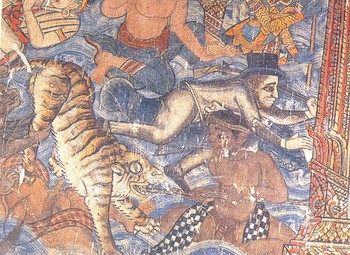
Portuguese in hat running from a tiger, temple mural from Wat Mai Ruak, Tha Rua, Thailand (photograph by the author).

Part of the problem was undoubtedly poor leadership of the diaspora. Da Costa, as he intimated in December 1665 to French Father Louis Chevreuil from the Sacred Congregation of Propaganda Fide, was anxious in his old age to retire from Cambodia to Goa in order “to prepare for his death”. He even wanted Chevreuil to take over his flock and “all his authority” (tutta la sua autorità).Footnote 119 In his correspondence, Lambert de la Motte plays on this to underline his rivals' worthlessness: that da Costa was happy to abandon his post to the French.Footnote 120 Da Costa's successor as Vicar Forane was no better; at the time of Siqueira's visit in 1684, a “priest who is worthless and has so little authority that nobody respects him”.Footnote 121
Nor does the military element the Portuguese provided to the King of Siam's retinue look particularly convincing. Kaempfer describes them as “idle vagrants”, who “roved and sauntered about the palace”.Footnote 122 Forbin describes how they were divided up into companies of thirty or forty and then, given their mediocrity, assigned a French or English commander.Footnote 123
RELIGIOUS DISPUTES IN SOUTH-EAST ASIA BETWEEN PORTUGUESE JESUITS AND FRENCH MISSIONAIRES ÉTRANGÈRES DE PARIS
The Portuguese became more and more involved in a protracted competition with the newly established French order of the Missionaires Étrangères de Paris, who began to arrive in the kingdom after King Narai granted permission to French Jesuit missionaries to preach Christianity in 1662 and accepted the first Vicar Apostolic Lambert de la Motte. A papal bull of 1673, Cum per litteras issued by Pope Clement IX, effectively placed lands such as Siam (extra dominium temporale regni Portugalliae) under the jurisdiction of the head of the church at Ayutthaya, whose charge was given to de la Motte.Footnote 124 Motte asked the Propaganda Fide that all Jesuits be removed from Vicar Apostolic's jurisdictionsFootnote 125 and everywhere reported ill of the Portuguese priests “who held an over-inflated opinion of themselves at court”, “abused the credulity of the Siamese” and “got married … for as long as it is convenient to them and it can satisfy their desires”.Footnote 126
The Portuguese contingent responded in kind. In 1663, the Archbishop of Goa circulated a letter that advocated “preventing the French to reach their missions by all means available”.Footnote 127 Certainly they were to be deprived passage aboard Portuguese vessels making the Carreira das Índias, the Portuguese authorities denouncing the “apostolic vicars” as mere emissaries of Colbert's Compagnie des Indes Orientales.Footnote 128 But it was not merely international politics. During the 1670s and the early 1680s, Portuguese authorities received several heartfelt letters from religious and other residents in Siam and elsewhere complaining about the presence of French missionaries in the region, denouncing them as impostors and condemning their “evil designs under the garb of religion”. Antonio da Fonseca, Procurator for Missing Persons in the Kingdom of Siam, complained in 1682 that they wished “simply to prevent the Portuguese from settling in this region where their intent is to stifle us. All that the French Bishops wish is to see us leave.”Footnote 129 Joseph Candone, a Jesuit, was reported to have left his mission in Cochin China because “one of the French bishops would not allow him to serve as a Vicar of the Christian community in that kingdom”, to which the Council of Missions in Goa had instructed its missionaries in 1683 “not to obey the French Bishops, or any other Missionary Priests who had been sent to various regions by the Propaganda Congregation”.Footnote 130
In the meantime the French mission had gone from strength to strength: their bishop in Siam, Monseigneur de Cicé, estimated in a letter of 1715 that approximately 40,000 children had been baptized by the French since the inception of the mission, five new churches had been built in several locations across the country, and they had acquired exclusive rights to minister to prisoners.Footnote 131
While the Portuguese Prince Regent Pedro ordered the Jesuits under his control to leave Vietnam in 1682, in the Siamese and Khmer kingdoms the dispute only exacerbated with time. A Portuguese embassy of 1684 led by Pero Vaz de Siqueira tried to win the support of the Siamese king in the quarrel. Unable to ask him to expel the French from his kingdom, they requested that, at the very least, foreigners be forbidden from entering the Portuguese Bandel and from disturbing its residents in any way.Footnote 132 In 1705 the Bishop of Melaka, Manuel de Santo Antonio, sent a vigário de vara or enforcement official to Siam to lay claim spiritually to the kingdom. The French bishop, Monseigneur de Cicé, refused to acknowledge the Portuguese mission churches and felt obliged to excommunicate the vicar, at which point the Portuguese vicar arrived with armed partisans and laid siege to the French seminary, tore up the episcopal sentence on the church door, and threatened to carry off the prelate to Goa. The French responded by summoning the Bishop of Melaka to appear before an ecclesiastical court presided over by Mgr. de Tournon, the papal legate to China, on pain of a fine of 1,000 gold écus to be paid to Rome, but the Bishop of Melaka understandably refused to appear. Several other instances of ecclesiastical disobedience amongst men of the cloth occurred thereafter, and the rivalry was only fueled further by the Chinese rites controversy, which divided the two orders. The feuding continued until at least 1796.Footnote 133 Events in Cambodia ran parallel.Footnote 134
Alain Forest argues that the reason for the “internecine quarrels” between French and Portuguese was the failure of the Christian conversion project in Siam. But there were problems between the two communities from the very beginning, and the dispute spilled out into wider factionalism, with the Cochin-Chinese Christian community falling in with the French, and the Portuguese allying more with the Japanese. Musical confrontations took place between the two factions, on armed barges and during processions. When accompanying dignitaries into the city, each community would send representatives. On these occasions the Portuguese/Japanese would try to drown out the French/Cochin-Chinese with fanfare and noise.Footnote 135 But the French undoubtedly had the upper hand, if only because they had greater ambitions and retained the high favour of the Siamese authorities. Ultimately, some of the more enlightened Jesuits such as Fr. Maldonado saw the way the wind was blowing and used their influence to urge loyalty to the vicars from 1681, though opposition from the archbishopric in Goa remained.Footnote 136
CONCLUSION
Because of the string of military defeats the Portuguese suffered at the hands of the Dutch at the beginning of the seventeenth century, conventional historiography all too often omits the Portuguese from the analysis of the Indian Ocean world. However, a number of French scholars such as Jacques Népote and Jacky Doumenjou have focused their attentions on the Portuguese communities in South-East Asia,Footnote 137 concentrating on these communities primarily in terms of “mercenary” or “interloping” activities for which the Portuguese were famous during the sixteenth century. Another perspective, left untreated by them, is that of these communities being part of ongoing historical development, such as the diasporic wave that emanated first from Japan in the 1620s and then Makassar in the 1660s. Ayutthaya lays a strong claim to our attentions because it was such a cosmopolitan city open to foreign settlers. There the dynamics of the Portuguese “tribe” are identifiable not only through the voluminous literature written by European visitors over the sixteenth and seventeenth centuries, but through urban plans (for which there is no parallel elsewhere, regarding the city of Ava for example). Correspondence and church records of the dispute between the French Mission Etrangère de Paris (M.E.P.) initiative and the entrenched Portuguese Jesuits also provide a rich body of evidence.
Recent research suggests that the communitarian politics of the Portuguese “tribe” and its diasporic connections across the Indian Ocean world were a complex affair. These insights should lead us away from the stereotyped image of the Portuguese as still something of a European power (an image inherited from the golden age of the Estado da Índia) and from the 1620s in decline. Relations between Portuguese settlers and host societies in mainland South-East Asia, however, were mixed, and in Siam dogged by economic poverty and outbreaks of inter-communitarian violence. While the French and Dutch were more successful in obtaining favour from the Siamese monarch and his ministers over the second half of the seventeenth century, the Portuguese community in Siam – always quick to miscegenate to a degree that made summary distinctions difficult – remained recognizable and distinct in South-East Asia well into the nineteenth century, as Crawfurd attested.Footnote 138