Introduction
Trophic studies provide information regarding the biology and ecology of organisms that allow the comprehension of their interactions with the environment (Cailliet, Reference Cailliet1996). Currently, there are two methods used to determine the trophic level of marine organisms: stable isotope analysis and studies regarding diet composition through stomach content analysis (SCA) (Cortés, Reference Cortés1997; Hansson et al., Reference Hansson, Hobbie, Elmgren, Larsson, Fry and Johansson1997). In this regard, SCA is a valuable tool that describes the interactions between prey and predator in a trophic chain (Langler, Reference Langler1956; Hyslop, Reference Hyslop1980; Krebs, Reference Krebs1989). Studies regarding the stomach contents of different fish species have served as a basis for establishing conservation or their management (Serrano and Soraya, Reference Serrano and Soraya2016).
In the Gulf of California (GC), the sharpnose shark Rhizoprionodon longurio (Jordan & Gilbert, 1882) is considered an important fishery resource. However, it is vulnerable under the red list of threatened species and needs management strategies for its sustainable use.
R. longurio is a small species that inhabits the coastal waters of the eastern Pacific Ocean. Its maximum size ranges from 110 cm total length (TL) up to 154 cm, in which females are larger than males (Mejía-Salazar, Reference Mejía Salazar2007; Conde-Moreno, Reference Conde-Moreno2009).
This species is commonly found in the GC and represents 10% of the catch volume (CONAPESCA, 2015). It exhibits a seasonal reproductive migration in Baja California Sur during the annual cold period associated with changes in temperature of water, ranking third in the state catches (9%; SAGARPA-CONAPESCA, 2007). This species is considered a generalist opportunistic whose diet mainly comprises teleost fishes, cephalopods, and crustaceans (Márquez-Farías et al., Reference Márquez-Farías, Corro-Espinosa and Castillo-Géniz2005).
The sharpnose shark's distribution is limited to the eastern Pacific Ocean. It is catalogued as vulnerable under the IUCN red list, which indicates the need to gather data that completes its life-cycle characteristics. Moreover, it is a fishery resource exploited throughout the year, figuring among the top three shark species fished in the GC (SAGARPA-CONAPESCA, 2007). Furthermore, this shark's reproductive and nursery areas have been documented within the study region (Salomón-Aguilar et al., Reference Salomón-Aguilar, Villavicencio-Garayzar and Reyes-Bonilla2009).
Despite being a highly exploited species in Mexico, studies regarding its feeding habits in the area are scarce. Thus, this study aimed to determine its feeding habits through SCA.
Materials and methods
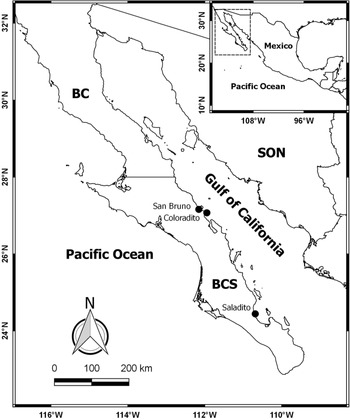
The stomach samples of R. longurio were obtained every 3 months from October 2017 to April 2018 in the central area (San Bruno and Coloradito), while samples in the southern region (El Saladito) were obtained during March and April 2018 (Figure 1). Biological sampling was carried out 1 week of each month using gillnets set by artisanal fishermen the night before capture and left exposed to the sea for 10–12 h. The TL data (cm) of the sharks were registered in situ. A cut was made from the pectoral fins to the cloaca of each specimen to extract the stomach from the body. Subsequently, stomachs were stored in labelled plastic bags and transported in ice to the Fish Laboratory at the Centro Interdisciplinario de Ciencias Marinas of the Instituto Politecnico Nacional.
Location of the fishing camps: San Bruno-Coloradito (central area) and El Saladito (southern area) in the west coast of the GC, Mexico.

Stomach content analysis
The percentage of stomach fullness for each organism was determined under the five categories established by Galván-Magaña et al. (Reference Galván-Magaña, Nienhuis and Klimley1989), ranging from zero (empty stomach), one (1–25% full), two (26–50% full), three (51–75% full) to four (76–100% full). The digestion state of the prey was determined based on a scale proposed by Galván-Magaña (Reference Galván-Magaña1999), which considers the following categories: one (fresh: recent), two (intermediate: skinless meat), three (advanced: skeletons and/or exoskeletons), and four (digested: otoliths, squid beaks).
Each prey was identified to the lowest possible taxonomic level using identification guides from Fischer (Reference Fischer1995) and studies from Díaz-Murillo (Reference Díaz-Murillo2006) and Lowry (Reference Lowry2011) for otoliths. In the case of squid beaks, identification guides were used based on the studies by Clarke (Reference Clarke1962, Reference Clarke1986) and Wolff (Reference Wolff1982, Reference Wolff1984).
Using the methodology of Hsieh et al. (Reference Hsieh, Ma and Chao2016), which is a modification to the one proposed by Chao et al. (Reference Chao, Gotelli, Hsieh, Sander, Ma, Colwell and Ellison2014) trophic diversity was determined from interpolation and extrapolation curves, which allow us to identify the percentage of the diet calculated from the diversity estimates with 95% confidence intervals.
Food items were quantified with the prey-specific relative importance index (%PSIRI) (Brown et al., Reference Brown, Bizzarro, Caillie and Ebert2012) using the below formula:

where %FOi is the number of stomachs containing the prey i divided by the total number of stomachs, %PNi is the specific abundance per prey, and %PWi is the weight of each prey.
The frequency of occurrence (%FOi) is calculated as follows:

where ni is the number of stomachs containing prey i and n is the total number of analysed stomachs.
Specific abundance per prey (%PNi) and weight (%PWi) were calculated as follows:

where %A is the abundance of each prey i in the stomach j and ni is the number of stomachs containing the prey i either in abundance or weight.
The %PSIRI is a modification of the index of relative importance (%IRI) (Pinkas et al., Reference Pinkas, Oliphant and Iverson1971). This measure accounts for %FO redundancies in the %IRI and is additive concerning taxonomic levels; thus, the %PSIRI of a family will be equal to the sum of the %PSIRI of the species in that taxon (Brown et al., Reference Brown, Bizzarro, Caillie and Ebert2012).
For the determination of the trophic position (TL K), the following formula proposed by Christensen and Pauly (Reference Christensen and Pauly1992) was applied:

where DCij is the diet composition; prey number proportion (j) in the diet of predators (i); PTj is the trophic position of the prey (j); and n is the total number of groups.
TLK was determined from the trophic level of the prey species reported on the website (https://www.fishbase.se/search.php). Trophic levels that could not be identified up to a species level were obtained from Cortés (Reference Cortés1999). The trophic overlap was calculated from a non-parametric analysis of similarities (ANOSIM) with software PRIMER-E 7 (Clarke and Gorley, Reference Clarke and Gorley2006), where values from −1 to 1 were obtained (Osuna-Peralta et al., Reference Osuna-Peralta, Voltolina, Morán-Ángulo and Márquez-Farías2014). Positive values mean similarity between sites, values close to zero do not show differences in sites, and negative values demonstrate a higher similarity (Osuna-Peralta et al., Reference Osuna-Peralta, Voltolina, Morán-Ángulo and Márquez-Farías2014). To complement ANOSIM, a similarity of percentages of prey species was realised (Clarke, Reference Clarke1993), which determines the level of significance of the results and the possible diet overlap between areas.
In the case of the diet amplitude, Levin's index was used (Krebs, Reference Krebs1989) through the formula:

where Bi is the Levin's index, Pij is the proportion of each prey that conforms to the diet of the predator, and n is the total number of prey items.
This method allows inferring how broad an organism's diet is, considering the proportion of each prey present and how they are distributed to the total number. The values obtained from Levin's index range 0–1, which indicate if the predator is a specialist (<0.6) or a generalist (>0.6) (Polo-Silva, Reference Polo-Silva2008).
Results
A total of 70 stomachs of R. longurio were analysed, of which 43 belonged to the central area and 27 to the southern area. The organisms ranged from 54 to 109 cm in TL. Of the total, 54% (n = 38) of the stomachs were empty and 46% (n = 32) contained food. Fifty-four per cent of the stomachs were found with stomach fullness zero, 33% with stomach fullness one, 7% with stomach fullness two, and finally 3% with stomach fullness three and four each. Most prey (49%) were found in a state of digestion three (skeleton or exoskeleton), 29% were found in a state of digestion four, 13% in a state of digestion two, and 9% in a state of digestion one.
Stomach content analysis
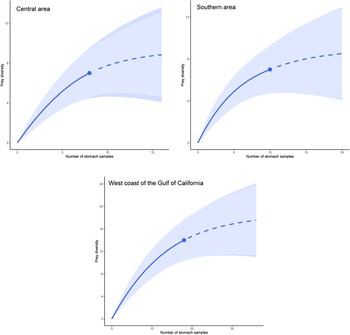
From the interpolation and extrapolation curves, 14 families of prey were identified that made up the trophic diversity of the sharpnose shark, with which it was possible to represent 72% of its diet in the west coast of the GC (67% of its diet in the central and 80% in the southern areas) (Figure 2).
Interpolation and extrapolation curves to determine trophic diversity and represented diet percentage of R. longurio on the west coast of the GC.

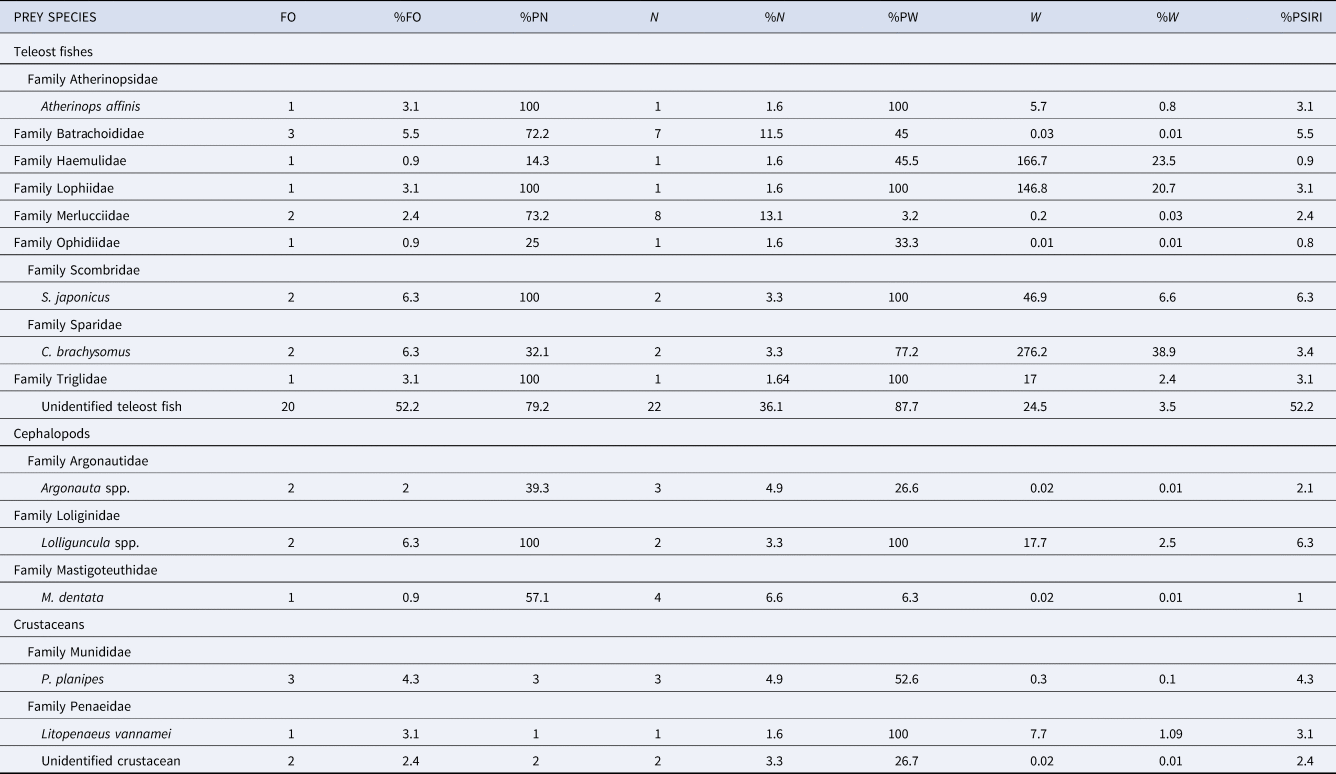
The general trophic prey spectrum was composed of ten teleost fish (nine families; one unidentified teleost fish), three families of cephalopods and three crustaceans (two families; one unidentified crustacean). The diet of R. longurio was dominated by fish (%PSIRI = 80.8), followed by crustaceans (%PSIRI = 9.8) and cephalopods (%PSIRI = 9.4). Fish of the Scombridae and Batrachoididae families (%PSIRI = 6.3 and 5.5, respectively), the cephalopod Lolliguncula spp. (%PSIRI = 6.3), and the crustacean Pleuroncodes planipes (%PSIRI = 4.3) dominated its diet (Table 1).
Summary of the diet composition of R. longurio in the west coast of the GC, Mexico, expressed as numbers and percentages: the number of stomachs containing the prey (FO), specific abundance per prey (PN), number (N), specific weight per prey (PW), and %PSIRI

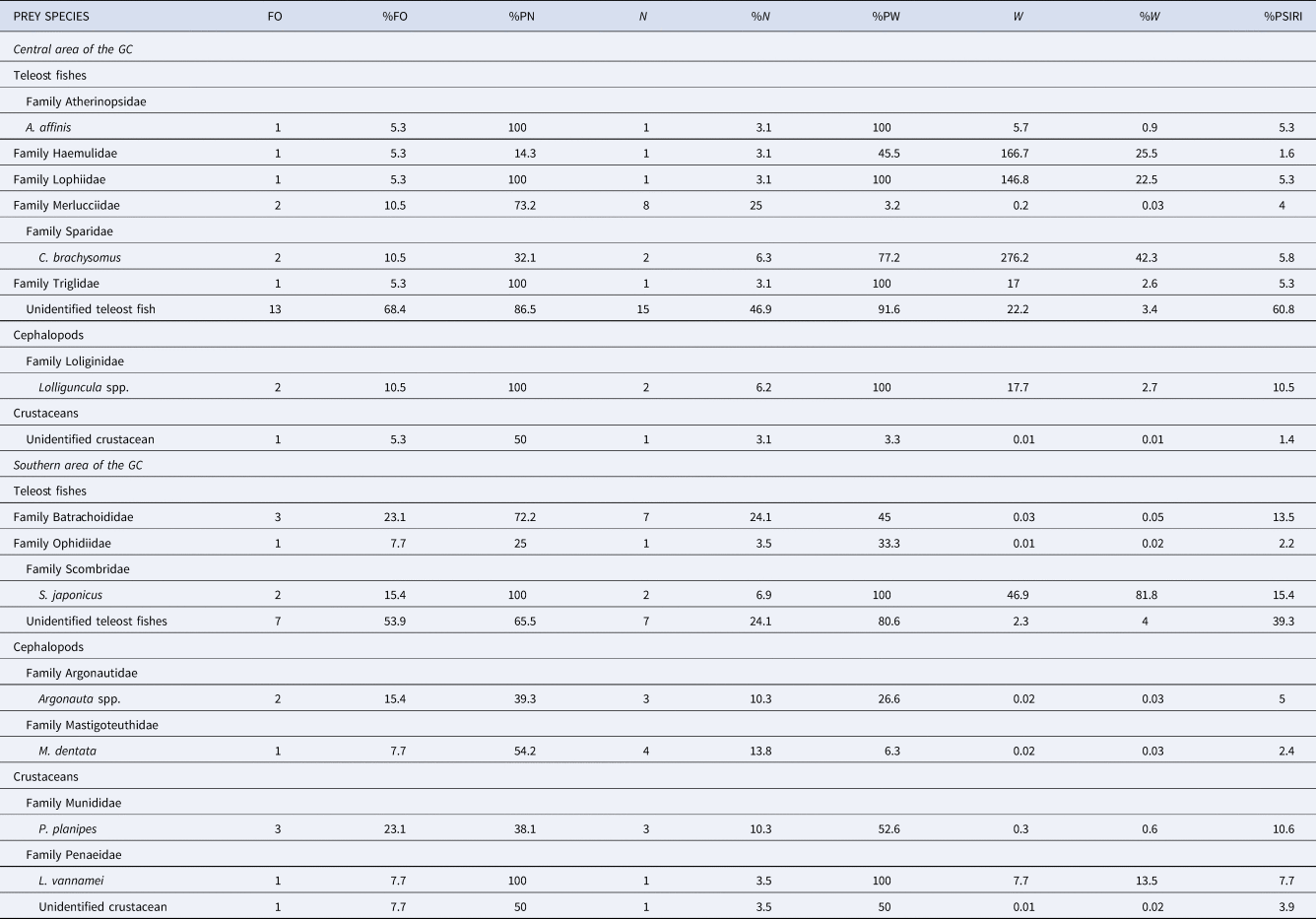
Only female stomachs were obtained (N = 19) in the central area of the GC. The %PSIRI indicated that the preferred prey were teleost fish (%PSIRI = 88.1), the cephalopod Lolliguncula spp. (%PSIRI = 10.5), and crustaceans (%PSIRI = 1.4) (Table 2). In the southern area of the gulf, the diet was dominated by fish (%PSIRI = 70.4), followed by crustaceans (%PSIRI = 22.2) and cephalopods (%PSIRI = 7.4). The %PSIRI indicated that the preferred prey were fish of the family Scombridae (Scomber japonicus; %PSIRI = 15. 4) and the crustacean P. planipes (%PSIRI = 10.6) (Table 2).
Summary of the diet composition of R. longurio in the west coast of the GC, Mexico: central and southern area, expressed by numbers and percentages: frequency of occurrence (%FO), per cent prey-specific number (%PN), per cent number (%N), per cent prey-specific weight (%PW), per cent weight (%W), and %PSIRI

A trophic level of TLK = 4.4 was obtained for R. longurio, while a TLK = 4.4 was obtained for the central area and a TLK = 4.3 for the southern area. The general trophic amplitude for this species was Bi = 0.19, considering it a specialist predator (Bi = 0.29) in the central area and a generalist predator in the southern area (Bi = 0.63).
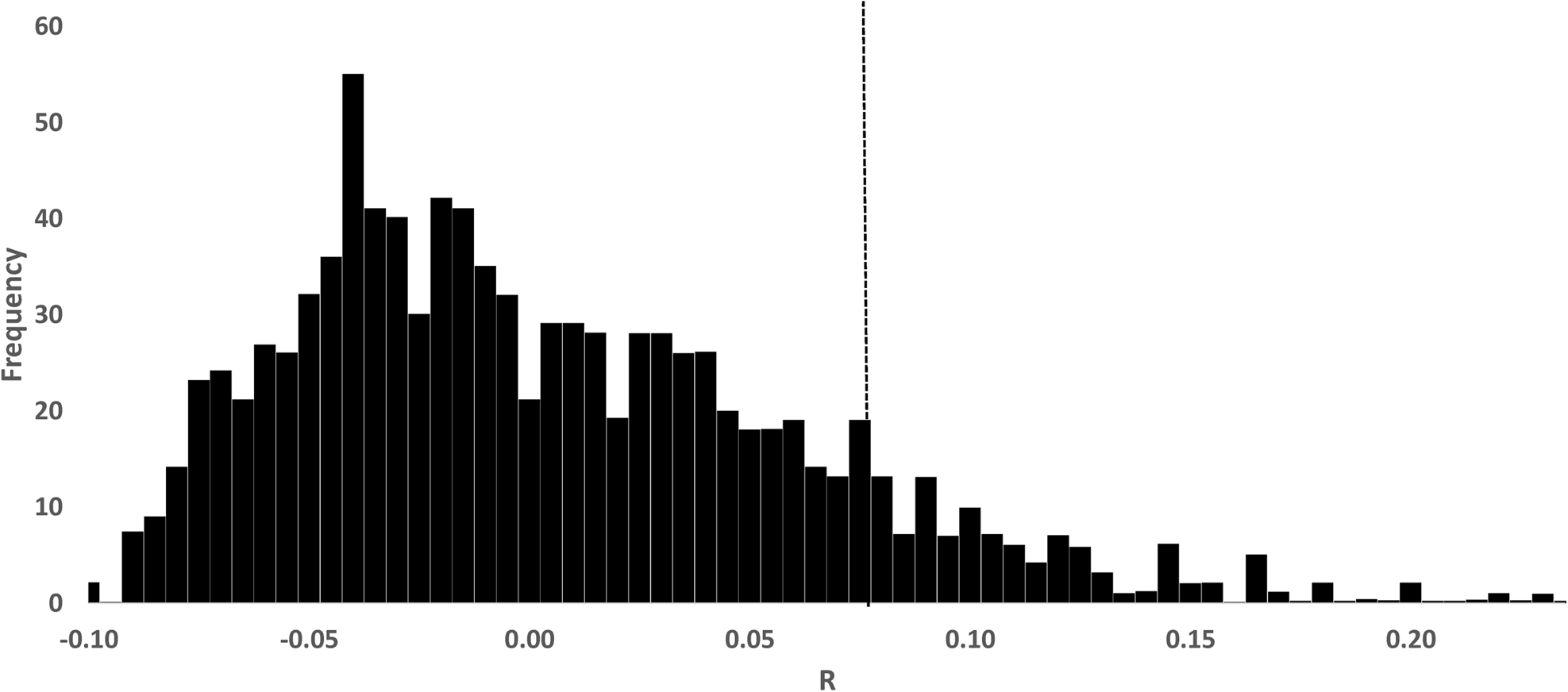
The trophic overlap between areas (Figure 3) had an average dissimilarity ≤72.79, which is consistent with that obtained from the %PSIRI, where the cephalopod Lolliguncula spp., as well as fish of the Sparidae (Calamus brachysomus) and Merlucciidae families, were the most important prey for the central area of the GC. Fish of the Scombridae (S. japonicus) and Batrachoididae families, the crustacean P. planipes, and the cephalopod Argonauta spp. were the most important prey for the southern area. The R values were equal to 0.069, which indicated that there were no statistically significant differences in their diet between both the areas.
Trophic overlap from ANOSIM in the west coast of the GC.

Discussion
In this study, the number of stomachs was insufficient to infer the diet differences of R. longurio by sex due to the low quantity of analysed samples (female = 51 stomachs and male = 19 stomachs) and a large number of empty ones. The latter can be explained by the fishing gear technique and the time of day when the sharks were caught. Gillnets are placed at night and collected until the following day, remaining for about 10 h at sea.
It could be inferred that prey were consumed at least one day before the sharks were captured since most were in an advanced stage of digestion. Alderete-Macal (Reference Alderete-Macal2007), Acosta-Alonso (Reference Acosta-Alonso2021), Castillo-Géniz (Reference Castillo-Géniz1990), and Alatorre-Ramírez et al. (Reference Alatorre-Ramírez, Galván-Magaña and Torres-Rojas2013) mention that, according to the time of gillnet placement and collection, sharks are caught with an empty stomach because they feed primarily at night.
Alatorre-Ramírez et al. (Reference Alatorre-Ramírez, Galván-Magaña and Torres-Rojas2013) also state that the fishing gear/technique used can cause high stress in sharks at the time of capture, resulting in regurgitation of the stomach contents. In this study, regurgitation was observed, which was related to the high number of empty stomachs. Furthermore, the activity of gastric juices can act on the degradation of prey organisms. Other authors Flores-Martínez (Reference Flores-Martínez2017) and Flores-Martínez et al. (Reference Flores-Martínez, Torres-Rojas, Galván-Magaña and Ramos-Miranda2017) agree that the filling percentage of the stomachs and the digestion state of the prey of R. longurio and other sharks are related to the time in which the organisms feed.
Regarding the fishing gear, Cabrera-Chávez (Reference Cabrera-Chávez2003) mentions that the best capture technique for trophic ecology studies is gillnets, since sharks are not attracted by bait as it happens with longlines that draw individuals with empty stomachs. However, the high number of empty stomachs in this study could be unrelated to the fishing gear, and more related to their feeding time or capture area.
Most prey were found in a state of digestion three (49%); however, prey were found in all four digestion states. Some authors mention that sharks of the genus Rhizoprionodon present different digestion stages of their prey due to their slow digestion rate in relation to other species (Flores-Martínez, Reference Flores-Martínez2017; Viana-Morayta et al., Reference Viana-Morayta, Torres-Rojas and Camalich-Carpizo2020). Therefore, the shark begins to hunt and feed until the digestion state of its prey has been partially or totally finished.
By the methodology proposed by Hsieh et al. (Reference Hsieh, Ma and Chao2016) it was possible to represent 72% of the diet of R. longurio.
Our results from the PSIRI coincide with the results obtained by Castillo-Géniz (Reference Castillo-Géniz1990), Márquez-Farías et al. (Reference Márquez-Farías, Corro-Espinosa and Castillo-Géniz2005), Alatorre-Ramírez et al. (Reference Alatorre-Ramírez, Galván-Magaña and Torres-Rojas2013), and Acosta-Alonso (Reference Acosta-Alonso2021). All authors used the IRI and reported that the diet of R. longurio is dominated mainly by teleost fish, followed by cephalopods and crustaceans. One of the reasons for using the %PSIRI and not the traditional methodology is related to the main weaknesses of the %IRI; its values depend on the taxonomic level or designated prey categories chosen by a researcher, which essentially defeats its purpose as a standardised measure of prey importance to facilitate comparisons. All prey items are not likely to be consistently identified to the same taxonomic level within a study, in addition to the bias resulting from the redundant calculation of the frequency of occurrence (%FO) (Brown et al., Reference Brown, Bizzarro, Caillie and Ebert2012).
This %PSIRI sums to 200%, and therefore dividing by two results in a version of the standardised %IRI with an important distinction: the %PSIRI is additive concerning taxonomic levels, such that the sum of the %PSIRI for species will be equal to the %PSIRI of the family containing those species, and so forth. This characteristic enhances the %PSIRI for comparisons between predators and studies since its values are not dependent upon the taxonomic level, suitability of or prey categories designated by a researcher (Brown et al., Reference Brown, Bizzarro, Caillie and Ebert2012). Therefore, our results represent a more robust interpretation.
The presence of other prey such as the pelagic red crab P. planipes, fish of the family Batrachoididae, and the cephalopods Mastigoteuthis dentata and Argonauta spp. coincide with the report by Acosta-Alonso (Reference Acosta-Alonso2021) in La Paz Bay, B.C.S. Mexico.
The sharpnose shark can perform vertical migrations in the water column within the first 100 m of depth, allowing it to capture both pelagic species and those with demersal habitats (Conde-Moreno, Reference Conde-Moreno2009; Alatorre-Ramírez et al., Reference Alatorre-Ramírez, Galván-Magaña and Torres-Rojas2013). These migrations would explain the presence of pelagic and benthic prey, such as the pelagic red crab P. planipes, which is distributed in muddy and sandy coastal bottoms, as well as the presence of pelagic prey such as fish from the Batrachoididae and Scombridae (S. japonicus) families (Acosta-Alonso, Reference Acosta-Alonso2021). Thus, the preference for different prey between areas can also be related to its abundance and availability in the environment.
Some authors consider R. longurio an opportunist predator (Castillo-Géniz, Reference Castillo-Géniz1990; Alatorre-Ramírez et al., Reference Alatorre-Ramírez, Galván-Magaña and Torres-Rojas2013) while others consider it a specialist (Alderete-Macal, Reference Alderete-Macal2007) or generalist (Trejo-Ramírez, Reference Trejo-Ramírez2017). It is worth mentioning that the selection of a type of predator depends on the zone and the distribution and abundance of their prey inside that zone. Likewise, changes in its diet may be related to environmental changes and each study area's oceanographic and biological characteristics. It is challenging to classify R. longurio as a predator under the terms established by Krebs (Reference Krebs1989) since the reported values of its prey based on the %PSIRI could indicate that it is an opportunistic predator that feeds on prey that coexist in time and space with them and are abundant in the area. The specialised behaviour of R. longurio could be related to its feeding on prey that form large schools, as has been reported by Alatorre-Ramírez et al. (Reference Alatorre-Ramírez, Galván-Magaña and Torres-Rojas2013). In addition, the central zone presented a wide abundance of fish in comparison with cephalopods and crustaceans, presenting a specialist behaviour, while the generalist behaviour in the southern zone can be related to the similar abundance between prey groups.
According to Cortés (Reference Cortés1999) and Alatorre-Ramírez et al. (Reference Alatorre-Ramírez, Galván-Magaña and Torres-Rojas2013), sharks occupy a tertiary trophic position. In the case of R. longurio, Cortés (Reference Cortés1999) reports a trophic level of 4.2, which coincides with the one found in the present study. Therefore, it is a tertiary consumer in the study areas, as it mainly feeds on teleost fish with trophic positions between 2 and 3.5 (Alatorre-Ramírez et al., Reference Alatorre-Ramírez, Galván-Magaña and Torres-Rojas2013).
The trophic overlap demonstrated no significant differences in the diet between both areas. A global R value equal to 0.069 was found from the test of ANOSIM. The R values range between −1 and 1, indicating a degree of discrimination among samples that depend on the richness and abundance of each organism's prey species (Clarke, Reference Clarke1993; Torres-Rojas, Reference Torres-Rojas2011). R achieves its maximum value when all the similarities within groups are greater than those between groups. In contrast, no separation or difference in the trophic spectrum between groups occurs when it achieves its minimum value (Clarke and Warwick, Reference Clarke and Warwick1994). In this study, the value obtained showed no such differences between the prey found in each area.
Our results could indicate the preference of different prey in both areas due to their availability, environmental factors, and the oceanographic conditions of each site, which is also reported in other study areas by Márquez-Farías et al. (Reference Márquez-Farías, Corro-Espinosa and Castillo-Géniz2005), Conde-Moreno (Reference Conde-Moreno2009), Osuna-Peralta et al. (Reference Osuna-Peralta, Voltolina, Morán-Ángulo and Márquez-Farías2014), and Acosta-Alonso (Reference Acosta-Alonso2021).
Acknowledgements
The authors acknowledge the Instituto Politécnico Nacional (CICIMAR-IPN) for the grant SIP 20196736 and the COFFA and EDI fellowships.
Author's contribution
A.H.-A. analysed the data, interpreted the findings, and wrote the article. F.G.-M. designed the study, collected samples from fishing camps, interpreted the findings, and wrote the article. M.R.S.-A. designed the study, collected samples from fishing camps, analysed the data, interpreted the findings, and wrote the article.
Competing interest
None.