Introduction
Promoting mutual awareness of HIV serostatus among sex partners is increasingly being recognized as a core component of HIV prevention and control programmes across the world (Hart et al., Reference Hart, Wolitski, Purcell, Parsons, Gomez and Seropositive Urban Men’s2005; Bachanas et al., Reference Bachanas, Medley, Pals, Kidder, Antelman and Benech2013; Jennings et al., Reference Jennings, Rompalo, Wang, Hughes, Adimora and Hodder2015). Encouraging serostatus disclosure is recognized as a key strategy to achieve the targeted 90% reduction in HIV incidence and AIDS-related mortality by 2030 (Barnhart Reference Barnhart2016; Stover et al., Reference Stover, Bollinger, Izazola, Loures, DeLay and Ghys2016; Granich et al., Reference Granich, Williams, Montaner and Zuniga2017; Ajayi et al., Reference Ajayi, Abioye, Adeniyi and Akpan2019; Karatzas et al., Reference Karatzas, Peter, Dave, Fogarty, Belinsky and Pai2019). This is because awareness of a partner’s HIV status can lead to improved sexual behaviours, which mitigate the risk of transmission of the infection (Groves et al., Reference Groves, Maman and Moodley2012; Jennings et al., Reference Jennings, Rompalo, Wang, Hughes, Adimora and Hodder2015). Studies have shown that partner awareness through disclosure can reduce inconsistent or no condom use, having multiple sex partners, indulgence in casual sex and sex-related substance abuse (Marks et al., Reference Marks, Crepaz, Senterfitt and Janssen2005; Hart et al., Reference Hart, Wolitski, Purcell, Parsons, Gomez and Seropositive Urban Men’s2005; Xia et al., Reference Xia, Molitor, Osmond, Tholandi, Pollack, Ruiz and Catania2006; Loubiere et al., Reference Loubiere, Peretti-Watel, Boyer, Blanche, Abega and Spire2009; Benki-Nugent et al., Reference Benki-Nugent, Chung, Ackers, Richardson, McGrath and Kohler2011; Irungu et al., Reference Irungu, Chersich, Sanon, Chege, Gaillard and Temmerman2012; Conserve et al., Reference Conserve, Sevilla, Mbwambo and King2013). Such frank communication between sex partners can also facilitate the utilization of HIV care services such as HIV testing and counselling (HTC), and related shared sexual health decision-making approaches (Millson et al., Reference Millson, Rasooly, Scott, Oxman, Frank and Sellors1994; Clark et al., Reference Clark, Long, Giron, Cuadros, Caceres and Coates2007; Bachanas et al., Reference Bachanas, Medley, Pals, Kidder, Antelman and Benech2013; Clark et al., Reference Clark, Segura, Perez-Brumer, Reisner, Peinado and Salvatierra2014).
In many low- and middle-income countries (LMICs), while HTC rates have significantly improved over the years following efforts by the United States President’s Emergency Plan for AIDS Relief (PEPFAR) (Karatzas et al., Reference Karatzas, Peter, Dave, Fogarty, Belinsky and Pai2019), disclosure rates vary significantly between and within countries (Dessalegn et al., Reference Dessalegn, Hailemichael, Sawleshwarkar, Lodebo, Amberbir and Hillman2019). Partner notification rates in LMICs range from 16% to 86% (average: 52%), compared with 42% to 100% (average: 71%) in high-income countries (Maman & Medley, Reference Maman and Medley2003; Dessalegn et al., Reference Dessalegn, Hailemichael, Sawleshwarkar, Lodebo, Amberbir and Hillman2019). Lower disclosure rates may contribute to the poor linkage to care observed in the HIV care continuum in many LMICs, including Nigeria (Karatzas et al., Reference Karatzas, Peter, Dave, Fogarty, Belinsky and Pai2019).
Despite the significant drop in prevalence of HIV in Nigeria over the years, significant socio-cultural hurdles need to be overcome in order to achieve the 90-90-90 targets (Adepoju, Reference Adepoju2019). One such hurdle is the persistent stigma inhibiting open communication about HIV serostatus, particularly among sexual partners (Odimegwu et al., Reference Odimegwu, Akinyemi and Alabi2017). A recent survey indicates that 1.9 million (1.4%) Nigerians currently live with HIV (Adeyinka et al., Reference Adeyinka, Olakunde, Oladimeji and Ezeanolue2019). The prevalence of HIV among women of reproductive age is almost twice that of their male counterparts. The two states with the highest prevalence are Akwa-Ibom (5.5%), located in the South-South region, and Benue (5.3%) located in the North-Central region (National Agency for the Control of AIDS, 2019).
The purpose of this study was to evaluate the factors that determine HIV-positive women’s awareness of their male sex partner’s HIV serostatus in Benue State, Nigeria.
Methods
Study design, context and participants
A cross-sectional survey of 8825 women of reproductive age living with HIV was conducted between June and December 2017 in Benue State, North-Central Nigeria. The selected participants had participated in an integrated mHealth platform intervention at five comprehensive HIV treatment centres in the state. Details of the development of the integrated mHealth platform have been reported elsewhere (Gbadamosi et al., Reference Gbadamosi, Eze, Olawepo, Iwelunmor, Sarpong and Ogidi2018). In brief, the mHealth platform is capable of storing encrypted patient information on a patient-held smartcard and smartphone mobile application that is linked with a secure web-based database. The patients’ records can be viewed on a mobile app without an internet connection, and this aids in health care decision-making at the point of care in low-resource environments. Benue State has an estimated total population of 5,138,531, of whom 49.6% are female. Most of the population reside in the rural areas and farming is the predominant occupation in the state (in 74.8% of the population) (Benue State Government, 2018). About 70% of the female population have attained less than secondary education with a literacy rate of 52.8% (National Population Commission and Inner City Fund International, 2014).
Study sites were selected using the following criteria: a comprehensive HIV treatment facility, received funding support from PEPFAR through Caritas Nigeria, had records of a high volume of HIV-infected women (≥2000 women on treatment) and offered free HIV testing services, antiretroviral therapy (ART) for both adults and children and services for the prevention of mother-to-child transmission of HIV. There were 21 comprehensive HIV treatment facilities in Benue State at the time of the survey: seven had ≥2000 women undergoing treatment, of which five were selected. Any HIV-infected women were eligible to participate in this study if they were of reproductive age (18–45 years) and received ART from any of the five selected treatment sites.
Of the total 8825 HIV-positive women surveyed, 6655 (75.4%) reported having a sexual partner at the time of the survey. Following the exclusion of observations with missing variables, a total of 5064 respondents were included in the final analyses.
Data collection
Trained health workers offered pre-printed mHealth smartcards with unique patient identifiers to eligible HIV-infected women as they presented for their routine pre-scheduled clinic appointments. The study’s purpose and procedures were explained to the women after which informed consent was obtained from those who chose to participate in the study.
Semi-structured questionnaires were designed, pre-tested and used by trained research assistants to collect data on socio-demographic and clinical characteristics of the study participants. Socio-demographic characteristics included age, marital status, highest level of education, occupation, number of living children and sex partner’s age. Clinical characteristics included viral load, ART start date, current ART regimen, partner’s HIV status and partner’s awareness about participant’s HIV status.
Variables
The dependent variable was ‘partner’s awareness of respondent’s HIV serostatus’. Respondents were asked if their partner was aware of their HIV status. The responses were coded as 0 for ‘not aware’ and 1 for ‘aware’. Seven independent variables were extracted from the survey database, which included the socio-demographic profile of the participants (age, highest level of education, marital status, occupation), their family profiles (partner’s age, number of children) and number of years the participants had been on ART.
Statistical analysis
Data analysis was performed using Stata version 15.0. Descriptive analysis of the independent and dependent variables was performed and presented on a frequency table indicating distribution of variables responses. Bivariable and multivariable binary logistic regression models were developed to estimate the association between the dependent and the independent variables presented as odds ratios (ORs) and 95% confidence intervals (CIs). Dummy variables with reference categories were created from categorical variables. ‘Single’ and ‘Other’ were designated as combined reference categories for ‘marital status’ due to the very small size of the ‘Other’ category.
Furthermore, post-estimation predictive margins and conditional marginal effects at means (MEM) analyses were conducted to evaluate the probability of outcomes with respect to each independent variable, holding other independent variable constant at their means.
Results
Descriptive statistics
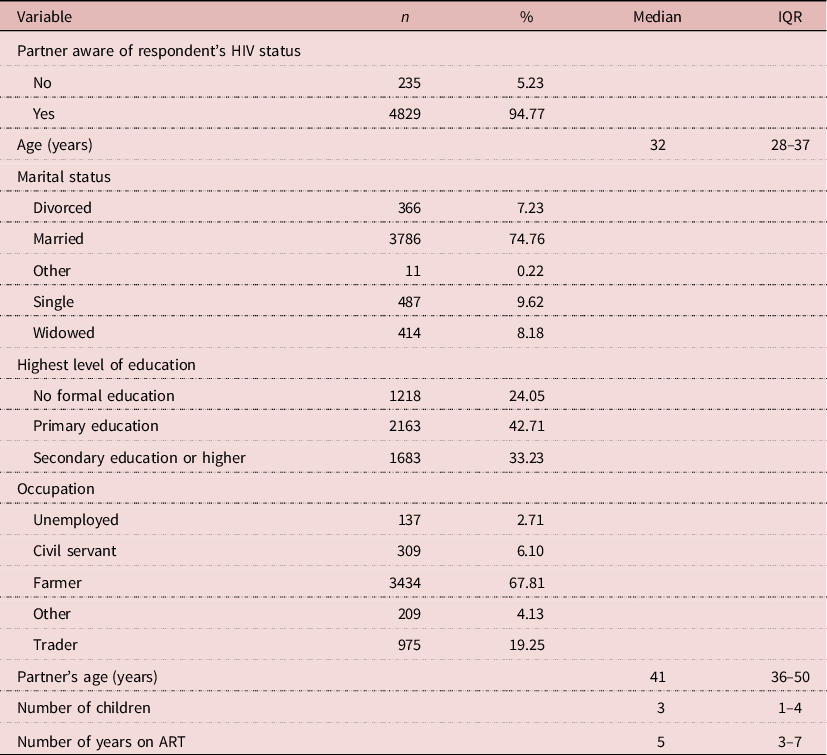
Table 1 presents the distribution of the socio-demographic characteristics of the study participants. Most of the study participants (74.8%) were married and 75.9% had a primary level education or higher (note that missing data were excluded from this analysis). The vast majority were farmers (67.8%). The median age of participants was 32 years (IQR: 28–37), while the median age of their partners was 41 years (IQR: 36–50). The median number of the children of participants was 3 years (IQR = 1–4 years), and the median number of years participants had been on ART was 5 (IQR = 3–7).
Descriptive socio-demographic characteristics of women of reproductive age living with HIV with a sexual partner at the time of survey, Benue State, Nigeria, N = 5064

Bivariable and multivariable logistic regression
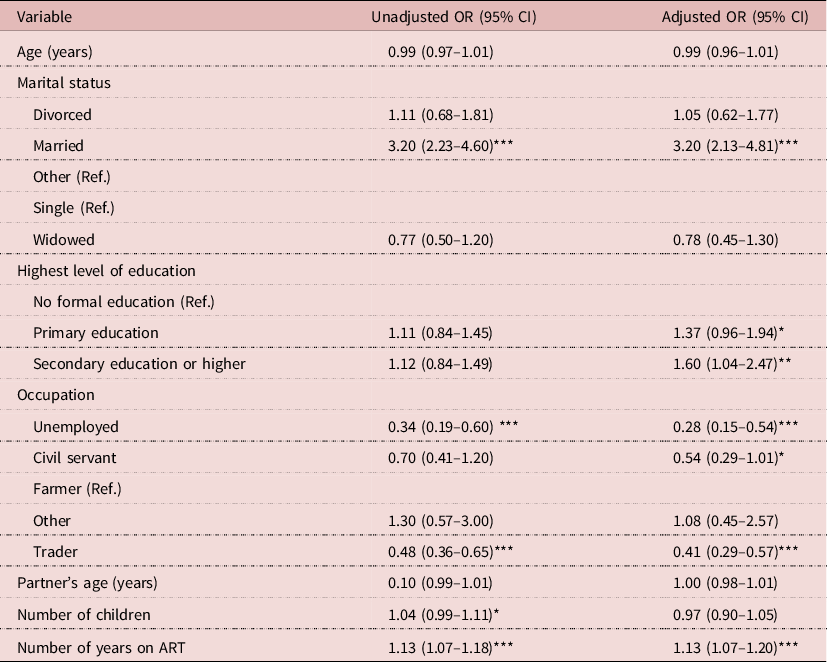
Table 2 shows the results of the bivariable (unadjusted) and multivariable (adjusted) regression models. Bivariable analyses showed significant association between marriage status and partner awareness. Partners of married women were three times as likely to be aware of the status of their spouses compared with partners of the reference categories (single women and ‘others’). This finding was similar with the multivariable analysis (adjusted OR (aOR): 3.20; 95%CI: 2.13–4.81). Furthermore, the odds of male partners being aware of the respondent’s HIV serostatus increased with each additional child the respondents had in bivariable model (aOR: 1.04; 95% CI: 0.99–1.11) but decreased in the multivariable model (aOR: 0.97; 95% CI: 0.90–1.05), but the association was not statistically significant in either models. The odds of partner awareness significantly increased by 1.13 times with each additional year on ART on both bivariable (95% CI: 1.07–1.18) and multivariable (95% CI: 1.07–1.20) models. Whereas there was significant association between male partner awareness of respondent’s serostatus and secondary or higher education (aOR: 1.60; 95%CI: 1.04–2.47) on the multivariable model, statistically significant association between these variables were not found on the bivariable model. Similarly, partner awareness was significantly associated with unemployed respondents (aOR: 0.28; 95%CI: 0.15–0.54) and traders (aOR: 0.41; 95%CI: 0.29–0.57) in the multivariable model in comparison to farmers (reference category).
Unadjusted and adjusted binary logistic regression on the association between explanatory variables and partner’s awareness of respondent’s HIV status

The likelihood ratio χ 2 if the logistic regression model was 136.27 (p<0.001). Pseudo R 2 was 0.0717 while post-estimation Hosmer-Lemeshow χ 2 was 11.80 (p=0.161). These diagnostic and goodness-of-fit tests indicate that the regression model was a good fit.
Ref., reference category.
***p<0.001; **p<0.05; *p<0.10.
Post-estimation predictive margins analyses
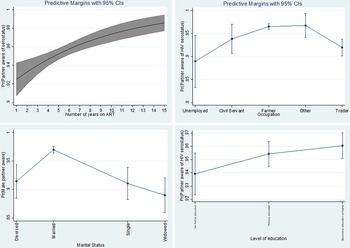
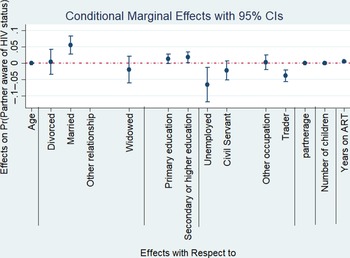
Figure 1 shows the outputs of the predictive margins analysis with respect to variables with significant outcomes in the logistic regression model (marital status, highest education, occupation and years on ART), while Figure 2 reports outcomes of the MEM model. The probability of women perceiving their male partners to be aware of their serostatus increased with the number of years the women had been on ART, with a conditional marginal effect of 0.004 (95% CI: 0.002–0.006). This indicates that the probability of perceived partner awareness of the respondent’s serostatus increased by 0.4 percentage points with each additional year the women were on ART. The probability of partners of married respondents being aware of their spouse’s HIV serostatus was 97%; and 5.4 percentage points (95% CI: 2.7–8.2) higher than partners of single women, as revealed by the MEM analysis. The conditional marginal effects of being educated to primary or higher levels were 1.2 (95% CI: –0.2 to 2.7) and 1.8 (95% CI: 0.09–3.4) percentage points higher, respectively, when compared with women with no formal education. Being unemployed or being a trader significantly decreased the probability of partners being aware of the respondent’s serostatus when compared with farmers, with conditional marginal effects of –6.7 (95% CI: –12.0 to –1.4) and –3.9 (95% CI: –5.7 to –2.2) percentage points, respectively.
Predictive margins of significant independent variables with 95% confidence intervals (95% CI).

Conditional marginal effects of independent variables with 95% confidence intervals (95% CI).

Discussion
The results of this study indicate that partner awareness of HIV status among HIV-positive women in the study population was generally high (94.77%), which may indicate a high disclosure rate. This rate is consistent with findings in other sub-Saharan African countries (Cameroon, Ghana, Tanzania, Kenya, Uganda, South Africa, Malawi and Namibia), where disclosure rates have been shown to be over 80% (King et al., Reference King, Katuntu, Lifshay, Packel, Batamwita and Nakayiwa2008; Bachanas et al., Reference Bachanas, Medley, Pals, Kidder, Antelman and Benech2013; Conroy & Wong, Reference Conroy and Wong2015; Obiri-Yeboah et al., Reference Obiri-Yeboah, Amoako-Sakyi, Baidoo, Adu-Oppong and Rheinlander2016; Brittain et al., Reference Brittain, Mellins, Remien, Phillips, Zerbe, Abrams and Myer2018; Wambiya et al., Reference Wambiya, Atela, Eboreime and Ibisomi2018). However, many African countries and communities still report partner notification rates as low as 16% (Maman & Medley, Reference Maman and Medley2003).
As with many studies in sub-Saharan Africa (Deribe et al., Reference Deribe, Woldemichael, Wondafrash, Haile and Amberbir2008; King et al., Reference King, Katuntu, Lifshay, Packel, Batamwita and Nakayiwa2008; Amoran, Reference Amoran2012; Kouanda et al., Reference Kouanda, Yameogo, Berthe, Bila, Yaya and Somda2012; Yaya et al., Reference Yaya, Saka, Landoh, Patchali, Patassi, Aboubakari and Makawa2015), being a married woman or educated to at least secondary level were associated with increased odds of male partners being aware of respondent’s serostatus. Similarly, the odds of male partner awareness increased by 13% with each additional year respondents remained on ART. Conversely, male partners of traders and unemployed women had 62% and 74% lower odds, respectively, of being aware of the respondent’s serostatus than employed participants with unspecified occupations.
Compared with men, African women are more constrained from disclosing their HIV status to their sex partner(s), as well as being informed about their partner’s HIV status (Bachanas et al., Reference Bachanas, Medley, Pals, Kidder, Antelman and Benech2013). This is not unconnected with the social stigma associated with disclosure of serostatus. Previous studies have identified prior knowledge of male partners’ positive status as a key determinant of female partner disclosure. Other determinants include strong partner support against discrimination (Amoran, Reference Amoran2012; Ezeanolue et al., Reference Ezeanolue, Obiefune, Yang, Ezeanolue, Pharr and Osuji2017; Hallberg et al., Reference Hallberg, Kimario, Mtuya, Msuya and Björling2019). These may be more likely to be experienced in a marital relationship, thus, may explain the strong association between marriage and disclosure. Monogamous marriages have also been associated with better disclosure when compared with polygamous marriages (Amoran, Reference Amoran2012). This may be indicative of a possible higher feeling of trust and commitment, leading to better communication within marital unions. However, the fear of domestic violence following disclosure is a very common finding in sub-Saharan Africa. This fear may preclude women from disclosing their status to their partners, particularly when their partner’s status is unknown or negative (Obiri-Yeboah et al., Reference Obiri-Yeboah, Amoako-Sakyi, Baidoo, Adu-Oppong and Rheinlander2016; Ngonzi et al., Reference Ngonzi, Mugyenyi, Kivunike, Mugisha, Salongo and Masembe2019). Disruption of a relationship has also been identified as a common fear among sub-Saharan African women, which impedes disclosure (Baba-Ari et al., Reference Baba-Ari, Eboreime and Hossain2018). Although common across various relationship types, unmarried women may be more affected by this fear (Arrey et al., Reference Arrey, Bilsen, Lacor and Deschepper2015). Yet male partner involvement is crucial for better outcomes of prevention of mother-to-child transmission of HIV (Ezeanolue et al., Reference Ezeanolue, Obiefune, Ezeanolue, Ehiri, Osuji and Ogidi2015, Reference Ezeanolue, Obiefune, Yang, Ezeanolue, Pharr and Osuji2017; Colvin, Reference Colvin2019).
The number of years on ART was positively associated with male partner awareness of the respondents’ serostatus. This may be a proxy indicator of the confidence built over the years from counselling services received by the women during clinic sessions. However, it may also be a reverse association, such that prior disclosure may have resulted in adherence to the ART regimen over the years. This assumption is supported by other studies from similar sub-Saharan African contexts (Bulali et al., Reference Bulali, Kibusi and Mpondo2018; Dessie et al., Reference Dessie, Wagnew, Mulugeta, Amare, Jara and Leshargie2019).
The relatively high rate of formal education among the women in this study (76% had at least primary level education) may also explain the understanding of the need to communicate their status with partners. Several studies have identified education as a determinant of disclosure rates (Batterham et al., Reference Batterham, Rice and Rotheram-Borus2005; Amoran, Reference Amoran2012; Kiula et al., Reference Kiula, Damian and Msuya2013; Yaya et al., Reference Yaya, Saka, Landoh, Patchali, Patassi, Aboubakari and Makawa2015). In particular, girl-child education is associated with a decrease risk of HIV transmission (Alsan & Cutler, Reference Alsan and Cutler2013).
Similarly, being economically empowered helps allay some of the fears associated with women disclosing their status to their partners. Thus, the low unemployment rate (3%) may also have contributed to the high male partner awareness rates in the study population. Loss of employment is a common fear mitigating against disclosure of status by women (Sowell et al., Reference Sowell, Seals, Phillips and Julious2003; Amoran, Reference Amoran2012). Being mostly farmers (thus self-employed), the women may be able to fend for themselves and their children. Consequently, the fear of being economically incapacitated following disclosure may be mitigated. However, trading was significantly associated with lower male partner awareness.
The findings from this study suggest that strategies aimed at improving women’s education and economic independence, as well as facilitating frank communication between sex partners, may encourage disclosure of HIV status to partners. Training peer educators to provide support for safe disclosure may prove to be a useful strategy, as part of a comprehensive policy intervention, to promote partner notification. Successful models can be adapted from those of other countries (Bergman et al., Reference Bergman, Gratrix, Pillay, Houston, Cooper and Charlton2015; Katz et al., Reference Katz, Dombrowski, Kerani, Aubin, Kern and Heal2016; Karatzas et al., Reference Karatzas, Peter, Dave, Fogarty, Belinsky and Pai2019), but contextual variations such as socio-cultural and political nuances must be taken into cognizance. Furthermore, gender sensitivity should be given adequate consideration in the development and promulgation of policies, legislation and programmes relating to HIV/AIDS.
The study reports male partner awareness from the female partner’s perspective, which may be subject to respondent bias. Future studies may seek to confirm responses by follow-up interviews with the male partners barring ethical restrictions. Given that this study retrospectively analysed data collected towards objectives of a broader study, some other ‘awareness-specific’ explanatory variables, such as number of sex partners and other social and behavioural characteristics reported in other studies, were not collected (Batterham et al., Reference Batterham, Rice and Rotheram-Borus2005; Amoran, Reference Amoran2012; Kiula et al., Reference Kiula, Damian and Msuya2013; Arrey et al., Reference Arrey, Bilsen, Lacor and Deschepper2015; Obiri-Yeboah et al., Reference Obiri-Yeboah, Amoako-Sakyi, Baidoo, Adu-Oppong and Rheinlander2016). Future studies may also employ a mixed-methods approach to identify and test possible context-specific explanatory variables.
In conclusion, the high rates of participants’ reported partner awareness of their HIV serostatus in this study in Benue State, Nigeria, indicates that the dynamics of disclosure in this population may be shifting positively. This may be influenced by increasing girl-child education and economic empowerment, which instil greater confidence in women of reproductive age. Consequently, prioritizing interventions aimed at improving these social determinants of health may significantly reduce the burden of HIV transmission in the population.
Acknowledgments
The authors acknowledge the support of the heads and staff of the participating health facilities, the patients and the staff of Caritas Nigeria and the staff of Center for Translation and Implementation Research (CTAIR) of the University of Nigeria, Nsukka, Enugu. The dataset used for this study is available from the corresponding author on reasonable request.
Funding
This study was funded by the Fogarty International Center of the US National Institutes of Health (NIH) (Grant No. R21TW010252) and the Eunice Kennedy Shriver National Institute of Child Health & Human Development of the NIH (Grant Nos R01HD087994 and R01HD087994-S1). The content is solely the responsibility of the authors and does not necessarily represent the official views of the NIH.
Author Contributions
EEE, IUI, OO and AGO conceptualized and designed the study. Data was collected by AGO, OO and EEE. EAE and EEE analysed the data. Data interpretation was done by EAE, IUI, CAO and EEE. EAE and IUI drafted the initial manuscript while EAE, IUI, TI, CAO and EEE critically revised the manuscript. All authors read and approved the final draft.
Conflicts of Interest
The EEE owns shares in the database platform Vitira Smart Solutions. This was supported by Fogarty International Center of the US National Institutes of Health (NIH) (Grant No. R21TW010252) and commercialized by Vitria Health LLC.
Ethical Approval
Ethical approval for this study was obtained from the Health Research Ethics Committee of the University of Nigeria Teaching Hospital (NHREC/05/01/2008B-FWA00002458-1RB00002323). Approval was obtained from the health administrators of all the study sites and written informed consent was obtained from participants. Informed consent was obtained for all participants in this study.