Introduction
Placers of platinum-group minerals (PGM) in which the relatively refractory iridium subgroup of platinum-group elements (IPGE: Ir, Os and Ru) predominate are typically associated with ophiolitic or Alaskan–Uralian-type complexes (e.g. Cabri, Reference Cabri2002, and references therein). However, in the Sisim placer zone, in eastern Sayans, Russia, Barkov et al. (Reference Barkov, Shvedov and Martin2018a) documented an atypical association of IPGE-rich PGM in which there are inclusions rich in Ti and rare-earth elements. These unusual enrichments led them to propose a probable provenance from ultramafic units of the Lysanskiy layered complex, exposed nearby. The Sisim placer zone is also known for gold- and PGM-bearing placers located along the rivers Ko and Seyba. The River Seyba is a tributary of the River Sisim, which in turn flows into the River Yenisey, one of the main river systems of central Siberia.
Our objectives in the present article are to describe assemblages of PGM encountered in placer occurrences along the River Seyba, with a focus on PGE-rich sulfide inclusions hosted by grains of Os–Ir–(Ru)-rich alloys. Two series of complex PGE-rich sulfides are involved: a PGE-rich pentlandite series; and a ferhodsite series. Both have grown in a highly sulfur-poor environment associated with ultramafic lithologies. We investigate element substitutions and extents of solid solutions in these series on the basis of our data and compositions reported in the literature. Our observations extend the knowledge about uncommon variants of economically significant sulfides enriched in the PGE.
Regional geology
The Au–PGE-bearing alluvial deposit is located along the River Seyba in south-central Siberia, close to Krasnoyarsk, the capital of the extensive territory of Krasnoyarskiy kray (Fig. 1a). The main massifs exposed in the area (Fig. 1b; Bezzubtsev, Reference Bezzubtsev2008, and references therein) consist of granite and granodiorite (Arzybeiskiy, Angulskiy, Derbinskiy and Kanzubinskiy, among others), a peralkaline granite (Okunevskiy), a gabbro–diorite–granodiorite association (Shindinskiy, also known as Olkhovsko-Chibizhekskiy), and a gabbro–monzonite–syenite suite (Buedzhinskiy). We do not consider these suites to be potential sources for the PGM-bearing placers along the River Seyba. Considered more probable are two complexes with voluminous ultramafic units, the Kulibinskiy layered clinopyroxenite–gabbro–anorthosite complex, in particular the Kuvaiskiy and Shirokologskiy massifs, and the Lysanskiy layered dunite–peridotite–gabbro complex (Fig. 1b). The latter is composed of three large separate blocks: Lysanskiy, Podlysanskiy and Kedranskiy (~0.5 km × 30 km in extent), and includes many smaller and fragmented bodies. This complex, located close to the Seyba placer (Fig. 1b), is the one considered previously to represent the source rocks for the PGM-bearing placers associated with the Sisim zone (Barkov et al., Reference Barkov, Shvedov and Martin2018a).
(a) Map showing the location of the Seyba placer zone in the Krasnoyarskiy kray of Russian Federation. (b) Simplified and generalised sketch of geology of the placer area showing the development of main massifs exposed (after Bezzubtsev, Reference Bezzubtsev2008, and references therein).

The Lysanskiy complex displays tectonic contacts with its host rocks of the Bakhtinskaya suite, of upper Proterozoic age; this suite is composed of various basalts, andesitic basalts and volcanic tuffs. The complex is formed of alternating sequences of serpentinite, wehrlite, lherzolite, harzburgite, clinopyroxenite, websterite, gabbronorite, troctolite, gabbro and anorthosite (Glazunov, Reference Glazunov1975). Some parts of this complex are dominantly ultramafic, whereas others contain mostly gabbroic rocks. The Lysanskiy complex hosts abundant occurrences of Ti–(V) mineralisation and podiform deposits of ilmenite–titanian magnetite ore up to 1–2 km across, exploited in the Rossyp, Piramida, Bezymyannyi and Malyi Lysan deposits.
The close association of PGM grains with native gold along the River Seyba indicates a mutual accumulation controlled by processes of placer formation. Stages of gold deposition are recognised quite well because occurrences of placer gold are more abundant and targeted than those of PGM. The geological history of placer gold involves a long period of orogenic development in the eastern Sayans (Tsykin and Popova, Reference Tsykin and Popova2008). Gold-bearing veins of hydrothermal origin were probably exposed by progressive denudation during middle-to-upper Paleozoic and early Mesozoic time. It was then that the first paleoplacers of gold probably formed in the region, and were later reworked during the Cenozoic. A peneplain occurred at the end of the Cretaceous and beginning of the Paleogene period; it is manifested by locally developed crusts of weathering. There is a notable enrichment of gold in the eluvium associated with primary ore-bearing zones. The orogenic processes were reactivated, and the modern river system formed during the neotectonic period. This activity also involved the deposition of alluvial gold + PGM-bearing material in placers of the Seyba area.
Samples and electron-microprobe analyses
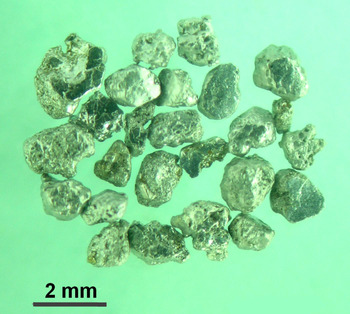
The placer grains recovered at Seyba are roundish to various extents, though crystal faces are locally preserved; they are relatively large (1.5–2 mm across: Fig. 2) and notably coarser than placer grains (≤1–1.5 mm) described previously from the associated placers at the rivers Sisim and Ko (Tolstykh and Krivenko, Reference Tolstykh and Krivenko1994; Krivenko et al., Reference Krivenko, Tolstykh, Nesterenko and Lazareva1994; Barkov et al., Reference Barkov, Shvedov and Martin2018a). The larger grain-size may be ascribed to the closer proximity to source rocks.
A microscopic image showing grains of Os–Ir–(Ru) alloy minerals selected from PGM concentrate collected in the Seyba placer deposit.

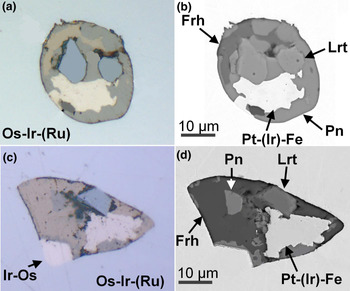
The host grains and inclusions of PGM (e.g. Fig. 3) were analysed by means of wavelength-dispersive X-ray spectroscopy (WDS) using a Camebax-micro electron microprobe at the Sobolev Institute of Geology and Mineralogy, Russian Academy of Sciences, Novosibirsk, Russia. The analytical conditions were 20 kV and 60 nA; the Lα line was used for Ir, Rh, Ru, Pt and Pd; the Mα line was used for Os; and the Kα line was used for S, Fe, Ni, Cu and Co. The following standards were used: pure metals (for the PGE), CuFeS2 (for Fe, Cu and S) and a synthetic compound of stoichiometric composition: FeNiCo (for Ni and Co). Values of the minimum detection limit were ≤0.1 wt.%.
Reflected-light photographs (a and c) and back-scattered electron images (b and d) showing polymineral inclusions hosted by placer grains of Os-dominant alloy [labelled Os–Ir–(Ru)] from the Seyba placer deposit. The label Lrt is laurite, Frh is ferhodsite, Pn is pentlandite (PGE-rich) and the label Pt–(Ir)–Fe pertains to the isoferroplatinum-type alloy rich in Ir.

Results and discussion
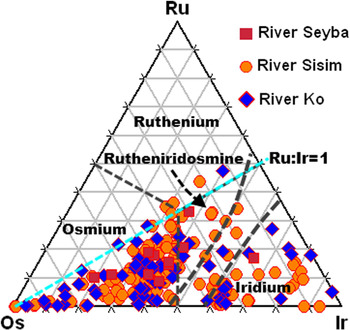
Osmium-dominant alloys, i.e. the mineral osmium, predominate among the grains of PGM analysed (Tables 1, 2). Grains of Ir-dominant alloy are subordinate or rare, as are alloy grains close to rutheniridosmine. The observed compositions of alloys (Fig. 4) are consistent with the overall field observed in placers at the rivers Ko (Krivenko et al., Reference Krivenko, Tolstykh, Nesterenko and Lazareva1994; Tolstykh and Krivenko; Reference Tolstykh and Krivenko1994) and Sisim (Barkov et al., Reference Barkov, Shvedov and Martin2018a).
Compositions of platinum-group minerals (wt.%) from the Seyba placer deposit, eastern Sayans.

‘–‘ = not detected.
Compositions of platinum-group minerals from the Seyba placer deposit, eastern Sayans, expressed in atom proportions.

Notes: Compositions of these grains of PGM (quoted in wt.%) are presented in Table 1. The values of atomic proportions are based on a total of 100 atomic % (#1–14), 3 apfu (#15–19), 17 apfu (#20–26) and a total of 6 apfu (#27).
Compositional variations of grains of Os–Ir–(Ru) alloys from placer deposits associated with the River Seyba (this study), River Ko (Krivenko et al., Reference Krivenko, Tolstykh, Nesterenko and Lazareva1994) and River Sisim (Barkov et al., Reference Barkov, Shvedov and Martin2018a) in terms of the Ru–Os–Ir diagram (atomic %). The nomenclature and miscibility gap are after Harris and Cabri (Reference Harris and Cabri1991).

Interestingly, the documented field is limited to the Ru-poor portion of the system Os–Ir–Ru by the line Ru:Ir = 1 in the entire Sisim–Ko–Seyba area (Fig. 4). In addition, patterns of zoning exist in euhedral grains of Os–Ir–(Ru) alloy; their trend extends subparallel to this boundary (Barkov et al., Reference Barkov, Shvedov and Martin2018a). It seems clear that Ir and Ru are related in their fractionation pattern, and that alloy phases with a Ru:Ir ratio exceeding 1 were not stable under the ambient conditions of crystallisation.
Inclusions of a Pt–Fe alloy <50 µm across are enclosed by grains of Os–Ir–(Ru) alloy. They correspond to the A3B-type formula of isoferroplatinum [(Pt2.34–2.40Ir0.38–0.39Rh0.09)Σ2.85–2.90(Fe1.02Ni0.07–0.11Cu0.01–0.02)Σ1.10–1.15] enriched in the chengdeite component (Ir3Fe). One of the grains of Pt–(Ir)–Fe alloy is rich in Ni (2.3%; #13, Table 1).
Members of the laurite–erlichmanite series, also present as micro-inclusions, contain relatively low amounts of Ir (#15–19, Table 1). There is no clear relationship involving Os and Ir, though it could rather reflect the insufficient number of analysed grains. In contrast, at Sisim, Ir and Os are strongly and positively correlated, Ir and Ru are negatively correlated, whereas Ru and Os are inversely correlated in this series. These relationships point to the substitution: [Os2+ + 2Ir3+ + □] → 4Ru2+ or, alternatively, to Os2+ + Ir2+ → 2Ru2+ (Barkov et al., Reference Barkov, Shvedov and Martin2018a). A positive correlation of Os–Ir was also observed in laurite–erlichmanite from the Pados-Tundra complex, Kola Peninsula, Russia (Barkov et al., Reference Barkov, Nikiforov, Tolstykh, Shvedov and Korolyuk2017).
The PGE-rich pentlandite and ferhodsite series
Our results from Seyba (#16–26, Tables 1, 2) and the data gathered from the literature (Table 3) indicate the existence of two solid-solution series, PGE-rich pentlandite and ferhodsite. Rhodium and Ir are the principal PGE present in the solid solution; Ru, Pt and Pd also can be important (Table 3).
Ranges and mean contents of the PGE, Co and Cu in members of the PGE-rich pentlandite and ferhodsite series from various complexes and placer localities.

Notes: The observed ranges and mean values (italics) of the PGE, Co and Cu are expressed in wt.%; n is the number of grains analysed. ‘–‘ = ‘not detected’ or ‘not analysed’. Also listed are the calculated values of the indices Ni# [100Ni/(Ni + Fe + Co + Cu)] and PGE# [100ΣPGE/ΣMe, in which ΣMe is a total of all metals]. The localities: RSE: River Seyba (this study); NT: Nizhniy Tagil (data on pentlandite: Genkin et al., Reference Genkin, Laputina and Muravitskaya1976; data on type-locality ferhodsite: Begizov and Zavyalov, Reference Begizov and Zavyalov2016); YUB: Yubdo (Cabri et al., Reference Cabri, Criddle, Laflamme, Bearne and Harris1981; Evstigneeva et al., Reference Evstigneeva, Kudryavtsev and Rudashevskiy1992); BU: Bushveld (Rudashevsky et al., Reference Rudashevsky, Avdontsev and Dneprovskaya1992); RKO: River Ko (Tolstykh and Krivenko, Reference Tolstykh and Krivenko1994); KON: Kondyor (Nekrasov et al., Reference Nekrasov, Lennikov, Zalishchak, Oktyabrsky, Ivanov, Sapin and Taskaev2005); COL: Coldwell alkaline complex (Ames et al., Reference Ames, Kjarsgaard, Good and McDonald2016); RSI: River Sisim (Barkov et al., Reference Barkov, Shvedov and Martin2018a); RBO: River Bolshoy Khailyk (Barkov et al., Reference Barkov, Shvedov, Silyanov and Martin2018b); RMI: River Miass (Barkov et al., Reference Barkov, Tolstykh, Shvedov and Martin2018c); RRU: River Rudnaya (Barkov et al., Reference Barkov, Tolstykh, Shvedov and Martin2018c); PEN: Penikat (Barkov et al., Reference Barkov, Fleet, Martin and Halkoaho2005).
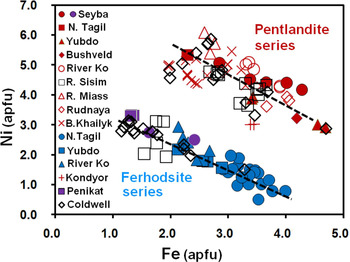
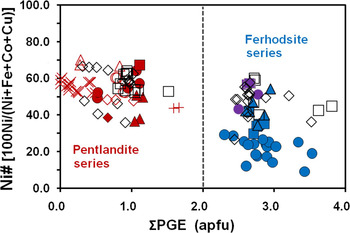
In a plot of Ni vs. Fe, the trends defined by these two series are subparallel (Fig. 5), reflecting similarities in their structure and patterns of substitution. The overall variations are extensive: the Fe content ranges from ~2 to 5 and from ~1 to 4 atoms per formula unit (apfu, calculated per a total of 17 apfu), respectively (Fig. 5). The ferhodsite series generally displays a lower content of Ni, lower values of the index Ni# [=100Ni/(Ni + Fe + Co + Cu)], and especially differs in the strong enrichment in the total PGE: ~2–4 apfu vs. ~0–1.5 apfu in the pentlandite series (Fig. 6). The proposed value of ~2 apfu PGE thus is close to the miscibility gap separating these two series of solid solutions.
Plot of contents of Ni versus Fe (in values of atoms per formula unit; apfu) in compositions of members of the PGE-rich pentlandite series and ferhodsite series from the Seyba zone (this study) and from various complexes and placers reported in the literature. The placer materials associated with the rivers Seyba and Ko (i.e. R. Sisim's tributaries) occur in the placer area investigated and are displayed by separate symbols for pentlandite and ferhodsite.

Plot of values of the index Ni# [100Ni/(Ni + Fe + Co + Cu)] versus a total content of the PGE, expressed in atoms per formula unit (apfu), in compositions of members of the PGE-rich pentlandite series and ferhodsite series from the Seyba deposit (this study) and from various localities reported in the literature (symbols as in Fig 5).

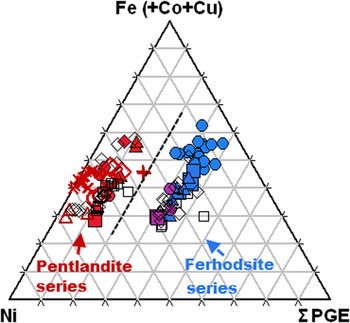
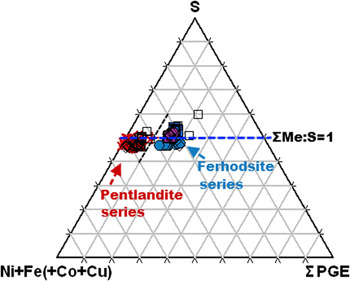
The total content of PGE reaches 20 at.% in the pentlandite series and exceeds 25–30 at.% in the ferhodsite series in terms of plot Ni–Fe(+ Co + Cu)–PGE (Fig. 7), or attain ~10% and 20 at.%, correspondingly, in the system Ni + Fe(+ Co + Cu)–S–PGE (Fig. 8). Elevated levels of Cu (~4–8 wt.%) are characteristic for the average compositions of ferhodsite (Table 3). Also note that the ferhodsite solid solutions are relatively enriched in S; their composition may extend fairly far above the S = 50 at.% line (Fig. 8).
Variation of compositions of sulfide phases of the pentlandite and ferhodsite type from the Seyba deposit (this study), compared with compositions from worldwide occurrences (symbols as in Fig. 5), in terms of ternary plot Ni–Fe (+Co + Cu)–ΣPGE (atomic %).

Variation of compositions of sulfide phases of the pentlandite and ferhodsite type from the Seyba deposit (this study) plotted in comparison with compositions from worldwide occurrences (symbols as in Fig. 5) in terms of ternary plot Ni + Fe (+Co + Cu)–S–ΣPGE (atomic %).

Pentlandite is known to incorporate considerable levels of PGE during the fractional crystallisation of Cu–Fe–Ni sulfide melts in experimental systems as well as in various mafic–ultramafic complexes (e.g. Junge et al., Reference Junge, Wirth, Oberthür, Melcher and Schreiber2014). A pentlandite-type phase Rh(Ni4Fe4)S8 was synthesised at 700°C along with other compounds of the type M(Fe4Ni4)S8 (M = Ru, Rh and Pd; Knop et al., Reference Knop, Huang, Reid and Carlow1976). In general, however, pentlandite typically contains only low to modest ranges of the PGE (ppb to ppm), mostly Rh or Pd (e.g. Chai et al., Reference Chai, Naldrett, Rucklidge and Kilius1993; Cabri et al., Reference Cabri, Sylvester, Tubrett, Peregoedova and Laflamme2003). Interestingly, Duran et al. (Reference Duran, Barnes and Corkery2016) proposed that the level of incorporation of Pd and Rh can be used to distinguish pentlandite formed in Ni–Cu sulfide deposits from pentlandite associated with low-sulfide PGE deposits hosted by layered intrusions.
Ferhodsite was discovered recently in the Solovyova Gora massif, part of the Nizhniy Tagil complex in the Urals. It has a complex composition [(Fe,Rh,Ir,Ni,Cu,Co,Pt)9–xS8, with 0 ≤ x ≤ 1] and a pentlandite-derivative structure with a tetragonal unit-cell and parameters a = 10.009(5) and c = 9.840(8) Å; its space group is P42/n (or P4/nmm) (Begizov and Zavyalov, Reference Begizov and Zavyalov2016; see comments of L.J. Cabri in Gagné et al., Reference Gagné, Belakovskiy, Cámara, Uvarova and Cabri2018). These authors also reported the occurrence of ferhodsite in the Kondyor placer deposit, northern Khabarovskiy kray, Russia. Note that monosulfide-type phases reported previously from various localities (Table 3) correspond to compositional variants of the ferhodsite series; they have a Me:S ratio of ~1 as a reflection of the (Fe,PGE,Ni,Cu)Σ8S8 stoichiometry, a formula that corresponds the maximum extent of vacancies in the structure.
We note that one of sulfide inclusions analysed at Seyba is consistent with a Ni-bearing variant of cubanite [(Cu0.68Ni0.18Fe0.11)Σ0.97Fe2.0S3.02 (#27, Table 1).
The mechanisms of substitution in the PGE-rich sulfides
Compositional variations (Table 3) suggest that both Ni and Fe are involved in substitution relationships with the PGE in the pentlandite and ferhodsite series. However, ferrous iron seems to be more likely, as implied by the coupled mechanism of substitution [Rh3+ + Co3+ + □ = 3Fe2+], inferred to account for PGE-rich pentlandite from an ophiolite-derived PGM-bearing placer at the River Bolshoy Khailyk in western Sayans of Russia (Barkov et al., Reference Barkov, Shvedov, Silyanov and Martin2018b). We note that Cu contents are consistently elevated in the mean compositions of ferhodsite-type phases from various geological settings (Table 3). This consistency suggests the existence of the following mechanism of substitution: [Cu+ + Rh(Ir)3+ = 2Fe (or Ni)2+]. Alternative schemes involving Cu2+ (cf. de Villiers and Liles, Reference de Villiers and Liles2010) appear to be less likely in our cases.
The atom ratio Me:S is found to vary to an important extent (Table 3); it seems to reflect the variable importance of vacancies existing at the metal sites in structure of the pentlandite and ferhodsite series. The vacancy-type departures may well be the result of the incorporation of the high-valence elements (PGE) into the structure, e.g. via a potential scheme: [2(Rh + Ir)3+ + □ = 3(Fe + Ni)2+] which involves Rh and Ir, i.e. the major PGE in these phases. The greater amounts of PGE present in the ferhodsite series, compared to the pentlandite series (Table 3, Fig. 6), probably leads to the appearance of a larger proportion of vacancies, as reflected by a greater ‘excess’ in S. Indeed, the compositional field of ferhodsite does deviate more strongly toward the S apex (Fig. 8).
Concluding comments
(1) The terrane affinities and mineral associations at the River Seyba suggest that placer grains of PGM were probably derived from chromitite zones associated with ultramafic units of the Lysanskiy layered complex of dunite–peridotite–gabbro composition. This complex thus could well represent the primary source for the PGM-bearing placers of the entire system of the rivers Sisim, Ko and Seyba, among others, of the Sisim Placer Zone. This type of lode source seems to be essential for Os–Ir–(Ru) mineralisation (lode and placers) in the overall region of eastern Sayans.
(2) The intimate association of placer grains of PGM with native gold probably implies that these detrital materials experienced together essentially the same geological history, beginning with an early stage (middle to upper Paleozoic and early Mesozoic), at which paleoplacers formed, being then redeposited during the Cenozoic and reactivated by the latest orogenic processes during the neotectonic period of development, followed by the co-accumulation of alluvial gold and PGM-bearing materials in placers of the Sisim Placer Zone.
(3) On the basis of our results and analytical data from the literature, we show that two distinct series of complex PGE-rich sulfides can be expected in mineralised assemblages characterised by highly S-deficient environments. Both the pentlandite and ferhodsite series have been found associated with ophiolitic rocks, Alaskan–Uralian–(Aldan)-type complexes, or with low-sulfide zones in layered intrusions (e.g. dunitic pipes at Bushveld, South Africa, or the Kirakkajuppura ‘base-metal-free’ mineralisation at Penikat, Finland: table 3, Barkov et al., Reference Barkov, Fleet, Martin and Halkoaho2005). The PGE-rich zones hosted by the Coldwell alkaline complex, Ontario, Canada (Good et al., Reference Good, Cabri and Ames2017) recall the S-deficient facies at Kirakkajuppura, and are reflected by occurrences of ferrorhodsite, i.e. the Fe-dominant thiospinel, and laflammeite (cf. Barkov et al., Reference Barkov, Martin, Halkoaho and Poirier2000, Reference Barkov, Martin, Halkoaho and Criddle2002, Reference Barkov, Fleet, Martin and Halkoaho2004).
(4) In these systems, the PGE-rich pentlandite or ferhodsite series formed from small volumes of fractionated Fe–Ni–Cu sulfide melts considerably enriched in the PGE. At Seyba, the PGE-rich pentlandite or ferhodsite formed from isolated portions of an S-bearing melt remaining during the crystallisation of the host Os–Ir–Ru alloy. Both of these series display varying extents of vacancies, probably related with the incorporation of the PGE, and some of their members even approach the Me 8S8 stoichiometry (or Me 9–xS8, in which x = 1), which can easily be mistaken for a monosulfide.
Acknowledgements
We thank Mrs. Liana Pospelova (Novosibirsk) for her expert assistance with EMP data and Drs F. Laufek, S.V. Krivovichev, R.H. Mitchell, and an anonymous referee for their reviews and efforts. A.Y.B. gratefully acknowledges a partial support of this investigation by the Russian Foundation for Basic Research (project #RFBR 16-05-00884 and #RFBR 19-05-00181).