INTRODUCTION
The 1965 Amendments to the United States Immigration and Nationality Act (INA) have had numerous long-term social, political, and economic impacts in the country (Kposowa Reference Kposowa1998). One consequence of the legislation has been a dramatic change in the racial and ethnic composition of American society since 1970. Within this context, interracial marriage has become more common (Wang Reference Wang2012). These trends, coupled with a more complex racial order raise the following question: What are the implications of interracial relationships among immigrant groups for their political attitudes?
Research on immigrant assimilation has focused on the determinants of intermarriage (Qian & Lichter, Reference Qian and Lichter2007). Yet little is known about the political implications of intermarriage among immigrant groups for their political attitudes. While intermarriage is more common today than in the past, unions between Blacks and Whites are the least common (Davenport, Reference Davenport2016). By contrast, Hispanics and Asian Americans have higher intermarriage rates with Whites (Wang Reference Wang2012). Jennifer Lee and Frank Bean (2010) have described this phenomenon as the diversity paradox, whereby racial boundaries become more rigid for particular groups even as society becomes more racially and ethnically diverse. As the United States has become more diverse, new immigrant groups have come to occupy varying positions, raising questions about the extent to which Asian Americans have “racial mobility,” or are treated as White (Bonilla-Silva Reference Bonilla-Silva2004; Lee Reference Lee2015).
While much has been said about the predictors of intermarriage, less has been said about the political implications of intermarriage for immigrant groups. Yet new immigrant groups assimilate both socioeconomically and politically into the United States, as new immigrant groups socialize into the American political system (Cain et al., Reference Cain, Kiewiet and Uhlaner1991; Ramakrishnan and Espenshade, Reference Ramakrishnan and Espenshade2001; Wong Reference Wong2000; Wong et al., Reference Wong, Karthick Ramakrishnan, Lee and Junn2011). Examining the consequences of intermarriage for one’s racial politics is necessary to understand how intermarriage may or may not undermine efforts toward eradicating systemic racism.
Although scholars have noted the importance of the domestic context for the political attitudes of children (Berelson et al., Reference Berelson, Lazarsfeld and McPhee1954; Davenport Reference Davenport2016; Jennings and Niemi, Reference Jennings and Niemi1968; Jennings et al., Reference Jennings, Stoker and Bowers2009), the relationship between the attitudes of one’s spouse and one’s own views (Jennings and Stoker, Reference Jennings and Stoker2001; Niemi et al., Reference Niemi, Hedges and Kent Jennings1977), as well as how being married or not conditions one’s attitudes about gender (Stout et al., Reference Stout, Kretschmer and Ruppanner2017), surprisingly few have examined the distinctions in political attitudes of individuals from non-White immigrant groups who often intermarry with Whites.Footnote 1
On one hand, the literature on the predictors of intermarriage suggests those who marry Whites may be less attached to racial group politics. On the other hand, the literature on the political characteristics of those who interracially date suggests those who practice exogamy are not necessarily detached from racial group politics. The political integration of Asian Americans into the American political system is complicated by their particular position in the American racial order (Bonilla-Silva Reference Bonilla-Silva2004; Kim Reference Kim1999; Masuoka and Junn, Reference Masuoka and Junn2013). Given this context, it is plausible that Asian American intermarriage with Whites indicates a ‘loosening’ of racial boundaries for non-Anglo immigrants (Lee Reference Lee2015; Zhou Reference Zhou2004) and may have ramifications for their attitudes about race, immigration, and minority representation. Whether this ‘loosening’ is happening among Asian Americans who engage in interracial relationships has yet to be explored.
We intervene in scholarly debates on immigrants and intermarriage, and research on interracial relationships to explore whether Asian Americans who report interracial partners are politically distinct from those who do not. We draw on previous research on the determinants of exogamy and the attitudes of those who date interracially to examine the implications of interracial relationships for political attitudes. We engage theories of Asian Americans’ racial position to examine how the attitudes of racial minorities may vary with the race of their choice of partner. As we discuss below, scholars have noted Asian Americans’ unique racial position in the United States and tendency to marry Whites. We are not aware of a study that considers the relationship between having an interracial partner and one’s political attitudes among Asian Americans. We test the hypothesis that those who have interracial relationships are less likely to place import on issues related to race, immigration, minority representation, and whether they belong to ethnically concentrated civic groups. We find that those with interracial partners are more likely to be concerned about racial issues, less likely to favor co-ethnic candidates and belong to ethnically concentrated civic groups, but are no more likely to be concerned about immigration or to favor a pathway to citizenship. We discuss the implications of these findings for the study of intermarriage and political attitudes.
THEORIES OF INTERMARRIAGE AND HYPOTHESES
Existing research on interracial relationships focuses on the determinants of exogamy and the political characteristics of those who enter interracial relationships. To our knowledge, no study to date has examined the political differences between Asian Americans who have interracial partners and those who do not. However, theoretical frameworks of assimilation and research on those who select interracial partners suggests two competing hypotheses for our study: 1) that Asian Americans who engage in interracial relationships—particularly with Whites—may have looser attachments to racial group politics, and 2) that those who select into interracial relationships may be more attuned to racial issues than those who do not.
Scholars have used intermarriage to measure immigrant assimilation (Bugelski Reference Bugelski1961; Gordon Reference Gordon1961, Reference Gordon1964; Reeves Kennedy Reference Reeves Kennedy1944) and contemporary research seeks to understand the assimilation processes of non-White immigrant groups (Portes and Zhou, Reference Portes and Zhou1993), including their opportunities for intermarriage (Alba and Nee, Reference Alba and Nee1997).Footnote 2 For Asian Americans, common predictors of intermarriage identified in studies using demographic data include age, being born in the United States,Footnote 3 educational attainment,Footnote 4 and English proficiency (e.g., Hwang et al., Reference Hwang, Saenz and Aguirre1997; Lee and Fernandez, Reference Lee and Fernandez1998; Lee and Yamanaka, Reference Lee and Yamanaka1990; Liang and Ito, Reference Liang and Ito1999; Min and Kim, Reference Min and Kim2009). Intermarriage between Asians and Whites is particularly common (Qian Reference Qian1997; Qian and Lichter, Reference Qian and Lichter2001, Reference Qian and Lichter2007), and the couples are the most educated with the highest earnings compared to other interracial couples with a White spouse (Fu Reference Fu2008; Wang Reference Wang2012). Marriage to Whites is especially likely among Asian women (Fu and Heaton, Reference Fu and Heaton2008; Jacobs and Labov, 2002).Footnote 5
While this line of research does not speak directly to our research questions, these patterns illustrate theories of Asian American racialization in the United States. Such theories suggest that Asian Americans occupy relatively privileged racial positions, and may be moving up in the racial order. While Claire Kim (Reference Kim1999) has argued that Asian Americans have been “racially triangulated” between Whites and Blacks—wherein Asian Americans are “valorized” as “superior” to Blacks, but “inferior” to Whites, and “foreign” in American society (pp. 107–108)—scholars who conceptualize the American racial order as a “hierarchy” (Masuoka and Junn, Reference Masuoka and Junn2013, p. 22) argue that due to the historical treatment of Asian Americans, as well as immigration policy, Asian Americans occupy a position immediately below Whites and above both Latinos and Blacks. Jennifer Lee (Reference Lee2015) has noted the shift in understandings of Asian Americans as “undesirable to marriageable” (p. 85), and trends in Asian Americans’ economic standing and relative treatment in the United States have led scholars to question whether Asian Americans are “becoming white” (Zhou Reference Zhou2004), and to suggest that select Asian American ethnic groups will eventually come to be viewed as “Whites” or “Honorary Whites” (Bonilla-Silva Reference Bonilla-Silva2004, p. 933).Footnote 6 Although Asian Americans generally do not see much “commonality” with other racial groups, the perception of commonality with Whites is greatest (Ramakrishnan Reference Ramakrishnan2014). Thinking of commonality trends in terms of interracial relationships among Asian Americans suggests that an individual may simply be uninterested in racial issues related to their group, as their engaging in an interracial relationship may signify weaker group attachments (Gordon Reference Gordon1964). Patterns of intermarriage with Whites and theories of the position of Asian Americans in the American racial order suggest the following hypothesis:
Hypothesis 1: Asian Americans who select interracial partners are less concerned with and attached to racial group politics than those who do not select interracial partners.
In this case, we would expect Asian Americans who report interracial partners to be less attentive or sympathetic to race and immigration issues in the United States, and less concerned with being represented by another Asian.
Research on the social and political leanings of those who practice racially exogamous relationships implies that engaging in interracial relationships may not indicate detachment from one’s group politics after all. This research commonly uses political predispositions as a variable to explain self-reports of interracial relationships or attitudes toward interracial relationships. For example, George Yancey’s (2002) study of interracial dating found that being more politically conservative was significantly associated with being less likely to say one interracially dated—but only for Whites, not for non-White groups. Although Yancey (Reference Yancey2002) did not examine group identity or attitudes toward group politics, his findings suggest that for non-Whites, to the extent that political ideology and attitudes about racial group politics are connected, engaging in interracial relationships may have little to do with one’s group political attachments. Political ideology is also relevant for dating interracially online (Anderson et al., Reference Anderson, Goel, Huber, Malhotra and Watts2014; Tsunokai et al., Reference Tsunokai, Kposowa and Adams2009; Yancey Reference Yancey2007b), as is partisanship (Golebiowska Reference Golebiowska2007).
Other work also highlights the relevance of political ideology. In a lab study, Eastwick and colleagues (Reference Eastwick, Richeson, Son and Finkel2009) found that rates of attraction to Black women were higher among liberal White men than among more conservative White men. However, in a second study on Black participants, Eastwick and colleagues found no significant relationship between conservatism and preferring a White partner, and only found a “marginally significant” relationship between having a more liberal pre-disposition and less of a preference for White partners.
Among Whites, Melissa Herman and Mary Campbell (2012) found that respondents to the 2008 Cooperative Congressional Election Study who considered themselves closer to the Republican party expressed attitudes against multiple forms of interracial romantic relationships with Blacks and Asians. Similarly, Michael Tesler (Reference Tesler2013) found that White disapproval of interracial dating between Blacks and Whites was negatively associated with supporting Barack Obama in 2008. In other work, Samuel Perry’s (2013) analysis used interracial relationships as an explanatory variable. In Perry’s analysis of mostly White survey respondents, those who said they “had ever dated or been romantically involved with a person of another race” were more likely to support legally recognizing same-sex couples than those who did not report interracial relationships (p. 253). While these two studies primarily focused on White respondents, these studies suggest that those who engage in interracial relationships are generally liberal and likely to have racially progressive attitudes in the first place.
While previous research on political attitudes/orientations and interracial relationships does not focus on Asian Americans in particular, it may be the case that Asian Americans who select interracial partners are even more racially conscious than their counterparts who do not have interracial partners. This suggests the second hypothesis:
Hypothesis 2: Those who have interracial relationships are more concerned about racial group politics than those who do not have interracial relationships.
If a relationship between engaging in interracial relationships and political outcomes related to Asian American politics exists while accounting for political orientation, Hypothesis 2 will be supported.
DATA AND METHOD
The data for the study come from the 2008 National Asian American Survey (Ramakrishnan et al., Reference Ramakrishnan, Junn, Lee and Wong2012). A total of 5,159 self-identified Asian Americans were surveyed by phone in English and in multiple Asian languages between August 2008 and October 2008. We use this survey because it is a nationally representative survey of Asian Americans and contains questions relevant to our inquiry: race or ethnicity of current or past partner, as well as individual questions about identity, and other demographic data.Footnote 7
Explanatory Variable
Our explanatory variable is having ever been in an interracial relationship. To identify the interracially coupled population, we used three survey questions that asked for the respondent’s marital status and race or ethnicity of the respondent’s current or former spouses/partners. As the dataset samples only those who identified as Asian, we treat all respondents as “Asian” and do not focus on multiracial-Asian identification here. Those who said they were married or living as married (QJ3) were asked the follow up question (QJ3B1): “What is the race or ethnicity of your wife, husband, or partner?” and were given the option to select two racial categories. They were asked the same question as a follow-up to select more racial categories (QJ3B2). Those who were not married were asked “What is the race or ethnicity of your former wife, husband, or partner?” and could select two categories (QJC31), and were asked the same question again to list more categories (QJ3C2). From these questions, we generated a dummy variable called interracial, where 1= identified a partner as non-Asian, and 0 = did not identify a partner as non-Asian. Coding respondents this way yielded 315 respondents who listed partners as belonging to a non-Asian group.
From here, we created two dummy variables from the marital status question (QJ3) where married = 1 if respondents said they were married or living as married, and 0 = if respondents said anything else. We then created a variable where ever married = 1 if respondents said they were married, widowed, divorced, or separated, and 0 = if respondents did not provide any of these answers. We then created two additional dummy variables interracial married and interracial ever married to denote the marital status of those who listed a partner as non-Asian. There were 241 respondents who were married and had an interracial partner and 285 who had ever been married and listed a partner with a non-Asian category. Of this whole group, 215 respondents identified their partner as White across the three questions that asked for their partner’s race (QJ3B1, QJ3B2, and QJ3C1). Thus, we limit our conclusions to those who are primarily involved or have been involved with Whites. Due to the relatively small sample size of people who listed an interracial partner in the survey, we do not stratify the sample by current marital status and race of spouse.
Dependent Variables
We generated dummy variables from several questions that touch on issues of race, immigration, and attitudes about Asian American representation. The first drew from a question (QB5) that asked respondents to select “the most important problem facing the United States today,” and we focused on “race/ethnic relations/ethnic groups getting along” or “racial discrimination,” where 1 = listed the issue(s) and 0 = all other answers; fifty-one people listed these issues. Using the same question (QB5), we also coded whether “immigration/illegal immigration” or “more services for immigrants/lack of immigrant rights;” forty-nine people listed these issues (1 = listed, 0 = did not list). Respondents were also asked about the extent to which they agreed or disagreed with the statement (QG3_D): “The U.S. should provide a path to citizenship for people in this country illegally.” 1,366 people disagreed strongly, 978 disagreed somewhat, 800 neither agreed nor disagreed, 916 agreed somewhat, and 640 agreed strongly. We retained the original coding where 1 = disagree strongly and 5 = agree strongly, and coded those who said they didn’t know or refused to answer as missing.
We also estimated the relationship between interracial relationships and the odds of favoring a co-ethnic political candidate over another candidate. For this dependent variable, respondents were asked (QF4), “Suppose you have an opportunity to decide on two candidates for political office, one of whom is (R’s ethnic group)-American. Would you be more likely to vote for the (R Ethnic group)-American candidate, if the two candidates are equally experienced and qualified?” 2,934 said “Yes,” and 1,369 said “No.” We created a dummy variable where respondents who said yes were coded as 1, while those who said “No,” “Don’t know,” refused to answer, or skipped the question were coded as 0.
We also examined how being in an interracial relationship correlates with the racial composition of civic groups with which one is involved. Respondents were asked (QH5), “Other than a religious group or place of worship, is there any other community that you are involved with?” Respondents who said “Yes” were asked the follow-up question (QH5B): “And how many members of this group would you say are (R’s ETHNIC GROUP FROM A1)-all of them, most, about half, some of them, or none?” We reverse-coded the responses, where 5 = all of them, 4 = most, 3 = about half, 2 = some of them, and 1 = none, and coded all other responses as missing. On average, respondents in civic groups said about half of their membership were from their ethnic group (mean = 3.51).
Control Variables
We also created a series of control variables. We created binary variables for Republicans (N = 786), Democrats (N = 1,591), and Independents (N = 1,086) (QD1). Responses as “other,” or “do not think in these terms” were collapsed into an Other Party ID (N = 1,208) category. We created a Party Missing variable for respondents who said “don’t know” or refused to answer (N = 488). Similarly, political ideology (QG4) was coded into three categories: Liberal (N = 1,127), Moderate (N = 1,709), and Conservative (N = 807). Those who said they had not thought much about ideology, did not know, or refused to respond were coded as No Ideology (N = 1,516).
We created dummy variables for nativity status. Native Born (N = 574) and Foreign Born (N = 4,568) were coded as binary variables (QA4). Gender was coded as a binary variable, and women made up about 46% of the sample (GENDER). Educational attainment was left in its original form as an interval variable, with higher values indicating more educational attainment (QJ1). We first coded “other,” “don’t know,” and “refused” responses as missing. We then mean substituted for missing education (mean = 4.79). Age was missing almost 20% of all observations (QJ10, N = 936), so we mean-substituted age (mean = 52.61) before recoding the age variable into several categories: Age 18 to 29 (N = 337), Age 30 to 39 (N = 598), Age 40 to 49 (N = 878), and Age 50+ (N = 3,346).
We also accounted for feelings of “linked fate” (Dawson Reference Dawson1994), which is often used by scholars of race and political behavior as a measure of the politicization of or strength of one’s racial identity (Junn and Masuoka, Reference Junn and Masuoka2008; Sanchez and Masuoka, Reference Sanchez and Masuoka2010; Schildkraut Reference Schildkraut2012).Footnote 8 Two questions (QF2 and QF3) asked, “Do you think what happens generally to other (Asians/Respondent’s Ethnic Group) in this country affects what happens in your life?” to measure feelings of linked fate with other “Asians” or with other members of the respondent’s ethnic group. Two dummy variables for Asian Linked Fate and Ethnic Group Linked Fate were created where 1 = respondent reported linked fate, and 0 = respondent did not report linked fate. 2,583 respondents reported ethnic group linked fate and 2,313 reported linked fate with Asians.
Regarding income (QJ6), unfortunately, 37.29% of responses to a question about pre-tax household income in the last year were either “don‘t know” responses or were cases in which respondents refused to answer the question. We did not substitute or impute to account for missing observations for the income variable as mean substitution would bias the estimates toward the mean and imputation would only be based on the existing responses, which are also biased as they only consist of individuals willing to disclose their incomes. We thus decided to drop this variable from the analysis entirely. Models that include the income categories may be found in the Appendix. Our data cleaning Stata do-file may be found in the supplementary materials.
Table 1 reports the descriptive characteristics of the sample across all variables in the models.Footnote 9 Variance inflation factors did not suggest multicollinearity. After some deliberation, we decided not to weight our models using the weight variable provided (“NWEIGHTNATYRS”), as it was highly correlated with being born in the United States (correlation = .20, p = .000). Where relevant, we note when the statistical significance of listing an interracial partner is sensitive to the inclusion of the weight. We report all models, with the weight and with controls for income categories in the Appendix. We evaluated our hypotheses with logistic regression and ordinary least squares regression with robust standard errors (Angrist and Pischke, Reference Angrist and Pischke2009).
Summary Statistics

FINDINGS
We first explore the relationship between partisanship, ideology, and listing an interracial partner. The relationship between identifying as a Democrat and reporting an interracial partner is statistically significant (Pearson χ2=9.7939, Pr =.002), as well as identifying as a liberal (Pearson χ2=15.7341, Pr=.000). There were no significant relationships between being a Republican (Pearson χ2=.0258, Pr=.872), an Independent (Pearson χ2=.0019, Pr=.965), a moderate (Pearson χ2=.0278, Pr=.868), or a conservative (Pearson χ2=.0019, Pr=.965). These relationships support previous findings that those who hold interracial relationships are not Republican and are more liberal.
We turn to racial issues in Table 2.Footnote 10 We find support for Hypothesis 2: those who reported interracial spouses or partners were nearly three times more likely to mention racial issues as the most important issue in the United States (OR = 2.805, p = .013). The statistical significance of this finding is sensitive to including the weight variable. Although statistically significant, the confidence interval is wide, most likely due to the small number of interracial couples in the sample. Liberals and Republicans are about two times more likely than Independents and Moderates to name racial issues as the most important, though we are cautious as only fifty-one people actually listed race as an issue at all. Although the reasons for viewing race as important may be different for Liberals and Republicans, the finding for Republicans may be due to perceptions of poor treatment from the Republican Party (Kuo et al., Reference Kuo, Malholtra and Mo2017; see also Wong et al., Reference Wong, Karthick Ramakrishnan, Lee and Junn2011).
The Association Between Interracial Coupling and the Odds of Listing Race as the Most Important Issue

Odds ratios; 95% confidence intervals in brackets
* p < 0.05, ** p < 0.01, *** p < 0.001
Turning to Table 3, we find no significant differences between those who list interracial partners and those who do not in the odds of listing immigration as the most important issue, nor do we find any significant relationships across all other variables. This may be because only forty-nine people listed immigration as an issue. Substantively, this suggests that having a non-Asian partner does not imply that one cares less about immigration, nor does it make immigration a more salient issue. Overall, we find no support for either hypothesis.
The Association Between Interracial Coupling and the Odds of Listing Immigration as the Most Important Issue

Odds ratios; 95% confidence intervals in brackets
* p < 0.05, ** p < 0.01, *** p < 0.001
In Table 4, we consider preferences for co-ethnic candidates. We find support for Hypothesis 1. Those who listed interracial partners were nearly 40% less likely than those who did not to prefer a co-ethnic candidate. This suggests that those who are in interracial relationships place less value on having a representative from their ethnic group in office, and are perhaps less politically attached to their ethnic groups. By contrast, both Democrats and Republicans expressed strong preferences for co-ethnic candidates, as both were more likely than Independents to prefer a candidate from their ethnic group. However, the relationship between partisan identification and preferences for co-ethnic candidates was not significant. Respondents who felt a sense of linked fate with other Asians were more likely to prefer a co-ethnic candidate, but the relationship was not statistically significant. Those who reported feeling ethnic group linked fate were about twice as likely than those who did not feel ethnic group linked fate to prefer a co-ethnic candidate. Younger people were less likely to prefer co-ethnic candidates. Those with more educational attainment were about 9% less likely than those with less education to vote for co-ethnic candidates. Respondents who were born in the United States were about 30% less likely than those born outside of the country to vote for a co-ethnic candidate. Thus, for the interracially coupled, the young, the native born, and the more educated, having a candidate from one’s ethnic group may not be important for voting choices.
The Association Between Interracial Coupling and the Odds of Preferences for a Co-Ethnic Representative

Odds ratios; 95% confidence intervals in brackets
* p < 0.05, ** p < 0.01, *** p < 0.001
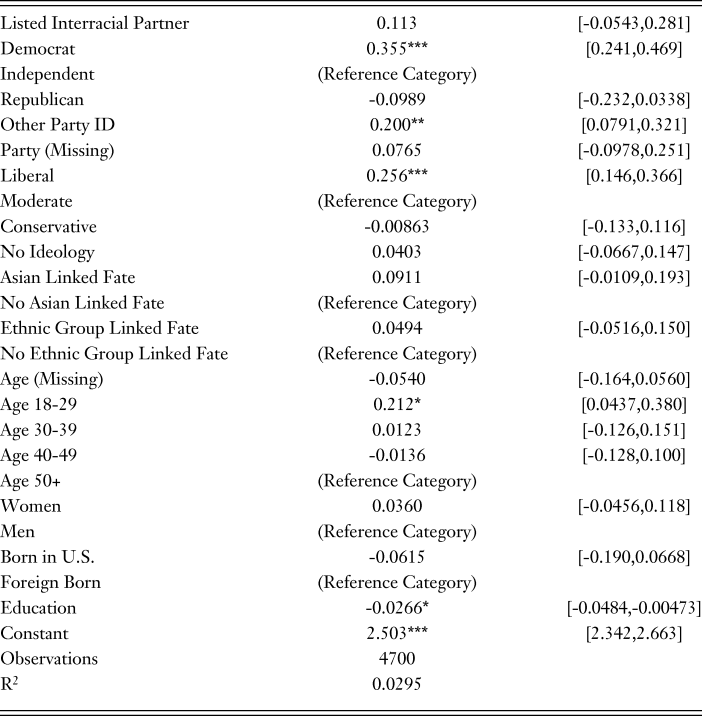
In Table 5, we examine attitudes toward a pathway to citizenship.Footnote 11 The estimates indicate shifts in agreement or disagreement with the statement that the United States should provide a pathway to citizenship for people in the country illegally. We do not find strong support for either hypothesis—there is no statistically significant difference between interracial couples and non-interracial couples on attitudes toward a pathway to citizenship. Instead, we see that partisanship and ideology are highly relevant. Relative to Independents, identifying as a Democrat increases agreement with a pathway to citizenship, as well as being a Liberal, relative to Independents and Moderates. Younger respondents were also more likely to agree with a pathway to citizenship than those over fifty years old. Greater educational attainment had a small but statistically significant negative effect, as those with more education were less agreeable to a pathway to citizenship. There was no difference between the native-born and the foreign born.
The Association Between Interracial Coupling and Support for a Pathway to Citizenship

95% confidence intervals in brackets
* p < 0.05, ** p < 0.01, *** p < 0.001
Table 6 reports linear regression estimates for the relationship between listing an interracial partner and the respondents’ perception of the ethnic composition of their civic group. Again, this estimate refers only to those who said they belonged to a civic group, which is the reason for the smaller sample size in the model. We find support for Hypothesis 1. From the table, we see that those who are in interracial relationships are less likely to be in civic groups that are more ethnically homogenous than those who are not in interracial relationships. In other words, there are fewer co-ethnics in their civic groups. A similar trend exists among the following: thirty to forty-nine-year olds, the more educated, and the native born.
The Association Between Interracial Coupling and Ethnic Composition of Civic Group

95% confidence intervals in brackets
* p < 0.05, ** p < 0.01, *** p < 0.001
DISCUSSION AND CONCLUSION
Our goal in this paper was to examine how being in an interracial relationship correlates with beliefs that racial issues/immigration issues are the most important issues facing the country, preferences for co-ethnic candidates, and attitudes toward a pathway to citizenship. We find differences on racial issues but not immigration issues. We limit the scope of this discussion to apply to a “racially triangulated” (Kim Reference Kim1999) minority group that is primarily engaged in relationships with Whites.
We recognize some of the limitations of this analysis. Some of the challenges of studying the social attitudes of those in interracial relationships are selection bias and endogeneity—those who are open-minded are likely those to engage in interracial relationships as well as have more liberal attitudes toward “nontraditional romantic relationships” (Perry Reference Perry2013, p. 255). This challenge also exists in examining one’s racial group politics—an individual may become more racially politically conscious as a result of being in an interracial relationship, possibly because racial issues affect their daily lives (Bratter and King, Reference Bratter and King2008; Dalmage Reference Dalmage2000; Datzman and Brooks Gardner, 2000; Lee and Bean, Reference Lee and Bean2012; Yancey Reference Yancey2007a). Or, perhaps they experience racism within the relationship, as their partners’ attraction to them may be racialized (Waring Reference Waring2013). For Asian Americans, such racialized attraction is gendered (e.g., Wilkins et al., Reference Wilkins, Chan and Kaiser2011; Wing Sue et al., Reference Wing Sue, Bucceri, Lin, Nadal and Torino2007).Footnote 12
Alternatively, an individual who is generally progressive on racial issues, including issues relevant to their own group, may simply be more accepting of interracial partners (see Carney et al., Reference Carney, Jost, Gosling and Potter2008; Caprara et al., Reference Caprara, Schwartz, Capanna, Vecchione and Barbaranelli2006; Gerber et al., Reference Gerber, Huber, Doherty, Dowing and Ha2010; Hirsh et al., Reference Hirsh, DeYoung, Xu and Peterson2010); Verhulst et al., Reference Verhulst, Eaves and Hatemi2012). This circularity is part of the challenge of studying the racial politics of those who engage in interracial relationships—“prejudiced people may avoid contact with out-groups” (Pettigrew Reference Pettigrew1998, p. 69). Unfortunately, we were unable to solve this problem with the existing dataset as nearly 25% of those who listed interracial partners said “don’t know” or “refused” to answer the income question. We believed matching techniques would be unreliable given the substantial missing data for respondent income (Ho et al., Reference Ho, Imai, King and Stuart2007). We were unable to identify a suitable instrumental variable (Sovey and Green, Reference Sovey and Green2011), or even variables to use as alternatives to instrumentation (Esarey 2015). Future research should aim to address this.
Nonetheless, much can be learned from this research. First, although Asian Americans who intermarry with Whites may be viewed as closer to Whites socially, they are not necessarily detached from issues that affect Asian Americans. Being in an interracial partnership does not preclude concern for racial issues, and Asian Americans may not necessarily assimilate into a racial ideology similar to Whites simply by being married to or intimately involved with them. We found no evidence that the exogamous are less attuned to racial issues, as one might expect given intermarriage trends among Asian Americans. Instead, those who were exogamous were more likely to list racial issues as the most important issue facing the country. The relatively small number of exogamous in the sample does not permit us to reliably test reasons for this finding, and the data does not allow us to discern what respondents were thinking about when they listed race relations or racial discrimination as the most important issue facing the country, but there are two potential reasons.
One reason for this finding is that Asian Americans who have interracial partners are not insulated from everyday experiences with racism as individuals (Kim Reference Kim1999; Kuo et al., Reference Kuo, Malholtra and Mo2017; Wong et al., Reference Wong, Karthick Ramakrishnan, Lee and Junn2011). In the 2008 NAAS, about 16% of foreign-born respondents reported being “treated unfairly or badly at restaurants or stores” (QF5 E). While Asian Americans may occupy a racial position that is higher than Blacks and Latinos (Masuoka and Junn, Reference Masuoka and Junn2013), and while they may intermarry at high rates with Whites, those who intermarry may still be afflicted by the negative stereotype of Asians as “foreigners” (Kim Reference Kim1999). A second reason is that race is more salient for interracial couples. Although interracial marriage is more common today than years past, interracial couples may still experience negative reactions from friends and family. This second reason is unlikely to explain our results, however, as Asian-White couples are less likely to view their partnerships as “interracial” and less likely to report negative experiences than couples with Black spouses (Lee and Bean, Reference Lee and Bean2010).
We find evidence that the exogamous are less likely to prefer co-ethnic candidates. Although statistically significant, we are cautious about this result—those who practice exogamy likely have weaker attachments to ethnicity in the first place. Thus, those who rely less on race as a determinant of their dating choices likely rely less on race as a determinant of their vote choice as well. This finding suggests that intermarriage may undermine explicit preferences for co-ethnic candidates, though we remain cautious about this claim and believe it warrants further research.
While we focused on Asian Americans in this study, this research raises further questions about the study of intermarriage and political attitudes—how does exposure to an interracial partner affect different groups’ racial attachments and political attitudes? While were unable to answer this question thoroughly with the existing data, future research should consider it. Overall, this research is one step toward examining the extent to which interracial relationships will shape minority group politics. By examining the political attitudes of those with exogamous relationships among a group whose politics are understudied, we expand upon previous research on intermarriage, interracial relationships, immigrant integration, and political attitudes. Rather than treating the process of immigrant political socialization separately from the process of political socialization via the home, scholars should consider how new immigrants who marry interracially may come to possess particular political attitudes that may have further implications for intergroup relations as intermarriage trends become more entrenched—or as more Hispanics and Asian Americans intermarry with Whites (See Cutaia Wilkinson Reference Cutaia Wilkinson2015; Lee and Bean, Reference Lee and Bean2012; Yancey Reference Yancey2003). Popular beliefs that Asian Americans are “becoming White” (Zhou Reference Zhou2004) may be unfounded if those who date interracially do not necessarily ignore the significance of race in America. In the issues we looked at here, there were few differences between those who reported interracial partners and those who did not.
SUPPLEMENTARY MATERIAL
To view supplementary material for this article, please visit https://doi.org/10.1017/S1742058X18000024
ACKNOWLEDGMENT
We thank the editor and anonymous reviewers for their helpful feedback.