Introduction
In a recent key to the species of the genus Pyrenula, Aptroot (Reference Aptroot2012) accepted 169 species out of the c. 745 named taxa in the genus. Among the accepted taxa were seven species that were still undescribed. Six of these are formally described in the present paper.
All of the species described below were collected in the last century. They all differ significantly from any species yet described, often by a unique character or combination of characters. Now that a world key to the genus exists for the first time, it is to be expected that more new species will be recognized in rapid succession.
One species already described, the neotropical Pyrenula micromma (Mont.)Trevis., is unfortunately missing in the world key. It is keyed out in Cáceres (Reference Cáceres2007) and should key out in Aptroot (Reference Aptroot2012) at B122. It differs from P. dermatodes (Borrer) Schaer. in the broader ascospores and the absence of pseudocyphellae. Pyrenula obvoluta (Nyl.) R.C. Harris & Aptroot (Aptroot Reference Aptroot1991) is a later synonym of P. micromma, not of P. dermatodes, as mentioned in Aptroot (Reference Aptroot2012).
Material and Methods
Identification and descriptive work in Soest was carried out using an Olympus SZX7 stereomicroscope and an Olympus BX50 compound microscope with interference contrast, connected to a Nikon Coolpix digital camera; in Wangen, a Wild M3 stereomicroscope, an Olympus BX51 compound microscope with interference contrast, a Canon EOS 40D camera with MP-E 65 mm and a Mic HM 560 cryotome were used. Sections were mounted in tap water (unless otherwise indicated), in which all measurements were also taken, or enhanced with KOH. The specimens are preserved in ABL, BM, BR, E, L, and STU. The chemistry of the type specimens has been investigated by TLC (Orange et al. Reference Orange, James and White2001), using solvent A.
The Species
Pyrenula borneensis Aptroot sp. nov.
MycoBank No.: MB 800131
Pyrenula with simple ascomata with vertical ostioles, inspersed hamathecium and muriform ascospores 20–26×10–12 µm.
Type: Borneo, Gunong Mulu National Park, 4th Division, Baram District, Valley of Ulu Jerneh (Hidden Valley), on twigs and stem of young tree, c. 500 m alt., 7 April 1978, B. J. Coppins 5126 (E—holotype; ABL—isotype).
Pyrenula borneensis (isotype) A–C; A, thallus with ascomata; B, transverse section through ascoma; C, ascospores. Pyrenula endocrocea (holotype) D–F; D, thallus with ascomata; E, inspersed hamathecium; F, ascospores. Pyrenula hawaiiensis (isotype) G–I; G, thallus with ascomata; H, transverse section through ascoma; I, ascospores. Scales: A & G=1 mm; B & H=100 μm; C, E, F & I=10 μm; D=0·5 mm.

Thallus corticate, smooth, continuous, thin, pinkish white, without pseudocyphellae or pockets of crystals; algae trentepohlioid.
Ascomata perithecioid, simple, dispersed, conical, emergent, 0·5–1·3 mm diam., black, edges without thallus covering. Wall only carbonized above, extending sideways as a clypeus, without crystals, KOH−, c. 150 µm thick. Ostioles black, KOH−, apical. Hamathecium hyaline, densely inspersed with oil droplets. Asci cylindrico-clavate, IKI−, with 8 uniseriate ascospores. Ascospores brown, IKI−, muriform with 3 primary transverse eusepta and 2–5 locules per row, fusiform, without constrictions at the septa, (19–)20–26(–28)×(8–)10–12(–13) µm, ends rounded, lumina mostly rounded or irregularly elongated.
Pycnidia not observed.
Chemistry. No substances detected.
Ecology and distribution. On smooth bark of trees and branches in primary forest. Known only from Borneo.
Discussion. This species resembles Pyrenula sublaevigata (Patw. & Makhija) Upreti, which differs by its longer ascospores (>30 µm long). It also resembles Pyrenula parvinuclea (Meyen & Flot.) Aptroot, which differs by its shorter ascospores (15–22 µm long) and by the absence of inspersion in the hamathecium.
Additional specimens examined. Borneo: Gunong Mulu National Park, 4th Division, Baram District, E side of Sungei Melinau, near Lobang Angin (Cave of the Winds), on horizontal branch, 1978, B. J. Coppins 5122 (E, ABL); Long Pala, 65 m alt., 1978, B. J. Coppins 5755 (E, ABL).
Pyrenula endocrocea Aptroot sp. nov.
MycoBank No.: MB 800132
Pyrenula with thallus with an orange medulla, simple ascomata with vertical ostioles and muriform ascospores of 32–44×13–16 µm.
Type: Philippines, island of Luzon, prov. Benguet, Baguio, Burnham Park, 120°33′E, 16°26′N, on bark of Alnus japonica, c. 1300 m alt., February 1987, A. Aptroot 20225 (BR—holotype; ABL—isotype).
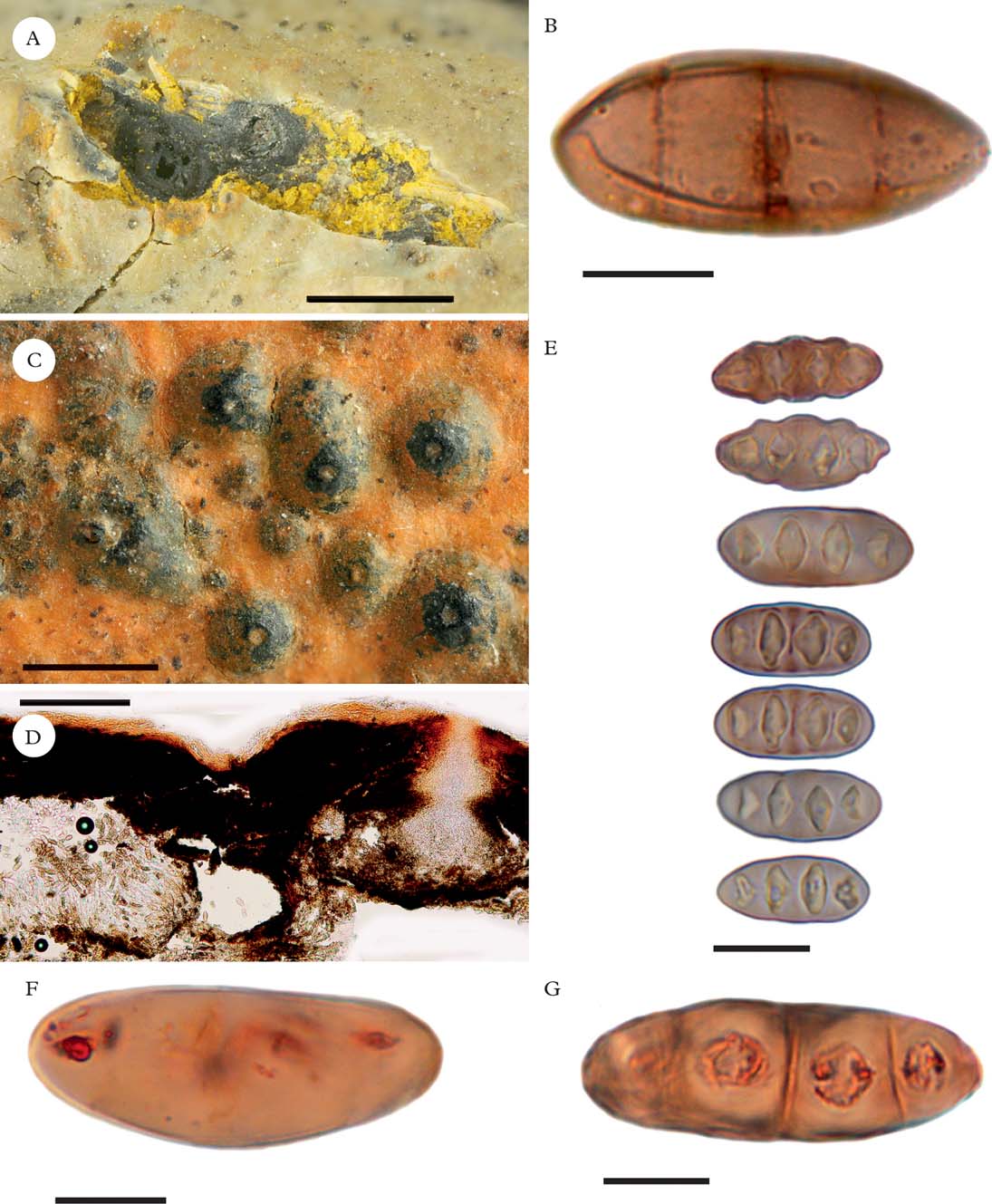
Pyrenula endocrocea (holotype) A & B; A, thallus with section through medulla and ascomata; B, ascospore. Pyrenula rubrojavanica (isotype) C, D & E; C, thallus with ascomata; D, transverse section through ascomata, in KOH, showing red reaction of thallus and ostiole; E, ascospores. Pyrenula thailandica (isotype) F–G; ascospores. Scales: A & C=1 mm; B, E–G=10 μm; D=200 μm.

Thallus corticate, smooth, continuous, rather thick, brownish, without pseudocyphellae, medulla with a soft layer of copious orange anthraquinone crystals reacting UV+ red and KOH+ crimson; algae trentepohlioid.
Ascomata perithecioid, simple, dispersed, conical, emergent, 0·3–0·6 mm diam., black, at least the edges with thick thallus covering. Wall more or less equally carbonized, without crystals, KOH−, c. 200 µm thick. Ostioles brown, KOH−, apical. Hamathecium hyaline, densely inspersed with oil droplets. Asci cylindrico-clavate, IKI−, with 8 irregularly arranged ascospores. Ascospores brown, IKI−, initially 3-septate, soon becoming muriform with 1–3 transverse eusepta and 4–8 rows of 1–4 lumina per row, fusiform, usually with one median constriction, (30–)32–44(–50)×13–16(–19) µm, ends rounded, lumina mostly rounded; postmature ascospores with red oil inside.
Pycnidia not observed.
Chemistry. Medulla with orange anthraquinone reacting UV+ red and KOH+ crimson.
Ecology and distribution. On bark of cultivated Alnus japonica tree in park. Known only from the type.
Discussion. This species resembles Pyrenula breutelii (Müll. Arg.) Aptroot by the muriform ascospores which contain red oil when postmature. It differs from all known species of Pyrenula by the soft layer of orange medullary crystals.
Pyrenula hawaiiensis Aptroot sp. nov.
MycoBank No.: MB 800133
Pyrenula with a thallus with lichexanthone, simple ascomata with lateral ostioles and 3-septate ascospores of 21–23×9·5–14·0 µm.
Type: USA, Hawai'i archipelago, Hawai'i island, Kaumana, mauka Hilo, on fallen branches of Acacia koa, 9 May 1979, O. Degener 34947 (STU—holotype; ABL—isotype).
Thallus corticate, smooth, continuous, thin, pale yellowish, without pseudocyphellae or pockets of crystals; algae trentepohlioid.
Ascomata perithecioid, simple, dispersed, pyriform, emergent, 0·2–0·4 mm diam., black, mostly with thallus covering. Wall more or less equally carbonized, without crystals, KOH−, c. 40 µm thick. Ostioles brown, KOH−, skewed to lateral, pointing in various directions. Hamathecium hyaline, not inspersed with oil droplets. Asci cylindrico-clavate, IKI−, with 8 irregularly arranged ascospores. Ascospores brown, IKI−, 3-septate, fusiform, without constrictions, 21–23×9·5–14·0 µm, ends rather pointed, lumina mostly diamond-shaped, angles sharp, terminal lumina separated from the end wall by an endospore layer.
Pycnidia not observed.
Chemistry. Thallus UV+ yellow, with lichexanthone.
Ecology and distribution. On smooth bark of Acacia koa tree. Known only from the type.
Discussion. This species resembles Pyrenula dermatodes (Borrer) Schaer., but differs by its pyriform ascomata with ostioles that are pointed sideways.
Pyrenula rinodinospora Aptroot sp. nov.
MycoBank No.: MB 800134
Pyrenula with simple ascomata with vertical ostioles, inspersed hamathecium and 3-septate ascospores of 26–30×11·0–12·5 µm with end lumina elongated and directly against the exospore wall.
Type: Papua New Guinea, Madang Province, Budub village, Ari logging site, c. 20 km NW of Madang, 5°02·6′S, 145°44·5′E, on tree trunks in primary forest, 150 m alt., 1 November 1995, A. Aptroot 36747 (BR—holotype; ABL—isotype).
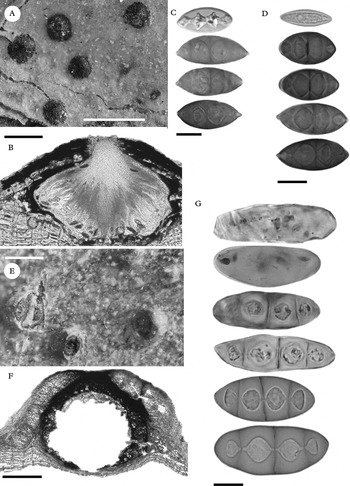
Pyrenula rinodinospora (holotype) A–D; A, thallus with ascomata; B, transverse section through ascoma; C & D, ascospores (C in KOH). Pyrenula thailandica (isotype) E–G; E, thallus with ascomata; F, transverse section through ascoma; G, ascospores. Scales: A & E=1 mm, C, D & G=10 μm; B=100 μm; F=200 μm.

Thallus corticate, smooth, continuous, thin, brownish, without pseudocyphellae or pockets of crystals; algae trentepohlioid.
Ascomata perithecioid, simple, dispersed, conical, emergent, 0·3–0·5 mm diam., black, edges without thallus covering. Wall more or less equally carbonized, but with a sideways extension (clypeus), without crystals, but with bark cells between the wall and the clypeus, KOH−, c. 25 µm thick. Ostioles black, KOH−, apical. Hamathecium hyaline, densely inspersed with oil droplets. Asci cylindrico-clavate, IKI−, with 8 irregularly arranged ascospores. Ascospores rather dark brown, IKI−, 3-septate, fusiform, without constrictions, (20–)26–30×11·0–12·5 µm, ends mostly pointed, lumina mostly quadrangular, angles blunt, terminal lumina elongated and not separated from the end wall by an endospore layer.
Pycnidia not observed.
Chemistry. No substances detected.
Ecology and distribution. On smooth bark of trees and branches in primary forest. Known only from Papua New Guinea.
Discussion. This species resembles Pyrenula maravelensis Vain., which differs by the shorter ascospores (20–25 µm long).
Additional material examined. Papua New Guinea: Madang Province: Budub village, Ari logging site, c. 20 km NW of Madang, 5°02·6′S, 145°44·5′E, on branches in primary forest, 150 m alt., 1995, A. Aptroot 36728 (ABL).
Pyrenula rubrojavanica Aptroot sp. nov.
MycoBank No.: MB 800135
Pyrenula with a thallus with superficial red pigment, aggregated ascomata with vertical ostioles, inspersed hamathecium and 3-septate ascospores of 19–20×7·5–9·0 µm.
Type: Indonesia, West Java, near Bogor, Camp Kedung Badak, on bark of Camellia sinensis, c. 700 m alt., c. 1959, P. Groenhart 7892 (L—holotype; ABL—isotype).
(Fig. 2C–E)
Thallus corticate, smooth, continuous, rather thick, dark reddish to orange-brown, KOH+ crimson, without pseudocyphellae or pockets of crystals; algae trentepohlioid.
Ascomata perithecioid, simple, dispersed, hemispherical, emergent, 0·4–0·7 mm diam., black, mostly with thin thallus covering. Wall only carbonized above, extending somewhat sideways and occasionally fusing with the wall of adjacent ascomata, without crystals, KOH−, c. 150 µm thick. Ostioles pale to orange-brown, KOH+ crimson, apical. Hamathecium hyaline, densely inspersed with oil droplets. Asci cylindrico-clavate, IKI−, with 8 irregularly arranged ascospores. Ascospores brown, IKI−, 3-septate, fusiform, without constrictions at the septa (old ascospores constricted at the lumina), (16–)19–22×(6·0–)7·5–9·0 µm, ends rounded, lumina mostly quadrangular, angles blunt, terminal lumina separated from the end wall by an endospore layer.
Pycnidia not observed.
Chemistry. Thallus and ostiole with orange-red, KOH+ crimson anthraquinone.
Ecology and distribution. On smooth bark of cultivated Camellia sinensis tree. Known only from the type.
Discussion. This species somewhat resembles Pyrenula cruenta (Mont.) Vain., which differs by the red rather than orange anthraquinone and the longer ascospores (27–35 µm). It also resembles Pyrenula rubroanomala Aptroot & Lücking, which differs by an absence of inspersion in the hamathecium and the shorter ascospores (15–17 µm).
Pyrenula thailandica Aptroot sp. nov.
MycoBank No.: MB 800136
Pyrenula with simple ascomata with vertical ostioles and 3-septate ascospores of 35–51×14–20 µm that have orange oil inside when postmature.
Type: Thailand, province Chiang Mai, Doi Suthep, transect-Wat Palad, 99°56′E, 18°48′N, dry evergreen forest, on bark of Xylia xylocarpa, 680 m alt., 26 November 1991, P. A. Wolseley & B. Aguirre-Hudson 5718 (BM—holotype; ABL—isotype).
(Figs 2F & G, 3E–G)
Thallus corticate, smooth, continuous, rather thick, brownish, generally with rather sparse, pale dots formed by pockets of crystals; algae trentepohlioid.
Ascomata perithecioid, simple, dispersed, globose, immersed to emergent, 0·6–1·1 mm diam., black, largely covered with thallus. Wall more or less equally carbonized, with crystals, KOH−, c. 75 µm thick, thinner below. Ostioles brown, KOH−, apical. Hamathecium hyaline, not inspersed with oil droplets. Asci cylindrico-clavate, IKI−, with 8 irregularly arranged ascospores. Ascospores brown, IKI−, 3-septate, fusiform, without or with slight constrictions, (30–)35–51×(10–)14–20 µm, ends rounded, lumina mostly quadrangular, angles blunt, terminal lumina separated from the end wall by an endospore layer; postmature ascospores with red oil inside.
Pycnidia not observed.
Chemistry. No substances detected.
Ecology and distribution. On bark of Castanopsis, Xylia xylocarpa and other trees in dry evergreen or montane forests. Known only from India, Thailand and Papua New Guinea.
Discussion. This species resembles Pyrenula bahiana Malme, which differs by the shorter ascospores (<35 µm long). While P. bahiana, and its muriform relative P. breutelii, are both common pantropical lowland species, the new species seems to be restricted to mountain areas in East Asia.
Selected additional material examined. Thailand: Chiang Mai: Doi Suthep, transect-Wat Palad, dry evergreen forest, on bark of Castanopsis, 680 m alt., 1991, P. A. Wolseley & B. Aguirre-Hudson 5712 & 5715 (ABL, BM); Doi Suthep, Kings Palace, dry evergreen forest, 1550 m alt., 1991, P. A. Wolseley & B. Aguirre-Hudson 5731 (ABL, BM). Uthai Thani: Khao Nang Rum, Valley plot, dry evergreen forest, 370 m alt., 1993, B. Aguirre-Hudson, P. W. James & P. A. Wolseley 3058a (ABL, BM).—India: Arunachal Pradesh: Dibang Valley distr., Roing, on way to Dambukh, c. 300 m alt., 1984, D. K. Upreti & B. C. Upreti L81724 (ABL, LWG).—Papua New Guinea: Southern Highlands: Tari-Komo Road, 17 km SW of Tari, on Castanopsis in lower montane forest, 1450 m alt., 1982, J. A. Elix & H. Streimann 13296 (ABL, CBG). Central Province: Varirata National Park, 20 km E of Port Moresby, secondary tropical forest, 800 m alt., 1987, A. Aptroot 19168a (ABL).
The collectors and curators of the specimens are warmly thanked for sending the respective specimens over the past years. MESC also thanks CNPq – Conselho Nacional de Desenvolvimento Científico e Tecnológico (Process 501633/2009-0) for a research grant.