Introduction
The family Alloglossidiidae Hernández-Mena, Mendoza-Garfias, Ornelas-García & Pérez-Ponce de León, Reference Hernández-Mena, Mendoza-Garfias, Ornelas-García and Pérez-Ponce de León2016 was recently erected to include some members originally allocated in the family Macroderoididae McMullen, 1937 (Hernández-Mena et al., Reference Hernández-Mena, Mendoza-Garfias, Ornelas-García and Pérez-Ponce de León2016). Using an integrative approach that combined morphology and genetic information, Hernández-Mena et al. (Reference Hernández-Mena, Mendoza-Garfias, Ornelas-García and Pérez-Ponce de León2016) uncovered the non-monophyly of the Macroderoidiidae. Subsequently, the validity of the new family was upheld by several studies that confirmed the monophyly of the family Alloglossidiidae (Sokolov & Shchenkov, Reference Sokolov and Shchenkov2017; Kasl et al., Reference Kasl, Font and Criscione2018; Davies et al., Reference Davies, Liquin, Lauthier, Párraga, Saravia, Davies and Ostrowski de Núñez2021).
According to Hernández-Mena et al. (Reference Hernández-Mena, Mendoza-Garfias, Ornelas-García and Pérez-Ponce de León2016), the members of the family can be differentiated from members of the Macroderoidiidae primarily by the combination of the following morphological characteristics: presence of dense tegumental spines at the anterior end of body, decreasing their number at the mid-level of hind body; extension of the vitelline follicles, from the level between the pharynx and the anterior end of the ventral sucker (VS) and the intertesticular area (not surpassing the posterior testis); and wide post-testicular space. Even though Hernández-Mena et al. (Reference Hernández-Mena, Mendoza-Garfias, Ornelas-García and Pérez-Ponce de León2016) suggested that the genera within the family were possibly distributed worldwide, only two genera were formally included in the family, that is, Alloglossidium Simer, 1929 and Magnivitellinum Kloss, Reference Kloss1966.
On the one hand, Alloglossidium comprises 18 species distributed in North America, and some members of the genus show a peculiar life cycle. The ancestral three-host life-cycle includes ictalurid catfishes. However, some species exhibit an abbreviated life-cycle where the definitive host is lost through a progressive event of facultative precocious development, leading to an obligate two-host pattern with a crustacean as the final host, and finally a host switching event from the crustaceans to leeches as definitive hosts (Kasl et al., Reference Kasl, Font and Criscione2018). On the other hand, Magnivitellinum is represented by only three species parasitizing characiform and siluriform fishes distributed in the Neotropical biogeographical region across the Americas, namely Magnivitellinum simplex Kloss, Reference Kloss1966 parasitizing several species of characids and one species of siluriform (Kohn et al., Reference Kohn, Fernandes and Cohen2007; Pérez-Ponce de León et al., Reference Pérez-Ponce de León, García-Prieto and Mendoza-Garfias2007; Davies et al., Reference Davies, Liquin, Lauthier, Párraga, Saravia, Davies and Ostrowski de Núñez2021); Magnivitellinum corvitellinum Lacerda, Takemoto & Pavanelli, Reference Lacerda, Takemoto and Pavanelli2009 parasitizing Hoplosternum littorale (Hancock) (Siluriformes); and Magnivitellinum saltaensis Davies, Liquín, Lauthier, Párraga, Saravia, Davies & Ostrowski de Núñez, Reference Davies, Liquin, Lauthier, Párraga, Saravia, Davies and Ostrowski de Núñez2021 parasitizing Psalidodon endy (Mirande, Aguilera & Azpelicueta) (Characiformes). Interestingly, the three species have been reported from Argentinian freshwaters (see Lunaschi, Reference Lunaschi1989; Ostrowski de Núñez et al., Reference Ostrowski de Núñez, Arredondo and Gil de Pertierra2017; Davies et al., Reference Davies, Liquin, Lauthier, Párraga, Saravia, Davies and Ostrowski de Núñez2021). Until now, only two species have been sequenced, that is, M. simplex and M. saltaensis and these were yielded as sister species in the phylogenetic analysis of Davies et al. (Reference Davies, Liquin, Lauthier, Párraga, Saravia, Davies and Ostrowski de Núñez2021). Nonetheless, specimens of M. simplex specimens from Argentina have not been sequenced and in view of the recent results, the presence of this species is considered doubtful.
In the course of a research project aimed at describing the digenean parasites of freshwater fishes of Argentina, we found a digenean infecting H. littorale (Callichthyidae) whose morphological characteristics were intriguing in that they could belong to the Alloglossidiidae or Macroderoidiidae; still, the specimens did not fit to any of the genera reported in both families. In this paper, we describe a new genus and species using morphological and molecular analyses, and we amend the diagnosis of the Alloglossidiidae family to include the newly described genus. In addition, M. saltaensis is reported from a new host and locality from Argentina.
Materials and methods
Sample collection and morphological study
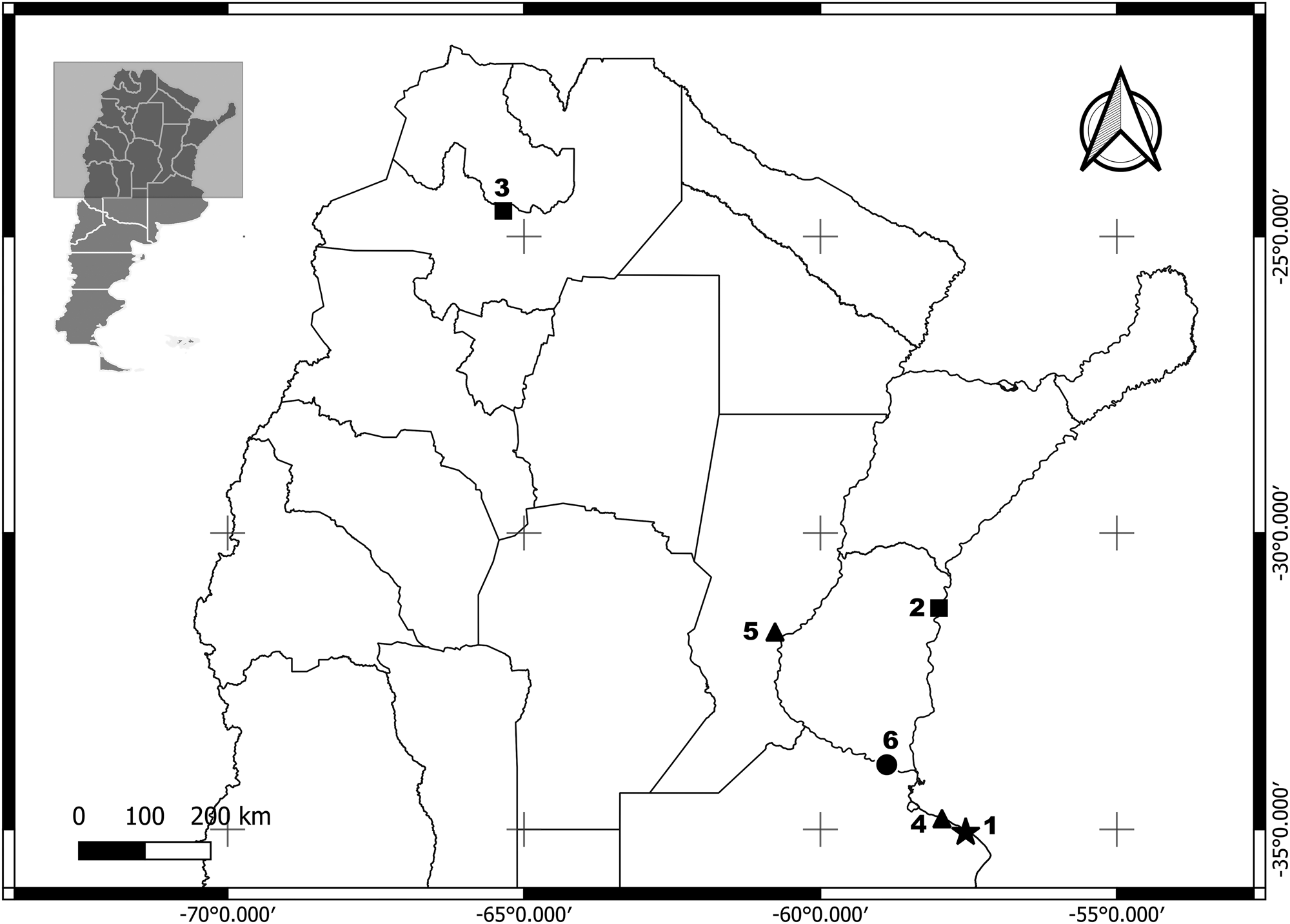
Two H. littorale were collected in September of 2019 using hand nets in Buñirigo River (35° 03′ S, 57° 33′ W), Buenos Aires province, Argentina (fig. 1). Live fishes were carried in bags to the laboratory with water from the sample site and added oxygen, and then kept in aquariums in the laboratory. Additionally, 30 specimens of Characidium rachovii (Regan) from Ayuí River (31° 16′ S, 58° 00′ W), Concordia, Entre Rios, were transported alive to the laboratory. The fishes were cold-anaesthetized and euthanized by cervical dissection, dissected under a stereomicroscope and the gastrointestinal tract examined for parasites.
Map of Argentina showing the species of Alloglossidiidae and the sampling localities: (1) Buñirigo Stream, Buenos Aires province (present study); (2) Ayuí River, Entre Ríos province (present study); (3) Reservoir Ingeniero Alfonso Peralta, Salta province (Davies et al., Reference Davies, Liquin, Lauthier, Párraga, Saravia, Davies and Ostrowski de Núñez2021); (4) lagoons and streams associated with estuary of de La Plata River (Lunaschi, Reference Lunaschi1989); (5) Colastiné River, Santa Fe province (Ostrowski de Núñez et al., Reference Ostrowski de Núñez, Arredondo and Gil de Pertierra2017); and (6) Paraná-Guazú River, Entre Ríos province (Ostrowski de Núñez et al., Reference Ostrowski de Núñez, Arredondo and Gil de Pertierra2017). Star = Diegoglossidium maradonai n. g., n. sp., square = Magnivitellinum saltaensis; triangle = M. simplex; and circles = Magnivitellinum corvitellinum.

Digeneans were carefully detached from the intestinal wall, washed in saline solution, placed in hot (near boiling) water and stored in 96% ethanol for morphological and molecular studies. For morphological studies, specimens were stained with hydrochloric carmine, dehydrated in a graded ethanol series according to the laboratory protocols (Pritchard & Kruse, Reference Pritchard and Kruse1982), cleared in clove oil and mounted in Canada balsam. Drawings were made with the aid of a drawing tube attached to an Olympus BX53 microscope equipped with differential interference contrast optics. Measurements are in micrometres. Type specimens were deposited at the Helminthological Collection of the Museo de La Plata, Buenos Aires, Argentina (MLP). Infection parameters were calculated according to Bush et al. (Reference Bush, Lafferty, Lotz and Shostak1997).
Molecular analyses
Parasite DNA was extracted from one whole individual specimen using PURO-Genomic DNA® (PB-L) according to the manufacturer's protocol.
A fragment of the large subunit ribosomal RNA (28S) gene was amplified by polymerase chain reaction (PCR) using the primer 1500R (5′ -GCT ATC CTG AGG GAA ACT TCG-3′) (Tkach et al., Reference Tkach, Littlewood, Olson, Kinsella and Swiderski2003) and the internal transcribed spacer (ITS) regions including ITS1, 5.8S, ITS2 (ITS) gene fragment was amplified using the primer Mitff1 (5′-CGT AAC AAG-GTT TCC GTA G-3′) (Tkach & Curran, Reference Tkach and Curran2015).
The reactions were carried out with GoTAQ Master Mix (Promega) according to the manufacturer's protocol, using the thermocycling conditions proposed by Tkach et al. (Reference Tkach, Littlewood, Olson, Kinsella and Swiderski2003). The PCR products were analysed by electrophoresis in 1% agarose gel using TAE 1 × buffer supplemented with 2 μl of ethidium bromide in the presence of ultraviolet light. Sequencing for each sample was carried out in a specialized laboratory (Macrogen, Korea).
All sequences were assembled using the platform Geneiuos R11 under free-trial (http://www.geneious.com, Kearse et al., Reference Kearse, Moir and Wilson2012) and the consensus sequence was built with the MUltiple Sequence Comparison by Log-Expectation (Edgar, Reference Edgar2004) alignment tool within Geneious.
The fragments of 28S and ITS obtained were used to search homologues in the GenBank with the Basic Local Alignment Search Tooln and then the sequences were aligned using the online version of Multiple Alignment using Fast Fourier Transform v.7 (Katoh et al., Reference Katoh, Rozewicki and Yamada2019). The alignments of the 28S (and ITS) was trimmed to the length of the shortest sequence, eliminating any poorly aligned regions of the rDNA using the online program Gblocks v0.91 (Castresana, Reference Castresana2000; Talavera & Castresana, Reference Talavera and Castresana2007) with relaxed parameters. The nucleotide ambiguously aligned excluded from each alignment were 17 and 38 base pairs (bp) in 28S and ITS genes. The final length was 980 and 973 bp for both, 28S and ITS matrix, respectively.
The best partitioning scheme and substitution model for each DNA partition were chosen under the Akaike information criterion (Posada & Buckley, Reference Posada and Buckley2004) in Jmodeltest2.1 (Darriba et al., Reference Darriba, Taboada, Doallo and Posada2012). The appropriate nucleotide substitution model for the 28S and ITS was TVM + I + G and GTR + I + G, respectively.
The phylogenetic reconstruction was conducted using Bayesian inference (BI) through MrBayes v. 3.2.1 (Ronquist et al., Reference Ronquist, Teslenkovan and van der Mark2012). The 28S and ITS trees were constructed using 979 and 829 bp with 26 and 31 taxa included in the analyses. Phylogenetic trees were reconstructed using two parallel analyses of Metropolis-Coupled Markov Chain Monte Carlo for 20 × 106 generations each, to estimate the posterior probability (PP) distribution using BI through MrBayes v. 3.2.1 (Ronquist et al., Reference Ronquist, Teslenkovan and van der Mark2012). Topologies were sampled every 1000 generations. The first 25% of the sampled trees were discarded as ‘burn in’. The consensus tree was visualized in FigTree 1.4.4 (Rambaut, Reference Rambaut2014). The proportion (p) of absolute nucleotide sites (p-distance) were obtained for each gene to compare the genetic distance and among taxa using Mega X (Kumar et al., Reference Kumar, Stecher, Li, Knyaz and Tamura2018).
Results
Diegoglossidium n. g.
Zoobank: urn:lsid:zoobank.org:act:7A7E21C7-34CC-4184-AED2-0EB323F45CFB
Description
Alloglossidiidae: body elongated. Tegumental spines not observed. Oral sucker (OS) round, subterminal. VS round, in middle body, about twice the size of the OS. Pre-pharynx short. Pharynx well-developed. Oesophagus short. Intestinal bifurcation halfway between pharynx and VS. Caeca elongated, terminating almost at posterior extremity of body. Testes two, oval, diagonal, located in hind body. Cirrus-sac transverse at the anterior margin of VS, contains bipartite seminal vesicle and curved cirrus. Genital pore immediately antero-lateral to VS. Ovary median or submedian, between VS and testes, overlapping VS, deeply lobate. Seminal receptacle not observed. Uterus extends to posterior extremity of body, filling post-caecal space completely, with ascending and descending coils overlapping the testes and caeca. Metraterm poorly differentiated. Eggs numerous, oval, not operculate. Vitellarium consists of large follicles forming lateral fields; anterior margin of vitelline fields at last third of the VS; posteriorly vitelline follicles extend to half the distance between the posterior end of testis and the caeca ending. Excretory vesicle apparently is I-shaped, excretory pore at posterior end of body. Intestinal parasites of freshwater fish.
Etymology: new genus is named in honour of Diego Maradona, the greatest Argentinean football player for the joy he brought to people regardless of nationality.
Diegoglossidium maradonai n. sp.
Zoobank: urn:lsid:zoobank.org:act:8529B553-68B6-4239-A170-6AA26310DDD5
Taxonomic summary
Type host: Hoplosternum littorale (Hancock) (Siluriformes: Callichthyidae).
Site of infection: intestine.
Type locality and collection date: Buñirigo stream (35° 03′ S, 57° 33′ W), Buenos Aires province, Argentina, September 2018.
Prevalence of infection: one of two fish examined from type locality.
Mean intensity: 4.
Mean abundance: 2.
Material: holotype (7773 MLP-He) and 2 paratypes (7774 MLP-He).
Etymology: species is named after Diego Maradona for the reasons mentioned above and for the love he always demonstrated for his country.
Description
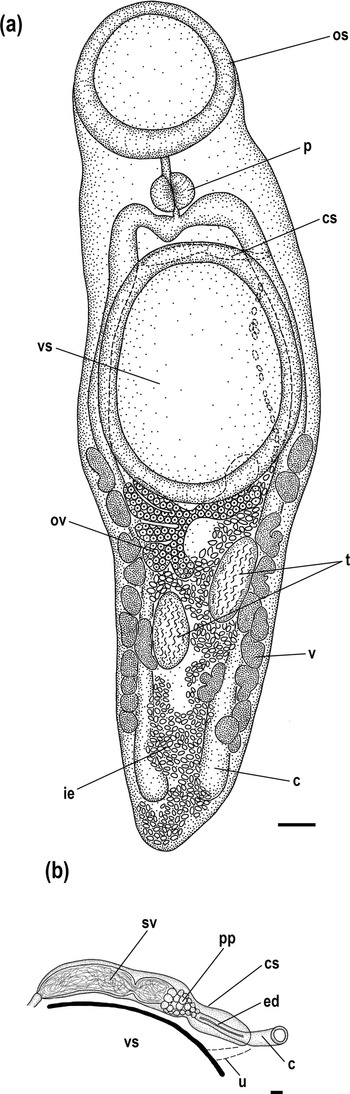
Diegoglossidium maradonai n. g., n. sp.: (a) drawing of the holotype, entire specimen, ventral view; And (b) terminal genitalia showing bipartite seminal vesicle. Abbreviations: c = caecum; cs = cirrus sac; ed = male duct; gp = genital pore; ie = immature egg; ov = ovary; os = oral sucker; p = pharynx; sv = seminal vesicle; t = testicle; u = uterus; v. = vitelline follicle; and vs. = ventral sucker. Scale bars: (a) = 200 μm; and (b) = 20 μm.

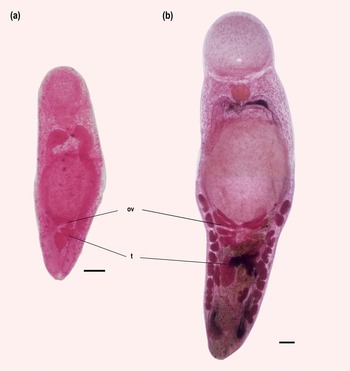
Photograph of Diegoglossidium maradonai n. g., n. sp., entire specimens at light microscope; note the lobed ovary: (a) juvenile; and (b) adult. Abbreviations: ov = ovary; and t = testicle. Scale bar: (a), (b) = 200 μm.

Adult
Measurements based on two mounted and fully mature specimens. Body elongated, 3568–4647 long × 1031–1308 wide at VS level, length/width ratio 1:3.46–3.55. Forebody 1671–2133 long, 46–47% of body length. Hind body 1897–2514 long, 53–54% of body length. Tegumental spines not observed. Oral sucker round, subterminal 627–873 × 669–915. VS large, rounded, in middle body, 1120–1436 × 984–1181, almost twice the size of the OS; OS to VS length ratio 1:1.64–1.79 and, OS to VS width 1:1.29–1.47. Pre-pharynx short 98–289 long. Pharynx well-developed 172–209 × 196–255. Pharynx 24–29% of OS length. Oesophagus 103–116 long bifurcates midway between pharynx and VS. Caeca 2554–3139 long, reaching close to posterior end of body, post-caecal space 129–271 long, and 4–6% of body length. Testes two, entire, oval-shaped in anteroposterior axis, oblique, in hind body, anterior testis 350–460 × 155–238; posterior testis 426–433 × 145–219. Post-testicular space 706–961 long, representing 20–21% of body length. Cirrus-sac transverse at the anterior margin of VS, 365 × 65, contains an internal tubular bipartite seminal vesicle, posterior portion of the seminal vesicle 177 × 44 long, anterior seminal vesicle 75 × 47 long, pars prostatic and cirrus 157 long. Genital pore lateral, immediately anterior to V (fig. 2b). Ovary strongly lobed occupying most of the area between testes and VS, with five lobes on the right side and two on the left side of body. Mehlis'gland, seminal receptacle and Laurer's canal not observed. Vitelline follicles arranged in two longitudinal rows on each side of body extending from last third of VS to midway between testis and end of caeca, with 11 follicles on the right and 10 on the left; follicles oval or rounded. Distance between vitelline follicles and posterior end of body 381–497, 11% of body length. Uterus occupying most of intracaecal space, between VS and posterior end of body, overlapping the testes and caeca. Eggs small, 25–31 × 15–18, numerous, oval, not operculated, with a non-occulated miracidium. Excretory vesicle not observed.
Juvenile
Measurements based on one specimen. Body elongated, 2027 long × 683 wide at level of VS, length/width ratio 1:2.97. Forebody 1127 long, 55% of body length. Hind body 908 long, 45% of body length. Tegumental spines lacking. OS rounded, subterminal 470 × 466. VS rounded, in mid body 677 × 573, larger than OS; OS to VS length and width ratio, 1:1.44 × 1:1.23, respectively. Pre-pharynx not visible. Pharynx well developed, rounded 176 × 178. Oesophagus short, 23 long, bifurcates midway between pharynx and VS. Caeca 1327 long, close to the posterior end of body. Post-caecal space 55 long, ratio between post-caecal space and body length 3%. Testes two, in hind body, entire, anterior testis triangular-shaped, 132 × 114, posterior testis oval-shaped, 175 × 110. Post-testicular space 289 long. Ovary not fully developed, with four lobes immediately posterior to VS, occupying intracaecal space. Mehlis'gland, seminal receptacle and Laurer's canal not observed. Vitelline follicles not developed; diffuse follicles formed in both sides of body. Excretory vesicle apparently is I-shaped.
Alloglossidiidae (amended diagnosis)
Amended diagnosis: Body elongated. Tegument bearing spines (when observed) with density variable; when present, usually denser in the anterior region of body, decreasing in number at mid-level of hind body. OS round, subterminal. VS round, typically in anterior half of body. Pre-pharynx short or long. Pharynx well-developed. Oesophagus distinct. Intestinal bifurcation halfway between pharynx and VS. Caeca elongate, usually terminating between posterior testis and posterior extremity of body. Testes two, tandem or diagonal, typically entire, in hind body. Cirrus-sac straight or curved, in the area of VS, contains simple or bipartite seminal vesicle and curved cirrus. Genital pore median or submedian, immediately anterior to VS. Ovary median, submedian, between VS and testes, sometimes close to, or overlapping VS, spherical to oval or deeply lobed. Seminal receptacle present. Uterus extends to posterior extremity of body, filling post-caecal space completely, with ascending and descending uterine coils passing between and over testes; transverse uterine loops overlapping caeca and expanding into extracaecal space. Metraterm poorly differentiated. Eggs numerous, oval, operculate or not. Vitellarium consists of large follicles forming lateral fields; anterior margin of vitelline fields at different levels between pharynx and VS; posterior vitelline follicles extend to intertesticular area or to post-testicular space, confluent or not. Excretory vesicle I-shaped or Y-shaped, pore terminal. Parasites of the intestine of freshwater fish (Characiformes, Siluriformes) or in freshwater crustaceans and leeches as progenetic metacercariae. Nearctic and Neotropical regions.
Type-genus Alloglossidium Simer, 1929. Other genera contained in family: Magnivitellinum Kloss, Reference Kloss1966; and Diegoglossidium n. g.
Molecular analyses
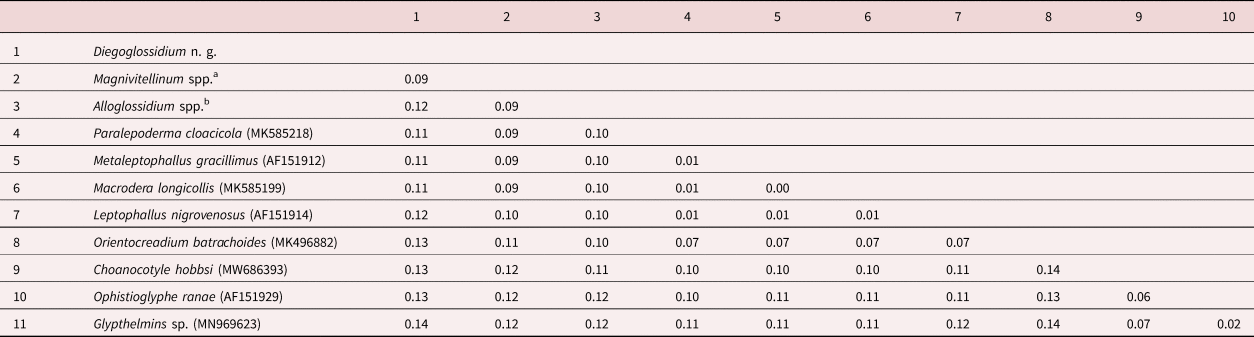
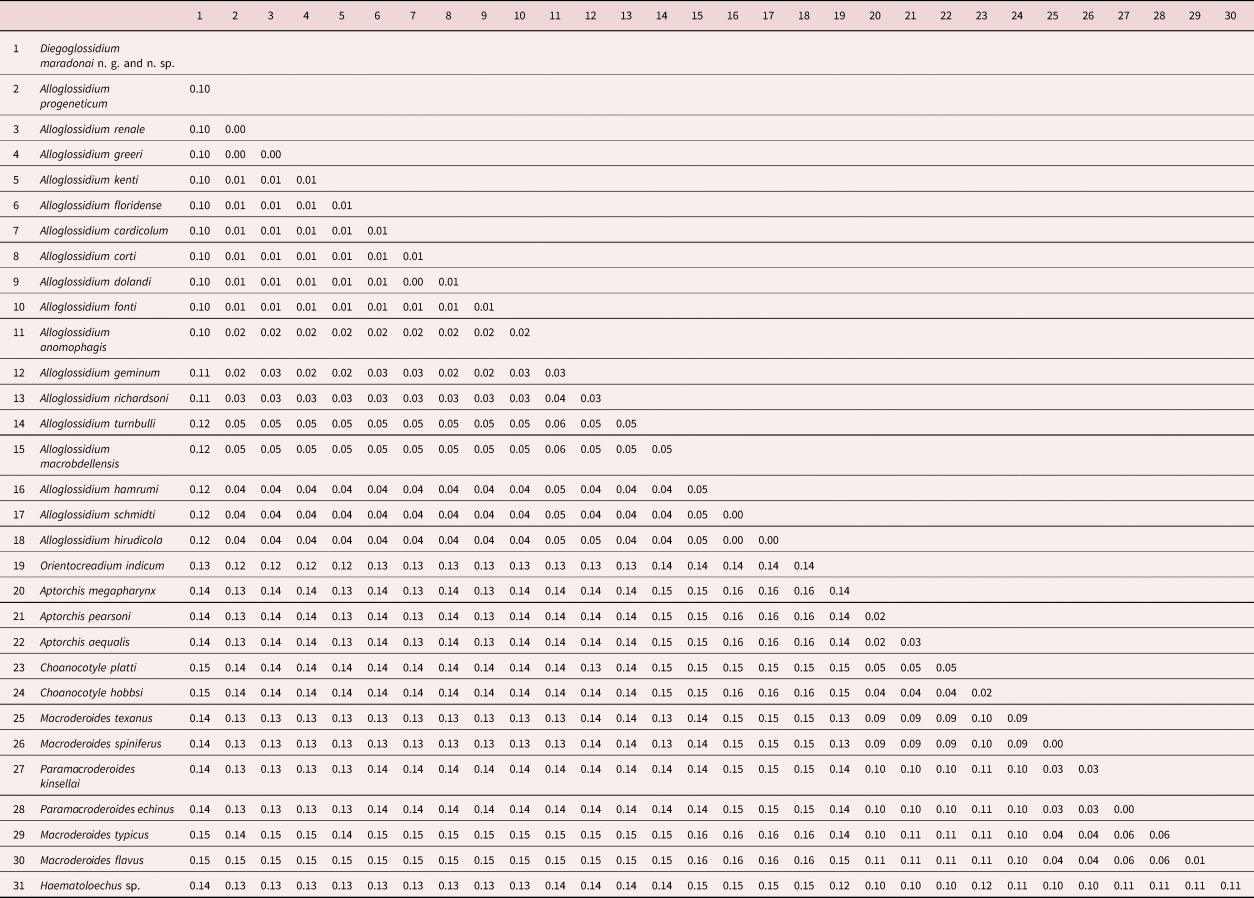
Genetic variation at the 28S and ITS sites between D. maradonai n. g., n. sp. other genera of plagiorchioids for which nucleotide data are available in GenBank are presented as pairwise comparison in tables 1 and 2.
Genetic divergence among genera relevant to the study, estimated through of uncorrected p-distance of the 28S rDNA.

Variable sites including gaps based on pairwise comparison of 980 sites.
a KU535682; and MN744313-14;
b JF440767; JF440771; JF440809; JX262944; KC812276, MH041377; MH041379; MH041381; MH041384; MH041389; MH041412; MH041414; MH041417-18; MH041420; and MH041424.
Genetic divergence among genera relevant to the study, estimated through an uncorrected p-distance of the ITS rDNA.

Variable sites including gaps based on pairwise comparison of 973 sites.
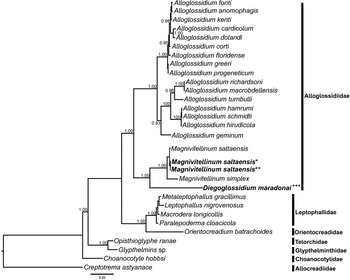
Sequences of the 28S varied between 0.00 and 0.14 across the entire data set (table 1). The new genus is close to Magnivitellinum (Alloglossidiidae) with 0.09 and to Alloglossidium (Alloglossidiidae) with 0.12. Diegoglossidium n. g. clustered with both genera; Magnivitellinum was yielded as the sister group of the new genus (fig. 4) with high PP (1.00). The specimens recovered from C. rachovii were conspecific with M. saltaensis (no genetic variation) and overall, they agree with the description provided by Davies et al. (Reference Davies, Liquin, Lauthier, Párraga, Saravia, Davies and Ostrowski de Núñez2021) (supplementary material S1).
Phylogram resulting from Bayesian inference (20,000,000 generations) of partial 28S rDNA gene sequences of Diegoglossidium maradonai n. g., n. sp. rooted by Creptotrema astyanace (Allocreadiidae). Branch support values indicate posterior probabilities. * OP533789, **OP533790; *** OP533788.

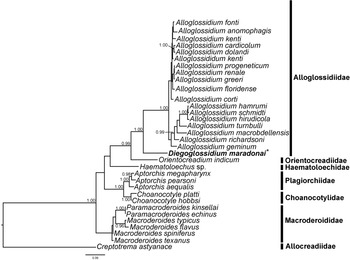
The range of variation of the ITS between the new species and the other members of the Plagiorchiida was 0.00–0.16 across the entire data set (table 2). Diegoglossidium n. g. is the sister taxa of Alloglossidium (Alloglossidiidae) and varied from 0.10–0.12, with high PP value (1.00) (fig. 5); there are no ITS sequences available for species of Magnivitellinum.
Phylogram resulting from Bayesian inference (20,000,000 generations) of partial ITS1-5.8S-ITS2 gene sequences of Diegoglossidium maradonai n. g., n. sp. rooted by Creptotrema astyanace (Allocreadiidae). Branch support values indicate posterior probabilities. * OP532984.

Discussion
The new specimens recovered from the intestine of H. littorale are morphologically similar to members of the Alloglossidiidae and Macroderoidiidae, although they also share some traits observed in both families (Font & Lotz, Reference Font, Lotz, Jones, Bray and Gibson2008; Hernández-Mena et al., Reference Hernández-Mena, Mendoza-Garfias, Ornelas-García and Pérez-Ponce de León2016). However, the molecular analyses unequivocally placed the new genus and species in the family Alloglossidiidae. Diegoglossidium n. g. is resolved as the sister genus of Magnivitellinum, and that is in concordance with results obtained by Hernández-Mena et al. (Reference Hernández-Mena, Mendoza-Garfias, Ornelas-García and Pérez-Ponce de León2016), since both genera are distributed in the Neotropical biogeographical region. Sister group relationships are like those reported by Hernández Mena et al. (Reference Hernández-Mena, Mendoza-Garfias, Ornelas-García and Pérez-Ponce de León2016) and Davies et al. (Reference Davies, Liquin, Lauthier, Párraga, Saravia, Davies and Ostrowski de Núñez2021); in both analyses, the Alloglossidiidae is related with the Leptophallidae Dayal, 1938 and the Orientocreadiidae Yamaguti 1958. This last family was not used in the former analyses but it seems to be sister with the Leptophallidae.
As mentioned above, the family Alloglossidiidae can be differentiated from the Macroderoidiidae according to Hernández Mena et al. (Reference Hernández-Mena, Mendoza-Garfias, Ornelas-García and Pérez-Ponce de León2016) by the combination of morphological features, including the density and distribution of the tegumental spines, the distribution of the vitelline follicles and the extent of the post-testicular space. But new features observed in the new genus required an amendment of the Alloglossidiidae.
According to Hernández-Mena et al. (Reference Hernández-Mena, Mendoza-Garfias, Ornelas-García and Pérez-Ponce de León2016), the tegumental spines in the Alloglossidiidae are denser at the anterior extremity and decrease in number at the mid-level of hind body whereas in the Macroderoidiidae the entire tegument is covered with spines. In D. maradonai n. g., n. sp. the tegumental spines were not observed with light microscopy. Considering that the spines could be very small and they might be lost during fixation procedures, it is possible that we did not find them but sampling more specimens and observing specimens through scanning electron microscopy (SEM) will be necessary to confirm the apparent lack of spines. It is interesting to note that this feature is quite variable among species of Magnivitellinum. For instance, in M. simplex the spines are denser at the anterior extremity and decrease in number to the mid-level of the hind body according to the original description by Kloss (Reference Kloss1966) and in the specimens from Mexico (Hernández-Mena et al., Reference Hernández-Mena, Mendoza-Garfias, Ornelas-García and Pérez-Ponce de León2016); however, the tegument is entirely covered by spines according to Lunaschi (Reference Lunaschi1989). In addition, in M. corvitellinum the tegument is covered with small spines distributed along the body, decreasing in number towards the posterior extremity (Lacerda et al., Reference Lacerda, Takemoto and Pavanelli2009). This observation confirms the need for SEM studies to verify the presence and distribution of tegumental spines. Nevertheless, this character appears to be not reliable for discriminating between members of the Alloglossidiidae and Macroderoididae.
The most noticeable feature in D. maradonai n. g., n. sp. is the deeply lobed ovary which is formed by seven lobes. This trait distinguishes the new species from all other members of the Alloglossidiidae. Alloglossidium kenti Simer, 1929, the type species of the genus possess an incipient lobed ovary (Tkach & Mills, Reference Tkach and Mills2011; Kasl et al., Reference Kasl, Fayton, Font and Criscione2014).
Other remarkable characteristics were overlooked and justify the emendation of the family diagnosis attempting to encompass the observed variation, that is, the shape of the seminal vesicle and the presence of an operculum in the eggs. Magnivitellinum simplex and M. saltaensis possess a simple seminal vesicle and operculated eggs (Jiménez-Guzmán, Reference Jiménez-Guzmán1973; Lunaschi, Reference Lunaschi1989; Davies et al., Reference Davies, Liquin, Lauthier, Párraga, Saravia, Davies and Ostrowski de Núñez2021), whereas in M. corvitellinum and D. maradonai n. g. and n. sp. the seminal vesicle is bipartite and the egg lacks an operculum (Lacerda et al., Reference Lacerda, Takemoto and Pavanelli2009; present study). A Y-shaped excretory vesicle is present in all the South American Alloglossidiidae (Jiménez Guzmán, Reference Jiménez-Guzmán1973; Lunaschi, Reference Lunaschi1989; Lacerda et al., Reference Lacerda, Takemoto and Pavanelli2009; Davies et al., Reference Davies, Liquin, Lauthier, Párraga, Saravia, Davies and Ostrowski de Núñez2021), but in D. maradonai n. g., n. sp. the excretory vesicle apparently is I-shaped.
Host association and biogeography.
The geographical distribution and host associations of the two Neotropical genera of the Alloglossidiidae: Magnivitellinum (three species) and Diegoglossidium n. g. (one species) are worth of discussion. Species of both genera are present in Argentinean freshwaters parasitizing fishes across the Parano-Platense basin (see fig. 1). Magnivitellinum simplex, the type species of the genus, was originally described from Astyanax bimaculatus (Linnaeus) in Brazil; later, the species was reported from several characid species across a wide geographical range spanning between Argentina and Mexico (Kohn et al., Reference Kohn, Fernandes and Cohen2007; Hernández-Mena et al., Reference Hernández-Mena, Mendoza-Garfias, Ornelas-García and Pérez-Ponce de León2016). In Argentina, M. simplex has been registered in four characids and also in one species of siluriform (Lunaschi, Reference Lunaschi1989; Ostrowski de Núñez et al., Reference Ostrowski de Núñez, Arredondo and Gil de Pertierra2017). In addition, M. simplex appears to exhibit a high instraspecific morphological variability (Lunaschi, Reference Lunaschi1989; Davies et al., Reference Davies, Liquin, Lauthier, Párraga, Saravia, Davies and Ostrowski de Núñez2021). Recently, molecular and morphological analyses conducted by Davies et al. (Reference Davies, Liquin, Lauthier, Párraga, Saravia, Davies and Ostrowski de Núñez2021) resulted in the description of M. saltaensis parasitizing P. endy (Characidae) in the Bermejo and Paraguay rivers; in our study, we report this species from a different characid, that is, C. rachovii (Crenuchiidae) from the Uruguay River, indicating that the geographical distribution and the range of hosts of the species is wider.
Interestingly, the genetically analysed specimens of M. simplex were sampled in characids from Mexico (Hernández-Mena et al., Reference Hernández-Mena, Mendoza-Garfias, Ornelas-García and Pérez-Ponce de León2016). Still, our analyses demonstrated that M. simplex and M. saltaensis are undoubtedly congeneric species; the taxonomic status of M. simplex must be the subject of further investigation due to the morphological variability and the wide geographical range, which cast doubts about the possibility that they represent a complex of cryptic species. Sampling new specimens of M. simplex from the type locality and host, as well as those reported from other hosts and localities and obtaining DNA sequences is required to test this hypothesis.
Magnivitellinum corvitellinum is the third species included in this genus and is found parasitizing H. littorale in the Paraná River basin in Brazil and Argentina (Lacerda et al., Reference Lacerda, Takemoto and Pavanelli2009; Ostrowski de Núñez et al., Reference Ostrowski de Núñez, Arredondo and Gil de Pertierra2017). As it was stated before, M. corvitellinum and D. maradonai n. g. and n. sp. shares the same fish host, H. littorale, and with the exception of the tegumental spines (absent in D. maradonai n. g. and n. sp.), they share certain resemblance. Ongoing research attempts to determine the phylogenetic affinities among M. corvitellinum and the other South American Alloglossidiidae.
Hoplosternum littorale has a wide geographical distribution, including the Paraguay, Paraná, Uruguay and la Plata rivers. The Buenos Aires province represents the southern limit of their distribution (Almirón et al., Reference Almirón, Casciotta, Ciotek and Giorgis2015; Mirande & Koerber, Reference Mirande and Koerber2020). Currently, in Argentina the fish is parasitized by three digenean species: M. corvitellinum; Porangatus ceteyus Fernandes, Malta and Morais, 2013; and D. maradonai n. g., n. sp. The host was examined for parasites in several localities alongside the Parano-Platense basin (see fig. 1), but the new genus and species was only found in the Buñirigo stream, Buenos Aires province, whereas the other two species were recorded in several localities in the Paraná River (Ostrowski de Núñéz et al., Reference Ostrowski de Núñez, Arredondo and Gil de Pertierra2017; unpublish data). It is possible that D. maradonai n. g., n. sp. is restricted to the middle and south of the Buenos Aires province.
The results discussed herein highlight the importance of a continuing research with the aim of improving the knowledge about the helminth fauna of Argentinean freshwater fishes; in particular, we will be sampling these hosts across the poorly explored Paranó-Platense basin, where it seems likely that new species of helminths are waiting to be discovered.
Supplementary material
To view supplementary material for this article, please visit https://doi.org/10.1017/S0022149X22000670.
Acknowledgements
We are grateful to Lic. Exequiel Furlán for helping with the map and M. Marcia Montes for the drawings. We thank the Buenos Aires Province for the sampling permits, CEPAVE which provided laboratory space for processing and study the specimens.
Financial support
This work was supported by the Consejo Nacional de Investigaciones; Científicas y Técnicas (CCT-CONICET-La Plata) (S.R.M., grant number PIP-0015; N.J.A., grant number 11220150100705CO); Centro de Estudios Parasitológicos y Vectores (grant number PUE 3334/16); Universidad de La Plata for (J.D. and S.R.M., grant number N859); and Fondo para la Investigación Científica y Tecnológica (FONCyT) (M.M.M., grants number PICT-2020-SERIEA-01531; N.J.A. grant number PICT-2020- SERIEA-00660). This study was also partially funded by CONACYT (A1-S-21694) to GPPL.
Conflicts of interest
None.
Ethical standards
The authors assert that all procedures contributing to this work comply with the ethical standards of the relevant national and institutional guides on the care and use of laboratory animals.