1. Introduction
In crafting laws, lawmakers cannot effectively foresee all of the particular circumstances for which their laws could apply.Footnote 1 This renders legislation general in nature and incomplete as a matter of practical necessity. In ancient Greece, Aristotle (Reference Aristotle, Nicomachean and Roger350 BC) realized the unavoidability of incomplete laws. But at times, incompleteness of legal rules is not only a matter of unavoidable necessity. Incomplete legal precepts can be purposefully enacted as a way to optimize the lawmaking and adjudication functions, transferring to the judiciary some of the tasks that would otherwise have to be carried out ex ante by the legislature. In this setting, Jeremy Bentham (Reference Bentham, Burns and Hart1776) addressed the question of optimal specificity of laws, providing fertile ground for the modern debate on rules versus standards. Bentham's idea of a two-tiered system, where the public learns of the general standards while the judges implement those standards by creating rules for the individual cases, provides a good example of the possible role of purposeful incompleteness of legal rules.
Since Bentham, contemporary legal theorists have attempted to formulate principles that should be used to determine the optimal degree of specificity of laws. In considering these criteria, legal and economic scholars have utilized instruments from optimal decision theory, public choice theory, and constitutional political economy. This strand of literature, far from being purely theoretical, is acquiring increasing practical significance in the European context. There, the ongoing process of unification of some areas of European law poses the question of choice among alternative legislative instruments. The preparatory work of new codifications, such as the Draft European Civil Code and the new Israeli Civil Code, poses the important question of how detailed these codes should be.
This paper contributes to this literature in general, and in particular offers a framework for identifying the optimal degree of specificity of legal rules in various legal and institutional contexts. Section 2 introduces the problem with brief references to the existing literature. Section 3 formulates a model of optimal specificity of laws to analyze how legal obsolescence, volume of litigation, legal traditions and codification styles, judges’ specialization, and complexity of reality affect the choice of optimal legal instruments. Section 4 revisits the results of the theoretical section, considering implications of the model in more complex institutional scenarios. These include the absence of benevolent planning, the dangers of instrumental use of legal specificity by legislators, and the way political time preference may affect the degree of legal specificity. The conclusion identifies areas where our propositions could be validated by future empirical research, and by considering policy analysis and ideas for further extensions.
2. Rules, standards, and the optimal degree of specificity of laws
In the law and economics literature, much attention has been paid to the difference between ‘standards’ and ‘rules’. Standards and rules can be visualized as two extremes in a one-dimensional space representing the degree of precision of laws. A standard is the legal or social criterion that adjudicators use to judge actions under particular circumstances. In that sense, standards are circumstantial; they are open-ended, allowing the adjudicator to make a fact-specific determination such as whether a driver used ‘reasonable care’ in a given situation. Standards such as reasonableness are largely intuitive, which makes them easy to understand for the general public. A rule, conversely, withdraws from the adjudicator's consideration the circumstances that would be relevant to decision-making according to a standard. Rules are more specific than standards; they create bright line tests such as whether a driver exceeded the speed limit of 55 miles per hour. Greater specificity decreases the flexibility of a rule. This often results in less than a perfect fit between the specific wording of a rule and the varying fact patterns of the regulated conduct.
When legislators choose between rules and standards, they must consider when, and at what cost, the rules and standards should be applied to specific situations. For instance, rules require advance determination of the law's content because of the high degree of specificity involved in their formulation. Lawmakers must perform research in advance to determine the appropriate rule to create ex ante. Therefore, rules are more costly for legislators to promulgate than general standards, which require less specificity. Laws that are not fully specified upfront, however, impose greater implementation and decision-making costs by judicial and administrative bodies. Standards are more costly for legal advisors to predict or adjudicators to apply because they require determinations of the law's content ex post. Footnote 2 Hence, in the event of a car accident where the driver was traveling more than 55 miles per hour, liability would be automatic under a 55 miles per hour rule. However, under a standard such as ‘reasonableness’, the judge or jury would have to determine the facts and circumstances at the time of the accident, and decide whether to impose liability. The application of a standard is more fact specific, but naturally less consistent in the long run. Thus, from an ex ante perspective, rules provide better guidance to the subjects of the law, and from an ex post perspective, standards may better be able to be adapted to the varying circumstances of the case.
Generally, scholars have postulated that laws articulated as ‘standards’ leave a greater margin of discretion to judges and administrative agencies in the implementation of the legal norms. On the other hand, ‘rules’ are laws that are specified upfront with a greater level of detail and thus leave a lesser margin of discretion in the implementation of such norms. The lack of a perfect fit between the ex ante legal rule and the circumstances of individual cases may create social losses. From an efficiency perspective, standards allow ad hoc custom-tailoring of the law to the circumstances of the case at bar, reducing problems of over-inclusion and under-inclusion. These problems are more serious when there is greater heterogeneity in regulated conduct and a faster rate of change in the regulated environment.Footnote 3
In this paper, we take the value of the law as a function of legal precision. Rules advance certainty, consistency, and predictability to private parties and promote judicial economies by minimizing the need for a detailed consideration of facts and circumstances each time a law is applied (Sullivan, Reference Sullivan1992). Individuals and firms often need to obtain professional legal advice to determine whether certain conduct violates the law.Footnote 4 Attorneys can more easily provide legal advice when the consequences of an actor's conduct are clearly specified up-front in detailed rules. Given the greater accessibility of detailed rules, more individuals are likely to become informed in a regime dominated by rules than standards. This represents a value of law's specificity. Under rules, individuals are more likely to adjust their conduct to the precepts of the law. Under a standard such as reasonableness, what is ‘reasonable’ under the circumstances can vary widely. Applying standards may require some guesswork by less experienced legal actors. As a result, standards tend to be more costly for individuals to interpret when deciding how to act, since standards are given content and substance only after individuals act. The forward-looking and deterrent functions of law are thus more effective when laws are formulated as precise rules. This constitutes another benefit of law's specificity.
In the literature it is often pointed out that when the regulated environment is subject to exogenous changes over time, laws may require more frequent revisions (e.g., Ehrlich and Posner, Reference Ehrlich and Posner1974). In other words, changes in the regulated environment lead to legal obsolescence. The fact that more specific rules become obsolete at a faster rate should imply that the optimal level of specificity of legal rules should depend on the expected rate of change of the external environment. The existing models, however, do not explicitly formulate the optimal level of specificity of law as a function of the expected rate of change of the external environment. In the following, we extend the results of the existing literature to consider how obsolescence and frequency interact in choosing the optimal detail of codifications, as well as considering the relevance of other factors in the choice of appropriate legislative instruments.
3. Lawmaking with obsolescence and economies in adjudication
We view the lawmaking process as a production function with both fixed and variable costs. The creation of law can be thought of as investing a fixed cost in the production of legal order. Lawmakers choose the level of specificity of legal rules by allocating fixed capital in the production process.Footnote 5 After a legal rule is promulgated, there is a variable adjudication cost whenever the legal rule is applied. A greater level of specificity of the law generally increases the cost of creation of the law, but requires lower implementation costs by courts and administrative agencies. That is, the more specific the law is, the greater the fixed investment and the lower the variable implementation costs will be. Clearly, the more frequent the legal rule is applied, the higher the total variable cost.
The optimal degree of specificity of legal rules should be chosen to maximize the value of the law net of the fixed cost of lawmaking and the variable cost of adjudication. Other than the costs and benefits discussed in the previous literature, we concentrate on some factors that have not been previously highlighted.
The model
Our model of optimal specificity of laws includes the frequency of the application of the legal rule, the rate of obsolescence of law, the cost of coordination and harmonization of new rules within existing legal systems, the degree of specialization of courts, and the complexity of the regulated environment. The impact of these variables in the choice of optimal legal instruments will be investigated.
Assume that the average value of a law V, appropriately discounted by the social discount rate, depends on the degree of specificity chosen in the formulation of the law (s) and the expected rate of obsolescence (ω). Following the existing literature, we assume that as the legal issue is specified in more details, the value obtained from the legal rule increases. For example, when a legal rule provides greater specification, it provides more informational content and becomes less costly for parties to interpret, increasing the value of the legal rule at a decreasing rate (VS>0 and V SS < 0).Footnote 6 As the rate of obsolescence increases, the value of the legal rule clearly decreases (V ω < 0). It is postulated that the marginal value of the level of specificity decreases as the obsolescence rate increases (V Sω < 0). If the frequency of application of the legal rule is N, then the total value of the legal rule becomes Nċ V(s,ω).
There are two cost components to lawmaking: a fixed promulgation cost and a variable adjudication cost. The fixed creation and promulgation cost F depends positively on the degree of specificity of the rule: the greater the specification, the higher the fixed cost (FS>0). Further, the marginal cost of promulgation increases as the level of specificity increases (FSS>0). A second factor that influences the fixed promulgation cost is the need to coordinate the new law with preexisting legislation or to comply with other institutional constraints. We refer to this as coordination cost or degree of difficulty in legislation λ, and assume that F λ > 0. In a Civil law system characterized by a comprehensive and coordinated codification, the cost of enacting a law which amends a provision of an existing codification is high, given the need to coordinate the new rule with other rules and principles already contained in the code. The degree of difficulty in legislation λ may include the need for bargaining between different political parties to reach consensus, the existence of institutional constraints, or aggravated constitutional procedures to follow for the legal enactment. The increment in promulgation cost due to a higher level of specification becomes larger as legislative coordination difficulties increase (F S λ > 0). A third determinant of the promulgation costs is the complexity of the regulated environment κ. We assume that the fixed promulgation costs increase with the complexity of the regulated environment (F κ > 0). Further, F Sκ > 0 is assumed. This may be for either of two reasons. First, when reality becomes more complex, the additional fixed cost of specificity becomes larger due to the obvious difficulty of specifying the contingencies of a complex environment. Lawmakers need to account for the complex interaction of a large number of contingent events, specifying the factual scenario under which a legal rule applies. Second, when the legal system becomes more complex, the fixed promulgation cost of specific legal intervention increases due to the need to coordinate the new legal rule with a more complex system of preexisting legal rules. Lawmakers will need to avoid conflict of laws, specifying how a new rules relates to prior rules (e.g., abrogating a prior rule or carving an exception to a preexisting rule), the timing of application of new rules vis-à-vis prior rules (e.g., retroactive versus non-retroactive application), and the territorial scope of application of new rules.
The second component of the lawmaking cost is related to the adjudication of the legal rule. If N is the frequency of application of the legal rule, the total adjudication cost is N ċ C, where C is the unit adjudication cost, appropriately discounted by the social discount rate. The adjudication cost C depends on the degree of specificity s, the degree of specialization of the court σ, and the complexity of reality κ. In particular, greater specification implies lower unit adjudication cost (CS<0). In absolute value, this change in adjudication cost can be thought of as the abatement in adjudication cost induced by a greater specificity of the rule, or more simply as an additional benefit of greater detail in the law.Footnote 7 With higher levels of specificity, the additional benefit of greater specificity |CS| decreases, implying a higher CS. Thus, CSS>0 is assumed. Next, we assume that the unit adjudication cost decreases as the courts become more specialized (C σ < 0). The additional benefit of greater specificity in legal rules is greater when those legal rules are interpreted and applied by a specialized court. In other words, as σ increases, |CS| increases, resulting in C Sσ< 0. This assumption captures the simple intuition that specialized judges are better able to interpret and apply complex law, given the greater familiarity acquired overtime with the legal system that is relevant to their subject-matter jurisdiction. So, for example, it seems reasonable to assume that a specialized tax judge is better able to handle a complex tax rule than a judge sitting in a court with general jurisdiction. Lastly, when reality becomes more complex, the unit adjudication cost increases (C κ > 0). The additional benefit of greater specificity is higher when reality is more complex. That is, as κ increases, |CS| increases, resulting in C Sκ< 0.
The level of specificity is chosen to maximize the net total value

With the assumptions made above, the second-order sufficient condition for the optimization problem is fulfilled. Specifically, the assumptions that greater specification increases the value of the legal rule at a decreasing rate (VSS<0), that marginal cost of promulgation increases with greater specification (FSS>0), and that the abatement in unit adjudication cost induced by a greater specificity of the rule decreases (CSS>0) imply that N ċ V S S − F S S − N ċ C S S < 0. Then the optimal level of specificity must fulfill the following condition

For now, assume that λ, σ, and κ are fixed and concentrate on the impact of changes in frequency of application N and in the rate of obsolescence ω on the optimal specificity level s*. To that end, the optimality condition to be fulfilled can be obtained by totally differentiating equation (1)

Equation (2) details how the different impacts generated by exogenous changes in the frequency of application dN, exogenous changes in the rate of obsolescence dω, and the required optimal changes in the level of specificity ds* must be balanced. Rearranging the terms, we have

Equation (3) must be satisfied if the optimal specificity is chosen whenever the frequency of application of the legal rule and the rate of obsolescence change. The first term in equation (3) indicates the total impact induced by changes in the volume of application of the legal rule. Since VS−CS>0, this impact is positive if, for example, there is an increase in the frequency of application of the legal rule. The second term in (3) represents the total impact induced by changes in the rate of obsolescence. This impact is negative if, for example, there is an increase in the rate of obsolescence, as V S ω< 0. Thus, equation 3) specifies that the total impact, positive and/or negative, from changes in N and in ω must be balanced by an adjustment in the chosen level of specificity s*.
The relevance of economies of scale in adjudication
Consistent with Kaplow (Reference Kaplow1992), our result suggests that the frequency of a law's application is important in determining optimal specificity. First consider the simple cases where there is only one exogenous change. If there is no change in the rate of obsolescence (dω = 0), then the optimal change in specificity must go in the same direction as the change in frequency of application of the legal rule (ds*/dN > 0).Footnote 8
For legal issues that arise frequently in settings with common characteristics, a rule with a higher degree of specificity is desirable. If a law is frequently applied, variable adjudication costs will tend to be higher than promulgation costs. Because learning about a rule is cheaper, individuals may spend less in learning about the law and be better guided by a rule since the law's content can be readily ascertained. This necessarily means that rules will be more efficient than standards when the law is frequently applied.
Conversely, where legal issues rarely arise and the circumstances are varied, designing a rule that accounts for every relevant contingency would require a high fixed cost and would be wasteful, as most of such hypothetical circumstances would never arise in actual cases. Thus, when frequency is low, a general standard is preferable.
The obsolescence problem
Circumstances change over time. An important cost of legal regulation by means of rules is the cost of altering rules to keep pace with social, economic, or technological change. Obsolescence is not as serious a problem with governance by standards as it is with rules. Standards are relatively unaffected by changes over time since a standard indicates only the types of circumstances that are relevant, and not particular, specific circumstances. The reasonableness concept can be followed despite immense changes of the optimal course of conduct over time. Thus, we expect more specific rules when there is a stable environment and general standards when there is a fast rate of change.
The existing literature points out that detailed rules are more sensitive to exogenous, unforeseen changes in the regulated environment and thus are more prone to obsolescence (Ehrlich and Posner, Reference Ehrlich and Posner1974). Our model shows that if we expect volatility in the environment and consequent obsolescence in the legal order, lower levels of specificity should be chosen. It further clarifies that if there is no change in the frequency of application of the legal rule (dN=0), the optimal change in specificity must go in opposite direction as the change in the rate of obsolescence (ds*/dω < 0).Footnote 9
Economies of scale in adjudication and obsolescence
Next, consider the cases in which there are changes in both the rate of obsolescence and the frequency of application of the legal issue. In these cases, the total impacts on changes in the optimal specificity are generally unknown. Various possibilities are conceivable. In the case where there is an increase in the frequency of application of the legal rule and a decrease in the rate of obsolescence, the two positive impacts induced by these exogenous changes reinforce each other to create a positive change, thus increasing the optimal level of specificity. This may be the case when certain new areas of the law become more established, with an increase in both the frequency of application of the rule and the stability of the regulated environment. As a new area of the law consolidates and grows in relevance, greater detail in the formulation of rules becomes desirable. Likewise, when there is a decrease in the frequency of application of the legal rule and an increase in the rate of obsolescence, the two impacts reinforce each other and lead to a reduction in the optimal level of specificity.
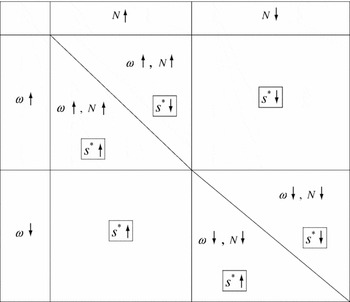
In cases in which changes in the rate of obsolescence and the frequency of application of the legal issue are in the same direction, the impacts induced counter-balance each other. Depending on the relative magnitudes and the scaling effects of these changes, optimal level of specificity may increase or decrease. For example, consider the case in which both the frequency in the application of a law and the rate of obsolescence increase. This may be the case of a booming area of the law where the increase in frequency of any legal issue is also accompanied by instability and change of the regulated environment. The impact of these factors goes in different direction. When the positive impact induced from the increase in the frequency of application of the law outweighs the negative impact induced from the increase in the rate of obsolescence, abbreviated here by N↑ and ω↑, the optimal level of specificity increases (s*↑). The relatively large and positive impact induced from changes in N may be due either to the large increase in magnitude dN, or to the large positive scaling factor of marginal net value of adjudication VS−CS, or to both. The relatively weak and negative impact induced from changes in the obsolescence rate may be due either to the small increase in the rate of obsolescence dω, or to the small decrease in marginal value due to obsolescence N ċ V Sω, or to both.
It is straightforward to consider the total impact on the optimal level of specificity s* for the other cases in which both frequency of application and the rate of obsolescence change in the same direction. In Figure 1, we summarize the resulting changes in the optimal specificity under different scenarios when there are simultaneous changes in ω and in N.
Changes in the optimal specificity of legal rules

Optimal detail of legal rules in civil law systems with specialized courts and complex regulated environments
After concentrating on the effects induced by changes in frequency of application and rate of obsolescence on the optimal specificity of legal rules, attention is now shifted to the impact caused by other exogenous variables. We consider how the methodological approach used by legal systems, the existence of specialized courts, and the complexity of the regulated environment affect the optimal level of detail in the formulation of law.
With respect to the impact of the methodological approach, it is important to consider the peculiar conception of ‘codification’ in Civil law systems. In a Civil law system, codifications are aimed at providing a comprehensive and coherent set of principles and rules, capable of application through deductive techniques of interpretation (Merryman, Reference Merryman1969). Like a set of mathematical theorems and corollaries, law is organized in a rigorous scheme of principles and rules, arranged in a pyramid-like fashion, from broad to specific, from general rules to particular exception. This conception of Civil law codification results from efforts of the seventeenth- and eighteenth-century French scholars and the later rational jurisprudence that inspired modern European codifications. The change of any specific provision in a Civil law codification is fairly problematic. The amendment of a provision often requires coordination and harmonization with other rules and principles of the code, with complex chain effects on yet other code provisions. This is clearly revealed by the relative infrequency with which Codes are revised in Civil law systems (compared with other pieces of ordinary legislation within the same Civil law system) and by the fact that when revisions occur, they are carried out by committees of experts that attempt to revise entire sections of a code in a systematic fashion, avoiding piecemeal intervention.
Given these system-specific methodological constraints, the cost of legislative revisions is higher for Civil law codifications than for other forms of legislation or codification. Using our first-order condition for the net value optimization problem, equation (1), we can study how the codification method influences the optimal level of specificity. The relevant comparative static results can be obtained directly: ds*/dλ<0.Footnote 10 This reveals that when it is more difficult to codify and amend a legal rule (λ increases), a lower level of specificity is desirable. Ceteris paribus, we should thus observe less detail and greater use of standards.
A second component that affects the optimal level of detail of legal rules is the degree of specialization of the courts. Most Civil law jurisdictions have specialized sections of the bench to deal with given set of issues of the law. For example, in ordinary Civil law courts (Tribunals, Courts of Appeal, and Supreme Courts), specialized panels (generally referred to as ‘Sections’ or ‘Divisions’ of the Court) are formed to deal with particular recurring legal issues. Thus, most Courts will have a division specializing in labor disputes, a division specializing in bankruptcy proceedings, another with contract disputes, another with succession disputes, and so on. In yet other cases, specialized jurisdictions, for example tax courts, are created to deal with particular competencies.
Furthermore, some legal rules affect only specific areas of the law that fall under the jurisdiction of a specialized panel of judges. A tax rule will most frequently be applied by a tax judge and will have only limited occasion to become relevant in a dispute pending before a different court. The optimal level of specificity of these rules of narrow application can thus be evaluated with respect to the specialized court. On the other hand, other legal rules affect matters that can fall under the jurisdiction of a large number of different courts instead. For example, laws concerning legal capacity or duress are potentially relevant in each and all fields of the law. The optimal level of specificity of these rules of widespread application would have to be considered with respect to the entire judicial system.
We thus want to see how the existence of specialized courts affects the optimal level of specificity of law. For the interpretation of this result, we refer to the specificity of laws that primarily fall under the jurisdiction of the specialized court. The relevant comparative static results can be obtained directly: ds*/dσ>0.Footnote 11 The optimal level of specificity increases for laws that are applied and interpreted by more specialized courts (σ increases). In these cases we should expect to see greater use of detailed legal provisions and to observe more rules.
Lastly, we comment on the effect of the complexity of the regulated environment on the choice of optimal specificity. Recall that a more complex reality raises the legislative fixed cost and also increases the adjudication cost. An increase in the legislative fixed cost favors a lower degree of specificity (laws should be formulated more like a standard) while an increase in the adjudication cost favors a higher degree of specificity (laws should be formulated more like a rule).
The relevant comparative static result shows that the sign of ds*/dκ is indeterminate.Footnote 12 In spite of the indeterminacy of the overall sign due to the two effects, if the force induced by an increase in legislative fixed cost of specificity dominates the force induced by an increase in adjudication cost, the optimal degree of specificity is lowered when reality becomes more complex.Footnote 13 Intuitively, with an increase in the complexity of the regulated environment, greater use of rules will be warranted when legislative costs are lower relative to judicial costs. An increase in judicial human capital, on the other hand, would lower judicial costs and thus justify the use of less specific laws in response to an increase in complexity of the regulated environment.
4. Contextualizing the analysis
Lawmakers can choose to craft laws with different levels of specificity. We considered factors that may affect the optimal degree of specificity of legal rules, including the relevance of legal obsolescence, volume of litigation, judges’ specialization, and complexity of the regulated environment. In order to keep things tractable, our model necessarily abstracts from reality to isolate effects that would otherwise be obfuscated by the many different forces in practice. In recognizing these limits, we consider our results further under the more complex institutional reality that characterizes contemporary legislative processes in various areas of the law.
Legislative information and legal experimentation
Lawmakers often undertake legal intervention with incomplete information concerning knowledge of current or future circumstances about the regulated issue. When lawmakers lack current information about the regulated issue, they adopt standards because they expect information to be revealed through implementation and enforcement of legislation. In light of the information acquired during the initial phase, legal amendments to increase the level of specificity can be implemented later. Standards are also useful to cope with legislative uncertainty about future events. Standards are more robust to surprises, since unexpected shocks in the regulated environment can more easily be coped with through adaptive adjudication.
Standards imply ex post regulation by courts. Our model ignores the intrinsic benefit of judicial lawmaking in terms of experimentation and gradual accretion of legal certainty. As is well-known in the law and economics literature – the Chicago-School efficiency of the Common law hypothesis is an example – courts may have an institutional advantage in designing and experimenting with alternative rules in light of case experience. This is an advantage if the adversarial process and the repeat filing of cases reveal otherwise unavailable private information to third-parties, allowing courts to better specify the proper domain of a legal rule. However, the institutional advantage of courts over legislators may disappear when selections of cases going to court are biased (Fon, Parisi, and Depoorter, Reference Fon, Francesco and Ben2005) or when ideological decision-making is taken into account (Fon and Parisi, Reference Fon and Francesco2003). Furthermore, hindsight bias often leads courts to depart from the optimal balancing of type-I and type-II errors (Rachlinski, Reference Rachlinski and Sunstein2000).Footnote 14
Our model assumes that greater levels of specificity lead to greater certainty and predictability of the system. Obviously, there are diminishing returns – excessive specificity and complexity may ultimately lead to less predictability than general standards. Unlike specific rules (a speed limit rule is applicable to specific categories of vehicles), standards generally have broader scope of application (a safe speed standard is applicable to all means of transportation). The advantage of rules in terms of predictability may quickly disappear due to the uncertain boundaries of rules (should horseback riding be covered under speed limit rules?) or because it is not clear ex ante which set of rules is applicable (are electric bicycles subject to the speed limit of bicycles or can they take advantage of higher limits allowed for motorcycles?).
The assumed relationship between specificity and adjudication costs (specific rules are easier and cheaper to adjudicate than general standards) ignores another relevant social cost: information costs faced by subjects of the law. Unlike courts and professional lawyers, subjects of the law may find it easier to gain a sense of what a legal standard requires of their behavior, rather than navigating through a complex web of detailed rules. Furthermore, as a stylized fact, the drafting styles of standards and rules may differ substantially. Standards are often formulated in plain language easily comprehensible to a lay person, while rules frequently incorporate statutory jargon that requires doctrinal interpretive techniques.
Beyond the benevolent lawmaker
Our stylized model of legal intervention assumes that lawmakers act benevolently, without considering the impact of political failures and selfish behavior by legislators, courts, and subjects of the law. There may be advantages and disadvantages of legal specificity when agency problems are taken into account, from the public choice or social choice viewpoints. For example, Mahoney and Sanchirico (Reference Mahoney and Chris2005) suggest standards as a tool for legislators to make lobbying less effective. However, this poses an inconsistency problem, inasmuch as lobbying generates potential benefits for the legislators. Hence it might be in the interest of lawmakers to pre-commit to enacting rules, rather than standards, as a way to maximize their rents from lobbying. Thus, only higher-order rules, such as constitutions or other institutional constraints, may be capable of creating an effective long-term constraint to reduce the risk of special-interest lobbying.
When legal intervention is used to deliver selective benefits over time, selecting rules, especially when contained in a code, may be a more effective tool for legislators to enhance the durability of their political decisions in the face of potential political turnover and unstable majority coalitions (Majone, Reference Majone2001). Specificity in legislation thus increases the present value of legislative rents. Choosing specificity of legislation is also relevant in the face of strategic actions by subjects of the law. Individuals and firms expend effort to find ways around specific commands of the law. Standards are more robust to attempts by subjects of the law to bypass legal constraints (Wegner, Reference Wegner1997). Thus, lawmakers may choose standards to protect the effectiveness of their legal enactments in the face of detrimental creativity by subjects of the law. Lawmakers must weigh the costs and benefits of specificity, since greater specificity enhances the durability of legislation in the face of later political changes, but renders it more vulnerable to strategic actions by individuals and firms to bypass the effectiveness of legal provisions.
Specificity of law is also relevant in the presence of misaligned objectives of different branches of government. Standards transfer lawmaking authority to courts. When courts and legislatures have different political make-ups, legal specificity may be a relevant political instrument. General standards allow courts to resist legislation; specific rules may reduce the ability of courts to corrode legislative enactments.
In mixed jurisdictions where legislative and judge-made sources compete to create legal order, the effect of legal specificity should be considered in conjunction with strategic judicial intervention. The interpretation and future application of a newly enacted standard is greatly affected by the first applicable cases. This creates an opportunity for strategic adjudication, where interventionist courts may race to adjudicate new standards, affecting the future interpretation of similar cases. On the other hand, rules are generally less vulnerable to strategic adjudication.
Lastly, lawmakers often operate under binding legal and institutional constraints. Legislation and regulation may be subject to higher-order rules (for example, constitutional rules, presidential vetoes, and international law). In the presence of binding constraints, lawmakers may use vague standards to avoid an open conflict with the higher source that could lead to an invalidation of their legislative efforts.Footnote 15 Likewise, the use of standards may be driven by political expediency when lawmakers serve conflicting demands of different constituencies.Footnote 16
Social versus political time-preference
Legislation imposes current lawmaking costs, producing benefits while incurring additional costs over time. Discount rates become a critical factor in computing the net present value of alternative legislative interventions. Our model assumes the presence of a benevolent lawmaker who weighs current costs against the future benefits of lawmaking and uses the appropriate social discount rate. The discounted present value of legislation is implicitly captured and approximated by our benefit variable. Although this analysis is appropriate to understand the factors that affect the optimal level of specificity of laws, a more realistic extension should allow the political discount rate to differ substantially from that of society as a whole, as lawmakers are political actors with a time horizon. This may affect the cost–benefit calculation in a number of ways. Interestingly, our analysis generates indeterminate results regarding the impact of political time-preference on specificity of legislation.
Whether a lawmaker's limited time-horizon leads to a greater use of standards over specific rules depends largely on context. When lawmakers use legal intervention to deliver future benefits that depend on the degree of specificity of rules, a higher political time preference will lead to inefficiently low levels of specificity. Although both the benefits of legislation and the adjudication costs occur in the future, the political discount factors have more impact on benefits than on costs. This is because, assuming that legal intervention is cost-justified, the expected benefits are larger than the costs. Thus, ceteris paribus, higher political discount rates would lead to less specificity and an increased use of standards. Put differently, if the benefits of legal intervention are only captured over time, a short-sighted lawmaker may give greater weight to the immediate costs of lawmaking, tilting towards the use of general standards. From an institutional perspective, the myopic behavior of lawmakers can be aggravated by institutional factors such as term-limits, shorter legislative periods, and unstable majority coalitions.
Political discount rates also affect the rate of legal change and the specificity of legal rules. When a new law is enacted, a learning period may create costs for both courts and subjects of the law. Once this period is over, these costs fade out and the net benefits of legal innovation begin to accrue. Depending on the duration of the learning period relative to the time horizon of the lawmakers, legal innovation may be discouraged and standards may be preferred to rules to reduce short-term costs. An extension of our analysis could consider optimal lawmaking patterns in light of alternative social and normative discount rates.
Implications and testable hypotheses
Results of this paper may shed light on the historical trends in legislation of special areas of private law, concentrating on the degree of detail utilized by European codifications. The peculiar structure of the modern codifications of Europe (such as the French Civil Code of 1804, the Italian Civil Code of 1865, and the German Civil Code of 1900) reveals heterogeneity in the degree of detail used in codifying different areas of the law, a variance that could be explained with the institutional and environmental variables identified in our analysis. A similar analysis could be carried out with respect to the recent draft codifications of Europe, which also reveal changes in codification style across different areas of the law. Empirical analysis could assess the consistency of these evolving patterns of codification with predictions by the economic model.
For example, an analysis of historical codifications could examine how exogenous environmental shocks affect codification styles of different areas of the law. Significant shocks that may be relevant for private law include the end of feudalism for the law of property, the establishment of a stable law merchant within Europe for the case of commercial and contract law, and the industrial revolution for the law of torts.
The French codification was enacted after the fall of the feudal era. The fall of feudalism brought about a substantial change in the structure of property ownership, with a resulting need for innovation in the law of property. Given the rapid economic and institutional changes brought about by the end of the feudal era, detailed property rules risked becoming obsolete. The hypothesis of our legal specificity model is that codifications of the law of property of this historical period should be relatively simple compared with prior (and subsequent) property law regimes.
A different prediction could be formulated with respect to modern codifications of contract and commercial law. By the time of the modern codifications of Europe, the law merchant had reached a point of maturity and stability. One would thus expect greater specificity in codifications of this area of law, compared with more recent periods, where exogenous shocks such as cyber-commerce and unification of national markets necessitate greater flexibility and less specificity.
Further, the model of optimal legal specificity developed here supports the more general hypothesis that greater legal specificity is expected in areas characterized by stability of the regulated environment and less specificity in areas undergoing rapid change. Important environmental shocks, such as the industrial revolution, are expected to affect the level of specificity of law in areas such as tort law. We hypothesize that the fast changes brought about by the industrial revolution increase the obsolescence rate of fact-specific rules, rendering general standards more desirable.
Another implication of our model is that greater levels of legal specificity result when the volume of litigation in a given area increases. More frequent usage of rules would justify greater fixed expenditures in rule drafting, inasmuch as these expenditures reduce average adjudication costs. Empirical study could verify whether the level of specificity of law is affected by the number of cases that are likely to be adjudicated in each area of the law. Empirical work could also determine whether specialized jurisdictions affect the level of specificity of rules. For example, cross-country studies could show whether specialized bankruptcy and tax courts affect the levels of specificity of rules enacted in such areas of the law.
Our model relies heavily on the assumption that lawmakers act as benevolent welfare maximizers. Empirical analysis could evaluate whether factors discussed in this section influence the behavior of lawmakers. That is, the analysis may control for public choice variables and assess the extent to which these variables affect the legislative style in different institutional and legal contexts.
Concluding remarks
The solution to our lawmaking problem generates several implications concerning the patterns of lawmaking under different legal, social, and economic conditions. These implications are relevant for both positive and normative analyses. From a positive standpoint, these results can be used for formulating a positive and testable hypothesis with respect to how legal systems respond to exogenous changes in the external environment by adopting varying patterns of lawmaking, thus maximizing the value of legal intervention. The results of our model of legal specificity may benefit from future empirical validation, and may potentially prove useful in explaining historical patterns of codification. Our results should be used with caution in a normative context. Models necessarily assume away many institutional factors that form an important part of reality. This is necessary to isolate effects and formulate results with predictive or explanatory power. In real life, optimal patterns of codification should be determined on the basis of a richer contextual analysis, in light of current circumstances. Some general criteria can nevertheless be offered to lawmakers on the basis of our stylized analysis, calling for an increased attentiveness to environmental changes in the optimal choice of legal intervention.