In the context of romantic relationships, different types of transgressions with different levels of severity may occur. In this regard, the ability to forgive can be one of the most important factors in maintaining a healthy relationship. However, although most of the empirical evidence that delves into the issue of forgiveness seems to be consistent insofar as this process can be very pleasing to relationships that have deteriorated, and it increases the possibilities of sustaining such relationships (e.g., Fincham, Reference Fincham2009; Kachadourian, Fincham, & Davila, Reference Kachadourian, Fincham and Davila2004; Kimmes & Durtschi, Reference Kimmes and Durtschi2016), the interpersonal consequences of declaring forgiveness may not always be favorable. Namely, granting forgiveness to the person who transgresses could become an inconvenience for the offended person if the former understands forgiveness as a sign that their behavior was innocuous, thus increasing the probability of repeating it in the future (Wallace, Exline, & Baumeister, Reference Wallace, Exline and Baumeister2008). In this sense, the reflection posed by the philosopher and sociologist Herbert Marcuse in response to the dilemma posed by Wiesenthal (Reference Wiesenthal1998) about whether or not to forgive the soldiers who committed the Nazi crimes can be argued. Marcuse, in this sense, was reticent to forgive, and understood that “the easy forgiving of such crimes perpetuates the very evil it wants to alleviate” (p. 150); that is, easy forgiveness only diminishes the severity of intransigent crimes. In the same vein, different authors have empirically revealed that in the face of abusive or violent behavior, people who grant greater forgiveness to the transgressing party tend to be perceived by the transgressors as an “easy target” if they do not exhibit the intention to sanction said behaviors, thus implying that the situation does not acquire a severe nuance (e.g., Gruder & Duslak, Reference Gruder and Duslak1973; Leng & Wheeler, Reference Leng and Wheeler1979). That is why, on certain occasions, forgiveness can also have very harmful effects for those who grant it and decide to stay in a relationship, even more if it is a highly affected relationship. Two particularly severe and complex cases to forgive within this context are, on the one hand, violence or abuse towards the partner, and, on the other hand, infidelity. In relation to violence, it has been shown that certain victims feel the need to forgive their abusive partners, even if, in these situations, forgiveness can be assessed negatively (Gordon, Burton, & Porter, Reference Gordon, Burton and Porter2004). Regarding infidelity, research has shown that it is considered the most serious and most difficult to forgive transgression (Beltrán-Morillas & Valor-Segura Reference Beltrán-Morillas and Valor-Segura2015; Pettijohn & Ndoni, Reference Pettijohn and Ndoni2013). Therefore, despite numerous transgressions that may occur within a romantic relationship, the present study will focus exclusively on the two considered as the most severe: Infidelity and intimate partner violence from the perspective of the offended person.
Severe Relational Transgressions: Infidelity and Intimate Partner Violence
Intimate partner violence has been defined as any real or potential threat of physical, psychological, sexual or economic abuse by an individual towards their partner (Gilbert & Gordon, Reference Gilbert and Gordon2017). Intimate partner violence ─mainly that of a physical nature─ has been estimated as the most difficult social issue to solve, given the danger factor that surrounds this relational phenomenon (Messing, Campbell, Wilson, Brown, & Patchell, Reference Messing, Campbell, Wilson, Brown and Patchell2015). In this regard, most of the discourse regarding intimate partner violence assumes that leaving an abusive partner is the safest option; however, several studies have found that violence can increase when a person decides to leave their abusive partner (e.g., Anderson, Reference Anderson2003), thus leaving people who suffer violence on behalf of their partner to face the difficult decision to either maintain or terminate their relationship. Intimate partner violence also causes innumerable negative sequalae in the victim, such as apprehension towards others, sleep disturbance, anxiety, depression and risk of suicide, which are associated, in turn, with a decrease in forgiveness towards the abusive partner (Davidson, Lozano, Cole, & Gervais, Reference Davidson, Lozano, Cole and Gervais2015).
On the other hand, infidelity has been specified as a sexual, romantic or emotional involvement that violates the commitment of relational exclusivity acquired by the parties, as it involves a third person in the relationship (Metts & Cupach, Reference Metts, Cupach, Spitzberg and Cupach2007). In therapeutic practice, infidelity has been valued as the third most complicated problem to treat, and second (only behind physical violence) in causing a potentially harmful impact on the relationship (Olmstead, Blick, & Mills, Reference Olmstead, Blick and Mills2009), establishing itself as one of the main causes of divorce (Fincham & May, Reference Fincham and May2017). Thus, as a result of infidelity, deep feelings of anger, disappointment, doubt, depression, and deterioration of self-esteem arise in the offended person (Kluwer & Karremans, Reference Kluwer and Karremans2009), as well as a marked loss of trust in their partner, or the suspension of other relationships such as friends or relatives (Heintzelman, Murdock, Krycak, & Seay, Reference Heintzelman, Murdock, Krycak and Seay2014), finding infidelities of a sexual nature as the most difficult to forgive (Pettijohn & Ndoni, Reference Pettijohn and Ndoni2013).
Forgiveness in Severe Transgressions: The Role of Partner-specific Dependency and Guilt
Despite all the negative connotations mentioned above in both types of transgressions, there are people who choose to stay in the relationship and work to repair it through forgiveness. In this regard, forgiveness has been referred to in general terms as a positive process of acclimatization, where the offended person relinquishes his/her feelings, thoughts and behaviors of rancor and resentment, and increases his/her compassion, understanding and altruism towards the person who transgresses (Enright & the Human Development Study Group, Reference Enright, Kurtines and Gewirtz1991). More specifically, McCullough, Bono, and Root (Reference McCullough, Bono and Root2007) approached this phenomenon as a set of motivational changes, through which the offended person experiences a decrease in the motivation to stay distant from, and/or to retaliate against the person who transgresses; as well as an increase in the motivation of benevolence or tolerance toward the transgressor. However, in order to encourage forgiveness towards the person who transgresses, it is not always necessary for the offended person to experience a change in the motivations of revenge and avoidance towards benevolence (Mullet, Girard, & Bakhshi, Reference Mullet, Girard and Bakhshi2004).
Partner dependency has been referred to as a need for continued attention and protection from the partner, as well as an accentuated trust in the relationship as a substantial principle for the habitual functioning of the person (Momeñe, Jáuregui, & Estévez, Reference Momeñe, Jáuregui and Estévez2017; Valor-Segura, Expósito, & Moya, Reference Valor-Segura, Expósito and Moya2009). Moreover, alluding to this interpersonal dependency construct, partner-specific dependency has been shown to be the dimension with the greatest orientation towards the partner as the only source of social support and confidant, thus relegating other significant relationships (Valor-Segura et al., Reference Valor-Segura, Expósito and Moya2009).
To date, there are insufficient studies that have examined the role of partner-specific dependency in the motivation of forgiveness by the offended person (e.g., Valor-Segura, Beltrán-Morillas, & Expósito, Reference Valor-Segura, Beltrán-Morillas and Expósito2017, May). Generally, people with a high partner-specific dependency, despite having suffered an offense, tend to evaluate their partner’s behavior more positively, in order not to lose the esteem and acceptance (González-Jiménez & Hernández-Romera, Reference González-Jiménez and Hernández-Romera2014). Research conducted in the field of intimate partner violence has shown that excessive partner-specific dependency is linked to dysfunctional relationships, and can lead to greater tolerance of abuse, becoming an obstacle to end an abusive relationship (e.g., Buttell, Muldoon, & Carney, Reference Buttell, Muldoon and Carney2005). A study carried out by Valor-Segura, Expósito, Moya, and Kluwer (Reference Valor-Segura, Expósito, Moya and Kluwer2014) revealed that, faced with different conflictive situations, women with a high partner-specific dependency experienced greater feelings of guilt, which led to a resolution of the conflict aimed towards loyalty or maintenance of the relationship. This could be because guilt tends to promote, essentially in women, a sense of reproach that stems from thinking or believing that they have done something wrong (Smith, Webster, Parrott, & Eyre, Reference Smith, Webster, Parrott and Eyre2002). Thus, and in the light of the above, it is expected that women with high partner-specific dependency will experience greater levels of guilt, responding accordingly, with higher levels of forgiveness towards the partner, especially in the face of a situation of physical violence in confrontation with an incident of sexual infidelity, as in this last transgression the offended person could make the transgressing partner more responsible for allowing a third person to become involved in their relationship (Hall & Fincham, Reference Hall and Fincham2006).
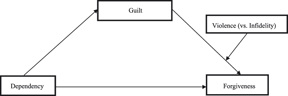
Based on the aforementioned considerations, the conceptual model that appears in Figure 1 was designed.
Conceptual Model Representing the Proposed Relationship between Partner-specific Dependency and Forgiveness Mediated by Guilt, and Moderated by the Condition of Violence (vs. Infidelity)

Empirical evidence reveals that it is women who suffer most from the transgressions referred to above (Fincham, Cui, Braithwaite, & Pasley, Reference Fincham, Cui, Braithwaite and Pasley2008; Tidwell & Eastwick, Reference Tidwell and Eastwick2013), as well as being the ones that report higher levels of partner-specific dependency (Beltrán-Morillas & Valor-Segura, Reference Beltrán-Morillas and Valor-Segura2015) and feelings of guilt in conflict situations within the context of intimate partner relationships (Valor-Segura et al., Reference Valor-Segura, Expósito, Moya and Kluwer2014). However, there are no known studies that examine in women, the effect of partner-specific dependency and the feeling of guilt over forgiveness, oriented towards the specific characteristics of the transgression (sexual infidelity and physical violence). Therefore, in order to provide greater knowledge in this area of research, the present study was designed with the main objective of investigating the influence that different relational, emotional, and motivational aspects exert on the process of forgiveness of sexual infidelity and physical violence. Specifically, it is expected that in the face of the transgressions under study: (a) Physical violence will be forgiven to a lesser degree than sexual infidelity, due to the risk involved in forgiving this type of transgression (e.g., Gilbert & Gordon, Reference Gilbert and Gordon2017); (b) high levels of partner-specific dependency will be predictive of higher levels of forgiveness in the face of physical violence (vs. sexual infidelity) and; (c) high levels of guilt will be predictive of greater forgiveness; as well as the high partner-specific dependency being associated with higher levels of guilt, consequently raising higher levels of forgiveness towards the transgressing partner, occurring mainly in physical violence in comparison to sexual infidelity.
Method
Participants
The initial sample consisted of 173 university women aged between 18 and 40 years (M = 21.36, SD = 2.83). Four of the participants that surpassed or equaled the age of 30 years were discarded from the analyses, in order to obtain a more homogeneous sample. Thus, the final sample consisted of 169 women from a university setting, with an average age of 21.09 years (SD = 2.17, range between 18 and 27). Of the 169 participants, 58% reported being involved in a relationship at the time of study, establishing the average duration of the relationship in 27.52 months (SD = 22.61). Likewise, 26.6% reported having suffered an incident with similar characteristics to the transgressions of interest at some point in their lives.Footnote 1
Instruments
Screening of the video “Enough” (Cowan, Winkler, & Apted, Reference Cowan, Winkler and Apted2002). To introduce the experimental manipulation, fragments of this film were selected, and two types of scenarios were created that showed the different transgressions (Sexual Infidelity vs. Physical Violence). Specifically, the scenarios were elaborated by sectioning and joining different scenes of the film, in order to reflect the transgressions object of study. In this way, the beginning and the end of the video was the same in both situations, narrating the life of a couple apparently in love and happy, which ended with the request for forgiveness from the transgressor to the partner after committing the transgression. The exact duration of each fragment was 3 minutes and 17 seconds for the violence condition, and 3 minutes and 34 seconds for the infidelity condition.
Sociodemographic characteristics. Data regarding age, whether they were currently in a relationship, relationship duration, and whether they had ever experienced the transgressions under study were collected.
Spouse-Specific Dependency Scale (SSDS, Valor-Segura et al., 2009). The subscale referring to partner-specific dependency was used, composed of 6 items (e.g., “My partner is the only one I could turn to in a crisis”). The response format is Likert type with 6 options that range from 1 (Strongly disagree) to 6 (Strongly agree). In the present sample, an alpha coefficient of .68 was obtained.
Guilt. Positive Affection and Negative Affection Schedule (PANAS, Sandín et al., Reference Sandín, Chorot, Lostao, Joiner, Santed and Valiente1999). The emotion of guilt was selected relative to the subscale of negative affect, which evaluates the negative affectivity of the individual at a given moment (“I would feel guilty”). It consists of a Likert type response format with 5 options that range from 1 (Not at all) to 5 (A lot).
Transgression-Related Interpersonal Motivations Scale–18–Item Form (TRIM–18, Fernández-Capo et al., Reference Fernández-Capo, Recoder, Gómez-Benito, Gámiz, Gual, Díez and Worthington2017). It is a measure of forgiveness that evaluates how people respond to interpersonal offenses. It consists of 18 items divided into three subscales: “Avoidance” (7 items, e.g., “I cut off the relationship with him/her”), “Revenge” (5 items, e.g., “I wish that something bad would happen to him/her”) and “Benevolence” (6 items, e.g., “Despite what he/she did, I want us to have a positive relationship again”). The response format is Likert type with 5 response options ranging from 1 (Strongly disagree) to 5 (Strongly agree). In the present sample, alpha coefficients of .85 were obtained for the “Avoidance” subscale; of .86 for the “Revenge” subscale, and of .81 for the “Benevolence” subscale.
Manipulation Check. In order to verify whether the experimental manipulation was adequate, that is, whether the participants had answered the measures of interest considering the situation they had just seen, they were asked to select from among the following alternatives, the one they believed they had seen reflected in the couple in the film: (a) “An incident of Sexual Infidelity” or; (b) “an incident of Physical Violence”. Prior to the execution of the statistical analyses, those participants that marked both response options were eliminated.
Procedure and Design
Through an intentional sampling, the participants voluntarily agreed to collaborate in the study carried out in different classrooms of several Bachelor’s degrees of the University of Granada, and in return, they were rewarded with an extra score in one of the subjects they were taking. The study was disseminated by the responsible faculty during the last 20 minutes of the class. Prior to the start of the study, participants were informed that the general purpose of the study was to examine “different emotional and motivational processes involved in the maintenance of interpersonal relationships”. Likewise, they were informed about the anonymity of their answers and they were guaranteed confidentiality, signing an informed consent. The study was developed after obtaining the acceptance of the ethics committee of the University of Granada.
The present study followed an experimental design with an independent variable manipulated at two levels (sexual infidelity vs. physical violence) with previously formed groups, through which, in each of the different classes, the participants were presented with a small fragment of a film which showed a situation of infidelity or a situation of violence towards the partner. After viewing the fragment of the film, participants were encouraged to imagine being the female protagonists of the video, and that this incident had happened in their relationship. Afterwards, they were asked to complete a questionnaire that contained the main measures of interest.
Analyses Strategy
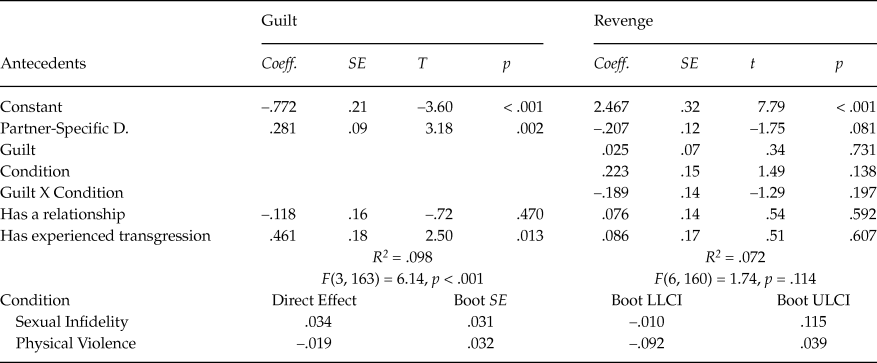
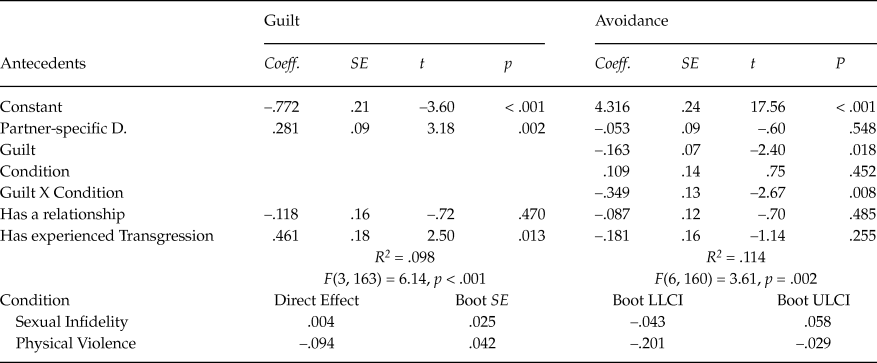
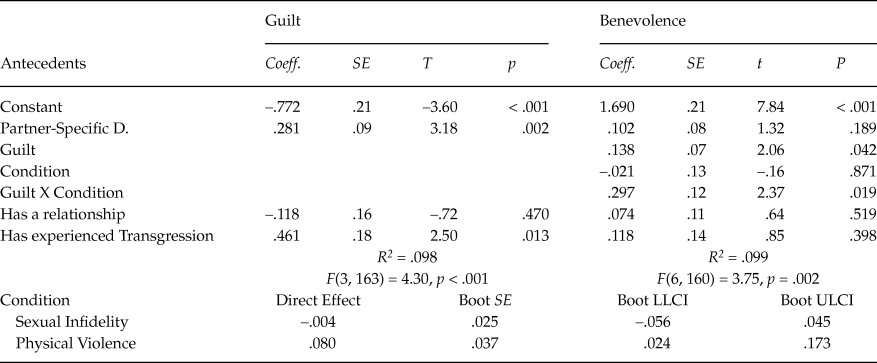
To corroborate the effectiveness of the experimental manipulation, a contingency analysis was first performed using the chi-square statistic. Afterwards, a multivariate analysis of variance (MANOVA) was performed to test the effect of the transgression condition (sexual infidelity vs. physical violence) on forgiveness. Subsequently, to test the initial predictions regarding the effect of the condition and dependency on forgiveness, mainly in violence (vs. infidelity), a hierarchical regression analysis was implemented. Finally, in order to determine whether guilt mediated the relationship between partner-specific dependency and forgiveness, mainly in violence (vs. infidelity), several moderate mediation analyses were performed using model 14 of the PROCESS macro program (Hayes, Reference Hayes2013, see Tables 1, 2, and 3). In these analyses, the fact of whether the participants maintained a relationship or not at the time of the study, as well as whether they had experienced any of the transgressions of interest were included as covariates.
Unstandardized Regression Coefficients, Standard Error and Summary Information for the Moderate Mediation Model 14 ("Revenge")

Note: SE = Standard error; LLCI = Lower level of the Confidence Interval; ULCI = Upper level of the Confidence Interval.
Unstandardized Regression Coefficients, Standard Error and Summary Information for the Moderate Mediation Model 14 ("Avoidance")

Note: SE = Standard error; LLCI = Lower level of the Confidence Interval; ULCI = Upper level of the Confidence Interval.
Unstandardized Regression Coefficients, Standard Error and Summary Information for the Moderate Mediation Model 14 ("Benevolence").

Note: SE = Standard error; LLCI = Lower level of the Confidence Interval; ULCI = Upper level of the Confidence Interval.
Results
Manipulation Check
The results confirmed the adequacy of the experimental manipulation, with 98.9% of the participants who visualized the “Sexual Infidelity” condition identifying the transgression as such, and with 100% of the participants that had visualized the “Physical Violence” condition identifying it correctly, χ2(1, 168) = 165.04, p < .001.
Effect of the type of transgression on forgiveness ("Revenge", "Avoidance", and "Benevolence")
To corroborate whether physical violence is forgiven to a lesser extent than sexual infidelity (Hypothesis 1), a MANOVA was performed with the “transgression condition” as the independent variable (IV), and the subscales of “Revenge”, “Avoidance” and “Benevolence” as dependent variables (DVs). The aforementioned covariables were included in the analysis.
In relation to “Avoidance”, the results did not reveal any main effects of the condition, Wilks’ λ = .960, F(1, 165) = 2.27, p = .134, ηp2 = .014 (M infidelity = 4.00, SD = .88; M Violence = 4.24, SD = .71). Similarly, no major effects were found for the condition of “Benevolence”, Wilks’ λ = .960, F(1, 165) = .97, p = .326, ηp2 = .006 (M infidelity = 2.08, SD = .80; M Violence = 1.92, SD = .66). However, with regard to “Revenge”, a main effect of the condition was obtained, Wilks’ λ = .960, F(1, 165) = 5.85, p = .017, ηp2 = .034, so that, in the condition of physical violence (vs. sexual infidelity), the participants showed a greater motivation of “Vengeance” (less forgiveness) towards the transgressing partner (M Violence = 2.18, SD = .93; M Infidelity = 1.86, SD = .81), thus confirming Hypothesis 1.
The covariables included in the analysis related to whether the participants were currently in a relationship or not, and whether they had experienced any of the transgressions of interest, were not significant.
Effect of the type of transgression and partner-specific dependency on forgiveness
In order to examine Hypothesis 2, that is, whether partner-specific dependency predicts greater forgiveness, mainly in the violence transgression (in comparison to infidelity), a hierarchical regression analysis was carried out. The predictive variables introduced were the transgression condition (0 = sexual infidelity; 1 = physical violence), and partner-specific dependency; and the criteria variables were the dimensions of “Revenge”, “Avoidance”, and “Benevolence”. Likewise, the control variables that were included were whether the participants were currently in a relationship or not (0 = no; 1 = yes), and previous experience of the transgression (0 = no; 1 = yes). To perform the corresponding analysis, all scores were standardized, contrasting in the first step the effects of the covariates, in the second step the main effects of the variables of interest, and in the third step, the second order interactions among the variables.
Firstly, the results showed a simple effect in the dimension of “Revenge”, so that partner-specific dependency predicted “Revenge” (β = –.18, p = .040). That is, the higher the level of partner-specific dependency, the lower the motivation of “Revenge” (greater forgiveness) towards the partner.
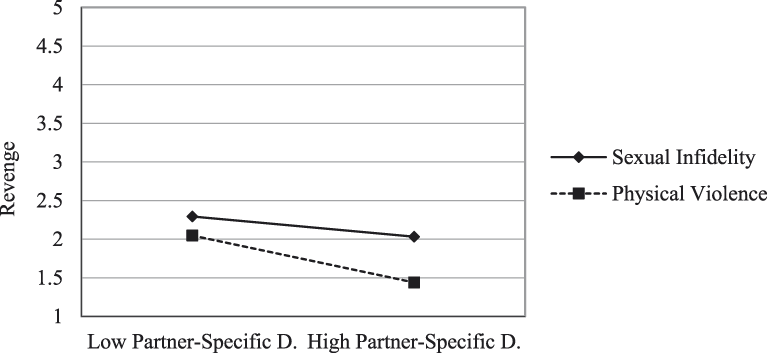
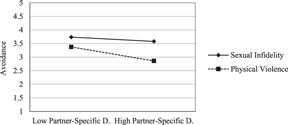
In relation to “Revenge”, the results also revealed a significant interaction between the condition and partner-specific dependency (β = –.23, p = .015), so that, in the transgression of violence, a high dependency predicted a lower “Revenge” (greater forgiveness) compared to a low dependency. With regard to the transgression of infidelity, partner-specific dependency did not predict “Revenge” (see Figure 2). On the other hand, in the “Avoidance” dimension, the results showed a significant interaction between the condition and partner-specific dependency (β = –.24, p = .013), so that, in the transgression of violence, a high partner-specific dependency predicted a lower “Avoidance” (greater forgiveness) compared to a low dependency. In the transgression of infidelity, dependency did not predict “Avoidance” (Figure 3). In addition, the experience with transgression, included as a control variable, was significant for the “Avoidance” dimension (β = –.16, p = .037), so that those who had not suffered any of the transgressions had a greater predisposition to avoid (less forgiveness) the transgressor.
Interaction between the Transgression Condition and Partner-specific Dependency on “Revenge” (Less Forgiveness).

Interaction between the Transgression and Partner-specific Dependency on “Avoidance” (Less Forgiveness)

Regarding the “Benevolence” dimension, the results showed no main effects or interaction effects between the condition of transgression and partner-specific dependency.
These findings corroborate Hypothesis 2.
Mediating effect of guilt between partner-specific dependency and forgiveness, moderated by the type of transgression
In order to verify Hypothesis 3, in which it is expected that guilt is predictive of greater forgiveness mainly in the face of violence (vs. infidelity), a hierarchical regression analysis was performed in which the condition of transgression and the feeling of guilt were the predictor variables, and the dimensions of forgiveness (“Revenge”, “Avoidance”, and “Benevolence”) were the criterion variables. The fact of whether the participants were currently in a relationship, and the previous experience with the transgression were included as covariables.
Regarding “Revenge”, the results revealed a main effect of the condition (β = .19 p = .016), so that, in the face of violence (vs. infidelity), the participants showed greater motivation of “Revenge”, and, therefore, a lower forgiveness towards the transgressor (M = 2.18, SD = .93; M = 1.86, SD = .81, respectively). The results also revealed that guilt predicted “Avoidance” (β = –.21 p = .010), so that higher levels of guilt led to a lower “Avoidance” (greater forgiveness) towards the transgressor. Similarly, as far as “Benevolence” is concerned, the results showed that higher levels of guilt (β = .20, p = .015) predicted a greater “Benevolence” (greater forgiveness) towards the transgressor.
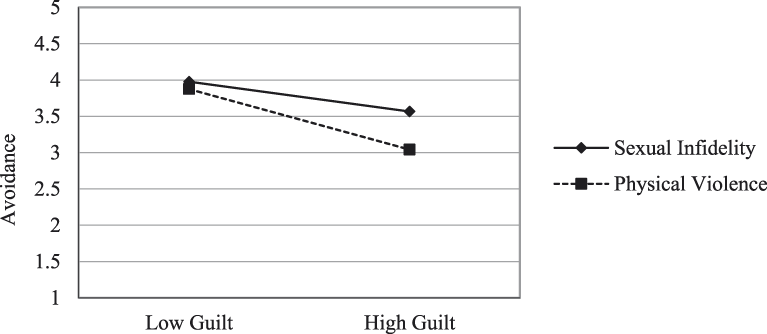
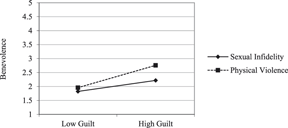
The results also revealed significant interactions between condition and guilt in both “Avoidance” (β = –.21, p = .007), and in “Benevolence” (β = .20, p = .010), noting that, in the face of violence, low levels of guilt predict a greater “Avoidance” compared to a high level of guilt. In addition, high levels of guilt predict a greater “Benevolence” compared to less guilt (see Figures 4 and 5). In relation to infidelity, guilt is not predictive of either “Avoidance” or “Benevolence”. In the same way, and regarding the motivation of “Revenge”, the results showed no interaction effects between the transgression condition and guilt.
Interaction between the Transgression Condition and Guilt on “Avoidance” (Less Forgiveness)

Interaction between the Transgression Condition and Guilt in “Benevolence” (Greater Forgiveness)

Finally, the experience with transgression, included as a covariate, was predictive of “Avoidance” (β = –.16 p = .034). That is, those participants who had never experienced any of the previous transgressions, had a greater motivation to avoid, and, therefore, not to forgive the transgressor, in comparison to those who had experienced one of the transgressions under study (M notexperienced = 4.22, SD = .74; M experienced = 3.88, SD = .91).
On the other hand, and parting from the previous results, in order to examine whether guilt mediated the relationship between partner-specific dependency and forgiveness (“Revenge”, “Avoidance”, and “Benevolence”) mainly in the face of physical violence (vs. sexual infidelity), the Moderate Mediation Model 14 of the macro PROCESS was used (Hayes, Reference Hayes2013). This model allows to prove the indirect effect of dependency on forgiveness through guilt and moderated by the transgression condition. The conditional indirect effect was significant where the confidence interval did not contain the value 0. The fact of whether the participants were currently in a relationship or not, and their experience with transgression were included as covariates.
First, the corresponding analysis of moderate mediation was implemented to examine whether the emotion of guilt mediated the relationship between partner-specific dependency and “Revenge”, showing non-significant results (Table 1). Subsequently, as can be seen in Table 2, the results revealed an effect of partner-specific dependency on guilt, as well as, an effect of guilt on “Avoidance”. That is, a high dependency was related to higher levels of guilt, which, in turn, led to a lower “Avoidance” towards the transgressor. Likewise, the results show that the previous relationship was moderated by the condition of transgression, finding an interaction effect between guilt and the condition of violence (vs. infidelity).
As far as “Benevolence” is concerned, the results show an effect of partner-specific dependency on guilt, and an effect of guilt on “Benevolence” (Table 3). In turn, a high dependency was related to higher levels of guilt, and consequently, leading to a greater “Benevolence” towards the transgressor. As in the previous case, the results show that this relationship was moderated by the transgression condition, evidencing that this effect occurred in the situation of violence (vs. infidelity).
Therefore, and in accordance with the initial predictions, the previous findings ratify Hypothesis 3. Previous experience with the transgression, included as a covariate, affected guilt in the preceding models.
Discussion
The purpose of the present study was to examine how partner-specific dependency and the feeling of guilt contribute towards the offended person ─in particular, women─ forgiving their partner to a greater or lesser extent for different transgressions (physical violence and sexual infidelity).
The results revealed that, on the one hand, the transgression of physical violence provoked a greater motivation of “Revenge”, and, therefore, less tendency to forgive the transgressor in comparison to infidelity. Although both types of transgressions represent an extremely damaging shock to the relationship, it seems understandable that participants adopt a more severe view towards physical violence than for sexual infidelity, and that they deem it more deserving of punishment, given that the sequelae that it causes are more visible and alarming (Messing et al., Reference Messing, Campbell, Wilson, Brown and Patchell2015; Olmstead et al., Reference Olmstead, Blick and Mills2009). Consequently, as an immediate response to the situation of violence that is often perceived as unjust and confusing, the offended person may be motivated by a need for revenge - the result of a lack of forgiveness - which, in the short term, can help combat the pain caused by the transgression (Davidson et al., Reference Davidson, Lozano, Cole and Gervais2015).
In relation to partner-specific dependency, the results show that it predicted a lower “Revenge” and “Avoidance”, and, therefore, a greater forgiveness towards the transgressor in the face of violence (vs. infidelity). People with high partner-specific dependency usually acquire a strong commitment to the relationship and tend to remain in it even though it is not pleasant because they tend to believe that this relationship brings benefits and covers needs that they will not achieve with a different partner (e.g., Rusbult & Martz, Reference Rusbult and Martz1995). This appreciation contributes, in a certain way, to the fact that women suffering from intimate partner violence consent more to an abusive situation (Rusbult & Martz, Reference Rusbult and Martz1995) and, consequently, end up forgiving the transgressor more often. In the same way, previous experience with the transgression affected the dimension of “Avoidance”. Thus, those participants who had not experienced any of the transgressions manifested a greater motivation to avoid, and, therefore, a lesser forgiveness towards the transgressor. In this regard, a phenomenon from which this effect could be justified would refer to the psychological distance with respect to the transgressor, as due to this protection mechanism, people who are not suffering or are distant from something or someone, usually emit more severe judgments about ethically objectionable actions in others (van Boven, Kane, McGraw, & Dale, Reference van Boven, Kane, McGraw and Dale2010).
Finally, the results showed that in the face of violence (vs. infidelity), women with high partner-specific dependency experienced greater guilt, and this in turn, resulted in a greater motivation to forgive the transgressor (less “Avoidance” and more “Benevolence”). Likewise, guilt was affected by the experience with the transgression, with more guilt experienced by those women who had actually suffered the transgression in question. Generally, women who have been victims of intimate partner violence tend to report a greater feeling of guilt, which reflects a lack of self-control and a sense of inability to protect themselves if they are assaulted (Cascardi & O’Leary, Reference Cascardi and O’Leary1992). These findings support previous research that shows that, in the face of negative interpersonal events, women with high dependency suffer greater feelings of guilt, thus increasing a possible resolution of the conflict aimed at maintaining the relationship (Valor-Segura et al., Reference Valor-Segura, Expósito, Moya and Kluwer2014). Moreover, such results provide evidence that, in a situation of physical violence, dependency combined with guilt can be key elements in the decision of the victims to forgive and maintain their abusive relationship. Although it is known that both variables contribute individually to the victim tolerating the abuse (e.g., Buttell et al., Reference Buttell, Muldoon and Carney2005), the role of guilt in relation to dependency and forgiveness in a situation of such characteristics had not been clarified to date.
While it is true that the present study exposes data that go in the expected direction and contribute towards a greater understanding of the process of forgiveness in dysfunctional relationships, there are limitations that should be taken into account in future research. The first of the limitations has to do with the methodology used, as using hypothetical situations, it is sensible to consider the degree to which the scenarios can achieve the spontaneity, precision, and experience of a real situation. However, and despite this drawback, this methodology is used in a variety of areas that simulate social interaction (Collect & Childs, Reference Collect and Childs2011). Similarly, it is possible that viewing the offer to forgive the transgressor after his behavior may have facilitated the ability of the participants to forgive the transgressor ─ affected by dependency and guilt─. This encourages us to think that, although the manipulation was performed through the creation of scenarios, it may have been transferred by the participants to a real couple context. The second limitation refers to the characteristics of the sample, as the intimate relationships that are usually established in this stage are generally of short duration, as well as lesser commitment and future expectations regarding the relationship, as several studies have shown through the use of self-report measures (Zhang, Ting-Toomey, Oetzel, & Zhang, Reference Zhang, Ting-Toomey, Oetzel and Zhang2015). Future studies should aim to solve these limitations, as well as take into account other variables that could affect the results obtained in the present study, such as the degree of responsibility attributed to the transgressor (Fincham, Jackson, & Beach, Reference Fincham, Jackson and Beach2005), and the level of self-esteem of the offended person, or the presence/absence of apologies on behalf of the offender towards the offended person (Fife, Weeks, & Stellberg-Filbert, Reference Fife, Weeks and Stellberg-Filbert2013).
Sexual infidelity and physical violence have been estimated as the most severe and painful transgressions that can occur in a relationship, resulting in very pernicious effects for the offended person - fundamentally women. It is for this reason that it is necessary to note that forgiveness can play a significant role in damaged interpersonal relationships, being mainly relevant in the context of the couple. In the same way, it is essential not to confuse forgiveness - a private act of a moral nature - with reconciliation, the latter referring to the cooperation of the members of the relationship in order to achieve the restitution of such relation.
The main findings show that, faced with a situation of physical violence (vs. sexual infidelity), dependency and the feeling of guilt significantly influence the decision of the offended person to forgive their transgressing partner. These results could have implications for clinical practice suggesting that, essentially in the face of abusive or violent relationships, special attention should be paid to partner-specific dependency in order to reduce the degree of need for the partner and increase personal autonomy. Similarly, the results suggest working simultaneously with dependency and the feeling of guilt in therapeutic practice, in order to eliminate the cognitive dissonance that is usually observed in the victims of intimate partner violence and that enables them to forgive their aggressor. Although it is essential to carry out interventions aimed at increasing forgiveness, whose final purpose would be aimed at mitigating the resentment or hostility resulting in the offended person, and helping them to determine whether they wish to repair or restore the relationship with the offender; it can also be extremely harmful to the person who grants it, even more if said process condemns that person to persist in a relationship with someone who exercises some type of mistreatment over them, such is the case of people who suffer intimate partner violence. Therefore, sometimes, forgiveness may not be so beneficial to the relationship, presenting a difficult dilemma for the offended person to solve.