We do not want to condemn the word. It is, after all, a mighty instrument; it is the means by which we tell each other of our emotions, the way in which we influence others. Words can do immeasurable good and also terrible injuries. It is true that at first there was the deed; the word came later. It was in some respects cultural progress when the deed became word. But the word was originally a spell, a magical act, and it has retained much of its power. (S. Freud Reference Freud and Freud1930)
Identity is the prototype of ideology. (T. W. Adorno Reference Adorno1966: 151)
1 Initial considerationsFootnote 1
In our daily lives, we often encounter combinations of words and images of all kinds. We take them as given, we use them to communicate and interpret information. We communicate with others in many different languages (including sign languages). We engage with new genres, often with interest or scepticism; these confront us almost daily due to rapid, global technological advances.
Thus, we no longer communicate only in ‘traditional’ written or spoken genres, but also using new ones, such as text messages, e-mail, tweets and Facebook posts. These force us to get accustomed to the reduction of geographical distance and of time-spans (‘time-space distanciation’, Giddens Reference Giddens1990: 87–88) due to the globalisation of communication. However, in all available genres, the use of language and communication as a ‘social practice’ enables dialogue, negotiation, argument and discussion, learning and remembering, and other functions.
We also present ourselves to others through our choice of language or language variety. Language choice, and language itself, are part of identity construction (both individual and collective), as has been extensively documented in sociolinguistic research from the 1970s onwards (see Martin Rojo & Grad Reference Martín Rojo, Grad, Dolón and Todolí2008 for an extensive overview). Depending on the context, we almost unthinkingly speak and act in ways appropriate to the situation, because we have learnt how to do this from a young age, in the family, in kindergarten and in our formal education. All human identities are social in nature because identity is about meaning, and meaning is not an essential property of words and things: meaning develops in context-dependent use. Meanings are always the ‘outcome of agreement or disagreement, always a matter of contention, to some extent shared and always negotiable’ (Jenkins Reference Jenkins1996: 4–5). Language and identity thus have a dialectic relationship. Languages and using language manifest ‘who we are’, and we define reality partly through our language and linguistic behaviour (e.g. Anderson Reference Anderson1983; Ricoeur Reference Ricoeur1992; Triandafyllidou & Wodak Reference Triandafyllidou and Wodak2003; Wodak et al. Reference Wodak2009).
The following assumptions are the basis for my research to date:
• Identities are always re/created in specific contexts. They are ‘co-constructed’ in interactive relationships. They are usually fragmented, dynamic and changeable – everyone has multiple identities.
• Identity construction always implies inclusionary and exclusionary processes, i.e. the definition of oneself and others.
• Identities that are individual and collective, national and transnational are also re/produced and manifested symbolically.
But who determines who can speak with whom, and how? Who decides on the norms of language use; who sets these norms and enforces them; who determines whether languages, linguistic behaviour and identities are accepted? Who, for example, decides, in the end, which language and which form of language is ‘good’ enough to pass a language test to attain citizenship or resident status?
We have thus arrived at the issue of power: the power of those who can use language for their various vested interests, as is expressed in the quotations above. Language (and other symbolic systems) is used to determine and define similarities and differences; to draw clear boundaries between ‘us’ and ‘others’. This is because the notion of identity presupposes that there are similarities/equivalences (idem and ipse, Ricoeur Reference Ricoeur1992) and differences. These differences are then evaluated: and thereby an ideological moment is often implicitly (and sometimes also explicitly) introduced through various kinds of categorisation. In political discourse, for example, political posters, advertisements, slogans and other means of persuasive communication are widely used (e.g. in election campaigns). Such powerful language in the hands of politicians serves to persuade people of intentionally established boundaries and, as has been poignantly expressed by, inter alia, Karl Kraus, language can be used to pave the way for physical violence (Klemperer Reference Klemperer2005). Words then become weapons, and words can also be used to legitimate weapons, as has been shown in many detailed studies (e.g. Fairclough Reference Fairclough1989; Chilton Reference Chilton2004; Wodak Reference Wodak2009a, Reference Wodak, Culpeper, Katamba, Kerswill, Wodak and McEneryb).
In this regard three different dimensions of power have been identified (see Holzscheiter Reference Holzscheiter2005): ‘power in discourse’, ‘power over discourse’, and ‘power of discourse’. The first of these means the struggle over meanings and interpretations of terms and discourses. This struggle over semiotic hegemony refers to the choice of ‘specific linguistic codes, rules for interaction, rules for access to the meaning-making forum, rules for decision-making, turn-taking, opening of sessions, making contributions and interventions’ (Holzscheiter Reference Holzscheiter2005: 69).
‘Power over discourse’ generally means access to publics, i.e. the extent to which specific actors become seen and heard (ibid.: 57). And the ‘power of discourse’ implies ‘the influence of historically grown macro-structures of meaning, of the conventions of the language game in which actors find themselves’ (ibid.). These struggles for power are not always visible, but sometimes happen beneath the surface. Here, I follow Steven Lukes (Reference Lukes2005 [1974]: 28), who formulates the ideological-hegemonic aspects of power as follows:
Is it not the supreme and most insidious exercise of power to prevent people, to whatever degree, from having grievances by shaping their perceptions, cognitions, and preferences in such a way that they accept their role in the existing order of things, either because they see it as natural and interchangeable, or because they value it as divinely ordained and beneficial?Footnote 2
The borderlines between us and others are, of course, not set in stone; boundaries can be shifted, allegiances change and are changed, depending on political and other interests. In our transnational and globalised society, borderlines have often been, and still are, very important: borders between states, the border of the Schengen Zone, linguistic boundaries. This raises the questions of which boundaries can be crossed, when, how, and by whom; and moreover, who are the gatekeepers who make and take the decisions on who is allowed to cross boundaries?
In this short reflection on the truly vast field of ‘language, power and identity’Footnote 3, I will only present a few examples from Austria and Europe (and different publics) that highlight the complex relations between these concepts, their instrumentalisation and the constantly redrawn boundaries between them. I will start with an example from the Austrian context that points to the tensions between Austrian German and Standard High German as normatively proposed by the prestige dictionary Der Duden published by the Institut für Deutsche Sprache, Mannheim (IDS) since 1880 (for details of the Duden's history, see www.duden.de/ueber_duden/). This example illustrates how the second Austrian Republic (founded after World War II, in 1945) constructs its national identity partly via top-down language policies. I will then briefly consider the concepts of language policy and language ideologies. Both necessarily influence and define the prestige and value of languages (in a/the linguistic market; see Bourdieu Reference Bourdieu1992; Unger Reference Unger2009) and impinge on individual and collective identity-politics. Via language policies, certain languages, genres and discourses (and their users) acquire more or less prestige and power. In the third part of this paper, I illustrate the effect of power via language and discourse by summarising some results of a large study of discrimination against migrants: more specifically, I will present ‘voices of migrants’ collected via focus group discussions in which problems encountered with second language acquisition are debated (Delanty, Wodak & Jones Reference Jones, Krzyżanowski and Delanty2008; Jones & Krzyżanowski Reference Jones, Krzyżanowski and Delanty2008). The experiences of migrants clearly show how their individual identity constructions relate to, and depend on, their language skills and on the many ways the latter are either accepted and respected, or rejected. Finally, I turn to the gatekeepers who decide on access to working permits and residence of migrants by introducing language tests as precondition for entering a country. Here, I draw primarily on EUDO (the European Union Democracy Observatory on Citizenship at the European University Institute, Florence)Footnote 4 and on a recent study published by the Council of Europe (2010). In my conclusions, I return to the assumptions mentioned above, and discuss the mid-term and long-term effects of ‘language, power and identity’ on some aspects of language teaching and language learning with respect to migrants and migration.
2 ‘Jam or Jelly’
Protocol no. 10 of the Austrian Treaty of Accession to the European Union (EU) contains a paragraph which allows the use of 23 terms in both High German (i.e. ‘the German language as used in Germany’) and Austrian German:
The specific Austrian terms of the German language contained in the Austrian legal order and listed in the Annex to this Protocol shall have the same status and may be used with the same legal effect as the corresponding terms used in Germany listed in that Annex.
This ruling was the result of extensive debate during the accession negotiations, in which many fears became apparent (see de Cillia Reference De Cillia1998; Wodak et al. Reference Wodak, de Cillia, Reisigl and Liebhart2009). Would accession mean that Austrian German would disappear? And thereby also the hard-won new Austrian identity? This is how the accession was viewed by many Austrian citizens before the referendum for accession in 1994; the relationship between language and identity was made very explicit. The Annex to the accession treaty listed those 23 Austrian words and their German counterparts, for example: Beiried/Roastbeef; Eierschwammerl/Pfifferlinge [chanterelles]; Erdäpfel/Kartoffeln [potatoes]; Faschiertes/Hackfleisch [minced meat]; Fisolen/Grüne Bohnen [green beans]; Grammeln/Grieben [crackling]; Karfiol/Blumenkohl [cauliflower]; Kohlsprossen/Rosenkohl [Brussels sprouts]; Kren/Meerrettich [horseradish]; Lungenbraten/Filet.
A new regulation (EU Regulation 10/2003), which stated that the term Konfitüre [jam] should be used instead of Marmelade (a term which is used for both jam and marmalade in Austria), caused a veritable ‘media war’. The Neue Kronenzeitung, the tabloid with the largest distribution in Austria, started a media campaign under the front page headline in huge bold letters ‘EU Marmalade diktat must go!’ (NKZ, 20.10.2003) (the original can be found at http://journals.cambridge.org/lta).
There were daily appeals to politicians to support Austria's position; in these appeals the inclusive ‘we’ clearly expresses the assumption that all the readers of the NKZ (and thus the majority of Austrians) identified with the campaign. The term Marmelade thus became an important symbol of Austrian identity:Footnote 5
‘Appeal to Minister: “Fight for our marmalade!”’ (22 October, 2003, p. 13)
‘We won't let our marmalade be taken away!’ (21 October, 2003, pp. 10–11)
‘New signal from Brussels: EU leaves us our marmalade!’ (23 October, 2003, headline, p. 1).
On 14 March 2004, the NKZ could finally announce its proud ‘victory’ in the weekly column of well known reporter Jeanée (to see the original got to http://journals.cambridge.org/lta, ‘Supplementary material’): A man (who remains anonymous but is clearly Austrian, and was obviously involved in the struggle for the Austrian German label) is portrayed, holding up his arms and making a victory sign with both hands. The headline states: ‘The winner of the marmalade war’ (NKZ, 30–31). Below the photo, the ‘winner’ is quoted, stating with a huge smile on his face: ‘The EU protects the term Wachauer Marille [apricot from the Wachau region], but wants to make “fruit spread” out of them. No way!’
This example clearly shows the powerful emotional associations language can have for people, and how closely everyday expressions are connected with identity construction. Furthermore, it shows how important many Austrians find it to draw boundaries between the Austrian and German varieties of the German language, and also between Austrian and German identities. Finally, the power of certain media in the re/production of struggles for hegemonic identity narratives and/or constructions is clearly demonstrated.
Language and language choice are thus strongly influenced by ideology. In sociolinguistics the term language ideologies is used for this phenomenon. In the following section, I briefly discuss the concepts of ‘language policy’ and ‘language ideology’ and provide an overview of relevant language policies proposed by the European Union. After this, the effects of such policies will be discussed, by listening to the voices of migrants and discussing the language tests put forward by some EU member states as thresholds for migrants to acquire residence and/or citizenship. Obviously, in the latter cases, language competence in the national language functions as a gatekeeper in the hands of powerful elites.
3 Multilingualism and identity: language ideologies and language planning
3.1 Language policies and language ideologies
For the purposes of this lecture, let me briefly review the concept of ‘language policies’, a concept clearly related to the status of multilingualism in any given society. Following Herbert Christ (Reference Christ, Bausch, Christ and Krumm1995: 75), I view language policy as
every public influence on the communication radius of languages, the sum of those ‘top-down’ and ‘bottom-up’ political initiatives through which a particular language or languages is/are supported in their public validity, their functionality and their dissemination. Like all policies it is subject to conflict and must regularly be re-ordered through constant discussion and debate. (Christ Reference Christ1991: 55)
This fluid and negotiation-based conception of language policy relates well to the conception of language put forward by Shohamy (Reference Shohamy2006) in her critical framework for language policy. As Shohamy argues, language is not ‘stagnated and rule-bound’ (ibid.: xvi) but primarily ‘personal, open, free, dynamic, creative and constantly evolving’ (ibid.). For this reason, language (or its more general policy or context-specific regulation) cannot be ‘owned’ by any individuals or groups and cannot – and should not – be dominated by individual or collective aims and interests. Language policy should thus not be an instrument of hegemony or of the imposition or exercise of power over individuals or social groups.
Moreover, it is clear that language should not be viewed as ‘a tool’ in the creation of what Gal (Reference Gal2010) defines as sociolinguistic regimes. As Gal argues, the EU has gradually become a typical late-modern sociolinguistic regime in the Foucauldian sense which, though officially multilingual, conceives of its multilingualism in rather limited ways. Gal claims that the EU can indeed be considered a ‘top down regime of multilingual standardization that tries to manage increased diversity in the same ways nation states managed non-standard varieties’ (ibid.). In this context, Gal enumerates a set of ‘constitutive others’ which includes ‘minority languages, migrant languages and vehicular languages (lingua francas, mainly English)’ (ibid.).
While drawing on critical approaches to language policies and language planning such as those proposed by Shohamy and others (e.g. de Cillia, Krumm & Wodak Reference De Cillia, Krumm and Wodak2003; Phillipson Reference Phillipson2003; Spolsky Reference Spolsky2004; Wright Reference Wright2004, Reference Wright2010; Ricento Reference Ricento2005), this paper also applies the concept of language ideologies as elaborated widely in sociolinguistics and linguistic anthropology. At a more general level, language ideologies can be defined as ‘cultural ideas, presumptions and presuppositions with which different social groups name, frame and evaluate linguistic practices’ (Gal Reference Gal, Mar-Molinero and Stevenson2006: 13). At the level of micro-interactions, they must however be conceived of as (re-)constructed and negotiated in debates ‘in which language is central as a topic, a motif, a target, and in which language ideologies are being articulated, formed, amended, enforced’ (Blommaert Reference Blommaert and Blommaert1999: 1). Such language-ideological debates are apparent in both public and semi-public spheres. Accordingly, language ideologies are ‘produced in discourses, in news media, in politics, in narratives of national belonging, in advertising, in academic text, and in popular culture’ (Blackledge Reference Blackledge2005: 44).
3.2 European and national language policies
Let me now move on to the European level: the equal status of all national languages as official languages within the EU and, theoretically, also as working languages, has been discussed repeatedly since the founding treaties were signed. In the same way, European multilingualism has been seen as an essential component of the future construction of a European identity/European identities, and of the preservation of national, regional, local, societal and individual multilingualism. The importance of language learning, for example, has repeatedly been stressed by various European authorities in declarations of political intent on matters of language, education and pedagogy (e.g. Article 2 of the European Cultural Convention, 19 December 1954; ‘Recommendation 814 on Modern Languages in Europe’ of the Council of Europe, 5 October 1977; the KSZE final document of 1 August 1975). In the treaties of Maastricht and Amsterdam 2000, the EU committed itself to European multilingualism, which was echoed by the Council of Europe's Resolutions by the Committee of Ministers and Parliamentary Assembly (PACE) ‘Recommendation concerning modern languages (98) 6’ (see www.coe.int/t/dg4/linguistic/migrants2_EN.asp). The last of these warns explicitly ‘of the dangers that might result from marginalisation of those who lack the skills necessary to communicate in an interactive Europe’ (ibid.) and states inter alia in its Appendix that
[S]teps should be taken to ensure that there is parity of esteem between all the languages and cultures involved so that children in each community may have the opportunity to develop oracy and literacy in the language of their own community as well as to learn to understand and appreciate the language and culture of the other. (ibid.: Appendix 2.2).
The recommendations (in the Appendix) also stress that governments should ‘[C]ontinue to promote bilingualism in immigrant areas or neighbourhoods and support immigrants in learning the language of the area in which they reside’ (ibid.: Appendix 2.3). It is important to emphasise that the Council of Europe endorses a more nuanced notion of plurilingualism than the European Union (i.e. the Commission).
Nevertheless, in the White Paper on Education and Training, issued by the European Commission, it was stated that ‘[L]anguages are also the key to knowing other people. Proficiency in languages helps to build up the feeling of being European with all its cultural wealth and diversity and of understanding between the citizens of Europe.’ (European Commission 1995: 67 (my emphasis)).
Between 2005 and 2007, the EU recognised the importance and relevance to policy of language and multilingualism by adding a multilingualism portfolio to the remit of the Union's Commissioner on Education and Culture. The key document of that period – ‘The new framework strategy for multilingualism’ (European Commission 2005) – argues for the Commission's ‘commitment to multilingualism in the European Union’ (ibid.: 1) and for ‘promoting multilingualism in European society, in the economy and in the Commission itself’ (ibid.). By arguing that multilingualism is not only good for the European economy but also for a ‘social Europe’ and for the democratisation of the EU, it places multilingualism between major EU discourses: the discourse on democratisation, and the discourse on the knowledge-based economy. In the same period the EU also proposed – for the first time – a policy-relevant definition of multilingualism. It argues that ‘multilingualism refers to both a person's ability to use several languages and the co-existence of different language communities in one geographical area’ (ibid: 3). This definition thus relates multilingualism to a rather abstract discourse of identities and values:
the Commission considers that the situation can and must improve and therefore urges Member States to take additional measures to promote widespread individual multilingualism and to foster a society that respects all citizens’ linguistic identities. (European Commission 2005: 15)
Moreover, the document states that:
The European Union is founded on ‘unity in diversity’: diversity of cultures, customs and beliefs – and of languages. (. . .). It is this diversity that makes the European Union what it is: not a ‘melting pot’ in which differences are rendered down, but a common home in which diversity is celebrated, and where our many mother tongues are a source of wealth and a bridge to greater solidarity and mutual understanding. (ibid.: 2)
In 2007, however, in the discourses related to the Lisbon Strategy of the early 2000s, we witness a (return to) rhetoric oriented towards skills and competences (see Krzyżanowski & Wodak Reference Wodak, Krzyżanowski, Auwera and Kortmann2011):
Improving language skills in Europe is also an important objective within the drive to improve the skills and competences of the population as part of the Lisbon growth and jobs strategy. (European Commission 2007: 2)
In a salient document in 2008 (European Commission 2008), multilingualism is conceptually divided into five areas. The first of them, ‘Multilingualism for intercultural dialogue and social cohesion’ (2008: 6), constitutes a clear departure from Lisbon and the reinstatement of social and intercultural aspects of multilingualism. Even a ‘democratic’ element of discourse appears within the latter to show that
[A] basic feature of citizenship is that people living in a local community can benefit from the services available and are able to contribute to the life of their neighbourhood. Tourists, foreign workers or students, and immigrants often come to local communities with limited proficiency in the national language. (European Commission 2008: 6)
The following two areas – devoted to ‘multilingualism for prosperity’ and languages and multilingualism in ‘lifelong learning’ (ibid.: 8–12) – reinstate the Lisbon-based discourse. We then encounter an area devoted to ‘the media, new technologies and translation’ (p. 12ff) and, finally, the ‘external dimensions of multilingualism’ (p. 14) are introduced. Multilingualism is defined as a potential tool for developing the Union's external relations. In sum, it is clear that the European Multilingualism Strategy has recently adopted a new and broader understanding of the social, political and economic role of languages and multilingualism. Sadly, in the wake of the 2008 crisis and because of the transfer of the Multilingualism Portfolio of the European Commission to Education, Culture and Youth in 2010, most of the key provisions of the policies elaborated above have not yet been implemented. It is, however, clear that multilingualism and the support of both individuals’ and collectives’ language identities form part and parcel of European language policies. Many aspects of these policies – as will be illustrated below – go against national language policies in some EU member states. These national policies, moreover, have a major influence on how migrants from non-EU countries are dealt with.
In fact, many national politicians endorse the so-called Leitsprachenmodell (a model which proposes that the language of the majority or of the dominant group should serve all communicative purposes). This, however, contradicts official proposals on diversity, intercultural communication and integration, as well as the European language policies mentioned above, which emphasise multilingualism, the equality of languages and diversity, as proposed by the Council of Europe and the European Commission. As Michael Clyne states,
[E]uropean integration was never intended to mean homogenization. One of its aims has always been unity within diversity and this should be one of its contributions to the world. (Clyne Reference Clyne, de Cillia, Krumm and Wodak2003: 40)
It is certainly important to know the language of the majority or the context in which it is used; what is problematic from the perspective of diversity and integration is if the dominant language comes to be viewed as the only relevant language. Competence in this language is made compulsory for success (see the implications for migrants, below). The gatekeepers demand the national language from those who wish to enter; and the language issue, as has been proved in multiple studies on migration in EU countries, is one of the most important factors for migrants with respect to access to employment, housing and education (Delanty et al. Reference Delanty, Wodak and Jones2008). The debates about the recontextualisation of official European language policies into ‘National Action Plans’ are, of course, related to language ideologies and to collective, national and individual identities (Falkner et al. Reference Falkner, Treib, Hartlapp and Leiber2005; Wodak & Fairclough Reference Wodak and Fairclough2010).
4 Borders: language and migration
As stated above, there has been increasing public debate about migration and about restrictions on migration in recent years. In EU countries, specific terms with very different meanings, such as ‘asylum seeker’, ‘refugee’ and ‘migrant’, are used interchangeably, and are frequently collapsed into the single category of ‘foreign’ or ‘other’. This is despite the very clear definitions of these terms found in legal documents and discourse on human rights (see Baker et al. Reference Baker, Gabrielatos, KhosraviNik, Krzyżanowski, McEnery and Wodak2008; Wodak & Köhler Reference Wodak and Köhler2010). Fear of foreigners is constructed; they are then perceived as dangerous, and are blamed for many problems. Foreigners are, in other words, the scapegoats of the present era!
Of course not all foreigners are treated equivalently. There is a clear ranking, both implicit and explicit, of who is considered dangerous. In Austria, people from Africa, from Turkey and from the Middle East are stigmatised. This applies even if they have lived in Austria for a long time, speak and write excellent German, and have long been Austrian citizens.
In the following passage, I quote a young Austrian (second generation, child of former Turkish migrants), to allow her to express her views on this topic in her own words (originally uttered in German):
Text 1:
Well, I for example feel in the middle. I feel I am neither a foreigner nor, well, I don't know. Sometimes, when for example I am among Austrians, I feel I am a foreigner, because – I am not a – I don't know – not a pure foreigner. I'm only born here, but my roots are in Turkey. And yeah, because of that, I only know life here, not how it is there, that is why – I don't know – when I go there I feel somehow different, because they are also – for example I can't speak Turkish that well and so on. And well, when I go there, they say that well, I'm born over there and so on. So when I come here they say well I'm just a Turk. I'm not a Turk, but, I am one too [laughs] I wouldn't say that I'm not one, but I feel – I feel in the middle, I don't know, I feel. . .
This text, collected as part of the EU project ‘XENOPHOB’, was uttered, recorded and transcribed in a focus group in Vienna. It shows the great ambivalence the girl feels towards her own identity: she feels she does not belong anywhere, is not integrated or accepted anywhere, and therefore does not know how to define herself.Footnote 6 The ambivalence is especially noticeable in the use of the deictic terms ‘here’ and ‘there’, where it is at first unclear which she means by each word: Austria or Turkey. Her emotional involvement is further explicitly marked by the many hesitations in the text, and suggests both conscious and unconscious difficulties in feeling fully ‘at home’ anywhere (Krzyżanowski & Wodak Reference Wodak2007). This example is quite typical: many children of former migrants, despite being Austrian citizens, experience borders that they cannot cross. They are often not accepted in their peer groups and face numerous instances of ‘everyday’ racism through official agencies and in their workplace.
Text 2:
Once here I went in and I had to iron something. And one girl opposite us and she said – eh we talked with her – she started saying speak German with her – why is this your business what I'm saying but I just don't listen me. Austria, I said, is free country where one can do what one wants I had an argument with her right away like, and the teacher, Mrs (Name) told me to stop it. I had, I was so furious I really wanted to – kill her I mean why is she interested in what I'm saying now. Totally that is my – own thing.
Text 2, also taken from a focus group in Vienna, clearly expresses the relationship between mother tongue and identity in a dramatic account. The young Austrian girl (second generation, child of former Turkish migrants) is ‘furious’ that someone wants to forbid her from using her language. She wants to speak however she pleases; after all, this is her ‘own thing’. She also uses an argument that proves her emotional attachment and successful integration into Austrian society: Austria is a free country, where ‘one can do what one wants’. This is an invocation of the democratic rights that are the entitlement of every Austrian citizen.
Many other statements by former migrants or Austrian citizens with a migrant background describe similar events. They also frequently describe how a good knowledge of German is not nearly enough to get a job. Jones & Krzyżanowski (Reference Jones, Krzyżanowski and Delanty2008) (see Figure 1) summarise the many obstacles that migrants must overcome before they can be truly accepted and integrated and also feel that this is the case. Membership of groups of various kinds is only given where there is recognition and acknowledgement. There are implicit and explicit thresholds that must be passed. Only then can attachments become true acceptance.
Stages of membership acquisition (adapted from Jones & Krzyżanowski Reference Jones, Krzyżanowski and Delanty2008: 41)

5 Citizenship, migration, and power
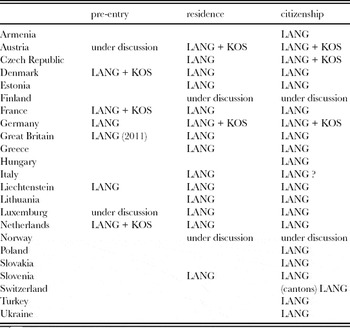
To conclude my – necessarily brief and condensed – discussion of migration and migrants in relationship to aspects of language, power and identity, I list some current regulations for the acquisition of residence and/or citizenship by migrants from non-EU countries in various EU member states as well as other European states, and discuss their implications for migrants. Here, I draw on the most recent documents published by EUDO, and on a survey which the Working Group: Linguistic Integration of Adult Migrants (from the Language Policy Division of the Council of Europe) conducted in 2009 in 44 European countries (thus including more than the 27 EU member states)Footnote 7. These survey data were analysed by Claire Extramiana and Piet van Avermaet and presented at an intergovernmental conference in Strasbourg on 24–25 June, 2010. It is notable that several states have significantly more and better provision than others for language lessons and second language acquisition. In other words, the legal requirements for the acquisition of citizenship and residency are not standardised across EU member states and Europe, but are determined, as mentioned above, by individual states.
Moreover, recent research into European citizenship policies (not specifically their language aspect) argues that governments tend to approach immigration as either a threat or an opportunity (Bauböck et al. Reference Bauböck, Ersboll, Groenendijk and Waldrauch2006, Modood, Triandafyllidou & Zapata-Barrero Reference Modood, Triandafyllidou and Zapata-Barrero2006). With regard to language, a general trend is that states that wish to encourage immigration (e.g. Romania, Poland and Hungary) place less emphasis on language and assessment than states that perceive immigration as a ‘problem’ (e.g. Austria, Finland, United Kingdom, Denmark, the Netherlands, France and Germany). Language and assessment procedures may be employed as an instrument of control, with language tests a legal requirement for some ‘groups’ but not others.
Some examples illustrating the variety of approaches and social contexts involved across 23 European states (17 EU member states, plus Armenia, Liechtenstein, Norway, Switzerland, Turkey and Ukraine) are summarised in Table 1 (here, I draw again on the research of Extramiana & Avermaet (Reference Extramiana and Van Avermaet2010); see above).
Language requirements for entry, residence and citizenship in European countries

LANG = language requirements
KOS = knowledge of society course/test
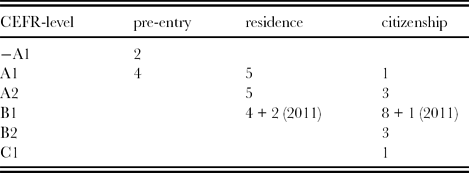
Table 2 shows how many countries require each CEFR level. For details of the CEFR levels and the criteria defining different levels of proficiency at all levels of language and communication, from lexicon to text and interaction, see www.coe.int/T/DG4/Portfolio/?L=E&M=/documents_intro/Data_bank_descriptors.html):
Numbers of European countries requiring each CEFR level
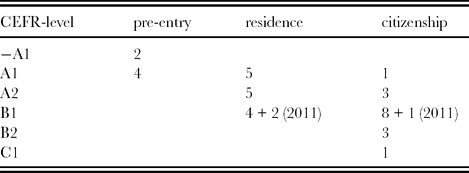
As Tables 1 and 2 illustrate, six European countries required A1 proficiency for entry in 2010, Austria and Luxemburg are currently discussing this requirement, and related laws will be decided upon in 2011; Great Britain has already opted for this by 2011. States are thus working independently to establish their own thresholds. According to Van Avermaet (Reference Van Avermaet2010), by 2009, 75% of the Council of Europe member states responding to the survey (23/31) had a language requirement as part of their integration regulations. The same percentage (75%) was found for 2007, but for 21 countries out of the total of 27 responding. Linguistic requirements have thus increased by at least 10% for all the stages: before entry to the host country (prospective migrants), for permanent residents (those who are already residing in the country), and for citizenship. Indeed, there has been a 20% increase in countries that have linguistic requirements for citizenship.
In 2007, 62% (13/21) of the countries covered by the survey provided language courses, and in 46% (6/13) of these countries, the course was obligatory. In 2009, 82% (19/23) provided language courses, in 42% (8/19) it was obligatory and in 58% (11/19) optional. In terms of language tests, in 2009, 65% (15/23) of countries had an obligatory language test for permanent residency and citizenship. The establishment of such entry and citizenship requirements for migrants implies, of course, that adequate language courses and materials are available and accessible, and also that prospective immigrants have enough money to pay for such language courses in their countries of origin and in the host countries. In this way, some migrants are inevitably discriminated against, namely those from rural areas, who are less educated, have less money, and do not work in Schlüsselberufe (‘essential jobs’). As will be illustrated below in the brief discussion of the Austrian case, the newly introduced Rot-Weiss-Rot Card (via the (Austrian) Action Plan for Integration, 2010, which stipulates Level A1 proficiency as an entry requirement) will become available for very highly educated young migrants without proficiency in German.
With regard to citizenship, Bauböck & Wallace Goodman (Reference Bauböck and Wallace Goodman2010) review the changes in legal requirements for naturalisation since the 1990s and conclude that:
[R]esidence conditions for ordinary naturalisation in 33 European states vary between three years (Belgium) and twelve years (Switzerland). Additional conditions for permanent residence exclude many highly mobile migrants. A minority of 15 states still require renunciation of a previously held citizenship; four of these either do not enforce renunciation (Spain), or make many exceptions (Germany, the Netherlands and Poland). There is a trend towards formal tests of language skills and civic knowledge. In 1998 six states had tests of either kind, in 2010 these are 18. Only five states define ordinary naturalisation as a legal entitlement of the applicant rather than as a discretionary decision of public authorities. 16 states offer facilitated naturalisation not only to close relatives of citizens, but also to persons who are perceived as ethnically or linguistically related to the majority population. (p. 1)
Let me again turn to Austria, as an example: There, the ‘Integration Agreement’ (2003) obliges applicants for permanent residence (other than asylum seekers and refugees, whose status is regulated by different laws) to complete a Deutsch-Integrations-Kurs (German Integration Course). Applicants were required to reach Level A1 of the six levels identified in the CEFR (see Table 2) within 100 sessions of 45 minutes. Applicants had to pass the test within 18 months of arriving in order to have 50% of their costs refunded by the Austrian government. If the applicant continued to fail, did not take the exam or did not attend the course, they were subject to fines and eventually lost their residence permit. This was the first time that the Austrian government had given financial support to immigrants for learning German.
As mentioned above, these requirements have now changed, and by 2012, migrants to Austria will have to acquire the Rot-Weiss-Rot Card before entry. Most migrants (except highly qualified ones) will have to demonstrate language proficiency at A1 level before entering Austria and must reach the C2 level of proficiency after 24 months of residence (see www.oe24.at/oesterreich/politik/Rot-Weiss-Rot-Card-fuer-Auslaender/1503102 for details). Moreover, in October 2009, the Austrian Parliament also approved a bill amending the Asylum Law, the Aliens’ Police Law, the Settlement Law and the Nationality Law, with severe consequences for the acquisition of Austrian citizenship. The new regulations came into force on 1 January, 2010. The most significant changes are as follows:
• Requirement for sufficient income: Acquisition of Austrian nationality depends on proof of regular and sufficient income. In addition, applicants must not have received social welfare assistance for the three years preceding the application for naturalisation. Since 2010, regular expenditures for rent, loan repayment, attachment of earnings or alimony payment must be taken into account when calculating an applicant's income level. Thus, the amendment raises the level of disposable personal income necessary for naturalisation.
• Citizenship fraud: The amendment introduces a new regulation. Obtaining nationality by fraud can entail a fine in the range of €1–5,000 or imprisonment of up to three weeks. In such cases, making use of health, accident or retirement insurance benefits or drawing social assistance can be punished by imprisonment for up to one year. If the benefits amount to more than €3,000, the person can be imprisoned for up to three years.
• Citizenship test: Since the introduction of a citizenship test in 2006, the nationality law provides for exemptions from that test for minor children, the elderly or those who are permanently sick. The new amendment adds a further exemption: foreign nationals with an Austrian school-leaving certificate that includes the subject of history and civics (Geschichte und Sozialkunde) at least at the level of grade four of secondary school (Hauptschule) do not need to take the citizenship test. Thus, adults with an Austrian school certificate are no longer required to take the citizenship test.
• Oath of loyalty: Successful naturalisation candidates must swear that they will be loyal citizens of the Republic. Since 2010 the oath has also included a commitment to the ‘core values of a European democratic state and society’. See http://eudo-citizenship.eu/citizenship-news/224-austria-changes-its-nationality-asylum-aliens-police-and-settlement-regulations for details.
This brief summary of the Austrian case is a good example of ever tougher regulations governing migration and of the introduction of language proficiency as a significant threshold for entry into the country. Both residence and citizenship legislation have thus become much more restrictive in recent years. In this way, language proficiency has been clearly attributed the status of a powerful ‘gatekeeper’, along with other factors such as education, money, profession and age.
6 Concluding remarks
In the necessarily brief discussion above, it has not been possible to fully discuss the complex terms ‘language, power and identity’. Despite this, I hope it has become clear how closely these three are connected, how the discursive construction of identities is influenced by vested interests, and how identities are thus continually re- and co-constructed and negotiated. However, these co-constructions operate within clear borders created in politics, in the economy and in legal frameworks. I have discussed public media, where particular opinions and prejudices are re/produced and passed on. However, I have also given the affected groups their say. Finally, I have briefly outlined the legal frameworks which confront us in EU member states (and other European states) and which (partly) determine the conditions that might make multilingualism and integration possible – or impossible. The contrast between policy regulations and the ‘voices of migrants’ allows the exposition of the many inherent contradictions in the search for European identities and related values, as stated in the Charter of Fundamental RightsFootnote 8. Parameters for determining exactly who is (or can become) a ‘resident’ and/or a ‘citizen’ are at present unresolved, with little consensus across the states. Two established criteria for determining citizenship, common in policy discourse, are birthplace and bloodline (Weil Reference Weil, Aleinikoff and Klusmeyer2001; ius soli and ius sanguinis). However, with the recent appearance of new states in Europe and the flow of populations across state boundaries, a new criterion centred on proficiency in the official language(s) of a state has emerged. Unlike the former two criteria, this is an attribute that can be acquired and has come to be seen as central to facilitating ‘integration’ (Carrera Reference Carrera2006).
Sociolinguists and other experts are unfortunately not yet sufficiently involved in advising the bureaucrats who establish such legal requirements in the various states. Rarely do discussions, research or proposals from the European Commission and Council of Europe actually reach national governments. And even more rarely are they taken into account in devising new legislation, or implemented in their original sense. The acquisition of language proficiency is apparently frequently perceived as being solely in the interests of migrants and not also in the interests of the host country, as well as being the host country's responsibility. Moreover, many politicians still have to be convinced that second language acquisition depends on the availability of professional teachers, good teaching materials and sufficient competence in one's native language (see Leung Reference Leung, Wodak, Johnstone and Kerswill2010; Piller & Takahashi Reference Piller, Takahashi, Wodak, Johnstone and Kerswill2010). Acceptance of, and respect for, migrants’ identities are important preconditions for second language acquisition and integration. Unfortunately, the worlds of language experts and politicians (and their bureaucrats) remain far apart, and much dialogue would be required to bring them together.
In creating language tests of various kinds, language competence has acquired the status of a key gatekeeper – providing access for some and rejecting it for others. There are certainly no easy recipes for dealing with second language acquisition and migration. However, it is clear that we must acknowledge the close, emotional relationship between language and identity, and take account of it in the many political and educational policy decisions made every day.
Note
Supplementary material accompanies this paper on the journal's website (http://journals.cambridge.org/lta).
Ruth Wodak has been Distinguished Professor of Discourse Studies at Lancaster University since 2004. Among other prizes, she was in 1996 awarded the Wittgenstein Prize for Elite Researchers. Her research interests focus on discourse studies, multilingualism, language and/in politics, and prejudice and discrimination. She is co-editor of the journals Discourse and Society (Sage) and Language and Politics (John Benjamins), and of the book series Discourse approaches to politics, society and culture (DAPSAC). She has held visiting professorships at Stanford University, the University of East Anglia, and Georgetown University (amongst others), and is member of the Austrian Academy of Sciences and the Academia Europaea. Among her recent book publications are Ist Österreich ein ‘deutsches’ Land? (with R. de Cillia, Studienverlag, Reference De Cillia, Fill, Marko, Newby and Penz2006); The politics of exclusion (with M. Krzyżanowski, Transaction Publishers, 2009) and The construction of politics in action: ‘Politics as Usual’ (Palgrave Macmillan, 2009).