Introduction
Some of the basic principles of mental health care are that persons with mental health disorders should be provided with the least restrictive health care and should exercise self-determination with regard to their treatment (World Health Organization, 1996). Though this guideline generally is widely accepted, a significant number of patients are admitted on a compulsory basis to psychiatric hospitals throughout Europe (Priebe et al. Reference Priebe, Badesconyi, Fioritti, Hansson, Kilian, Torres-Gonzales, Turner and Wiersma2005; Mulder et al. Reference Mulder, Broer, Uitenbroek, van Marle, van Hemert and Wierdsma2006; de Stefano & Ducci, Reference de Stefano and Ducci2008; Keown et al. Reference Keown, Weich, Bhui and Scott2011; Health & Social Care Information Centre, 2015; Juckel & Haußleiter, Reference Juckel and Haußleiter2015), with Switzerland presenting one of the highest numbers of such patients in European comparative terms (Salize & Dressing, Reference Salize and Dressing2004; Gassmann, Reference Gassmann2011; Lay et al. Reference Lay, Nordt and Rössler2011). In Switzerland, unlike in other countries, there was no involuntary outpatient commitment up until 2013. The legal basis for compulsory admission is regulated by the Swiss Civil Code, but implementary regulations are on a Federal State (‘cantonal’) level. According to those of the Canton of Zurich, e.g. all physicians are authorised to mandate compulsory admission to psychiatric care.
An increasing body of research over the past years highlights the impact of coercive practices such as involuntary hospital admission. For most patients admitted compulsorily, improvements in symptoms and/or functioning at discharge have been reported (Katsakou & Priebe, Reference Katsakou and Priebe2006). A prospective multicentre study suggests, however, that outcomes over a 1-year period, in terms of the clinical and social benefits patients experience following involuntary admission and subsequent treatment, are on average rather limited (Priebe et al. Reference Priebe, Katsakou, Yeeles, Amos, Morriss, Wang and Wykes2011). There are also several negative effects of compulsory hospitalisation. For most patients involuntary treatment is a negative experience (Thornicroft et al. Reference Thornicroft, Farrelly, Szmukler, Birchwood, Waheed, Flach, Barrett, Byford, Henderson, Sutherby, Lester, Rose, Dunn, Leese and Marshall2013) and a substantial number of involuntary patients retrospectively do not feel that their admission was fair, justified or beneficial (Katsakou & Priebe, Reference Katsakou and Priebe2006; Jäger & Rössler, Reference Jäger and Rössler2010). Moreover, compulsory admission may affect the therapist–patient relationship adversely and be associated with a subjective lack of improvement (Bonsack & Borgeat, Reference Bonsack and Borgeat2005; Katsakou et al. Reference Katsakou, Bowers, Amos, Morriss, Rose, Wykes and Priebe2010; Kallert et al. Reference Kallert, Katsakou, Adamowski, Dembinskas, Fiorillo, Kjellin, Mastrogianni, Nawka, Onchev, Raboch, Schutzwohl, Solomon, Torres-Gonzalez, Bremner and Priebe2011; Priebe et al. Reference Priebe, Katsakou, Yeeles, Amos, Morriss, Wang and Wykes2011). Perceived coercion is linked to (lower) treatment satisfaction and (less frequent) utilisation of mental health services and medication (Kaltiala-Heino et al. Reference Kaltiala-Heino, Korkeila, Tuohimaki, Tuori and Lehtinen2000; Katsakou et al. Reference Katsakou, Bowers, Amos, Morriss, Rose, Wykes and Priebe2010). The ‘provision of the least restrictive type of mental health care’ therefore is not only a question of mental health care policy. The ethical and personal relevance as well as the adverse effects of compulsory admission for the patients concerned stress the necessity to introduce measures to prevent the need for involuntary admissions in patients with severe and persistent psychiatric disorders.
Several promising treatment formats have been proposed to actively involve the patient in the process of crisis planning and to reduce the need of compulsory hospitalisation. These include psycho-education, which offers opportunities to focus on individual risk factors for a crisis, as well as on possibilities of social support and information on mental health care services (Krischke, Reference Krischke2006), and there are some indications that psycho-education is also suitable to address the needs of schizophrenia patients with lack of insight into illness, non-compliance, and comorbidities (Bäuml et al. Reference Bäuml, Pitschel-Walz, Volz, Engel and Kessling2007; Xia et al. Reference Xia, Merinder and Belgamwar2013).
A further approach proposed as an alternative to hospital admission for people experiencing an acute mental health crisis are crisis resolution teams (CRT), a format that has been implemented nationwide in England (Onyett et al. Reference Onyett, Linde, Glover, Floyd, Bradley and Middleton2008). A recent review provided limited evidence from quantitative studies that CRT can reduce hospital admissions and increase service-user satisfaction in some circumstances, and it appears that outcomes of CRT vary considerably (Wheeler et al. Reference Wheeler, Lloyd-Evans, Churchard, Fitzgerald, Fullarton, Mosse, Paterson, Zugaro and Johnson2015). Moreover, most studies on CRT suggested that these prevent primarily voluntary admissions, whereas patients who cooperate poorly with treatment, neglect themselves, or have previously been compulsorily detained are at an increased risk of admission despite the availability of CRT (Cotton et al. Reference Cotton, Johnson, Bindman, Sandor, White, Thornicroft, Nolan, Pilling, Hoult, McKenzie and Bebbington2007; Wheeler et al. Reference Wheeler, Lloyd-Evans, Churchard, Fitzgerald, Fullarton, Mosse, Paterson, Zugaro and Johnson2015).
A concept explicitly targeting the reduction of compulsory treatment are joint crisis plans (JCP), which imply the active involvement of the patient in the process of planning care in the event of future psychiatric emergencies. Beneficial effects of this concept, advocated by patient groups, are that it is likely to promote patient empowerment and service-user satisfaction (Sutherby et al. Reference Sutherby, Szmukler, Halpern, Alexander, Thornicroft, Johnson and Wright1999; Henderson et al. Reference Henderson, Flood, Leese, Thornicroft, Sutherby and Szmukler2009) and, as with other formats of advance directives, to improve the working alliance with the clinician (Swanson et al. Reference Swanson, Swartz, Elbogen, Van Dorn, Ferron, Wagner, McCauley and Kim2006). As to the impact of JCP on future service use and coercion, however, evidence is mixed. Whereas three of four randomised controlled trials (RCTs) did not suggest significant effects (Papageorgiou et al. Reference Papageorgiou, King, Janmohamed, Davidson and Dawson2002; Thornicroft et al. Reference Thornicroft, Farrelly, Szmukler, Birchwood, Waheed, Flach, Barrett, Byford, Henderson, Sutherby, Lester, Rose, Dunn, Leese and Marshall2013; Ruchlewska et al. Reference Ruchlewska, Mulder, Van der Waal, Kamperman and Van der Gaag2014; contrary to Henderson et al. Reference Henderson, Flood, Leese, Thornicroft, Sutherby and Szmukler2004), a recent meta-analysis showed a statistically and clinically relevant reduction in compulsory admissions for the studies on advance statements; for other forms of treatment no evidence of such a reduction was found (de Jong et al. Reference de Jong, Kamperman, Oorschot, Priebe, Bramer, van de Sande, Van Gool and Mulder2016).
There is no robust evidence from previous research as to the specific factors that influence the effectiveness of such interventions. It is conjecturable that inconsistent findings might originate in different formats and intensities or stringency of implementation. Moreover, implementation in routine clinical care as a one-off intervention, without providing for later follow-ups or follow-up during a crisis, might limit its effectiveness. The question of a need for further studies, particularly to examine more intensive forms of interventions, thus has been repeatedly raised (Swartz et al. Reference Swartz, Swanson, Hiday, Wagner, Burns and Borum2001; Campbell & Kisely, Reference Campbell and Kisely2009; Khazaal et al. Reference Khazaal, Manghi, Delahaye, Machado, Penzenstadler and Molodynski2014).
In this paper, we report outcomes of an innovative intervention programme that ties on to earlier research findings in this problem area but combines various measures into a more comprehensive intervention programme comprising personalised psycho-education, crisis cards and a 24-month monitoring. The main aim of this intervention is the prevention of compulsory re-admission to psychiatric inpatient treatment in high-risk patients with serious mental illness. We therefore tested the primary hypothesis that compared with treatment as usual (TAU), compulsory inpatient episodes (accumulated over 24 months) are less frequent in the intervention group.
The study was implemented as a sub-project within the framework of the Zurich Program for Sustainable Development of Mental Health Services (ZInEP), which was funded by a private donation (ZInEP, 2009). ZInEP aims to contribute to a sustainable improvement in the quality of psychiatric care in the Canton of Zurich.
In the present analysis, we seek to: (1) evaluate the rate of compulsory readmission to psychiatry over the 24-month period of this trial, and (2) analyse factors associated with the risk of compulsory readmission. (3) Furthermore, the analysis aims to examine dropouts more closely in order to better understand the factors, which are crucial for retention in such an intervention programme and (4) to perform a sensitivity analysis to assess whether results of our primary analysis might have been affected by dropout effects.
Methods
Study design
We did a RCT to compare the intervention programme with a TAU control condition. The study protocol was approved by the Ethical Review Board for Clinical Studies of Canton Zurich, Switzerland and is registered with Current Controlled Trials ISRCTN63162737.
The study sample was recruited from a naturalistic user sample from four psychiatric hospitals, all mandated to provide psychiatric care to adult patients in the Canton of Zurich. Inclusion criteria were one or multiple compulsory admissions to psychiatry during the past 24 months, age 18–65, and current place of residence in the Canton of Zurich. Patients who could not be contacted by telephone and those with insufficient language skills were not eligible for inclusion in this trial. Further exclusion criteria were the psychiatric diagnosis of an organic mental disorder (ICD-10: F0), mental retardation (F7), or behavioural syndromes associated with physical factors (F5).
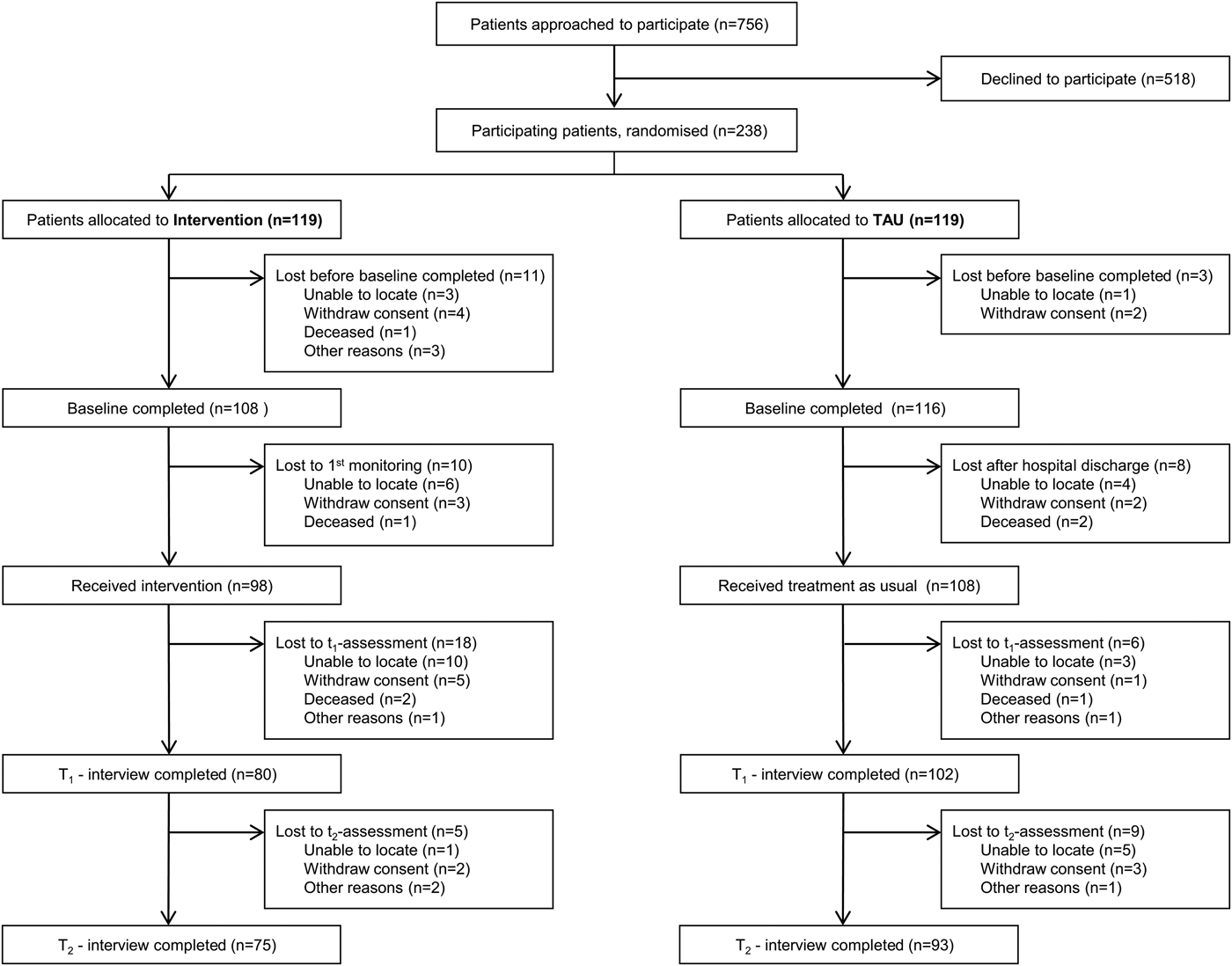
After having given informed consent to participate the 238 patients were randomly allocated to the intervention group or to a control group (using block random allocation within centres). All study participants had to complete a comprehensive baseline interview covering data on service use, psychopathology and patient's perceptions. Data were gathered by means of a face-to-face interview and questionnaires, and assessed again at follow-ups 12 (t1) and 24 months (t2) after discharge from the hospital. Figure 1 summarises the patient flow over the entire trial.
Study participant flow diagram.

Intervention
The design of this study and the intervention programme are described in detail elsewhere (Lay et al. Reference Lay, Salize, Dressing, Rusch, Schönenberger, Buhlmann, Bleiker, Lengler, Korinth and Rössler2012). The programme comprising individualised psycho-education and a focused preventive monitoring over 24 months primarily addresses the self-management skills of chronically mentally ill patients. It seeks to activate their potential for secondary prevention of relapses, assuming that patients with previous involuntary placement(s) have a strong interest in avoiding further compulsory admission and therefore might benefit from such a programme.
All parts of the programme (psycho-education, preventive monitoring) were carried out by a personal mental health care worker who maintained the contact to the study participant over the course of the 24-month intervention. In each centre there was one member of the study team (all of them graduated psychologists) who carried out the programme with the participants from that centre.
In brief, the programme started before the patient was discharged from the psychiatric hospital, offering individualised psycho-education focussing on behaviours prior to and during illness-related crises. Individual risk factors for relapse, personal and social resources, and use of mental health care services were assessed in detail and finally compiled into an individual checklist. This checklist included familial, work, or financial problems, as well as personal and social resources the patient felt were helpful in a crisis. With this information, a crisis card including patient information, contact persons, and treatment preferences was assembled and handed out to the patient at discharge (Drack-Schönenberger et al. Reference Drack-Schönenberger, Bleiker, Lengler, Blank, Rössler and Lay2016). All suggestions and resolutions for crisis management reflected primarily the personal preferences of the patient. The clinical team of the hospital was not involved in this process. It was also left fully to the patient to decide the way in which they applied the crisis card.
After discharge from the hospital each participant was contacted by telephone every fourth week over a period of 24 months. At each monitoring contact, the participant's present mental health status was assessed using the individual checklist covering present living conditions, emotional state (signs of depression, withdrawal), suicidality, substance abuse and violence, as well as utilisation of mental health care services (recent inpatient and outpatient psychiatric episodes, contacts to health care professionals, medication etc.). The monitoring contacts were monthly in order to increase the chance of maintaining contact with the patient. They were designed to provide a dense individual pattern of the course of illness (to target early signs of a crisis) and of the utilisation of health care services. If a relapse threatened to occur, participants were reminded to activate the resources they had previously specified and to contact their regular therapist or other mental health care services in order to prevent compulsory hospital re-admission.
Thus, the intervention programme is an individual measure to give chronically mentally ill patients support to become more actively involved in their care. The long-term support offers opportunities to reflect on treatment-related behaviours (utilisation of health care services; medication compliance) and to refer to ways of optimised service use in case of a relapse.
Treatment as usual
Whereas the intervention group received the intervention programme supplementary to ‘TAU’, the control group received ‘standard care’ only. Standard care implies that upon discharge from hospital a psychiatric inpatient is referred to an outpatient institution or a health care professional for further treatment where usually the initial appointment is arranged for the patient. Whether a patient makes use of the referral and continues treatment, however, is usually not pursued further. After discharge from the hospital, patients therefore might avoid further outpatient treatment, but contrariwise, various health care providers might be involved at the same time in the patient's care later on. It should be noted that community mental health care in the Canton of Zurich is well-resourced. A wide variety of community mental health services (e.g. walk-in clinics, psychiatric outpatient departments, psychiatrists and psychologists in private practice, substance abuse counselling agencies) can be accessed if people actively seek treatment. Moreover, general practitioners play an important role in providing health care of people with mental health problems.
Measures
Diagnostic and treatment-related data of the patients’ history were taken from the patient files. Psychiatric diagnoses were made by the hospital physicians in charge at the participating study centres. Due to the high prevalence of psychiatric co-morbidity in this sample, multiple diagnoses were recorded in the patient files (56.3% with more than one ICD-10 diagnosis; up to eight different diagnoses according to the clinical records of the index episode). For the present analysis, we used the main diagnosis documented at discharge. In patients who had been diagnosed with a personality disorder, we considered the ICD-10 F6 diagnosis as prior-ranking, even if it was not recorded in the first place, in order to take into account the clinical significance and persistence of these conditions and behaviour patterns.
Information on socio-demographic data, and patients’ history and utilisation of mental health care services was gathered using the Client Socio-demographic and Service Receipt Inventory CSSRI-EU (Chisholm et al. Reference Chisholm, Knapp, Knudsen, Amaddeo, Gaite and van Wijngaarden2000). Data were assessed in (face-to-face) baseline and follow-up interviews. To obtain the most accurate and timely information possible, individual risk factors and service utilisation (participant's re-hospitalisations and further use of mental health care) also were recorded during the regular monitoring phone calls. Participants in the control group, which did not receive such monitoring, received a brief telephone call every 3 months (for evaluation purposes only) in order to assess their service utilisation over the past period. All objectively verifiable information on service use provided by the patient was cross-checked and, where necessary, completed by means of administrative data documented in the clinical records.
To analyse outcomes of the intervention programme, numbers of readmissions (both compulsory and voluntary) and times in hospital were accumulated over all inpatient stays during the period between baseline and t2 assessment.
Sample
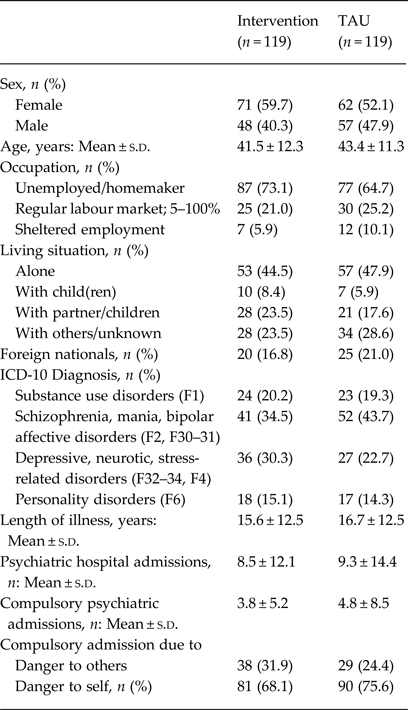
The baseline sample comprised 119 patients in the intervention group and 119 in the TAU group. Table 1 shows the baseline characteristics of the participants. Randomisation ensured roughly comparable treatment groups. There were no substantial differences in any of the baseline characteristics. Participants suffered from a broad range of mental diseases, of which psychotic disorders were most prevalent. Of the 35 patients with a personality disorder, 30 (85.7%) were diagnosed with an emotionally unstable personality (ICD-10 F60.3, borderline) or mixed personality disorder (F61.0), i.e. disorders associated with a high risk of self-harming behaviours. Of the 30 ICD-10 F4 diagnoses, most (23; 76.7%) were stress-related and adjustment disorders (F43). Across all diagnostic groups, psychiatric comorbidity was common (e.g. substance use disorder as a comorbid condition in 33.6%, schizophrenic/delusional disorder as comorbid diagnosis in 8.8% of the sample). Especially high rates of comorbidity were seen among those persons with a personality disorder (F6), of whom every second person also suffered from serious substance-related problems (51.4% with additional F1 diagnosis). In sum, most of the participants showed serious and/or persistent behaviour problems (being aggressive and/or suicidal), low levels of social adjustment and a great many social problems. Social and occupational spheres of life were characterised by major functional impairments.
Baseline characteristics of study participants

TAU, treatment as usual; Intervention v. TAU, no statistical significant group differences.
Corresponding to the severity of the disorders, most participants had already experienced a high number of previous hospitalisations (24.1% > 10 psychiatric hospitalisations) at baseline assessment. For 39.8% of the intervention group and for 37.3% of the TAU group the index hospital admission was the first compulsory admission (lifetime), whereas almost every second participant (43.2% in the intervention group; 46.6% in the TAU group) had already experienced three or more compulsory admissions previously.
The majority of the sample (71.8%) had been compulsorily admitted to psychiatry because of their high risk of self-harm. Severe danger to others was the reason for a compulsory (index) hospitalisation in 28.2%, several of whom also were in severe danger of harming themselves.
Statistical analyses
We compared baseline characteristics of the intervention to those of the TAU group by χ2-tests (nominal variables) and non-parametric Mann–Whitney U tests (metric variables) to account for skewed data. Results are considered statistically significant at p < 0.05, two-tailed.
The time-to-dropout in the two treatment groups was analysed by survival analysis methods. To compare the survival distribution of participants with and without complete t2 data we fitted Cox proportional hazard models. To estimate the effect of the baseline characteristics (specified below) on the risk of dropout, all explicative variables were first examined separately. In a further step, we fitted a Cox regression model using forward stepwise variable selection to identify significant predictors of dropout, taking into account variable interdependence.
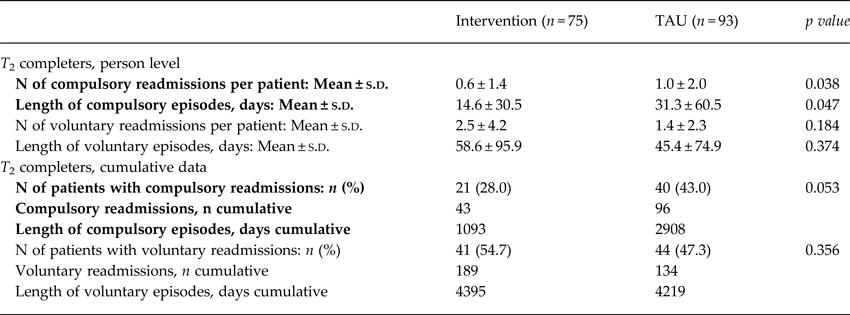
In order to evaluate intervention effects at t2, we first explored on a bivariate basis whether the two randomisation groups differ in the proportions of compulsory readmission, the number of readmissions, or the length of hospital episodes (both compulsory and voluntary), using χ2-tests and Mann–Whitney tests. T2 outcomes of the two treatment groups at the level of single outcome measures are presented in Table 2.
Summary of outcomes after 24 months of preventive monitoring (as-treated-analysis, n = 168)
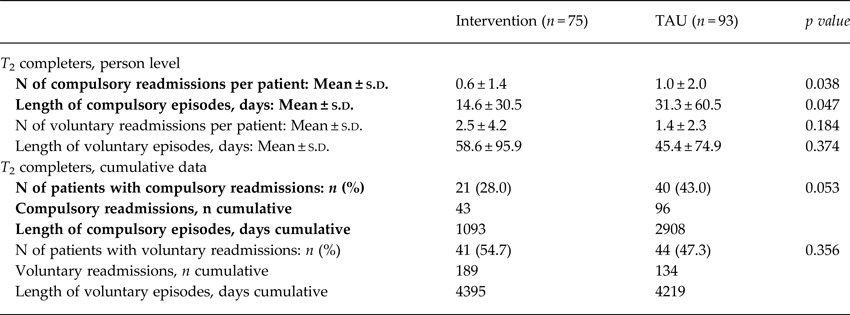
TAU, treatment as usual. In bold: compulsory psychiatric readmissions.
Mann–Whitney U tests; χ2-tests.
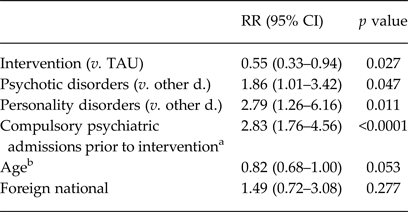
In our primary analysis, we analysed the outcome measure ‘number of compulsory readmissions’ by means of negative binomial regression models to control for relevant baseline characteristics. Negative binomial regression is appropriate for modelling count variables, particularly when data are over-dispersed. This primary analysis was performed with the dataset of the 168 participants who completed t2. Besides ‘treatment group’ (intervention = 1, TAU = 0), we analysed the baseline (pre-intervention) measures: age (in units of 10 years), sex, occupational status, living situation, nationality, the patient's diagnosis at the index episode, the reason for compulsory admission (danger to self, danger to others), and the number of previous compulsory psychiatric admissions (‘number of compulsory admissions during the 24 months prior to t0’, log transformed). The variables were first examined separately to determine the significance of baseline patient characteristics. In the final step, we fitted a regression model, including the significant predictors jointly in the regression. To adjust for heterogeneity in the model, we estimated robust standard errors for the regression coefficients (Table 3 gives the results of the primary analysis).
Risk factors of compulsory inpatient readmission (as-treated-analysis, n = 168)

RR, relative risk; CI, confidence interval; TAU, treatment as usual.
a N of compulsory admissions log-transformed.
b Age in units of 10 years.
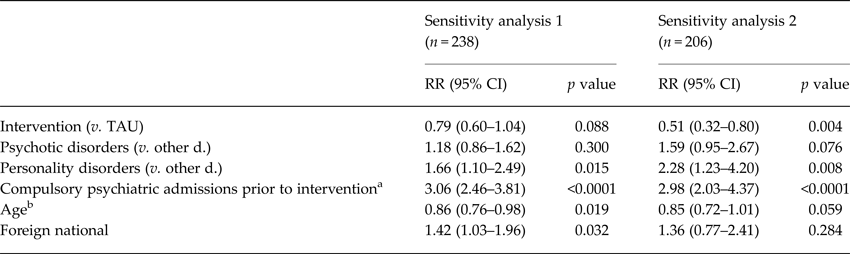
To analyse bias due to missing follow-up data we carried out two sensitivity analyses (SEA) under intent-to-treat principles. With these SEA, we intend to assess how attrition effects impact on the results of our primary analysis. We therefore fitted GENMOD models accounting for exactly the same covariates as in the final primary analysis to ensure comparability of the analyses.
As a first SEA, we took a retrospective imputation approach, replacing missing data by information from the patient's history: For every participant who prematurely terminated the programme, the number of compulsory admissions in the patient's history was imputed on an individual basis for the equivalent period of time that was lacking up to t2. (Such an approach is based on the assumption that the prevalence of compulsory admissions before starting the intervention is equal to that after the intervention, implying that the intervention had no effect). With this dataset of 238 participants (based on the observed values in 168, and with imputed values in 70 participants) we repeated the primary analysis accounting for the same aforementioned variables.
As a second SEA, we analysed the outcome of all participants who had received intervention or TAU for at least 1 day. We used xCA/td as outcome measure (where xCA = number of compulsory admissions; td = time-to-dropout, with the logarithm of time serving as an offset. xCA/td thus represents the ‘intensity of compulsory admission over time’ irrespective of how long a participant had remained in the programme). This dataset utilises the full monitoring information over time of those who terminated the programme regularly and of those who terminated it prematurely. With this dataset of 206 participants, we repeated the primary analysis again (Results of the SEA are given in Table 4).
Risk factors of compulsory inpatient readmission (sensitivity analyses)

RR, relative risk; CI, confidence interval; TAU, treatment as usual.
Analysis 1: compulsory admission rate; missing data imputed according to patient history.
Analysis 2: ratio of compulsory admissions according to length of time in programme.
a N of compulsory admissions log-transformed.
b Age in units of 10 years.
Data were analysed using SPSS 22 and SAS 9.4 procedures.
Results
Effect of the programme on primary outcome at t2
T2 interviews/assessments were conducted on average 743 days (±38 intervention group; 744 ± 44 days TAU) after discharge from the index hospital episode. Of the intervention group, 75 participants and of the TAU group, 93 had completed the whole 24-month programme.
The comparison of compulsory readmissions (primary outcome criterion) shows a significantly lower number of such per patient at t2 in the intervention group, compared with the TAU group (Table 2). In addition, the length of compulsory hospital episodes was shorter, compared with TAU. Correspondingly, the proportion of patients with compulsory readmission(s) in the intervention group is lower at 28.0% than in the TAU group at 43.0%, a difference that is on the margin of statistical significance.
There were more voluntary psychiatric readmissions during this period, though, in terms of both average number of voluntary readmissions per patient and number of patients with voluntary readmissions, but differences are not statistically significant.
A more rigorous GENMOD model taking into account effects of diagnosis, patients’ history, and demographic factors provides further support for a treatment effect (Table 3). This regression model suggests that the intervention group has a significantly lower risk of compulsory readmission than the control group (RR = 0.55) does, even after controlling for other significant risk factors. The most important predictor in this analysis proved to be the ‘number of compulsory psychiatric admissions in the patient's history’, which makes the biggest contribution to the risk of compulsory readmission. Considering diagnosis, results suggest an almost three times higher risk in patients diagnosed with a personality disorder, and an almost two times higher risk in patients diagnosed with a psychotic disorder, compared with other diagnoses.
Comparison of patients who completed the programme to those who dropped out
During the 24-month programme we lost more patients in the intervention group (44; 37.0%) than in the TAU group (26; 21.8% of the baseline sample). Premature termination of participation happened particularly at the very beginning of the study: e.g. 21 patients assigned to the intervention group already dropped out during baseline assessment, before the intervention started. The majority of patients who did not remain in the study up to t2 dropped out already during the first 3 months (see online Supplementary Fig. S1).
The reasons for dropout were very similar in the two treatment groups (Fig. 1). Most study participants were lost because they were no longer traceable (20 in the intervention group; 13 in TAU) or were explicitly no longer willing to participate in the programme (14; 8); another eight dropped out for other reasons (6; 2). There were also serious adverse events, none of them related to the trial, in that four (intervention group), respectively three (TAU) patients died in the course of the study.
To further analyse the potential bias due to dropout, we compared baseline characteristics of participants who completed the programme to those of dropouts. Results suggest that, at the bivariate level, the risk of dropout is associated with treatment group, socio-demographic factors (age, nationality, living situation, occupational status) and length of illness, whereas other variables of the psychiatric patient's history and type of disorder were not found to be significantly associated with dropout risk (see online Supplementary Table S1).
Using these baseline variables simultaneously in a model, the Cox regression identified four significant predictors. According to this regression model, the risk to leave the study prematurely was significantly increased in patients participating in the intervention group, and higher in patients at a younger age, of foreign nationality and with a high number of past compulsory psychiatric admissions.
To investigate whether the treatment effect we had seen in the primary as-treated-analysis was linked to dropout effects, we performed additional SEA.
Sensitivity analyses
In a first SEA, we re-run the primary analysis with the data of all 238 participants included at baseline, thus assuming for dropouts that the number of compulsory readmissions after withdrawal from the trial is the same as prior to the trial and the same as if they had received no intervention at all.
According to this model, the treatment effect is no longer statistically significant at the 5% level, albeit the coefficient for ‘treatment’ (RR = 0.79) still appears appropriate, suggesting a lower risk of compulsory readmission in the intervention group, compared with TAU. The results suggest that the risk of compulsory readmission is explained by the number of compulsory admissions in the past, age, nationality and a diagnosis of personality disorder, while ‘treatment’ appears not to add significantly to the prediction (Table 4).
In a further SEA, we used all observed data up to the time a participant either regularly terminated the programme after 24 months, or dropped out earlier. Considering that individuals with varying retention time were aligned in one model, here the intensity of compulsory readmissions during this period, rather than the frequency, was analysed as the outcome variable.
This second SEA led to virtually the same results as those of our primary analysis. According to this regression model the risk of compulsory readmission in the intervention group is about half that of the TAU group (RR = 0.51). This treatment effect is statistically significant after controlling for further covariates (psychiatric diagnosis and effects associated with dropout).
The number of compulsory psychiatric admissions in the patient's history again proved to be the most important predictor of compulsory readmission in this model. As to the psychiatric diagnosis, a significant risk increase was confirmed, but only for personality disorders.
Discussion
This study examines the effects of an intervention programme that targets the prevention of compulsory readmission to psychiatry. The programme, which included individualised psycho-education and a close monitoring by phone over 24 months, was offered to and carried out with persons (psychiatry patients) with severe mental illness at high risk of compulsory admission. Outcomes of the intervention group are compared with those of a control group who received TAU without these supplementary measures.
Main findings
(1) Results after 24 months (t2) suggest that patients in the intervention group had a lower number of compulsory readmissions and spent fewer days in inpatient care in connection with compulsory psychiatric admissions than the TAU group did. Whereas 28% in the intervention group were compulsorily readmitted to psychiatry, 43% in the TAU group were. This suggests that for those patients who completed the programme the intervention had beneficial effects.
There are several other approaches to patient empowerment that also aim to empower consumers to take a more active role in their treatment and to improve the patient-clinician working alliance, and in so doing intend to facilitate the early detection of relapse and the prevention of compulsory treatment (e.g. Papageorgiou et al. Reference Papageorgiou, King, Janmohamed, Davidson and Dawson2002; Henderson et al. Reference Henderson, Flood, Leese, Thornicroft, Sutherby and Szmukler2004; Swanson et al. Reference Swanson, Swartz, Elbogen, Van Dorn, Ferron, Wagner, McCauley and Kim2006; Thornicroft et al. Reference Thornicroft, Farrelly, Szmukler, Birchwood, Waheed, Flach, Barrett, Byford, Henderson, Sutherby, Lester, Rose, Dunn, Leese and Marshall2013). There is evidence from studies on JCP suggesting that it is not uncommon, however, that contents the participants wanted to include in their JCP were not followed during a subsequent crisis (Thornicroft et al. Reference Thornicroft, Farrelly, Szmukler, Birchwood, Waheed, Flach, Barrett, Byford, Henderson, Sutherby, Lester, Rose, Dunn, Leese and Marshall2013).
The intervention we applied differs from these formats in various ways, particularly with regard to its long-term perspective, the close and continuous contacts to the patient, and the use of an approach that stipulates working with the patient only (rather than involving a therapeutic team). For these reasons the results of the current trial cannot be compared directly with those of other formats of advance directives.
Nevertheless, it is assumed that the more intensive form and the long-term nature of the present intervention (phone contacts every 4 weeks and over an extended period after discharge) were important for the success of this programme in so far as it offers support to timely bring to mind coping strategies and personal resources before or during a crisis. It is likely that this may produce more sustainable effects in people with severe or persistent problem behaviour and poor social adjustment than a one-off intervention will. However, since this intervention combined several approaches, it is difficult to disentangle the effects of the different components (psycho-education, crisis cards, long-term monitoring), respectively their combination, in retrospect.
(2) Of all patients randomised, 63% remained in the programme over the whole 24-month period. Considering the difficult and inconsistent personal circumstances of the majority of our study participants, this adherence rate is within expectations (in other areas of medical treatment adherence rates as low as 30% have been reported (Ten Have et al. Reference Ten Have, Normand, Marcus, Brown, Lavori and Duan2008)). This supports the notion that for a considerable quantity of this target population, many of them heavy users of mental health services, this programme was attractive despite the fact that this long-term engagement demanding regular appointments (being called up; discussion of problematic issues etc.) was most challenging. According to the participants, its attractiveness has to do with the opportunity to reflect on the experience of a compulsory admission, which was often referred to as a very stressful critical incident. Moreover, participants in the intervention group appreciated the availability of an ‘impartial’ person not directly involved in their treatment and not trying to persuade or to push them, but listening to and discussing their views and supporting them in finding their personal way to handle problems, making them feeling respected. The higher number of contacts in the intervention group is likely to facilitate building a relationship between the participant and the study psychologist. In analogy to research on the mechanisms of psychotherapy, it can be assumed that effects of this intervention, too, might be non-specific to a considerable extent (Wampold, Reference Wampold2015). Nevertheless, we cannot rule out that the higher dropout rate in the intervention group, compared with the TAU group, is associated with the close contact intervals and the non-intervening nature of this approach as well. A higher dropout rate in the intervention group, however, was reported also in other randomised trials in this field (Thornicroft et al. Reference Thornicroft, Farrelly, Szmukler, Birchwood, Waheed, Flach, Barrett, Byford, Henderson, Sutherby, Lester, Rose, Dunn, Leese and Marshall2013; Ruchlewska et al. Reference Ruchlewska, Mulder, Van der Waal, Kamperman and Van der Gaag2014).
Younger age, foreign nationality and a higher number of compulsory admissions in the patient's history were the strongest risk factors for study attrition. Whereas among foreign nationals communication problems as well as uncertainties in connection with their residence status impeded the retention in this programme, we can only speculate why younger people were more likely to drop out. One reason might be that younger patients more often felt that continued participation interfered with activities or obligations they aspired to (starting their education, trial placement, employment; new social contacts), putting them under additional stress in a stage of life during which they were already experiencing substantial upheavals.
Even though patients with a high number of compulsory admissions in their history were less likely to complete the programme, clinical characteristics, e.g. type or severity of mental disorder, psychiatric comorbidity or the nature of endangerment at admission, were not associated with study attrition, so there is no evidence in our data that we lost the more severely disordered patients. This suggests that the intervention is not restricted to a definite diagnostic group or to less serious cases only, but is a feasible option for those psychiatry patients who are motivated to get involved with this programme.
(3) The SEA we did in order to explore the impact of attrition effects on our main findings led to inconclusive results: whereas SEA 2 confirmed the significant intervention effect shown in our main analysis, SEA 1 (which considered all randomised subjects irrespective of whether or not they had received the treatment) did not confirm its superiority over standard care. The fact that the intent-to-treat approach (SEA 1) and the as-treated analysis led to divergent results emphasises that attrition effects diminishing the benefits of the intervention (effectiveness) have to be taken sufficiently into consideration when administering this intervention in the community. It should be noted, however, that the intervention applied was a newly developed preventive measure that had not been under evaluation before. In this situation, an as-treated analysis measuring the effect, relative to the control condition, when patients adhere to the treatment, is the primary research goal (Ten Have et al. Reference Ten Have, Normand, Marcus, Brown, Lavori and Duan2008).
(4) All three analyses showed quite unequivocally that the number of compulsory admissions in the patient's history was the most important predictor of further compulsory re-hospitalisation during the trial. A higher number of compulsory admissions (at t0) though was not significantly related to longer illness duration (chronicity), and thus cannot be interpreted merely as a function of time, but rather appears to be a correlate of certain forms of deviance (liable to endangering behaviour). It was mainly personality disorders that contributed to an unfavourable prognosis, and patients with a personality disorder were even more likely to be compulsorily readmitted than those with a psychotic disorder. All in all, these findings are broadly consistent with those of a recently reported 5-year follow-up of an extensive cohort of involuntarily admitted patients: in the ASAP study, too, high care consumption and a history of high service utilisation and involuntary admission, as well as younger age, predicted (a higher risk of) involuntary readmission (van der Post et al. Reference van der Post, Beekman, Peen, Zoeteman, Twisk and Dekker2016). These findings therefore stress the need to prevent unfavourable courses of illness as early as possible and the importance of detecting and dealing with crises at an early stage in order to prevent severe relapses that inevitably result in emergency or involuntary psychiatric admissions.
Limitations and strengths
This study has several important limitations. First, a general limitation of this trial is the fact that this programme exclusively targets individual risk factors that are subject to the patient's self-management, while aspects of the mental health care system (referral procedures, crisis intervention practices, use of de-escalation measures, etc.) that also are likely to influence the incidence of compulsory admissions are not addressed. It is evident that additional efforts on a service-system level are still required to further reduce high compulsory admission rates considerably. A further important factor to be considered are regional laws and regulations, which are likely to have a share in the use of compulsory placement, on which such a programme, however, does not make any impact.
Second, because the recruitment of patients in diverse hospitals took much more time and absorbed more organisational capacities than initially planned, we failed to obtain the planned sample size of 400 patients (Lay et al. Reference Lay, Salize, Dressing, Rusch, Schönenberger, Buhlmann, Bleiker, Lengler, Korinth and Rössler2012). Thus, this study based on a smaller sample size might have been underpowered, so that effects may have remained unrevealed in the analyses. Third, the benefits of this preventive programme may not generalise to all patients with severe mental illness. Outcomes of our primary analysis may not be representative for patients who refuse to participate or for dropouts. This means that such a programme should be appealing to a patient, and a minimum level of language skills as well as motivation to accept such support, are crucial prerequisites. Moreover, it must be possible to contact a person by phone, which is difficult in the case of, e.g. homeless or other socially disadvantaged people. Fourth, considering that a new intervention format is evaluated in this study, the present findings should be considered as first results and should be examined in subsequent replication studies. Further research is also necessary to examine for which psychiatric patients such a programme is most beneficial. It is obvious that a large(r) sample is required in order to study differential effects for patient subgroups.
The strengths of this study are its prospective design, the inclusion of patients with a broad spectrum of mental disorders and severe social disabilities, and its implementation under real community mental health care conditions.
Implications
This study provides evidence that this intervention programme is a valuable option to prevent further compulsory rehospitalisation in people with severe mental health problems, low levels of social functioning, and a history of hospitalisation. Considering that most of this group present with unstable social backgrounds, considerable time and efforts are required to maintain long-term contact.
It appears conducive to the prevention of compulsory re-admission that the programme starts before the patient is discharged from psychiatry. Moreover, regular monitoring by the mental health care worker thereafter is necessary to help patients at risk to avert compulsory hospitalisation by timely seeking (outpatient or inpatient) treatment. This programme's empowerment orientation emphasising patients’ self-management skills makes it attractive even for the difficult-to-reach severely mentally ill.
Despite the high relevance of compulsory hospitalisation for the people affected, as well as for mental health care policy, effective interventions that address the complex needs of the severely mentally ill are still scarce. Thus, promising options that contribute to a reduction of involuntary hospitalisation should be pursued. A further exploration of the potential of this approach therefore seems worthwhile.
Supplementary material
The supplementary material for this article can be found at https://doi.org/10.1017/S0033291717002239.
Acknowledgements
The authors would like to thank all members of the study team for their dedicated efforts to implement this programme and for their contributions to achieve the reported results. We also thank the patients for participating in this study. This ZInEP project was funded by a private donation. The donator had no role in the study design or the collection, analysis and interpretation of the data.
Declaration of Interest
The authors declare that there is no conflict of interest.
Ethical Standards
The authors assert that all procedures contributing to this work comply with the ethical standards of the relevant national and institutional committees on human experimentation and with the Helsinki Declaration of 1975, as revised in 2008.