Introduction
Nitric oxide is continuously released from the human respiratory tract and has been proposed as a useful non-invasive marker of inflammation in the lower airways. 1 In general, patients with allergic airway inflammation have higher levels of nitric oxide in their exhaled breath. 1 Measuring the fractional concentration of nitric oxide in bronchial exhaled air (i.e. the oral fractional exhaled nitric oxide) is a standardised method of evaluating allergic airway inflammation in patients with underlying asthma. 1 – Reference Dweik, Boggs, Erzurum, Irvin, Leigh and Lundberg 4
Nasal nitric oxide production is often increased with allergic rhinitis and decreased with sinusitis, nasal polyps, cystic fibrosis and primary ciliary dyskinesia.Reference Silkoff, Erzurum, Lundberg, George, Marczin and Hunt 2 , Reference Scadding and Scadding 3 , Reference Struben, Wieringa, Mantingh, de Jongste and Feenstra 5 , Reference Lundberg 6 Many factors affect nasal nitric oxide concentrations, including ambient air quality, age, exercise, local nasal factors, smoking and medication. 1 , Reference Scadding and Scadding 3 – Reference Kharitonov, Rajakulasingam, O'Connor, Durham and Barnes 7
Two main methods of assessing upper airway nitric oxide are currently recommended: nasal aspiration via one nostril during breath holding and soft palate closure (referred to as nasal aspiration during breath holding), and nasal exhalation through a tight face mask (i.e. the nasal fractional exhaled nitric oxide). 1 , Reference Kharitonov, Walker and Barnes 8 Nasal fractional exhaled nitric oxide measurements differ fundamentally from those obtained with the nasal aspiration during breath holding method. Nasal fractional exhaled nitric oxide represents the fraction of nitric oxide that the nasal cavities add to exhaled, endogenous air contaminated by nitric oxide. An advantage of nasal fractional exhaled nitric oxide measurement is that exhalation can be performed at the flow recommended for measuring the oral fractional exhaled nitric oxide level, which facilitates comparison between upper and lower airway outputs. 1 The short mucosal contact time and high air volume mean that nasal nitric oxide levels obtained by exhalation are lower than those measured with the aspiration technique.Reference Silkoff, Chatkin, Qian, Chakravorty, Gutierrez and Furlott 9 , Reference Weschta, Deutschle and Riechelmann 10 Standardised nasal nitric oxide measurements are not yet available, resulting in a wide variation of reported nasal nitric oxide values.Reference Scadding and Scadding 3 , Reference Struben, Wieringa, Mantingh, de Jongste and Feenstra 5 , Reference Kharitonov, Rajakulasingam, O'Connor, Durham and Barnes 7 – Reference Montella, Alving, Maniscalco, Sofia, De Stefano and Raia 27
This study aimed to (1) compare two sampling methods for nasal nitric oxide in healthy individuals and allergic rhinitis patients using an electrochemical analyser and (2) examine within-subject reliability of nasal nitric oxide measurements.
Materials and methods
Study design and participants
This study was conducted between November 2011 and March 2012 at the Clinic of Otorhinolaryngology and Maxillofacial Surgery, Clinical Centre of Serbia. Thirty-three participants aged 21 years and older were recruited: 23 allergic rhinitis patients and 10 healthy individuals. The allergic rhinitis patients had a history of more than three years of allergic rhinitis without concomitant asthma and were positive for serum allergen-specific immunoglobulin E (IgE) against house dust mites (Dermatophagoides pteronyssinus) or pollen. Healthy participants (control group) were volunteers and all were non-atopic. Data on age, body weight and height were collected for all participants. Upper airway patency was confirmed by ENT examination for all patients.
Exclusion criteria were active or passive smoking; use of systemic, inhaled or nasal steroids, nasal decongestants, and antibiotics in the previous month; an acute respiratory infection or acute rhinosinusitis within the last month; chronic respiratory system disease (cystic fibrosis, primary ciliary dyskinesia, asthma or other chronic disease of the respiratory system); and nasal or sinus surgery within the last three months.
All participants were required to refrain from eating and to drink only water for eight hours before measurement. They were instructed not to perform physical activity for three hours before measurements were taken. All measurements were carried out in the non-pollen season and performed in a quiet sitting position between 8:00 and 12:00 hours.
All participants gave written informed consent. The study was reviewed and approved by the Ethics Committee of the Belgrade University School of Medicine.
Study procedures
All participants underwent a standard prick test panel for inhalant allergens (Institute of Virology, Vaccines and Sera ‘Torlak’, Belgrade) using the following common allergens: house dust, cat and dog hair, mould mix, feather mix, tree pollen mix, grass pollen mix, weed pollen mix, and house dust mite (D. pteronyssinus).
Allergen-specific IgE levels in serum were measured using the ImmunoCAP system (Phadia, Uppsala, Sweden). Levels of specific IgE against D. pteronyssinus – d1, grass pollen mix – gx1, tree pollen mix – tx9 and weed pollen mix – wx1 were measured using fluorescence enzyme-labelled assays (Specific IgE 0-100 kit, Art No. 10-9462-01; d1, Art No. 14-4107-01; gx1, Art No. 14-4163-01; tx9, Art. No. 14-4274-01; wx1, Art. No. 14-4195-01); distributor LKB Vertriebs GmbH (Branch office in Belgrade, Serbia).
All allergic rhinitis patients underwent spirometry and methacholine provocation testing according to the recommendations of the American Thoracic Society. 28 Spirometry was performed using a MasterScope spirometer (Jaeger, Höchberg, Germany). A short protocol for methacholine testing was performed using the Aerosol Provocation System Pro nebuliser system (CareFusion, Höchberg, Germany). Patients first underwent spirometry after inhaling a normal saline solution and then inhaled increasing methacholine doses: 0.015, 0.045, 0.180 and 0.720 mg (the protocol thus delivered cumulative methacholine doses of 0.015, 0.060, 0.240 and 0.960 mg). Two minutes after each inhalation, the forced expiratory volume in 1 second (FEV1) was measured. The methacholine provocation test was terminated if the decline in FEV1 exceeded 20 per cent of the baseline value. This test was always first performed on the day prior to nitric oxide measurement.
Nitric oxide measurements for all participants were performed using a hand-held NIOX MINO electrochemical analyser (Aerocrine, Solna, Sweden). Nitric oxide was measured non-invasively from the lungs (oral fractional exhaled nitric oxide) and nose according to American Thoracic Society and European Respiratory Society guidelines 1 by a single ENT specialist. Both oral and nasal nitric oxide measurements were repeated within a month. The average of two measurements obtained from each participant was taken as the nitric oxide level. Before each measurement, the ambient nitric oxide concentration was recorded.
The oral fractional exhaled nitric oxide was measured through a mouthpiece. Participants first exhaled through the mouth down to the residual lung volume and then inhaled nitric oxide free air through the adapter of the device up to the total lung capacity. Participants then exhaled for 10 seconds at a mouth pressure of 10–20 cm H2O guided by visual and auditory cues (from the NIOX MINO device) to maintain a constant flow rate of 50 ± 5 ml/seconds. The measurement range of the device is 5–300 parts per billion.
The nasal nitric oxide level was measured in two different ways: (1) nasal aspiration via one nostril during breath holding and soft palate closure (i.e. nasal aspiration during breath holding) and (2) the single-breath quiet exhalation method against a resistance of 10–20 cm H2O through a tight face mask (i.e. nasal fractional exhaled nitric oxide).
In the nasal aspiration during breath holding method, the nasal nitric oxide level after a deep inhalation was measured using a NIOX MINO Nasal device. This device is a research application comprising a nasal olive with tubing connected to a bacterial and viral filter, along with dedicated software. The measurement range is 5–1700 parts per billion. The device returns the result of the buffered analysis as a single output on the screen after either 2 minutes (sampling rate, 2 ml/second) or 45 seconds (sampling rate, 5 ml/second). A successful test relies on complete, uninterrupted sampling throughout the required sampling time. This study used a sampling flow rate of 5 ml/second.
To determine the nasal fractional concentration of exhaled nitric oxide, nasal nitric oxide levels were measured using a NIOX MINO device fitted with a tight-fitting mask covering the nose (ComfortStar, Drägerwerk, Germany). The nasal mask was connected to the mouthpiece filter of the NIOX MINO analyser. Participants first exhaled through the mouth down to the residual lung volume and then inhaled nitric oxide free air through the adapter up to the total lung capacity. They then exhaled through the nose for 10 seconds at a pressure of 10–20 cm H2O to maintain a constant flow rate of 50 ml/second via a disposable mouthpiece into the device.
Statistical analysis
Data are presented as the mean ± standard deviation (SD) or as n (percentage). The Student's t-test was used to compare nitric oxide values. The Mann–Whitney U-test for independent samples and Wilcoxon's test for paired data analysis were used for non-parametric data. Test–retest reliability was assessed with an intraclass correlation coefficient: greater than 0.75 was considered excellent, 0.40–0.75 was considered good and less than 0.40 was considered poor.Reference Fleiss 29 Cut-off points for sensitivity and specificity were obtained from receiver operating characteristic curves, and the area under the curve was determined. A p value of less than 0.05 was considered statistically significant. Statistical analysis was performed using SPSS for Windows, version 17.0 (SPSS Inc, Chicago, Illinois, USA).
Results
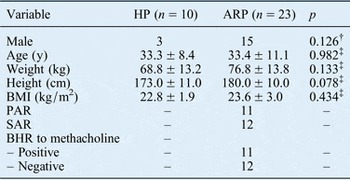
Ambient nitric oxide levels ranged from less than 5 to 19 parts per billion, and 90 per cent of measurements were performed at less than 5 parts per billion. Characteristics of the study cohort (18 men and 15 women) are shown in Table I. The mean ± SD age of the study population was 33.4 ± 10.2 years (range, 21–56 years). There were no significant differences in sex, age, weight, height and body mass index between healthy participants and allergic rhinitis patients (Table I). In the allergic rhinitis patients (n = 23), the mean ± SD allergen-specific serum IgE levels were 43.8 ± 35.4 kUA/l for D. pteronyssinus (n = 11), 17.3 ± 14.2 kUA/l for tree pollen mix (n = 3), 35.6 ± 35.5 kUA/l grass pollen mix (n = 11) and 35.8 ± 32.0 kUA/l for weed pollen mix (n = 11).
Characteristics of allergic rhinitis patients and healthy participants*

* N = 33. Data are presented as the mean ± standard deviation or number of patients per group. †Fisher's exact test. ‡Student's t-test. HP = healthy participants; ARP = allergic rhinitis patients; y = years; BMI = body mass index; PAR = perennial allergic rhinitis; SAR = seasonal allergic rhinitis; BHR = bronchial hyper-responsiveness
A positive allergy screening blood test showing sensitisation to seasonal allergens only was obtained for 12 allergic rhinitis patients (52 per cent), while 5 (22 per cent) were also sensitised to a perennial allergen (D. pteronyssinus) and 6 (26 per cent) were sensitised to perennial allergens only. Allergic rhinitis patients were therefore divided into two groups according to perennial allergen sensitisation: seasonal allergic rhinitis or perennial allergic rhinitis. Bronchial hyper-responsiveness to methacholine was present in 11 (48 per cent) allergic rhinitis patients (Table I).
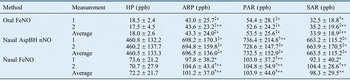
Table II lists the oral and nasal nitric oxide values for each method of measurement. The average oral fractional exhaled nitric oxide and nasal nitric oxide values were significantly higher in both perennial and seasonal allergic rhinitis patients than in healthy participants, except for the average nasal fractional exhaled nitric oxide value in the seasonal allergic rhinitis subgroup. Compared with seasonal allergic rhinitis patients, perennial allergic rhinitis patients had a significantly higher mean oral fractional exhaled nitric oxide value (33.9 ± 18.9 vs 53.5 ± 25.6, p = 0.047). There was no significant difference in mean nasal nitric oxide values as measured by nasal aspiration during breath holding and nasal fractional exhaled nitric oxide between perennial and seasonal allergic rhinitis patient groups (Table II).
Differences in nitric oxide measurements between healthy participants and allergic rhinitis patients

Data are presented as the mean ± standard deviation. *Student's t-test. **Mann–Whitney U-test. † p < 0.05. ‡ p < 0.01. HP = healthy participants; ppb = parts per billion; ARP = allergic rhinitis patients; PAR = perennial allergic rhinitis patients; SAR = seasonal allergic rhinitis patients; FeNO = fractional exhaled nitric oxide; AspBH = aspiration during breath holding; nNO = nasal nitric oxide
Intraclass correlation coefficients were 0.97 (95 per cent confidence interval (CI), 0.94 to 0.98) for the oral fractional exhaled nitric oxide method, 0.79 (95 per cent CI, 0.58 to 0.90) for the nasal aspiration during breath holding method and 0.80 (95 per cent CI, 0.60 to 0.90) for the nasal fractional exhaled nitric oxide method.
Mean oral fractional exhaled nitric oxide values correlated poorly with mean nasal aspiration during breath holding nasal nitric oxide values (intraclass correlation coefficient, 0.283; 95 per cent CI, −0,451 to 0,646) and moderately with mean nasal fractional exhaled nitric oxide values (intraclass correlation coefficient 0.555; 95 per cent CI, 0.098 to 0.780). Mean nasal nitric oxide values obtained with the nasal aspiration during breath holding method correlated poorly with mean nasal fractional exhaled nitric oxide values (intraclass correlation coefficient 0.382; 95 per cent CI, −0,382 to 0.695).
To test bronchial hyper-responsiveness as a possible confounding variable, allergic rhinitis patients were subdivided into those with or without a diagnosis of bronchial hyper-responsiveness (Table III). Compared with healthy participants, both bronchial hyper-responsiveness subgroups of allergic rhinitis patients had a significantly higher mean oral fractional exhaled nitric oxide values. Mean nasal nitric oxide values measured by the aspiration and exhalation methods were significantly higher in both bronchial hyper-responsiveness subgroups of allergic rhinitis patients than in controls. The average nasal nitric oxide levels measured in both ways did not differ significantly between the two bronchial hyper-responsiveness subgroups of allergic rhinitis patients. In contrast, the mean oral fractional concentration of exhaled nitric oxide was significantly higher in the bronchial hyper-responsiveness positive subgroup than in the bronchial hyper-responsiveness negative subgroup.
Between-group comparisons in nitric oxide measurement by bronchial hyper-responsiveness diagnosis

*Student's t-test. †Mann–Whitney U-test. HP = healthy participants; ARP = allergic rhinitis patients; BHR− = negative diagnosis of bronchial hyper-responsiveness; ppb = parts per billion; BHR+ = positive diagnosis of bronchial hyper-responsiveness; SD = standard deviation; FeNO = fractional exhaled nitric oxide; AspBH = aspiration during breath holding; nNO = nasal nitric oxide
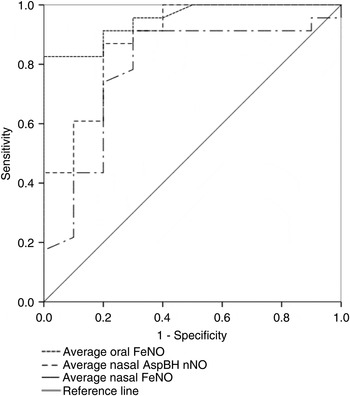
Figure 1 shows the area under the curve values obtained using the NIOX MINO device. Cut-off values for the best combination of sensitivity and specificity were 22.2 parts per billion (sensitivity, 0.83; specificity, 1.00) for the average oral fractional concentration of exhaled nitric oxide, 564.5 parts per billion (sensitivity, 0.83; specificity, 0.80) for the average nasal nitric oxide values using the nasal aspiration during breath holding method and 82.2 parts per billion (sensitivity, 0.74; specificity, 0.80) for the average nasal fractional concentration of exhaled nitric oxide.
Receiver operating characteristic curves generated using the hand-held analyser for nitric oxide measurements in allergic rhinitis patients vs healthy participants. AspBH = aspiration during breath holding; FeNO = fractional exhaled nitric oxide; nNO = nasal nitric oxide

Discussion
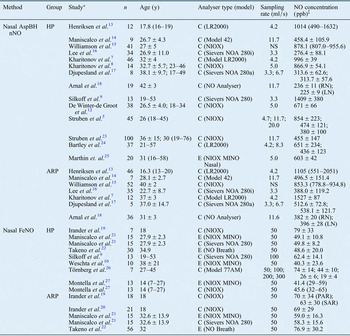
Several reports have described nasal nitric oxide measurement in healthy participants and allergic rhinitis patients using the aspiration and exhalation methods.Reference Scadding and Scadding 3 , Reference Struben, Wieringa, Mantingh, de Jongste and Feenstra 5 , Reference Kharitonov, Rajakulasingam, O'Connor, Durham and Barnes 7 – Reference Montella, Alving, Maniscalco, Sofia, De Stefano and Raia 27 However, the values are difficult to compare because different measurement techniques and transnasal flow rates were used in these studies (Table IV).
Nasal nitric oxide concentrations in allergic rhinitis patients and healthy participants sampled by the aspiration and exhalation methods

Data are presented as mean ± SD, median (range) or range. *Some studies are cited twice but in different groups (e.g. HP and ARP). y = years; s = second; NO = nitric oxide; ppb = parts per billion; AspBH = aspiration during breath holding; nNO = nasal nitric oxide; HP = healthy participants; C = chemiluminescence; NS = not specified; RN = right nostril; LN = left nostril; E = electrochemical; ARP = allergic rhinitis patients; FeNO = fractional exhaled nitric oxide; PAR = perennial allergic rhinitis; SAR = seasonal allergic rhinitis
Nasal nitric oxide concentrations as determined by the aspiration during breath holding method
Healthy participants
Scadding and Scadding published a guide to the clinical correlation between nitric oxide values determined by the oral fractional exhaled nitric oxide and nasal aspiration during breath holding methods in both adults and children.Reference Scadding and Scadding 3 With the aspiration method, nasal nitric oxide concentrations of 450–900 parts per billion were interpreted as the normal range and concentrations of less than 450 parts per billion were interpreted as low, possibly reflecting obstruction of the sinus ostium. In the present study, values for the mean nasal nitric oxide concentration in healthy participants as determined by the aspiration method were consistent with those in the previous report.
Allergic rhinitis patients
Henriksen et al. reported nasal nitric oxide levels in 46 allergic rhinitis patients without asthma and 12 healthy participants.Reference Henriksen, Sue-Chu, Lingaas, Langhammer and Bjermer 13 In both pollen and non-pollen seasons, nasal nitric oxide levels were not significantly different between healthy participants and allergic rhinitis patients or between allergic rhinitis patients with both seasonal and perennial sensitisation and those with seasonal sensitisation only. Maniscalco et al. reported the nasal nitric oxide levels in seven patients with seasonal allergic rhinitis without asthma and nine healthy participants.Reference Maniscalco, Sofia, Carratù and Higenbottam 14 In the non-pollen season, basal nasal nitric oxide concentrations were not significantly different in allergic rhinitis patients and healthy participants. Williamson et al. measured the nasal nitric oxide concentrations in 52 allergic rhinitis patients without asthma and 41 healthy participants, but found no significant difference between groups.Reference Williamson, Vaidyanathan, Clearie, Stewart and Lipworth 15 In contrast, there are several reports that allergic rhinitis does affect nasal nitric oxide levels. Lee et al. measured nasal nitric oxide concentrations in 35 allergic rhinitis patients without asthma and 34 healthy participants.Reference Lee, Cho, Lee, Tae, Yoon and Kim 16 The mean nasal nitric oxide value for allergic rhinitis patients was significantly higher than for healthy participants. Kharitonov et al. compared nasal nitric oxide levels between symptomatic seasonal allergic rhinitis patients and healthy participants.Reference Kharitonov, Rajakulasingam, O'Connor, Durham and Barnes 7 , Reference Kharitonov, Walker and Barnes 8 Allergic rhinitis patients with or without asthma had significantly higher nasal nitric oxide concentrations compared with healthy participants. Similarly, Djupesland et al. reported significantly higher nasal nitric oxide concentrations in symptomatic seasonal allergic rhinitis patients compared with healthy participants.Reference Djupesland, Chatkin, Qian, Cole, Zamel and McClean 17 Arnal et al. found that both seasonal and perennial allergic rhinitis patients had significantly higher nasal nitric oxide concentrations than healthy participants.Reference Arnal, Didier, Rami, M'Rini, Charlet and Serrano 18 The present study also found that the mean nasal nitric oxide value measured by the aspiration method was significantly higher in allergic rhinitis patients than in healthy participants. In addition, there was no significant difference in the mean nasal nitric oxide value as determined by this method between perennial and seasonal allergic rhinitis patients.
Nasal nitric oxide concentrations as determined by the exhalation method
Irander et al. reported the nasal fractional concentration of exhaled nitric oxide in 7 healthy participants and 18 allergic rhinitis patients sensitised to both perennial and seasonal allergens.Reference Irander, Palm, Borres and Ghafouri 19 , Reference Irander, Borres and Palm 20 In non-pollen seasons, there were no significant differences in nasal nitric oxide levels between healthy participants and any allergy subgroup. Maniscalco et al. reported the nasal fractional exhaled nitric oxide levels in 15 allergic rhinitis patients and 15 healthy participants: levels were slightly (but not significantly) higher in allergic rhinitis patients than in healthy participants.Reference Maniscalco, de Laurentiis, Weitzberg, Lundberg and Sofia 21 Takeno et al. measured the oral and nasal fractional concentrations of exhaled nitric oxide in 56 patients with perennial allergic rhinitis without asthma and 30 healthy participants in the pollen dispersion season: compared with healthy participants, allergic rhinitis patients had significantly higher nasal fractional exhaled nitric oxide levels.Reference Takeno, Noda and Hirakawa 22 The present study also found that the mean nasal fractional concentration of exhaled nitric oxide was significantly higher in allergic rhinitis patients than in healthy participants. In addition, there was no significant difference in this value between perennial and seasonal allergic rhinitis patients.
Reliability and reproducibility of nasal nitric oxide measurements
Struben et al. and de Winter-de Groot and reported good short- and long-term reproducibility for nasal nitric oxide testing.Reference de Winter-de Groot and van der Ent 12 , Reference Struben, Wieringa, Mantingh, Bruinsma, de Jongste and Feenstra 23 Similarly, Silkoff et al. reported excellent reproducibility for five different nasal nitric oxide measurement techniques.Reference Silkoff, Chatkin, Qian, Chakravorty, Gutierrez and Furlott 9 Bartley et al. reported good reproducibility for the nasal aspiration during breath holding method of nasal nitric oxide measurement.Reference Bartley, Fergusson, Moody, Wells and Kolbe 24 Weschta et al. and Bozek et al. reported good to excellent test–retest reliability for determining the nasal fractional concentration of exhaled nitric oxide.Reference Weschta, Deutschle and Riechelmann 10 , Reference Bozek, Krajewska and Jarzab 30 The present study also found good to excellent test–retest reliability for the nasal aspiration during breath holding and nasal fractional concentration of exhaled nitric oxide methods.
Correlations between oral fractional exhaled nitric oxide and nasal nitric oxide values
Williamson et al. reported that nasal nitric oxide values correlate with the oral fractional concentration of exhaled nitric oxide in both allergic rhinitis patients and healthy participants.Reference Williamson, Vaidyanathan, Clearie, Stewart and Lipworth 15 In contrast, several authors have reported no significant correlation between the nasal nitric oxide value and the oral fractional concentration of exhaled nitric oxide levels in either allergic rhinitis patients or healthy participants.Reference Weschta, Deutschle and Riechelmann 10 , Reference Henriksen, Sue-Chu, Lingaas, Langhammer and Bjermer 13 , Reference Lee, Cho, Lee, Tae, Yoon and Kim 16 , Reference Struben, Wieringa, Mantingh, Bruinsma, de Jongste and Feenstra 23 In the present study, the mean oral fractional concentration of exhaled nitric oxide values did not correlate with mean nasal nitric oxide values as determined by either the average nasal aspiration during breath holding or the average nasal fractional concentration of exhaled nitric oxide.
Cut-off levels, sensitivity and specificity of nasal nitric oxide concentrations
Standardising nasal nitric oxide cut-off values for the nasal aspiration during breath holding and nasal fractional exhaled nitric oxide methods will only be possible when all researchers conduct their studies using the same methodology (e.g. type of analyser, sampling rate). The present study found that the cut-off values for nasal nitric oxide had sensitivity and specificity values of more than 80 per cent for discriminating allergic rhinitis patients from healthy participants. For the lower airways, the cut-off values for the oral fractional exhaled nitric oxide were consistent with those of others.Reference Dweik, Boggs, Erzurum, Irvin, Leigh and Lundberg 4 For the upper airways, nasal nitric oxide cut-off values for discriminating allergic rhinitis patients from healthy participants were obtained. In addition, nasal nitric oxide cut-off values for discriminating allergic rhinitis patients from healthy participants have to be established by each laboratory according to the methodology used. Further studies using a larger sample with the same methods are necessary to confirm these results.
Conclusion
Nasal nitric oxide measurement by the aspiration and exhalation methods provides a useful, reliable clinical tool for assessing allergic rhinitis in patients without asthma. The results of this study could be useful in the out-patient setting because nasal nitric oxide measurement is a non-invasive method for assessing allergic inflammation in the nose and paranasal sinuses.
However, the methods for measuring nasal nitric oxide need to be improved and standardised to become useful for monitoring inflammation in allergic rhinitis.
Acknowledgements
The authors are grateful to members of the Department of Laboratory Diagnosis, in particular Dr Gordan Blagojevic, Institute of Virology, Vaccines and Sera ‘Torlak,’ Belgrade, Serbia, for analysing specific serum IgE from allergic rhinitis patients.