Introduction
In recent years, thanks to advance in nanomaterial growth and characterization, spherical core/shell quantum dots (SCSQDs) have been widely realized on various material systems and extensively studied experimentally and theoretically.[Reference Chen and Gerion1–Reference Zhong, Xie, Basche, Zhang and Knoll5] These nanostructures usually consist of an inorganic material (core), which is covered by a layer of another material (shell) with a band gap lower than that of the core (i.e., reverse type-I). The nanostructures can be coated with another material (usually organic molecules as ligands) which stabilizes these nanostructures via the passivation of their surfaces thus prevent their physical degradation and ensure their optical properties. The novel properties of these nanoscale structures arise from quantum confinement effects, and therefore they draw great interest in nanomaterial research community due to their potentially wide variety of applications such as photovoltaics,[Reference Huynh, Dittmer and Alivisatos6,Reference Schaller and Klimov7] light-emitting diodes,[Reference Coe, Woo, Bawendi and Bulovic8–Reference Tessler, Medvedev, Kazes, Kan and Banin10] and nonlinear optics.[Reference Kraabel, Malko, Hollingsworth and Klimov11] Many studies have been realized for SCSQDs.[Reference Kortan, Hull, Opila, Bawendi, Steigerwald, Carroll and Brus12–Reference Bryant18] From these results we can conclude that these nanostructures acquire interesting physical properties, such as the enhanced binding energy due to strong confinement when the hydrostatic pressure and magnetic field are applied, plus increased band-edge absorption for small band gap shell materials, as well as the enhanced intensity of luminescence.
Numerous investigations have been carried out on optical properties of these nanostructures, with or without external factors such as applied pressure, temperature, magnetic field, etc.[Reference Karabulut and Baskoutas19–Reference Karabulut, Mora-Ramos and Duque22] We have recently studied the linear and nonlinear optical properties of a confined exciton inside an SQD (GaAs) and found that optical properties are strongly affected by QD size, hydrostatic pressure, as well as temperature.[Reference Aghoutane, El-Yadri, El Aouami, Feddi, Dujardin, El Haouari, Duque, Nguyen and Phuc23] The absorption coefficients (AC) and refractive index (RI) spectra displayed blueshift toward higher energies with increasing pressure, but displayed redshift with increasing temperature and QD sizes. Another study performed by Yildirim et al.[Reference Yildirim and Tomak24] investigated the nonlinear part of AC of GaAs QDs and demonstrated that the AC depends on both applied electric field and geometrical asymmetry. Rezaei et al.[Reference Rezaei, Vahdani and Vaseghi25] have studied the linear and third-order nonlinear optical AC, and RI of a hydrogenic donor impurity confined in an ellipsoidal quantum dot. Using the compact-density matrix formalism and an iterative method, they found that the total RI and AC are strongly dependent on the sizes and geometry of QDs and their peaks red-shifted with increasing sizes. It has been demonstrated that the shapes of the QDs can modify the optical properties associated with band to band transition. Another study by Yesilgul et al.[Reference Yesilgul, Ungan, Al, Kasapoglu, Sari and Sökmen26] investigated the effects of temperature, magnetic field, and pressure on the optical responses in a symmetric double semi-V-shaped quantum well (GaAs/AlxGa1−xAs), and found that the optical properties are deeply affected by temperature, magnetic field, and pressure. Kasapoglu et al.[Reference Kasapoglu, Ungan, Sari, Sökmen, Mora-Ramos and Duque27] have studied the donor impurity state transitions in a 2-D QD of triangular shape under an applied electric field and found that the applied electric field may lead to quenching of interstate light absorption.
However, among the existing reports in the literature, most reports were devoted to nonlinear optical properties due to impurities; very few studied the nonlinear optical properties associated with excitonic transitions.[Reference Aghoutane, El-Yadri, El Aouami, Feddi, Dujardin, El Haouari, Duque, Nguyen and Phuc23,Reference Hanamura28,Reference Lu, Xie and Shu29] In the case of CSQD, El Haouari et al.[Reference El Haouari, Talbi, Feddi, El Ghazi, Oukerroume and Dujardin30] have determined the effect of pressure on the energy of ground state and on the optical properties of a single dopant confined in the CSQD, whose optical properties deeply depend on the shell thickness, impurity position, as well as hydrostatic pressure. AC and RI undergo a blue-shift induced by decreasing shell size or increasing hydrostatic pressure; while a red-shift is observed when impurity moves toward the edges of the shell. Zeng et al.[Reference Zeng, Garoufalis, Terzis and Baskoutas31] have reported a theoretical work on the behaviors of linear, nonlinear, and total AC (TAC) and RI during the intersubband transitions of CSQDs of ZnO/ZnS and ZnS/ZnO when considering the shell thickness, impurity position, as well as dielectric effects. Ha et al. have calculated the optical properties of AlxGa1−x/AlN core/shell nanowires, and also found that they are strongly influenced by sizes, temperature, and pressure.[Reference Haa, Liua and Zhu32]
To our knowledge, there are yet no studies which treat the excitonic transition 1s − 1p in the SCSQD system. In order to further our previous study[Reference Aghoutane, El-Yadri, Feddi, Dujardin, Sadoqi and Long33] regarding the pressure effect on the energy of a confined exciton in an SCSQD (AlN/GaN), we study the effect of core/shell ratios and pressure on the linear and third-order nonlinear AC and RI during 1s–1p excitonic transitions of an exciton confined in this structure, to determine contribution from the excitonic state transitions to optical properties. Our calculations are carried out in the effective mass approximation (EMA) framework and the binding energies are calculated by the Ritz method, by choosing an appropriate wave function accounted for different inter-particle correlations between 1s and 1p states. This paper is structured as follows: in the section “Theoretical framework” our theoretical framework is presented to calculate the energies and the optical properties for the 1s − 1p intersubband transition; in the section “Results and discussion” our numerical results and discussions are provided; and in the section “Conclusions” our conclusions are given.
Theoretical framework
Determination of the energies of 1s and 1p states
To calculate the energies of 1s and 1p states, we consider a confined exciton X(e,h) in a SCSQD (AlN/GaN). In the EMA framework, the Hamiltonian of the system, considering the contribution from applied pressure P, can be expressed as:
 $$H_X = - \displaystyle{{\hbar ^2} \over {2m_{\rm e}^{^\ast} \lpar P \rpar }}\Delta _{\rm e} - \displaystyle{{\hbar ^2} \over {2m_{\rm h}^{^\ast} \lpar P \rpar }}\Delta _{\rm h} - \displaystyle{{e^2} \over {\varepsilon \lpar P \rpar r_{{\rm eh}}}} + V_{\rm s}^{\rm e} + \; V_{\rm s}^{\rm h} $$
In Eq. (1),  $r_{{\rm eh}} = \vert {\overrightarrow {r_{\rm e}} - \overrightarrow {r_{\rm h}}} \vert $, where
 $\overrightarrow {r_{\rm e}} $ and
 $\overrightarrow {r_{\rm e}} $ are the positions of an electron and hole, respectively.
 $m_i^* \lpar P \rpar $ (i = e,h) are the effective masses (EMs) of the electron and hole, respectively. The dielectric constant ε(P), as the function of the applied pressure, can be written as, according to Refs.[Reference Ha and Ban34–Reference Duque, Morales, Mora-Ramos and Duque36]:
 $$\varepsilon \lpar P \rpar = 1 + \lpar {\varepsilon \lpar 0 \rpar - 1} \rpar {\rm exp}\left( { - \displaystyle{5 \over {3B_0}}\lpar {0.9 - f_{\rm i}} \rpar P} \right),$$
where f i is the Phillips ionicity parameter of GaN, and B 0 can be written as:
 $$B_0 = \displaystyle{{\lpar {C_{11} + C_{12}} \rpar C_{33} - 2{\lpar {C_{13}} \rpar }^2} \over {C_{11} + C_{12} + 2C_{33} - 4C_{13}}}.$$
The EMs of the electron and hole as the function of the applied pressure can be determined by[Reference Eshghi37]
 $$m_{i\;} ^{^\ast} = \displaystyle{{m_0} \over {1 + (C_i/E_{\rm g}(P))}},\quad i = \lpar {e,\; h} \rpar $$
where m 0 is the free electron mass and C i is a fixed value for GaN. The band gap of GaN at the center of the Brillouin zone (point Γ), E g(P), which is pressure-dependent, can be written as[Reference Zhang and Shi38]:
 $$E_{\rm g}\lpar P \rpar \;\lpar {{\rm meV}} \rpar = E_{\rm g}\lpar 0 \rpar \;\lpar {{\rm meV}} \rpar + \vartheta P + \beta P^2.$$
In the above relations, the pressure is given in the unit of GPa. The band offset between AlN (E g = 6.2 eV) and GaN (E g = 3.4 eV) is very large, and therefore the presence probability of the carriers is important only in the GaN region (shell) and therefore the charge carriers' wave functions stay confined in the shell. As a result, an infinite potential barrier outside the shell is a good approximation to describe the problem:
 $$V_{\rm s}^i \lpar {r_i} \rpar = \left\{ {\matrix{ {0,} & {{\rm if}\;a \lt r_i\lpar P \rpar \lt b} \cr {\infty,} & {{\rm if}\;r_i\lpar P \rpar \lt a\;{\rm and}\;r_i\lpar P \rpar \gt b} \cr} \quad i = \lpar {{\rm e},{\rm h}} \rpar } \right.,$$
where a and b are the core/shell radii, respectively.
Yu et al.[Reference Yu and Cordona39] have demonstrated that the QD volume is strongly affected by the hydrostatic pressure effects. It can be generalized to obtain the following equation of the core/shell radii:
 $$\eqalign{& R_i\lpar P \rpar = R_i\lpar 0 \rpar \lsqb {1 - 3P\lpar {S_{11} + 2S_{12}} \rpar } \rsqb ^{1/3}, \cr & \quad \; i = \lpar {{\rm core},{\rm shell}} \rpar \;}$$
where R i (0) is the radius when external pressure is zero. S 11 and S 12 are the compliance parameters of GaN defined by the elastic constants C 11 and C 12 in the following relations[Reference Baghramyan, Barseghyan, Kirakosyan, Restrepo and Duque20,Reference Culchac, Porras-Montenegro and Latge40,Reference Barseghyan, Mora-Ramos and Duque41] :
 $$S_{11} = \displaystyle{{C_{11} + C_{12}} \over {\lpar {C_{11} - C_{12}} \rpar \; \lpar {C_{11} + 2C_{12}} \rpar }}$$
and
 $$S_{12} = \displaystyle{{C_{12}} \over {\lpar {C_{11} - C_{12}} \rpar \; \lpar {C_{11} + 2C_{12}} \rpar }}\;. $$
Adopting the excitonic units  $a_X = \hbar ^2{\it \varepsilon} /\mu \; e^2$ for length and
 $R_X = \hbar ^2/2\mu \; a_X^2 $ for energy, where
 $\mu ^{ - 1} = (m_{\rm e}^*)^{-1}+(m_{\rm h}^*)^{-1}$ is the excitonic reduced mass, the Hamiltonian (1) can also be written as:
 $$\eqalign{H_X & = - \displaystyle{1 \over {1 + \sigma}} \left[ {\displaystyle{{m_{\rm e}^{^\ast} \lpar 0 \rpar } \over {m_{\rm e}^{^\ast} \lpar P \rpar }}} \right]\Delta _{\rm e} - \displaystyle{\sigma \over {1 + \sigma}} \left[ {\displaystyle{{m_{\rm h}^{^\ast} \lpar 0 \rpar } \over {m_{\rm h}^{^\ast} \lpar P \rpar }}} \right]\Delta _{\rm e} \cr & - \displaystyle{{2\varepsilon \lpar 0 \rpar } \over {\varepsilon \lpar P \rpar r_{{\rm eh}}}}\; \;,}$$
where  $\sigma = m_{\rm e}^* /m_{\rm h}^* $ is the electron to hole mass ratio.
In fact, such a two-body system is well-suited to be described by the Hylleraas coordinates (r e, r h, r eh, z e, z h).[Reference Dujardin, Feddi, Assaid and Oukerroum42–Reference El Khamkhami, Feddi, Assaid, Dujardin, Stébé and Diouri44] So the Laplacian, for the electron (positron), can be written as:
 $$\eqalign{\Delta _{\rm e} & = \displaystyle{{\partial ^2} \over {\partial r_{\rm e}^2}} + \displaystyle{2 \over {r_{\rm e}}}\displaystyle{\partial \over {\partial r_{\rm e}}} + \left( {\displaystyle{{r_{\rm e}^2 - r_{\rm h}^2 + r_{{\rm eh}}^2} \over {r_{\rm e}r_{{\rm eh}}}}} \right)\displaystyle{{\partial ^2} \over {\partial r_{\rm e}\partial r_{{\rm eh}}}} + \displaystyle{2 \over {r_{{\rm eh}}}}\displaystyle{\partial \over {\partial r_{{\rm eh}}}} \cr & + \displaystyle{{\partial ^2} \over {\partial r_{{\rm eh}}^2}} + \displaystyle{{2z_{\rm e}} \over {r_{\rm e}}}\displaystyle{{\partial ^2} \over {\partial z_{\rm e}\partial r_{\rm e}}} + 2\left( {\displaystyle{{z_{\rm e} - z_{\rm h}} \over {r_{{\rm eh}}}}} \right)\displaystyle{{\partial ^2} \over {\partial z_{\rm e}\partial r_{{\rm eh}}}} + \displaystyle{{\partial ^2} \over {\partial z_{\rm e}^2}}. \;}$$
For positron, Δh can be obtained by substituting the index e by h.
Therefore, in such a coordinate system, the Schrödinger equation is given by H XΨX(r e, r h, r eh, z e, z h) = E XΨX(r e, r h, r eh, z e, z h). The eigenvalue energy E X can be obtained by the minimization of the mean value of H X:
 $$E_X = \min \displaystyle{{\langle{\psi_X} \vert H_X\vert {\psi_X} \rangle} \over {\langle{\psi_X} \vert {\psi_X} \rangle}} $$
As mentioned earlier, our study is devoted to the excitonic transition from the ground state 1s (n = 1, l = 0, m = 0) to the first excited state 1p (n = 1, l = 1, m = 0). For this reason, the trial wave functions can be chosen as:
 $$\psi _{1s} = N_0J_0\lpar {r_{\rm e}} \rpar J_0\lpar {r_{\rm h}} \rpar Y_0^0 \lpar {\theta_{\rm e},\varphi_{\rm e}} \rpar Y_0^0 \lpar {\theta_{\rm h},\varphi_{\rm h}} \rpar {\rm exp}\lpar { - \gamma r_{{\rm eh}}} \rpar $$
 $$\psi _{1p} = N_1J_1\lpar {r_{\rm e}} \rpar J_1\lpar {r_{\rm h}} \rpar Y_1^0 \lpar {\theta_{\rm e},\varphi_{\rm e}} \rpar Y_1^0 \lpar {\theta_{\rm h},\varphi_{\rm h}} \rpar r_{{\rm eh}}{\rm exp}\lpar { - \delta r_{{\rm eh}}} \rpar $$
where J 0(r i) and J 1(r i) are the zero order and the first order spherical Bessel functions, respectively, considering the core and shell radii.[Reference Aghoutane, El-Yadri, El Aouami, Feddi, Dujardin, El Haouari, Duque, Nguyen and Phuc23,Reference El Haouari, Talbi, Feddi, El Ghazi, Oukerroume and Dujardin30] N 0 and N 1 are the normalization constants.  $Y_{\rm l}^{\rm m} \lpar {\theta, \varphi} \rpar $ represent the spherical harmonics. exp( − γr eh) and exp( − δr eh) describe the coulombic spatial overlapping between the electron and hole for the ground and first excited states respectively. γ and δ are the nonlinear variational parameters, which must be determined in order to minimize the energy mean value E X.
Optical properties
To discuss optical properties, we recall that the total refractive index (TRI) change is given by, based on the compact density matrix approach[Reference Vahdani and Rezaei45–Reference Abraham, Mark and John Peter47]:
 $$\displaystyle{{\Delta n\lpar \omega \rpar } \over {n_{\rm r}}} = \displaystyle{{\Delta ^{\lpar 1 \rpar }n\lpar \omega \rpar } \over {n_{\rm r}}} + \displaystyle{{\Delta ^{\lpar 3 \rpar }n\lpar {\omega, I} \rpar } \over {n_{\rm r}}}$$
Δ(1)n(ω) and Δ(3)n(ω, I) are the linear RI (LRI) and third-order nonlinear RI (NLRI), respectively, given by the following equations:
 $$\displaystyle{{\Delta ^{\lpar 1 \rpar }n\lpar \omega \rpar } \over {n_{\rm r}}} = \displaystyle{1 \over {2\varepsilon _0n_{\rm r}^2}} \displaystyle{{\sigma _1{\vert {M_{{\rm fi}}} \vert } ^2\lpar {E_{{\rm fi}} - \hbar \omega} \rpar } \over {{\lpar {E_{{\rm fi}} - \hbar \omega} \rpar }^2 + {\lpar {\hbar \Gamma_{{\rm fi}}} \rpar }^2}}$$
and
 $$\eqalign{\displaystyle{{\Delta ^{\lpar 3 \rpar }n\lpar {\omega, I} \rpar } \over {n_{\rm r}}} = & - \displaystyle{{\mu _1cI\sigma _1{\vert {M_{{\rm fi}}} \vert } ^4} \over {\varepsilon _0n_{\rm r}^3}} \displaystyle{{\lpar {E_{{\rm fi}} - \hbar \omega} \rpar } \over {{\lsqb {{\lpar {E_{{\rm fi}} - \hbar \omega} \rpar }^2 + {\lpar {\hbar \Gamma_{{\rm fi}}} \rpar }^2} \rsqb }^2}} \cr & \times \left[ 1 - \displaystyle{{{\lpar {M_{{\rm ff}} - M_{ii}} \rpar }^2} \over {4{\vert {M_{{\rm fi}}} \vert }^2(E_{{\rm fi}}^2 + {\lpar {\hbar \Gamma_{{\rm fi}}} \rpar }^2}}\right. \cr & \times \left\{ \vphantom{\left[ 1 - \displaystyle{{{\lpar {M_{{\rm ff}} - M_{ii}} \rpar }^2} \over {4{\vert {M_{{\rm fi}}} \vert }^2(E_{{\rm fi}}^2 + {\lpar {\hbar \Gamma_{{\rm fi}}} \rpar }^2}}\right.} E_{{\rm fi}}\lpar {E_{{\rm fi}} - \hbar \omega} \rpar - {\lpar {\hbar \Gamma_{{\rm fi}}} \rpar }^2\right. \cr & \left. \left. \vphantom{\left[ 1 - \displaystyle{{{\lpar {M_{{\rm ff}} - M_{ii}} \rpar }^2} \over {4{\vert {M_{{\rm fi}}} \vert }^2(E_{{\rm fi}}^2 + {\lpar {\hbar \Gamma_{{\rm fi}}} \rpar }^2}}\right.} \times - {\lpar {\hbar \Gamma_{{\rm fi}}} \rpar }^2\displaystyle{{2\lpar {2E_{{\rm fi}} - \hbar \omega} \rpar } \over {(E_{{\rm fi}} - \hbar \omega )}} \right\} \right]} $$
In the previous expressions [(16) and (17)], E fi = E ff − E ii denotes the transition of energy between the states 1p and1s.  $M_{{\rm fi}} = e\psi _i\vert {\overrightarrow {r_{\rm e}} - \overrightarrow {r_{\rm h}}} \vert \psi _{\rm f} = e\psi _i\vert {r_{{\rm eh}}} \vert \psi _{\rm f}$ denotes the electrical dipole moment of the transition 1s to 1p under the selection rule (Δl = ± 1). c is the speed of light in vacuum. σ 1 is the density of electron given by: σ 1 = n/V(P), where V(P) is the volume of QD under pressure, I is the incident light intensity, μ 1 is the permeability, n r is the RI of the GaN, ε 0 denotes the vacuum dielectric constant under zero pressure,
 $\hbar \omega $ is the energy of photon, Γfi is the non-diagonal matrix element, equal to 1/τ fi, where τ fi is defined as initial and final state relaxation rates. Following the same steps one can get the TAC:
 $$\alpha \lpar {\omega, I} \rpar = \alpha ^{\lpar 1 \rpar }\lpar \omega \rpar + \; \alpha ^{\lpar 3 \rpar }\lpar {\omega, I} \rpar $$
The linear and third-order nonlinear parts of the AC (LAC and NLAC) are written as:
 $$\alpha ^{\lpar 1 \rpar }\lpar \omega \rpar = \omega \sqrt {\displaystyle{{\mu _1} \over \varepsilon}} \displaystyle{{\sigma _1\hbar \Gamma _{{\rm fi}}{\vert {M_{{\rm fi}}} \vert } ^2} \over {{\lpar {E_{{\rm fi}} - \hbar \omega} \rpar }^2 + {\lpar {\hbar \Gamma_{{\rm fi}}} \rpar }^2}}$$
and
 $$\eqalign{\alpha ^{\lpar 3 \rpar }\lpar {\omega, I} \rpar =& - \omega \sqrt {\displaystyle{{\mu _1} \over \varepsilon}} \left( {\displaystyle{I \over {2\varepsilon_0n_{\rm r}c}}} \right)\; \displaystyle{{4\sigma _1\hbar \Gamma _{{\rm fi}}{\vert {M_{{\rm fi}}} \vert } ^4} \over {{\Big[ {{\lpar {E_{{\rm fi}} - \hbar \omega} \rpar }^2 + {\lpar {\hbar \Gamma_{{\rm fi}}} \rpar }^2} \Big] }^2}} \cr& \left[ {1 - \displaystyle{{{\lpar {M_{{\rm ff}} - M_{ii}} \rpar }^2} \over {4{\vert {M_{{\rm fi}}} \vert }^2}}\left\{ {\displaystyle{{3E_{{\rm fi}}^2 - 4\hbar\!\! \omega E_{{\rm fi}} + \hbar^2\lpar {\omega^2 - \Gamma_{{\rm fi}}^2} \rpar } \over {E_{{\rm fi}}^2 + {\lpar {\hbar \Gamma_{{\rm fi}}} \rpar }^2}}} \right\}} \right]}$$
Results and discussion
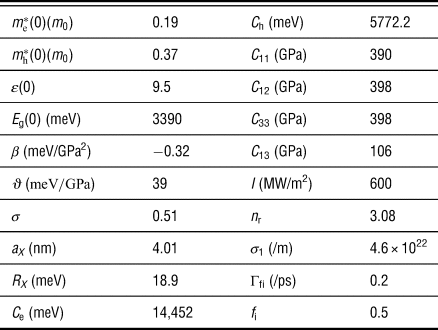
The purpose of this paper is to investigate how hydrostatic pressure and core/shell sizes affect optical properties, such as the changes of the optical responses (LAC, NLAC, LRI, and NLRI) of a confined exciton in SCSQDs, the physical parameters of which are listed in Table I.
Physical parameters of GaN material.[Reference Ha and Ban34,Reference Zhang and Shi38]

Before we start our discussion, we should note that the energy difference E fi = E ff − E ii, the electric dipole moment M fi, and incident electromagnetic field strength I are the main parameters affecting the optical properties, where the AC and RI expressions depend strongly on these parameters.
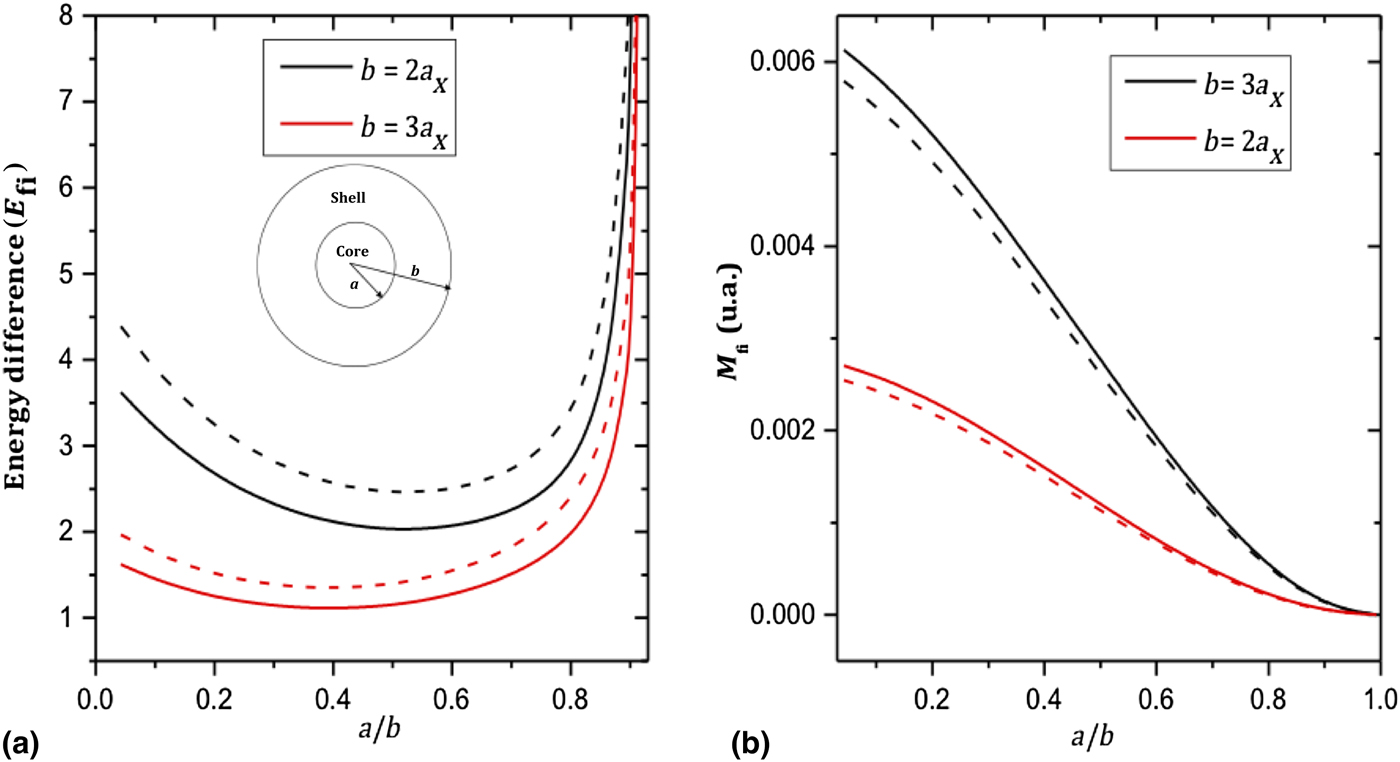
To show the energy difference contribution to the optical responses, and to indicate the confinement effect on these energies, shown in Fig. 1(a), the transition of the energy E fi = E 1p − E 1s, for (b = 2 and 3a x) versus the core/shell radii ratio a/b and for different pressure values. It clearly shows that, the E fi increases for small radii due to the size reduction effect. For the strong confinement, (a = 2a x for example) the energy difference includes two intervals: one between (a/b = 0 and a/b = 0.6), where it decreases and the other between (a/b = 0.6 and a/b = 1), where it increases. Whereas for larger radii (weak confinement), the energy difference is always an increasing function. We remark also that when a tends to b (a/b = 1), the difference E 1p − E 1s is much larger because the confinement becomes very strong; therefore, the kinetic energies of the uncorrelated particles dominate, in this case, the total energy of exciton. Concerning the effects of hydrostatic pressure on E fi [dashed line in Fig. 1(a)], we remark that E fi increases when the pressure is applied, i.e., the pressure behaves as an additive confinement; however, the orbitals waves functions are less sensitive to pressure when a → b, because of the excitonic orbital is less expansive, and therefore the correlated pair (electron–hole) is not influenced by this applied pressure.
(a) Energy difference as a function of the radii ratio a/b: (b = 2a X and 3a x) and for different pressure values (solid line: P = 0 GPa and dashed line: P = 4 GPa). (b) The electric dipole moment as the function of the radii ratio a/b: (b = 2a X and 3a x) and for different pressure values (solid line: P = 0 GPa and dashed line: P = 4 GPa).

In Fig. 1(b) we plot the variation of the electric dipole moment M fi against the radii ratio a/b for b = 2a x and 3a x (solid line) and under different pressure values (dashed line). We notice that the electric dipole moment increases with decreasing SCSQD size; however on the other hand, the M fi reduces when the core/shell radii ratio a/b increases and tends to 0 for a/b → 1. The pressure (dashed line) has a little effect, where the M fi slowly diminishes when the pressure increases. Another remark can be added: the influence of pressure is less pronounced for strong confinement (a → b) than for weak confinement.
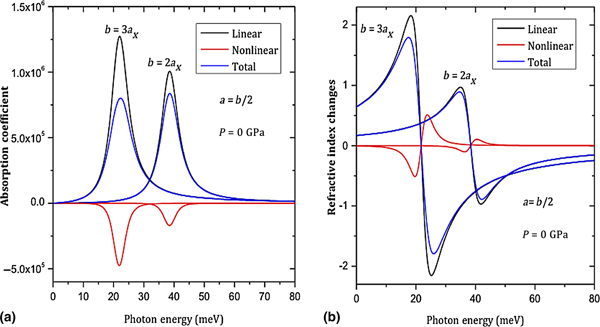
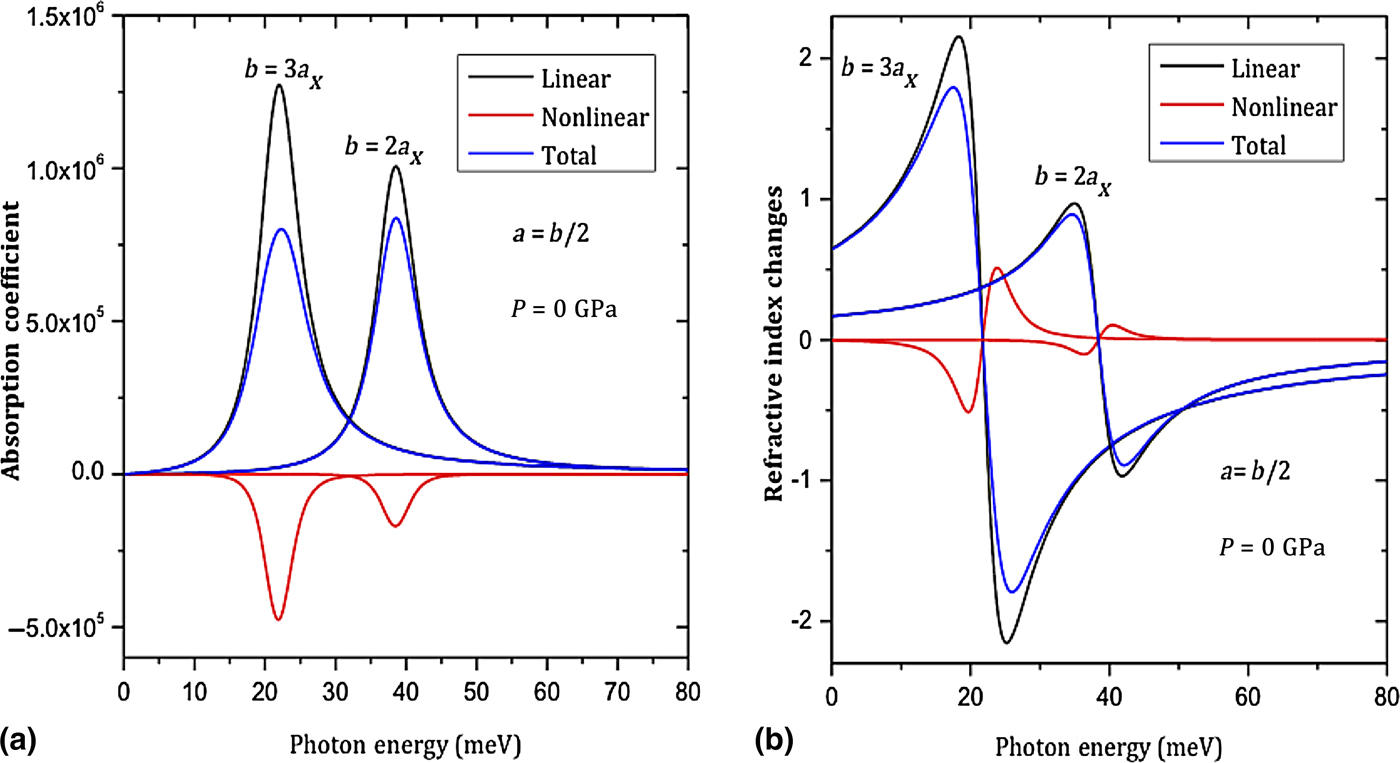
Now let us analyze how the SCSQD sizes influence the behaviors of the optical properties. We plot in Fig. 2(a) the LAC, NLAC, and TAC versus  $\hbar\hskip-2.3pt \omega $ for two shell size values: b = 2a x and 3a x and for a = b/2. First, we remark from Eqs. (16) and (19), that the LAC and LRI constitute the major contribution to the TAC and TRI, and the NAC and NRI vary oppositely with respect to the LAC and LRI terms, so the NAC and NRI terms reduce the TAC and TRI. From Fig. 2(a), we observe that the two components of the TAC have a prominent peak corresponding to the threshold frequency of the incident light. This threshold is equal to 38 and 22 meV for b = 2a x and b = 3a x respectively, so the optical AC are strongly influenced by the shell sizes where, the peaks move to the region of higher energies (blueshift) when the shell radius decreases. This behavior is related to an increase of the excitonic difference energy [Fig. 1(a)] when the radius decreases, due to the confinement effect. Indeed, the confinement effect reinforces the coulombic particle attraction, and therefore the excitonic energies become dominating, and consequently the E fi increase as the size decreases. Furthermore, we can see that the AC amplitudes decrease with the reduction of the size. This behavior can be justified by the decrease of the M fi [Fig. 1(b)], when the shell radius diminishes. In Fig. 2(b), we have presented the RI against
 $\hbar \omega $ for b = 2a x and 3a x and for a = b/2. As we found in the optical AC cases, the RI peaks follow the same behavior as that of the AC, they move to the low energies (redshift), and peak amplitudes increase when the confinement becomes weak.
(a) The LAC, NLAC, and TAC versus the incident  $\hbar\hskip-2.3pt \omega $: (b = 2a X and 3a x) and a = b/2. (b) The LRI, NLRI, and TRI versus the incident
 $\hbar \hskip-2.3pt \omega $: (b = 2a X and 3a x) and a = b/2.
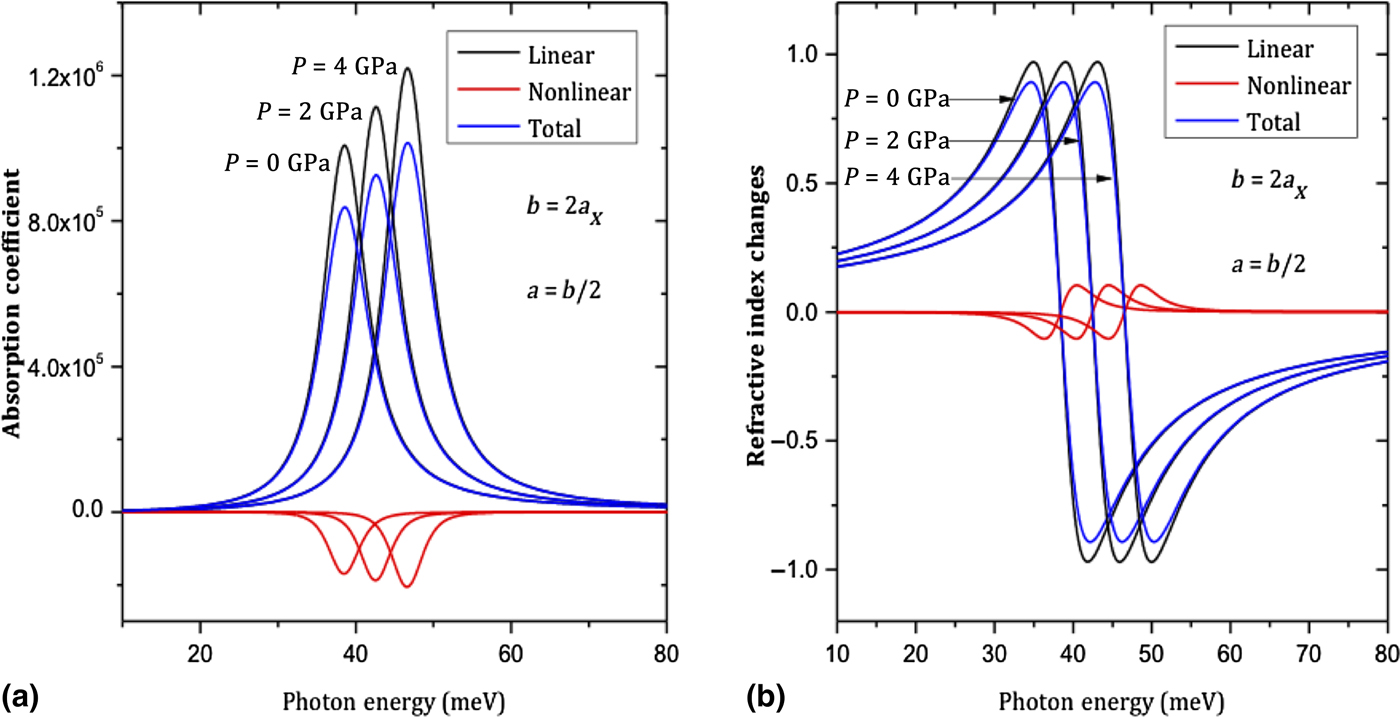
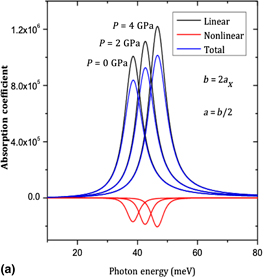
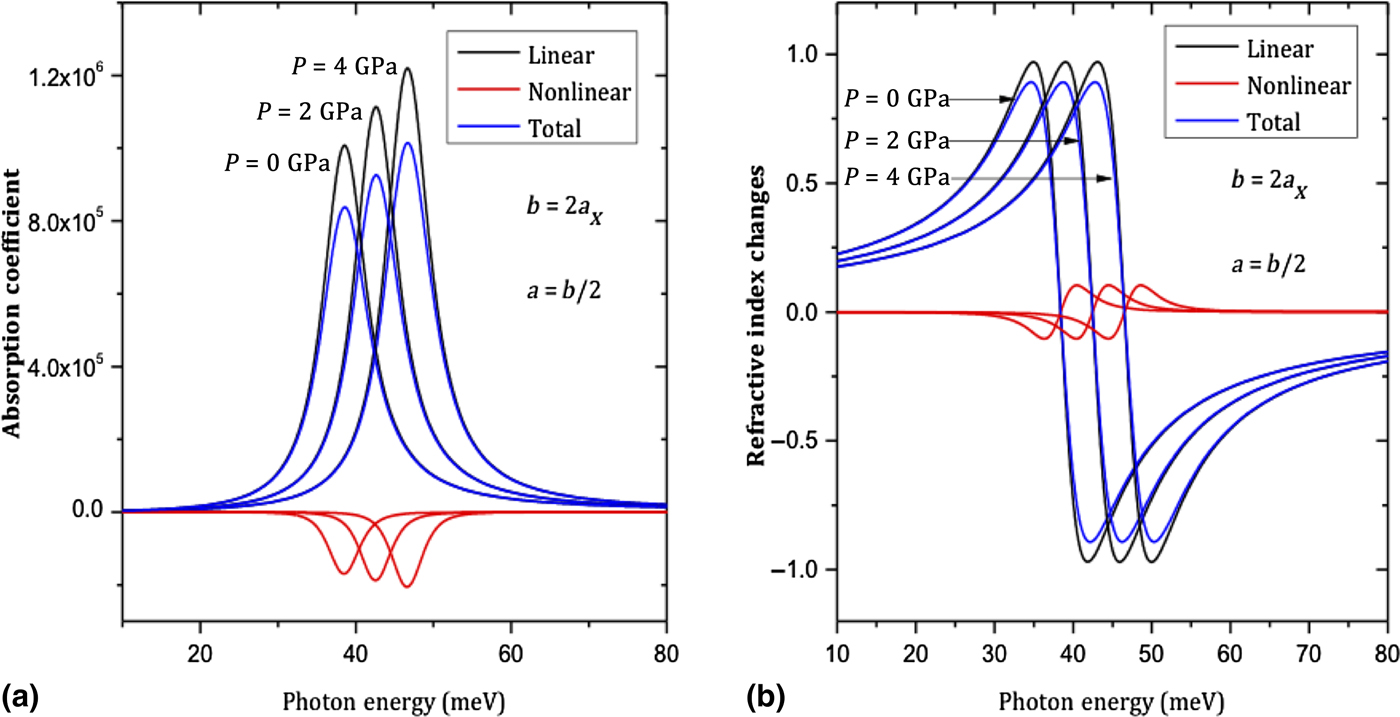
To describe the effects of hydrostatic pressure (P) on the optical responses of a SCSQD, we plot in Fig. 3(a), the LAC, NLAC, and TAC versus  $\hbar \hskip-2.3pt \omega $ for b = 2a x, a = b/2 and under different pressure values. As expected, we see that the different curves of the optical AC are deeply affected by pressure application, and they shift to the higher energies (blueshift: shifted from 38 meV for P = 0 to about 42.5 meV and 46.5 meV for P = 2 and 4 GPa respectively). This is due to, on the one hand, the pressure enhances the confinement by reducing the lattice parameter of GaN material. The pressure-dependent behavior of GaN material can be generalized by the formula a GaN = a GaN(1 − P/3B 0)[Reference Haa, Liua and Zhu32]; and on the other hand, the applied pressure strongly influences the dielectric constant [Eq. (2)] and the reduced excitonic mass [Eq. (4)]. All these parameters lead to an increase of the E fi [Fig. 1(a)], and consequently a shift toward high energies of the optical AC can be remarked. In Fig. 3(b), we present the variation of the LRI, NLRI, and TIR versus
 $\hbar \hskip-2.3pt \omega $ for b = 2a x, a = b/2, and for P = 0, 2 and 4 GPa. The same behavior of the optical AC showing a blueshift with increasing pressure was found for the optical RI. Concerning the AC and RI intensities, we observe an increase and “stability” of the AC and RI peaks respectively. These behaviors can be explained based on the meaning of the AC and RI expressions. By analyzing Eqs. (19) and (20) we see that AC is related to the transition energy E fi, the dielectric constant ε(P), and the electric dipole element M fi. These parameters are functions of the pressure with different ways, which induce a competition between them. The calculus shows that the applied pressure influences ε(P) more than M fi and E fi. For the AC, the amplitudes are dominated by a pressure dependent dielectric constant, and therefore an intensity strengthening occurs. Eqs. (16) and (17) show that RI does not depend on ε(P), and therefore, their amplitudes are dominated by the electric dipole element which depends on P [Fig. 1(b)], which explains the “stability” of RI intensities when pressure increases.
(a) The LAC, NLAC, and TAC versus the incident  $\hbar \hskip-2.3pt \omega $: (b = 2a X and a = b/2) and for different pressure values. (b) The LRI, NLRI, and TRI versus the incident
 $\hbar\hskip-2.3pt \omega $: (b = 2a X and a = b/2) and for different pressure values.
Conclusion
Within the EMA and using variational approach, the optical properties (AC and RI) from transition between 1s and 1p states, as a function of the sizes of core/shell and pressure effect on the behavior of an exciton in a SCSQD were reported. Our results show that core/shell sizes, and applied pressure strongly affect the optical properties of the exciton. With the increasing pressure, AC and RI blueshift toward higher energies. Moreover, the electric dipole moment M fi (although not affected much by pressure) increases with decreasing SCSQD size, but reduces when the core/shell radii ratio a/b tends to 0 for a/b → 1. We also found that AC is strongly influenced by the shell sizes; the AC curve peaks display a blueshift when the shell radius decreases (strong confinement); the AC amplitudes also decrease with reducing shell size (strong confinement); the RI spectrum peaks follow the same behavior as AC, i.e., moves to the higher energies (redshift), and peak amplitudes decrease when the confinement becomes stronger.