I. INTRODUCTION
Nowadays, system-level simulation is an efficient answer to problems encountered in complex microwave circuit simulation. However, in order to minimize computational resources and to conserve a good accuracy, black-box simulation requires accurate behavioral models of the microwave elementary subsystems which constitute the system.
The RF power amplifier is a key element of transmission–reception modules. The use of high power creates nonlinearities and material self-heating inside the component. Interaction of these effects leads to amplitude and phase distortions on the transmitted signal. Within the context of development of active electronically scanned array radar such as those developed by Thales Airborne Systems, the amplifier position, downstream of the amplitude, and the phase control, does not allow in correcting these distortions. This is the reason why behavioral modeling of RF power amplifiers represents an important research axis. Many works [Reference Pedro and Maas1–Reference Le Gallou5] have already been performed in order to obtain a system-level model allowing a tradeoff between an accurate prediction of performances and the simulation time.
The black-box model presented in this paper, takes into account the coupling between nonlinear effects, high-frequency memory effects, and thermal effects due to the amplifier self-heating. Its integration in Scilab/Scicos environment allows in performing fast transient simulation with very good precision and convergence properties.
II. Scilab/Scicos SIMULATION PLATFORM
A) Introduction
Scicos is a part of the scientific software package Scicoslab providing many capabilities available in Simulink [Reference Nikoukhah6, Reference Nikoukhah and Steer7]. It has been developed at INRIA Rocquencourt for about 15 years by project-team METALAU. Based on an open formalism motivated by synchronous languages extended to continuous time dynamics, Scicos can be used to model and simulate hybrid dynamical systems.
B) Scicos environment
Scicos is a complete environment which allows construction of models, simulation, and code generation. It includes:
– A block diagram editor: Scicos contains a graphical editor that can be used to build block diagram models of dynamical systems. The blocks can come from various palettes provided by Scicos or can be defined by user. These new blocks can be defined in C, Fortran, or Scilab.
– A compiler: Scicos compiler defines scheduling tables based on the model description. These tables, usually compiled by the Scicos editor, can then be used by the simulator and the code generation function.
– A simulator: Scicos simulator runs simulation using the scheduling tables and other information provided by the compiler. This is a hybrid simulator able to deal with both discrete and continuous time systems, and events. For the continuous time part, it uses the ODE solver LSODAR or the DAE solver DASKR depending on the nature of the continuous time system considered. Moreover it includes a code generator. Scicos can generate C code to represent the behavior of some subsystems. These subsystems must not include continuous time components.
C) Scicos and Scilab
Scicos is a Scicoslab toolbox and runs in the Scilab environment. The access to Scilab functions when designing simulation models is of great importance: Scicos user often needs to use Scilab functions such as those dedicated to database interpolation, as it will be seen thereafter, in the development of simulation models. Scilab programming language can be used for batch processing of multiple simulation tasks. More generally, models designed by Scicos can be used as functions in Scilab. Scilab graphical facilities can also be used for post-processing simulation results.
D) Scicos formalism
Scicos is a tool for designing reactive systems. Scicos models are designed using a block diagram editor, but an underlying language exists providing a well-defined formalism. This formalism is very simple because it deals exclusively with the reactive part of the design; it does not provide a complete programming language. The blocks are considered as atoms in Scicos; Scicos simulator considers them almost as black boxes. It knows some of their properties but not the underlying code. The code realizing the behavior of a block (called the simulation or computational function) can be written in C, Fortran, or Scilab. In Scicos formalism, the execution of simulation functions is considered instantaneous so Scicos can be considered as a synchronous language or more specifically as an extension of it to handle continuous time systems. The existence of a unique universal time is assumed in the formalism.
E) Create new Scicos block
In addition to the available blocks, Scicos allows user to create and use new blocks. Various ways are possible:
– New blocks can be based on existing blocks using the super blocks construction and masking. This function allows to group different existing blocks together in order to create a new function (see Section III.E). However, super blocks are just graphical facilities, they do not reduce time calculation.
– Scicos also makes different generic blocks available for users in order to create Scilab, Fortran, or C basic functions. The major drawback of these blocks is that they are unsuitable with complex functions such as the amplifier behavior description.
– Finally, Scicos blocks can be defined using C or Scilab programs and loaded in Scilab (see Section III.C). Such new blocks require a good understanding of how Scicos works and the data structures used.
F) Scicos block structure
The Scicos blocks are built around two functions: an interfacing function expressed in Scilab language and a computational function written in C, Fortran, or Scilab.
The interfacing function is used during model construction by interfacing with the block diagram editor. It contains routines used notably for initializing the block data structure, defining the block geometry and the number of inputs and outputs, and handling the interface with the user.
The computational function is used during simulation and contains the routines for computing in particular the outputs and the state blocks.
III. INTEGRATED ELECTROTHERMAL BEHAVIORAL MODEL
The system-level model implemented in Scilab/Scicos environment is the result of a fruitful collaboration between Thales Airborne Systems and Xlim laboratory.
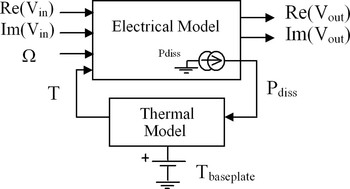
The electrothermal behavior prediction of the RF power amplifier is possible, thanks to the coupling of an electrical model with a thermal model (Fig. 1).
Electrothermal behavioral model.

A) Electrical system-level model
The studied amplifier is a narrow band device working around the central carrier frequency f o. Input and output complex envelope signals are linked by a transfer function using the truncated first-order modified Volterra series [Reference Le Gallou5]. This formalism is particularly well suited to narrow band highly nonlinear devices. These series have been extended to take into account the temperature, considering thermal effects as independent of frequency [Reference Mazeau, Sommet, Caban-Chastas, Gatard, Quéré and Mancuso8]. They lead to the following expression of S 21 transmission parameter with a 1(t), the input power wave:

In case of radar applications, the use of the model is limited to pulsed continuous wave (CW) signal. Therefore, only the carrier frequency is considered so the second term in (Reference Pedro and Maas1) is simplified. Expression (Reference Pedro and Maas1) can be expressed as follows:

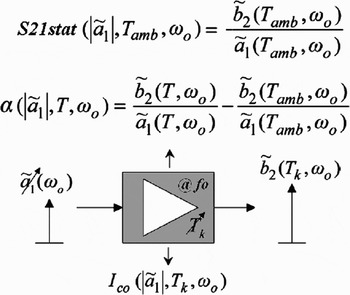
The static transmission parameter S 21stat describes the amplifier nonlinear behavior at the central carrier frequency f o for a working temperature T inside the component. Its expression is the following:


The differential gain α represents gain variations brought by temperature variations inside the components. This term is equal to zero at the ambient temperature T amb.
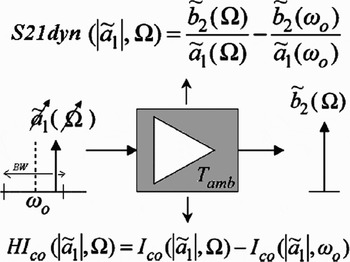
The dynamic gain S21 dyn represents the gain variation due to the displacement of the carrier frequency in the device bandwidth BW (HF memory). Its expression is

The dissipated power calculated by the electrical model can be expressed by

The continuous power P dc is only the bias power at the collector assuming the base bias current negligible compared to the collector bias current (I bo ≪ I co). The V ceo collector voltage being constant, the power P dc depends only of current I co which varies with the input signal magnitude, the temperature, and the carrier frequency. The bias current I co can be expressed by the summation of two independents terms as the S 21 parameter expression: a static term representing the thermal influence at frequency f 0 and a dynamic differential term HI co representing the spectral dispersion. The current I co can be expressed as follows:

This model can be driven by input signal of type CW, pulsed CW, and chirp.
B) Electrical model extraction
The static terms S 21stat(|a 1|, T amb), α(|a 1|, T), and I co(|a 1|, T) are extracted, thanks to an isothermal single-tone harmonic-balance simulation of the circuit model. The extraction is performed at central carrier frequency f o for various temperatures T within the device (Fig. 2).
Identification of static terms.

The identification of the dynamic terms S 21dyn(|a 1|, f) and HI co(|a 1|, f) is performed, thanks to a single-tone harmonic-balance simulation for a fixed temperature (T = T amb) inside the amplifier and for various frequencies within the component bandwidth (Fig. 3). The terms a 1 and b 2, respectively, represent the input and output power waves.
Identification of dynamic terms.

This database is fully representative of the amplifier behavior. It defines the domain of validity for each parameter, carrier frequency, input power wave magnitude, temperature, and device bias point.
These data can be obtained by measurements although isothermal measurements are difficult to perform for the extraction of the static terms. For the dynamic terms identification, it is imperative to use short pulse duration (≈2 µs) in comparison with the main thermal time constant (≈30 µs) in order to avoid self-heating effects.
C) Electrical model integration
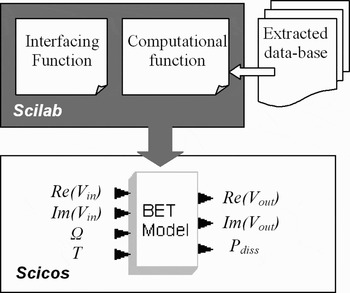
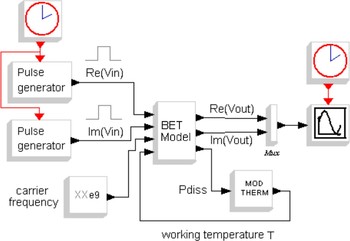
The electrical model implementation in Scicos has been performed, thanks to the creation of a block called “BET model” (Fig. 4). This block is defined with two functions: the interfacing function, which describes notably the block geometry; the computational function, written in Scilab language, which reproduces the amplifier behavior from data files resulting from isothermal simulations of circuit model. The data files are splined under Scilab (Splin and Splin2D). These two functions, defined in Scilab, are then loaded into Scicos to obtain the full electrical model.
“BET model” block.

The input variables of the BET model are the voltage V in (real and imaginary parts) corresponding to the input signal envelope, the carrier frequency f, and the temperature T received from the thermal model. The block delivers the output power P out and the dissipated power P diss (Fig. 4).
The BET model allows in evaluating nonlinear and high-frequency memory effects. The amplifier self-heating is computed by the thermal model described in the next section.
D) Thermal model
The thermal model allows in predicting the transient thermal behavior of the amplifier. This physics-based model is obtained from a three-dimensional (3D) thermal simulator based on a finite element method (FEM).
First, a coarse grain thermal analysis is performed in order to evaluate the coupling between the different stages of the amplifier. Simplifications can often be applied to multistage amplifiers, without affecting the accuracy of the results: neglecting the inter-stage coupling effects, simplifying the layer structure and the dissipation volumes in the transistor [Reference Mazeau, Sommet, Caban-Chastas, Gatard, Quéré and Mancuso8].
Thanks to the FEM, a linear system with characteristic matrices of the heat equation is extracted:
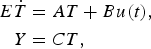
E and (−A) represent, respectively, the heat capacity and the heat conductivity matrices of the system composed of n linear equations determined by the mesh of the structure. B represents the distribution of the dissipated power and T the distribution of the temperature. Y is the output temperature extracted from the solution T through the C product.
Applying Fourier transform to the previous system leads to the transfer function

Unfortunately, this function cannot be directly computed and used in a simulator system because of its important dimension and the great difficulty to invert high-dimensional matrices.
Thus, a model order reduction technique based on the Ritz vector approach [Reference Sommet, Lopez and Quéré9, Reference Hsu and Vu-Quoc10] has been developed. This method enables the reduction of system dimensions and the extraction of an equivalent operating temperature for the amplifier with the use of C. This approach is very efficient to cope with linear problems, but a linear system requires the heat conductivity of the used materials to be constant.
The Ritz vector approach is a projection method which relies on the generation of an orthogonal and E-orthonormal basis Φm constituted of m vectors (m≪n). Rewriting the original system in the new coordinate results in a smaller system
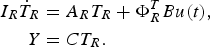
The “R” subscript indicates the reduced system. The previous equations represent the system implemented as presented in Fig. 5 of the next section.
“MOD THERM” super block.

The accuracy of the transient regime depends on the time constant number (it means the number of Ritz vectors m) which can be freely chosen by the designer.
E) Thermal model integration
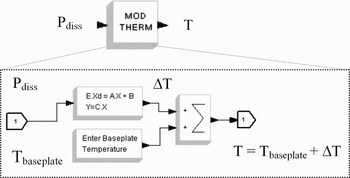
The thermal model implementation in Scicos platform is realized, thanks to the “MOD THERM” super block (Fig. 5) which is built around three blocks:
– The “EX d = AX+BY = CX” block allows to solve the linear system of matrices extracted from 3D thermal simulation of the equivalent power amplifier structure. This block calculates the working temperature variations ΔT knowing the dissipated power inside the amplifier.
– The “enter baseplate temperature” block has been created to take into account the amplifier baseplate temperature T baseplate.
– “Summation” block, available in Scicos linear palette, allows determining the working temperature T doing the summation of the baseplate temperature T baseplate with the temperature variation ΔT.
The behavior of “MOD THERM” super block is equivalent to a thermal impedance. It means it determines the amplifier working temperature T for a dissipated power P diss and a given baseplate temperature T baseplate.
IV. BET MODEL IN Scicos/RESULTS
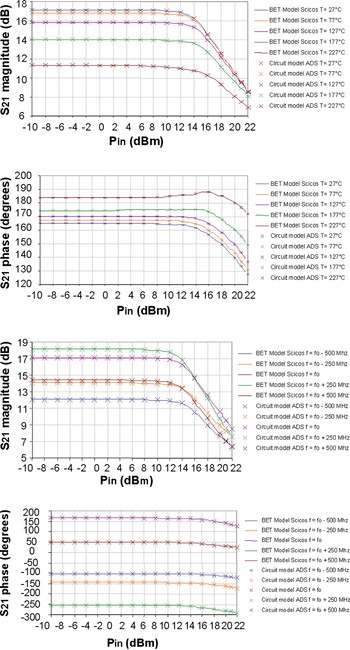
Results plotted in Fig. 6 allow in comparing the behavioral electrothermal model (BET model) stemming from Scicos simulation, and the circuit model simulation for a power amplifier based on (AsGa/GaInP) HBT technology. The generated power reaches 8 W in X-band (harmonic-balance simulation under Agilent ADS simulator). The S21 parameter is represented in module and phase versus the input power, for various values of the temperature, and various values of the carrier frequency.
Comparison of S21 (magnitude and phase) calculated by the BET model in Scicos and the circuit model ADS for various temperatures and carrier frequencies.

Figure 7 shows the implementation of the BET model in Scicos simulation platform. The electrical and thermal models that have been developed separately are associated in the same Scicos simulation interface. The so-created BET model is driven by a pulsed envelope signal V in generated by two Scicos block “pulse generator”. The carrier frequency is given by a “constant” Scicos block. In this case, the carrier frequency assumes to be constant (pulsed CW signal). However, the BET model is able to consider a varying carrier frequency during the simulation to handle frequency modulated signal (chirp signal for example).
BET model in Scicos environment.

The model computes the output envelope signal V out and the dissipated power P diss. Constantly, P diss is injected into the thermal model translating the evolution of the working temperature T.
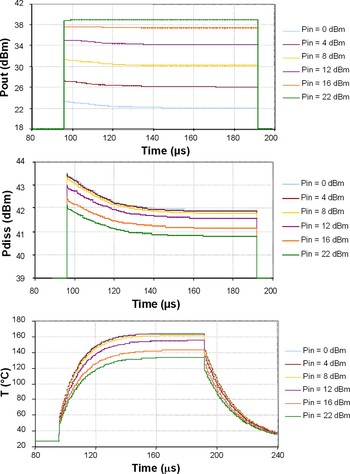
The output power time-domain response, the dissipated power, and the amplifier working temperature are plotted for various input power levels (Fig. 8), when the model is driven by a 96 µs long pulse.
Output power, dissipated power, and working temperature calculated by the BET model in Scicos for various input powers (pulse duration of 96 µs).

The results show a very good agreement between the BET model and results stemming from the circuit model ADS simulation with a mean square error lower than 10−3.
V. CONCLUSION
In this paper, we have proposed an integrated solution in the open source environment Scilab/Scicos for a BET model. The use of this solution has revealed a great improvement in time domain simulation and very good convergence properties. The computation time has been divided by (at least) 1000 in comparison to an envelope simulation of the circuit model as in ADS software.
This work has been performed in the framework of the French MoD (Ministry of Defense) project SCERNE [Reference Mons11] (XLIM, IMS, INRIA, THALES, and IPSIS consortium) for the development of an extraction/simulation tool of “fine-grains” behavioral model and its integration in radar simulator ASTRAD and network antenna simulator SAFAR.
 Florent Besombes received a master's degree in high-frequency and optical telecommunications in 2007 from the Limoges University, France. He is currently working toward a Ph.D. degree at the XLIM laboratory in the high frequency components circuits signals and systems department, Limoges University in collaboration with THALES Airborne Systems, Elancourt, France. His research interests are dedicated to electrothermal system-level models of power amplifiers for radar applications.
 Julie Mazeau received a master's degree in high-frequency and optical telecommunications from the University of Limoges, Limoges, France, in 2003, and a Ph.D. degree about “electrothermal system-level model of power amplifiers for radar applications” at the Research Institute XLIM, University of Limoges in collaboration with THALES Airborne Systems, Elancourt, France, in 2007. She joined the advanced technologies team at THALES Airborne Systems, Elancourt, France. She is in charge of microwave modeling and design for active antenna T/R modules.
 Raphaël Sommet received a French Aggregation in applied physics degree and a Ph.D. degree from the University of Limoges, Limoges, France, in 1991 and 1996, respectively. From 1997, he has been a permanent researcher with the C2S2 team “Nonlinear Microwave Circuits and Subsystems,” XLIM Research Institute, Centre National de la Recherche Scientifique (CNRS), University of Limoges. His research interests concern HBT device simulation, 3-D thermal FE simulation, model-order reduction, microwave circuit simulation, and generally the coupling of all physics-based simulation with circuit simulation.
 Edouard Ngoya received a Ph.D. degree in electronics from the University of Limoges in 1988. He worked as R&D engineer with CAROLINE and RACAL-REDAC in 1988 and 1989. In 1990 he joined the French Centre National de la Recherche Scientifique (CNRS) as a senior researcher at XLIM-University of Limoges. He has initiated key circuit simulation and modeling techniques and contributed to the development of several ADE tools for nonlinear RF and microwave circuits. His current domains of interest include full-chip RFIC simulation techniques, analog system bloc-level modeling, and PA linearization techniques.
 Jean-Paul Martinaud received a Ph.D. degree in applied mathematics from the University Pierre et Marie Curie PARIS VI, France, in 1984. He is currently dean expert of hardware modeling at THALES Airborne System and responsible of electromagnetism modeling and simulation tools development in the antennas and circuits application domain.