Introduction
Despite several work–life balance (WLB) studies indicating that there are different work characteristics across occupations that require different WLB practices (Holman, Reference Holman2002; Lambert & Haley-Lock, Reference Lambert and Haley-Lock2004; Perry-Jenkins, Reference Perry-Jenkins2005; Swanberg, Pitt-Catsouphes, & Drescher-Burke, Reference Swanberg, Pitt-Catsouphes and Drescher-Burke2005; Lyonette, Crompton, & Wall, Reference Lyonette, Crompton and Wall2007: 238), there is a dearth of academic research that considers and examines the WLB perceptions of different occupational status groups Eaton, Reference Eaton2003; (Bianchi, Casper, & King, Reference Bianchi, Casper and King2005; Grandey, Cordeiro, & Michael, Reference Grandey, Cordeiro and Michael2007; Lambert, Reference Lambert2009; Özbilgin, Beauregard, Tatli, & Bell, Reference Özbilgin, Beauregard, Tatli and Bell2011). Although social class divisions and income disparities in workplaces and societies are widening worldwide (Pearce, Xin, Rao, & Xu, Reference Pearce, Xin, Rao and Xu2005; Habibis & Walter, Reference Habibis and Walter2008; Masterman-Smith & Pocock, Reference Masterman-Smith and Pocock2008), the paucity of WLB research investigates fairness among professional/managers versus non-professionals in relation to WLB opportunities (Lambert, Reference Lambert2009). This issue is particularly relevant to the reality of the increasing inequality of power within contemporary organizations and societies (Özbilgin et al., Reference Özbilgin, Beauregard, Tatli and Bell2011). Adding to the concern, WLB research in Australia repeatedly reports that Australian organizations are not adequately managing the WLB of full-time employees and that employees have become increasingly dissatisfied with their WLB in the past few years (Campbell, Reference Campbell2007; De Cieri, Holmes, Abbott, & Pettit, Reference De Cieri, Holmes, Abbott and Pettit2005; Pocock, Reference Pocock2005,Reference Pocock2008; ABC News, 2010). To date, very few organizational justice studies have been conducted in the area of WLB (see Judge & Colquitt, Reference Judge and Colquitt2004; Siegel, Post, Brockner, Fishman, & Garden, Reference Siegel, Post, Brockner, Fishman and Garden2005) and no research – to the best of authors’ knowledge – has examined the perception of WLB/organizational justice between distinctive occupational groups. In order to fill the existing void in the literature, we adopt the organizational level stratification (Lambert & Haley-Lock, Reference Lambert and Haley-Lock2004); workers’ power status (Kalleberg, Wallace, & Althauser, Reference Kalleberg, Wallace and Althauser1981); and critical social science/WLB perspectives (Özbilgin et al., Reference Özbilgin, Beauregard, Tatli and Bell2011) to examine WLB opportunities across different full-time occupational groups in Australia.
Specifically, this study examines the WLB/organizational justice perceptions of professional and managerial workers against the rest of the workers. By understanding the different levels of organizational justice/WLB perceptions along with the qualitative accounts of professional/managerial workers and the rest of the workers in Australia, this study seeks to promote WLB practices that are fair, inclusive and socially responsible for all occupational groups (Colby, Sippola, & Phelps, Reference Colby, Sippola and Phelps2001).
The organizational justice research widely acknowledges that employees’ perceptions of organizational fairness influence work-related psychological outcomes such as trust in supervisors, intention to stay in an organization, commitment to an organization and job satisfaction (Sweeney & McFarlin, Reference Sweeney and McFarlin1997; Lee & Farh, Reference Lee and Farh1999; Schmitt & Dörfel, Reference Schmitt and Dörfel1999; Lee, Pillutlal, & Law, Reference Lee, Pillutlal and Law2000; Foley, Hang-Yue, & Wong, Reference Foley, Hang-Yue and Wong2005; Brammer, Millington, & Rayton, Reference Brammer, Millington and Rayton2007). Therefore, this implies that WLB fairness perceptions are an essential indicator of positive psychological WLB conditions in a workplace (Moliner, Martínez-Tur, Ramos, Peiró, & Cropanzano, Reference Moliner, Martínez-Tur, Ramos, Peiró and Cropanzano2008). Employees in lower occupational status and income earning groups represented by non-professional groups tend to be unfairly treated by their employers (Lambert & Haley-Lock, Reference Lambert and Haley-Lock2004; Bianchi, Casper, & King, Reference Bianchi, Casper and King2005; Goward et al., Reference Goward, Mihailuk, Moyle, O'Connell, de Silva, Squire and Tilly2005; Perry-Jenkins, Reference Perry-Jenkins2005). Thus, our study aims to promote fairer WLB policies and practices that provide equal WLB opportunities for all occupational groups in the Australian workforce.
The paper is organized as follows. First, we provide our theoretical perspective (i.e., the organizational level stratification, workers’ power status and critical social science/WLB) for this study and review the current discourse on WLB to justify our focus on two groups – the professional/managerial and the non-professional group. This is followed by a discussion on organizational justice, and its different taxonomies relating to a WLB/organizational justice study. Next, we discuss the qualitative and quantitative method used for the study and the findings. We conclude by discussing the implications of the study along with avenues for further research.
PROFESSIONAL/MANAGERIAL AND NON-PROFESSIONAL GROUPS FOR WLB
We adopt the perspectives of organizational level stratification, along with workers’ power status (Lambert & Haley-Lock, Reference Lambert and Haley-Lock2004; DiTomaso, Post, & Parks-Yancy, Reference DiTomaso, Post and Parks-Yancy2007; Lambert, Reference Lambert2009) and critical social science/WLB perspectives (Özbilgin et al., Reference Özbilgin, Beauregard, Tatli and Bell2011) as our major theoretical framework for undertaking this study. The study examines WLB opportunities across a full-time professional/managerial group and the rest of the workers, which are distinguished by their income earnings and power structure within the Australian workforce.
The WLB/organizational stratification perspective underpinned by occupational labor market theory (e.g., Pfeffer & Cohen, Reference Pfeffer and Cohen1984) stresses the importance of comparing the application of human resource policies, programs and practices across different occupations so that organizations can identify how employers – regardless of available social policies or the forces of the external labor market – distribute WLB opportunities to different occupational groups (Lambert & Haley-Lock, Reference Lambert and Haley-Lock2004). A critical social science/WLB perspective supports this stream of WLB research, which seeks to explicate the different WLB perceptions of those with different power status in organizations and societies (Fay, Reference Fay1987; Özbilgin et al., Reference Özbilgin, Beauregard, Tatli and Bell2011). The critical social science/WLB perspective views WLB literature from power disparity and diversity perspectives, which criticizes a blind spot in the WLB research and argues the case for capturing the changing nature of demographic workforce compositions that differentiate employees’ work-life experiences within social and historical contexts (Özbilgin et al., Reference Özbilgin, Beauregard, Tatli and Bell2011).
Notably, DiTomaso, Post, and Parks-Yancy (Reference DiTomaso, Post and Parks-Yancy2007: 475), who examined workforce diversity inequality from a sociological point of view, defined power as ‘one's access to and control over valuable resources,’ and status as ‘relationships of honor between groups.’ Along with other sociologists (e.g., Berger, Rosenholtz & Zelditch, Reference Berger, Rosenholtz and Zelditch1980; Ridgeway, Reference Ridgeway1997) they argue that workers’ power and status tend to concomitantly affect levels of workplace inequality. Those who have greater access to positions of higher status tend to simultaneously gain greater access to the resources, valued rewards and critical organizational decision-making within a social system (e.g., status characteristic theory: Berger, Fisek, Norman, & Zelditch, Reference Berger, Fisek, Norman and Zelditch1977; system justification theory: Jost, Banaji, & Nosek, Reference Jost, Banaji and Nosek2004). Therefore, professional/managerial group with higher status tend to gain more valued rewards (e.g., greater WLB) than those with lower status (Kalleberg, Wallace, & Althauser, Reference Kalleberg, Wallace and Althauser1981). Ironically, the system justification theory further argues that lower status groups (e.g., non-professional/manager groups) tend to justify the system of inequality, accepting the status quo of getting what their status deserves (DiTomaso, Post, & Parks-Yancy, Reference DiTomaso, Post and Parks-Yancy2007). Some argue that their justification is partly owing to their hesitation to challenge the system of inequality (Jost, Banaji, & Nosek, Reference Jost, Banaji and Nosek2004). While the power status differential has existed for a long time, the conformation and acceptance of those in disadvantaged status groups further facilitate those in higher power status groups to feel more entitled to valued rewards and resources (DiTomaso, Post, & Parks-Yancy, Reference DiTomaso, Post and Parks-Yancy2007). Sociology work on status construction theory further denotes that status differences and different levels of access to resources have become a widely accepted path way through which inequality in society is accomplished (Ridgeway, Boyle, Kuipers, & Robinson, Reference Ridgeway, Boyle, Kuipers and Robinson1998).
Therefore, the status difference between the professional/manager group versus the rest of the group may mirror the substantially different accessibility, span of control and flexibility in obtaining resources and valued rewards such as WLB. The inequality pertaining to those with different power status, therefore, has generated considerable attention in understanding the concept of justice and its implication for policies (Benabou & Tirole, Reference Benabou and Tirole2006). Based upon these perspectives, this study quantitatively and qualitatively compares and contrasts the justice perceptions of two major occupational groups, namely, a professional/managerial group and a non-professional group.
For the purpose of this study, seven occupational groups were selected from the major classification of occupational groups published by the Australian Bureau of Statistics (ABS, 2006) and were categorized into the professional/managerial and the non-professional groups. Based upon their average weekly cash earning levels in accordance with ABS data, we defined professional/managerial groups as those with AUS$1,500 or above weekly earnings, and the non-professional groups with AUS$1,050 or less weekly earnings (ABS, 2008). Specifically, Managers and Professionals were categorized as the professional/managerial group, and Clerical and Administrative Workers, Machinery Operators and Drivers, Laborers, Sales Workers, and Technicians and Trade Workers were categorized as the non-professional group. According to the ABS (2010), the professional/managerial full-time employees make up 39.6% of the Australian workforce, and the remainder 60.4%. The relatively larger number of employees involved in the non-professional/managerial workforce (60.4%) as opposed to professional/managerial workforce (39.6%) highlights the importance of workforce equality, concerning employees’ WLB in the Australian workforce.
WLB reflects ‘the absence of unacceptable levels of conflict between work and non-work demands’ (Greenblatt, Reference Greenblatt2002: 179); ‘positive role balance’ (Marks & MacDermid, Reference Marks and MacDermid1996: 421) and ‘equal levels of attention, time, involvement, or commitment’ devoted to work and non-work roles (Greenhaus, Collins, & Shaw, Reference Greenhaus, Collins and Shaw2003: 512). When employers put efforts into granting employees opportunities to balance their work and non-work lives, their efforts should be equally distributed among all employees regardless of their occupational status, family status, social identity (e.g., age and gender) and background, so as to maximize the full potential of the entire labor force (Lambert & Haley-Lock, Reference Lambert and Haley-Lock2004; Swanberg, Pitt-Catsouphes, & Drescher-Burke, Reference Swanberg, Pitt-Catsouphes and Drescher-Burke2005; Kalliath & Brough, Reference Kalliath and Brough2008; Özbilgin et al., Reference Özbilgin, Beauregard, Tatli and Bell2011). To date, however, several studies have found that different social groups tend to achieve different levels and nature of work-life imbalance, implying social inequality among employees. For example, female employees tend to report more work-life family imbalance than male employees (Moen & Yu Reference Moen and Yu2000; Toth Reference Toth2005; Bergman & Gardiner Reference Bergman and Gardiner2007) and male employees tend to display a greater inverse relationship between sleep duration and long working hours than female employees (Chatzitheochari & Arber, Reference Chatzitheochari and Arber2009). Some research has further indicated that employees with higher income earnings and more education at higher levels in an organization's hierarchy, tend to receive greater access to WLB opportunities than those employees at lower levels (Glass & Camarigg, Reference Glass and Camarigg1992; Lambert & Haley-Lock, Reference Lambert and Haley-Lock2004; Hyman, Scholarios, & Baldry, Reference Hyman, Scholarios and Baldry2005; Swanberg, Pitt-Catsouphes, & Drescher-Burke, Reference Swanberg, Pitt-Catsouphes and Drescher-Burke2005). On the other hand, several studies report that employees who are regarded as managers and professionals tend to report more work-life imbalance than those in the non-professional group Dex & Bond, Reference Dex and Bond2005; (Bergman & Gardiner, Reference Bergman and Gardiner2007; Lyonette, Crompton, & Wall, Reference Lyonette, Crompton and Wall2007; Moore, Reference Moore2007). Drawing from these literatures, as far as organizational justice perceptions are concerned, we hypothesize that managers/professionals – who have higher income earnings and are likely to be more educated – will report greater perceptions of fairness than the non-professional group because they are given more WLB opportunities. Some research in organizational justice indicates that individuals tend to gather information about the fairness of past events by exchanging opinions among colleagues who are close to them (Lind & Tyler, Reference Lind and Tyler1988; Umphress, Labianca, Brass, Kass, & Scholten, Reference Umphress, Labianca, Brass, Kass and Scholten2006). As managers/professionals tend to affiliate more with authorities in organizational hierarchy and they are in a position to better influence their decisions than the rest of workers, we hypothesize that they are likely to have greater level of organizational justice perceptions.
The study quantitatively investigates the levels of WLB/organizational justice perceptions between the professional/managerial and the non-professional groups first, and then qualitatively explores their WLB/justice perceptions. Specifically, we examined the following research questions: (1) Do the professional/managerial and the non-professional groups report different levels of organizational justice in relation to their WLB opportunities? (2) What aspects of organizational WLB incidents do the professional/managerial and the non-professional group perceive as just or unjust? (3) How do these perceptions of justice differ between the professional/managerial and the non-professional groups? (4) What HR interventions may assist professional/managerial and the non-professional groups in managing their WLB?
WLB/ORGANIZATIONAL JUSTICE FOR PROFESSIONAL/MANAGERIAL AND NON-PROFESSIONAL GROUPS
In this study, the organizational justice taxonomy of procedural, distributional and interactional justice is used to examine the WLB/justice perceptions of employees about WLB-related work incidents (Adams, Reference Adams1965; Thibaut & Walker, Reference Thibaut and Walker1975; Bies & Moag, Reference Bies and Moag1986).
Procedural justice (Thibaut & Walker, Reference Thibaut and Walker1975) refers to perceived fairness about the design of formal human resource decision-making processes, policies and practices, which are used to determine employees’ work outcomes such as promotion and pay. Based on this taxonomy, we examine employees’ fairness perceptions of the organization's formal and informal decision-making processes in relation to employees WLB. Distributive justice (Adams, Reference Adams1965) refers to perceived justice about employees’ work outcomes against their work contributions. Based on this taxonomy of distributional justice, employees’ perceptions of WLB outcomes (e.g., special leave, flexible hours) relative to their work contribution are examined. Interactional justice (Bies & Moag, Reference Bies and Moag1986) refers to perceived justice about the quality of interaction that people receive from authorities and third parties. Based on this taxonomy of interactional justice, employees’ perceptions of the quality of interactions with the authorities are examined in relation to their achievement of WLB. Interactional justice is often separated into interpersonal justice and informational justice. Interpersonal justice refers to the degree to which people are perceived to be treated with courtesy, dignity and respect by authorities/third parties, whereas informational justice refers to the explanations provided to employees about why certain practices were used or why outcomes were distributed in a certain way (Bies & Moag, Reference Bies and Moag1986; Colquitt, Reference Colquitt2001). Based upon the taxonomies of interpersonal and informational justice, the present study examines the degree to which employees are treated with courtesy, dignity and respect by authorities in relation to allocations of WLB opportunities; and the explanations provided to employees by authorities about why certain WLB practices were used or why certain WLB outcomes were distributed in a particular way. We use these taxonomies of WLB/organizational justice as a key focus of our study for the professional/managerial and non-professional groups. Based on the above discussion and the existing literature we established the following hypotheses for the quantitative study:
Hypothesis 1 : Professional/managerial group will perceive more procedural justice than the non-professional group in relation to WLB procedures in their organizations.
Hypothesis 2 : Professional/managerial group will perceive more distributional justice than the non-professional group in relation to their WLB outcomes.
Hypothesis 3 : Professional/managerial group will perceive more interactional (interpersonal and informational justice) than the non-professional group in relation to managers’ social interaction for their WLB.
To further elaborate on and validate the findings of the quantitative study, we also undertook a qualitative study.
METHOD
The present study employed mixed quantitative and qualitative methods to examine the justice perceptions of WLB incidents of the professional/managerial and the non-professional group. The combined use of quantitative and qualitative methods is considered most appropriate as this study attempts to research WLB/organizational justice, which is a relatively new area of WLB research (cf. Miles & Huberman, Reference Miles and Huberman1994; Maxwell, Reference Maxwell1996). Therefore, the two groups’ justice perceptions are quantitatively tested first and their verbatim responses are qualitatively analyzed to add further meanings to the quantitative result.
SAMPLE FOR BOTH STUDIES
A total of 437 full-time employees participated in the study in 2008, which represented 192 women and 245 men. We ensured that each occupational group had at least 40% women. By utilizing the ABS data (2009), we sought to capture representative sample perspectives of professional/managerial and non-professional samples across the four most-populated states in Australia (NSW, 29.9%; QLD, 23.8%; VIC, 27%; and SA, 19.2%). We compared our data with the ABS data by calculating the percentage of each occupational group in the ABS data. We randomly sampled full-time (i.e., +40 hours/week) working participants in the following major occupational groups: (a) Managers (N = 107, 24.5% compared with 22.8% in ABS population data); (b) Professionals (N = 120, 27.4% compared with 31.9% in ABS); (c) Clerical and Administrative Workers (N = 112, 25.6% compared with 20.3% in ABS); (d) Machinery Operators and Drivers/Laborers (N = 56, 12.8% compared with 12.5% in ABS); and (e) Technicians and Trade Workers (N = 42, 9.7% compared with 27% in ABS). As indicated earlier, the key difference between the professional/managerial group and the non-professional managerial group is their average weekly income earnings (ABS, 2008). The participants for the professional/manager group were selected if their income was more than AUS$50,000/annum, and the participants for the non-professional group were selected if their income was less than AUS$50,000/annum.
In comparison with the ratio of each occupational group reported by the ABS data reported in May 2008, our sample more or less represents an equivalent ratio except for the ratio of technicians/trade workers, which was considerably less than that of the ABS data. In our sample, however, we ensured that the labor-intensive group, which includes technicians/trade, machinery operators and laborers, was equally represented (21.1%). Consequently, 336 participants worked in the service industry and 101 participants worked in the manufacturing industry. In our sample, 90% of participants were employed for more than 1 year in organizations with more than 100 employees. The age groups of the participants ranged from 21 to 30 (17.4%); 31 to 40 (26.7%); 41 to 50 (31%); and 50 years old and over (24.9%). The average work tenure category was between 5 and 10 years. The participants’ educational backgrounds ranged from high school attendance (38.8%); TAFE (28.8%); university undergraduate degrees (21.4%); university postgraduate degrees (10.7%) to PhD degrees (0.4%). The income ranged approximately from <$40,000 (15.8%); $40,001–$50,000 (32.2%); $50,001–$70,000 (21.8%); $70,001–$100,000 (20%); to >$100,000 (10.2%). The professional/managerial group represented 52% and the non-professional group represented 48% of the total sample.
Procedures for Quantitative and Qualitative Studies
The different occupational groups were sought through the Bloomberg database and an online research company. The Bloomberg database was used to randomly retrieve contact details of professionals and managers. Owing to the difficulties in locating non-professional group members, an online research company was also recruited to ensure their participation.
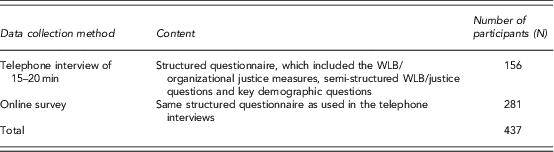
Telephone interviews and online surveys were used in the study to collect both quantitative and qualitative data. As these procedures did not disclose observable gender differences, their use minimized the observable bias of interviewers (Strauss, Miles, & Levesque, Reference Strauss, Miles and Levesque2001). During the period from April to September in 2008, two chief research assistants and two junior research assistants conducted the interviews under the random monitoring of the author. Approximately, 1,700 phone calls were made with a 9% response rate, which resulted in 156 responses from the telephone inquiries. Once the consent of participants was obtained, the researchers made an appointment for a telephone interview or conducted an interview on the spot. Owing to the acute working schedules of the participants, a structured questionnaire was used to complete each interview within 15–20 min. The structured questionnaire included the WLB/organizational justice measures, semi-structured WLB/justice questions and key demographic questions.
As it was difficult to access labor-intensive workers by telephone (i.e., machine operators, drivers, laborers and administrators) and because of the low response rate experienced by telephone sampling, an online survey, administered by a professional online data-collection company, was also utilized to increase the sample size. The online survey, using the same structured questionnaire as used in the telephone interviews, added 281 responses across all groups, giving a total of 437 participants, which included 227 professionals/managers and 210 non-professional full-time employees in Australia. The potential participants were targeted on the basis of the same criteria as in our telephone interview. The online data-collection company also helped us with equalizing the representation of major states, major occupational groups, income earnings and gender.
In the following section, we first report the approaches we have taken for the quantitative and qualitative studies. We then report the key findings of the quantitative study first, followed by the qualitative findings to add more meanings to the quantitative findings.
Quantitative study
The quantitative study was used to test the research questions, particularly the hypotheses that we framed earlier. The following measures were used in the quantitative study. The professional/managerial group was dummy coded in SPSS.
WLB/organizational justice
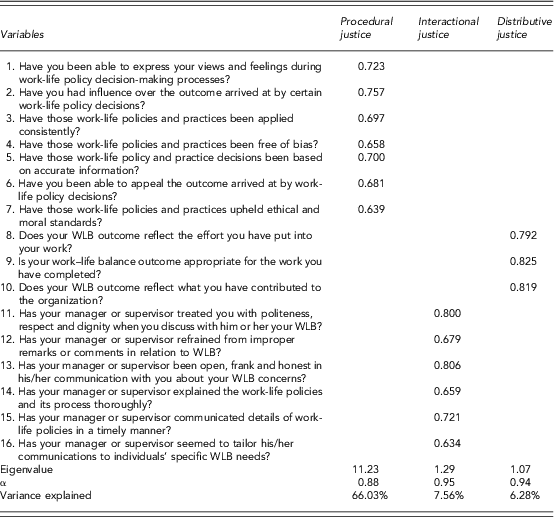
The 17 justice perception items based on Colquitt's (Reference Colquitt2001) organizational justice scales were used (see Table 1). For the purpose of this study, the wording of items was changed to measure the degree of WLB/justice perception. The items asked about four dimensions of organizational justice, namely, procedural (7 items), distributive (4 items), interactional justice (interpersonal: 3 items and informational: 3 items). The participants were asked to rate the items using a 5-point Likert-type scale ranging from 1 = ‘strongly disagree’ to 5 = ‘strongly agree’. The items of WLB/procedural justice include ‘Have you been able to express your views and feelings during work-life policy decision-making processes?’; ‘Have those work-life policies and practices been free of bias?’ The items of WLB/distributive justice include ‘Is your work-life balance outcome appropriate for the work you have completed?; Is your WLB outcome justified given your performance?’ The items of WLB/interactional justice include ‘Has your manager or supervisor been open, frank and honest in his/her communication with you about your WLB concerns?; Has your manager or supervisor seemed to tailor his/her communications to individuals’ specific WLB needs?’ WLB/organizational justice items are provided in Table 1.
Overview of procedures for quantitative and qualitative studies
Note: WLB = work–life balance.
Testing validity and reliability of organizational justice items on WLB
As the wording of the questions was changed, exploratory factor analysis was performed on the perceived justice scale (i.e., distributive, procedural, interpersonal and informational justice) in order to validate the scale. Assumptions of normality were generally satisfactory, and 33 outliers identified by Mahalanobis distance scores were deleted. The informational justice item 3 was deleted since the item had multicollinearity with other items. The appropriateness of factor analysis for these items was assessed by Bartlett's Test for Sphericity and the Kaiser–Meyer–Olkin measure of sampling adequacy. Obtained statistic was BTS = (7,407.883; p < .00) for Bartlett's Test and 0.96 for the Kaiser–Meyer–Olkin measure, indicating a very good fit of the factor analytic method to the data. Reponses from all participants were combined and a principal-axis factor analysis with varimax rotation was performed in order to identify the number and composition of the factors. The factor analysis resulted in three factors with eigenvalues >1.00, which explained 79.872% of total variance. As shown in Table 1, factor 1 indicates procedural justice; factor 2 indicates the combined interpersonal and informational justice (i.e., interactional justice) and factor 3 indicates distributive justice.
Qualitative study
Based upon the organizational justice typology and WLB literature, semi-structured questions were developed. The following questions were asked: (1) How does your organization assist you, in a formal or informal way, to obtain WLB? (i.e., perception of WLB/procedural justice); (2) Please tell us how you have been treated by your managers or supervisors in relation to managing your work-life conflicts (i.e., perception of WLB/interpersonal and informational justice); (3) Do you think that you have been receiving equitable outcomes in comparison to other staff in relation to achieving your WLB? Please describe the situation (i.e., perception of WLB/distributional justice); (4) What kind of job design and policies would you prefer in your current job? (i.e., preference for an immediate work context); (5) If the world were perfect and ideal, how would you like to balance your work and non-work life? (i.e., desire for WLB if no contextualconstraints). For the fourth and fifth questions, we were seeking any major differences between those two groups to find out about any inequalities in their WLB opportunities. By asking about these different dimensions of WLB/organizational justice, WLB/justice perceptions of the participants were sought to give meaning to the quantitative results.
Results
The authors wanted to determine whether or not those employees with professional/managerial occupational status had higher levels of perceived justice than those with non-professional/managerial occupational status. Analysis of variance was used to determine the levels of perceived justice between the professional/managerial and the non-professional groups. The relationship between three dependent variables (procedural, distributive and interactional justice) and an independent variable (professional/managerial group vs. non-professional group) was examined. Normality of data was assessed using descriptive statistics and the interactional justice variable was found to be negatively skewed. Thus, the interactional justice variable was transformed into a normal curve using log. There were no outliers in our data. In relation to control variables, we tested the effect of participants’ demographic backgrounds (i.e., sex, age, racial-ethnic backgrounds) on organizational justice perceptions as demographic differences among participants may affect attitudinal outcomes such as justice perceptions (Roberson & Stevens, Reference Roberson and Stevens2006). As demographic data did not have any influence on organizational justice variables in this study, they were not controlled in our analysis.
We used an analysis of variance to test the levels of organizational justice perceptions between the professional/managerial group and the non-professional group. We totaled the Likert scores for each organizational type for our analysis. For the interactional justice score, we made a total composite score by adding interpersonal and informational justice item scores. As hypothesized, the professional/managerial group reported more organizational justice in all justice dimensions (i.e., procedural, distributional, interpersonal and informational justice) than the non-professional group. We report each organizational justice finding as follows.
Procedural justice
A significant difference in the levels of procedural justice was found between the professional/managerial group (M = 23.5) and the non-professional group (M = 20.5), F(1, 402) = 21.09, p < .0005. The result of the study indicates that professional/managers are more likely to perceive more fairness about the way their organizations formulate and implement WLB policies and practices, including their degree of contribution to the WLB-related decision-making process than the non-professionals.
Interactional justice
A significant difference in the levels of interactional justice (i.e., interpersonal and informational justice) was found between the professional/managerial group (M = 25.65), F(1, 402) = 11.721, p < .0005 and the non-professional group (M = 21.65). The result of the study indicates that professionals/managers are more likely to perceive more fairness about the quality of managers’ treatment toward them such as politeness, respect and explanation for WLB outcomes than the non-professionals would.
Distributional justice
A significant difference in the levels of distributional justice was found between the professional/managerial group (M = 13.9) and the non-professional group (M = 12.3), F(1, 402) = 11.72, p < .0005. The results of the study demonstrate that professionals/managers are more likely to report higher levels of distributive justice than non-professionals/managers. This result indicates that members of the professional/managerial group tend to perceive more fairness about the way their WLB outcome has been achieved relative to their work contribution than the non-professionals.
Qualitative study
In order to explore the meaning of quantitative data further, the participants’ verbatim responses to the semi-structured interviews were qualitatively analyzed and the similar and dissimilar perceptions relating to WLB justice incidents among the two groups were identified.
WLB/Justice incident categories
In total, 2,925 phrases were identified. However, the main ideas conveyed by participants’ narratives were used as the unit of analysis so as to identify the similar and dissimilar perceptions (Patton, Reference Patton2002: 432). First, two coders independently identified codes (or main ideas) from phrases within each occupational group (Krippendorff, Reference Krippendorff1980; Miles and Huberman, Reference Miles and Huberman1994). Second, for each occupational group, the coders met to discuss identified codes, the frequency of those codes and the themes among those codes until agreement was reached. The initial codes were used later to differentiate the data into justice and injustice incidents based upon organizational justice typologies.
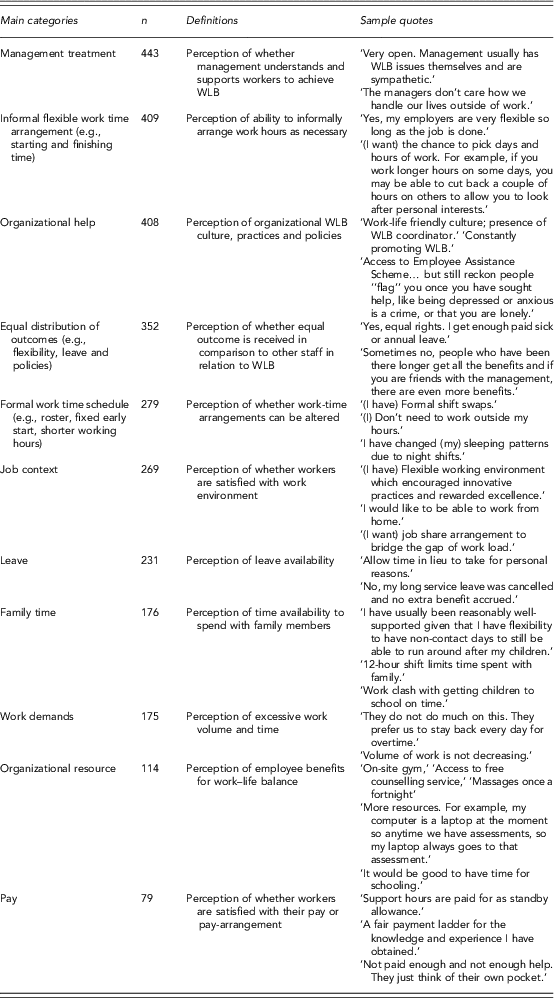
Once content analysis was completed for all occupational groups, a total of 66 themes were identified and categorized into 11 major categories (see Table 2). Some themes were not included in the 11 major categories since significant meanings could not be extracted. For example, several participants answered some of the interview questions by saying ‘don't know’ or ‘no preferences,’ which were not significant to the research question. Table 2 explains the 11 categories for the WLB justice perceptions with sample quotations.
Varimax rotated component loading for 17 perceived justice items on WLB

Note: WLB = work–life balance.
WLB justice and injustice incidents
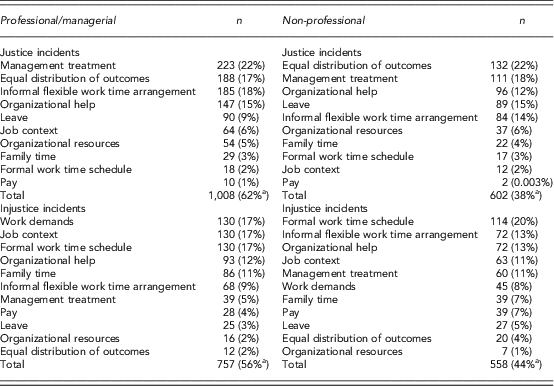
Within each WLB/justice category (Table 2), the coders further divided the codes into ‘justice incidents’ or ‘injustice incidents’ based upon organizational justice typologies (see Table 3). The total corpus sizes for each group's interviews were: Professional (12,328 words); Managers, including human resource managers (18,919 words); Blue collar (15,243 words); Administration (14,802 words). Therefore, the accounts from the professional/manager group totaled 31,247 words, and accounts from the non-professional/managers totaled 30,045 words. The justice and injustice incidents were based on participants’ positive and negative accounts, respectively. We distinguished negative from positive accounts to inform fairness concerns since fairness theory, attribution research and diversity fairness study at a workplace suggest that people tend to engage in more attributional processes after experiencing negative or unfavorable outcomes or procedures (Weiner, Reference Weiner1985; Folger & Cropanzano, Reference Folger and Cropanzano2001; Roberson and Stevens, Reference Roberson and Stevens2006). Once both coders had completed a coding of justice (coded as 1) and injustice incidents (coded as 2), a ‘coding-check’ was undertaken by a research assistant to compute inter-coder reliability (Miles & Huberman, Reference Miles and Huberman1994: 64). The calculated κ measure was 0.675 with a significance of p < .0005. For several codes, therefore, it was necessary for the two coders to discuss them until agreement on their re-categorization as a justice or injustice incident was reached. The resulting justice and injustice incidents among the professional/manager and the non-professional groups are demonstrated in Table 3. In the next section, we discuss the key differences in perceptions of WLB justice/injustice incidents between the professional/managerial and the non-professional groups.
The 11 main categories of WLB justice, definitions and sample quotes
The quantitative result of the professional/managerial group perceiving greater WLB/justice in all justice dimensions was confirmed in the interviews. Specifically, 1,008 WLB/justice or positive phrases were reported by the professional/managerial group, whereas only 602 WLB/justice phrases were reported by the non-professional group. Furthermore, as indicated in Table 3, the findings from the qualitative study further indicate WLB justice/injustice perceptions between the professional/managerial and the non-professional groups.
In particular, among the 11 WLB/justice categories, the professional/managerial group reported significantly more justice incidents for management treatment (n = 223 vs. n = 111) and informal flexible work time arrangement (n = 185 vs. n = 84) than the non-professional group (see Table 3). The professional/managerial group also reported considerably more justice incidents for organizational help (n = 147 vs. n = 96) and equal distribution of outcomes (n = 188 vs. n = 132) than the non-professional group did. It is also notable that, except for ‘leave,’ more fairness perceptions (i.e., fairness in job context, organizational resources, family time, formal work time schedule and pay) were reported by the professional/managerial group than the non-professional group (see Table 3). We refer job context as employees’ perception of whether workers are satisfied with work environment. In addition to the reporting of more justice incidents by the professional/managerial group, the study also highlighted injustice incidents that this group faced in the areas of their work demands (n = 130 vs. n = 45) and job context (n = 130 vs. n = 63) compared with non-professional group (see Table 3). The following section discusses these major discrepancies that were identified between the two groups in their perceptions of justice and injustice incidents, and relates them to the quantitative findings.
Management treatment
The professional/managerial group reported significantly higher frequencies (n = 223) of fairness incidents for management treatment than the non-professional group (n = 111). In comparison to the professional/managerial group's perception of proactive management support, the non-professional group frequently reported more reactive management support for their WLB. The professional/managerial group's perception of proactive management support is indicated in the following representative quotes:
‘Really good, very supportive, very pro-work-life balance. We're all in fairly similar situations with our work and our lives, so it creates an understanding between all of us.’ (P20)
‘Every time we're here, they are here as well, that's great having their visibility on site, even if they're not, you can always call them. So, they're always available in one form or another.’ (M10)
‘Flexible work time, personal leave, no fixed start or stop times, independent work management.’ (P38)
On the contrary, the themes of the injustice incident accounts of management treatment for the non-professional group are indicated in the following key representative quotes:
‘On the outside (to the public) and propaganda they put out they say what a great flexible company they are, but that's only if you are a manager or hierarchy it seems. A few years ago they used to have a promotion called “get a balanced life” (or similar) but that disappeared as it did not happen. They stopped any initiatives that had been started, cancelled individual's leave at times, can't take a day off for a specific reason, consequently, sick leave is very high.’ (B94)
‘The managers don't care how we handle our lives outside of work; they have a job to do and make sure that it is done.’ (B30)
‘Everyone has someone above them so they are just passing on someone else's message. But I think there should be more respect for physical safety.’ (A42)
‘Basically, they treat us as machines not humans.’ (B34)
The management mistreatment reported by the non-professional group further confirms the result of the quantitative study, which reported less interpersonal justice (i.e., less dignity and respect by authorities) for the non-professional group than for the professional/managerial group. The study conducted by Hyman, Scholarios, and Baldry (Reference Hyman, Scholarios and Baldry2005) also confirmed this phenomenon, that call center employees (i.e., technicians) were given only a few practical concessions despite the available family-friendly organizational policies in their organization. The lack of management respect for the WLB of the non-professional group seems to be further explained by the following findings.
Informal flexible work time arrangements
Another major difference was found in the informal flexible work time arrangements (see Table 3), which add more meaning to the quantitative result of less procedural justice for the non-professional group than for the professional/managerial group. It presents evidence that the non-professional group had less influence over their work time. They repeatedly emphasized rostering conflicts such as ‘constant shift work’ and ‘weekend night shifts’ accompanied by minimum interaction with their managers. Owing to the nature of the jobs that the non-professional groups engage in (e.g., machine operation and clerical work), this finding is not surprising. Nevertheless, the significantly fewer informal flexible work time arrangements reported by the non-professional group add salience to their perception of less procedural justice, and perhaps refer to their inadequate decision-making power to gain more flexible hours.
In contrast, the professional/managerial group mentioned more than twice as many informal working arrangements compared with the non-professional group (see Table 3). For example, one manager mentioned, ‘Allows me to take time for special familyfunctions (i.e., kids’ schoolfunctions, or if children or wife is sick I am able to work from home) more of an informal arrangement which is not abused;’ and another professional mentioned, ‘Yes, I have flexible hours on an informal basis and even have a four-day week.’
Mirroring this inverse phenomenon between the professional/managerial and the non-professional groups in relation to informal flexible work time, the non-professional group members mentioned formal work schedules as the most frequently acknowledged WLB/injustice incidents (see Table 3). The following representative quotes demonstrate that formal channels were often utilized by the non-professional group to gain flexible hours:
‘Formal ways is through formal distinct channels. Problems are first put to specialist then to the team manager and, if not resolved then, through VCAT (Victorian Civil and Administrative Tribunal).’ (B53)
‘Better shifts so I could feel awake and healthy, therefore giving me a better life outside of work.’ (B169)
‘Yes and no [for WLB]. I am subcontracted for a certain number of hours a week. I can work more hours in a week, so I can have Saturday off. This usually makes my work-life balance WORSE, though.’ (B62)
Adding a complementary dimension to this finding, the study conducted by Hyman, Scholarios, and Baldry (Reference Hyman, Scholarios and Baldry2005) found that the business-determined flexible work hours in the call centers were perceived as intrusive by call center staff, hindering their achievement of WLB. Their study confirmed little organizational support in the way that the call center staff had to cope by informal shift-swapping with other operators, formal job sharing, self-determined informal absence, refusal to take on more responsibilities and receiving family support (if any). Their formal work time schedule, alarmingly, indicates that WLB has to be self-managed by the non-professional group themselves rather than by the organizational and/or management initiatives (Table 4).
WLB/justice incidents for professional/managerial and non-professional groups
aPercentage refers to justice: injustice ratio for the two groups.
Note: WLB = work–life balance.
These findings of lower WLB/justice perceptions for the non-professional group raise concerns as they earn less than the professional/managerial group and, therefore, have fewer financial resources to increase their WLB by themselves (e.g., access to child care facilities and unpaid leave). As working-poor households in which a member is employed full- or part-time have become a significant concern in Australia (Payne, Reference Payne2009), lack of WLB support for lower income earners exacerbates their circumstances, especially when looking after dependent households. The salient issues of lack of management treatment and informal flexible work time incidents for the non-professional group indicate that managers’ efforts to improve informal WLB initiatives and formal compliance with WLB policies would be the most important turning point for assuring the group's WLB. This phenomenon, therefore, calls out for social justice and social responsibility from authorities such as managers and supervisors to ensure that all employees, regardless of their occupation, income and social background, are treated fairly in relation to their WLB (Özbilgin et al., Reference Özbilgin, Beauregard, Tatli and Bell2011).
Work demands for the professional/managerial group: WLB policies and job contexts
In relation to the professional/managerial group, the study highlighted injustice incidents in the areas of their work demands and job context (see Table 3), which confirms and articulates similar trends in previous research findings for managers and professionals (Dex & Bond, Reference Dex and Bond2005; Bergman & Gardiner, Reference Bergman and Gardiner2007; Lyonette, Crompton, & Wall, Reference Lyonette, Crompton and Wall2007; Moore, Reference Moore2007). Despite the professional/managerial group reporting more favorable management treatment and informal flexible work time incidents compared with the non-professional group, excessive work demands for the professional group as reported can be explained by the fact that work demands reside in the job, and the nature of the job contributes to the work demands (Skinner & Pocock, Reference Skinner and Pocock2008).
Similar to previous research findings (e.g., Dex & Bond, Reference Dex and Bond2005; Reference Bergman and Gardiner2007; Bergman & Gardiner), the following quotations highlight the professional/managerial members’ excessive work demands:
‘With the [recruitment of] a new candidate manager, she wants someone who will support in our recruits, so, for example, referencing. I will have to stay behind full time to get those completed work probably…so just those extra hours, yeah, I'm falling behind a little bit and I know we will get a new candidate manager at some point, but how much that would affect what I'm doing at the moment, I'm not too sure.’ (P84)
‘Generally, they consider outside commitments, but sometimes they just demand something be done, regardless of the fact that it is in your personal time and regardless of any family commitments.’ (M108)
‘I'm the person! I'm the one that needs to balance the load, which is hard with the demands of the job and the cost-cutting of departments where there isn't enough money to employ more people to do out-of-normal-hours work.’ (M97)
In Australia, although statistics tend to report excessive working hours for full-time employees in general (ABC News, 2010), this finding confirms that the concerns for full-time employees’ excessive work demands (rather than long working hours) are associated more with professional/managerial full-time employees than other full-time employees. The excessive work demands for the professional/managerial group are further reinforced by their accounts of more injustice incidents in the areas of family time (n = 86 vs. n = 39), job context (n = 130 vs. n = 63) and formal work time schedule (n = 130 vs. n = 114) compared with the non-professional group. This, therefore, indicates that management sensitivity in this issue is required, particularly for full-time professional/managers. Notably, Skinner and Pocock's (Reference Skinner and Pocock2008) study confirms that full-time employees (51% of whom were managers or professionals) reported that work overload, rather than long working hours, was the strongest predictor of work-life conflict. Therefore, policy-makers need to focus more on how to reduce and manage executives’ excessive work demands rather than reducing their long working hours per se (Skinner & Pocock, Reference Skinner and Pocock2008). As research findings report that insufficient rest increases fatigue and burn-out (Sonnentag, Binnewies, & Mojza, Reference Sonnentag, Binnewies and Mojza2008; Reference Chatzitheochari and Arber2009 Chatzitheochari & Arber, ), the excessive work demands of the professional/managers need to be decreased to eradicate the negative consequences for their mental and physical well-being.
In relation to dealing with their excessive work demands and long hours, the professional/managerial group also frequently mentioned their desire for more sensible WLB policies to help them cope with their work overload. The representative quotations below illustrate this point:
‘In an ideal world, I would use technology better and utilise the opportunity to work from home or a satellite site (closer to home) to alleviate the time spent in transit and the excessive time spent in the workplace. I think rather than offering employees de-stressing options in the workplace (i.e., gym etc.) it would be beneficial if more annual leave was available (either purchase more annual leave via salary negotiation), or additional leave with pay (family leave) was provided as a benefit, promoting a life balance.’ (P91)
It is, however, interesting to note that unlike the non-professional group, the professional/managerial group has higher earnings to self-manage their WLB if a self-financing option (e.g., the purchase of more leave through salary sacrifices) is available. Perhaps, WLB policies for the professional/managerial group could include increased self-financing WLB options, taking into consideration their excessive work demands.
Further, their perception of excessive work demands seems to be exemplified by their unfair job context in relation to work duties and work standards (Rice, McFarlin, Hunt, & Near, Reference Rice, McFarlin, Hunt and Near1985). The following representative quotes highlight such concerns:
‘I would prefer more fairness in the way that I am expected to work harder than anyone else in my department just because I have the highest productivity rate. A lot is left up to me, and other people then take it for granted and slack off or be lazy.’ (M14)
‘No comment beyond stating the obvious – we go to work to support other objectives, we have limited control over the terms of our engagement, and really would rather be doing something else. We can go on about designing our jobs, but unless we can have control over why we are there at all, it's pretty unsatisfying to talk about job design.’ (P15)
From the qualitative findings for the professional/managerial employees, WLB initiatives that: (1) adjust the work demands, (2) offer more workload-sensitive policies and (3) clarify work activities and standards, would need to be considered to enhance their WLB. We conclude this paper with the practical implications and limitations of this study, followed by directions for future research.
Conclusions
Based on empirical evidence involving 227 professionals/managers and 210 non-professional full-time employees in Australia, the study draws our attention to the WLB/justice perceptions of employees from different occupational status backgrounds. In particular, the findings confirm that the non-professional group tends to perceive less justice regarding their WLB than the professional/managerial group in all WLB/justice dimensions, which include procedural, distributive, interpersonal and informational justice. The qualitative study, in addition to confirming the results of the quantitative study, further identified major differences in the WLB justice/injustice perceptions among the two groups. Among the 11 WLB/justice categories identified, while the professional/managerial group reported significantly more justice incidents for management treatment(n = 223 vs. n = 111) and informal flexible work time arrangements(n = 185 vs. n = 84) than the non-professional group, the findings also indicated more injustice incidents for the professional/managerial group in the areas of work demands (n = 130 vs. n = 45) and job context (n = 130 vs. n = 63). These findings suggest, therefore, that for the non-professional group, the informal initiatives of managers such as conscious efforts to customize a worker-sensitive working arrangement, and formal compliance with WLB policies, would enhance their WLB and justice perceptions. For the professional/managers, WLB initiatives that adjust their work demands, offer more workload-sensitive policies and more clearly specified work activities and standards would enhance their WLB and justice perceptions.
The different levels and the nature of the justice perceptions explained by the professional/managers and the non-professional groups in the study provide direction to policy-makers and authorities in formulating and implementing customized-WLB initiatives for all occupational groups. By implementing occupational and income-oriented WLB policies and practices, organizations would benefit from greater employee well-being in all occupations and at all hierarchical levels, thus creating not only healthier organizations but healthier households and communities (cf. Greenhaus & Powell, Reference Greenhaus and Powell2006).
This study has some limitations. First, key occupational groups were categorized into professional/managerial and non-professional groups. This social categorization has insufficient research application for specific occupational groups such as machine operators versus accountants. However, by analyzing two distinct categories of professional/managerial and non-professional groups, the main differences in their justice perceptions were identified, which provides implications for organizations to, at least, customize their support for occupational groups on distinct income earning levels. Second, this study was conducted within the Australian context, which is not necessarily applicable to other countries with different social policy contexts and socio-economic and historical frameworks (e.g., Lambert & Haley-Lock, Reference Lambert and Haley-Lock2004; Özbilgin et al. Reference Özbilgin, Beauregard, Tatli and Bell2011). For this reason, future research on WLB/justice perceptions of employees is encouraged within other national contexts. In addition, cross-sectional studies for specific industry and organizational contexts would also assist employers to offer detailed, customized WLB support to their employees (Hyman, Scholarios, & Baldry, Reference Hyman, Scholarios and Baldry2005).
As workloads and working hours continue to rise in Australia and in the rest of the world (Bonney, Reference Bonney2005; Pocock, Reference Pocock2005) as does increased social stratification (Pearce et al., Reference Pearce, Xin, Rao and Xu2005; Reference Lambert2009 Lambert), it is hoped that the key findings from this study will offer new insights for policy-makers, practitioners and scholars alike to search for justice-based WLB initiatives for all employees, regardless of their social status and background.
In particular, findings signify the need for organizations to enact more equitable and inclusive WLB initiatives for non-professional/managerial workers to make them feel valued equally with those in the professional or managerial positions. In order to enhance WLB treatment by managers, we suggest that immediate managers who supervise non-professional/managerial workers need to be trained to be more sensitive and attentive to their daily needs. These managers also need their treatment of WLB issues to be assessed upwardly by their own workers. Unless organizations establish an accountable system to meet the WLB needs of non-professional/managerial workers, we expect that the future will remain the same, that is, perceptions of WLB injustice by those workers.
We also propose that organizations should grant more self-paced working patterns to professionals/managers to enable them to flexibly adjust when and how their work gets done. Organizations will need to foster open communication with them to set clear and manageable goals and standards so they can manage their workload at their own pace. Ultimately, WLB for all occupational groups will encourage more inclusive and energized organizations.
In this increasingly work-centric century, we hope that more WLB scholars will engage in WLB/organizational justice research for different occupational groups. While all occupations tend to produce work-related stress, several studies confirm that occupations with poor physical working conditions (e.g., factory workers, cleaners), physically demanding jobs (e.g., call center staff, nurses) and little involvement in a decision-making process are particularly vulnerable to work-related stress and poor health conditions (Cooper & Marshall, Reference Cooper and Marshall1976; Johnson et al., Reference Johnson, Cooper, Cartwright, Donald, Taylor and Millet2005). This phenomenon signals to us that we need more rigorous research to find ways that organizations can provide appropriate breaks for all workers.
We advocate that this is an urgent call for all involved in influencing employees’ access to WLB – practitioners, policy-makers and scholars – to work toward creating organizations that include, respect and energize all individual workers, regardless of his or her occupations.