1 Aims and scope of the article
The aim of this article is to assess the analysis of roothave to and must in the literature, in which have to is basically presented as a marker of objective necessity, and in which must is said to express subjective necessity.Footnote 2 We will show that a careful examination of the notion source of the necessity, i.e. the driving force behind the necessary state of affairs expressed by have to and must, needs to be more sophisticated than this simple binary division. Our investigation into this component of modal meaning will shed light on the semantic and/or pragmatic differences between these markers of necessity, and will therefore result in a better understanding of non-epistemic necessity in general.
We first summarise previous accounts of root have to and must (section 2).Footnote 3 It will become clear that the notion of ‘source’ is crucial, and, accordingly, section 3 subjects this notion to theoretical and empirical scrutiny. Examples are taken from the ICE-GB corpus, including a quantitative analysis in section 4.Footnote 4
2 Root have to and root must in the modality literature
The term deontic is often used in the literature to refer to root necessity meaning. However, ‘deontic’ does not always cover the same conceptual load: for some, ‘deontic modality’ is synonymous with (any instance of) ‘nonepistemic modality’ (cf. e.g. Larreya Reference Larreya1982: 103; Groussier Reference Groussier1985); others use ‘deontic’ in a narrower sense, i.e. as a label for the subcategory of obligation imposed by the speaker and permission granted by the speaker (cf. e.g. Palmer Reference Palmer1990: 69ff.; van der Auwera & Plungian Reference Auwera and Plungian1998: 81).
The lack of a unanimous view on what syntactic, semantic and/or pragmatic features characterise deontic root necessity has resulted in divergent views on which modal auxiliaries can express deontic necessity. For instance, Tregidgo (Reference Tregidgo1982) observes that have to can never be deontic, whereas Huddleston & Pullum et al. (Reference Huddleston and Pullum2002: 206) maintain that have to can be deontic. We will therefore refrain from using the term and use the label ‘root’ to refer to nonepistemic modality. The term ‘deontic’ will only be used when quoting work by others.
What is of particular interest to our investigation is the observation that the deontic/nondeontic distinction seems to be closely linked up with the subjective necessity vs objective necessity distinction. It is commonly argued that have to expresses ‘external’ necessity, originating in e.g. a rule or a regulation, and that must typically expresses an obligation imposed by one of the discourse participants, i.e. the speaker in affirmative sentences and the addressee in questions:
(1) You have to come in now. (‘I'm likely to be relaying someone else's instruction’) (Huddleston & Pullum et al. Reference Huddleston and Pullum2002: 205–6)
(2) You must be back by 10 o'clock. (‘You are obliged to be back . . .’ ‘I require you to be back . . .’) (Quirk et al. Reference Quirk, Greenbaum, Leech and Svartvik1985: 225)
The following quotes describe the root necessity meanings commonly associated with have to vs must:
Have and have got are most commonly used for deontic necessity . . . Here they characteristically differ from must in being objective rather than subjective. (Huddleston & Pullum et al. Reference Huddleston and Pullum2002: 206)Footnote 5
Thus must, unlike have (got) to, typically suggests that the speaker is exercising his authority. (Quirk et al. Reference Quirk, Greenbaum, Leech and Svartvik1985: 225) In the obligation sense . . ., have (got) to is often felt to be more impersonal than must, in that it tends to lack the implication that the speaker is in authority. (1985: 226)
A variety of labels have been used to capture the ‘objective’ and ‘subjective’ nature of modal expressions and as the following survey shows, opinions differ as to the potential of have to and must to express objective and subjective necessity:Footnote 6
have to: objective only (Coates Reference Coates1983; Quirk et al. Reference Quirk, Greenbaum, Leech and Svartvik1985; Huddleston & Pullum et al. Reference Huddleston and Pullum2002), neutral and circumstantial (Palmer Reference Palmer1990), not speaker-oriented (Tregidgo Reference Tregidgo1982), neutral orientation (Larreya & Rivière Reference Larreya and Rivière2005)
must: subjective and objective (Tregidgo Reference Tregidgo1982; Leech 1988; Huddleston & Pullum et al. Reference Huddleston and Pullum2002), subjective only (Coates Reference Coates1983; Quirk et al. Reference Quirk, Greenbaum, Leech and Svartvik1985), subjective and neutral (Palmer Reference Palmer1990), subjective orientation (Larreya & Rivière Reference Larreya and Rivière2005)
We will argue here that a more sophisticated analysis is necessary. Using corpus data, we will demonstrate that a range of sources can lie at the origin of necessity in utterances with have to and in utterances with must.
3 Sources in which the necessity originates
3.1 Conceptual issues
Any necessity (be it expressed by have to or must) is linked up with a source: if there is reference to a necessity, it must originate somewhere, i.e. some entity must be at its origin. This hypothesis is obviously motivated by our knowledge of the world and is as such not concerned with the linguistic expression of sources.
In our analysis, ‘source’ refers to the driving-force behind the necessity, while the entity that communicates the necessity is called the ‘channel’. A speaker or writer is always the channel of a necessity, while in a number of cases he may also be the source.Footnote 7 For instance, in You must show your passport and boarding pass to the police before entering the plane the speaker is the channel and the source is a rule.Footnote 8
The question we will need to answer is whether must and/or have to explicitly communicate information about the kind of source that lies at the origin of the necessity they express: are they, as linguistic expressions, markers of a particular kind of source? To give an objective answer to this question, it seems important to identify the range of extralinguistic sources in which necessities originate. We have classified the ICE-GB data in terms of two main types of sources: discourse-internal sources (the speaker in statements, the hearer in questions) and discourse-external sources (e.g. circumstances, rules and regulations, etc.).Footnote 9 The example in (3), taken from a piece of academic writing (social sciences), states a requirement, i.e. successful nation-building, that must be achieved so as to have an effective foreign policy. Likewise, in (4), it is also an external source, i.e. a UN resolution, that calls for a particular kind of behaviour: it is necessary to attack Iraq in order to comply with UN regulations.
(3) [Identification theory has clearly pointed out how to achieve such a situation, i.e. an effective foreign policy.] First, there must be successful nation-building. (ICE-GB:W2A-017) (source: condition)
(4) And until we get there we are entitled to attack his army . . . where we have to attack it in order to achieve the UN resolutions. (ICE-GB:S1B-027) (source: UN resolution)
In the next set of examples, the speaker may be identified as the source of the necessity in the sense that he is convinced that a certain situation is necessary:
(5) They must tell us why the alarm bells did not ring sooner, and who in the City is to blame. (ICE-GB:W2E-002)
(6) This, in my opinion, lends urgency to the need to provide young people's education and training in as cost-effective a manner as possible. We have to ask ourselves whether the eleven years of full-time compulsory education which every child receives does all it could to lay the sure and solid foundation of knowledge and motivation that will ensure the success of vocational education and training. (ICE-GB:S2A-031)
We have found that no modal has ‘exclusivity rights’ on a particular source and that no particular source is exclusively associated with one particular auxiliary. Have to, for instance, can have a discourse-external source (cf. (4)), but also a discourse-internal source (cf. (6)). The same holds for must. The most striking fact has been to observe that the corpus evidence contradicts many of the supposedly strong ties described in reference grammars between a particular kind of source and a particular modal (cf. section 3-4-3).
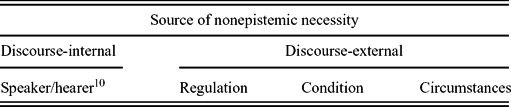
We established that the set of sources in table 1 is needed to describe nonepistemic necessity meanings.
Survey of possible (discourse-internal or discourse-external) sources in which nonepistemic necessity originates
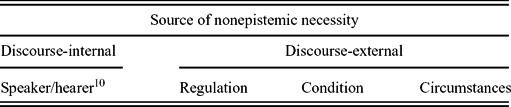
In some cases, the necessity may also be reported: it is channelled by someone mentioned in the discourse, explicitly, in the case of indirect speech and thought, or implicitly, in the case of free indirect speech and thought. In other words, there are two channels: the speaker and the reported speaker.Footnote 11 In such cases, the reported speaker is either the source of the necessity or the necessity reported arises as a result of compelling external factors. For instance, in (7), it is likely to be the boss's conviction that the addressee should read the books in question (reported internal source). Likewise, in (8), it is the referent of the subject (he) who urges himself to continue. In (9) and (10), there are arguably two sources: a rule in combination with a personal opinion in (9), and circumstances in combination with a personal opinion in (10):
(7) My boss had said you must read those books. (ICE-GB:S1A-016)
(8) Quietly doomed, he felt he must continue. (ICE-GB:W2F-008)
(9) But Mr Genscher today was saying that actually what's happened over the Gulf as far as Europe's concerned only illustrates too clearly that there has to be a common foreign policy and probably a common defensive policy as well. (ICE-GB:S2B-013)
(10) On the one side: Fidesz, a remarkable party . . . saying . . . that history must look after its own, a line must be drawn and transitions must be allowed to go ahead without consideration for these historic concerns. (ICE-GB:S2B-047)
These observations mean that it would be confusing to add an additional category of ‘reported source’ since, ultimately, it is one of the four sources listed above that lie at the origin of the (reported) necessity. The term ‘reported’ merely reflects the fact that there is a channel other than the speaker.
In the next section, examples with both have to and must will illustrate the different sources.
3.2 Examples
3.2.1 Discourse-external: regulation or rule
In this category, we have included examples in which the necessity results from a ‘regulation or a rule’, this label being a cover term to refer to compelling situations resulting from stronger binding forces such as laws, household rules, and institutional rules as well as from weaker binding forces such as traditions, instructions for use, rules of a game, commonly accepted social patterns, etc. They may, but need not, be laid down in writing.
(11) It [i.e. the tax disc] shows the registration mark and the date up to which duty has been paid, and it must be displayed on the left hand side of the vehicle's windscreen. (ICE-GB:W2D-010) (vehicle registration rules, must)
(12) Pre-enrolment applies to all courses but must be at the centre where the course is taking place. (ICE-GB:S2B-044) (enrolment procedure, must)
(13) You can only have showers on week-days after supper, and you have to pay 5 Francs each time. (ICE-GB:W1B-002) (household rules at the Grenoble ‘foyer’, have to)
(14) Most working people have to pay National Insurance contributions. (ICE-GB:W2D-004) (brochure about National Insurance, have to)
(15) Thus in soliciting the patient's consent to treatment or the removal of tissues the doctor has to disclose any potential or other economic gain that he or anyone else so far as he knows may obtain from the post-operative use of the patient's tissues. (ICE-GB:S2B-046) (rules of professional conduct, ‘moral obligation’, has to)
(16) You [generic subject, ‘an Italian bride’] have to go after your wedding to be photographed in one of these places which has been around for two and a half thousand years. (ICE-GB:S2A-024) (tradition, have to)
It might be argued that, strictly speaking, rules and regulations constitute a kind of reported source as they are imposed by a body of people or a person. From that point of view, the ultimate source behind the examples listed in this section is not the set of rules and regulations as such, but it is actually the authority behind them. While this may indeed be a more accurate description, the distinction is too subtle to matter. Moreover, it is in many cases impossible (especially in the case of rules of social behaviour or traditions) to pin down the ultimate source of the ‘rule’.
3.2.2 Discourse-external: circumstances
Circumstances may be of different types: they may refer to (i) (one-off) arrangements or particular situations (cf. e.g. (17) to (22)) that necessitate the actualisation of a particular situation, but they may also relate to (ii) ‘the nature of things’. The latter label covers (a) the literal interpretation in the sense of the necessities resulting from the laws of nature (cf. e.g. (23)), but also (b) a broader interpretation in the sense of the only logically possible outcome given by the state of the world (cf. (24) to (26)). Examples belonging to category (ii) tend to indicate existential truths, the necessity being unalterable.
In (17), it is the impossibility of living in Turkey or Iran that obliges the Iraqis to return home; in (18) the financial situation of the speaker and Zix is such that they are forced to share resources. Likewise, in (19) to (22), there are compelling external circumstances (instructions in (19),Footnote 12 an arrangement in (20), the fact of there being no river in (21) and the speaker's intellectual skills in example (22)) that bring about a necessity:
(17) On the border rumours of continuing Iraqi army atrocities abound and still the collective memory of Haladja and the terrible consequences of Sadam's willingness to use chemical weapons override the general longing to return home. But return home they must for there's no life for them in exile neither in Turkey nor Iran. (ICE-GB:S2B-040)
(18) Housing is expensive and Zix and I are relatively skint, alas, so we must cohabit in each other's pockets. (ICE-GB:W1B-015)
(19) I couldn't actually tell you what I'm stuck on at the moment cos I've got like my project that I have to hand in. (ICE-GB:S1B-015)
(20) I have to go abroad on business next week. (ICE-GB:W1B-020)
(21) The city has no river and must bear the heavy cost of pumping water in and sewage out over the surrounding mountains. (ICE-GB:S2B-022)
(22) I have to swot I'm not clever like you lot. (ICE-GBS1A90)
(23) All [sea-snakes] must surface to breathe and so may be affected by the slick. (ICE-GB:W2B)
(24) It's your body, you have to live with it, and the more you know what state it's in the more you can do something positive to look after it. (ICE-GB:W2B-022)
(25) There have to be exceptions. (ICE-GB: S1B-031)
(26) But even builders have to make a profit. (ICE-GB:S1B-073)
The nature of the source in examples like the following is no doubt similar:
(27) [T]he arrival of Gothic as a dominant force in England had to await the start of a second great wave of ecclesiastical building which began in the 1170s. (ICE-GB:W2B-003)Footnote 13
There is reference to a sequence of past events whose outcome is known: looking back, the speaker knows that it was not until 1170 that a new development started which was triggered by a wave of ecclesiastical building. In such examples, have to seems not unrelated to the use of be to to refer to a predetermined future. It can be paraphrased as ‘that's how it went’. In other words, we do not get a straightforward prototypical modal meaning.
In the following example, it is the disposition of the subject (i.e. particular circumstances, admittedly internal to the subject referent) that is at the origin of the necessity:
(28) If you must put it like that. (ICE-GB:S1A-068)
Idiomatic constructions of the type given in (28) (cf. e.g. Quirk et al. Reference Quirk, Greenbaum, Leech and Svartvik1985: 225; Palmer Reference Palmer1990: 130; Huddleston & Pullum et al. Reference Huddleston and Pullum2002: 185) are sometimes treated separately because it is the referent of the subject that is the source of the necessity. This kind of subject-oriented (or ‘dynamic’) modality is also used to characterise sentences with will (She will sit there for hours, cf. e.g. Palmer Reference Palmer1990: 136–7), or in sentences that express ability (She can play the violin). We would like to argue that the type of source in so-called subject-oriented examples with ability can and volition will is quite different from that in examples with necessity must. In the case of ability, the skills that lie at the origin of the ability are internal to the subject referent. In a similar way, in the ‘obstinate insistence’ example with will, it is the subject referent's conscious volition that is the source of the modality. By contrast, in examples like (28) the source is a particular kind of circumstance: the subject referent is a ‘patient’ submitted to an inner urge and the sentence communicates that the addressee is subjected to what might be called an ‘internal necessity’ (cf. e.g. Declerck Reference Declerck1991: 386, who uses the term to refer to particular uses of need). Such cases of subject-driven necessity constitute one of a number of subtypes within the broader category of circumstances.
Necessity brought about by circumstances features under a variety of labels in the literature: ‘external necessity’ (Quirk et al. Reference Quirk, Greenbaum, Leech and Svartvik1985: 226; Palmer Reference Palmer1990), ‘circumstantial necessity’ (Declerck Reference Declerck1991: 383; Huddleston & Pullum et al. Reference Huddleston and Pullum2002: 185), ‘neutral necessity’ (Palmer Reference Palmer1990), ‘objective necessity’ (Coates Reference Coates1983: 36) and ‘general objective necessity’ (Goossens Reference Goossens and Barcelona2000: 161). While in Huddleston & Pullum et al.'s opinion, both must and have to can express circumstantial necessity (the latter form being preferred), Palmer claims that must is not used for what he calls external necessity, must and have to only being interchangeable in cases of neutral necessity.Footnote 14
3.2.3 Discourse-external: condition
A category that is related to the previous one is that of condition. In examples of this type, a particular situation is necessary in order to achieve a particular purpose, which can be referred to in three different ways: (a) an adverbial subclause of purpose, (b) an if-clause or (c) an implicit conditional clause or an implicit adverbial subclause of purpose. All these examples allow a paraphrase in terms of ‘X is necessary in order to Y’ or ‘if Y is to actualise, X is necessary’:
(29) So what possible advantage can you have from the fact that light has to travel through a row of at least three cells to get to the photoreceptors. (ICE-GB:S1B-015) (has to, subclause of purpose)
(30) To reach it on foot you must navigate hundreds of miles across a perishing sub-zero landscape of blizzards, open water, crevasses and drifting ice. (ICE-GB:S2B-024) (must, subclause of purpose)
(31) and therefore to some extent we have to go with the values of the age if we're to retain their affiliation. (ICE-GB:S1B-047) (have to, conditional clause)
(32) And the free world has reacted quickly to this momentous process and must continue to do so if it is to help and influence events. (ICE-GB:S1B-054) (must, conditional clause)
(33) Even something as simple as this has to be learned otherwise you will never know the correct procedure. (ICE-GB:S2A-054) (has to, implicit conditional meaning: ‘if you want to know the correct procedure’)
(34) Many of the technical problems posed have been resolved, but some major developments must still be made, so such a vehicle must remain a long-term ideal. (ICE-GB:W2B-035) (must, implicit conditional meaning, ‘if you want to build a spaceliner’ [i.e. a type of aeroplane to fly passengers])
What the conditional examples and the purposive subclause examples have in common is that they both represent the actualisation of a particular situation (the main clause situation) as necessary and sufficient for the actualisation of another situation (which is referred to in the if-clause or the subclause of purpose or result). In other words, the situations aimed at are necessity-inducing factors, the driving forces behind the necessities.
The examples are related to those listed under ‘circumstances’ since the conditioning factors can be interpreted as circumstances that may induce the agent to behave in a particular way, i.e. given that he wants to bring about the situation referred to in the conditional clause or the subclause of purpose, a certain necessity arises. The difference with the category of circumstances is, first, that the conditioning situation is posterior to the modal meaning of necessity (X is necessary at t in order for Y to actualise at t + 1) while in the case of circumstantial necessity, the circumstantial source is simultaneous or anterior to the modal meaning (X is necessary at t because Y ≤ t). Secondly, in many of the ICE-GB conditional examples the compelling circumstances are evaluated positively: the situations in the conditional or purposive clauses are represented as situations that the addressee may want to achieve (or in the inverted case, as in, for instance, (33), the agent may want to behave in a particular way in order to avoid an unpleasant situation).
The existence of conditional necessity examples is usually mentioned in passing (cf. e.g. Huddleston & Pullum et al. Reference Huddleston and Pullum2002: 185), Larreya's analysis of modalité implicative [implicated modality] (1982: 114ff.) being the most notable exception. His description of the main characteristics of modalité implicative can be summarised as follows:
(a) The modal utterance is equivalent to a necessary or sufficient condition.
e.g. Epidemiologists generally estimate that a person must smoke two to five cigarettes a day to increase the risk by twofold over that of a non-smoker. (‘If you want to increase the risk by twofold, you must smoke two to five cigarettes a day.’)
e.g. There is no shortage of nutrients in the oceans, but they are of use to plants only when present in the illuminated surface waters. For a region to be fertile, water movements must occur for the distribution of these nutrients from below to above. (‘If a region is to be fertile, water movement must occur.’)
(b) The modal meaning can only be grasped if the whole utterance is taken into account. In other words, the implicative relation implies the existence of a link between the antecedent and the consequent.
(c) Utterances with implicated modality are very often ‘a-temporal’ or omni-temporal in the sense that they are not restricted in time, which is typical of hypothetical sentences: a hypothetical event by definition does not exist; it is not located in time.
Larreya's observations are to the point. As will be shown in the quantitative analysis below, about 15 per cent of the ICE-GB examples are conditional; they should therefore be given due space in descriptions of nonepistemic necessity meanings.Footnote 15
It could be argued that there is an implicit condition in the ‘rules and regulations’ examples, too. For example, (11), repeated here, could be paraphrased by (11a):Footnote 16
(11) It [i.e. the tax disc] shows the registration mark and the date up to which duty has been paid, and it must be displayed on the left hand side of the vehicle's windscreen. (vehicle registration rules, must)
(11)(a) If you wish your car to comply with the law, it is necessary to display the tax disc on the left hand side of the vehicle's windscreen.
However, this paraphrase differs from cases in which the source of the modality is a condition because, in Larreya's terms, the modal utterance is not a necessary and sufficient condition for the situation in the if-clause. Bearing in mind Larreya's point (b), we can note that the message of (11a) is not: ‘it is the case that displaying the tax disc will (on its own) bring about your car's compliance with the law’. Rather, the meaning of (11a) is ‘(for those people who wish their car to comply with the law), it is necessary to display the tax disc in the right place’. The condition if you wish your car to comply with the law, far from being the goal that imposes the necessity, in fact limits the applicability of the modal statement to the set of people who wish to obey the law. To take another example, we might say that it is possible to supply the condition ‘if you wish to abide by tradition’ for example (16), repeated here:
(16) You [generic subject, ‘an Italian bride’] have to go after your wedding to be photographed in one of these places which has been around for two and a half thousand years.
However, we would not want to say that the meaning of (16) is ‘it is the case that being photographed in a historic site will (on its own) result in your abiding by tradition’. This is not a case in which the condition is the source of the necessity. Rather, the supplied condition results in the meaning that the necessity (to be photographed in a historic site), which originates in the rules and norms of the society in question, only applies to that set of people who wish to abide by tradition. In other words, the status of the condition in the ‘rules and regulations’ examples is different because the actualisation of the condition is presupposed (it is a fact that the addressee wants to comply with, for instance, vehicle registration rules (example (11), or that the addressee wants to be a member of a particular community (example (16)).Footnote 17
It should also be added that the presence of an if-clause or a purposive clause does not automatically imply that the source is conditional. The following example, for instance, illustrates ‘rules and regulations’, the if-clause obviously not being the aim that results in a necessity:
(35) If you have a partner he or she must be ordinarily resident in the United Kingdom (Great Britain and Northern Ireland) (ICE-GB:W2D-005) (requirements to obtain a family credit)
Similarly, the subclauses of purpose in the following examples do not constitute the source of the necessity. They feature in an information brochure on how to obtain certain grants or benefits, and the requirements mentioned are stative predicates with nonagentive verbs:
(36) To get a mandatory grant you have to be eligible as well as having been admitted to a designated course. (ICE-GB:W2D-003)
(37) Self-employed share fishermen pay a special kind of Class 2 contribution which counts for Unemployment Benefit, but they have to satisfy special conditions to get benefit. (ICE-GB:W2D-002)
Even though, strictly speaking, these examples also allow a paraphrase ‘if Y is to actualise, X is necessary’, i.e. ‘if you want to get a mandatory grant, you have to be eligible’, or ‘if you want to get a benefit, you have to specify certain conditions’, rather than stating a logical relationship between a cause and a result, a particular category of people is being defined. The necessities expressed in these examples therefore originate in the rules that determine who is eligible for a grant or who can benefit from financial help.
3.2.4 Discourse-internal: personal opinion (speaker/hearer)
In the following examples, it is the speaker who is identified as the source of the necessity: the sentences can be paraphrased as ‘I want the situation referred to in the sentence to be brought about’ or ‘X is necessary and my reason for saying so is that I am convinced it is necessary’, or ‘In my opinion it is necessary to X’:
(38) You must let me photograph your baby for my magazine. (ICE-GB:S1A-039)
(39) and perhaps I even hope that they will because I believe that religious thought must be challenging must force us to reflect on the values by which we live. (ICE-GB:S1B-047)
(40) And the police in my view have to have their ethics grounded in an acceptance of their role to protect human rights and fundamental freedoms and our instruments of democratic government. (ICE-GB:S1B-033)
(41) I think there is a strong case for avoiding that term because there has to be a distinction made between the selection of information which is conveyed, which the military inevitably will do, in fact, anyone has to do in the presentation of any kind of complex situation and manipulation, which implies that you are attempting to use the media to present a particular deceitful picture (ICE-GB:S1B-031)
Note that ‘discourse-internal’ necessity means that the speaker is the source in affirmative sentences (You must report to me = ‘I want you to report to me’) and the addressee is the source in questions (Must she report to you? = ‘Do you want her to report to you?’).Footnote 18 The ICE-GB corpus does not contain any interrogatives with must.
In previous descriptions, different labels, such as ‘subjective’, performative, speaker-orientation, and speaker involvement are used to refer to what remain to a considerable extent intuitive notions, rather than clearly defined features primarily associated with must (cf. e.g. Palmer Reference Palmer1990: 73; Hoye Reference Hoye1997: 43–4; Huddleston & Pullum et al. Reference Huddleston and Pullum2002: 183, 206).Footnote 19 A typical view is that expressed by Tregidgo, who claims that ‘HAVE TO never positively implies speaker-orientation [i.e. the speaker is not the source of the necessity], while MUST often does’ (Tregidgo Reference Tregidgo1982: 81). The following are some additional observations to that effect:
To stop the addressee from making assumptions about the personal beliefs or desires of the speaker being involved, a form like have to has to be used. (Groefsema Reference Groefsema1995: 68)
Les auxiliaires indicateurs de modalités déontiques vont se distribuer selon ce critère de l'engagement de l'énonciateur . . ., must et shall/should indiquant cet engagement, have to . . . indiquant le refus ou l'absence de cet engagement. (Groussier Reference Groussier1985: 141) [The distribution of modals that communicate deontic meaning depends on speaker involvement, must and shall/should indicating speaker involvement, have to indicating a refusal or absence of involvement.]Footnote 20
‘Speaker involvement’ or ‘subjectivity’ is often illustrated with what Coates calls the ‘psychologically prototypical’ (Coates Reference Coates1983: 38) use of nonepistemic must, in which the speaker urges the addressee to bring about a certain situation, as in (42):
(42) You must play this ten times over, Miss Jarova would say. (Coates Reference Coates1983: 34)
Whether or not this type of example is indeed ‘psychologically prototypical’ – in the sense that it is the first type that comes to mind when native speakers are asked to give an example of nonepistemic necessity must – it is, as Coates shows, by no means quantitatively predominant in actual usage (only 7 per cent of her corpus examples belong in this category (1983: 33)). This is for the obvious reason that there are few situations which admit of such a blunt expression of an order. Even if there is a clear hierarchical relationship, for reasons of diplomacy or courtesy, speakers are unlikely to express their wishes/orders directly through the use of must (cf. Coates Reference Coates1983: 33). Such examples are more acceptable when there is pragmatic weakening, as in (38) (cf. footnote 23).
This use of must in examples like (42) is subjective in the sense that the speaker has authority over the addressee(s) and imposes his will to get the addressee(s) to undertake some action. Coates uses the label ‘performative’ to refer to these examples and points out that the force of the obligation is strong in such cases. Likewise, Palmer (Reference Palmer1990) explains that modals can be thought of as performative, i.e. ‘as indications of speech acts’ (1990: 10): ‘deontic modals signal “directives”, i.e. “where we get them [our hearers] to do things”’ (1990: 10) (cf. also Palmer Reference Palmer1990: 69–70). In other words, it seems that in previous analyses of nonepistemic necessity, ‘performative’ is mainly used to refer to speech acts with the illocutionary force of a directive. There is reference to a particular discourse situation in which the speaker is in a position to give an order to bring about a certain situation by using a modal auxiliary, typically must.
The ICE-GB data call for a broader interpretation of subjectivity. Speaker involvement need not be limited to directing the addressee to do something, but can be as subtle as the reflection of the speaker's point of view on what is necessary, which is why we used the label ‘personal opinion’ as the heading to this section. Put differently, a speaker may think it necessary to bring about a certain situation, but is obviously not always in a position to impose his will, which does not imply that he is not the source of the necessity (cf. van Linden Reference Linden2006: 4–6). For instance, an adequate gloss of (40) would be: ‘I think it is necessary that religious thought is challenging.’ The examples in (39), (40), and (41) show that the subjective element can be reinforced by phrases like ‘I feel’, ‘in my opinion’, etc., which is an illustration of what is called ‘modal harmony’ in Halliday (Reference Halliday1970: 331), Lyons (Reference Lyons1977: 807), Huddleston & Pullum et al. (Reference Huddleston and Pullum2002: 179), and Hoye (Reference Hoye1997: 19–20, 232–42). At first sight, it might be argued that the presence of markers of speaker involvement should not be used as evidence for the fact that the source associated with e.g. have to is the speaker in these utterances. Two remarks are relevant here: (a) the first is that it is our contention that the presence of these markers is likely to have an impact on the meaning communicated by have to, which in a way becomes imbued with speaker-orientation, (b) even if the presence of subjective markers and the identification of the speaker as the source of the necessity should be kept clearly distinct (i.e. if the hypothesis put forward in (a) were to be rejected), the fact that have to can occur in such a subjective context means that – unlike what seems to be implied by the standard view – subjective contexts are not reserved for modal expressions with must.
While the majority of descriptions underline the suitability of must to express a subjective obligation, it has not gone unnoticed that must is not always subjective. As Palmer (Reference Palmer1990) points out, must also occurs ‘where, in assertion, there is little or no indication of involvement of the speaker’ (1990: 113) (cf. also e.g. Coates Reference Coates1983: 35; Kruisinga Reference Kruisinga1925: 346). Conversely, observations to the effect that the speaker can be the source in sentences with have to are scarce, Westney (Reference Westney1995: 117–18) and Collins (Reference Collins, Aijmer and Altenberg1991: 159–60) being the only studies – to our knowledge – to have pointed this out.Footnote 21
The following are some further instances in which the source associated with have to is discourse-internal:
(43) [A: I wasn't an awful teenager. B: You were on that tape we played, saying gays are disgusting. You were going ‘I can't get a girlfriend’. A: I don't remember anything of the things what you're talking. B: You don't remember it. Well, you have to listen to the tape then.] You have to listen to it. [A: No I don't. B: All teenagers are awful at some point.] (ICE-GB:S1A-085) (‘you should really do it, it is interesting to listen to those conversations’, emphatic advice comparable to the example in (38))
(44) The poll tax has to be abolished. Don't mend it. End it. (ICE-GB:W2C-018)
In sum, in the ‘personal opinion’ or ‘discourse-internal source’ examples the speaker is clearly the source of the modal meaning expressed: he states what he considers to be necessary and in this way he gives his own opinion on the necessity of bringing about a state of affairs. We would like to advocate an interpretation of subjectivity that is disconnected from the notion of strong obligation or performativity. A discourse-internal source of necessity can mean that the speaker is the one who imposes an obligation upon the addressee. Alternatively, and in most instances, it means that the speaker indicates that in his personal opinion, it is necessary for a certain situation to be brought about without actually giving a directive.
3.2.5 Mixed sources
In a limited number of cases (29 examples (out of 845)), several sources seem to be involved.Footnote 22 We have identified a combination of ‘discourse-internal source plus circumstances’ (e.g. (45) and (46)) and ‘discourse-internal source plus condition’ (e.g. (47) and (48)):
(45) I think we all have to be careful with the fabric cos there's so much of it. (ICE-GB:S1A-086) (discourse-internal + circumstances)
(46) [You find most of the early writers referring to the Christians as mad or depraved for worshipping an alleged God who had suffered the death reserved for the lowest form of criminals . . . Paul and the early Christians were trying to market a revolutionary kind of upside-down sort of God . . . Christians today tend to take it for granted that we can easily take that as read] But I am suggesting that in every way it is almost insuperable and the fact that it was overcome in those first two or three centuries of faith is something that we must accept even if we cannot entirely understand it. (ICE-GB:S2B-028) (discourse-internal + circumstances)
(47) When Saddam Hussein has been expelled and Kuwait is again independent, the world community through the United Nations must focus firmly on helping the peoples of the Middle East to gain a just and enduring settlement. (ICE-GB:S2B-030) (discourse-internal + condition)
(48) I feel that before a war is declared there has to be absolute maximum possibility for discussion in a democratic society to make sure that there is a will to proceed. (ICE-GB:S1B-031) (discourse-internal + condition)
While all these examples can be paraphrased as ‘I consider it necessary to X’, there is an additional source, as the speaker motivates his opinion by referring to external circumstances or conditions:
(45): I consider it necessary to X because of the sheer quantity.
(46): I consider it necessary to X because of the course of history.
(47): I consider it necessary to X in order to achieve stability.
(48): I consider it necessary to X in order to make sure people are in favour of waging war.
3.3 Relevance of source for ‘strength’ of the modality
The parameter of strength of modality is sometimes used to characterise pragmatic aspects of root necessity meaning. For instance, Coates (Reference Coates1983: 32–7) points out that the necessity expressed by must may range from ‘it is obligatory/absolutely essential that’ to ‘it is important that’ (cf. also e.g. Palmer Reference Palmer1974: 120; Declerck Reference Declerck1991: 381–2; Hoye Reference Hoye1997: 63–5; Huddleston & Pullum et al. Reference Huddleston and Pullum2002: 175–7; Depraetere & Reed Reference Depraetere, Reed, Aarts and McMahon2006: 282–3).Footnote 23 It seems to us that ‘strength’ may well need to be analysed in the light of the different sources that can be associated with a modal utterance.
As we see it, when circumstances constitute the source of the necessity, two factors which certainly seem to determine the strength of an utterance are (a) the possibility of noncompliance or (b) the gravity of noncompliance. There are indeed examples in which the necessity is inescapable (option (a)). In the next examples, for instance, there is simply no alternative to ‘living in this particular real world’ or ‘bearing the cost of pumping water’:
(49) And in the real world which we all have to live in, a dictator a tyrant like Saddam Hussein is going to listen with great amusement to those who say well we're going to simply use economic sanctions we're simply going to use diplomatic negotiations but we rule out in advance the option of force even if these fail. (ICE-GB:S1B-035)
(50) The city has no river and must bear the heavy cost of pumping water in and sewage out of the surrounding mountains. (ICE-GB:S2B-022)
Obviously, such examples illustrate strong, inescapable necessity in the strict sense of the word. As far as the link between strength and the gravity of noncompliance is concerned (option (b)), in the case of rules and regulations, for instance, not abiding by the law is likely to have more effect on an individual than cheating during a game of cards. Assessing the outcome of noncompliance is obviously a subjective matter and not as simple as in the comparison just mentioned. In the case of discourse-internal sources (cf. section 3.2.4) the strength of the necessity depends on the social relationship between the discourse participants and the addressee's attitude towards authority. Comparing the strength of a particular ‘discourse-external source’ necessity with that of a particular ‘discourse-internal source’ necessity is even more delicate. Also, utterances with generic you or one as subject are less likely to have an impact on the addressee than when the latter is straightforwardly addressed with a second-person (nongeneric) you. Since the pragmatic strength of necessity is dependent on a large number of discourse factors and our knowledge of the world, it is difficult to achieve an accurate measurement. It is inherent in the pragmatic feature ‘strength of necessity’ that any measurement is bound to be relative and to a certain extent vague.
It will be clear from the observations in this section that there is no strict correlation between source and strength such that one might say, for instance, that discourse-internal sources are strong and discourse-external sources less so.
3.4 Quantitative analysis
3.4.1 Criteria for data selection
Our analysis is based on the occurrences of nonepistemic have to and nonepistemic must in ICE-GB. We have filtered the corpus in a number of ways: future tense (cf. (51)) and past tense (cf. (52)) forms of have to have been disregarded, since must does not have these forms and as a result comparison is not possible:
(51) I believe in the next ten years we will have to continue to make changes that will genuinely produce across the whole of this country a genuinely classless society. (ICE-GB:S2B-003)
(52) Interest rates were raised, and they had to stay high until there were unmistakeable signs that excess demand pressure had been removed. (ICE-GB:S2B-04)
Examples with the infinitive form of have to have been left out for the same reason.
Negative sentences (cf. (53)) and fragments that could not be interpreted in the context (cf. (54)) have not been included either:
(53) The light must not be scattered or reflected in any way. (ICE-GB:S1B-015)
(54) I must I don't read Private Eye unless Private Eye <unclear-words> (ICE-GB:S1A-065)
We have excluded negative sentences because the scope of negation is different for have to (absence of necessity, ‘not necessarily’) and must (prohibition, ‘necessarily not’).
Finally, we obviously discarded examples in which no modal meaning is expressed, as in (55):
(55) Part of the reason has to do with two relatively permanent weather features. (ICE-GB:W2B-026)
3.4.2 Epistemic vs non-epistemic uses of must and have to
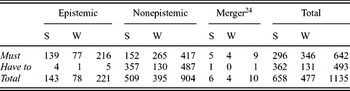
Table 2 indicates that have to is hardly ever used as a marker of epistemic necessity in ICE-GB, confirming claims about regional differences between American English and British English in the literature (cf. e.g. Coates Reference Coates1983: 57; Quirk et al. Reference Quirk, Greenbaum, Leech and Svartvik1985: 226; Palmer Reference Palmer1990: 56; Declerck Reference Declerck1991: 412; Huddleston & Pullum et al. Reference Huddleston and Pullum2002: 206).
Survey of modal meanings expressed by have to and must in ICE-GB, raw data (S = spoken, W = written)

3.4.3 Sources of have to and must in ICE-GB
The most recent detailed and well-balanced corpus investigation into the meaning of modal auxiliaries in general is Coates (Reference Coates1983). Smith (Reference Smith, Facchinetti, Krug and Palmer2003) is a recent quantitative analysis of modals and semi-modals of so-called ‘strong obligation’ aimed at describing the shifts in frequency of use of have to, (have) got to, need to, must, and need. Coates observes several times that modal auxiliaries do not in fact typically convey what is considered as their ‘core meaning’. Applied to must, this modal is not primarily used ‘performatively’, i.e. in contexts in which an authoritative speaker is the source (Coates Reference Coates1983: 21, 32, 38, 245). In the majority of cases, there is no speaker who has authority over the subject referent and who makes use of his authority to make the addressee perform a certain action. The only element of meaning all root necessities convey is that some situation is deemed necessary. Still, reference grammars published after Coates (Reference Coates1983) have mostly failed to take into account this very important finding, and tend to perpetuate many of the generally accepted views, one of which is that necessities originating in the speaker's will are commonly expressed by must, while those linked with a circumstantial source are typically expressed by have to (Westney Reference Westney1995 being a notable exception). Clearly, a quantitative analysis will be useful to substantiate, or, if necessary, to correct these generalisations. In this section, we will present the results of our quantitative investigation into sources, and our data will allow a more fine-grained presentation that does justice to actual usage patterns.
Before presenting the data, two methodological observations need to be added.
1 We have opted not to classify examples with a reported source separately. As explained in section 3.1, in these examples there are two channels: the speaker and an explicitly or implicitly reported speaker. We have classified the examples in terms of their (ultimate) sources: (a) speaker, (b) rules and regulations, (c) circumstances, (d) condition, (e) unclear.
2 There is a relatively large number of examples (30 with must and 29 with has to or have to) in the corpus with verbs of communication ‘used performatively’ (cf. e.g. Quirk et al. Reference Quirk, Greenbaum, Leech and Svartvik1985: 225):
(56) I must remind you, however, that I am a historian rather than a lawyer. (ICE-GB:W2F-011)
(57) I have to say I never had a career. (ICE-GB:S1B-045)
These examples contain verbs of communication that are ‘performative’ in the sense that by uttering say, admit, remember, etc. with a first-person subject the speaker actually ‘says’, ‘admits’, ‘remembers’, etc. However, as Fraser points out (Reference Fraser, Cole and Morgan1975: 187–8), when used in combination with must or have to, these verbs are no longer literally performative in that, strictly speaking, the sentence expresses that the speaker is under the obligation to say, remind, etc., rather than directly saying something or reminding someone of something. Since such examples constitute a conventionalised usage type, we have chosen not to include them in the quantitative analysis.
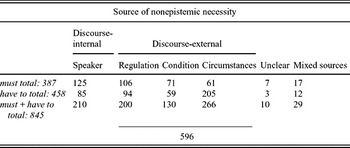
Table 3 presents a quantitative analysis of the examples with nonepistemic have to and nonepistemic must in terms of their sources.
Sources associated with nonepistemic have to and must in ICE-GB, raw data

Before interpreting the data, it is necessary to correct the raw figures for the following reason.Footnote 25 ICE-GB is a relatively small (1 million words) but well-balanced corpus with spoken (60 per cent) as well as written (40 per cent) data. We have observed rather high concentrations of certain types of examples (i.e. particular sources) in particular text types. For instance, in library regulations there are bound to be more expressions of necessity than in, say, a broadcast programme on gardening. In order not to distort the representativeness of the data, we have left out literal repetitions and forms that occur in coordinated clauses or in enumerations (as in the examples below). Examples of the latter type are to be considered as only one token too because, in some of the cases, once the speaker or writer has made a choice to use a particular verb, say, must, in the first clause, the use of the same auxiliary in the subsequent clauses is a mere matter of duplication:
(58) But to reach orbit an object must accelerate to a speed of about 17,500 miles per hour (28,000 kilometres per hour, called satellite speed or orbital velocity) in a horizontal direction; and it must reach an altitude of more than 100 miles (160 kilometres), in order to be clear of the atmosphere. (ICE-GB:W2B-035)
(59) What you have to do is you have to dress up as an Easter bunny. (ICE-GB:S1B-079)
The repetitions, summarised in table 4, have led us to subtract a number of examples from a number of categories.
Number of examples that are literal repetitions or forms occurring in coordinated clauses or enumerations and that have therefore been subtracted

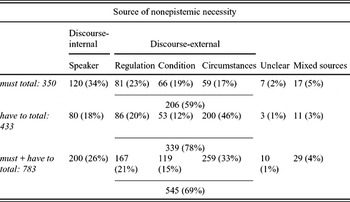
Table 5 provides an overview of the relative distribution of the different sources.
Sources associated with nonepistemic have to and must in ICE-GB, relative data

3.4.4 Discussion
The main conclusions to be drawn from table 5 are that both must and have to can be used to communicate a necessity with a discourse-external or a discourse-internal source and that discourse-external sources occur two and a half times more often than discourse-internal sources (26 vs 69 per cent). In other words, the figures indicate that there is more often a discourse-external source at the origin of a necessity, be it expressed by must or have to. The ICE-GB data thus falsify Coates’ claim that ‘root HAVE TO is never subjective’ (1983: 53), and Palmer's generalisation that ‘HAVE (GOT) TO is never deontic [i.e. subjective], MUST never external’ (1990: 116).
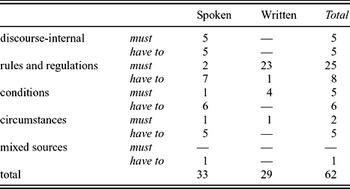
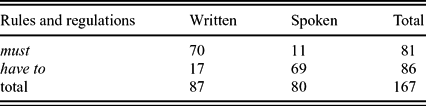
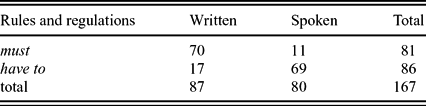
1. Rules and regulations (see table 6): all the written examples with must occur in the ICE-GB category of instructional writing, a majority featuring in administrative or regulatory texts. They are typically formal rules such as library regulations, admission procedures, application procedures, car licence regulations, and instructions for the installation of equipment. In the examples with have to there is a wider range in the nature of the ‘rules’, including less formalised ones such as traditions, rules of professional conduct, etc. These observations, together with the fact that there are only 11 spoken occurrences of must in this category, whereas only 17 examples with have to occur in the written corpus, suggest that must tends to be used in a more formal register.Footnote 26
Distribution of have to and must in the ‘rules and regulation’ class in ICE-GBFootnote 27
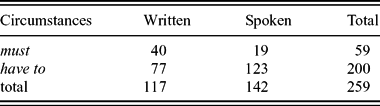
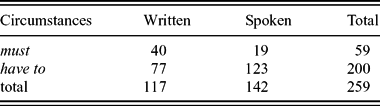
2. Circumstances (see table 7): the data confirm a common generalisation, namely that have to is typically used when the necessity is circumstance-driven. However, they also lay bare a tendency which is hardly ever commented on, namely that must is compatible with a circumstantial source: in 59 out of 259 examples, must is used. As in the case of the rules and regulations category, we again observe that must occurs more frequently in written English than in spoken English.
Distribution of have to and must in the ‘circumstances’ class in ICE-GB
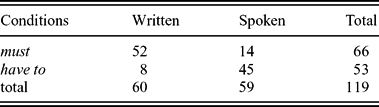
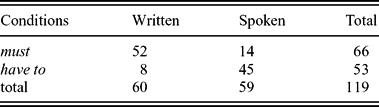
3. Conditions (see table 8): the corpus features slightly more conditional examples with must than with have to. While this type of sentence with have to occurs predominantly in spoken English, in sentences with must it is just the opposite: it features more often in the written than in the spoken data, which ties in with the earlier observations about register.
Distribution of have to and must in the ‘conditions’ class in ICE-GB
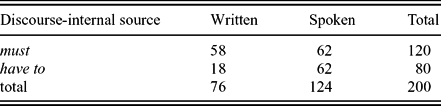
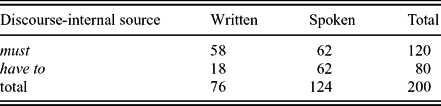
4. Discourse-internal sources (see table 9): the figures do not allow us to conclude that must is predominantly used if the source of the necessity is discourse-internal: in 80 (40 per cent) out of 200 sentences, have to is used to communicate a discourse-internal source. Register seems to be a more important determining feature: whereas there is a balanced distribution between the spoken and written data in the examples with must, the have to examples feature predominantly in the spoken corpus.
Distribution of discourse-internal have to and must in ICE-GB
It may be useful at this stage to return to the observation made in section 3.2.4: it is one thing to identify extralinguistic sources, it is another to claim that linguistic markers (i.e. must and have to) explicitly communicate reference to a particular source. The data do not allow us to make any statement to the effect that must is the linguistic expression of a discourse-internal source. Obviously, we came across examples which support the commonly accepted view on must and have to:
(60) A vital principle in British policing is that of the unarmed policeman. There have to be exceptions – but they must be few, and the case for them made out to public satisfaction. (ICE-GB:S2B-037) (source have to: circumstances – source must: speaker)
The speaker first mentions what seems reasonable to expect (‘there have to be exceptions’) and then gives his own view (‘but not too many’).
However, it is not impossible to use have to in a directive; witness the following examples:
(61) here's a girlfriend of mine whose husband – now you have to listen carefully; no not whose husband; a girlfriend of mine whose man, the man in her life, left his wife for her. (ICE-GB:S1A-080) (source: speaker)
(62) [A: We were talking about that man at college who was saying all these outrageous things to you. B: O God . . . it was so embarrassing. A: Oh do tell me. B: I can't. there's people here. A:] You have to say it. (ICE-GB:S1A-091) (source: speaker)
Generally speaking, the only claim that the data seem to justify is that must seems more appropriate to express the illocutionary force of a directive, have to being less ‘assertive’ or suggesting that the necessity is less ‘urgent’. In this respect, we could refer to Smith (Reference Smith, Facchinetti, Krug and Palmer2003: 259), who talks about ‘the irresistible nature of the force expressed in the obligation’ when characterising must. Smith refers to Sweetser (Reference Sweetser1990: 54), who describes must in a similar way by claiming that must is more intense.
The effect of replacing have to by must in (63a) is indicative of the observation just made:
- (63)
(a) The really sad thing about this is that the men who fish in the Clyde and the navy have a fairly well designed liaison system designed precisely to avoid what has happened there. And yet it has happened. And we have to get to the bottom of that [i.e. fishing net incidents]. (ICE-GB:S2B-011) (source: speaker)
(b) And we must get to the bottom of that.
In (63b) the speaker seems more committed than in (63a) in the sense that he feels that the truth about the fishing net incidents urgently needs to be revealed. The sentence with must sounds more emphatic than that with have to.
The following set of examples is interesting in the light of the observation that there is no one-to-one link between a particular source and a particular modal, because even though the necessities seem to be associated with the same source, a different modal is used (cf. also Westney Reference Westney1995: 96, 125 for a similar observation):
(64) The Franks did make great efforts to try and govern Brittany, so it must be asked what stood in the way of preventing their rule, what were the limiting factors to Frankish control? (ICE-GB: W1A-003)
(65) But I think what we have to ask ourselves is are we serious about our determination to ensure that Saddam Hussein leaves Kuwait a friendly country which he invaded with no excuse. (ICE-GB:S1B-035)
(66) Would my right honourable friend not agree that the mark of a single currency is that all other currencies must be extinguished and not merely extinguished but that the capacity of other institutions to issue currency has to be extinguished and that in the case of the United Kingdom would involve this Parliament binding its successors in a way which we have hitherto regarded as unconstitutional. (ICE-GB:S1B-053)
In the examples in (64) and (65), the speaker is the source. The contexts are similar: in both cases, the speaker finds a particular question self-evident and expresses that he believes it is necessary to ask the question. If we replace ‘it must be asked’ by ‘it has to be asked’ in (64), or, alternatively, if we replace ‘we have to ask ourselves’ by ‘we must ask ourselves’ in (65), the difference in effect between the alternative forms seems to be minimal. In these cases, it is not possible to pinpoint a clear difference in effect apart from the fact that the urgency is even greater when must is used, but one could hardly say that the source of the necessity is different. Such a claim could only be made if one accepts as an axiom that must presupposes more speaker-involvement than have to. In (66), the necessity is circumstance-oriented, no matter whether must (other currencies must be extinguished) or have to (the capacity to issue currencies has to be extinguished) is used.
We would tend to side with Palmer (Reference Palmer1990) who, in a discussion of examples in which have to and must can be used quite interchangeably, comments: ‘In every example in this section MUST could replace HAVE (GOT) TO (. . .), but it is not clear whether the meaning would be really different. One can, of course, insist that with MUST the speaker is in some way involved, even though this involvement may be minimal, but that can hardly be proved’ (1990: 115).
4 Summary of findings
Our investigation has resulted in an in-depth discussion of a variety of sources that can lie at the origin of root necessity meaning. It has revealed that usage distinctions between must and have to are less clear-cut than reference grammars usually suggest, and therefore confirm Westney's observation that ‘whatever tendencies may be evident, any kind of obligatory connection between the use of modals and an initiating role for the speaker cannot be justified’ (1998: 65). The analysis shows that the source of a necessity may be one (or more) of a variety of sources, whether the necessity is communicated by must or by have to. The ICE-GB data show that it is only in the category of ‘circumstances’ that have to is preferably used. None of the other sources is typically linked with either have to or must. Among the criteria that seem more relevant for the choice of modal are (a) register (spoken vs written): have to typically occurs in spoken English, and must predominantly in written English; and (b) strength: must conveys necessity with more insistence than have to.
A very tentative hypothesis might therefore be that have to is gaining ground, at this stage, and especially in spoken British English (cf. e.g. Collins Reference Collins, Aijmer and Altenberg1991: 154; Smith 1993: 249; Krug Reference Krug2000: 251). Since it can be associated with any type of source, the development might well be one in which have to becomes the primary marker of necessity. It will be evident that more corpus research is required to substantiate this hypothesis.Footnote 28
What the consequences of these findings are for a classification of modal meanings, i.e. whether the differences in sources result in semantically and/or pragmatically distinct subclasses of nonepistemic necessity (such as deontic, nondeontic, dynamic, implicative, etc.), is a topic that will be addressed in ensuing research.