INTRODUCTION
Cerithiopsidae are a large family of marine gastropods, probably including hundreds of species, living mostly from the intertidal zone down to about 200 m, nearly invariably associated with, and feeding on sponges (see Marshall Reference Marshall1978, for a summary of feeding records).
The alpha-taxonomy of the Cerithiopsidae (here conservatively including also the bathyal and abyssal Cerithiella, Eumetula and Laiocochlis (Gofas & Le Renard, Reference Gofas and Le Renard2012)), still has to be solved all over the world, but it is currently accepted that many different species occur on European coasts, the exact number still being uncertain; 40 species listed by the European Register of Marine Species (Costello et al., Reference Costello, Bouchet, Boxshall, Arvantidis and Appeltans2008); 49 species listed by WoRMS (Appeltans et al., 2012); 48 species listed by CLEMAM (Gofas & Le Renard, 2008). The type genus of the family, Cerithiopsis Forbes & Hanley, Reference Forbes and Hanley1850, comprises a group of small or very small species (3 to 15 mm long) usually less than 10 mm long. The slender, pupoid to sub-cylindrical, highly spired shell has a reticulated sculpture of axial and spiral ribs with tuberculated or beaded intersections, a small aperture and short siphonal canal, and has no varices or umbilicus (Figure 2). The genus Cerithiopsis was nominally based on Murex tubercularis Montagu, Reference Montagu1803. Recently, Prkić & Mariottini (Reference Prkić and Mariottini2010) have shown that in the Croatian waters the gastropods usually called Cerithiopsis tubercularis in fact comprise a complex of cryptic species, which can be easily diagnosed only by examining the coloration of the soft parts. However, doubts on the actual status of these morphotypes as distinct species have been raised (Cecalupo & Robba, Reference Cecalupo and Robba2010; Scuderi & Criscione, Reference Scuderi and Criscione2011). Therefore, we have specifically tested this hypothesis, and in the present paper we provide the genetic basis (COI partial sequences) for the existence of three distinct sympatric species of this complex, corresponding to the species morphologically identified by Prkić & Mariottini (Reference Prkić and Mariottini2010), and discuss the implications of the resulting taxonomic pattern for the systematics and nomenclature of the genus Cerithiopsis.
Although the types of Murex tubercularis Montagu, Reference Montagu1803 are not conspecific with any of the species in this complex (and the nomenclatural issue is under examination by the International Commission on Zoological Nomenclature (ICZN): see Cecalupo & Robba, Reference Cecalupo and Robba2011, and Prkić et al., Reference Prkić, Mariottini, Oliverio and Warén2012, for a recent review on this subject), we will conservatively use hereafter the binomen ‘Cerithiopsis tubercularis’ in the sense adopted by nearly all authors in the past 160 years.
MATERIALS AND METHODS
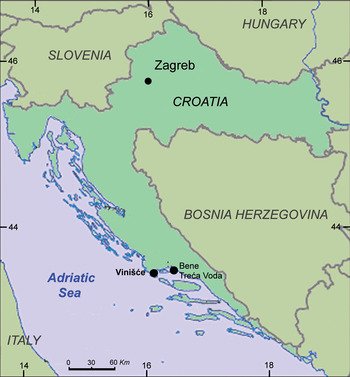
A total of over 4800 live specimens were collected along the Croatian coast and observed alive before fixing and preserving them in EtOH. Samples used for DNA extraction have been collected at three Croatian localities: Vinišće, Split—loc. Bene and Split—loc. Treća Voda (Figure 1). The two sampling sites at Split (Bene and Treća Voda) are less than one kilometre apart, and samples can be thus considered as sympatric. Specimens were collected by handpicking them from unidentified sponges under stones in the intertidal, or by washing the sponge/algal coverage of stones at low depth (1–8 m).
Location of the sampling sites (Bene, Split, 43°30′50″N 016°24′02″E; Treća Voda, Split, 43°30′53″N 016°24′40″E; Vinišće, 43°29′20″N 016°06′44″E).

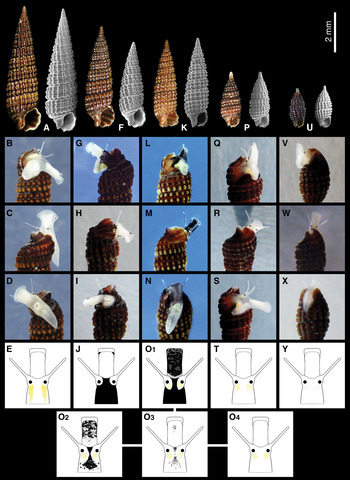
Two species were readily identified by shell morphology: C. minima (Brusina, 1865) (Figure 2P–T), and C. ladae Prkić & Buzzurro, Reference Prkić and Buzzurro2007 (Figure 2U–Y). Species of the ‘Cerithiopsis tubercularis’-complex were classified by the colour pattern of the head-foot, according to Prkić & Mariottini (Reference Prkić and Mariottini2010). Lots of voucher specimens have been given an ID BAU (Department of Biology and Biotechnologies, ‘La Sapienza’ University) and two vouchers of each lot have been deposited at MNHN (Muséum National d'Histoire Naturelle, Paris) (Table 1). Specimens for future anatomical studies have been preserved in 75% EtOH, while specimens for DNA extraction have been preserved in pure EtOH.
Morphology of voucher specimens of the assayed species. (A–E) Cerithiopsis petanii; (F–J) Cerithiopsis oculisfictis; (K–O) Cerithiopsis sp.; (P–T) Cerithiopsis minima; (U–Y) Cerithiopsis ladae. Scale bar = 2 mm.

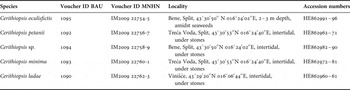
Voucher numbers, collection localities and European Molecular Biology Laboratory sequence accession numbers of the cerithiopsid dataset. Lot vouchers are stored at the Department of Biology and Biotechnology ‘Charles Darwin’, Rome, Italy (BAU) and two specimens of each lot have been deposited at the Muséum National d'Histoire Naturelle, Paris, France (MNHN).

Due to their very small size, the shell of specimens for DNA extraction was cracked to extract the animal. Total genomic DNA was extracted using a standard proteinase K phenol–chloroform method with ethanol precipitation as reported in Oliverio & Mariottini (Reference Oliverio and Mariottini2001). The DNA-barcode fragments of the mitochondrial cytochrome oxidase I (COI) was amplified by polymerase chain reaction (PCR) using the universal primers LCO1490 and HCO2198 (Folmer et al., Reference Folmer, Black, Hoeh, Lutz and Vrijenhoek1994). PCR conditions: 30 amplification cycles (30 seconds at 94°C, 30 seconds at 60°C, 1 minute and 30 seconds at 72°C). PCR products were purified using Exosap-IT (USB Corporation) and sequenced by Macrogen Inc. (Seoul, South Korea). Sequences were readily aligned by hand. Base composition of nucleotide sequences was analysed with MEGA 5.0 (Tamura et al., Reference Tamura, Peterson, Peterson, Stecher, Nei and Kumar2011). Nucleotide homogeneity was tested with the χ2 statistics implemented in PAUP* (v. 4.0b10, Swofford, Reference Swofford2002). Genetic variation (nucleotide diversity, haplotype diversity and nucleotide differences) was calculated using DnaSP 5.10 (Librado & Rozas, Reference Librado and Rozas2009).
Phylogenetic relationships among the sequences were inferred by neighbour-joining (NJ), maximum likelihood (ML) and Bayesian inference (BI) methods, using the Kimura-2-parameters (K2p) nucleotide substitution model, by the softwares MEGA 5.0 (Tamura et al., 2007, Reference Tamura, Peterson, Peterson, Stecher, Nei and Kumar2011), Treefinder (v. October 2008, Jobb et al., Reference Jobb, von Haeseler and Strimmer2004; Jobb, Reference Jobb2008) and MrBayes (four chains run twice in parallel for 107 generations, and trees sampled every 1000 generations: v. 3.1.2, Ronquist & Huelsenbeck, Reference Ronquist and Huelsenbeck2003).
RESULTS
Among the ~3000 specimens of C. minima (2270 specimens) and C. ladae (709 specimens), a diagnostic feature was observed in the head-foot: the opercular lobe and small dots behind the eyes are yellow in C. minima, while in C. ladae they are white. Among the over 1800 specimens of the ‘Cerithiopsis tubercularis’-complex collected alive and screened for taxonomic identification, the three distinct patterns already described by Prkić & Mariottini (Reference Prkić and Mariottini2010) were present, with no intermediates. Specimens have been accordingly classified as either C. petanii Prkić & Mariottini, Reference Prkić and Mariottini2010 (723 specimens: Figure 2A–E), Cerithiopsis oculisfictis Prkić & Mariottini, Reference Prkić and Mariottini2010 (361: Figure 2F–J), or C. sp. (759 specimens: Figure 2K–O), the latter corresponding to ‘C. tubercularis auct. nec Marshall’ of Prkić & Mariottini (Reference Prkić and Mariottini2010). The number of specimens are not exactly proportional to the respective frequency in nature, very roughly indicating that C. minima is the most common species and C. oculisfictis the less frequent.
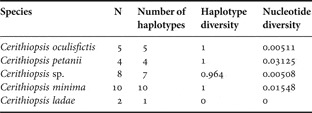
Partial sequences of the mtDNA encoding the COI were obtained from 10 specimens of C. minima and 2 of C. ladae, and from 21 specimens of the ‘Cerithiopsis tubercularis’-complex (morphologically ascribed to C. oculisfictis, C. petanii and C. sp.). Cerithiopsis ladae served as outgroup. The sequences have been deposited at the European Molecular Biology Laboratory (EMBL, accession numbers: HE862960–HE862996), and at BOLDSYSTEM (www.boldsystem.org; project BCER). A total of 658 base pairs were unambiguously aligned, without gaps, with 200 variable position, resulting in 27 distinct haplotypes (total haplotype diversity, Hd: 0.9; total nucleotide diversity, π: 0.03849; see Table 2 for haplotype and nucleotide diversity in each species).
Number of haplotypes, haplotype diversity (Hd, Nei, Reference Nei1987), and nucleotide diversity (Pi, Nei, Reference Nei1987) calculated within the species with more than 2 sequences.

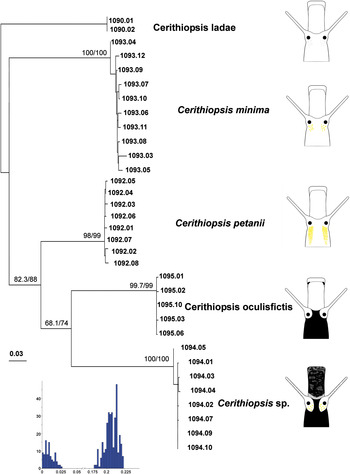
All three phylogenetic analyses (NJ, ML and BI) yielded the same topology (Figure 3). In Figure 3 the ML tree is reported with bootstrap (ML) and posterior probability (BI) supports at the nodes. The specimens of C. minima were the sister to a monophyletic ‘Cerithiopsis tubercularis’-complex. The specimens morphologically ascribed to either species in the complex all fell within their respective monophyletic clade. Cerithiopsis oculisfictis and C. sp. were always more closely related to each other than they were to C. petanii.
Maximum likelihood (ML) tree of the cerithiopsid COI sequences. Scale is calibrated ML distance. The histogram shows the distribution of the pairwise estimated genetic distances (K2p) in intraspecific (left) and interspecific (right) comparisons.

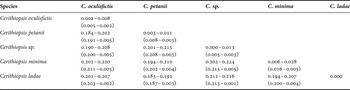
The intraspecific distance (K2p) ranged 0.009–0.004 in C. petanii, 0.025–0.004 in C. oculisfictis, 0.005–0.001 in C. sp., 0.015–0.003 in C. minima, and 0.000 in C. ladae, with an overall range of 0.000–0.025. The interspecific K2p distance ranged 0.186–0.215 (Table 3; Figure 3).
Genetic distances estimated using the Kimura 2 parameter substitution model. Inter- and intraspecific values are reported as ranges, with mean and standard deviation in parentheses.

DISCUSSION
A complex of species
Although the marine malacofauna of the Mediterranean Sea is commonly considered as the best known in the world (Oliverio, Reference Oliverio2003), new species are still being described at a remarkable pace; over 10 new species per year (see also Crocetta et al., Reference Crocetta, Bonomolo, Albano, Barco, Houart and Oliverio2012). Nearly all these new taxa have been originally based on diagnostic morphological features, but in many cases, intra- and interspecific morphological variation overlap making genetic data essential for differentiation. Traditionally, shell characters are primarily employed for the taxonomy of gastropods, yet the identification of Cerithiopsis species by shell morphology alone can be very difficult or impossible because of their small size, frequent encrustations and damage, loss of the protoconch (larval apical whorls), the extreme variability within some species and, in other cases, the extreme similarity of shell features between different species. By contrast, the flesh colour of the living molluscs often proves to be of clear diagnostic value, similar to what is observed in the closely related Triphoridae (Bouchet, Reference Bouchet1985, Reference Bouchet1997). However, doubts have been raised on the validity of the head-foot chromatism in the taxonomy of these species by Scuderi & Criscione (Reference Scuderi and Criscione2011) who—referring to the species identified by Prkić & Mariottini (Reference Prkić and Mariottini2010)—reported the finding in Sicily of ‘not only the same three forms described by these authors but also intermediate forms connecting to each other. We consider the presence of these intermediates as the evidence of the expression of an intraspecific variability in the colour pattern of the head-foot of C. tubercularis’ (Scuderi & Crisione, 2011: 45). Our genetic data, unequivocally confirmed that the three morphotypes, identified by Prkić & Mariottini (Reference Prkić and Mariottini2010) as Cerithiopsis oculisfictis, C. petanii and C. tubercularis (here called Cerithiopsis sp.), do actually represent distinct species that occur sympatrically in the Croatian waters (Prkić & Mariottini, Reference Prkić and Mariottini2010; J.P., unpublished observations). Since the presumed intermediate specimens have not been figured by Scuderi & Criscione (Reference Scuderi and Criscione2011), and based on the evidence of our genetic data, we argue that either they observed specimens of Cerithiopsis sp. being misled by the high variability of its animal background colour, ranging from completely white to almost completely black (Figure 2L–O; Prkić & Mariottini, Reference Prkić and Mariottini2010), or a re-examination of their material may reveal the presence of more species within their samples. In fact, distinct head-foot patterns (without intermediates) have been observed throughout most of the range of the ‘Cerithiopsis tubercularis AA complex’ in the Mediterranean Sea and in the Atlantic (our data, unpublished; Gofas (Reference Gofas, Gofas, Moreno and Salas2011) and personal communication; Ian Smith at http://conchsoc.org/spaccount/Cerithiopsis-tubercularis). The present data show that the DNA-barcode sequences (COI) can be a very reliable tool for species identification when live collected specimens cannot be scrutinized in the field. The values of the estimated K2p genetic distance fall into two distinct groups, intra- and interspecific estimates, respectively, with the intraspecific values always smaller than the usual barcoding gap, i.e. <3% divergence.
The status of Murex tubercularis Montagu, Reference Montagu1803
Montagu's (1803) description of Murex tubercularis fits at least 10 recent European cerithiopsid species. Marshall (Reference Marshall1978: figure 13C) selected a lectotype among two (very likely conspecific) specimens, which have been recently re-figured by Cecalupo & Robba (Reference Cecalupo and Robba2010: figure 1C–F). However, these two shells have little to do with what has nearly invariably been called Cerithiopsis tubercularis in the past one and half centuries, being two specimens of Cerithiopsis barleei Jeffreys, Reference Jeffreys1867, a fact noticed by Marshall himself, and accepted—at least for the lectotype—by the recent specialists of the European malacofauna (e.g. van Aartsen et al., Reference Aartsen, Menkhorst and Gittenberger1984). The modern (erroneous) concept of Cerithiopsis tubercularis arose when Forbes & Hanley (Reference Forbes and Hanley1850: pls 00, 91, 92) introduced the genus Cerithiopsis, nominally for Murex tubercularis Montagu, but in fact not for the species indicated by the types. This concept of C. tubercularis has been followed nearly invariably by all subsequent authors, including Jeffreys (Reference Jeffreys1867) who, describing his Cerithiopsis barleei, compared it with C. tubercularis (Montagu, Reference Montagu1803) (sensu Forbes & Hanley (1850–1851)), and obviously found them to be different.
Cecalupo & Robba (Reference Cecalupo and Robba2011) have applied to the ICZN (under Article 75.6 of the Code), with the aim to conserve the current usage of the name Cerithiopsis tubercularis (Montagu, Reference Montagu1803), and the Commission has been asked to set aside the previous type fixation (Marshall, Reference Marshall1978) for Murex tubercularis Montagu, Reference Montagu1803 and to designate as neotype a ‘probable syntype BMNH 20090384’ (consistent with the current usage).
A serious problem is raised by the fact that the ‘current usage’ of Cerithiopsis tubercularis (Montagu, Reference Montagu1803), actually comprised a complex of cryptic species, impossible to identify by examining only the shell characters. Forbes & Hanley (1851: 364), while describing the type species of the genus Cerithiopsis (‘Cerithiopsis tubercularis’) may have mixed more than one species, as can be deduced from their notes on the coloration of the head-foot. This is the reason why we (Prkić et al., Reference Prkić, Mariottini, Oliverio and Warén2012) have not supported Cecalupo & Robba's application, and have recommended that before the Commission takes any decision, the intricate puzzle of the species complex of C. tubercularis sensu Auct., must be solved by the study of live collected specimens, with types designed on morphologically and genetically characterized specimens. In the present study we have demonstrated that the colour pattern of the head-foot is diagnostic at the species level in this complex and, coupled with genetic data (the DNA-barcode COI seems to work very well in this regard), may provide a sound basis for a revision of the cerithiopsids of the European coasts.
ACKNOWLEDGEMENTS
We thank Serge Gofas (Malaga), Bruce Marshall (Wellington) and Anders Warén (Stokholm), for discussion on cerithiopsid systematics and biology, Ian Smith (Stockport) for sharing his observation on living cerithiopsids from the UK and for improving the English text, and Alen Petani (Zadar) for some images of live specimens. P. Bouchet and an anonymous referee are thanked for constructive criticisms of the manusript.