INTRODUCTION
Experts on clinician–patient communication are often asked to advise on how best to discuss end-of-life planning and advance care directives. In the case below, we contrast the communication advantages of using the term “do-not-resuscitate directive” instead of “allow-natural-death directive.”
CASE
A dejected nurse described a 40-year-old male who “blew through his [allogeneic] transplant and is basically dying” just two months after the procedure. The challenge was one of communication: the patient and his family would “not agree to a DNR,” despite a lengthy discussion with the oncologist.
“I spoke at length with the family [after they met with the oncologist] regarding the poor outlook and their concerns about giving up. I contrasted this with the poor quality of life he might have in the ICU on a vent, but they are in denial. How can I make them see what is happening?” he asked, demoralized.
As communication trainers at a comprehensive cancer center, we suggested that he consider using the term “allow natural death” instead of “DNR” and to focus the conversation on dying and end-of-life goals of care. We cited data showing that inpatients with cancer who completed a DNR died a median of one day later, suggesting that such “DNR” conversations are more about guiding the dying process rather than whether to attempt resuscitation or not (Levin et al., Reference Levin, Li and Weiner2008).
The nurse wrote us the next day, “It was when I stopped using DNR but instead used the term AND, or allow natural death, that the family gained some understanding and comfort in the decision [to facilitate a peaceful death]. It wasn't stopping things from happening or quitting. It was simply allowing nature to take its course. It was of great help. Thank you for your insight.”
DISCUSSION
Clinicians and, as this case illustrates, bedside nurses care greatly about discussing “DNR” with their patients and the notion of a good death. The question arises as to whether the term AND is semantically a better communication tool than DNR.
The term AND was first employed in the 1990s (Meyer, Reference Meyer2000), and many hospitals have since adopted it. Articles advocating its use have appeared in the popular press. Wikipedia mentions the DNR-versus-AND controversy, and there is even a website, predictably, called allowinganaturaldeath.org.
The only randomized, controlled study examining the issue found that AND-framing language compared to DNR usage resulted in fewer surrogates choosing cardiopulmonary resuscitation (61 vs. 49%, OR = 0.58 [CI 95 = 0.35–0.96]) in a simulation exercise of critical illness (Barnato & Arnold, Reference Barnato and Arnold2013). It also found that normative framing of the decision by the physician—“In my experience, most people do not want CPR”—resulted in surrogates less likely to choose CPR compared to the alternative—“In my experience, most people want CPR” (64 vs. 48%, OR = 0.52 [CI 95 = 0.32–0.87].
Our comprehensive cancer center and many others have been slow to adopt the AND language. It seems that, once forms are printed, institutional culture is hard to change. To counter this, we add our perspective as medical communication trainers on why semantics are important.
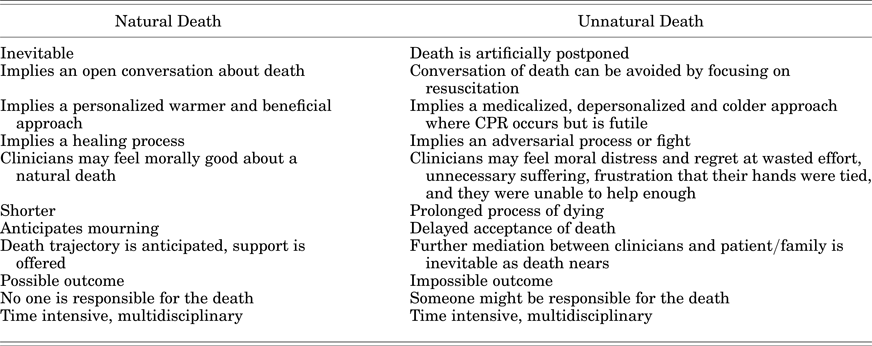
From the communication viewpoint, the advantage of using the term “allow natural death” is that it facilitates a goals-of-care discussion, with acceptance of the inevitable. A natural death is somewhat synonymous with a “good” death, implying an ethics of caring. Its flipside, an unnatural death, further delineated in Table 1, evokes a greater sense of moral distress, and is more medicalized, adversarial, and depersonalized.
Discussing natural versus unnatural death

The major disadvantage of the DNR language is the implication that there is a choice to be made between resuscitation (i.e., life) and death, with an expectation, or at least an outside chance, that resuscitation might work, with the person returned to his or her meaningful self. Patients and families are asked to decide and, in many instances, to sign “the DNR,” and this can be very stressful. Research shows a significantly greater posttraumatic stress, depression, and anxiety symptoms in bereaved family members who were asked to make the DNR decision for their loved ones who died in the ICU (Azoulay et al., Reference Azoulay, Pochard and Kentish-Barnes2005).
The reality is that resuscitation of the sickest cancer patients with multi-organ failure results in 98% dying and 2% surviving to discharge (Wallace et al., Reference Wallace, Ewer and Price2002; Reisfield et al., Reference Reisfield, Wallace and Munsell2006), with mostly a negative impact on the quality of death when resuscitation is futile.
The communication alternative to imposing a DNR choice on the patient and family and asking them to decide is a guiding clinical voice that offers to lead them though an unfolding death and does not put ethically indefensible, futile options on the table. This guiding voice reflects a collaborative stance that is framed by empathic and “we” statements, and employs the words “death” and “dying”:
This is really difficult [empathic silence]. We will do our best to help you and your family though the dying process.
Whether there is such a thing as a natural death in a person ravaged with multi-organ disease or it is more of an idealized hope is secondary to a communication stance that reflects an ethics of caring and comfort. The AND semantic opens the gates for such a profound conversation between clinician and patient/family.
CONCLUSION
There are clear advantages for abandoning the term “do not resuscitate” (DNR) and instead employing “allow natural death” (AND) in end-of-life discussions and communications training, as illustrated in this case study. Use of the term “AND” is also supported by one well-designed randomized, controlled study that found that using it was less likely to result in a surrogate preference for CPR compared to the term “DNR” in a critical illness simulation.
ACKNOWLEDGMENTS
The authors have no conflicts of interest to disclose.