There has been growing interest in using spray drying to preserve lactic acid bacteria (LAB) because the technology consumes 10 times less energy than freeze-drying (Schuck et al., Reference Schuck, Dolivet, Méjean, Hervé and Jeantet2013). However, spray drying promotes osmotic, thermal and oxidative stresses which cause a loss of cell viability. To overcome these drawbacks, studies have pointed to controlling operational drying parameters and using encapsulating materials with protective thermal properties as ways to improve the cell survival (Martins et al., Reference Martins, Cnossen, Silva, Junior, Perrone and Carvalho2019a, Reference Martins, Cnossen, Silva, Vakarelova and Carvalho2019b). Another way to prevent LAB cell death consists in adapting the microorganisms prior to spray drying by subjecting them to sublethal stresses. This increases LAB tolerance for stresses that occur both during and after spray drying (Miyoshi et al., Reference Miyoshi, Rochat, Gratadoux, Le Loir, Oliveira, Langella and Azevedo2003). No previous studies have examined the possibility of promoting cell adaptation by applying progressive, sublethal stresses with increasing intensity. To evaluate the feasibility of this new approach, this study tested the hypothesis that progressive acid, osmotic and oxidative stresses may increase the survival rate of Lactococcus lactis subps. lactis both during spray drying and during dried culture storage.
Materials and methods
Microorganism and culture conditions
L. lactis subsp. lactis was activated by adding 1% v/v of the culture to 10 ml of Man, Rogosa and Sharpe medium (MRS, Difco, France) with an incubation at 30 °C for 18 h. This strain was chosen as a model for thermal-sensitive bacteria based on data reported in our previous studies (Martins et al., Reference Martins, Cnossen, Silva, Junior, Perrone and Carvalho2019a, Reference Martins, Cnossen, Silva, Vakarelova and Carvalho2019b).
Preparation of the drying medium
100 g whole milk powder (Itambé, Brazil) and 5 g lactose crystals (Cromoline, Brazil) were dispersed in 125 g distilled water, heated at 85 °C for 1 h and subsequently held at 40 °C in a water bath (Martins et al., Reference Martins, Cnossen, Silva, Vakarelova and Carvalho2019b).
Application of sublethal stresses
To induce progressive acid conditions, an MRS broth with an adjusted pH with acetic acid 10% v/v (Cap-Lab, Brazil) was used to cultivate the L. lactis cells. 1% v/v active cultures (~109 CFU/ml) were added to 0.9 ml of MRS with pH 6.5 and incubated at 30 °C for 24 h. After incubation, 1% v/v of the culture was transferred once more to 0.9 ml MRS with pH 6.5 and incubated at 30 °C/24 h in order to preserve the adapted cells in an active state. At the same time, an aliquot of 100 μl of this culture was serially diluted in saline solution 0.85% w/v and viable cells were enumerated using the microdroplet technique in MRS agar with an incubation at 30 °C/ 24 h in anaerobic jars (Martins et al., Reference Martins, Cnossen, Silva, Vakarelova and Carvalho2019b). Once the number of viable cells was established to be around 109 CFU/ml, 1% v/v of the active culture in MRS with pH 6.5 was transferred to 0.9 ml MRS with pH 6.0 and incubated at 30 °C/24 h to continue the progressive stress. After incubation, an aliquot was once again transferred to MRS with pH 6.0 and incubated (30 °C/ 24 h) while a second aliquot was plated in MRS agar for cell enumeration. These procedures were repeated several times by reducing the MRS pH by 0.5 units for each new cultivation until a final pH level of 4.5 was reached. The progressive stress was halted at pH 4.5 because when the cells were cultivated in MRS with pH 4.0, a reduction in 1 log cycle in the final population was observed after incubation (30 °C/24 h).
The cells that had adapted to the pH 4.5 environment were cultivated day after day in the same media (MRS broth with pH 4.5) and incubation conditions (30 °C/ 24 h) until the moment of drying.
Osmotic stress was induced by incubating active cultures at 30 °C for 24 h in MRS broth containing increasing concentrations of NaCl (1.5 to 8.0% w/v) (Dinâmica, Brazil). Oxidative stress was induced in MRS broth containing concentrations of hydrogen peroxide (H2O2) that ranged from 0.5 to 1.0 mM (Dinâmica, Brazil) with incubation at 30 °C for 24 h. The progressive methods for inducing of osmotic and oxidative stresses were carried out using the same procedures as described for inducing progressive acid conditions.
The cells that had adapted to the osmotic and oxidative stresses were also cultivated day after day in their respective MRS broths containing 8.0% w/v of NaCl or 1.0 mM of H2O2 with incubation at 30 °C for 24 h until the moment of drying.
To prepare the L. lactis control cell sample, 1% v/v active culture (~109 CFU/ml) were added to 0.9 ml of MRS with pH 7.0 and incubated at 30 °C for 24 h.
Preparation of cell suspensions and spray drying
Following the sample cells' adaptation to stress conditions, 1% v/v of each sample culture was transferred to 250 ml of MRS with pH 4.5 or containing NaCl 8.0% w/v or added of 1.0 mM of H2O2. For the control sample, 1% v/v of active culture was transferred to 250 ml of MRS with pH 7.0.
All cultures, including the control sample, were incubated at 30 °C for 18 h and centrifuged separately (Eppendorf, German) at 5000 × g for 10 min. The resulting pellets were washed twice in saline solution 0.85% w/v and each sample was resuspended in the drying medium in order to obtain sample cell suspensions with approximately 109 CFU/g.
The cell suspension samples were dried in an MSD 1.0 spray dryer (Labmaq, Brazil) as described by Martins et al. (Reference Martins, Cnossen, Silva, Vakarelova and Carvalho2019b): inlet air temperature = 130 °C; outlet air temperature = 55 °C and cell suspension flow rate = 0.5 kg/h. The resulting powders were collected in sterile glass bottles which were sealed and stored at 4 or 25 °C. Vacuum conditions were not used in order to simulate potential abusive storage conditions.
Physical analysis
The water activity (A w) of the powder samples stored at 25 °C was determined using a water activity meter (Aqualab, Decagon 3TE, Decagon Devices Inc., USA).
3 g of the sample cell suspensions, or 1.5 g of powder, were mixed with sand and heated at 105 °C until they attained a constant weight. Moisture (M%) was calculated by determining weight loss after heating and then expressed as a percentage. Dry extract (DE, in %) values were determined by the equation:
 $${\rm DE} = 100\ndash {\rm M}\percnt $$
All measurements were performed in triplicate.
Determination of cell viability
Cell viability was evaluated both in the cell suspension samples and the powder samples immediately after drying and during storage. 1 ml concentrate or 1 g powder was dispersed in 9 ml saline solution 0.85% w/v and serial dilutions were performed in the same diluent.
The enumeration of viable cells was performed using the microdroplet technique in MRS agar with an incubation at 30 °C/ 72 h in anaerobic jars (Martins et al., Reference Martins, Cnossen, Silva, Vakarelova and Carvalho2019b). The enumeration of colony-forming units (N) was expressed in relation to dry material content of sample concentrate or sample powder (CFU/g).
The cell viability loss was determined by the following equation:
 $${\rm Viability\ loss} = {\rm log\ }{\rm N}_ 0 \hbox{-}{\rm \ log\ N^{\prime}}$$
Where N0 represents the number of CFU/g of surviving L. lactis in the cell concentrate sample and N’ indicates the number of viable cells (CFU/g) just after drying.
Cell viability after storage was evaluated by measuring the difference between initial cell populations in the powder samples immediately after drying (log N’) and final populations after 45 d of storage.
Statistical analysis
The drying processes were carried out in three repetitions and the results were evaluated using the ANOVA and Tukey tests (P < 0.05). Statistical analysis was performed using PAST software.
Results and discussion
Influence of adaptive stresses on the survival of L. lactis
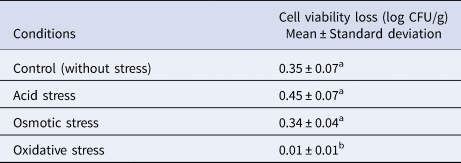
After drying, the L. lactis samples which had been forced to adapt to acid or osmotic conditions did not show any statistical differences in terms of cell viability loss compared to the control samples (~0.38 log cycles) (Table 1). Conversely, the cell samples that had adapted to oxidative conditions demonstrated a cell viability loss of only 0.01 log cycles. This represents a total cell viability loss that was 35 times lower than the control sample (Table 1).
Cell viability loss of L. lactis after spray drying

Different letters in each the column indicate significant differences between treatments (P < 0.05).
This agrees with the results of Ghandi et al. (Reference Ghandi, Powell, Howes, Chen and Adhikari2012), who reported that over 80% of L. lactis cell death occurred during the spray drying process in their study. This was attributed to the adverse conditions of oxidative and shear stress to which the cells had been subjected.
Exposure to oxygen promotes the formation of reactive oxygen species which can damage proteins and nucleic acids (Miyoshi et al., Reference Miyoshi, Rochat, Gratadoux, Le Loir, Oliveira, Langella and Azevedo2003). L. lactis is characterized as sensitive to oxidative damage since it is unable to produce the catalase enzyme responsible for the degradation of H2O2 (Chen et al., Reference Chen, Shen, Solem and Jensen2013). Thus, our results suggest that progressive adaptation to H2O2 may have induced an oxidative stress response in L. lactis.
The oxidative stress response mechanisms frequently found in L. lactis are based on the NADH oxidase/NADH peroxidase system, superoxide dismutase enzyme and induction of synthesis of proteins that repair DNA and macromolecules, i.e., the chaperones (Miyoshi et al., Reference Miyoshi, Rochat, Gratadoux, Le Loir, Oliveira, Langella and Azevedo2003).
Chaperones represent a general response mechanism that is equivalent to thermal stress. Thus, exposing sample cells to H2O2 may also have increased their resistance to heat, via a cross-response acquisition. Our results are in keeping with those of Dijkstra et al. (Reference Dijkstra, Setyawati, Bayjanov, Alkema, Van Hijum, Bron and Hugenholtz2014), who reported that L. lactis shows tolerance to both oxidative and thermal stress conditions, thus indicating a correlation between the adaptive responses to these stress conditions.
Although the drying parameters have a strong influence on the ultimate viability of L. lactis, the sample powders' physical properties can also have a strong influence. In general, powders with values of Aw beyond to 0.20 are not ideal for the survival of spray-dried bacteria (Martins et al., Reference Martins, Cnossen, Silva, Junior, Perrone and Carvalho2019a).
To confirm that the viability loss observed in the Table 1 was caused by adaptive stress and not by water content variation between the powders, all of the dried culture samples were analyzed. The Aw analysis confirmed that no samples differed in water content (0.207 ± 0.004) which indicates that viability loss variations can only be explained by the progressive stresses to which the cells were subjected.
Cell stability during storage
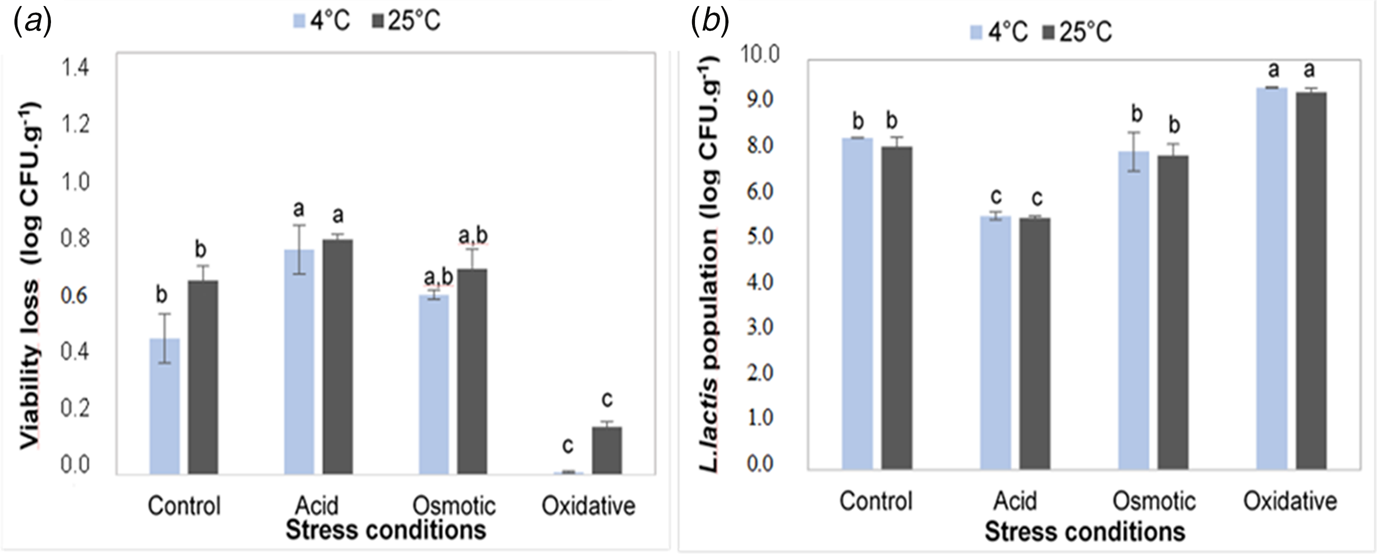
The cell population reductions of the samples over time showed no statistical differences between those stored at 4 °C and those stored at 25 °C. This indicates that refrigeration is not necessary to maintain cell viability (Fig. 1a). By contrast, a viability loss of approximately 0.58, 0.82 and 0.68 log cycles was observed in the control, acid and osmotic adapted cell samples, respectively (Fig. 1a). Once again, lower viability losses were noted for L. lactis samples which had been conditioned for oxidative cultivation (Fig. 1a).
(a) Viability loss after 45 d of storage; (b) Viable cell population in the powder samples after 45 d of storage. Different letters on the bars indicate significant differences between treatments.

The final cell populations in the powder samples varied from 6.17 to 9.26 log CFU/g with the samples subjected to acid conditions accounting for the lowest cell populations recorded (Fig. 1b).
The L. lactis samples were stored in contact with atmospheric air, which may have exposed them to further damage and loss of viability. However, the stress caused by prior H2O2 exposure was shown to be enough to avoid cell viability loss after drying and during powder storage. It resulted in a 48-fold increase in cell survival when compared to the control sample.
It should be noted that similar results have been found for other LAB varieties. A strain of Lactobacillus plantarum which had been exposed to sublethal oxidative stress conditions demonstrated a reduced loss of cell viability after 180 d of storage at room temperature (Barbosa et al., Reference Barbosa, Borges and Teixeira2015).
In conclusion, the low survival rates for bacteria exposed to spray drying procedures are frequently attributed to thermal and osmotic damages suffered by the microorganisms. However, in this study, we have demonstrated that oxidative stress seems to be the key factor in causing L. lactis death. By progressively adapting these microorganisms by increasing sample concentrations of H2O2, it was possible to produce dried cultures with very low cell reduction levels (<1 log cycle), even after storage. Additionally, we have shown that spray-dried L. lactis remains stable at room temperature over time. This represents an important advantage over other industrial ferment processing methods which require refrigeration up until the final use of the strains. This new approach opens up opportunities in the dairy industry for spray-drying microorganisms like LAB to increase their resistance to oxygen.
Acknowledgements
The authors are grateful for the financial support provided by CAPES, CNPq and FAPEMIG to carry out this research.