INTRODUCTION
Living beings, in general, show oscillations in their behavioural repertoire throughout the day and at specific times of the year in order to adjust to variations in environmental and climatic conditions (Krebs & Davis, Reference Krebs, Davis, Krebs and Davis1996; Alcock, Reference Alcock and Alcock2001). This selective pressure, which interferes with the expression of behaviour, also acts on cetaceans, influencing daily movements, habitat use and feeding regime, amongst others. An example of this is the oscillation in the behaviour of an individual in response to food availability variations throughout the day (Wells et al., Reference Well, Irvine, Scott and Herman1980). Similar oscillations occur on diurnal activities, associated with tidal variation, and lead to lower energy expenditure (Krebs & Davis, Reference Krebs, Davis, Krebs and Davis1996; Geise et al., Reference Geise, Gomes and Cerqueira1999; Azevedo et al., Reference Azevedo, Oliveira, Viana and Sluys2007). Thus, food availability and distribution, as well as the physical characteristics of the habitat, are examples of ecological pressures acting upon behaviour. Wells et al. (Reference Well, Irvine, Scott and Herman1980) propose that, for some odontocete species, the similarity in social and environmental characteristics, suggests that the same ecological forces act on different populations.
As such, Sotalia guianensis (van Bénéden, 1864), widely distributed in the low latitudes of the coastal western Atlantic, could be used as a model for understanding how variations in the environment interfere with behaviour, when comparing regions with similar and diverse environmental characteristics.
The diurnal and tidal variations of an equatorial population of S. guianensis were studied and compared with examples in the literature of other populations of the same species from different regions of the Brazilian coast. Although the species is restricted to the warm and shallow waters of coastal areas, it is widely distributed in terms of latitude (15°N–27°S, da Silva & Best, Reference da Silva and Best1996), which makes it particularly interesting for comparison studies between localities.
Furthermore, local populations of S. guianensis are being exposed to increasing vessel traffic and urban development of coastal areas, which are being gradually degraded, with effects on their general welfare (IBAMA, 2001; Tosi & Ferreira, Reference Tosi and Ferreira2008).
The present study aimed to describe the influence of time of the day and tide in the behavioural patterns and the presence of S. guianensis in enseada do Curral, north-eastern Brazil.
MATERIALS AND METHODS
Study area
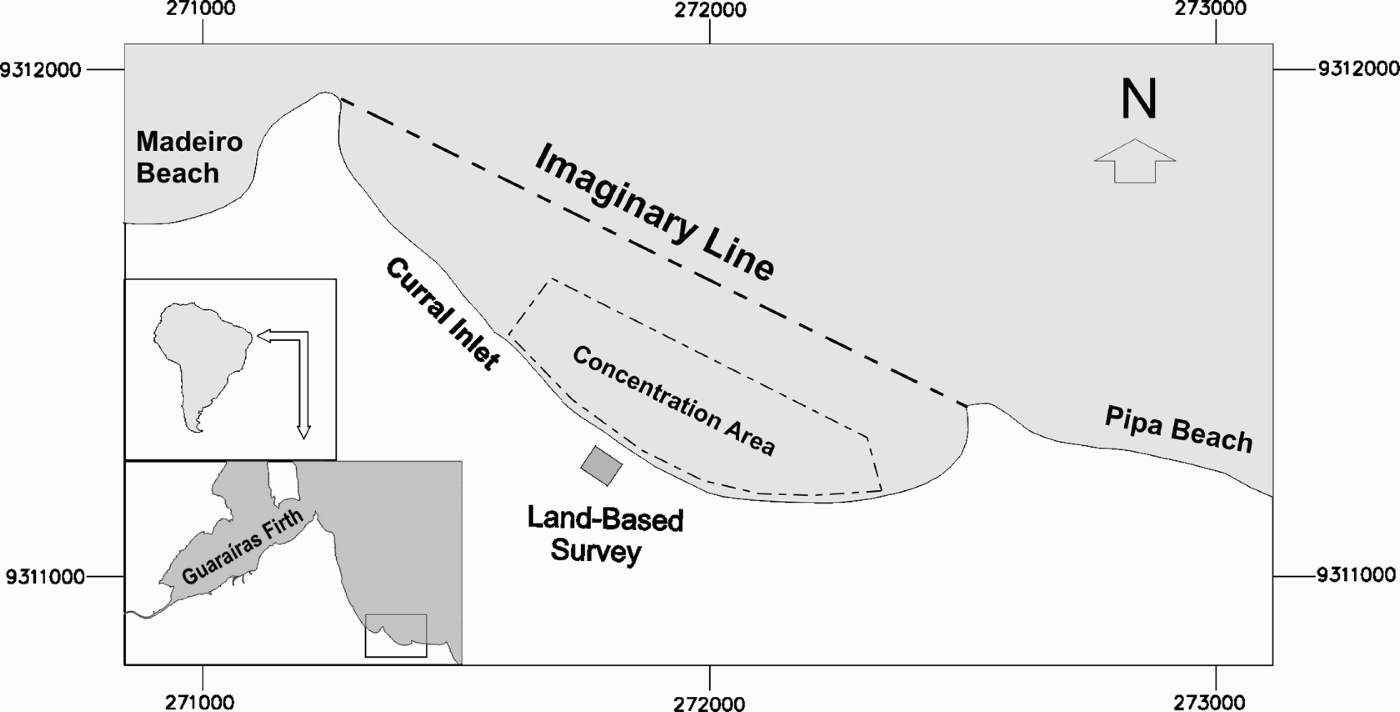
Enseada do Curral (Curral inlet) is located within Reserva Faunística Tibau do Sul–Reserva de Uso Sustentável (sustainable use reserve), Pipa district, on the southern coast of the State of Rio Grande do Norte, north-eastern Brazil (6°13′36″S 35°3′00″W). The inlet is approximately 1 km wide and has a maximum depth of 5 m; the bottom is mostly composed of sand, with the exception of the extremities, which are composed of sedimentary sandstone. The right hand side of the inlet is protected from strong winds and currents (<1.0 Beaufort scale), as opposed to the left side, which is subject to such variables. The limits of the study area were defined by an imaginary line connecting the two extremities of the inlet (Figure 1).
Location of the study area (Curral Inlet, Pipa Beach, north-eastern Brazil).

Observations
Observations were carried out three times a month between October 1999 and September 2003. This effort was constant throughout the period of data collection, for six hours continuously, distributed throughout the daylight period (0600 to 1700 h). Although the animals were constantly observed whilst inside the inlet, their behaviour was registered every five minutes on standardized field sheets. Two observers using binoculars (10 × 50 mm) simultaneously collected and double-checked all information from a fixed point on land (station height: 30 m) that allowed a good view of the entire inlet. More details of the methodology employed can be seen in Guilherme-Silveira & Silva (Reference Guilherme-Silveira and Silva2007).
Data analysis
Predominant activity sampling was carried out as detailed by Mann (Reference Mann1999, Reference Connor, Wells, Mann, Read and Mann2000). Behaviours registered were: socialization and foraging. The number of individuals in the inlet throughout the day was also classified.
Socialization (according to Acevedo-Gutiérrez et al., 2005; Daura-Jorge et al., 2005): it is any activity not considered as foraging. These activities included physical contact among conspecifics (agonistic or associative behaviours) and jumps out of the water exposing the body totally or partially, irrespective of the animal position.
Foraging (based on Monteiro-Filho, Reference Monteiro-Filho1995; Monteiro et al., Reference Monteiro, Souto and Nascimento2006): any activity associated with food acquisition, including chasing fish and fish associated milling.
No other behaviour categories were used because records of behaviours of other kinds were very infrequent throughout the data collection period.
The days were divided into three periods: 0700 to 1000, 1000 to 1300 and 1300 to 1600 hours. Sampling carried out before 0700 and after 1600 represented 30% (N = 43 replicates) of the total collected data but was excluded from analysis because it consisted of less than four hours of continuous observation. The tides were considered as low or high during the period of one and a half hours before and after low and high tide. The interval ‘between tides’ was considered as the three hours before or after high and low tide.
The moon phase was not considered here because the difference between high tide in full moon and high tide in new moon or difference between the low tides in full moon and low tide in new moon in equatorial regions is little—from 0.1 to 0.3 m.
The average frequency of each variable—individual frequency; socialization and foraging frequency—was obtained from the mean of each continuously observed three-hour periods according to the groups established above—daily periods and tide. These averages were then compared according to period of the day and tide, using the Friedman test. The post hoc test used was Wilcoxon (dependent measures), adopting α = 0.05 significance level.
RESULTS
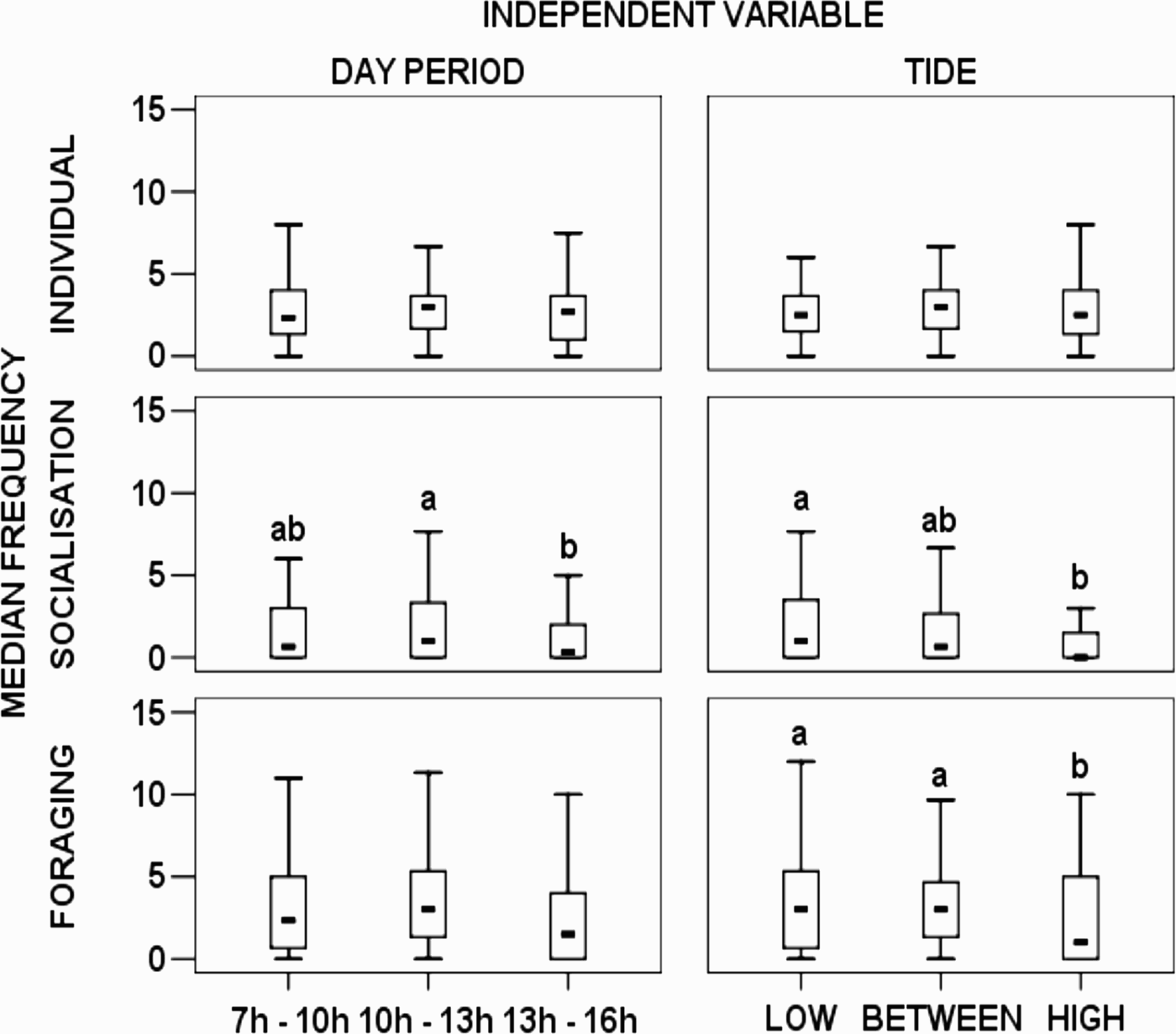
Individuals were absent from the inlet on only two days throughout the study period (N = 101 days; 1.98% absence). The number of individuals varied between zero and 16, averaging 5.703 ± 2.583. No significant difference was found between the average frequency of individuals during different periods of the day (N = 101; Friedman = 2.060; df = 2; P = 0.357), and the mean for each time interval was 0700–1000 = 2.828 ± 2.030; 1000–1300 = 2.885 ± 1.667 and 1300–1600 = 2.619 ± 1.928 (Figure 2). The average frequency of individuals during the different tide periods also did not vary (N = 101; Friedman = 1.173; df = 2; P = 0.556) and the average was LOW = 2.804 ± 1.974; HIGH = 2.711 ± 1.966 and BETWEEN TIDE = 2.817 ± 1.699 (Figure 2).
Box plot of individuals, socialization and foraging at different periods-of-day and tide states. The different lower case letters show there is significant difference at 5%.

Socialization represented 47.24% and foraging 52.76% of the total observations. There was significant difference in the frequency of socialization and foraging for different periods of the day (N = 101; Friedman Socialization = 7.284; df = 2; P = 0.026; Friedman Foraging = 6.488; df = 2; P = 0.039) and tide periods (N = 101; Friedman Socialization = 12.374; df = 2; P = 0.002; Friedman Foraging = 16.049; df = 2; P = 0.0001).
The frequency of socialization was significantly different between the second and third periods of the day (N = 101; 1000–1300 = 2.998 ± 5.022; 1300–1600 = 2.035 ± 4.591; Z = −2.372; P = 0.018). The frequency of foraging, however, did not show any significant difference between the first and second (N = 101; 0700–1000 = 3.487 ± 4.206; 1000–1300 = 3.515 ± 2.925; Z = −1.117; P = 0.264), the first and third (N = 101; 7000–1000 = 3.487 ± 4.206; 1300–1600 = 3.142 ± 4.315; Z = −1.061; P = 0.289) or the second and third periods of the day (N = 101; 1000–1300 = 3.515 ± 2.925; 1300–1600 = 3.142 ± 4.315; Z = −1.618; P = 0.106) (Figure 2).
Socialization was significantly different between low and high tide (N = 101; LOW = 3.927 ± 7.386; HIGH = 2.099 ± 4.779; Z = −3.478; P = 0.001), whilst foraging showed significant difference between low and high tide (N = 101; LOW = 3.535 ± 3.798; HIGH = 2.992 ± 4.231; Z = −1.961; P = 0.050) and between the high tide and the ‘between tides’ period (N = 101; HIGH = 2.992 ± 4.231; BETWEEN TIDE = 3.548 ± 3.475; Z = −1.966; P = 0.049) (Figure 2).
DISCUSSION
Our results show the presence of individuals of Sotalia guianensis to be constant inside enseada do Curral, showing only a small variation throughout the day and relative to the tides. This level of permanence indicates that the area is of extreme importance to that population, as confirmed by an earlier study carried out at the same site (Souto et al., Reference Monteiro, Souto and Nascimento2006). Studies on the northern and north-eastern coasts of Brazil have shown the presence of these animals inside inlets and bays throughout the entire day, although the number of individuals is significantly higher during the morning period (Hayes, Reference Hayes1998; Araujo et al., 2001; Torres & Beasley, Reference Torres and Beasley2003).
For the same regions, the number of individuals was significantly smaller during the high tides (Oliveira et al., Reference Oliveira, Ávila, Alves, Furtado-Neto and Monteiro-Neto1995; Torres & Beasley, Reference Torres and Beasley2003). A similar pattern has been observed on the south-eastern coast of Brazil, where their presence in the studied areas is constant throughout the day (Geise et al., Reference Geise, Gomes and Cerqueira1999; Lodi, Reference Lodi2003). The majority of animals there, however, entered the estuary (Geise et al., Reference Geise, Gomes and Cerqueira1999) and bay (Lodi, Reference Lodi2003) in the morning and remained until late afternoon. The arrival and departure from the estuary was also associated with the tides, the frequency of individuals being smallest during the high tide (Geise et al., Reference Geise, Gomes and Cerqueira1999).
The higher frequency of individuals during the morning period and lower frequency at high tide for the northern, north-eastern and south-eastern regions above mentioned, suggests a similar behavioural pattern along the Brazilian coast. This pattern is a result of recurrent daily environmental factors, reflected on the animals’ activity cycle, such as greater food availability in the morning thus concentrating a higher number of individuals (Saayman et al., Reference Saayman, Tayler and Bower1972; Wells et al., Reference Well, Irvine, Scott and Herman1980; Karczmarski et al., Reference Karczmarski, Thornton and Cockcroft2000). The small variation in the frequency of individuals inside enseada do Curral, however, could suggest stability in environmental factors (Santos et al., Reference Santos, Acunã and Rosso2001).
There are very few studies on the relation between social activity and other behaviours or external factors. The present study found an association between socialization and the period of the day and the tides, the frequency of this behaviour being significantly lower during late afternoon and at high tides. In Cananéia, south-eastern Brazil, social activity showed a peak after midday and at the end of the afternoon, contrary to forage activity (Geise et al., Reference Geise, Gomes and Cerqueira1999). In contrast, in the north-eastern region, at Iracema, foraging was associated with socialization, with both activities peaking during the morning (Oliveira et al., Reference Oliveira, Ávila, Alves, Furtado-Neto and Monteiro-Neto1995). At enseada do Curral, though different to Cananéia and similar to Iracema, socialization was associated with foraging, both showing the same pattern of variation under the influence of the tides and throughout the day. This is due to foraging being determinant in how much time is spent socializing. Neumann (Reference Neumann2001) made similar observations in the Bay of Plenty, New Zealand, where the common dolphin's socialization began after foraging and the time spent socializing was directly related to food availability or to how satiated the individuals were.
Although not significantly different from other periods of the day (post hoc test), foraging activity at enseada do Curral was more frequent during the morning. Relative to the tides, however, the variation in the frequency of foraging activity was considerable, being lowest at high tide. Similar patterns for foraging activity were found in other studies carried out on the northern and north-eastern coasts of Brazil (Oliveira et al., Reference Oliveira, Ávila, Alves, Furtado-Neto and Monteiro-Neto1995; Hayes, Reference Hayes1998; Araujo et al., 2001; Torres & Beasley, Reference Torres and Beasley2003). And the same pattern of activity relative to period of the day was verified on the south-eastern coast (Geise et al., Reference Geise, Gomes and Cerqueira1999; Azevedo et al., Reference Azevedo, Oliveira, Viana and Sluys2007).
This behavioural tendency for more intense foraging activity during the ebb, low and flow tides is related to a higher density of prey in a smaller volume of water. This reduces the prey's escape possibilities, enabling a larger catch with lower energy expenditure. This strategy has been observed for both S. guianensis (Monteiro-Filho, Reference Monteiro-Filho1995; Monteiro et al., Reference Monteiro, Souto and Nascimento2006) and other odontocetes (Saayman et al., Reference Saayman, Tayler and Bower1972; Wilson et al., Reference Wilson, Thompson and Hammond1997; Connor et al., Reference Connor, Wells, Mann, Read and Mann2000; Karczmarski et al., Reference Karczmarski, Thornton and Cockcroft2000).
Despite the latitude variation (15°N–27°S, da Silva & Best, Reference da Silva and Best1996), the behaviour patterns have shown a relative similarity. This most probably could be due to relative similarity in the environment with regard to availability of food or bottom profile or both, yet, as a pressure selective force delineating the behaviour pattern (Wells et al., Reference Well, Irvine, Scott and Herman1980) of different populations of S. guianensis along the Brazilian coast.
As for the pattern of permanence of S. guianensis at enseada do Curral, it has been observed for other populations that: the individuals present a level of site fidelity (Azevedo et al., 2004) as a consequence of their association with the spatial-temporal distribution of prey (Monteiro-Filho, Reference Monteiro-Filho1995; Wedekin et al., Reference Wedekin, Daura-Jorge, Piacentini and Simões-Lopes2007); that they are opportunistic predators (Simão & Polleto, Reference Simão and Poletto2002) with a generalist diet, making use of the most abundant prey (Borobia & Barros, Reference Borobia and Barros1989; da Silva & Best, Reference da Silva and Best1996); have coastal habits, generally giving preference to prey with resident habits (Monteiro-Filho, Reference Monteiro-Filho1995; Araújo et al., Reference Araújo, Passavante and Souto2001; Santos et al., Reference Santos, Acunã and Rosso2001), although occasionally taking seasonal prey (Guilherme-Silveira & Silva, Reference Guilherme-Silveira and Silva2007) and, with regard to their preference for the morning period, it is a reflex of the variability in food availability, which migrates throughout the day (Saayman et al., Reference Saayman, Tayler and Bower1972; Wells et al., Reference Well, Irvine, Scott and Herman1980; Norris et al., Reference Norris, Würsig, Wells and Norris1994; Karczmarski et al., Reference Karczmarski, Thornton and Cockcroft2000; Garcia & Trujillo, Reference Garcia and Trujillo2004). Those findings may explain why S. guianensis is present throughout the day in the study area, with an apparent preference for the low tide.
On the other hand, Estes et al. (Reference Estes, Ronald and Rhode1982) demonstrated that a balanced environment where predator and prey are in equilibrium, reflects on foraging activity with peaks throughout the day and great energetic expenditure, while an unbalanced environment results in a more homogeneous pattern of activity, with low energetic expenditure. Then we must consider the possibility that, the lack of significant variation (post hoc test) in foraging activity throughout the day at enseada do Curral could be indicating a certain homogeneity and low energetic expenditure, as a consequence to an imbalance in the region.
We believe that the pattern of permanence throughout the day with lower frequency of socialization and foraging during the high tide, observed at enseada do Curral, is occurring as a result of the relationship with prey and the reduction of energy spent in obtaining it, respectively. Furthermore, socialization is related to foraging, which determines how much time is spent socializing. This pattern is further suggesting that this population is dependent on that area, which becomes crucial for its survival.
Otherwise, although reaction to human activity may be different amongst individuals and species (Watkins, Reference Watkins1986), environmental degradation may cause irreversible alterations to behaviour, habituation or even abandonment of certain areas, affecting welfare (Watkins, Reference Watkins1986; Simões-Lopes & Paula, Reference Simões-Lopes and Paula1997). Dolphin-watching and tourism in the region have recently resulted in increased human activity inside enseada do Curral (Embratur, 2006).
The inlet's degradation, with consequent modifications on the behaviour of the local S. guianensis population, may lead to strategies which neither represent the best option in adaptive terms, nor safeguard the wellbeing of the population; factors that can result in socio-economic losses for the local community that earns a living from dolphin-watching tourism.
The behavioural activity of the individuals which live in the region and make use of enseada do Curral is related to the period of the day and the tides. If this population is highly adapted to local conditions, this equilibrium may be threatened by the negligence of local authorities, who fail to acknowledge the presence of the animals and take adequate measures to guarantee their protection. Our results suggest this population is dependent on the study area, likewise several other studies on S. guianensis along the Brazilian coast improve our knowledge about this species, and suggest the need for regulating the dolphin-watching activities in order to preserve the integrity of the populations threatened by growing human activity within their range.
ACKNOWLEDGEMENTS
The authors would like to thank Luena Fernandes for the suggestions and review of the manuscript; Anne Massami Nishizaki Rufino and Leonardo L. Wedekin for suggestions to the manuscript; and Érico dos Santos Junior, Kelly Cristina de Araújo Pansard, Lídio França do Nascimento, Mariana Alves Gondim, Luiza, Priscila Izabel Alves Pereira de Medeiros, Sandra Mara de Araújo Ananias and Rose Emília Macedo de Queiroz for their helpful contribution in the field activities. Thanks are also due to the referees for their suggestions and comments. This research was supported by CAPES.