Introduction
Strawberry is an important economic and nutritious crop in Japan. The 496 cultivars of strawberry (Fragaria × ananassa Duch.) germplasm are maintained in the NIAS genebank project and commonly preserved as plants in either field or insect-proof screen houses. Clonal repository collection has several problems such as time consuming and cumbersome to maintain, requiring both space and labour. Moreover, the plant material maintained is exposed to pests, pathogens and environmental stresses. For strawberry preservation, periodic replanting, possibility of contamination by runners from other lines and naturally spread viruses or virus-like diseases are the main issues. Cryopreservation of plant materials has proven to be an ideal method for the long-term preservation of plant germplasm because this method requires a minimum of space, labour, medium and maintenance. Cryopreservation techniques are now used for plant germplasm storage at several institutes around the world (Niino, Reference Niino and Jung-Hoon Kang2006; Sakai et al., Reference Sakai, Hirai, Niino and Reed2008). Kartha et al. (Reference Kartha, Leung and Pahl1980) reported cryopreservation of strawberry shoot tips using the conventional slow-freezing method. They clearly indicated that it was possible to cryopreserve strawberry meristems in liquid nitrogen (LN) for 28 years without a decrease in viability (Karen and Kartha, Reference Karen and Kartha2009). After this, some papers have been published which used the conventional slow-freezing method (Reed and Hummer, Reference Reed, Hummer and Bajaj1995), the encapsulation dehydration method (Navatel and Capron, Reference Navatel and Capron1997), the encapsulation vitrification method (Hirai et al., Reference Hirai, Shirai, Shirai and Sakai1998), the vitrification method (Niino et al., Reference Niino, Tanaka, Ichikawa, Takano, Ivette, Shirata and Uemura2003) and the droplet vitrification method (Pinker et al., Reference Pinker, Halmagyi and Olbricht2009). In the NIAS genebank, to date, the vapour phase of LN tanks is used for long-term cryostorage of in vitro-grown strawberry shoots. Last year, LN tanks for liquid phase were introduced, for that reason, systematic and efficient procedure should be developed for large scale cryostorage using these. Recently, vitrification using the aluminium cryo-plate (V-Cryo-plate) method was developed by Yamamoto et al. (Reference Yamamoto, Rafique, Priyantha, Fukui, Matsumoto and Niino2011a), which has many advantages. Treatments for osmoprotection with loading solution (LS) and for dehydration with plant vitrification solution 2 (PVS2) can be carried out on cryo-plates with attached shoot tips, resulting in no or low level of injury or loss of shoot tips during handling, quick dipping and large-scale treatment (Yamamoto et al., Reference Yamamoto, Rafique, Priyantha, Fukui, Matsumoto and Niino2011a, Reference Yamamoto, Rafique, Fukui, Sekizawa and Niinob). The objective of this paper was to describe how to apply the V-Cryo-plate method for the cryopreservation of in vitro-grown strawberry shoot tips for facilitating practical cryostorage.
Materials and methods
Plant material
Tissue-cultured shoots of the strawberry (Fragaria × ananassa Duch., cultivar Benihime) were used for the experimental tests. Fifteen other cultivars of strawberry were also tested. In vitro-grown strawberry shoots were obtained from strawberry stocks cryopreserved by vitrification in 2003–2004 experimentally and stored in the vapour phase of LN tanks (Niino et al., Reference Niino, Tanaka, Ichikawa, Takano, Ivette, Shirata and Uemura2003). Regrowth rates of 16 cultivars were in the range of 30–90%. The re-warmed shoot tips were grown normally within 1 month on Murashige and Skoog (Reference Murashige and Skoog1962; MS) medium in a culture flask (80 mm × 100 mm) containing 0.2 mg/l benzyl aminopurine, 1 g/l polyvinyl pyrrolidone, 2.5% (w/v) sucrose and 8 g/l agar at pH 5.8 (Niino et al., Reference Niino, Tanaka, Ichikawa, Takano, Ivette, Shirata and Uemura2003). The stock shoots were subcultured every 2 months on the MS medium. Cultures were incubated at 25°C with a 16-h photoperiod under white fluorescent light (52 μmol/m2s, standard condition).
Preconditioning and pre-culture
For obtaining uniform materials, shoots (about 5 mm in length) were divided and plated on the 20 ml solid MS medium (as mentioned above) in Petri dishes (90 mm × 20 mm), and cultured for 2–3 weeks until growth at 25°C under standard conditions (Fig. 1(A)). Then, the shoots were cold-hardened at 5°C with an 8-h photoperiod (26 μmol/m2s) for 3–4 weeks. After cold accumulation, shoot tips with the basal plate (1.5–2.0 mm long × 0.5–1.0 mm wide) were dissected from the shoots and pre-cultured for 1–2 d at 5°C on the MS medium with 2 M glycerol and 0.3 M sucrose as described by Niino et al. (Reference Niino, Tanaka, Ichikawa, Takano, Ivette, Shirata and Uemura2003) (Fig. 1(B)).
The V-Cryo-plate procedure and appearance of in vitro-grown strawberry after cryopreservation. (A) Shoot after cold-hardening, (B) pre-culture on the MS medium with 0.3 M sucrose and 2 M glycerol after excision, (C) shoot tips mounted on the aluminium plates, (D) hardening of the alginate gel, (E) treatment by LS (left) and PVS2 (right), (F) storage of cryotubes on the canes in LN, (G) removal from LN and warming in 1 M sucrose solution (2 ml), (H) plating the vitrified shoot tips in the gel, (I) regenerated plantlets 20 d after plating (cultivar Cavalier). Scale bars indicate 50 mm (A, E), 5 mm (B–D, F, G, I) and 1 mm (H).

V-Cryo-plate procedure
The V-Cryo-plate procedure (Yamamoto et al., Reference Yamamoto, Rafique, Priyantha, Fukui, Matsumoto and Niino2011a, b) was applied for the cryopreservation of in vitro-grown shoot tips of strawberry. The size of the aluminium cryo-plate used was 7 mm × 37 mm × 0.5 mm with ten wells (diameter 1.5 mm, depth 0.75 mm; Fig. 1(C)). These plates fit into a 2 ml cryotube. The main steps of the V-Cryo-plate procedure are as follows:
(1) Place an aluminium cryo-plate in a Petri dish and pour 2.0–2.5 μl of a 2% (w/v) sodium-alginate solution in a calcium-free MS basal medium on each well of the cryo-plate.
(2) Place the pre-cultured shoot tips in the well, one by one, with the tip of a scalpel blade and slightly press the shoot tips to make them fit into the plate's well (Fig. 1(C)).
(3) Pour the calcium solution drop (about 0.3 ml in total) on the section of the aluminium plate where the shoot tips are located until they are covered, and leave for 15 min to achieve complete polymerization (Fig. 1(D)). The calcium solution contains 0.1 M calcium chloride in the MS basal medium.
(4) Remove the calcium solution from the cryo-plate by sucking it up gently with a micropipette. The shoot tips adhere to the cryo-plate through the alginate gels distributed in the wells.
(5) Place the cryo-plate with shoot tips in a 25 ml pipetting reservoir filled with about 20 ml LS (Nishizawa et al., Reference Nishizawa, Sakai, Amano and Matsuzawa1992), which contains 2 M glycerol+0.6–1.0 M sucrose in the liquid MS basal medium (Fig. 1(E)). The shoot tips are thus osmoprotected at 25°C for 30–90 min.
(6) Remove the cryo-plate from the LS and place it in a 25 ml pipetting reservoir filled with about 20 ml PVS2 (Sakai et al., Reference Sakai, Kobayashi and Oiyama1990). The shoot tips are treated with PVS2 at 25°C for 30–60 min.
(7) After dehydration, transfer the cryo-plate in an uncapped 2 ml plastic cryotube, which is held on a cryo-cane, and directly plunge into LN where it is kept for at least 30 min (Fig. 1(F)).
(8) For regeneration, retrieve the cryotube from LN, take the cryo-plate with shoot tips out of the cryotube and immerse it in 2 ml of a 1 M sucrose solution in a 2 ml cryotube (Fig. 1(G)). The shoot tips are incubated in this solution for 15 min at room temperature and then transferred onto the MS medium (Fig. 1(H)).
Data analysis
Post-thaw regrowth (regrowth level) was evaluated after 5 weeks of cultures at 25°C under standard conditions. Regrowth means normal shoot elongation and growing, and sometimes rooting. Three replicates of ten shoot tips each were tested in each experimental treatment. Results of the replicates are presented as means ± SD. Statistical analysis was performed using ANOVA, and then Fisher's protected least significance difference was used to compare the means. Significant differences were set at P < 0.05.
Results
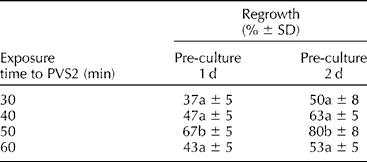
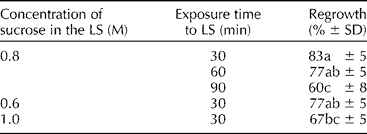
In the V-Cryo-plate method, shoot tips are attached on the plate and encapsulated with a thin layer of alginate gel (2.0–2.5 μl). The first step was to determine the exposure times to the PVS2 solution and the LS, and the sucrose concentration of the LS. The highest regrowth was obtained by a 50 min exposure to PVS2 when pre-cultured for 2 d (Table 1). Also, the highest regrowth was obtained by a 30 min exposure to the LS containing 0.8 M sucrose (Table 2).
Effect of different exposure times to plant vitrification solution 2 (PVS2) and pre-culture days on the regrowth of cryopreserved shoot tips using the aluminium cryo-platea

Different small letters indicate significant differences (P < 0.05).
a Shoot tips of strawberry (variety name: Benifuji) were treated as follows: in vitro shoots were hardened at 5°C for 25 d; pre-cultured for 2 d at 5°C on MS with 0.3 M sucrose+2 M glycerol; loaded in 2.0 M glycerol and 0.8 M sucrose solution for 30 min at 25°C; exposed to PVS2 for 30–60 min at 25°C. Ten shoot tips were tested for each of the three replicates.
Effect of different exposure times to loading solution (LS) (2 M glycerol and 0.8 M sucrose) and the concentration of sucrose in the LS on the regrowth of cryopreserved shoot tips using the aluminium cryo-platea

Different small letters indicate significant differences (P < 0.05).
a Shoot tips of strawberry (variety name: Benifuji) were treated as follows: in vitro shoots were hardened at 5°C for 25 d; pre-cultured for 2 d at 5°C on MS with 0.3 M sucrose+2 M glycerol; loaded in 2.0 M glycerol and 0.6–1.0 M sucrose solution for 30–90 min at 25°C; exposed to PVS2 for 50 min at 25°C. Ten shoot tips were tested for each of the three replicates.
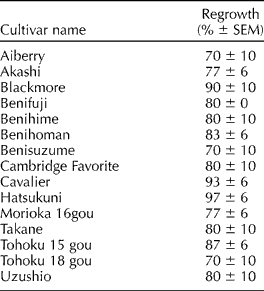
The second step was to test the regrowth levels of shoots of other strawberry cultivars by the procedure developed. Regrowth was very high for all cultivars, ranging from 70 to 97%, with an average of 81% for the 15 cultivars (Table 3). The shoot tips resumed growth within 10 d after plating and developed into normal shoots without any intermediary callus formation (Fig. 1(I)).
Regrowth of cryopreserved shoot tips of 15 strawberry cultivars using the aluminium cryo-platea

a Shoot tips of strawberry cultivars were treated as follows: in vitro shoots were hardened at 5°C for 21 d; pre-cultured for 2 d at 5°C on MS with 0.3 M sucrose+2 M glycerol; loaded in 2.0 M glycerol and 0.8M sucrose solution for 30 min at 25°C; exposed to PVS2 for 50 min at 25°C. Ten shoot tips were tested for each of the three replicates.
Discussion
The V-Cryo-plate procedure contains several steps such as preparation of materials to be cryopreserved, preconditioning, excision, pre-culture, mounting the shoot tips onto the cryo-plate, osmoprotection, dehydration by PVS, storage and regeneration. For adapting this method to a new plant material, Yamamoto et al. (Reference Yamamoto, Rafique, Fukui, Sekizawa and Niino2011b) proposed the investigation of the following main steps: preconditioning; pre-culture; osmoprotection by LS; dehydration by PVS2.
In each of the cryogenic protocols, the cells and tissues to be cryopreserved must be in a physiologically optimal status for the acquisition of dehydration tolerance and for producing vigorous recovery of growth. Preconditioning of shoot tips is necessary for obtaining uniform and vital shoot tips to start with. For this purpose, 2–3-week-grown strawberry shoots from plants with the same stage were used for the cryopreservation of shoot tips. Cold acclimatisation was also effective and necessary for the high regrowth level of strawberry (Reed and Hummer, Reference Reed, Hummer and Bajaj1995; Navatel and Capron, Reference Navatel and Capron1997; Hirai et al., Reference Hirai, Shirai, Shirai and Sakai1998; Niino et al., Reference Niino, Tanaka, Ichikawa, Takano, Ivette, Shirata and Uemura2003). Pre-culture on the MS medium with high sucrose concentrations was effective for the induction of osmotolerance towards PVS2 (Niino et al., Reference Niino, Tanaka, Tantely, Fukui and Shirata2007). Pre-culture of strawberry shoot tips on 0.3 M sucrose and 2 M glycerol (Niino et al., Reference Niino, Tanaka, Ichikawa, Takano, Ivette, Shirata and Uemura2003) or 5% dimethyl sulphoxide (Reed and Hummer, Reference Reed, Hummer and Bajaj1995) for 1–2 d at about 5°C was effective in producing a high level of regeneration. For a quick development of the protocol of the V-Cryo-plate method, preconditioning and pre-culture information from the literature is indispensable. In the case of strawberry, cold accumulation at 5°C for 3–4 weeks and pre-culture on 0.3 M sucrose and 2 M glycerol for 2 d at 5°C were adapted finally as the procedure of the V-Cryo-plate method.
An effective osmoprotective treatment appears to be essential for improving post-thaw growth. The LS is very effective in inducing tolerance to freeze dehydration or dehydration (Nishizawa et al., Reference Nishizawa, Sakai, Amano and Matsuzawa1992; Sakai et al., Reference Sakai, Hirai, Niino and Reed2008). Kim et al. (Reference Kim, Yoon, Pak, Lee, Baek, Cho and Engelmann2009) indicated that when developing a new LS for the droplet vitrification procedure, the loading treatment may act as an osmotic stress neutralizer and/or induce a physiological adaptation of tissues and cells prior to both dehydration and vitrification. Also, they pointed out that an appropriate LS should be selected for plant species that are highly sensitive to the cryotoxicity of the PVS solution. The sucrose concentration of the LS used was 0.6 M (in potatoes by the encapsulation vitrification method; Hirai and Sakai, Reference Hirai and Sakai1999), 0.8 M (in mint by the V-Cryo-plate method; Yamamoto et al., Reference Yamamoto, Rafique, Fukui, Sekizawa and Niino2011b), 1.4 M (in carnation by the V-Cryo-plate method; Sekizawa et al., Reference Sekizawa, Yamamoto, Rafique, Fukui and Niino2011), 1.4 M (in Dalmatian chrysanthemum by the V-Cryo-plate method; Yamamoto et al., Reference Yamamoto, Rafique, Priyantha, Fukui, Matsumoto and Niino2011a) and 1.6 M (in sweet potatoes by the encapsulation vitrification method; Hirai and Sakai, Reference Hirai and Sakai2003). In the case of strawberry, 30 min osmoprotection with the LS containing 2 M glycerol and 0.8 M sucrose achieved the highest regrowth. These results indicate that the optimal concentration of sucrose in the LS might be species specific.
The last checking factor for successful cryopreservation by vitrification is the carefully controlled procedures for dehydration and prevention of injury from chemical toxicity or excessive osmotic stresses during the treatment with PVS2. Using the V-Cryo-plate method, it is possible to control this step more easily than using the other methods because of the adhesion of shoot tips to the cryo-plate. Using this procedure, in the case of strawberry, the appropriate exposure time to PVS2 was 50 min, which was the same exposure time as in the vitrification method (Niino et al., Reference Niino, Tanaka, Ichikawa, Takano, Ivette, Shirata and Uemura2003). These results suggest that almost all treatment conditions developed in the vitrification method might be applicable to the V-Cryo-plate method.
The V-Cryo-plate method has a possibility to overcome some disadvantages such as insufficient dehydration, damage and loss of material, and manipulative problems of the vitrification procedure including the droplet vitrification procedure, since all treatments can be carried out only by moving and transferring the cryo-plate with attached shoot tips from one solution to another (Yamamoto et al., Reference Yamamoto, Rafique, Priyantha, Fukui, Matsumoto and Niino2011a). Also, this procedure can be performed by semi-skilled staff with a little expertise in mounting shoot tips (Yamamoto et al., Reference Yamamoto, Rafique, Fukui, Sekizawa and Niino2011b).
For long-term storage by V-Cryo-plate method, the cryotube containing the cryo-plate and LN was capped and stored in LN tanks (Fig. 2(A–C)). The 100 shoot tips (10 cryo-plates) were stored in LN for each cultivar (Figure 2(D, E)). The time of process from mounting the shoot tips on the cryo-plate to storage by the V-Cryo-plate method was about 2 h for each cultivar (12–15 cryo-plates). In the present study, 30 cultivars have been cryopreserved in the liquid phase of LN tanks by the V-Cryo-plate method (Fig. 2(F)).
Long-term storage procedure by the V-Cryo-plate method. (A) Treatment of cryo-plates by the LS/PVS2 solution (13 cryo-plates/cultivar), (B) immersion into LN, (C) after capping, a cryotube with LN and a cryo-plate settle on a cryo-cane, (D) ten cryotubes are held on a cryo-cane, (E) a cryo-cane is stored into a canister (16 cryo-canes/canisters), (F) a 450 l LN tank (108 canisters/tanks; Taiyo Nippon Sanso Co.).

This V-Cryo-plate method is thus a very practical cryopreservation method for strawberry germplasm and also appears to be promising for the cryopreservation of other plants with a slight change in procedure.
Acknowledgements
We are grateful to Ms A. Nishiuchi, Ms N. Nohara and Ms N. Ishikura for their excellent technical assistance.