INTRODUCTION
The conspicuous macrofauna of the ocean surface known as pleuston, commonly referred to as ‘blue plankton’, are an understudied component of the oceanic environment and mainly comprise a few species of molluscs (e.g. Janthina and Glaucus), hydrozoans (e.g. Velella, Physalia and Porpita) and barnacles (e.g. Dosima fascicularis) (reviewed in Cheng, Reference Cheng1975; Rayner, Reference Rayner1986).
Particularly, works aiming to study the blue goose barnacle Dosima fascicularis (Ellis & Solander, Reference Ellis and Solander1786) are scarce and mostly based on stranding events that occur under singular oceanographic and climatic conditions that cast pleustonic organisms ashore (Cheng & Lewin, Reference Cheng and Lewin1976; Minchin, Reference Minchin1996; Liss & Duce, Reference Liss and Duce1997).
The genus Dosima Gray, Reference Gray1825 includes two species of stalked barnacles of the family Lepadidae: Dosima fascicularis and Dosima guanamuthui (Daniel, Reference Daniel1971), the first with worldwide distribution (Weisbord, Reference Weisbord1979) and the second limited to the northern Indian Ocean. Accordingly with Zevina (Reference Zevina1982), Dosima fascicularis differs from D. guanamuthui by the presence of four rather than three filamentary appendages on the base of the first cirrus and the position of the carina umbo lower than the middle part of the capitulum.
Dosima fascicularis is characterized by the presence of thin and delicate plates, and a ball-shaped body surrounding the distal part of the peduncle (Darwin, Reference Darwin1852; Young, Reference Young1990; Hinojosa et al., Reference Hinojosa, Boltaña, Lancellotti, Macaya, Ugalde, Valdivia, Vásquez, Newman and Thiel2006). The ball is secreted from the cement glands and consists of numerous gas-filled chambers that serve as a flotation device to keep the organism at the sea–air interface (Darwin, Reference Darwin1852; Boetius, Reference Boetius1952–1953; Zheden et al., Reference Zheden, Von Byern, Kerbl, Leisch, Staedler, Grunwald, Power and Klepal2012). Additionally, D. fascicularis exhibits a blue coloration typically observed in other euneustonic species (i.e. permanent inhabitants of the sea surface layer) as pontellid copepods, Glaucus and Janthina molluscs, etc. (Herring, Reference Herring1965; Zaitsev, Reference Zaitsev1971). Newmann & Abbott (Reference Newman, Abbott, Morris, Abbott and Haderlie1980) state that ‘The stomachs of L. (Dosima) species are commonly packed with copepods, whose pigment is the source of the carotenoprotein providing the barnacle's blue color’ which is exhibited irrespective of whether it was attached to a Velella or to inanimate flotsam (Fox & Crozier, Reference Fox and Crozier1967; Fox et al., Reference Fox, Smith and Wolfson1967).
Before the development of the vesicular ball the cypris larva needs to settle over a substratum. The biochemistry of the cement is primarily described in three works (Barnes & Blackstock, Reference Barnes and Blackstock1974, Reference Barnes and Blackstock1976; Power et al., Reference Power, Klepal, Zheden, Jonker, McEvilly, von Byern, von Byern and Grunwald2010). These authors determined that the cement is composed mainly of acid proteins and differs from other cirripeds (balanids) having a distinctly higher proportion of glutamic acid and smaller quantities of lysine, histidine and tyrosine which could be providing a spongy mass which will act as a float rather than a strong adhesive structure. This cement usually forms an oval, whitish-beige foam-like float that may enclose the initial substratum (Zheden et al., Reference Zheden, Von Byern, Kerbl, Leisch, Staedler, Grunwald, Power and Klepal2012). Cheng & Lewin (Reference Cheng and Lewin1976) observed that the majority of the Dosima recorded on the coast of California were attached to a noticeable substrate as feathers or brown algae or unattached (at least noticeably) with a minor proportion attached to tar lumps. These records are in agreement with the observations of Boetius (Reference Boetius1952–1953) for the North Sea who also found that all the ‘free-floating’ organisms had the initial substrata remaining (e.g. coke-pieces and pieces of algae) enclosed in their vesicular balls. Additionally, Dosima has been reported as a common rafter organism attached to anthropogenic debris, usually to microplastics or tar pellets which are abundant in the oceans and can be favouring an increase in its abundance and dispersal (Minchin, Reference Minchin1996; Thiel & Gutow, Reference Thiel and Gutow2005; Vandendriessche et al., Reference Vandendriessche, Vincx and Degraer2006). Thus, as pointed out by Newman & Ross (Reference Newman and Ross1971) and Whitehead et al. (Reference Whitehead, Biccard and Griffiths2011), it seems that Dosima has a preference for small/light substrata (e.g. microplastics and feathers) or substrata that eventually will break apart (e.g. algae and fruits) which may be a strategy to avoid competition using surfaces unavailable for other stalked barnacles. Boetius (Reference Boetius1952–1953) found that the development of the vesicular ball is independent of the type and size of the former substrate and appears to grow regularly as the capitulum increases in size, possibly soon after the larvae settlement. This behaviour allows the attachment to very tiny substrates and ensures the organisms' buoyancy in case of being released from the substrate.
Dosima fascicularis is abundant in oceanic temperate waters; Coates (Reference Coates1829) suggested the temperate waters of the South Atlantic as the common habitat for this species based on observations of very large aggregations of Dosima near Tristan da Cunha (37°4′S–12°19′W). Farran (Reference Farran1905) considered that this species is ‘widely spread over the great oceans of the world on both sides of the equator’, indeed it has also been recorded for warm waters of Mexico attached to the tropical sea snake Pelamis platurus (Young, Reference Young1990; Álvarez & Celis, Reference Álvarez and Celis2004). Weisbord (Reference Weisbord1979) furnished an updated list of occurrence of D. fascicularis around the world, being clear that this species are mostly common in temperate waters, but it could also be occasionally observed in higher latitudes and in the tropics.
In the South Atlantic D. fascicularis has been sparsely recorded on the south-east coast (Congo, 6°S–10°E; Angola, 6°S–11°E, 17°S–12°E and South Africa, 35°S–27°E) (Weisbord, Reference Weisbord1979), central southern Atlantic (Tristan da Cunha, 37°S–12°W″) (Coates, Reference Coates1829) and on the south-west coast (Brazilian waters between Cabo Frio, 23°S and Rio Grande do Sul, 33°S) (Weisbord, Reference Weisbord1979; Young Reference Young1990, Reference Young and Young1998). A questionable record has been reported from the Drake Passage (57°S) (Newman & Ross, Reference Newman and Ross1971)Footnote 1 .
In this paper we report for the first time the occurrence of D. fascicularis on the Uruguayan coast (34°–34°40′S), from living individuals washed up on different localities and dates, constituting the southernmost reliable Atlantic records for the species. We discuss these within an oceanographic context that includes both local and general South Atlantic features, presenting some biogeographical considerations that refer to the entire Atlantic distribution of this species.
MATERIALS AND METHODS
Study area
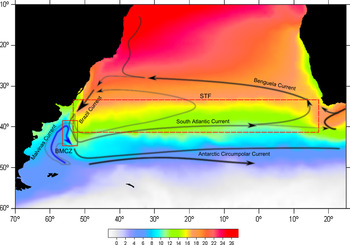
The most relevant oceanographic feature of the south-western Atlantic is the Brazil–Malvinas Confluence Zone: where the warm poleward-flowing Brazil Current and the cold equatorward-flowing Malvinas/Falklands Current converge (Figure 1; Gordon, Reference Gordon1981, Reference Gordon1989). The location of this zone shifts seasonally reaching higher latitudes during austral summer (Maamaatuaiahutapu et al., Reference Maamaatuaiahutapu, Garçon, Provost, Boulahdid and Bianchi1994; Barré et al., Reference Barré, Provost and Saraceno2006). The seasonal cycle of local wind regime, the continental freshwater discharge (Miranda et al., Reference Miranda, Luedemann and Miyao1973; Lima et al., Reference Lima, Garcia and Möller1996; Guerrero & Piola, Reference Guerrero, Piola and Boschi1997; Garcia, Reference Garcia, Seeliger, Odebrecht and Castello1998) and migration of the Brazil–Malvinas/Falklands Confluence Zone (Hubold, Reference Hubold1980; Ciotti et al., Reference Ciotti, Odebrecht, Fillmann and Möller1995; Zavialov et al., Reference Zavialov, Wainer and Absy1999) modify the thermohaline characteristics of the water masses over the shelf, with a predominance of Subantarctic Water in winter–spring and Tropical and Subtropical Waters in summer–autumn (Lima et al., Reference Lima, Garcia and Möller1996; Garcia, Reference Garcia, Seeliger, Odebrecht and Castello1998; Ortega & Martínez, Reference Ortega and Martínez2007). In fact, offshore Uruguayan waters present warm oceanic waters all year round in the north related to the presence of the Brazil Current that reaches the coast during the warm period.
Schematic representation of the most relevant surface currents of the South Atlantic modified from Stramma & England (Reference Stramma and England1999). The Brazil–Malvinas/Falklands Confluence Zone (BMCZ) and the Southern Subtropical Front (STF) are shown over an Aqua MODIS Sea Surface Temperature (°C) summer climatology (2002–2013, http://oceancolor.gsfc.nasa.gov/cgi/l3).

Samples and observations of stranded pleuston
We examined the collection of Invertebrate Zoology of the Museo Nacional de Historia Natural (MNHNM, Montevideo), which includes large holdings of coastal invertebrates (including stranded pleuston) collected between late 1950 and late 1970. Summer observations of the stranded material at La Paloma (see Table 1 for detailed location) were made each year between 1965 and 2004 by M. Demicheli and between 1992 and 2013 by G. Fabiano. Samples of D. fascicularis obtained during that period and those collected sporadically by colleagues and us were also deposited at MNHNM.
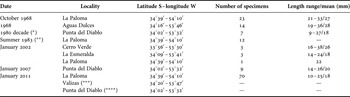
Records of Dosima fascicularis stranded along the Uruguayan coast: (*) specimens attached to a feather; (**) specimens attached to a feather, not preserved but photographed; (***) specimens collected but not measured; (****) specimens attached to a feather, observed but not preserved.

The capitulum length of all the specimens was measured from the base of the scutum to the apex of the tergum. Each soft-preserved specimen was checked for the presence and number of filamentary appendages. Also, the presence and nature of substratum was recorded without its dissection due to the uniqueness of the material.
Oceanographic data
Temperature and salinity data from the moment of stranding events were obtained from in situ continuous measurements made by G. Fabiano at La Paloma's station of Dirección Nacional de Recursos Acuáticos (DINARA).
Sea surface temperature anomalies images were obtained from the standardized Sea Surface Temperature Anomaly version 2 dataset based on IRI/LDEO Climate Data Library (Reynolds et al., Reference Reynolds, Rayner, Smith, Stokes and Wang2002). Monthly wind speed anomalies (WSA) and meridional (v) and zonal (u) wind components for the region (at 1000 mb pressure level) were downloaded from the IRI/LDEO Climate Data Library (Kalnay et al., Reference Kalnay, Kanamitsu, Kistler, Collins, Deaven, Gandin, Iredell, Saha, White, Woollen, Zhu, Chelliah, Ebisuzaki, Higgins, Janowiak, Mo, Ropelewski, Wang, Leetmaa, Reynolds and Dennis1996).
RESULTS AND DISCUSSION
Uruguayan records: characterization, dates, substratum and association with blue plankton
The records of D. fascicularis from Uruguayan waters consisted in all cases of stranded specimens collected in 1968, 1983, 2002, 2007 and 2011 at different coastal localities of the Department of Rocha (Table 1). The average capitulum length was 21.2 mm (range 9.2–38.5 mm). All 142 specimens showed well-developed vesicular balls, some of them with a noticeable substratum.
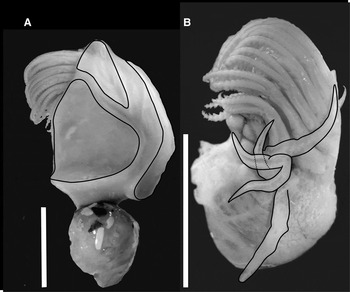
The shell plates (scuta, terga and carina) are very thin and delicate with a wide space between them connected by a thin membrane. The carina has a concave section on the upper part and is rounded flat at its base allowing a lateral widening of the body; the surface is smooth without a central ridge; width of the upper part is approximately 1/2 of the rounded flat basis. Five filamentary appendages were observed, four originated at the base of the cirrus I and one just bellow, at the prosoma (Figure 2).
Dosima fascicularis collected at Punta del Diablo in January 2007: (A) whole body with the floating ball slightly turned to show the flat carina basis; (B) lateral view of prosoma with its cirri and filamentary appendages. Contour lines are added to emphasize the filamentary appendages and shell plates shape. Scale bars = 1 cm.

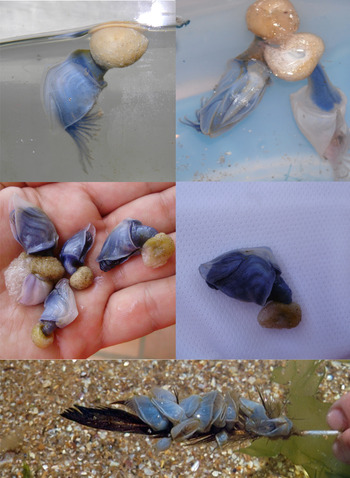
Most of the occurrences and specimens of D. fascicularis consisted of isolated specimens stranded together (Figure 3) including several individuals with their floats surrounding one skeleton of the jellyfish Velella velella. This is in agreement with Knudsen (Reference Knudsen1963) who observed and reported several specimens of Dosima attached to the chitinous float of V. velella off the coast of California. Furthermore, one specimen each was found attached to a coleopteran and to a living Janthina sp. (Gastropoda).
Specimens of Dosima fascicularis collected in the summer of 2011 in La Paloma (top) and Valizas (medium) and specimens attached to a feather photographed in 1983 in La Paloma (Rocha, Uruguay) (bottom) (photographs by M. Abreu, G. Fabiano, F. Scarabino and R. González de Baccino).

We also recorded specimens within a wide range of sizes attached to feathers (Table 1; Figure 3). The settlement of the larvae of Dosima over feathers has been previously reported by Cheng & Lewin (Reference Cheng and Lewin1976) and Boetius (Reference Boetius1952–1953) who also refers to previous observations on the occurrence of the cypris larvae attached to live seabird species such as Puffinus griseus in the South Atlantic. Whitehead et al. (Reference Whitehead, Biccard and Griffiths2011) also reported a significant preference of Dosima for feathers on the south-west coast of South Africa.
As reported by other authors for the North Atlantic (e.g. Minchin, Reference Minchin1996) and eastern South Atlantic (Ryan & Branch, Reference Ryan and Branch2012), the occurrence of D. fascicularis on Uruguayan beaches is part of stranding events that involve other species of the blue plankton community such as Janthina spp., Glaucus sp., Velella velella, Porpita porpita and small light-blue specimens of the brachyuran crab Planes sp. (Ortega & Martínez, Reference Ortega and Martínez2007; personal observation). This was the case for the records of 2002, 2007 and 2011. The 2011 event was the strongest event of blue plankton stranding on the Uruguayan coast for at least the last 20 years (G. Fabiano, personal observation), which followed an unusual irruption of these species in the Western Cape of South Africa in November of 2011 as reported by Ryan & Branch (Reference Ryan and Branch2012).
Oceanographic context of the Uruguayan records
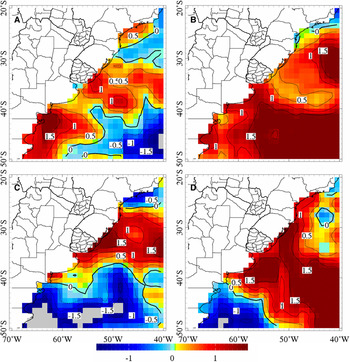
Most of the records of D. fascicularis for Uruguayan waters correspond to the austral summer. Summer and autumn are characterized by the prevalence of warm oceanic waters in the Uruguayan shelf, related to an enhanced southward advection of warm waters of the Brazil Current (Ortega & Martínez, Reference Ortega and Martínez2007). Particularly, all the summer records were during strong influence of positive sea surface temperature anomalies (Figure 4) that are associated with the prevalence of winds from south-eastern quadrant that advect warm waters that occur offshore. Also, during 2002, 2007 and 2011 stranding events, comparatively high salinity values (~30 ppt) were recorded at La Paloma which supports the presence of warm tropical waters on the Uruguayan coast (G. Fabiano, personal observation).
Sea surface temperature anomalies corresponding to Dosima fascicularis records in Uruguayan waters: (A) summer of 1983; (B) January 2002; (C) January 2007; (D) January 2011.

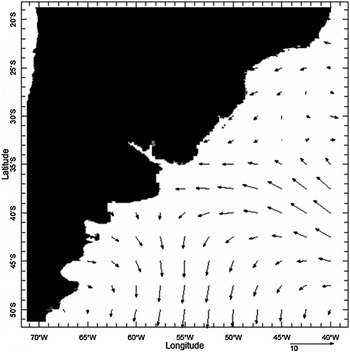
The only records that do not match with this pattern are from October of 1968 (austral spring) dominated by cold Subantarctic Waters (Martínez & Ortega, Reference Martínez and Ortega2007; Ortega & Martínez, Reference Ortega and Martínez2007). The prevalence of easterly and south-easterly winds during this month could facilitate the advection of offshore warm oceanic waters with D. fascicularis (Figure 5). In a region dominated by northern winds, south-easterly, easterly–south-easterly and easterly winds constitute an anomaly that enhances the advection of warm oceanic waters towards the coast carrying these conspicuous organisms. Thus, the occurrence of D. fascicularis in Uruguayan waters must be taken as sporadic and related to specific atmospheric and oceanographic factors that cast blue plankton ashore.
Map of wind velocity (m/s) and direction corresponding to the Dosima fascicularis record in October of 1968 in Uruguayan waters.

Biogeographical and taxonomic considerations
The above mentioned observations indicate that the geographical distribution of D. fascicularis is probably restricted to particular oceanographic conditions (i.e. species-specific sea surface temperature) as observed by Hinojosa et al. (Reference Hinojosa, Boltaña, Lancellotti, Macaya, Ugalde, Valdivia, Vásquez, Newman and Thiel2006) for the other three species of goose barnacles on the Chilean coast. The occurrence of D. fascicularis as well as the influence of the convergence of the Antarctic Circumpolar Current with the South Atlantic Gyre (i.e. Subtropical front, with temperatures ranging from 13 to 18 °C), could be suggesting that the Subtropical front zone is the main area of occurrence of D. fascicularis in the South Atlantic, which includes Tristan da Cunha as testified by Coates (Reference Coates1829), as a source of this species to the South America and Africa coasts (Figure 1). The relationship between this scenario and the occurrence of D. fascicularis in the North Atlantic remains unknown. In fact, Coates' (Reference Coates1829) hypothesis of the occurrence of a North Atlantic ‘source’ of this species in the Subtropical Convergence and the sporadic arrival of individuals to the coasts of North America and Europe must be re-evaluated. In the Weisbord (Reference Weisbord1979) list, there are more records from the North Atlantic when compared to South Atlantic; this difference could be related to sampling bias, but the hypothesis of bipolar populations on temperate belts in the South and North Atlantic cannot be dismissed. This pattern is known in the biogeographical literature (Ekman, Reference Ekman1953) and the connectivity of both populations must be investigated.
Also, as we are dealing with a worldwide-distributed taxon, a proper taxonomic revision might reveal hidden diversity, and as a matter of fact, Darwin (Reference Darwin1852) listed two varieties of D. fascicularis: var. villosa Darwin, Reference Darwin1852 (described from material apparently collected in the Atlantic Ocean) and var. donovani (described as Pentalasmis donovani Leach, Reference Leach and Tukey1818, from specimens collected between São Tomé and Principe and Gabon (0o38′S 7O50′E)). The variety villosa presents a very narrow carina and the cirri are covered by very minute spines giving a villous appearance. The var. donovani was characterized by Darwin (Reference Darwin1852) as having a flat upper carina and a narrow central ridge on its exterior. None of these features were observed in the examined specimens thus precluding its assignment to one of them. Furthermore, the records from both varieties are geographically imprecise (see Darwin, Reference Darwin1852). All these facts highlight the necessity of further analysis on a comparative basis to clarify the taxonomic status of D. fascicularis in a broad sense.
Final considerations
The occurrence of ‘blue plankton’ and particularly of this conspicuous crustacean could be included in a monitoring strategy for unusual oceanographic conditions on the Uruguayan coast. The continuous monitoring and recording of blue plankton stranding events on the coast as well as the application of techniques directed to sample the surface community in the open ocean will provide new insights in the distribution of blue plankton and its relationship with oceanographic conditions in Uruguayan waters.
ACKNOWLEDGEMENTS
The authors acknowledge DINARA and MNHNM for their support as well as Lucía Rodríguez for her cooperation with conserving a sample secured many years ago. We are also grateful to Biodiversity Heritage Library for making available important literature as well as to two anonymous referees for their valuable comments and corrections offered.