Introduction
The implementation of policies related to gender equality and anti-discrimination in the European Union is a multi-level game. Member states have to transpose these EU directives, prepared by the EU Commission and agreed upon collectively, into national legislation and are responsible for their actual implementation in the domestic context. The EU Commission supervises the implementation process and to make sure member states comply with EU requirements it relies heavily on a decentralised monitoring system by fire-alarm (Tallberg Reference Tallberg2002; Jensen Reference Jensen2007). Local actors can monitor implementation informally by assessing whether targets are actually met and provide information on incorrect applications whenever there is a problem. Though the importance of monitoring by local actors to help enforce compliance is acknowledged in the compliance literature (Börzel Reference Börzel2000; Tallberg Reference Tallberg2002; Jensen Reference Jensen2007), little is known about how these actors organise their monitoring activities and what determines effective information exchange.
Following Keck and Sikkink’s (Reference Keck and Sikkink1998) seminal work, ample research on advocacy networks has shown how civil society organisations, research institutions and political actors can use information politics to increase transparency in the implementation process and hold governments accountable. This study aims to establish what factors determine the structure of these networks and what drives information exchange in a monitoring network. A social network approach is adopted to combine theories on the operation of social networks (Granovetter Reference Granovetter1973; Burt Reference Burt2000) with insights from the literature on monitoring activities by interest groups (Klüver Reference Klüver2012), research on drivers of stakeholder interaction in policy networks (Kenis and Schneider Reference Kenis and Schneider1991; Stokman and Berveling Reference Stokman and Berveling1998; Weible Reference Weible2005; Ingold Reference Ingold2011; Leifeld and Schneider Reference Leifeld and Schneider2012) and the effect of network structure in collaboration networks more specifically (Carpenter et al. Reference Carpenter, Esterling and Lazer2004; Berardo and Scholz Reference Berardo and Scholz2010; Ulibarri and Scott Reference Ulibarri and Scott2016).
Most policy network studies focus on actors aiming to push a certain policy forward and have found that interactions are dense, interconnected and based on shared preferences and organisational similarity. In contrast, networks used for monitoring the implementation process serve a completely different functional purpose. Instead of building trusted partnerships, actors in a monitoring network aim to gather information and gain access to valuable sources. Therefore, I expect that networks used for monitoring the implementation process will benefit from a more broad-based interaction. In fact, rapid information exchange in a multi-level monitoring network is likely to be driven by efficiency, brokerage and diversity.
The focus of analysis is the monitoring network of the national platform of women’s groups in the Netherlands. The Dutch women’s council is the national coordination of the European Women’s Lobby (EWL) and is considered the most relevant network for monitoring the implementation of the EU directives on gender equality and anti-discrimination on the basis of sex in the Netherlands. Not only is the environment in the Netherlands favourable to monitor implementation due to active monitoring by the Equality Body, Anti-Discrimination Bureaus and the social partners, it also represents a case of good practical implementation of the relevant legal requirements by the EU. To test what factors drive the monitoring network and increase the likelihood of information exchange, an Exponential Random Graph Model is fitted.
The findings demonstrate that monitoring networks indeed have a distinct functionality and are structured differently as a result. First, actors gain access to information on policy implementation efficiently through a cohesive network structure, allowing information to spread throughout the network rapidly by limiting the number of intermediaries with overlapping sources of information. At the same time, the multi-level structure of the monitoring network accounts for densely connected clusters of actors. This underlines the value of brokerage between different parts of the network, which is another significant mechanism through which actors exchange information for the purpose of monitoring. Finally, the results indicate that actors do not discriminate against different kind of actors, as they exchange information with others no matter their preference regarding policy instruments or organisational background. Even though monitoring is not driven by diversity, it does require efficient and broad-based information exchange to increase transparency in the implementation process.
Set against the background of policy network analysis, the article will first elaborate on the theoretical argument on the drivers of information exchange in a monitoring network. Following a description of the data collection and the method of analysis, the results are presented and discussed.
Policy network analysis
Policy networks can be defined as the linkages between governments and other actors around shared interests in the policy-making and implementation process (Rhodes Reference Rhodes2006). Most studies conceptualise policy networks as a form of interest intermediation for policy-making, which may include informal and implicit interactions. Rather than formalised processes, policy networks can describe informal patterns of brokerage between public agencies and stakeholder groups (Ansell and Gash Reference Ansell and Gash2008). Actors are linked to each other to exchange all kinds of resources, forming network structures specific for dealing with the policy problems at hand (Scharpf Reference Scharpf1997).
The majority of the literature on collaborative processes between policy-makers and stakeholders is focussed on the policy-making stage of the policy process. However, Newig and Koontz (Reference Newig and Koontz2014) provide an overview of studies and insights on implementation in collaborative settings. Studies on policy implementation have put emphasis on the relation between policy on article and policy as implemented in practice (Saetren Reference Sandström and Carlsson2005 and in EU context Zhelyazkova et al. Reference Zhelyazkova, Kaya and Schrama2016). This link depends on the transparency in the policy process and the extent that policy-makers are able to enforce implementation. Especially when policy implementation is a multilevel and interorganisational task, such as the case in the EU policy process, successful implementation requires networked communication and exchange of resources (O’Toole Reference O’Toole2011). In the context of the EU, interactions among policy-makers, implementers and stakeholders are directed to foster implementation of EU policies at the member state level (Newig and Koontz Reference Newig and Koontz2014).
Even though the EU policy process does not concern the collaborative implementation of voluntary agreements, as implementation can be enforced by law, network interactions are still relevant for detecting implementation problems. However, networks used to increase transparency in the implementation process by gathering information on how EU policies are implemented serve a functionally different purpose than other policy networks. It has yet to be theorised what characterises an effective monitoring network.
Network structure: bridging versus bonding
Since transparency in the implementation process is an effect of the network as a whole, instead of a single actor’s attribute, the key factor determining the effectiveness of the network is its structure (Provan and Milward Reference Provan and Milward1995). Interorganisational approaches to policy networks study the patterns of relationships and highlight network structure as a facilitator of exchange (Thatcher Reference Thatcher1998). Network theories to policy networks are based on actor-centred institutionalism (Kenis and Schneider Reference Kenis and Schneider1991). By applying social network analysis on network formation both the effects of the actors’ attributes and the structure of interaction in which actors are embedded can be examined independently. In their study on information exchange on policy issues in politics, Carpenter et al. (Reference Carpenter, Esterling and Lazer2004) find that even accounting for all kinds of actors’ attributes, interactions are ultimately determined by the network structure. However, the structural characteristics that matter most are likely to depend on the type of interaction and purpose of the network.
As demonstrated in Ulibarri and Scott’s comparative study (Reference Ulibarri and Scott2016) on different collaborative governance processes, there are distinct network configurations at hand depending on the network’s purpose. Networks that exhibit dense, interconnected collaborative interactions facilitate quick decisionmaking by a trusted inner-circle. According to Coleman’s social closure argument (1990), these bonding network structures are crucial for actors working together towards a common goal. Coordinative action is considered most effective when densely clustered actors are in close contact so that they can build trust. In contrast, Ulibarri and Scott (Reference Ulibarri and Scott2016) found that networks designed to provide access to diverse knowledge to improve policy, benefit from more widely dispersed connections and greater overall cohesion. These bridging network structures enable actors to gain resources and information that is different from what is already circulating among their close relations. Seminal work by Granovetter (Reference Granovetter1973) and Burt (Reference Burt2000) on bridging ties demonstrates that the added value in some networks originates from actors who act as brokers and are able to bridge different parts of the network.
Similarly, Berardo and Scholz (Reference Berardo and Scholz2010) emphasise how context matters for the preferred structure of interaction and demonstrate that bonding structures are preferred when there is a need for committed partners to share reliable information, whereas bridging structures are more suited for efficient methods of broad-based information exchange. Moreover, Scholz et al. (Reference Scholz, Berardo and Kile2008) find that bridging relations are most valuable for actors in search of information in a fragmented and complex context. Altogether, networks used to gather new information and monitor multilevel policy implementation are likely to have a distinct bridging structure compared to networks with the aim of collaboration.
Drivers of information exchange in monitoring networks
In a monitoring network actors need to collect broad-based information to be able to detect and assess implementation problems. Monitoring entails the activities related to assessment of whether targets are actually met (Brambilla Reference Brambilla2001). Monitoring increases transparency during the implementation process and creates chances for collaboration with partner organisations and ultimately leads to greater accountability. Effective networks should include interactions among state actors, civil society actors and independent experts, as they can complement each other.
First, ministries or other governmental actors have the capacity to collect background information, regularly review and reflect on activities and establish lists of priorities that feed into action planning processes. Whereas international organisations (such as international or European non governmental organizations (NGOs) like the EWL, the International Council of Women or entities of the Council of Europe) can advocate for a comprehensive political will for policy implementation. In addition, they can provide input for the data collection process, report on implementation efforts and distribute information. Furthermore, they can help build capacity and assist in establishing contacts among governmental institutions and local civil society organizations (CSOs). Instead, local CSOs are able to provide input for the data collection process such as specific knowledge and feedback on the concrete impact of outlined activities and share information with other organisations. Finally, independent experts or research institutions can build capacity by data collection and external evaluations (Beetham and Popovic Reference Beetham and Popovic2009).
The exchange of specialised information related to policy issues is the primary reason for interaction among the variety of organised governmental and nongovernmental actors (Knoke Reference Knoke1996; Schneider et al. Reference Schneider, Scholz, Lubell, Mindruta and Edwardsen2003; Leifeld and Schneider Reference Leifeld and Schneider2012). One actor cannot possibly be knowledgeable about all policy facets and is therefore in need of information from other actors dealing with the same policy issues, possibly with a different expertise and an alternative point of view. This is particularly important when actors have to handle policy issues that are complex and in areas with high uncertainty (Heclo Reference Heclo1978). Especially the application phase of a multilevel policy process is complex and uncertain. It is difficult for the EU Commission to oversee how EU directives are actually implemented in each specific domestic context, making them heavily dependent on local actors to provide this information (Börzel Reference Börzel2000; Pleines Reference Pleines2010).
In sum, actors monitoring policy implementation are in need of a network that allows them to keep track of all developments in the policy process and detect implementation problems immediately. To gain access to this type of information, actors must exchange information rapidly and among a diverse set of actors. In this context, the types of interactions that add the most value are the ones that increase connectivity of the network resourcefully, broker between different parts of the network and do not discriminate against different kind of actors. Information exchange in a monitoring network is therefore expected to be driven by efficiency, brokerage and diversity.
Efficiency
First, actors gain greater access to external information and resources by increasing the connectivity of the network and use their exchange relations efficiently. Berardo and Scholz (Reference Berardo and Scholz2010) theorise that actors in need of swift access to novel information will try to minimise the number of links to get to that information. Hence, efficient information transmission requires actors to exchange information with those that provide new connections. This way they can reach and gain insights from a higher number of actors in the network and learn about information that is different from their own pool of knowledge.
Monitoring entails detecting implementation problems whenever they occur, so connections that bring in information that is unknown, even to someone’s close relations, are the most advantageous. Considering the costs of maintaining contacts, actors that seek access to information will avoid overlapping connections (Carpenter et al. Reference Carpenter, Esterling and Lazer2004). To save the costs of the additional link that will not lead to new information anyway, actors tend to exchange of information with actors without overlapping sources of information. Gathering information from a source that already shares information with your direct contact will not lead to new information and can be considered redundant.
This strategy is in sharp contrast to networks with the aim of collaboration, where overlapping links are needed to carry credibility, build trust and ensure commitment. However, more widely dispersed connections foster more broad-based interaction and access to diverse information on policy implementation (Ulibarri and Scott Reference Ulibarri and Scott2016). In essence, for the purpose of monitoring, dense interactions are inefficient in terms of gathering and sharing information, because information is likely to be the same. Accordingly, monitoring requires less overlap, instead it is more advantageous to establish contacts providing information that is different from what is already known.
H1: Information exchange for monitoring purposes is more likely among actors without overlapping sources of information.
Brokerage
Another mechanism driving interactions to gain new information is brokerage. Based on the fundamental work of Granovetter (Reference Granovetter1973) on bridging ties, Burt (Reference Burt2000) theorises and shows how actors with high betweennessFootnote 1 are able to span so-called structural holes in the network by brokering between otherwise unconnected actors. Brokers essentially create indirect relations where there are no direct ones (Gould and Fernandez Reference Gould and Fernandez1989) and thereby increase the flow of information and connectivity of the network.
As demonstrated by Laumann and Knoke (Reference Laumann and Knoke1987), brokers allow information to flow throughout a large and diverse network, resulting in more coordination of collective action among organisations. Focussing on information exchange in politics, Carpenter et al. (Reference Carpenter, Esterling and Lazer2004) argue that brokers can facilitate communication among other actors by providing a common frame of reference. Similarly, Ingold (Reference Ingold2011) found that policy brokers bring together actors with divergent policy stances to avoid political stalemates.
In the context of a monitoring network, brokers can connect actors with a distinct focus on the implementation process and different pools of information. The ability to establish contacts with actors from various parts of the network is particularly important for monitoring, as it provides an opportunity to access information that is different from what is already circulating. Much more than networks with a focus on stable relations and trusted partners for collaboration, a monitoring network requires information to flow freely, so that problems can be detected in every phase and in each aspect of the policy process. As a result, in order to fully monitor policy implementation, actors in the valuable position to bridge parts of the network that are otherwise unconnected are the most prominent actors to exchange information with.
H2: Actors able to bridge otherwise unconnected parts of the network are more likely to be involved with information exchange for monitoring purposes.
Diversity
Finally, diversity is key when it comes to information exchange in monitoring networks. In contrast to findings by the majority of studies on collaboration networks (see Leifeld and Schneider Reference Leifeld and Schneider2012), similarity in preferences, mutual objectives and compatible organisational backgrounds are unlikely to drive information exchange for the purpose of monitoring. Monitoring benefits from actors gathering as much valuable information as possible from a variety sources.
Different kinds of actors will process and value information according to their distinct perspectives, leading to more broad-based monitoring (Beetham and Popovic Reference Beetham and Popovic2009). Information exchange for the purpose of monitoring entails sharing detailed information and specific knowledge about the concrete impact and implementation of policies. This type of information is often shared by research actors and CSOs and put to use through access relations with state actors (Stokman and Zeggelink Reference Stokman and Zeggelink1996). Monitoring by fire alarm (McCubbins and Schwartz Reference McCubbins and Schwartz1984) assumes interaction between societal actors and governmental actors to get full information on implementation practices to those in the position to do something about it. Information is likely to be dispersed among actors with divergent preferences on implementation strategies. In addition, CSOs rely on the information resources produced by research actors. When actors are believed to be functionally interdependent or dependent on resources of other actors, as is the case in a monitoring network, actors will link up no matter their preferences (Weible Reference Weible2005).
Consequently, monitoring the implementation of external rules requires a network that includes different perspectives in order to gain full information on the process of implementation. Therefore, whether or not actors agree on the necessary implementation measures does not matter for the exchange of information in a monitoring network.
H3a: Information exchange for monitoring purposes is not more likely among actors with shared preferences for the necessary implementation measures.
Furthermore, various types of organisations have distinct expertise and resources and are expected to process and interpret information differently as well. In line with Burt’s structural hole argument (Reference Burri and Van Eijken2000), new information is most likely to seep in when networks are prone to diversity. Actors from dissimilar backgrounds, representing different organisational units, can be assumed to span many structural holes (Sandström and Carlsson Reference Saetren2008). Information that comes from different parts of the network is assumed to be more valuable, as it differs from what is already circulating among closer-related actors. Since different kinds of organisations are likely to produce different kinds of information, the exchange of information among actors with distinct organisational backgrounds may actually be advantageous in a monitoring network.
H3b: Information exchange for monitoring purposes is more likely among actors with a different organisational background.
Research design
Gender equality and women’s rights in the Netherlands
To test what drives information exchange in a monitoring network, this study focuses on the network of societal, research, political and governmental actors concerning the implementation of the EU gender directivesFootnote 2 in the Netherlands. Within the area of Employment and Social Policy, EU requirements on gender equality and antidiscrimination are relatively well developed. Since the 1990s, the EU Commission has promoted coordination among women’s groups across member states and advocated women’s rights on a European level. In response to the expansion of EU policies affecting women’s daily lives the EWL was founded by national representations of women’s groups in all EU Member States.Footnote 3 Today the EWL is considered the most influential transnational women’s network in the EU (Lang Reference Lang2009). The activities of the EWL are aimed at providing EU institutions with information on Member States’ legislation and at communicating local needs in the preparation of policies and legislation.
The Dutch women’s council, coordinating the Dutch women’s groups and representing them in the EWL, is considered the most relevant network for monitoring the implementation of the EU requirements on gender equality and women’s rights in the Netherlands. There are a number of reasons why this study focuses on the monitoring network of women’s groups in the Netherlands.
First, the EU Commission has positively assessed the practical implementation of the relevant legal requirements in the Netherlands in commissioned evaluation reports. These reports were prepared by external experts contracted by the EU Commission to evaluate the national implementation of EU directives in each member state, both in law and practice (Zhelyazkova et al. Reference Zhelyazkova, Kaya and Schrama2016). According to these evaluations the Dutch Equality Body (Institute of Human Rights) is adequately resourced and has means to enforce implementation such as the authority to request information and documents in case of discrimination and it can additionally bring cases to attention of relevant ministers, take legal action to obtain a judgement or forward opinions to relevant organisations (Ammer et al. Reference Ammer, Crowley, Liegl, Holzleithner, Wladasch and Yesilkagit2010). The length and costs of court proceedings are also closely monitored by the Dutch judiciary and Supreme Court and do not pose major issues (Burri and Van Eijken Reference Burri and Van Eijken2015). As the protection against indirect discrimination is often problematic in practice because it is difficult to prove (Farkas and O’Farell 2015), the Netherlands allows (but does not require) statistical evidence that would indicate indirect discrimination to implement this legal provision. In addition, collective arrangements provide for more beneficial implementation of rules regarding the right to childcare facilities and parental leave than transposed in legislation.
Second, the Netherlands is one of the few member states where monitoring activity is explicitly included as a task of the national equality body by law. Monitoring activities are aimed at assessing trends and developments in discrimination and equal treatment and evaluating the effectiveness of relevant legislation (Ammer et al. Reference Ammer, Crowley, Liegl, Holzleithner, Wladasch and Yesilkagit2010). All municipalities in the Netherlands are required to establish and fund Anti-Discrimination Bureaus that monitor situations of discrimination and assist victims. Social partners are reportedly playing a part in the realisation of gender equality by stimulating the exchange of ideas regarding issues as equal pay and positive action. Moreover, to raise awareness and increase transparency on wage inequality employers in the Netherlands are required to establish a sound job evaluation system and a state subsidised initiative of a collaboration of NGOs and social partners enables online comparisons of wages and substantive information provision about equal pay (Timmer and Senden Reference Timmer and Senden2016).
In short, not only is the environment for monitoring implementation favourable in the Netherlands, it also represents a case where good compliance in terms of the practical implementation at member state level is achieved and maintained. It also demonstrates a high activity in monitoring, both in terms of the number of actors involved in information exchange and the frequency of information exchange among actors. By analysing what factors shape the network of the Dutch women’s council used for monitoring the implementation of EU gender directives in practice, this case study represents a data-rich environment to analyse what drives an effective monitoring network for EU policies.
Data collection and methodology
The network of the Dutch women’s council was mapped out by a computer-assisted telephone survey data using the egocentric network data collection programme EgoNet (McCarty Reference McCarty2003). The two-stage survey entailed a name generator to list all the relevant actors in the monitoring network and an online meeting for the survey interview. In addition, data was collected by analysing online documents and year reports of the actors they named as part of their monitoring network. As the data represents the monitoring network of the Dutch women’s council and all actors they exchange information with, they themselves need to be excluded from the analysis. As Ego, they are connected to the other actors by definition, hence, if not excluded it would influence the parameters strongly (Lubbers et al. Reference Lubbers, Molina, Lerner, Brandes, Ávila and McCarty2010; Robins and Lusher Reference Robins, Pattison, Kalish and Lusher2013). The resulting matrix of the network (excluding Ego), the attributes of the named actors and the type of interactions between the named actors are analysed by the use of the software package Statnet (Handcock et al. Reference Handcock, Hunter, Butts, Goodreau and Morris2003). Note that the data are symmetric, therefore the network consists of undirected ties only. The exchange of information should therefore be considered as a mutual interaction. Finally, the network consists of 21 actors and thereby represents a relatively small network compared with most policy networks that have been studied.
Dependent and independent variables
The definition of a tie in the information exchange network is whether there was a regular exchange of information about affairs related to the implementation of the EU gender directives. The interviewed expertFootnote 4 was prompted to first name all relevant actors with whom they had such a relation. Second, they were asked to indicate whether it was not likely, somewhat likely or very likely that the named actors exchanged information with the other named actors. Only when it was very likely that actors engaged in information exchange, the tie was represented in the network.
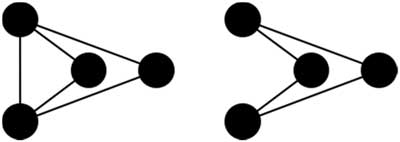
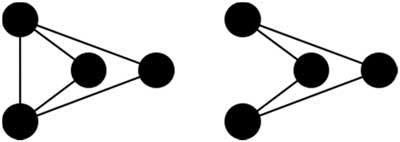
The independent variables are either operationalised as network configurations (graph attributes), network relations (edge attributes) or as relevant attributes of actors (node attributes). Testing the tendency of information exchange among actors without overlapping sources of information was done by taking into account two types of network configurations (see Figure 1). First, a geometrically weighted edge-wise shared partner statistic was used to operationalise transitivity. This captures the extent an actor shares information with another actor both directly as well as via a third actor in a closed triad. Second, the geometrically weighted dyad-wise shared partner statistic captures whether an actor tends to exchange information with others only directly, without closing the triad. These open two-paths represent information exchange among actors without redundant ties, limiting the overlap of information. The graph statistics are geometrically weighted to account for conditional dependence patterns and help overcome model degeneracy (Snijders et al. Reference Snijders, Pattison, Robins and Handcock2006).
Transitive triads (geometrically weighted edge-wise shared partner statistic) and open two paths (geometrically weighted dyad-wise shared partner statistic).
To test whether actors that bridge unconnected parts of the network tend to exchange information the most, the betweenness scoreFootnote 5 of every actor was calculated and used as a node attribute. Essentially, this measures the effect of an actor’s level of betweenness in the network on the likelihood of a tie.
Furthermore, Agreement on policy instruments is an edge attribute and is measured as a tie when both actors agree (coded as 1 as opposed to 0) on the policy instruments needed to implement gender equality and anti-discrimination measures on the basis of sex, based on the survey interview with the expert from the Dutch women’s council.
Lastly, node attributes such as their organisational type (civic, political, governmental or research) were included as separate variables. For a list of all actors in the network and their attributes see Table 1 in the Supplementary appendix. To measure the homophily effect of actors with the same organisational background, a nodal attribute matching statisticFootnote 6 was used to represent ties where the connected actors are both civic, both governmental or both research actors.Footnote 7
Control variables
In addition to these hypothesised effects on the likelihood of information exchange between actors in the network there are other effects that are expected to matter and that have to be accounted for in the model. First, monitoring the implementation process is costly. It requires extensive efforts to gather information, process and order the information and transmit it to the relevant actors. Klüver (Reference Klüver2012) demonstrated that interest groups with more money and staff were better able to effectively monitor the EU policy process. In their study on monitoring by citizens’ organisations in collaboration with researchers and other professionals as a tool to improve environmental policy, Nerbonne and Nelson (Reference Nerbonne and Nelson2008) found that better staffed organisations produced higher quality information and that the more money at their disposal, the more this information was used in official reports or as motivation for an investigation. Resources are a node attribute and measured as the number of employed staff for each actor. To use the number of employees as an indicator for resources is common practice, because it is hard to find reliable information on the size of the budget for each organisation (Kollman Reference König and Bräuninger1997; Carpenter et al. Reference Carpenter, Esterling and Lazer2004; Klüver Reference Klüver2012). A mutually exclusive categorical variable was created for organisations with less than 10 employees (coded as 1), more than 10 and less than 50 employees (coded as 2), more than 50 and less than 100 employees (coded as 3), more than 100 and less than 500 employees (coded as 4) and more than 500 employees (coded as 5).
Second, because establishing any kind of exchange relation costs time and effort it is crucial to link up with actors that are considered influential (Leifeld and Schneider Reference Leifeld and Schneider2012). Neo-institutionalists’ accounts of policy-making stress the significance of formal procedural settings and assume that actors will try to get access to those actors that are in the formal position to influence the policy process (König and Bräuninger Reference Kollman1998; Stokman and Berveling Reference Stokman and Berveling1998). Hence, the most influential actors in a network based on monitoring the implementation of EU gender policies are those actors responsible for implementing them, both in law and in practice. A dummy variable assigns actors to being an implementing actor (coded as 1) when they have some kind of institutional responsibility in the implementation process. For example, actors responsible for the implementation of the EU gender directives in the Netherlands were the Ministry of Justice and the Ministry of Education, Culture and Science, as they are required to transpose the directives in national law and enforce their implementation. Furthermore, both the social partners and the equality body are required by the directives to be part of the implementation process as well. Moreover, the national government designated the municipalities to implement anti-discrimination action plans and to establish Anti-Discrimination Bureaus.
Furthermore, different types of interaction in the monitoring network are likely to have an effect on each other. The concept of overlapping relations between a set of actors is called multiplexity and is identified as an endogenous process that influences network formation among organisations as well (Simpson Reference Simpson2015). Although it is useful to analyse distinct types of relations separately, they are likely to depend on each other. In line with general models of network formation (Bala and Goyal Reference Bala and Goyal2000), it is assumed that actors weight costs and benefits when they consider linking up with another actor. By using opportunity structures, actors can exchange information at low cost. For example, actors that are involved in joint reports or collaboration have more opportunities to exchange information without the transaction costs associated with establishing contact (Leifeld and Schneider Reference Leifeld and Schneider2012). To take this endogenous effect into account, the effect of collaboration and joint reporting is controlled for in the model.
Joint reporting is operationalised as a network relation (weight based on the number of joint reports) when actors contributed to a joint monitoring reportFootnote 8 on the implementation of gender equality and women’s rights together. Similarly, actors were coded as collaborators in a matrix when they were found to act in partnership, develop common projects or jointly organised events as reported in their year reports or on their website. For example, a partnership of the Association of Netherlands Municipalities and the Dutch Equality Body (College voor de Rechten van de Mens) is set up to exchange best practices regarding human rights on a local level and they organise meetings and workshops together with other local actors for a better understanding on how to best tackle discrimination on the basis of sex. Furthermore, the research institute Atria regularly works together with the European Institute of Gender Equality on projects to collect comparable data and indicators on women’s rights to raise awareness of gender inequality. Another example is the joint organising of recurring events, such as a festival with workshops and network meetings by the civil society actor Women Inc. and the Netherlands Trade Union Confederation (FNV) aimed to help women in their career.
Finally, in the context of EU politics information politics is described as a crucial tactic employed in transnational advocacy networks to transmit information efficiently and credibly to where it will have the most impact (Keck and Sikkink Reference Keck and Sikkink1998). In the case of monitoring, the implementation of EU directives by national governments and administrative actors the most effective information transmission will be on a national level. Domestic groups are expected to use channels to their governments if possible. However, when there is limited access, or governments are unresponsive to information, civil society actors will link up with actors across borders and pressure their government to respond. For this reason, the model should take into account the tendency to interact with actors within the same polity level. Polity level is a node attribute and takes into account whether actors work within the national, European or international polity level. To measure to what extent they tend to interact with actors within the same or across polity levels a nodal attribute matching statistic was used.Footnote 9
Exponential random graph models
To test the hypotheses on the likelihood of information exchange, Exponential Random Graph Models (ERGM, see Handcock et al. Reference Handcock, Hunter, Butts, Goodreau, Krivitsky and Morris2016) were used to fit the model. This is because networks consist of complex dependencies between ties and standard logistic regressions would result in matrix autocorrelation (Robins et al. Reference Robins and Lusher2007). The theoretical assumptions of ERGMs are that networks self-organise and are influenced by actor attributes and exogenous factors as well. Patterns within networks can be understood as evidence for continuing processes. Since multiple processes can operate simultaneously it is necessary to model the effects of interest and find a distribution of graphs with the observed network central to that (Robins and Lusher Reference Robins, Pattison, Kalish and Lusher2013). By estimating the relevant parameters, the model can be fitted accordingly using the ERGM package (Handcock et al. Reference Handcock, Hunter, Butts, Goodreau, Krivitsky and Morris2016). Sampling is done by use of the Markov Chain Monte Carlo procedure that produces a sequence of simulated networks. These are updated through small changes so that they best represent the sample space. The centring of the distribution of network graphs is done according to the method of maximum likelihood estimation. Finally, to assess how well the model captures the observed network a goodness of fit (GOF) procedure is performed. After the convergence of the model, its fit is assessed by looking at features of the data that were not explicitly modelled in a distribution of simulated network graphs compared with the observed network.
Results
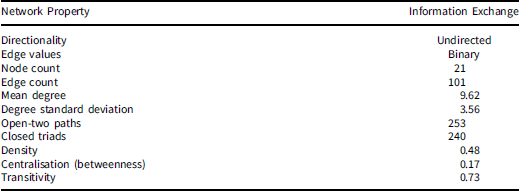
Before testing the hypothesis, the network structure information exchange is described by some summary statistics (see Table 1). On average, actors exchange information with 9.62 other actors. Compared with random networks of the same size, the network structure of information exchange (0.48) is not particularly dense. On the other hand, betweenness centralisation is relatively high (0.17), compared with what you would expect from a network of that size and density. This implies that monitoring indeed benefits from actors brokering between otherwise unconnected actors in the network. Furthermore, transitivity is significantly prominent when it comes to information exchange (0.73). However, when you compare the count of open two-paths (253) and transitive triads (240), it becomes clear that a substantial portion of information exchange occurs through connections that do not already provide access to that information indirectly.
Descriptive statistics for network of information exchange
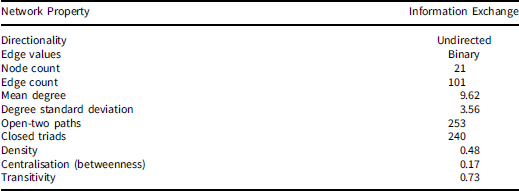
Note: Estimation was conducted using the Igraph package in R (Csardi and Nepusz Reference Csardi and Nepusz2006).
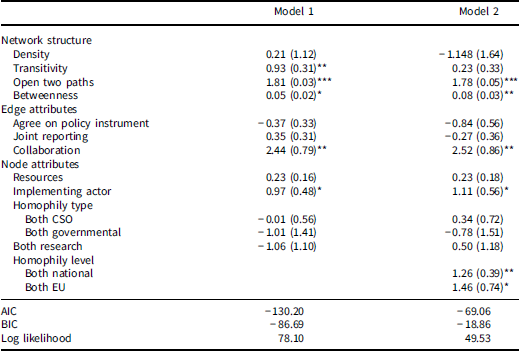
To test the hypotheses, the monitoring network is simulated using Exponential Random Graph Models. Both a partial model and a full model was fitted. Unlike the partial model (1), the full model (2) is fitted according to the multilevel structure of the monitoring network. The results are presented in Table 2.
Results Exponential Random Graph Models
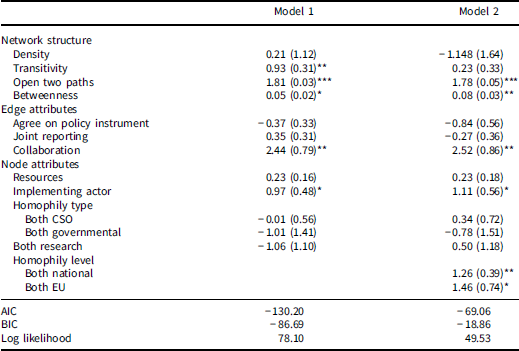
Markov Chain Monte Carlo maximum likelihood estimation.
***p<0.001, **p<0.01, *p<0.05.
AIC = akaike information criterion; BIC = Baysian information criterion.
First, the results of model 1 show that both transitivity (p>0.01) and open two-paths (p<0.001) are significant structural characteristics when it comes to information exchange in a monitoring network. This implies that the network consists of separate clusters of densely connected actors that exchange information among each other.
However, model 2 sheds more light on the type of actors that tend to exchange information in transitive triads, resulting in a network combining both bonding and bridging structures. Transitivity seems to be largely accounted for by the increased likelihood of actors sharing information with others within the same polity level. Actors active on the national level are more than three times as likely to exchange information with other nationally active actors than with actors on either the EU or international level (p<0.01). At the same time, EU level actors are more than four times as likely to share information among each other than among actors across polity levels (p<0.05). This indicates that when actors are able to access the relevant institutions on a domestic level to exchange information on the affairs related to the implementation of the policies they are interested in, they are less inclined to use information as leverage transnationally.
Taking into account this multilevel structure of the monitoring network, the results show that in line with Hypothesis 1, information exchange does indeed tend to be among actors without overlapping sources of information (see model 2). As demonstrated by the positive effect of open two paths, actors are almost six times as likely to exchange information when they are not already sharing information indirectly (p<0.001). Hence, the monitoring network facilitates an efficient flow of information.
Moreover, as revealed by the significant positive effect of betweenness centrality (p<0.01), the more actors are able to broker between unconnected parts of the network, the more likely they are to be involved in information exchange. This is evidence in support of Hypothesis 2 that actors bridging unconnected parts of the network tend to exchange information the most. It is evident that to monitor EU directives it is particularly important to rely on actors that allow information to flow between clusters of national and EU actors. Brokerage is demonstrated to be another significant mechanism at work in accessing information for monitoring purposes.
In contrast to the clustering based on polity level, there is no tendency of like-minded actors to stick together. There is no effect of agreement on the type of policies to implement gender equality on the likelihood to exchange information (Hypothesis 3a). Information exchange is just as likely among actors with different ideas about the best measures to implement gender equality as it is among actors with similar preferences. It follows that valuable information on the implementation process is needed no matter whether you agree or disagree on the preferred policy instruments.
Similarly, CSOs, governmental actors or research institutions are not inclined to exchange information with their own counterparts. However, the results do not indicate that actors tend to exchange information with actors with a different organisational background either. Hypothesis 3b cannot be confirmed, as the type of organisation does not influence whether two actors exchange information or not. Even though the monitoring network exhibits diversity in terms actors with divergent preferences and different organisational backgrounds exchanging information with one and other, interactions are not driven by diversity.
Furthermore, both models control for multiplexity and actor attributes that are thought to affect the likelihood to exchange information. First, collaborative projects help actors to exchange information with each other. Collaboration creates opportunities for actors to exchange information at low cost, making it more likely for collaborators to share information as well (p<0.01). The lack of effect of joint reporting on the likelihood of information exchange indicates that the preparation of joint reports requires more stable relations among actors than merely exchanging information. Second, controlling for both the resources actors have at their disposal and whether actors have a responsibility to implement the EU policy, the results show that information exchange predominantly entails actors using access relations to influential actors in charge of the implementation process. Implementers are indeed more involved in the monitoring network and other actors are three times more likely to exchange information with them than with others (p<0.05). Although it is the case that implementing actors also tend to have more money and staff, resources do not affect the likelihood of information exchange by actors that do not have any formal responsibilities in the implementation process.
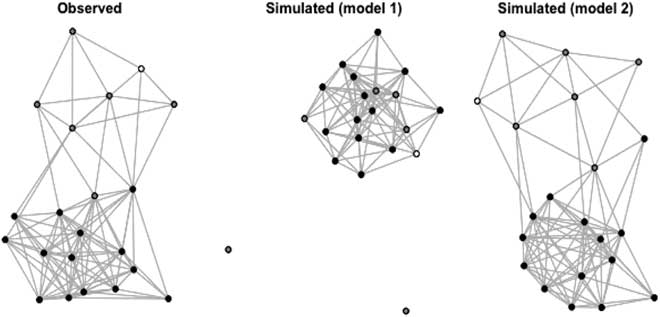
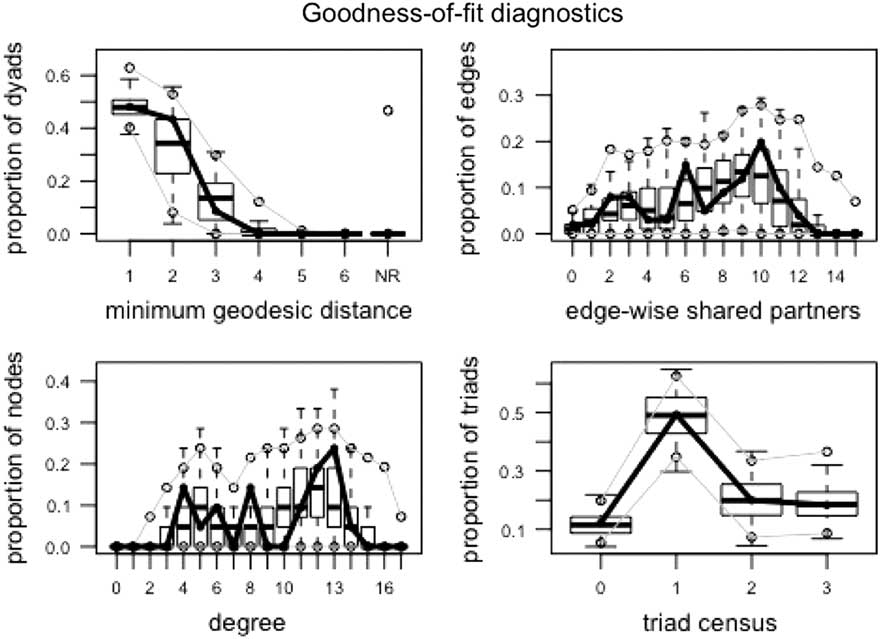
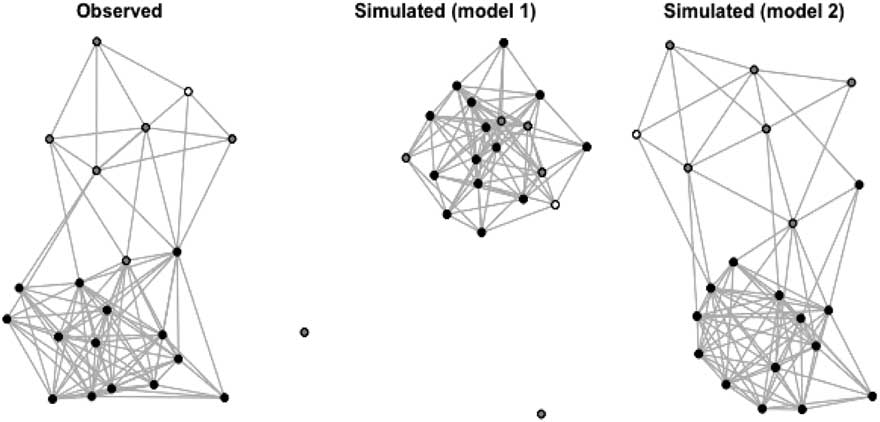
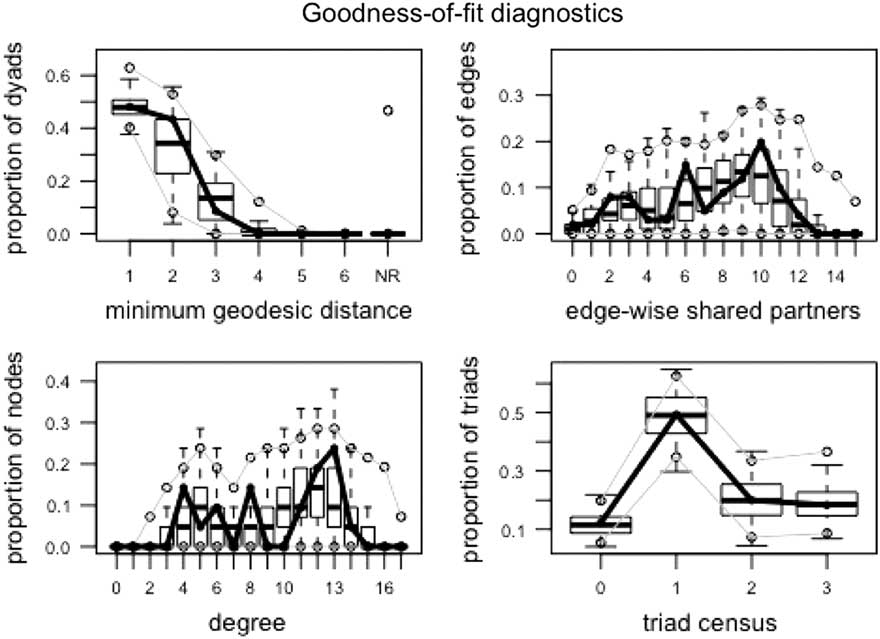
To assess the GOF of the models on information exchange, the networks can be simulated based on the coefficients. Whereas the full model is slightly over fitted compared with the partial model and has a greater Akaike and Baysian information criterion, it is much better equipped to simulate the observed network (see Figure 2). The simulated network based on model 2 appears to have the same structural features as the observed network and seems to replicate reality quite well. Both the observed network and the simulated network visualise the clustered actors based on polity level and the bridging network structures indicative of high cohesion and brokerage. To support this interpretation of the fit of the full model, Figure 3 shows the distribution of the samples of simulated networks (boxplots) according to the model, plotted against the real network (line). Well-established structural network parameters for assessing GOF (such as degree, edge-wise shared partners, minimum geodesic distance and triad census) fit the data well, as all statistics fall within the range.
Observed and simulated networks of information exchange. Note: Colour of nodes according to polity level; black=national, grey=EU, white=international.
Goodness-of-fit of full model (2).
Conclusion
The application of policies related to gender equality and anti-discrimination in accordance with EU requirements in the domestic context depends on local actors monitoring the implementation process. Scholars on compliance have recognised the importance of this decentralised monitoring system by fire-alarm (Tallberg Reference Tallberg2002; Jensen Reference Jensen2007) and studies on advocacy networks as defined by Keck and Sikkink (Reference Keck and Sikkink1998) have demonstrated how nonstate actors can use information to increase transparency and hold governments to account. However, it is yet to be established what determines the structure of networks for monitoring purposes and what factors drive information exchange.
Combining insights from the literature on interest groups, transnational networks and studies on policy networks with a social network analysis approach, this study tries to establish predictors of information exchange among actors in a monitoring network. The analysis is based on the case of the monitoring network of the Dutch women’s council, the national platform for women’s groups that is part of the EWL and represents women’s interest in a national, EU and international context. Exponential Random Graph Models are employed to test whether the network used for the monitoring of EU policy implementation is driven by structural characteristics attributed to efficient methods of broad-based information exchange (Carpenter et al. Reference Carpenter, Esterling and Lazer2004; Berardo and Scholz Reference Berardo and Scholz2010; Ulibarri and Scott Reference Ulibarri and Scott2016). Actors monitoring policy implementation were expected to use their network differently than in more collaborative settings so as to let information flow freely at low cost (efficiency), broker information between different parts of the network (brokerage) and facilitate information exchange among a diverse set of actors with divergent preferences (diversity).
The findings indicate that a cohesive network structure indeed connects the variety of actors and lets information travel through the least possible links (Berardo and Scholz Reference Berardo and Scholz2010). As a result, actors gain access to diverse information on policy implementation at low cost (Ulibarri and Scott Reference Ulibarri and Scott2016). However, the network does clearly demonstrate more densely connected clusters of actors as well. This is accounted for by the multilevel structure of the monitoring network, indicating that the majority of actors tend to exchange information with their counterparts on either the national or the EU level. The finding that information exchange in this network is heavily influenced by border-effects sheds some light on the link between access relations (Stokman and Berveling Reference Stokman and Berveling1998) and information politics in transnational networks (Keck and Sikkink Reference Keck and Sikkink1998). When actors are able to access policy-makers and implementing actors within the domestic setting, there is less need to make use of transnational networks to exchange information for monitoring purposes. It does scrutinise the importance of actors that can broker these otherwise separate clusters of actors.
In fact, brokerage is a significant mechanism through which actors gain access to valuable information for the purpose of monitoring. Actors able to bridge unconnected parts of the network increase the likelihood of information exchange. This effect indicates that brokers are important in multilevel monitoring networks to improve coordination of collective action (Laumann and Knoke Reference Laumann and Knoke1987), bring together actors from differently polity-levels to help them understand implementation problems with common terms of reference (Carpenter et al. Reference Carpenter, Esterling and Lazer2004; Ingold Reference Ingold2011).
Furthermore, the study finds that in contrast to what is known about collaboration networks more generally, information exchange for monitoring purposes is not more likely when actors share preferences regarding the necessary implementation measures or have similar organisational backgrounds. Monitoring requires that actors do not discriminate; information exchange occurs equally among actors in agreement or disagreement and across all types of organisation. This is in line with the theoretical assumption that when actors are dependent on the resources of others they are likely to link up to each other no matter the differences (Weible Reference Weible2005). Even though monitoring is not driven by diversity, it does require broad-based information exchange to increase transparency in the implementation process.
In sum, the monitoring network on the implementation of EU gender and anti-discrimination policies in the Netherlands is characterised by efficiency, brokerage and broad-based information exchange among a diverse set of actors. To discuss the generalisability of these findings, they should be seen in light of the network’s multilevel structure. Gender and anti-discrimination policies are dealt with on a national, EU and international level and attract stakeholders which are active on different levels as well. In line with findings from Scholz et al. (Reference Scholz, Berardo and Kile2008), this study shows that when authority is fragmented, an effective monitoring network necessitates interactions that are bridging. The monitoring network in this study is inclusive and broad-based and indicative of effective information exchange. When networks lack these bridging structures, this would limit their effectiveness in ensuring that essential information reaches those that can act upon it. Although closely bound interactions are found to be crucial by a large share of policy network studies as they are associated with trusted exchanges carrying credibility, this study finds that actors in multilevel monitoring networks are in need of speedy and diverse information more. These findings contribute to the literature that scrutinise the logic and context of interaction for determining the preferred network structures (Carpenter et al. Reference Carpenter, Esterling and Lazer2004; Berardo and Scholz Reference Berardo and Scholz2010; Ulibarri and Scott Reference Ulibarri and Scott2016).
Still, there are some limitations to this explorative study. First, the empirical data are limited to the network as described by the Dutch Women’s Council, contains undirected and binary relations only and is smaller than most other type of policy networks that have been studied. Whereas this type of data collection allowed for a more in depth understanding of the monitoring network of the coordination of women’s groups in the Netherlands, it may limit the external validity of the study. For example, the network structures may be dependent on the size of the network (Krivitsky et al. Reference Krivitsky, Handcock and Morris2011). Considering that the network in this study is relatively small compared with other policy network studies, the question is how these network structures translate to networks with different sizes.
Furthermore, the case study poses questions on how specific the drivers for information exchange are for monitoring EU policy implementation in the Netherlands. Does monitoring in other policy areas occur according to the same principles of efficiency, brokerage and broad-based interaction, or is this especially important for EU policy on gender equality and antidiscrimination? Moreover, monitoring increased transparency in the implementation process, but does not improve implementation performance directly. Though seemingly effective, it should be investigated whether the same network structure and formation of ties have similar benefits in different cultural and institutional settings. Future research should investigate the role of these structural characteristics in other domestic settings and test whether they benefit the efficacy of monitoring networks in general and under which conditions it results in better implementation.
Acknowledgements
This work was partially supported by the Center of Comparative and International Studies at ETH Zurich. A preliminary version was presented at the EUSA conference in Miami, 9–11 May 2017. The author is indebted to participants at the EUSA session and to colleagues at the European Politics Group at ETH Zurich for helpful comments to her analysis. The author also thanks the anonymous reviewers for their constructive feedback. Furthermore, the author thanks the informants at the Dutch Women’s Council for generously sharing their time and knowledge. Replication materials are available at https://doi.org/10.7910/DVN/K8MWBX
Supplementary materials
To view supplementary material for this article, please visit https://doi.org/10.1017/S0143814X1800017X