INTRODUCTION
When a person is dying, who cares? Typically, care is expected of healthcare professionals, and required by the person who is ill and their loved ones. Do healthcare professionals care? How do we know they care? What does it mean to care and be cared for in this context and why does it matter?
The aim of this study was to investigate perceptions of care in medical practice; how someone can tell that their doctor cares about them and whether it is important for people who are dying and their loved ones to feel cared for by their doctors. In doing so we draw upon narratives that describe the nature and quality of care experienced by people with cancer near the end of life and their carers, and illustrate how that care can be demonstrated.
What is Care?
There is no universally agreed definition of care but we argue that care is a primary element of our concept of, and language around experiences of, illness (e.g., “caregivers,” “healthcare professionals”) and consequently of our well-being and quality of life. To care is a fundamental part of human relationships that form as health professionals work with patients. A recent study showed that among the nurses whom patients perceived as caring are also those who reported being most emotionally affected by the patient relationship and providing the greatest continuity of care (Perskey et al., Reference Perskey, Nelson and Watson2008).
Care is demonstrated through behavior and motivation (MacLeod, Reference MacLeod2000). Good quality care in health has been described as individualized, patient-centered, related to need, and provided “humanistically” as part of a caring relationship by staff who demonstrate involvement, commitment, and concern (Attree, Reference Attree2001). Therefore, it is for the patient to define what care means for them.
Why is Care Important?
To recognize the importance of care we must acknowledge the human need to feel secure and the ways in which this feeling is compromised through the vulnerability, uncertainty, and loss of control that can arise during illness. It is to recognise the right of each person to have dignity, be heard, and be valued as a human being with their own unique array of experiences, hopes, needs, beliefs, and concerns.
In recognition of the importance of care, there is an expectation that institutions responsible for educating the health workforce will produce graduates who care. For example, the Association of American Medical Colleges (1998) specifies that medical schools will develop physicians who “must be altruistic … compassionate and empathetic in caring for patients … They must continue to care for people who are dying even when disease-specific therapy is no longer available or desirable.” (p. 4).
As a central component of care, empathy has both affective and cognitive components. It is to experience the world from another's point of view, feeling as they feel (Darwall, Reference Darwall1998) as well as reflecting on why they may feel this way (Reynolds & Scott, Reference Reynolds and Scott2000). The capacity to empathize requires the development of theory of mind — an understanding of one's own and others' minds. Such development begins in infancy, is propelled by opportunities to interact socially and thereby learn about and reflect on how the mind works, and has the potential to continue throughout the lifespan (Perner et al., Reference Perner, Ruffman and Leekham1994). Closely related to empathy, compassion involves the additional motivation to relieve the distress that is identified and felt by way of empathy.
Demonstration of empathy and compassion predicts a range of valuable elements in the caring relationship, including increased patient satisfaction (Reynolds & Scott, Reference Reynolds and Scott2000); improved diagnostic accuracy among clinicians; a reduction in negative symptoms; greater patient compliance (Roter et al., Reference Roter, Stewart and Putnam1997; Coulehan et al., Reference Coulehan, Platt and Egener2001); higher ratings of competency among students (Hojat et al., Reference Hojat, Gonnella and Nasca2002); and reduced patient anxiety (Fogarty et al., Reference Fogarty, Curbow and Wingard1999).
Medical education genuinely seeking to produce caring doctors would presumably provide an abundance of opportunities for ongoing development of empathy and compassion by encouraging students to reflect on their many patient encounters and providing support to nurture their caring tendencies. Rather than these traits and capacities being nurtured and reinforced, however, there is evidence that during the course of medical education students' tendencies to feel and demonstrate empathy and compassion toward those experiencing serious illness decline (Branch, Reference Branch2000; Janssen et al., Reference Janssen, MacLeod and Walker2008). Further, general practitioners demonstrate a lack of confidence and unmet educational needs in providing psychosocial aspects of care for people who are dying (Kelly et al., Reference Kelly, Varghese and Burnett2008). Recent research has revealed that for 90% of 384 opportunities that physicians had to demonstrate empathy toward lung cancer patients, physicians chose to concentrate on biomedical matters (Morse et al., Reference Morse, Edwardsen and Gordon2008). This substantiates continuing evidence that care, in so far as it is demonstrated through empathy and compassion, is neglected in much of modern medical education (Chen et al., Reference Chen, Lew and Hershman2007; Egnew & Wilson, Reference Egnew and Wilson2010). This is alarming and demands attention, particularly because patients recognize when they are respected by their physicians (Beach et al., Reference Beach, Roter and Wang2006) thus influencing the caring relationship.
Caring is more than “management of disease.” As Feinstein (Reference Feinstein2002) asserts, performing clinical duties such as ordering diagnostic tests, prescribing treatment, or performing surgery is not the same as caring. Caring is an inter-subjective, individual experience that varies in relation to a person's needs, expectations, and priorities. Although, ideally, empathy and compassion are central to all aspects of medical care, skills in relating to patients in a caring way may be subordinated to the technical skills involved in fixing or curing.
Nowhere more than in terminal illness, however, does caring for the patient go beyond curing the disease. Empathy and compassion are paramount and must shape the physician's actions and intentions. Medical education in palliative and end-of-life care has shown some much-needed improvements in recent years but this is not consistent across institutions (Charlton & Currie, Reference Charlton and Currie2008). Moreover, the need for ongoing evaluation and updating of existing education is often overlooked (Spruyt et al., Reference Spruyt, MacLeod, Hudson, Wee and Hughes2007). Despite progress and the development of guidelines and policy to improve such education, and the value students place on learning to care for dying patients (Mutto et al., Reference Mutto, Cavazolli and Ballbe2009), evidence continues to show that in many institutions worldwide, it remains at best ill-timed and often substandard or nonexistent (Lloyd-Williams & MacLeod, Reference Lloyd-Williams and MacLeod2004; Spruyt et al., Reference Spruyt, MacLeod, Hudson, Wee and Hughes2007; Charlton & Currie, Reference Charlton and Currie2008; Pereira et al., Reference Pereira, Pateux and Cantin2008; Gibbons et al., Reference Gibbons, McCoubrie and Maher2009).
How Can We Tell if a Doctor Cares?
Even if the importance of care is acknowledged, the lack of understanding of the skills it involves remains a concern (Churchill & Schenk, Reference Churchill and Schenk2008). This gap may explain the absence of assessment of ability to demonstrate care in medical education. How do we know whether graduates meet the expectations of their educational institution? Quirk et al. (Reference Quirk, Mazor and Haley2008) have tried to define caring behaviors with three challenging encounters: discussing the transition from curative to palliative care, delivering bad news (cancer), and discussing a medical error. They concluded that there is a set of behaviors that represent caring conceptually but that the manifestation of these behaviors is “in the eye of the beholder.”
Given this, a valid approach to ascertaining what it means to care and be cared for, and whether medical graduates demonstrate care is to ask patients: Do you feel cared for by your doctors and why?
METHOD
Sampling
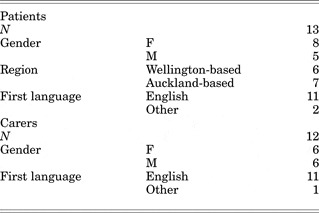
Personnel at two hospices in Auckland and Wellington, New Zealand were asked to identify people with cancer from their community program who were able and willing to be interviewed. These locations are representative of New Zealand's urban population. Thirteen patients were enlisted. Their demographic characteristics were representative of patients in these hospice communities. Each interviewee nominated a carer (often a close family member). Thirteen patients were enlisted. All invitees received an information pack outlining the study purpose, procedure, and proposed handling and utilization of data. The study was approved by the New Zealand Health and Disability Multi-Region Ethics Committee.
Data Collection and Analysis
There is wide consensus that the most valid way to collect subjective data regarding quality of life issues for people who are dying is directly from the patients (Kaasa & Loge, Reference Kaasa and Loge2003). By way of semi-structured interviews, this study assessed how those receiving end-of-life care perceived their experiences with doctors. We asked them to focus on doctors who were not specialists in palliative care. Prompt questions included: Did they think their doctor cared? What aspects of doctors' behavior and language demonstrated that? Interviews were held in participants' homes and lasted between 60 and 90 minutes.
Our interviews took an interpretive phenomenological perspective (Benner, Reference Benner and Benner1994). We sought narrative accounts of interviewees' actual experiences, rather than general opinions, beliefs, or ideology regarding interviewees' perspectives of care. Rather than taking an objective look at “what happened,” this methodology emphasizes the importance of the person's subjective explanations of what happened and what it was like for them. Schattner's (Reference Schattner2009) concept of humanistic medicine holds at its core the comprehension of the patient's narrative and emotions. In keeping with this, our methodology is ideal when seeking to understand patients' accounts of their care experiences. It focuses on getting to know the patient by giving them a voice. Experts in healthcare see this process as central to quality palliative care and clinical judgment (Tanner et al., Reference Tanner, Benner and Chesla1993; Luker et al., Reference Luker, Austin and Caress2000).
Interviews were tape-recorded and then transcribed. Transcripts were read and reread as a whole by both authors to ascertain a global understanding. We then employed commonly-used strategies to adopt and understand the participant's viewpoint. These included (a) discerning paradigm cases or meaningful examples that demonstrate the participant's understanding of her or his experience; (b) thematic analysis of patterns across cases to illustrate similarities and differences; (c) selecting exemplars to highlight and clarify similarities, differences, and paradigm cases (Benner, Reference Benner and Benner1994). Recruitment and interviewing continued until data reached saturation and no new themes emerged.
RESULTS
Of all patients approached, one patient was not well enough to participate. One participating patient did not nominate a carer. See Table 1 for participant characteristics. In this article we present findings from patient participants' narratives.
Patient demographics

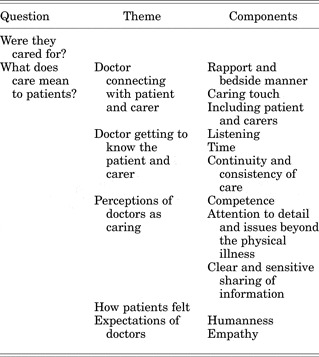
Patients' experiences and perceptions of care during illness are richly described in a breadth of ways touching on what care means to them, their experiences of care, their needs for care, expectation of doctors in terms of care provision, and the consequences for the patient of feeling cared for or not. Themes and subthemes are outlined in Table 2.
Themes and components

1. Were They Cared For?
In opening their stories patients could quickly and concisely say whether or not they felt cared for either in general or by a particular doctor.
The [GP and specialist] are brilliant, both of them. Nothing's too much trouble. (1a)
Other patients were clearly disappointed or hurt at the lack of care they felt.
It's just a job, they don't seem to care. (12a)
2. What Does Care Mean to Patients?
Participants offered rich and varied descriptions of what care means to them and the ways in which it is reflected in their experiences with doctors, helping us to enhance our understanding of what care means. Descriptions were largely based on a doctor's behavior but also related to participants' perceptions of a doctor's competency, manner, and intentions. Participants also vividly described their experiences of poor care. These ranged from a passive absence of care to alarming experiences of actively uncaring behavior and attitudes.
2.1. Doctor Connecting with Patient and Carer
Caring doctors made the effort to connect with their patients as people from the outset, through rapport, touch, and inclusion of carers and other loved ones. Central to this theme were doctors' communication styles.
Rapport and bedside manner. Participants valued being spoken to in a respectful, empathetic, and nonthreatening way.
Little personal things – always just called me B, shook my hand and made me welcome, and really cared. (7a)
He never spoke to you, never ever spoke to you, he always shouted at you or he'd throw his hands in the air. That was a habit with him and he stood up all the time. He wouldn't sit down, just stood up. I'd sit down in the chair and [wife] was there and he was looking down on you all the time. (11a)
Caring touch. Patients sometimes felt that their illness separated them from staff and was seen as a danger. They recommended touch as a way to communicate and overcome this.
Touch the patient; you will not get the disease you should know better. You will not die if I am dying and you squeeze my hand or say something nice. (6a)
Maybe a touch on the shoulder…not a feeling of intimacy but of friendship…it makes a big difference. (2a)
Including patient and carers. Part of feeling cared for involved both patients and carers being acknowledged by and included in the healthcare team. Some participants described the experience of being denied this.
I've been quite happy about the way they've been treated, especially with Dr C at [hospital]. Even though he's only got a small room he's always invited the wife and daughter in (5a).
I notice that my G.P. will always greet [my son and me] with “Hello Team”. The way he speaks he considers himself part of the team; might even be team leader I don't know, but part of the team. (3a)
They didn't want to [include my wife], they wanted to speak to me. My wife's a main player in this as well… She must just be so frustrated, just sitting there and not being able to do anything. (7a)
2.2. Doctor Getting to Know the Patient and Carer
Caring doctors made an effort to get to know patients by listening, spending time with them, and considering their points of view. Patients valued the safety and trust that came with continuity of care.
The oncologist said, “so tell me about yourself”…I was so stunned because nobody had ever said that…[usually] you're just a melanoma or a bunch of symptoms. (13a)
My GP…is absolutely fantastic. She says to me “this is what I think, what do you think? We can do this or this, what do you think?” (12a)
Participants relayed accounts of the raw, emotional consequences of a doctor's failure to listen.
was just appalled that he didn't listen to me. This is one of the things that I've learnt about talking to doctors. They are so fixed on the results of their studies and tests and things that they don't listen to the patient. (9a)
Time. Participants' narratives showed the close relationship between spending time with patients, getting to know each other, and demonstrating care.
The doctor] is very accessible, she speaks in a very clear, thorough way and she spends a lot of time with us, as much time as we've needed to go through the detail in the letter and so we're very happy. (13a)
Feeling hurried was a common complaint and indicative of a lack of care.
[Doctor] used to lose his temper… “I am far too busy…I haven't got the time”…he was a right sod. (11a)
Continuity and consistency of care. Participants valued the feeling that doctors knew them. Engendered through consistency and continuity of care, this had implications for their experiences of rapport, communication, and attention to detail; their understanding of what to expect; and their feelings of security and trust in the care team.
If I was to go to a strange doctor I wouldn't know what to expect. If I had to sit there and tell them that I've got this and I've got that, they'd either think I was a know-all and why am I there instead of going to my original G.P…Would they then (a) want to become involved, (b) give the treatment as far as they know it or (c) couldn't care one way or another. So you are very apprehensive, you tend to want to stick to the people you know. (2a)
they change shifts all the time and you have to start the whole process again. They do not read the notes from the previous doctor… One doctor writes it down and another doctor takes over and doesn't read what's taken place so we start again. It was hell, there's no other way to describe it. (11a)
2.3. Perceptions of Doctors as Caring
Participants' perceptions of doctors showed how caring can be expressed through a variety of elements in a doctor's repertoire of manner and skill.
Competence. Being competent as a doctor is integral to providing care. Those who thought their doctors were clearly skilled and knowledgeable generally described their experiences of care more positively. In contrast, dissatisfaction was clear among those who saw their doctors as lacking necessary expertise and felt their care was compromised.
He said…“but I'm not a lung specialist … I'm just here to help you go through the X-ray and to write you a prescription”. That's why I was angry. What's the point of those appointments? You wait for a month to see your specialist but in the end you are not seeing your specialist, you are seeing someone else…It's just a waste of time. (6a)
They are the experts but it shows you just how wrong they can be. In fact for such clever people how stupid they can be. If they would only just listen to the simple patient who knows their own body, knows when they have got fibromyalgia or the cancer coming back. (9a)
Attention to detail and issues beyond the physical illness. Participants felt a doctor cared when they made the effort to be thorough and think of issues beyond the immediate, physical illness that impacted on participants' daily lives.
He was obviously a thinking caring man himself. He cared about not just how often he got to see me or I got to see him but the very fact that he understood the positive bind of getting down to [city] … not just “next patient please”. Even the time of the appointments, he made suitable times so as not to catch the rush-hour. (3a)
Patients were not expecting a lot from doctors. Often the simplest acts made the difference between feeling cared for and not.
The little things – a glass of water, arranging the pillows on the bed for comfort. (1a)
Clear and sensitive sharing of information. It is important for patients to know what is happening and what to expect. A caring doctor tries to ensure the information is imparted sensitively and honestly and is understood by the patient.
They always explain what the medication is and what it's for, and that's the main thing…that personal feeling that they're interested enough to tell you what's happening. (4a)
Clarity involves a balance of honesty and tact as opposed to the insensitive imparting of raw facts.
I was told the bad news by the coldest woman that I ever met in my life…She was a snake to me. (6a)
Not all patients can handle the information you get, or understand it if they do get it. (2a)
2.4. How Patients Felt
Many patients reflected on the feelings that were evoked within them when they experienced care. They described feeling secure and able to trust the doctor; feeling known, valued, heard, and respected.
I just felt that [the doctors] were interested …Just the whole feeling, they made you feel confident and they made me feel as though they cared for me as an individual…It's just that, kind of like a friend more or less. (4a)
In contrast, some patients felt unwelcome.
“When are you going home? Are you going home yet?”…in the hospital it's like that all the time and you wonder why you are here. You've only just got in there and they want to get rid of you. You feel uncomfortable and there's nothing you can do about it. (11a)
Doctors' apparent motivation and interest impacted on participants' feelings.
Even if he didn't think it was anything to do with the cancer – he didn't even bother to find out… he just shoved you off and made you feel you're a bit of a fool; that's what hurt me I think. (9a)
Regardless of preferences for positive approaches to care, most participants explained that feeling patronized, inadequate, or ignored strongly impacted on their experiences of care. Words, tone, and body language can all actively demonstrate a lack of care.
The consultant and registrar walked past about three times, the door was wide open and the consultant didn't hand wave, didn't smile, or anything.' (13a)
I know morphine doesn't work for me from past experience…yet I had to go on it again…nonetheless the pain is still there. I got nausea and other side effects. They didn't seem interested in my experience of it. (10a)
2.4. Expectations of Doctors
When exploring what care means to the patient it is important to consider participants' expectations of doctors.
Humanness. Central to their expectations was participants' need to know that their doctors are human.
You have to have emotions; you will have patients you feel sympathy for… there's nothing wrong in feeling sympathy. It's not wrong to go home and feel bad because you've lost a patient, that's normal. That is what many doctors in the hospital should learn. It doesn't cost a lot [to] just say I am sorry. (6a)
Empathy. They want doctors to show some emotion, genuine sympathy and humility, urging them to recognize mistakes, do their best to fix them, and to apologize if they get something wrong.
I remember getting on the phone to [doctor] and crying. [Doctor] said “I'll do what I can” and she said “ I'm sorry, it sounds like a complete nightmare.” That was a very short sentence but it was recognition of [what we were going through]. (2a)
In all of this, patients want basic human relationships, which come from being spoken to and listened to with respect and being told what to expect.
DISCUSSION
This study sends some strong and poignant messages about what care means to people who are experiencing terminal illness both as patients and carers. Their stories enlighten us about why care is significant and what actually takes place in contexts where care is typically expected and often presumed by both providers and recipients of care.
In the eyes of people who are dying and their families, most healthcare professionals do care. Inevitably, however, one person's idea of care isn't necessarily the same as another's. In their descriptions of care and what it means to them, almost all participants touched on doctors' communication styles, for example. Their descriptions of good communication show that differing styles of communication can portray care and one size does not fit all patients or doctors. These findings support the conclusions of Quirk et al. (Reference Quirk, Mazor and Haley2008) but go further. The four domains or themes identified in that study were effective communication, meeting healthcare needs, respectfulness, and empathy. Participants in the present study have added to that list. They valued competence, consistency, and continuity of care; and attention to “the little things” and to factors beyond the immediate physical disease. It was clear that they wanted their doctors to “know” them as people. In this they reinforce the messages of Peabody (Reference Peabody1927), Osler (Reference Osler1914), and more recent literature (e.g., Back et al., Reference Back, Young and McCown2009).
Reassuringly, some of what it took for our participants to feel cared for feature in doctors' descriptions of how they go about developing a healing relationship with patients (Churchill & Schenk, Reference Churchill and Schenk2008). However, patients' stories also that indicated some doctors did not seem to care. They included descriptions of the doctors' body language and communication styles. A lack of interest in patients and family as people, apparent differing priorities and motivations, and overall, perhaps, a lack of respect, compounded the negative experiences and emotions that patients and families had as a result of their interactions with these doctors. Beach et al. (Reference Beach, Roter and Wang2006) demonstrated a positive relationship between doctors showing respect for patients and patients receiving more information. Patients in our study have indicated in their words that lack of respect has a significant impact on them. This is perhaps a reflection of the power that economics, administration, science, and technology have in shaping the values and priorities of supposedly caring institutions (Watson, Reference Watson2003).
So what does care mean to patients and their carers? These participants' discussions of their care, priorities, expectations and needs were inherently complex and “in the eye of the beholder” as Quirk et al. (Reference Quirk, Mazor and Haley2008) put it. The participants give us an understanding of what care means to them not only as recipients of care but also as individuals with differing backgrounds, styles of expression, preferences, expectations, and approaches to human interaction.
Just as patients are individuals, so too are doctors. Participants' contrasting and intricately detailed examples could be daunting for any doctor hoping to engender a feeling of “being cared for” among his or her patients. Some examples, if used in isolation as guides to caring, could lead a doctor to feel obliged to do something that veers uncomfortably away from his or her own personality or nature. Rather than letting the complex and detailed nature of the participants' accounts be a challenge, we urge doctors to recognize the valuable guidance that comes from the overarching picture painted by these stories. Our findings reinforce the simple but potent message of Osler (Reference Osler1914) that “it is much more important to know what sort of patient has the disease than to know what sort of disease the patient has.” This is similar to the comment by Francis Peabody (Reference Peabody1927) who emphasized the importance of getting to know the patient as a major part of the art of medicine; a comment he wrote when he knew he was dying.
Participating patients and carers were all of European origin and well aware of the nature of their illness and prognosis. We recognize that in this, the study represents a specific subset of the population of people who are dying in New Zealand and that different perspectives may exist among patients and carers who were unwilling or unable to participate.
The study raises several questions which, in order to understand and improve medical care, are worthy of further research. Are doctors involved in end-of-life care aware of how patients perceive care and the value they place upon feeling cared for? We also need to explore how motivated and capable doctors feel about meeting patients' expectations and needs for a caring patient–doctor relationship.
This study provides greater insight into the needs and perspectives of patients and families and can be used to illustrate the nature of care near the end of life. These and subsequent findings will be used to encourage faculty to reinvest time and energy in ensuring that listening skills and a holistic, human approach are adopted in each clinical encounter.
Together, our findings illustrate the importance of being human in the often frightening and emotional context of illness and suffering. As well as the inclusion of seminal event review and role modelling suggested by Branch (2000), we advocate that patients' voices be frequently heard in medical education. The underlying message our participants send about what care means to them and why it is important, is reassuringly simple. Building a caring human relationship begins with doctors recognizing themselves and each patient as individuals first and foremost. A connection invited on that level provides a firm base on which to nurture and develop the caring human relationship, indicating in some ways a reciprocal dependence (Fine & Glendinning, Reference Fine and Glendinning2005). Developing such relationships can ensure that ultimately medicine is not simply concerned with managing disease, but rather with caring for the person who is suffering.
Participants portray relationships between doctors and patients built on empathy, trust, skill, respect and commitment as important elements of quality care. They also seek continuity and competence in their doctors' clinical practice. All of these aspects must be reflected in doctors' learning to care for people who are dying.
ACKNOWLEDGMENTS
We thank our participants and our transcriber, Annette Davis, for their generous contributions to this research.