Introduction
The status of the sorediate, corticolous species Punctelia subrudecta in North America has been the subject of considerable study and debate (Adler & Ahti Reference Adler and Ahti1996; Aptroot Reference Aptroot2003). While P. subrudecta has generally been considered to be distinct from P. perreticulata (e.g., Wilhelm & Ladd Reference Wilhelm and Ladd1987), Adler and Ahti (Reference Adler and Ahti1996) amended the definition of the latter species to exclude the scrobiculation of the upper surface as a diagnostic character, and added that the species could have either longer or shorter filiform conidiaFootnote 1. This change created a single, polymorphic species under the name P. perreticulata (the name P. subrudecta was correctly reserved for specimens with unciform conidia). Aptroot (Reference Aptroot2003), following these changes, assigned the name P. perreticulata to all corticolous, sorediate Punctelia specimens from North America with a pale lower surface and C+ red medulla (due to the presence of lecanoric acid). Through this process, P. perreticulata became the accepted name for all specimens from North America that were previously identified as P. subrudecta (since the conidia, when present, are always filiform, and not unciform). For some time, we have been uncomfortable with this treatment (Lendemer Reference Lendemer2004), but lacked the ability to generate a robust, well-supported alternative hypothesis using chemical, ecological, morphological, and phytogeographic data alone.
Recognizing the potential value of molecular data in addressing this problem, we undertook a study of the North American populations referred to Punctelia perreticulata. We first sampled broadly within the geographically widespread populations of P. perreticulata treated by Aptroot (Reference Aptroot2003), inferring a phylogeny of these organisms and some of their closest known relatives using ITS1, 5.8S, and ITS2 sequence data. We generated taxonomic hypotheses from this molecular analysis and attempted to correlate them with taxonomic hypotheses based on so-called ‘traditional’ characters (e.g., chemistry, ecology, morphology, phylogeography). Using a holistic taxonomic approach we accepted as species those that were well-supported by both datasets and rejected those that were not.
The results demonstrate the taxonomic utility of certain characters that have been rejected as uninformative by previous authors (e.g., conidium length and morphology of the upper surface; Adler & Ahti Reference Adler and Ahti1996), and reveal the presence of three distinct species within Punctelia perreticulata sensu Aptroot (Reference Aptroot2003).
Materials and Methods
Fieldwork and herbarium materials
During our fieldwork throughout North America over the last five years, we have made an effort to collect sorediate Punctelia specimens with the goal of one day better understanding the circumscription of the taxa purported to be present in our region. Hundreds of specimens of P. perreticulata/subrudecta have been collected across the continent including regions where both taxa had been reported to occur. Additionally, we examined the specimens held at the Canadian Museum of Nature (CANL), The New York Botanical Garden (NY) and Duke University (DUKE). The ecological and distributional data used in this study have been gathered largely as part of our field studies, and molecular analyses have been carried out on samples collected by the first author and his collaborators (all materials have been deposited in the herbarium at NY).
Molecular data collection
DNA was extracted from North American specimens of Punctelia perreticulata s. lat. (e.g., including P. subrudecta auct. Amer. and P. perreticulata sensu Wihelm and Ladd) to generate a hypothetical circumscription of the species that could be tested with morphological characters as an independent dataset. Additionally, a sample of P. missouriensis, a species with weakly corticate squamiform isidiose-soredia, had its DNA extracted in order to determine its relationship, if any, to specimens that were the main focus of the study. DNA extractions were performed at NY using the DNeasy Plant Mini Kit (Qiagen, Valencia, CA, USA) with the instructions modified to include a prolonged (∼12 hour) incubation period in the lysis buffer. Isolated DNA was resuspended in 100 μl of sterile water and stored at −20°C. PCR amplification of the ITS1, 5.8S, and ITS2 regions was performed at NY using the primers ITS4 and ITS5 (White et al. Reference White, Bruns, Lee, Taylor, Innis, Gelfand, Sninsky and White1990). Amplification reactions of 25 μl contained each of the following: 2·5 μl 10X PCR Buffer (Qiagen), 2·5 μl dNTP solution (mixed to a concentration of 2 mM of each dNTP), 2·5 μl BSA solution (mixed to a concentration of 2·5 mg μl−1of bovine serum albumin; Hillis et al. Reference Hillis, Morritz and Mabel1996), 0·2 μl Taq DNA Polymerase (= 1 U; Qiagen), 1 μl of each primer (in solution at a concentration of 10 μM), 9·3 μl of sterile water, 1 μl of extracted DNA suspended in sterile water, and 5 μl of Q-solution (Qiagen). PCR protocol followed Nelsen et al. (Reference Nelsen, Lücking, Umaña, Trest, Will-Wolf, Chaves and Gargas2007) and consisted of an initial denaturation of 95°C for 5 min, followed by 10 cycles of 95°C for 1 min, 62°C for 1 min, and 72°C for 1 min, then 35 cycles of 95°C for 1 min, 53°C for 1 min and 72°C for 1 min with a final extension for 7 minutes at 72°C. PCR products were visualized prior to sequencing by UV examination of a 1% agarose gel on which 1 μl of amplified PCR product had been subjected to electrophoresis and stained with ethidium bromide. Unpurified amplified PCR products were sent to the University of Washington Biochemistry DNA Sequencing Facility (BDSF) for sequencing. Sequences were assembled and manually edited using the software package Sequencher™4.9 (Gene Codes Corporation, Ann Arbor, MI, USA). In order to identify contaminants, nearest sequence matches were found by searching the nucleotide collection in GenBank using BLASTn (Altschul et al. Reference Altschul, Madden, Schaffer, Zhang, Zhang, Miller and Lipman1997).
Phylogenetic analyses
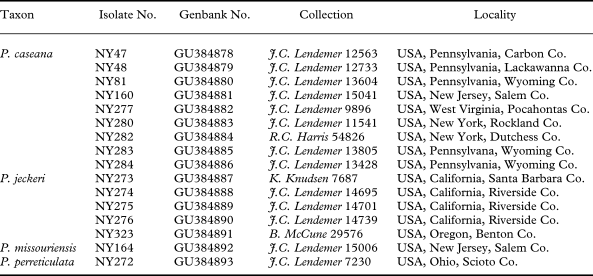
Molecular datasets were assembled using reference ITS sequences representing our species of interest (e.g., all Punctelia jeckeri/ulophylla, P. perreticulata, and P. subrudecta sequences from GenBank) in addition to the sixteen sequences generated as part of this study (Table 1). Sequences from the outgroup taxa P. borreri and P. rudecta were added because of their affinity to the species in question and the number of sequences (more than two of each) available from GenBank. Sequences were initially aligned using ClustalX 2.0 (Larkin et al. Reference Larkin, Blackshields, Brown, Chenna, McGettigan, McWilliam, Valentin, Wallace, Wilm and Lopez2007); those that contained numerous clear inconsistencies with all other aligned sequences were assumed to have resulted from the sequencing of heterogeneous amplicon pools, and were excluded from phylogenetic analyses (for an example of how heterogenous amplicon pool sequence analysis can be used effectively, see Hodkinson & Lutzoni Reference Hodkinson and Lutzoni2009). Alignments were subsequently adjusted manually using Mesquite 2.6 (Maddison & Maddison Reference Maddison and Maddison2009), and the nucleotides in ambiguously-aligned regions were excluded from analyses (by defining them as members of an exclusion set). Ambiguous bases (e.g., N's, R's, Y's, etc.) and terminal gaps were changed to missing (‘?’) and the NEXUS file was saved with the taxa and characters compressed into a data block.
GenBank Accession numbers of ITS sequences and data for voucher specimens from which the sequences were generated in this study

Using standard text editing software, the NEXUS alignment file was then prepared for a weighted maximum parsimony analysis with recoded ambiguously-aligned regions. First, constant sites were excluded from analyses by typing ‘constant’ into the exset line of the assumptions block. Each of the ambiguously aligned regions was then recoded using INAASE 3.0 (Lutzoni et al. Reference Lutzoni, Wagner, Reeb and Zoller2000) and specific step matrices were generated (through the same program) using a transition:transversion:gap ratio of 1:2:3. Step matrices produced by INAASE were subsequently altered based on manual adjustments to the provided pair-wise alignments of ambiguous regions. For those regions that could not be reasonably realigned in a pair-wise manner, INAASE characters were rejected and the regions were recoded using ARC (Kauff et al. Reference Kauff, Miądlikowska and Lutzoni2003; Miądlikowska et al. Reference Miądlikowska, Lutzoni, Goward, Zoller and Posada2003). ARC characters and accepted INAASE characters were then pasted immediately below the nucleotide matrix (as the final characters in an interleaved matrix). The data block was altered to accommodate the newly-inserted recoded characters. First, the number of characters (nchar in the dimensions line of the data block) was changed to the value equivalent to the number of characters in the nucleotide alignment + the number of INAASE regions + 23 times the number of ARC regions (since each ARC region is recoded as a series of 23 characters). Since the NEXUS file was originally saved in a non-interleaved format, the format was manually changed to interleaved (by typing “interleave” in the format line of the data block) to accommodate the insertion of ARC and INAASE characters into the character matrix. In the same line, “datatype=DNA” and “gap=-” were removed and replaced by ‘symbols = “A C G T - 0 1 2 ...”’ listing each of the characters used in the nucleotide+INAASE+ARC character matrix.
Those ambiguously-aligned regions recoded using INAASE were subjected to the aforementioned manually-adjusted symmetric step matrices initially produced by the same program. Likewise, unambiguously-aligned portions were subjected to their own step matrices, which were computed separately for each of the three regions (ITS1, 5.8S, and ITS2) using STMatrix 3.0 (written by S. Zoller; Miądlikowska et al. Reference Miądlikowska, McCune and Lutzoni2002) as outlined by Gaya et al. (Reference Gaya, Lutzoni, Zoller and Navarro-Rosinés2003, Reference Gaya, Navarro-Rosinés, Llimona, Hladun and Lutzoni2008). The step matrices produced from both INAASE and STMatrix were pasted directly into the assumptions block and renamed (name inserted between “usertype” and “stepmatrix”) according to the region on which each would be employed. In the typeset line of the assumptions block, each of the regions subjected to a step matrix was defined by typing the name of the region, followed by a colon and the identifier numbers of the character(s) contained within it. So as not to over-inflate the influence of certain characters that are inextricably linked, all but one of the 23 ARC characters was down-weighted for each ARC region as follows: characters 2–5 were each given a weight of 0·25; characters 6–15 each had a weight of 0·10, and characters 16–23 were each assigned a weight of 0·5 (Reeb et al. Reference Reeb, Lutzoni and Roux2004; Gaya et al. Reference Gaya, Navarro-Rosinés, Llimona, Hladun and Lutzoni2008). Weights were entered manually into the wtset line of the assumptions block. The resulting NEXUS file is available for download at the second author's website, accessible at http://www.duke.edu/~bph8/.
Phylogenetic analyses were run using weighted maximum parsimony (MP) in PAUP* 4.0b10 (Swofford Reference Swofford2001). A first round of searches was performed with 1000 random-addition-sequence (RAS) replicates and TBR (tree bisection-reconnection) branch swapping. The MULTREES option was in effect and zero-length branches were collapsed. All equally most parsimonious trees were saved with branch lengths, and a strict consensus tree was computed for reference. Branch support for MP trees was estimated through bootstrap analyses (Felsenstein Reference Felsenstein1985) by performing 1000 bootstrap replicates with 10 RAS per bootstrap replicate, with all other settings as above. Clades with high bootstrap proportion (BP) support (> 70% MP-BP) on branches that had a length of ten or more changes in all most parsimonious reconstructions were designated as potential ‘species’ to be tested using an independent morphological dataset. In addition to the above analyses maximum likelihood (ML) and Bayesian topology searches were performed as outlined by Lendemer & Hodkinson (Reference Lendemer and Hodkinson2009) and B. P. Hodkinson and J. C. Lendemer (unpublished), respectively.
Chemical and morphological analyses
All specimens were studied dry using a Bausch & Lomb StereoZoom 7 dissecting microscope. Characters of size, broadness, aspect, and basal colour were noted. All specimens were also subjected to chemical analysis using standard spot tests (reagents are abbreviated following Brodo et al. (Reference Brodo, Sharnoff and Sharnoff2001)) or thin-layer chromatography (TLC). TLC was carried out using solvent systems A or C following the standardized methods of Culberson & Kristinsson (Reference Culberson and Kristinsson1970).
Results and Discussion
The results of our morphological and phylogenetic analyses of P. subrudecta s. lat. in North America are presented below, followed by a summary taxonomic treatment including additional discussion, distribution maps and illustrations. As the proceeding discussion should make clear, we do not consider the present study to be the final word on the status of the sorediate lecanoric acid producing species of Punctelia with a pale lower surface in North America. Rather, our study, much like the one by Crespo et al. (Reference Crespo, Divakar, Argüello, Gasca and Hawksworth2004), is intended to be a base line for more detailed research that is needed to understand the characters used to circumscribe species of Punctelia, and to understand the relationships between populations of ‘P. subrudecta’ in North America and abroad.
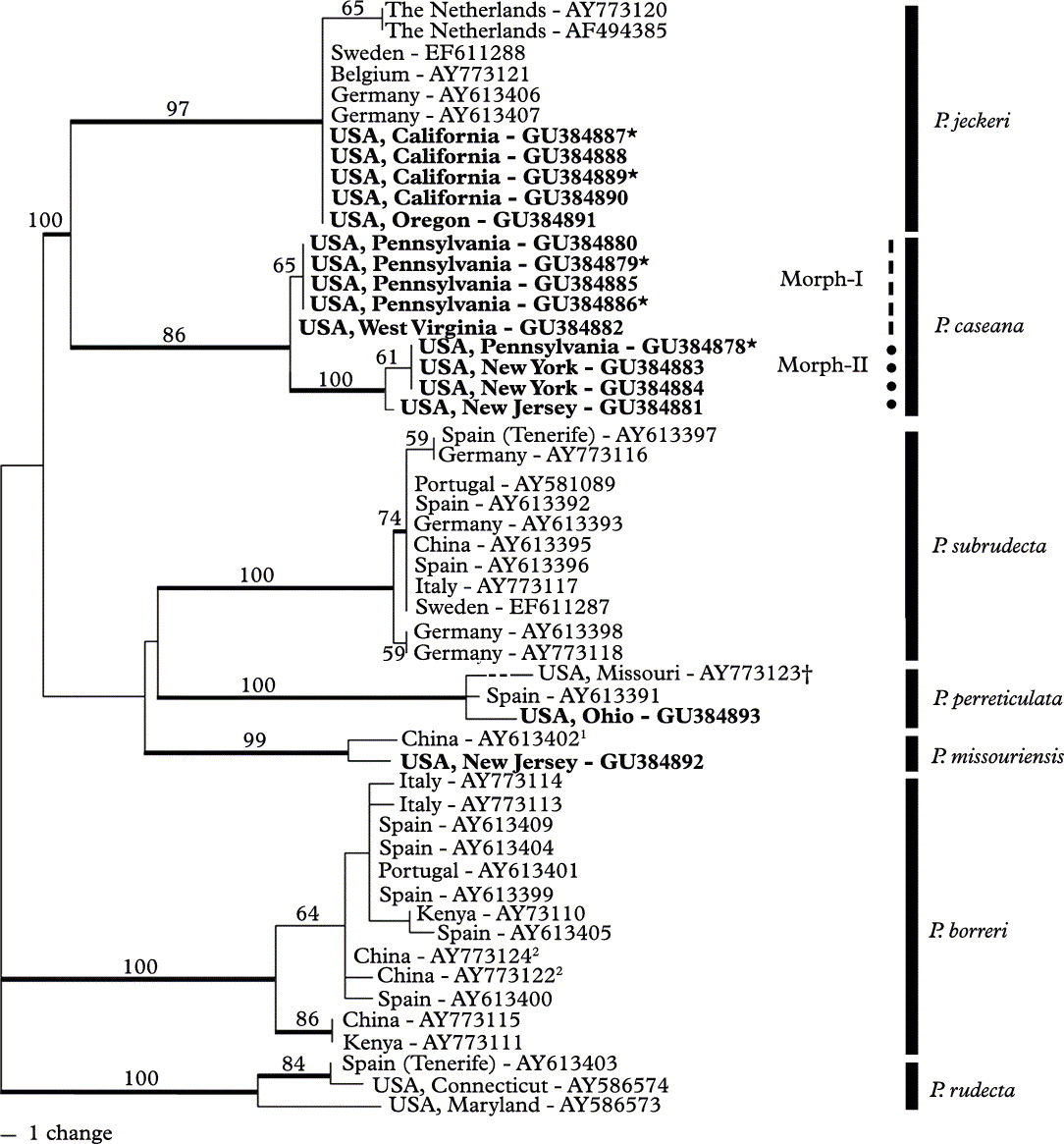
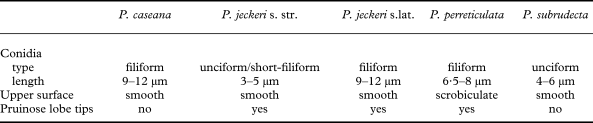
In total, we generated fifteen new ITS sequences from North American specimens of corticolous sorediate Punctelia species with lecanoric acid and a pale underside, in addition to one sequence from the isidiose-sorediate P. missouriensis. Parsimony analyses resulted in four equally most parsimonious trees, one of which was topologically equivalent to the strict consensus of all four trees; this tree is shown in Figure 1. All clades that were well-supported by MP-BP appeared in both ML and Bayesian 50% majority-rule phylogenetic trees. The new sequences from sorediate Punctelia specimens with lecanoric acid sorted into three distinct clades, two of which already had representatives in GenBank (P. jeckeri and P. perreticulata; Fig. 1). Certain combinations of morphological characters were found to correlate with each of these monophyletic entities (Table 2), leading us to accept as ‘species’ the phylogenetic entities suggested by our molecular analyses.
Phylogeny of Punctelia subrudecta s. lat. and its relatives based on ITS1, 5.8S, and ITS2 sequence data, inferred using weighted maximum parsimony (MP). MP-bootstrap proportions (BP) from 1000 resamplings are shown at each node that has a support value >50%; branches with MP-BP support >70% are thickened. For sequences generated as part of this study, the locality and accession number are in bold. An asterisk (*) following a sequence indicates that we have found and examined conidia in the voucher specimen. A dagger (†) is used to denote a sequence on a long terminal branch (12.77 changes in length) that has been shortened for space (as indicated by the hashed branch). Based on our analysis, it is likely that the following sequences in GenBank represent misidentifications: 1– AY613402 as “aff. rudecta” is probably P. missouriensis; 2– AY773122 and AY773124 as “perreticulata” are probably P. borreri (see text for discussion).

Tabular comparison of Punctelia species discussed in this study.

Considering the differences in conidia reported by Adler & Ahti (Reference Adler and Ahti1996) for European and North American populations of Punctelia perreticulata, we expected that phylogenetic analyses of a diverse sampling of populations from within P. perreticulata sensu Aptroot (Reference Aptroot2003) would likely reveal the existence of more than one morphologically recognizable species (especially since comparable differences in conidium length were used to distinguish P. semansiana C. Culb. & W. L. Culb. [= P. graminicola (B. de Lesd.) R. S. Egan] from P. hypoleucites (Nyl.) Krog by Culberson & Culberson (Reference Culberson and Culberson1980)). We were, however, quite surprised that these data revealed the existence of three distinct species (none of which is P. subrudecta) that can be distinguished both morphologically and phylogenetically (see Fig. 1). Each of these species is discussed more fully below.
The outgroup taxa Punctelia borreri (which has a black underside, gyrophoric acid, and soredia) and P. rudecta (which has a pale underside, lecanoric acid, and isidia) formed distinct, monophyletic entities (Fig. 1), supporting the utility of the widely-used characters of underside colour, medullary chemistry, and diaspore type for separating these species from the species at issue in the present study. The sequence generated from P. missouriensis produced a rather unexpected result. Strangely, this sequence formed a strongly-supported clade with a singleGenBank sequence generated from Chinese material [tentatively identified as “P. aff. rudecta” and discussed in detail by Crespo et al. (Reference Crespo, Divakar, Argüello, Gasca and Hawksworth2004); Fig. 1], suggesting that this species, previously known only from North and South America, may actually also exist in Asia.
The status of Punctelia perreticulata sensu Aptroot (Reference Aptroot2003)
Punctelia perreticulata s. str
One of the primary goals of our study was to determine the status of Punctelia perreticulata s. str. in North America. The type specimen of P. perreticulata is from Italy (van Herk & Aptroot Reference van Herk and Aptroot2000) and the species has traditionally been separated from others with a pale underside and lecanoric acid by its scrobiculate upper surface with few pseudocyphellae and medium sized (6–8 μm long) filiform conidia. The species, in the strict sense, was considered to occur rarely in south-central North America (Wetmore Reference Wetmore1976; Hale Reference Hale1979; Wilhelm & Ladd Reference Wilhelm and Ladd1987). We examined material at NY identified as P. perreticulata and found several specimens that corresponded to the strict concept of P. perreticulata. We successfully extracted DNA from one of these specimens. In our analyses the sequence generated from this specimen formed a well-supported clade along with another specimen from North America [studied by Thell et al. (Reference Thell, Herber, Aptroot, Adler, Feuerer and Kärnefelt2005)] and one from Spain [studied by Crespo et al. (Reference Crespo, Divakar, Argüello, Gasca and Hawksworth2004)]. The presence of P. perreticulata s. str. in North America is thus confirmed and the original circumscription of P. perreticulata supported by molecular data.
Adler & Ahti (Reference Adler and Ahti1996) expanded the concept of Punctelia perreticulata to include specimens from Australasia and North America with longer conidia (9–12 μm) and a smooth to moderately ridged upper surface. Our results do not support this expanded concept since North American specimens with the above characters form two distinct highly supported clades quite distant from P. perreticulata s. str.; these are discussed in the subsequent sections.
It should be noted that we are not the first to reject Adler & Ahti's (Reference Adler and Ahti1996) broad circumscription of Punctelia perreticulata. Thell et al. (Reference Thell, Herber, Aptroot, Adler, Feuerer and Kärnefelt2005) also arrived at this conclusion in conjunction with their larger phylogenetic studies of Punctelia. Their conclusion was based on the fact that in their analysis sequences of two specimens identified as P. perreticulata from China grouped with sequences of P. borreri, rather than with a sequence of P. perreticulata from North America [identified by D. Ladd and presumably thus congruent with the concept of the taxon outlined by Wilhelm & Ladd (Reference Wilhelm and Ladd1987)]. Thell et al. (Reference Thell, Herber, Aptroot, Adler, Feuerer and Kärnefelt2005) also reported P. perreticulata as new to China despite the fact that their own data indicated that P. perreticulata was polyphyletic (and that the Chinese samples did not represent P. perreticulata s. str.).
In addition to the sequences of Punctelia borreri generated by Thell et al. (Reference Thell, Herber, Aptroot, Adler, Feuerer and Kärnefelt2005) we included those generated by Crespo et al. (Reference Crespo, Divakar, Argüello, Gasca and Hawksworth2004) in our analyses. The Chinese sequences of P. perreticulata generated by Thell et al. (Reference Thell, Herber, Aptroot, Adler, Feuerer and Kärnefelt2005) were nested within a well-supported clade otherwise comprised of sequences of P. borreri from Africa, Europe, and Asia in the phylogeny presented here. We examined the voucher (Aptroot 56094, hb. Aptroot) which is the basis of AY773124 and found it to be a mixture of P. borreri (gyrophoric acid detected by GE) and a sorediate species with a pale underside. Almost certainly the fragment used for molecular analysis represented P. borreri. Unfortunately we were unable to examine the other Chinese specimen (Aptroot 56005) cited as P. perreticulata by Thell et al. (Reference Thell, Herber, Aptroot, Adler, Feuerer and Kärnefelt2005); however, in light of the above it is very likely to be P. borreri, and at the very least, not P. perreticulata.
Punctelia subrudecta sensu Lendemer (Reference Lendemer2004)
As has been mentioned above, the sequences derived from North American samples that correspond to the expanded concept of Punctelia perreticulata proposed by Adler & Ahti (Reference Adler and Ahti1996) actually belong to two well-supported clades distinct from P. perreticulata s. str. One of these (identified as P. caseana in Fig. 1) corresponds to P. subrudecta sensu Lendemer (Reference Lendemer2004) and is sister to a clade comprised of sequences from GenBank identified as P. jeckeri and those from our study generated from specimens of P. subrudecta s.lat. from western North America.
The clade recognized here as Punctelia caseana is comprised entirely of sequences generated from specimens collected in eastern North America. We were initially surprised that our study supported these populations as distinct from those in western North America because both sets of populations have long filiform conidia (8–12 μm) and a smooth to moderately ridged thallus surface. Further study in light of the results of our molecular analyses led to the recognition that the P. caseana and P. jeckeri clades were distinguished respectively by the absence and presence of pruina on the lobe tips. Since there is no name available for the eastern North American populations previously referred to P. subrudecta, we describe them herein as a new species, P. caseana.
In our analyses, P. caseana contains within it a single, well-supported, monophyletic entity. The remainder of the sequences form a group that cannot be definitively characterized as either monophyletic or paraphyletic based on ITS sequence data. These two sets of sequences correspond to two morphotypes that are reasonably well defined on morphological and biogeographic grounds. While each morphotype dominates a given geographic region, both often occur at the same locality in northern Pennsylvania/southern New York.
The morphotype that cannot be definitively characterized as monophyletic in our analyses (“Morph-I” in Fig. 1) is most common in northern North America and also frequently occurs at high elevations throughout the central and southern Appalachian Mountains. This morphotype is often extremely distinctive because of its large size, sparse pseudocyphellae, and primarily marginal soralia with fine soredia giving it the appearance of a species of the genus Cetrelia C. Culb. & W. L. Culb. in the field (all Cetrelia species have a black rather than pale underside and different medullary chemistry). It is illustrated in Hinds & Hinds (Reference Hinds and Hinds2007) and has clearly been a source of confusion for lichenologists as many specimens had been identified as P. perreticulata or P. subrudecta with some indication of hesitation (e.g., “?” or “s.l.”).
The second morphotype (“Morph-II” in Fig. 1) is exemplified by the type collection of Punctelia caseana and is most common in the coastal plain and piedmont of North America. It also occurs frequently at middle to low elevations (e.g., ∼2000 ft. and below) of the Appalachian Mountains and in the Ozark Ecoregion. Populations of this morphotype can be recognized by their smaller thalli with narrower lobes (compared to the above morphotype), and primarily laminal soralia with coarse granular soredia that often aggregate and give the appearance of squamules or lobules (this causes confusion with P. missouriensis).
Punctelia perreticulata sensu Egan & Aptroot (Reference Egan, Aptroot, Nash, Ryan, Diederich, Gries and Bungartz2004)
Though Egan reported Punctelia jeckeri (syn. P. ulophylla) for the western North American state of New Mexico in 2002 (after Bouly de Lesdain Reference Bouly de Lesdain1942), Egan & Aptroot (Reference Egan, Aptroot, Nash, Ryan, Diederich, Gries and Bungartz2004) later applied the name P. perreticulata to all populations of P. subrudecta s. lat. in western North America, essentially following the evaluation of these populations by Aptroot (Reference Aptroot2003). Despite this treatment by Aptroot, P. ulophylla was once again reported for the continent by Tucker et al. (Reference Tucker, Knudsen and Robertson2006) as part of a lichen survey of Pinnacles National Monument in California. We sampled broadly within the populations occurring in California; however, we were unable to obtain fresh material from populations in the arid south-west and Rocky Mountains. Like the populations from eastern North America, the western populations that we sampled are characterized by long filiform conidia (8–12 μm long) and a smooth to moderately ridged upper surface.
In our molecular analyses the sequences derived from the western populations of Punctelia subrudecta s. lat. are indistinguishable from those sequences generated from European specimens identified as P. jeckeri, with which they form a well-supported clade that is sister to P. caseana. The samples from which these sequences were generated are all characterized by the presence of pruina on the tips of the lobes. Our results do not support the separation of P. perreticulata sensu Egan & Aptroot (Reference Egan, Aptroot, Nash, Ryan, Diederich, Gries and Bungartz2004) from P. jeckeri and thus we report these populations here under the latter name.
The use of the name Punctelia jeckeri for these populations is problematic because P. jeckeri s. str. has unciform to short-filiform conidia, while the western North American populations uniformly have long-filiform conidia. Since differences in the type and length of the conidia are supported as species-level characters elsewhere in our study, it is curious that they would not be useful in the case of P. jeckeri. We have not revised all of the vouchers upon which the European sequences of P. jeckeri are basedFootnote 2 and thus are unable to state with certainty what type of conidia they have (if conidia are present). If these vouchers do have the typical conidia reported for European P. jeckeri, this phenomenon could potentially be explained by a founder effect, and a single anomalous individual or set of individuals could have given rise to the representatives of this species on one of the two continents. However, it is more likely that another species is present in Europe that is morphologically similar to P. jeckeri but differs in conidium type. Clearly, further study of this taxon is needed.
Taxonomy
Below we provide an account of the three North American species of sorediate Punctelia with a pale lower surface and lecanoric acid in the medulla. The new species P. caseana is described and treated in full, while P. jeckeri and P. perreticulata are treated in a shortened form primarily to detail their separation from P. caseana and each other. A key to the genus Punctelia in North America (north of Mexico) is included below.
Key to genus Punctelia in North America (north of Mexico)
1 Thallus lacking lichenized diaspores; apothecia often present ... 2
Thallus with isidia, lobules, or soredia ... 5
2(1) Lower surface black; medulla C+ pink (gyrophoric acid); Texas ... ... P. subpraesignis
Lower surface pale; medulla C+ red (lecanoric acid) or C−; distribution various ... 3
3(2) Medulla C− (fatty acids present) ... P. bolliana
Medulla C+ red (lecanoric acid) ... 4
4(3) Conidia (3–)5–6(–9) μm long ... P. graminicola
Conidia (7–)10–13(–16) μm long ... P. hypoleucites
5(1) Thallus sorediate ... 6
Thallus isidiate or lobulate ... .13
6(5) Lower surface pale-brown ... 7
Lower surface black ... 11
7(6) Saxicolous; coastal southern California; thallus with false soredia developing from the breakdown of papilliform isidia ... P. punctilla
Corticolous (rarely saxicolous); distribution and thallus not as above ... 8
8(7) Soredia coarse and isidioid, squamiform and partially corticate, few per soralium; central and eastern North America ... P. missouriensis
Soredia finer and not isidioid, not squamiform, and fully ecorticate, many per soralium; widespread ... 9
9(8) Upper surface smooth to somewhat ridged, not scrobiculate; lobe tips pruinose or not ... 10
Upper surface scrobiculate; lobe tips pruinose ... P. perreticulata
10(9) Lobe tips epruinose; central and eastern North America ... P. caseana
Lobe tips pruinose; western and southwestern North America ... P. jeckeri
11(6) Saxicolous; rare, medulla C+ pink (gyrophoric acid) ... P. stictica
Corticolous (rarely saxicolous); medulla C+ pink or C− ... 12
12(11) Medulla C+ pink (gyrophoric acid) ... P. borreri
Medulla C− (fatty acids) ... P. reddenda
13(5) Thallus isidiate ... 14
Thallus lobulate ... 16
14(13) Saxicolous; coastal southern California; isidia short and papilliform, breaking down into coarse soredia ... P. punctilla
Corticolous (rarely saxicolous); absent from southern California; isidia otherwise ... 15
15(14) Isidia tall, cylindrical to branched; very common ... P. rudecta
Isidia short and squamiform, (except in central North America), restricted to pseudocyphellae and resembling heaps of corticate soredia; less common ... ... P.missouriensis
16(13) Lower surface black ... 17
Lower surface pale ... P. bolliana
17(16) Medulla C+ pink (gyrophoric acid); Texas ... P. subpraesignis
Medulla C- (fatty acids); Appalachian ... P. appalachensis
The Species
Punctelia caseana Lendemer & Hodkinson sp. nov
MycoBank No. 514021.
Thallus ut in Punctelia jeckeri sed epruinosus et conidiis longioribus differt.
Typus: USA, New Jersey, Atlantic Co., Nature Conservancy Reserve, SE of Egg Harbor City, NE of Germania, 1/3 mile S of NJ 561, on branches of Vaccinium, 21 October 2003, J. C. Lendemer et al. 1431 (NY—holotypus; isotypi distributed as Lich. East. N. Amer. Exs. III: 149).
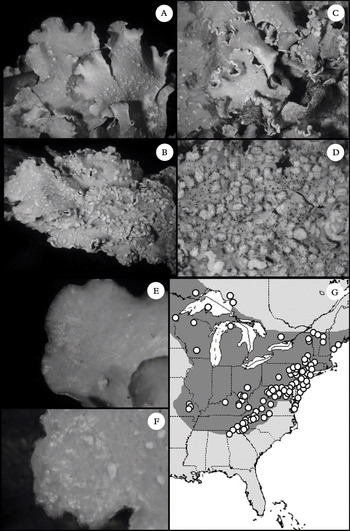
(Fig 2)
Punctelia caseana. A & B, thallus margin, ×0·5; A, morphotype 1; B, morphotype 2; C & D, soralia, ×1; C, morphotype 1; D, morphotype 2; E & F, epruinose lobe tips, ×3; E, morphotype 1; F, morphotype 2; G, geographic distribution based on herbarium material at CANL and NY; shaded region approximates to the eastern range mapped by Brodo et al. (Reference Brodo, Sharnoff and Sharnoff2001)). Images of morphotype 1 are from Lendemer 12205 (NY) and morphotype 2 are from Harris 54826 (NY).

Thallus corticolous, closely attached to the substratum, highly variable in size depending on microhabitat conditions, sorediate. Lobes flat to ridged, often upturned at the margins. Upper surface grey-blue, glabrous, with a narrow brown zone near the lobe tips, epruinose. Lower surface pale to off-white, rarely light brown but never black. Soralia frequent, primarily marginal along the secondary lobes with laminal soralia arising from the pseudocyphellae in the older portions of the thallus. Soredia large, coarse.
Apothecia rare (seen only in Lendemer 17592, DUKE, NY) lecanorine, with sorediate margins. Ascospores 8-ascus, hyaline, 14–17 × 10–12μm.
Pycnidia infrequent, immersed, black. Conidia filiform, hyaline, (8–)9–10(–12) μm long.
For colour illustrations see Flenniken (Reference Flenniken1999, as Punctelia subrudecta) and Hinds & Hinds (Reference Hinds and Hinds2007, as P. perreticulata).
Etymology. The epithet “caseana” honours the undergraduate major professor of the second author, Dr Martha A. Case, who supported his interest in lichenology and encouraged him to study the lichens of the state of Virginia, USA, where the new species commonly occurs.
Chemistry. Atranorin (cortex), lecanoric acid (medulla). Spot tests: cortex, K+ yellow, C−, KC+ yellowish, P−, UV−; medulla, K−, C+ red, KC+ red, P−, UV−.
Ecology and distribution. The new species essentially follows the distribution of Punctelia subrudecta in eastern North America as illustrated and described by Brodo et al. (Reference Brodo, Sharnoff and Sharnoff2001). It is common on the bark of conifers (Pinus, Tsuga) and, in some regions, is equally common on the bark of hardwoods (Acer, Quercus).
The reader should note that the distribution map presented here is heavily biased against portions of central and northern North America because these regions are not well represented in the NY herbarium. The available literature indicates that the taxon is common in the region highlighted by Brodo et al. (Reference Brodo, Sharnoff and Sharnoff2001) west of the Appalachian Mountains [see e.g., the distribution map of Punctelia subrudecta for Ohio provided by Showman & Flenniken (Reference Showman and Flenniken2004)]. The apparent rarity of P. caseana in the coastal plain and piedmont of south-eastern North America south of Virginia is probably ‘real’ because the macrolichens in this region were intensively collected by Clyde F. Reed whose herbarium has been incorporated into NY.
All specimens identified as Punctelia subrudecta from south-western North America that we have examined have proved to be P. jeckeri. However Egan (Reference Egan2002) noted both P. subrudecta and P. ulophylla (= P. jeckeri) to be present in New Mexico, USA, and it is thus possible that both P. caseana and P. jeckeri occur in that region.
Exsiccati specimens examined. Lich. East N. Amer. Exs. 149 (NY, type collection), 355 (NY, exemplar of morphotype II), 356 (NY, exemplar of morphotype I).
Selected specimens examined. CANADA: Ontario: Hastings Co., 3·5 miles E of Marmora, 1976, P. Y. Wong 2251 & P. A. Bowler (CANL); Peel Co., NW of Palgrave, 1957, R. F. Cain 26398 (CANL, NY); Slate Islands, SE end of Leadman Island, 1977, C. M. Wetmore 29210 (DUKE); York Co., NW of Nobleton, 1958, R. F. Cain 27122 (CANL, NY).—USA: Connecticut: Fairfield Co., Highstead Arboretum, 2005, R. C. Harris 51579 (NY); Litchfield Co., Holleran Swamp Preserve, 2003, R. C. Harris 48071 (NY). Delaware: Sussex Co., Delaware Wild Lands Cypress Swamp Conservation Area, 1989, R. C. Harris 24962 (NY). Georgia: Rabun Co., Chattahoochee National Forest, Rabun Bald, 1997, R. C. Harris 41270 (NY); Walker Co., 1992, R. C. Harris 28194 (NY). Kentucky: Bath Co., Daniel Boone National Forest, Stoney Cove Recreation Area, 1995, R. C. Harris 36956 (NY); Bell Co., Pineville, 1981, C. F. Reed 111115 (NY); Bullitt Co., Bernheim Arboretum, 2002, D. Ladd 23522 (NY); Carter Co., Carter Caves State Park, 1981, P. G. Reed 1981-15 (NY); Estill Co., Daniel Boone National Forest, ∼1·5 miles NW of Cottage Furnace Campground, 1995, R. C. Harris 36976 (NY); Fleming Co., Grange City, 1981, C. F. Reed 112890 (NY); Jessamine Co., near Wilmore, 1962, C. F. Reed 57279 (NY); Laurel Co., Cumberland National Forest, Morgan Ridge, 1962, C. F. Reed 58214 (NY). Letcher Co., Bad Branch Nature Preserve, 1991, R. C. Harris 27076 (NY); Montgomery Co., Reid Village, 1980, C. F. Reed 111133 (NY); Owen Co., New Liberty, 1980, C. F. Reed 120850 (NY); Rowan Co., Daniel Boone National Forest, SE end of Cave Run Lake, 1995, R. C. Harris 36803 (NY); Spencer Co., 1962, S of Elk Creek, 1962, C. F. Reed 56780-B (NY); Wayne Co., Mill Springs, 1962, C. F. Reed 58399 (NY). Maine: Lincoln Co., Spruce Point, 1994, B. Allen 15785 (NY); York Co., Ferry Beach State Park, 2002, R. C. Harris 46352 (NY). Maryland: Allegany Co., near Midlands, 1963, C. F. Reed 64615B (NY); Baltimore Co., Ward's Chapel Road, 1980, E. G. Worthley s. n. (NY); Cecil Co., Elk Neck, 1987, C. F. Reed 126459 (NY); Frederick Co., Thurmont, 1962, C. F. Reed 59360A (NY); Garrett Co., High Bog, 1989, R. C. Harris 24583 (NY); Somerset Co., near Mt. Vernon, 1963, C. F. Reed 64576 (NY); Washington Co., near Big Pool, 1963, C. F. Reed 64966 (NY); Wicomico Co., 5 miles SW of Sharptown, 1980, E. G. Worthley s. n. (NY). Massachusetts: Middlesex Co., SE of East Acton, 1954, W. L. Culberson 4647 (DUKE). Michigan: Emmet Co., S of Wycamp Lake, 1974, W. R. Buck s. n. (NY); Houghton Co., near Calumet, 1957, H. A. Imshaug 20849 (CANL). Minnesota: Pine Co., Nemadji State Forest, 1983, J. P. Schuster 1655 (CANL). Missouri: Carter Co., MOFEP site 9, 1007, D. Ladd 20501 (NY); Iron Co., St. Francois Mountain, Clark National Forest, 1993, R. C. Harris 31116 (NY); Madison Co., Mark Twain National Forest, Rock Pile Mountain Wilderness, 2003, R. C. Harris 48267 (NY); Shannon Co., MOFEP site 4, 1996, D. Ladd 19494 (NY); St. Genevieve Co., Pickle Springs Natural Area, 1990, R. C. Harris 25975 (NY); Washington Co., Hughes Mountain Conservation Area, 2002, R. C. Harris 46452 (NY). New Hampshire: Grafton Co., Benton Tr. N Moosilauke, 1935, G. P. Anderson s.n. (NY). New Jersey: Altantic Co., Wharton State Forest, Batsto Natural Area, 2003, J. C. Lendemer et al. 985 (NY); Burlington Co., Wharton State Forest, Skit Branch, 1995, R. C. Harris 36618 (NY); Camden Co., Winslow Wildlife Management Area, 2009, J. C. Lendemer 15327 (NY); Cape May., Peaslee Wildlife Management Area, 2009, J. C. Lendemer 15172 (NY); Cumberland Co., Peaslee Wildlife Management Area, 2009, J. C. Lendemer 15140 (NY); Fulton Co., 3 km SE of Barnes Gap, 1989, S. A. Thompson 6826 & J. E. Rawlins (NY); Hunterdon Co., Mitchell Property, 1992, R. C. Harris 29034 (NY); Monmouth Co., Allaire State Park, 2009, J. C. Lendemer 15411 (NY); Ocean Co., 3 miles SW Warren Grove, 1982, L. Brako 4947 (NY); Salem Co., Parvin State Park, 2008, J. C. Lendemer et al. 15041 (NY); Sussex Co., Stokes State Forest, 2008, J. C. Lendemer et al. 11592 (NY). New York: Albany Co., Limestone Rise Preserve, 2005, R. C. Harris 51878 (NY); Dutchess Co., Roger Perry Memorial Preserve, 2008, R. C. Harris 54826 (NY); Greene Co., Catskill Park, Blackhead Range Trail, 1996, R. C. Harris 38573 (NY); Putnam Co., Peach Lake Natural Area, 2006, W. R. Buck 51201 & R. C. Harris (NY); Rockland Co., Harriman State Park, 2008, J. C. Lendemer et al. 11541 (NY); Suffolk Co., Long Island, 1991, R. C. Harris 26839 (NY); Ulster Co., summit area of Giant Ledge, 1993, R. C. Harris 30509 (NY). North Carolina: Ashe Co., Horse Gap, 1982, C. F. Reed 143278-B (NY); Caldwell Co., Moses G. Cone Memorial Park, 1981, P. G. Reed 1981-105 & L. L. Reed (NY); Graham Co., Nantahala National Forest, along Santeelah Creek, 1994, R. C. Harris 32923 (NY); Haywood Co., Great Smoky Mountains National Park, vicinity of Baxter Creek, 2008, J. C. Lendemer et al. 11917 (NY, DUKE); Henderson Co., Pisgah National Forest, North Mills River Recreation Area, 2006, J. C. Lendemer et al. 7084 (NY); Macon Co., Nantahala National Forest, Southern Nantahala Wilderness Area, 1997, R. C. Harris 41109 (NY); Mitchell Co., Pisgah National Forest, trail to Roan High Bluff, 1993, R. C. Harris 30918 (NY); Stokes Co., Hanging Rock State Park, 1993, R. C. Harris 30699 (NY). Ohio: Adams Co., Chaparral Prairie State Nature Preserve, 2006, R. C. Harris 52804 (NY); Hocking Co., Crane Hollow, 1968, I. M. Brodo 14502 (CANL); Scioto Co., Shawnee State Forest, 2006, J. C. Lendemer et al. 7231 (NY). Pennsylvania: Carbon Co., Hickory Run State Park, 2008, J. C. Lendemer 12594 (NY); Chester Co., Nottingham County Park, 2003, J. C. Lendemer 1678 & E. W. McCardell (NY); Columbia Co., State Game Lands No. 58, 2008, R. C. Harris 54332 (NY); Huntingdon Co., Rothrock State Forest, 2008, J. C. Lendemer et al. 11702 (NY); Lancaster Co., Susquehannock State Park, 2008, J. C. Lendemer 11349 & E. Tripp (NY); Lackawanna Co., Lackawanna State Forest, Phelps Road (loop), 2008, J. C. Lendemer 13089 (NY); Luzerne Co., State Game Lands No. 91, 2008, J. C. Lendemer 13123 (NY); Monroe Co., Tobyhanna State Park, 2008, J. C. Lendemer 13766 (NY); Pike Co., Delaware State Forest, Bruce Lake, 2008, J. C. Lendemer 12087 (NY); Sullivan Co., Wyoming State Forest, 2004, J. C. Lendemer 2255 & J. A. Macklin (NY); Wayne Co., Lacawac Sanctuary, 2008, J. C. Lendemer 12205 (NY); Wyoming Co., State Game Lands No. 57, 2008, J. C. Lendemer 13604 (NY). Tennessee: Carter Co., Ripshin Bog on Tiger Creek Road, 1993, R. C. Harris 30955 (NY); Greene Co., Horsehitch Gap, 1991, R. C. Harris 27212 (NY); Polk Co., Cherokee National Forest, Cohutta Wilderness Area, 1998, R. C. Harris 42467 (NY); Sullivan Co., 3 miles S of Bluff City, 1964, C. F. Reed 66918 (NY); Washington Co., 3 miles N of Johnson City, 1964, C. F. Reed 66735 (NY). Vermont: Essex Co., Victory State Forest, 2008, R. C. Harris 54394 (NY); Grand Isle Co., North Hero State Park, 1996, W. R. Buck 30736 (NY); Lamoille Co., Babcock Nature Preserve, 2005, R. C. Harris 51402 (NY); Windsor Co., Hartland Bog, 1986, I. M. Brodo 25473 (CANL). Virginia: Accomack Co., N of Pungoteague, 1957, C. F. Reed 38567-A (NY); Amherst Co., Long Mt., 1963, C. F. Reed 62199 (NY); Bland Co., E of Ceres, 1964, C. F. Reed 66951 (NY); Fairfax Co., Pohick Church, 1962, C. F. Reed 60340 (NY); Franklin Co., near Snydersville, 1947, C. F. Reed 10056 (NY); Gilles Co., Moonshine Dell, 1995, R. C. Harris 36688 (NY); Grayson Co., Grayson Highlands State Park, 1991, R. C. Harris 26924 (NY); Madison Co., Big Meadows, 1966, I. M. Brodo 9509 (CANL); Northampton Co., 3 miles NE of Eastville, 1963, C. F. Reed 64166 (NY); Pittsylvania Co., 3 miles W of Chatham, 1963, C. F. Reed 138253 (NY); Rockingham Co., Endless Caverns, 1964, P. G. Reed 67529 (NY); Rappahannock Co., just N of Thornton Gap, 1964, C. F. Reed 66966 (NY); Smyth Co., Jefferson National Forest, Whitetop Mountain, 2008, R. C. Harris 54122 (NY); Warren Co., Smithsonian CRC, 2005, J. C. Lendemer 3839 (NY). West Virginia: Hardy Co., South Branch Mountain, 1964, C. F. Reed 66510 (NY); Tucker Co., Monongahela National Forest, along FS 13, 2001, R. C. Harris 44941 (NY); Pendleton Co., Spruce Knob, 1976, R. C. Harris 10626 (CANL); Pocahontas Co., Monongahela National Forest, upper slopes of Spruce Mountain, 2007, J. C. Lendemer 9896 & A. Moroz (NY); Preston Co., Cranesville Swamp, 1963, C. F. Reed 64440 (NY). Wisconsin: Bayfield Co., Point Detour, 1965, I. M. Brodo 5776 (CANL); Iowa Co., 6 miles W of Arena, 1965, I. M. Brodo 5643 (CANL); Oneida Co., Patterson Hemlocks State Natural Area, 2002, R. C. Harris 46046 (NY).
Punctelia jeckeri (Roum.) Kalb
Bib. Lich., 95: 312 (2007).—Sticta jeckeri Roum., Revue Mycol., 3: 33 (1881); type: Sur les roches de la cascade de Crévent (Deux-Sévres), M. Jecker (Lichenes Gallici Exs. 245, UPS—lectotype n.v.).
Punctelia ulophylla (Ach.) van Herk & Aptroot, Lichenologist 32: 239 (2000).—Imbricaria borreri var. ulophylla (Ach.) Jatta, Nov. Giorn. Bot. Ital., new series 9: 470 (1902).—Parmelia dubia var. ulophylla (Ach.) Harm., Bull. Soc. Sci. Nancy, ser. 2 31: 224 (1897).—Parmelia ulophylla (Ach.) F. Wilson, Pap. Proc. R. Soc. Tasm., 172 (1893).—Parmelia borreri var. ulophylla (Ach.) Nyl., Flora 55: 547 (1872).—Parmelia rudecta var. ulophylla (Ach.) Ach., Synops. Lich. 197 (1814). Parmelia caperata var. ulophylla Ach., Lichenogr. Univ. 458 (1810); type: Switzerland, J. Schleicher (H-ACH-1338—lectotype, n.v.).
(Fig 3)
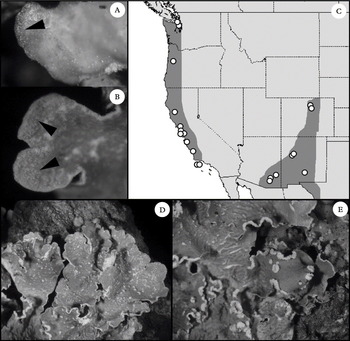
Punctelia jeckeri (Lendemer 14695, NY). A & B, pruinose lobe tips with arrows highlighting position of the pruina, ×5; C, geographic distribution based on selected herbarium material at NY, shaded regions correspond to western populations mapped by Brodo et al. (Reference Brodo, Sharnoff and Sharnoff2001); note that several populations in Canada are not mapped due to space constraints; D, thallus margin, ×0·5; E, soralia, ×1.

For colour illustrations see Brodo et al. (Reference Brodo, Sharnoff and Sharnoff2001, as Punctelia subrudecta) and St. Clair (Reference St. Clair1999, as P. subrudecta).
Description. See van Herk & Aptroot (Reference van Herk and Aptroot2000) under the name Punctelia ulophylla (Ach.) van Herk & Aptroot.
Discussion. In North America, this taxon is restricted to the western portion of the continent, and its distribution centres around two geographic regions: the Pacific coast of California, Oregon and Washington; and the arid mountains of Arizona, Colorado and New Mexico north to Alberta. The species typically occurs on the bark of hardwoods in coastal regions, and occurs on conifers in the arid interior. Further study of populations from south-western North America is needed to determine the eastern edge of the range of this taxon, and whether it is sympatric with Punctelia caseana in this region, as has been suggested by Egan (Reference Egan2002).
After the existence of this species in North America was called into question by Aptroot (Reference Aptroot2003), Tucker et al. (Reference Tucker, Knudsen and Robertson2006) reinstated it as a North American taxon under the name Punctelia ulophylla based on a specimen from San Benito County, California. We have examined the collection and confirmed its identity as P. jeckeri.
Exsiccati specimens examined. Lich. Exs. ASU 132 (NY).
Selected specimens examined. CANADA: Alberta: Elk Island National Park, 1961, G. W. Scotter 657 (CANL). British Columbia: Gulf of Georgia, Galiano Island, 1977, T. Ahti 34085 & W. J. Noble (CANL). Manitoba: 40 miles SW of Winnipeg, 1969, I. M. Brodo et al. 15987 (CANL).—USA: Arizona: Cochise Co., Chiricahua Mountains, Herb Martyr Dam, 1973, T. H. Nash 6937 (DUKE); Graham Co., Coronado National Forest, Mount Graham, 1995, S. D. Sharnoff & S. Sharnoff 1644.24 CANL, [photo voucher for Brodo et al. (Reference Brodo, Sharnoff and Sharnoff2001)]; Pima Co., Santa Catalina Mtns, Mount Lemmon, 1972, T. H. Nash 4019 (CANL). California: Contra Costa Co., Briones Regional Park, 1991, S. D. Sharnoff & S. Sharnoff 833.1 (CANL); Lake Co., end of Hell's Peak Rd., 1973, D. Toren 978 (CANL, fertile); Monterey Co., Hastings Natural History Reservation, 1991, T. H. Nash 29975 (DUKE); UC Hastings Reservation, 1992, S. D. Sharnoff & S. Sharnoff 844.03 (CANL); Riverside Co., Santa Ana Mountains, Santa Rosa Plateau, 2008, J. C. Lendemer 14695 & K. Knudsen (NY), J. C. Lendemer 14701 & K. Knudsen (NY), J. C. Lendemer 14739 & K. Knudsen (NY); San Benito Co., Pinnacles National Monument, 2005, S. C. Tucker et al. 38694 (SBBG); San Luis Obispo Co., Green Valley and W of Black Mtn., 1999, R. E. Riefner 20-290-A (NY); Los Padres National Forest, Hi Mtn., 2000, C. Bratt 11619 (NY); Cuesta Ridge, 1974, McLeod et al. 11912-B (CANL); San Mateo Co., 4 miles W of Palo Alto, 1957, R. F. Cain 26392 (DUKE); Santa Barbara Co., Channel Islands, Santa Rosa Island, 2006, K. Knudsen et al. 7687-A (NY, mixed with P. borreri); Santa Cruz Island, 2007, I. M. Brodo et al. 31925 (CANL); Santa Clara Co., Summit Rd., 1953, J. W. T. & A. W. Herre 4586 (DUKE). Colorado: Boulder Co., Boulder Canyon above the “Narrows”, 1994, W. A. Weber L-89611 & J. Corbridge (NY); Jefferson Co., Coal Creek Canyon, 1962, S. Shushan 1129 (CANL, NY). New Mexico: Bernalillo Co., Sandia Crest Summit, 1952, H. A. Imshaug 12673 (DUKE); Otero Co., Cloudcroft, 2001, I. M. Brodo 30444 & F. Brodo (CANL); Santa Fe Co., Holy Ghost Creek, 1952, H. A. Imshaug 12594 (DUKE); Little Tesuque Creek, 1952, H. A. Imshaug 12469 (DUKE). Oregon: Benton Co., Oregon State University Campus, 2008, B. McCune 29576 (NY, OSC). Washington: Island Co., Goose Rock, Langley, 1923, J. M. Grant 44364 (DUKE); San Juan Co., central and E part of San Juan Island, 1969, I. M. Brodo et al. 11569B (CANL).
Comparative specimen examined. AUSTRIA: Steiermark, Steirisches Randgebirge, 2005, W. Obermeyer 10786 (NY, = Dupla Graecensia Lichenum 467).
Punctelia perreticulata (Räsänen) G. Wilh. & Ladd
Mycotaxon 28: 249 (1987).—Parmelia perreticulata (Räsänen) Hale, Southwest. Nat. 3: 212 (1959).— Parmelia dubosquii var. perreticulata Räsänen in Sbarbaro, Ann. Mus. Civic. Storia Nat. Genova 41: 40 (1941); type: Italy, Liguria, Spotorno, 1936, C. Sbarbaro (= Lichenotheca parva 72) (H—epitype n.v.).
(Fig 4)
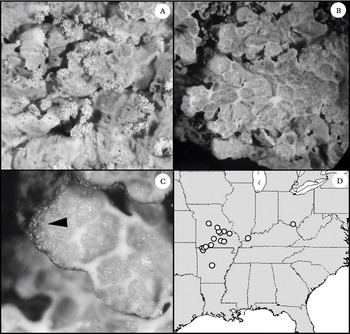
Punctelia perreticulata (Lendemer 7230, NY). A, soralia, ×1; B, thallus margin, ×0.5; C, pruinose lobe margin, ×4; D, geographic distribution based on herbarium material at CANL and NY.

Description. See Wilhelm & Ladd (Reference Wilhelm and Ladd1987).
Discussion. While Wilhelm & Ladd (Reference Wilhelm and Ladd1987) correctly separated Punctelia caseana from P. perreticulata, they used the name P. subrudecta for the former taxon because, at that time, conidia from the type of P. subrudecta had not been studied. It was only when Adler & Ahti (Reference Adler and Ahti1996) reported on the separation of P. perreticulata and P. subrudecta that the difference in conidium-type between the North American material referred to P. subrudecta (hereafter referred to as ‘P. subrudecta auct Amer.’) and that of the type of P. subrudecta was actually realized. These authors included P. subrudecta auct. Amer. (= P. caseana) in their concept of P. perreticulata because both taxa have rod-shaped to filiform conidia, and they considered the statistically significant differences in the length of the conidia (see Table 2) to have no taxonomic value.
We believe that Adler & Ahti (Reference Adler and Ahti1996) included Punctelia subrudecta auct. Amer. in their concept of P. perreticulata because they did not actually examine North American material of P. perreticulata s. str., and that their report of long conidia actually refers to a mixture of P. caseana and P. jeckeri. This supposition is based on the fact that in North America P. perreticulata s. str. is known only from the Ozark Ecoregion and a handful of scattered populations in rare Ozark-like habitats (e.g., glades), and all of the specimens cited by Adler & Ahti (Reference Adler and Ahti1996) were from outside of this region and from other habitats. In fact, specimens of P. perreticulata sensu Wilhelm & Ladd (= P. perreticulata s. str.) have the short conidia (Harris & Ladd Reference Harris and Ladd2005) reported as characteristic of European populations of this species. In the light of our results, we reject the emendation of P. perreticulata proposed by Adler & Ahti (Reference Adler and Ahti1996), and recognize this species as originally conceived.
While the confusion discussed above is understandable in the light of the lack of available material, we find the subsequent treatment by Aptroot (Reference Aptroot2003) considerably more puzzling because that author was presumably well acquainted with Punctelia jeckeri (syn. P. ulophylla), P. perreticulata and P. subrudecta as a result of his studies of these taxa in Europe (van Herk & Aptroot Reference van Herk and Aptroot2000). Despite having correctly separated these species in the past, the North American material was all lumped into a broad concept of P. perreticulata, following the arguments and implications of Adler & Ahti (Reference Adler and Ahti1996).
Specimens examined ITALY: Liguria: Spotorno (Savona), 1952, C. Sbarbaro s. n. (NYx2); Alassio, 1950, C. Sbarbaro s. n. (NY).—USA: Arkansas: Carroll Co., along US 62 NE of White River, 2000, R. C. Harris 44601, 44610, 44622 (all NY); Garland Co., Ouachita National Forest, 1993, S. D. Sharnoff & S. Sharnoff 1058.13 (CANL). Missouri: Carter Co., Peck Ranch Conservation Area, 1997, R. C. Harris 40429 (NY); Ozark Co., Mark Twain National Forest, Smoke Tree Scenic Lookout, 1997, R. C. Harris 41393 (NY); Shannon Co., Ozark National Scenic Riverways along CR NN, 1990, R. C. Harris 25723 (NY). Stone Co., Ashe Juniper Natural Area, 2002, R. C. Harris 44685, 46702 (both NY); Washington Co., Hughes Mountain Conservation Area, 2002, A. Amtoft 326 (NY). Illinois: Gallatin Co., Shawnee National Forest, 1999, I. M. Brodo 29732 (CANL). Ohio: Scioto Co., Shawnee State Forest, Copperhead Lookout, 2006, J. C. Lendemer et al. 7230 (NY).
We thank Andre Aptroot, Irwin Brodo, Robert Egan, Richard Harris, and Douglas Ladd for their helpful discussions of Punctelia subrudecta and its history in North America. We also thank Kerry Knudsen and Bruce McCune for providing material that was used in this study. Thanks to the curators of the following herbaria for making material available to us: CANL, DUKE, NY, SBBG and hb. Aptroot. The second author would like to thank Jolanta Miądlikowska and François Lutzoni for training in the use of all phylogenetic software. Fieldwork was made possible in part with funding from the Department of Conservation and Natural Resources of the Commonwealth of Pennsylvania, The Zalk Travel Fund of the City University of New York, The New York Botanical Garden, and The Western Pennsylvania Conservancy. The molecular data obtained during this study was generated using the facilities of the Lewis B. and Dorothy Cullman Progam for Molecular Systematics.