Margaret Thatcher became the British prime minister in 1979. Her government decided, as its primary goal, to fight inflation, a scourge which had haunted her predecessors for a decade. By 1981, she had achieved some degree of success, but unemployment was rising and clouding her successful policy against inflation. Her approval rating, which stood at 45 per cent when she took office, suddenly declined to a record low of 25 per cent in late 1981.Footnote 1 Several economists even claimed that Britain was suffering through another ‘Great Depression’ in the early 1980s and voiced their fears that ‘the prospects for a thirties-style recovery were not good’.Footnote 2 Others blamed Thatcher’s austerity policies for eroding Britain’s industrial base and threatening the country’s socio-political stability.Footnote 3 Despite this inauspicious setting, Thatcher’s popularity index rose seven points to 32 per cent in April 1982, the first month of the Falklands War, and eventually reached 52 per cent in June 1982, which was the final month of the war.Footnote 4 Thatcher’s popularity remained above 45 per cent until her re-election in 1983.
Thatcher’s example is not unique. A growing body of empirical research indicates that leaders in struggling governments will at times use external military force for diversionary purposes.Footnote 5 They will dispatch soldiers on a foreign military mission in the hope that it will boost their standing in the country, end domestic unrest or stimulate the country’s economy. In fact, it is commonly argued that both Argentinian and British involvement in the Malvinas/Falklands War resulted at least in part from diversionary pressures. Severe economic problems in Argentina and Britain led to increased political opposition to both the Galtieri and the Thatcher governments, providing the former with a strong incentive to take the Malvinas by force and the latter with an equally strong reason to reverse the situation through war.Footnote 6
In this article, we contend that the Argentinian use of diversionary force was an anomaly in 1982, but the British diversion was not. Contrary to common normative assumptions, leaders in mature, established democracies are more prone to use foreign military force for domestic political gain than even the most contemptible autocrats. This argument seems paradoxical, because policy makers in established democracies have presumably not only accepted norms which emphasize negotiation, compromise and the value of human life, they operate within systems designed to check their own authority. We maintain that it is these very checks which often compel decision makers in mature democracies to divert. Institutional and partisan restraints prevent them from implementing effective domestic policy when their electoral prospects dim, forcing them to at least consider diversionary force. Leaders in the most liberal states in the international system may consequently, and seemingly illogically, fall into an illiberal pattern of using foreign military force to solve domestic problems.
We have followed our own earlier extension of Bruce Bueno de Mesquita and his associates’ institutional approach, rational choice literature on voting and research on democratic audience costs to develop the three major components of our argument.Footnote 7 We define ‘audience costs’ as the penalty that leaders incur for failing to keep commitments or for initiating disastrous policies.Footnote 8 Following Michael Doyle’s conceptualization, we define mature democracies as countries with sovereignty, market and private economies, judicial rights and representative political institutions.Footnote 9
The institutional approach highlights the institutional barriers that leaders in mature democracies encounter when they try to find domestic solutions to certain domestic problems. The rational choice literature on voting demonstrates how difficult it is for leaders in mature democracies to regain popular support when the country has experienced domestic economic difficulties. Even domestic policy which successfully resolves economic problems and increases growth often does little to boost the political executive’s popular support and may even have the seemingly contradictory effect of reducing the leader’s standing in public opinion polls further.Footnote 10 Since the voting public is not inclined to reward successful economic policy, embattled leaders in mature democracies may turn to foreign policy to regain their political credibility and to improve their chances of retaining office. The decision to use diversionary force is made easier when leaders are confident that the military operation will be both a military success and provide the domestic political boost they are seeking. Recent research on audience costs suggests that military missions launched by leaders in mature democracies have a high probability of achieving both of these outcomes.
Of course, a good deal of institutional variation exists among countries typically labelled ‘mature democracies’. The final component of our theory refines our earlier approach further by developing hypotheses on the impact that institutional differences have on mature democracies’ diversionary proclivities. To determine whether the leaders of mature democracies, and especially certain types of mature democracies, are more likely both to use diversionary force and to reap political rewards from doing so than other leaders, we test the reciprocal relationships which exist between the use of foreign military force and the domestic political and economic variables which may cause it.
Our study is certainly not the first to analyse mature democracies’ propensity to use diversionary military force. A number of studies have been undertaken on the subject with, to date, mixed results.Footnote 11 Our analysis is, however, the first to separate out and test the diversionary behaviour of several distinct types of established democracies and to determine whether diversionary force by these actors ‘works’ by producing domestic political and economic benefits for leaders. To our knowledge, it is also the first to develop an integrated, multi-layer theory that attempts to bring greater clarity to the seemingly illogical phenomenon of democratic diversion.
The reciprocal theoretical and empirical approach we employ fills an additional gap in the literature. Over fifteen years ago in a review of research on diversion, Jack Levy observed that diversionary force is ‘fundamentally dynamic and reciprocal in nature’.Footnote 12 Since that time, not a single cross-national study on diversionary force’s reciprocal qualities has appeared. Karl DeRouen has demonstrated the reciprocal relationship that exists between external military force and leader approval ratings in the United States and Karl DeRouen and Jeffrey Peake have found a similar relationship between external force and popular perceptions of the economy in the United States, but empirical studies have yet to analyse potential reciprocal relations outside of the United States.Footnote 13
We do so in a sample of 140 countries from 1950 to 1996 using a dynamic generalized method of moments (GMM) estimator developed by Manuel Allerano and Stephen Bond to capture the endogeneity of the domestic political and economic causes of diversion.Footnote 14 Given recent criticism of the use of Militarized Interstate Disputes (MIDs) in studies of diversion, we use Frederic Pearson and Robert Baumann’s International Military Intervention (IMI) dataset to operationalize the unilateral use of external military force.Footnote 15 We rely on annual economic growth rates and inflation rates to assess economic performance. Because public opinion polling data are not available for most of the states in our sample, we cannot follow the conventional path in the diversionary literature of examining leader approval ratings in this article. We analyse overt forms of public dissatisfaction instead, using Arthur Banks’s data collection to operationalize elite unrest and mass unrest.Footnote 16
We begin with a brief review of the empirical literature on diversionary behaviour, before summarizing the institutional approach and our own earlier adaptation of it in the second section of the article. We then develop our theory on mature democracies in greater detail using the literatures on rational voting and audience costs in the third section. We also distinguish different types of mature democracies and their diversionary proclivities. We present variable measurement and our methods in the fourth section, and discuss our empirical findings in the fifth. We provide conclusions in the final section of the article.
Extant research on diversionary behaviour
The notion that leaders attempt to divert public attention away from domestic policy failures has a long pedigree. It has practically become conventional wisdom that leaders may be tempted to ‘wag the dog’ by pursuing policies aimed at refocusing public concern over domestic troubles on a pressing or even a contrived foreign issue. The genesis of international relations research on diversionary force can be found in the sociological literature on in-groups and out-groups.Footnote 17 Research on group behaviour demonstrates that individuals within in-groups tend to become more cohesive and supportive of their leader when facing threats from out-groups. International relations research has similarly shown that populations tend to rally around their leaders when the country faces an external threat or is involved in an international crisis. The rally effect is often brief, but it may provide a window of opportunity for struggling leaders to resurrect their political fortunes.Footnote 18
Although scholars have repeatedly found short-lived spikes in US presidential approval following US uses of military force, empirical studies have only recently begun to find consistent evidence of diversionary behaviour. The first quantitative research on the subject, exemplified by the work of Rudolph Rummel and Raymond Tanter, found no correlation between unrest within countries (such as riots, protests, civil wars, etc.) and external conflict, and quantitative research through the late 1980s continued to raise doubts about the empirical validity of diversionary theory.Footnote 19 Since the early 1990s, however, the development of more precise theories on the types of domestic influences which prompt diversionary behaviour in democracies has produced more consistent support for the theory. Clifton Morgan, Kenneth Bickers and Christopher Anderson, for example, highlight the critical role that elites from the leader’s ruling party play in compelling national decision makers to use diversionary force, while Benjamin Fordham has demonstrated that different domestic stimuli compel Republican and Democratic leaders to divert, presumably because of the different constituencies they serve.Footnote 20 Much of the evidence of diversionary behaviour uncovered to date focuses on militarily powerful democracies, such as the United States, Britain and Israel, and a number of studies highlight the importance of electoral cycles.Footnote 21
Evidence of diversionary behaviour by powerful democracies in an increasing number of studies does not mean, however, that consensus has been reached on the subject. Joanne Gowa, James Meernik, Sara McLaughlin Mitchell, Will Moore and David Lanoue have argued that there is little evidence of US diversionary behaviour.Footnote 22 These authors maintain that the failure to adequately model the way that the international environment compels US leaders to use force abroad, the narrowness of the time frames typically analysed, and methodological problems such as aggregation and truncation bias have led researchers to accept misleading empirical results on US diversionary behaviour. Cross-national literature on the impact regime type has on diversionary behaviour remains similarly divided.Footnote 23
Perhaps the most novel attempts to reconcile conflicting results in the diversionary literature focus on the international context which exists when decision makers try to divert. James Meernik, Brett Ashley Leeds, David Davis and Alastair Smith have advanced arguments about the importance of selection effects in diversionary processes which have transformed research on diversion.Footnote 24 In a series of studies, Meernik has argued that it is the presence of international crises which explains US decisions to use military force rather than the domestic factors emphasized by diversionary literature. His recent work suggests that domestic conditions in the United States may be linked with the onset of international crises which involve the United States, because foreign leaders are more apt to initiate a crisis when they believe the US president is politically weak than when he is popular and confident. Meernik maintains that because past research has not taken the opportunities that leaders have to use force (i.e., the presence of international crises) and the impact that US domestic political conditions have on the timing of crises into account, it has drawn flawed conclusions from mis-specified models.
Leeds and Davis advance a different line of argument when they empirically test Smith’s formal theoretical work on what is now termed strategic conflict avoidance (SCA).Footnote 25 In an analysis of eighteen advanced industrial democracies, Leeds and Davis demonstrate that democratic leaders have difficulty finding suitable targets during periods when they are apt to use diversionary force. The transparency of democratic institutions allows decision makers in potential target states to know when a democratic leader might contemplate diversion. They can consequently adjust their behaviour to avoid provoking the troubled democracy. Studies by David Clark and Benjamin Fordham provide further evidence of SCA by potential target states when the United States encounters domestic difficulties.Footnote 26 The findings of Sara McLaughlin Mitchell and Brandon Prins not only suggest that SCA affects all democracies, they also demonstrate how important international opportunities, such as those provided by rivalries, are for diversion.Footnote 27 Meernik and scholars studying strategic conflict avoidance thus come to starkly different conclusions about how foreign governments act when democratic leaders encounter domestic political and economic difficulties. Both, however, emphasize the necessity of taking the international context into account in diversionary studies.
Although recent advances in diversionary research focus on the opportunities the international environment either provides to or denies to potentially diversionary actors, we take a different approach. While we are careful to incorporate the international contexts most frequently emphasized in the literature, crisis and rivalry, in all of our statistical analyses, the selection effects generated by the international environment are not the crux of our theory. We build off of our earlier attempt to reconcile the literature by using refined conceptualizations of domestic regime type.Footnote 28 We have argued that one reason cross-national research on diversion continues to produce conflicting results is the common practice of dichotomizing regime type. Referencing democratic peace research that distinguishes established democracies from embryonic democracies,Footnote 29 we used Bruce Bueno de Mesquita et al.’sFootnote 30 institutional approach to develop theory explaining the diversionary proclivities of four regime types: mature democracies, consolidating democracies, mature autocracies and consolidating autocracies. Our theory led us to anticipate that mature democracies are the form of government with the greatest proclivity for diversion, and our empirical analysis bears this contention out.
In the next section, we briefly summarize our earlier extension of the institutional approach to diversionary force. Following that, we build upon the approach by adding insights from the rational choice voting and audience costs literatures.
The institutional approach
The institutional approach’s central assumption is that political leaders want above all else to stay in office. They enjoy the power and the perks associated with positions of leadership, and they will not surrender them easily. They thus continually strive to satisfy the domestic constituencies which help them to keep power. Since the character of these constituencies varies cross-nationally, the institutional approach focuses on two tiers of supporters to build generalizations on the strategies that leaders use to retain office. The first is the selectorate, or the set of citizens ‘who have an institutional say in choosing leaders’,Footnote 31 such as voting publics in democracies. The second is the winning coalition, or the most minimal grouping of people, typically politicians, from whom leaders need support to remain in office. Not surprisingly, selectorates and winning coalition sizes tend to be much larger in democracies than in autocracies.
In our earlier work we merged the institutional approach’s insight on the policy options which are available to leaders in different institutional settings with a common argument in the diversionary literature. What may be termed the policy availability argument contends that leaders who have reliable, credible domestic policy options which allow them to respond effectively to political and economic problems typically do not resort to diversionary force.Footnote 32 Domestic policies tend to carry less risk than military missions abroad, even diversionary missions which are carefully planned and selected for success.
Following the combined logic of the institutional approach and the policy availability argument, we have argued that leaders in mature autocracies (mature autocrats) rarely use diversionary force. Mature autocrats have relatively small winning coalitions, the members of which can often be controlled with a steady flow of private goods. Even when the domestic economy is in severe distress mature autocrats can channel a disproportionate proportion of the country’s wealth to their winning coalitions to ensure that the base of their political power is satisfied. They also have a range of domestic policy options they can use to bolster their domestic political positions that democratic leaders lack. Autocrats can crack down on public protesters, jail dissidents, purge elites and censure or close press outlets.Footnote 33 Public and peripheral elite dissent can thus be dealt with by the mature autocrat’s henchmen, and this is a less risky and costly course of action than launching a foreign military venture.
The leaders of mature democracies (mature democrats) find themselves in a much more tenuous position when domestic difficulties arise which are serious enough to threaten their tenure in office. They operate within large winning coalitions, which represent at least a plurality of the selectorate. They cannot possibly disperse private goods widely enough to keep members of their winning coalition loyal. To retain office, they must deliver public goods by implementing policies which are beneficial for society. The problem is that in comparison with mature autocrats they have few policy levers to pull in response to serious domestic difficulties. If negative public opinion is being generated by motivated opposition groups, mature democratic leaders cannot (and presumably would not) use repressive policies to quiet these groups. If political scandal or policy failure is the root cause of mature democrats’ declining political standing, they cannot censure the press. If leaders in some types of democracies (notably presidential democracies and parliamentary democracies with coalition governments, as will be explained below) attempt to implement bold new domestic policies to revive their electoral prospects, the institutional and partisan checks and balances inherent in the political system will slow, modify or block them.Footnote 34 If an economic downturn is to blame for the leader’s political woes, these same checks and additional institutional constraints, particularly independent central banks, will limit mature democrats’ ability to resuscitate the economy with macroeconomic policy.Footnote 35
Domestic economic difficulty is, in fact, a particularly vexing problem for mature democrats. Even when mature democrats are free to intervene in the economy, they have few policy options which will produce either guaranteed or quick results. Among the alternatives they might consider are tax cuts to lessen the impact of unemployment, interest rate cuts by central banks to increase investor confidence and fiscal austerity programmes to curb inflation. None of these options works rapidly to ameliorate economic problems, and all have the potential for negative side-effects. Tax cuts diminish revenue for other programmes, including those designed to buffer individuals from economic hardships. Fiscal austerity programmes tend to dampen economic growth. Interest rate cuts may reduce savings and create dangerous bubbles in the economy. Worse still for mature democrats, dramatic macroeconomic policy changes stand a good chance of alienating important domestic constituencies.Footnote 36
Political executives in mature democracies consequently often find themselves ‘hemmed in’ by institutional, partisan and policy checks when they attempt to forge domestic legislation to solve major domestic economic and political problems. When mature democrats find that they cannot implement effective national policy in response to mounting domestic problems, they may turn to foreign policy in an attempt to salvage their political careers and in the hope of winning another term in office. The use of military force overseas is not the only foreign policy option mature democrats may consider to improve their standing at home, but if they want to initiate a decisive shift in the domestic agenda it is often their most potent alternative.Footnote 37
In our earlier work we examined consolidating democracies and autocracies as well. While we had anticipated that both regime types would have considerable potential to use diversionary force, our empirical results refuted this presumption. We thus concluded with the seemingly paradoxical finding that the countries with the greatest amount of political freedom are also the most prone to dispatch troops abroad for personal political gain. While our adaptation of the institutional approach took us some way towards explaining this outcome, we believe that insights from two related literatures add important substance to the argument.
Rational voters, audience costs and democracies’ propensity for diversion
The General Model
Rational choice literature on voting provides a clear perspective on the political dilemma mature democrats face when their political standing is being undermined by domestic economic and political problems. We use a simple hypothetical example of politically damaging inflation to illustrate the argument. Our example of inflation can be applied to other economic problems such as declining economic growth or unemployment, mutatis mutandis. The advantage of using inflation is that price instability generates a variety of welfare-reducing distortions so severe that the maintenance of price stability is one of the core desiderata of normative macroeconomics.Footnote 38 Our example reveals that when the economy sours mature democrats are often placed in a no-win position vis-à-vis the selectorate, which rational voting literature typically presumes is divided into two types of voters. Naïve voters are rarely informed about political events and they seldom question the motives of political leaders. Sophisticated voters are more politically astute.Footnote 39 They understand the political process fairly well, and they realize that political leaders may be motivated by the pursuit of political gain. The proportion of voters that is naïve or sophisticated can be expected to vary across countries and across time, though this may not matter much to leaders’ contemplating macro-economic intervention.Footnote 40 Neither group tends to reward them for initiating policies that revive the economy.
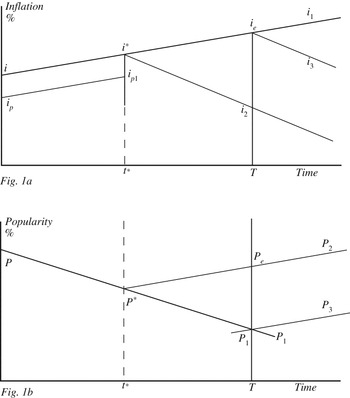
Our example is best presented in graphical form. Figures 1a and 1b illustrate why mature democrats must think hard before implementing substantial new macroeconomic policy if their main objective is to increase their poll numbers and their chance for re-election.Footnote 41 Assume, for the sake of argument, the economy is overheating and moving along path ii1, as Figure 1a illustrates. Under this scenario, it would seem that if the government wants to be re-elected, it should intervene with macroeconomic policy before the upcoming election at time T. Of course, such an intervention depends heavily on the institutional configuration found in most polities, of which central bank independence (CBI) is the most important factor. If the country does not have an independent central bank, the executive can directly intervene with its unique instrument, the bank lending rate to raise interest rates, to reduce aggregate demand at t*. By intervening to cool the economy, the government hopes inflation will head downward on path i *i 2 and popularity will simultaneously rise in Figure 1b from P * to Pe. If it does not intervene, the government may not have the chance to do so at T because it may lose the upcoming election.
Popularity and policy choice
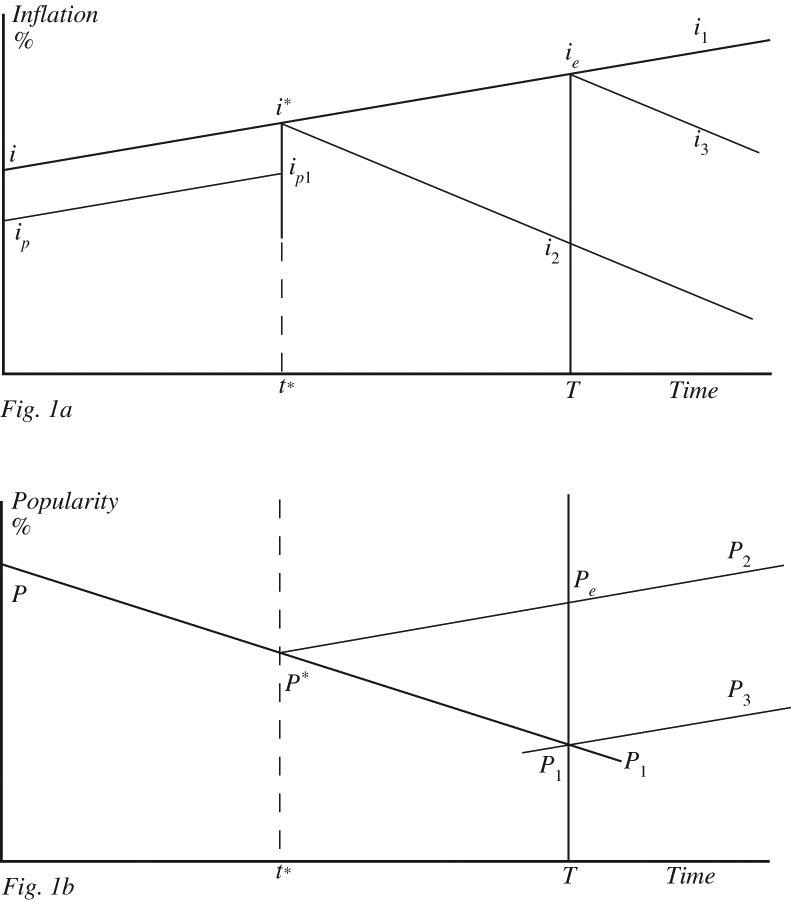
Unfortunately for mature democrats, even a successful intervention at t* may reduce their popular support among both naïve and sophisticated voters. Voters that fit the naïve model are not fully attuned to the country’s economic difficulties. Their perception of inflation is assumed to proceed along the path ipip 1, a level which is lower than the real inflation levels tracked by the government and the media. Since they are not fully cognizant of the country’s economic struggles, government intervention alerts naïve voters to the full extent of the country’s economic plight for the first time. The disappointing outcome for the government is a lingering belief among naïve voters that the government cannot manage the economy, a belief which persists even if the government initiates policy which improves the economy. The government consequently tends to be ‘rewarded’ for successful macroeconomic intervention with its popularity among naïve voters falling from P* to P 1 instead of rising from P* to P e. The outcome is no better for mature democrats among sophisticated voters. Sophisticated voters are assumed to be sceptical of the motives behind macroeconomic intervention and to catch on fast when political executives try to fool them by manipulating the economy before elections.Footnote 42 Consequently, even a successful intervention which causes inflation to fall from i * to i 2 may not have the desired effect on this large, cynical group of voters. Many sophisticated voters will presume that the government intervened in the economy solely for political gain and will not give the government credit for any economic recovery which follows. Sophisticated public opinion is thus as likely to fall from P * to P 1 following successful intervention as it is to rise from P * to P e. Both of these ill-fated outcomes, from the government’s perspective, assume that the macroeconomic intervention is successful. If it is not, the decline in the government’s popular standing will only accelerate.
The only winner with either type of voter is the political opposition. If the government loses the election at T, the new political leaders will likely intervene quickly after assuming office if inflation has not been curbed. They hope their policy will cause inflation to drop from i e to i 3 and their popularity to rise from P 1 to P 3. Since they can pin blame on the recently ousted government, they do not have to worry about informing naïve voters about the economy’s underperformance. They have little reason to be concerned about sophisticated voters questioning their motives either. The next election is still years away.
The discussion to this point assumes that political leaders’ ability to implement macroeconomic policy is unconstrained by central bank independence. Unfortunately for mature democrats, they do not fare any better with the voting public when they co-exist with an autonomous central bank. No matter who intervenes in the economy, the central bank or the political executive, intervention draws naïve voters’ attention to the country’s economic problems. They tend to place blame on elected leaders rather than appointed central bankers.
CBI has a more palliative effect on sophisticated voters. It alleviates sophisticated voter suspicion over the timing and the motives of an intervention. Nonetheless, CBI creates other problems for political executives hoping to stimulate the economy and to improve their standing in polls.Footnote 43 The conservative policies central banks typically use to fight inflation often generate negative transfers to the poor, who represent the median voter in democracies.Footnote 44 An independent bank’s isolated decision to implement economic policy at t * thus has the potential to do considerable harm to mature democrats’ poll numbers and their prospects for election at T. It may actually push the executive even harder to find alternative means to recover their popularity before T.
In sum, regardless of CBI, mature democrats find it hard to stimulate a struggling domestic economy in a way which will translate into improved popularity. Since even successful domestic economic policy can undermine mature democrats’ political standing, it is hardly surprising that they might consider using diversionary force to improve their chances of retaining office. They are all the more likely to do so if they feel confident of the outcome of the military mission. Recent research on audience costs suggests that they have good reason to believe that diversionary force will not only succeed militarily, it will generate the domestic political benefits mature democrats desire. Chief among those benefits, of course, is retention of the foremost political office in the land.
Building on the formal work of James Fearon and Alastair Smith, Kenneth Schultz and Matthew Baum demonstrate empirically that mature democrats tend to be selective when they take action which attracts public attention and thereby invokes audience costs.Footnote 45 Even threatening to use military force abroad can be risky for mature democrats. Mature democrats who back down from a public threat may have to pay a substantial price at home, such as losing the next election.Footnote 46 This will be especially the case if the public views the capitulation as a sign of incompetence.Footnote 47 The actual deployment of troops abroad should only intensify this effect. Mature democrats who launch military missions which fail, cost lives disproportionate to the mission’s goals, or are characterized as military or diplomatic blunders may find it hard to restore their political credibility. For this reason, mature democrats call attention to military operations overseas only when they believe they will succeed.Footnote 48 In the diversionary context, success can be defined not only by meeting the military requirements of the mission quickly and at relatively low cost, but also by alleviating, at least for a short time, the domestic problems which prompted the diversionary operation in the first place. In other words, just as mature democrats tend to select themselves into wars they can win because of audience costs, they should also tend to select themselves into diversionary military missions that will result in military success and will help them to achieve their domestic goals.Footnote 49
Audience costs tend to be less potent in other political systems, and thus the connection between policy performance and leadership tenure may not be fully established in embryonic democracies and may barely exist at all in autocracies. Since leaders in these regimes have less reason to fear losing office following a foreign policy slip, they will tend to be less judicious than mature democrats when they select the targets for and the timing of military operations. One consequence is that the military missions autocrats launch will stand less chance of either achieving battlefield success or producing domestic political benefits than the missions initiated by mature democrats. Given this, our first two hypotheses are:
HYPOTHESIS 1: Mature democrats are more likely than leaders in other regimes to use external military force for diversionary purposes.
HYPOTHESIS 2: Mature democrats are more likely than leaders in other regimes to achieve positive domestic outcomes, such as decreased levels of political unrest and improved domestic economic performance, from the use of external military force.
We believe that audience costs, naïve voters and sophisticated voters are present to different degrees in all mature democracies. We nonetheless recognize that major institutional differences exist across mature democracies and these differences can shape the policy options that leaders have at their disposal. The final component of our theory thus combines the institutional approach and the policy availability argument to develop hypotheses on the diversionary proclivities of presidential democracies and four types of parliamentary democracies commonly discussed in the literature.
Institutional Variation among Mature Democracies and the Incentive to Divert
Perhaps the most influential and systematic method to distinguish mature democracies is George Tsebelis’s veto-player approach.Footnote 50 Since veto players are actors within the political system with the ability to thwart the passage of policies, it can be expected that leaders in political systems with larger numbers of veto players should stand less chance of passing ambitious or tough legislation to solve the country’s immediate political and economic problems than counterparts who encounter fewer veto players. Leaders in presidential systems and in coalition governments in parliamentary systems should thus have greater difficulty implementing effective domestic policy than leaders in single-party majority parliamentary systems. Presidents face potential vetoes from other branches of government and prime ministers or chancellors in coalition governments can be checked by their coalition partners. Tsebelis terms the former ‘institutional’ vetoes and the latter ‘partisan’ vetoes. In contrast, so long as they control the votes of the members of their party in the parliament, leaders in single-party majority parliaments (‘majoritarian’ leaders) face virtually no institutionalized restraints on their policy proposals.Footnote 51 The government’s own backbenchers are the main potential brake to majoritarian leaders. They must defect before a government programme can be blocked.
Following the logic of the policy availability argument, we would expect majoritarian leaders to have less need to use diversionary force than presidents and coalition government leaders because they are better able to implement effective domestic policies. Majoritarian leaders must, of course, still work with inadequate economic policy tools and must overcome the ungrateful attitudes of naïve and sophisticated voters, but if they do manage to craft domestic policy which has the potential to boost their popular standing they have a much higher probability of implementing it intact than presidents and coalition government leaders.Footnote 52
Although we have discussed the three most fundamental institutional types among mature democracies, other variants exist. Two commonly studied are single-party minority governments and single-party majority governments with weak control over their backbenchers. Single-party minority governments tend to rule in ways consistent with single-party majority governments, though they face an additional veto from opposition parties in parliament.Footnote 53 In extreme cases, majoritarian governments with weak party cohesion may resemble multi-party coalitions as party leaders scramble to form political alliances with backbenchers in order to pass legislation. We would expect both forms of government to have less need to turn to diversionary force than presidential governments and coalition governments because they face fewer clearly defined veto players, but more need than majoritarian leaders.Footnote 54 Consequently, our final two hypotheses are:
HYPOTHESIS 3: Presidents and leaders of coalition governments are more likely to use diversionary force than majoritarian leaders.
HYPOTHESIS 4: Leaders of minority governments and single-party governments with weak party cohesion will have mixed records of using diversionary force.
Models: variables, data and methods
Analysing reciprocal relations between the use of foreign military force, domestic political unrest and domestic economic performance requires estimating a number of different dependent variables. We estimate one dependent variable for foreign military force and two each for domestic political unrest and domestic economic performance. In our reciprocal analysis our dependent variables also serve as independent variables in subsequent estimates. Political unrest and economic performance represent independent variables explaining foreign military force, while military intervention is the explanatory variable in political unrest and economic performance models. Each dependent variable requires a distinct set of control variables as well.
Dependent and Independent Variables
Foreign military force
Because leaders tend to divert with low-scale force, we need data on small-scale as well as large-scale military missions. Most cross-national studies of diversion use MID data to operationalize interstate military force. The MID collection, however, was developed to study interstate conflict, not decisions to use military force. It excludes categories of military deployments which may be common in diversion, such as actions against non-state actors. It also includes periodic shooting incidents across borders and incidents involving police or private actors who are not relevant to diversionary theory.Footnote 55 As a result, we use a newly updated dataset that focuses explicitly on a political executive’s decision to use military force abroad. Frederic Pearson and Robert Baumann’s IMI data collection records all verifiable cases when national ‘troops or forces … move into the territory … of another country’ to pursue political, economic or strategic objectives.Footnote 56 In essence, it catalogues episodes when national military personnel are purposefully dispatched into other sovereign states, no matter how large or small the mission. Military intervention is considered first and foremost a policy tool which results from state level political decisions in this conceptualization. Originally spanning the years 1946 to 1988, IMI has recently been expanded to 1996 and used in an increasing number of studies of interstate force.Footnote 57 We create the count variable military intervention with IMI which enumerates the number of times a state unilaterally intervenes abroad in a calendar year.
Political unrest: elite unrest and mass unrest
Most past research on popular support and diversion focuses on advanced industrial democracies and uses public opinion polling data to operationalize both mass and elite support for the government. The temporal and geographic coverage of our analysis necessitates a different operationlization. Five overt forms of political dissatisfaction recorded by Arthur Banks are used to operationalize elite and mass unrest: government crises (mostly in democracies) and purges (mostly in autocracies) are combined to produce our measure of elite unrest; general strikes, anti-government demonstrations and riots are combined to create mass unrest.Footnote 58 We assume that if both types of unrest are low, support for the leadership is relatively high, and if either form of unrest is rising political support for the leadership is deteriorating.
Domestic economic performance
Many empirical studies of diversion utilize a ‘misery index’ which combines unemployment and inflation to operationalize domestic economic difficulty, while others use economic growth as measured by annual changes in real gross domestic product (GDP). These studies typically focus on the United States or other developed countries where economic data are plentiful. Since reliable data on unemployment are not available for 102 of the 140 countries in our sample, we rely on the other two measures. For economic growth, we use the real annual percentage change in GDP using data from Angus Maddison.Footnote 59Inflation is operationally defined as annual changes in the price index using data from the International Monetary Fund.Footnote 60Economic growth and inflation are not strongly correlated with one another in our sample (correlation = −0.12).
Control Variables
Intervention as dependent variable
In our ‘Intervention Model’, we include three control variables found in the literature to be positively correlated with military intervention. The first two control variables assess the opportunities the international environment provides for the use of military force. Strategic rivalry and sub-system crisis thus control for the selection bias that affects decisions to use diversionary force. William Thompson defines strategic rivals as ‘states that are sufficiently threatening competitors to qualify as enemies’.Footnote 61 He uses historical sources to identify states that contemporary decision makers perceived as strategic rivals. Our control variable strategic rivalry employs Thompson’s data to count the number of strategic rivalries in which a state is involved in a given year. A prominent alternative to Thompson’s collection, the enduring rivalry data, was substituted for Thompson’s data in supplemental analyses.Footnote 62 The outcomes were substantively similar. Sub-system crisis counts the total number of crises in an actor’s local sub-system annually, using data from the International Crisis Behavior data collection.Footnote 63
Our last control variable in the Intervention Model is election. It is a binary variable coding the year national elections were held for the political executive. Data are drawn from Banks.Footnote 64 While some studies contend that democratic leaders use military force prior to elections to produce a rally effect, Kurt Gaubatz’s findings suggest that democratic leaders are more likely to initiate external military ventures soon after an election to leave themselves sufficient time to recover politically if the mission goes awry.Footnote 65 We assess both of these arguments using different time lags and leads on our variable election and retain the latter because most of its coefficients were positive and stable. In the analyses presented, election is a lead variable t + i, where t and i represent time and the number of years after elections, respectively. Non-democratic states are given a value of 0 for this control variable.
Political unrest as dependent variable
Our estimates of elite and mass unrest include economic growth, inflation and political fractionalization as our main control variables. Following extant literature, we expect that economic growth and fractionalization will be negatively correlated with political unrest, while inflation will be positively correlated with it.Footnote 66
Economic growth and inflation as dependent variables
Our estimates of economic growth include the two control variables that are most commonly used in economic literature on the subject. Investment as a percentage of GDP is used as a measure of capital and the natural logarithm of a country’s total population is used as a measure of labour. Investment and population should be positively and negatively correlated with economic growth, respectively.Footnote 67 Data for these standard controls are from diverse sources.Footnote 68 In our estimate of inflation, economic growth is our lone control variable because of the impact it is presumed to have on prices.
Models and Description of Our Mediating Variable ‘Mature Democracy’
Model specification
Using our five dependent variables, we estimate the following equations:

where CI is the set of control variables other than lagged intervention and ε is the error term.


where CP is our set of control variables, and υ is the stochastic term.


where CE is a vector of the control variables, and η is the stochastic term.
Our mediating variable: ‘mature democracy’
There are two components to our operationalization of mature democracy. The first uses Doyle’s conceptualization of liberal democracies to delineate the institutional requirements for countries in this category.Footnote 69 Following Immanuel Kant, Doyle maintains that liberal democracies possess four characteristics: market and private property economies, sovereignty, citizens with judicial rights and representative, ‘republican’ political institutions. To have republican institutions, a state must possess a legislative branch which has an effective role in policy formation and is competitively elected. Doyle’s classification also takes into account whether male suffrage is wide (at least 30 per cent) and that female suffrage is granted within a generation of its being demanded by an extensive suffrage movement. Since Doyle’s data ends in 1982, we use his criteria to categorize liberal democracies for the remaining years in our study. We also ran our models with a widely-used operationalization of established democracies using the Polity data, +7 on the polity variable that subtracts autocracy scores from democracy scores.Footnote 70 The results were nearly identical. Since every country that Doyle describes as a liberal democracy but one meets the +7 threshold during the time period of our sample, this is not surprising. Doyle categorizes France as a liberal democracy after 1945, but France slips below +7 in Polity between 1958 and 1968.
A static classification of liberal democracy does not fully capture our conceptualization of mature democracy, however. We presume that mature democracies have stable, well-entrenched institutions. As the example of France during the first decade of the Fifth Republic illustrates, however, a country can surpass the Polity or Doyle cutoffs for established democracies only to slip from that category at a later time. The second component of our operationalization consequently incorporates a time element. Our mediating variable mature democracy counts the number of years a country has been a liberal democracy without interruption. For example, according to Doyle, the United States has been a democracy since 1865 without disruption. The first figure we record for mature democracy in the United States is thus 86 for 1950 (the first year of our study) and the last figure is 122 for 1996 (the last year in our sample). Since Great Britain became a liberal democracy in 1832 according to Doyle’s classification, scores of 119 and 165 are recorded for 1950 and 1996 respectively.Footnote 71
Our continuous variable thus captures the maturity of democratic political systems, as measured by their longevity, as well the liberalness of their institutions. Because mature democracy is a mediating factor, we use it in interaction with our independent variables in the statistical analyses. We term states meeting Doyle’s criteria mature democracies and all other states non-democracies (scoring 0). We recognize that some countries in the latter category might be considered democracies, or at least embryonic democracies, by some measures. We refer to them with a single term to make the presentation of our results easier to follow.
We also distinguish between mature democracies. We use Arend Lijphart’s and Bingham Powell’s classifications to create continuous variables which measure the age of presidential democracies and four different forms of parliamentary democracy.Footnote 72
Recapitulation and Methods
In essence, we estimate the ‘reciprocal nature’ of diversionary force and its domestic consequences using a set of three simultaneous equations: 1, 2a or 2b, and 3a or 3b. This system can be reformulated in matrix format as follows:

where y, X and θ are the vectors of endogenous, exogenous and coefficients to be estimated respectively; ω is the vector of stochastic error terms with three components given by

where ϕ i is the country specific component, λt is the time specific component and ξit represents white noise related to both country and time. Moreover, ξit is normally distributed with mean 0 and a constant variance. In general, ϕi and λt will be correlated with the regressors in the equation. As we pointed out in our introduction, we use the dynamic panel GMM developed by Arellano and BondFootnote 73 to exploit the linear moment restrictions implied by dynamic panel data.Footnote 74 This method requires that the variables be measured as deviations from their period means and equations be estimated in differenced form. Equation 4 can be rewritten as follows:

where  and
 are centred on their period means, and Δ is the difference operator or (Δyt = yt−yt −1). Arellano and Bond also proposed several estimators that include one-step, two-step and robust one-step estimators. We retain the robust estimator because the first two estimators were inefficient. Finally, we relied on the Akaike Information Criterion to determine the number of lags for our variables.
Reviewing the evidence
The Diversionary Force Model (Model 1 or Equation 1)
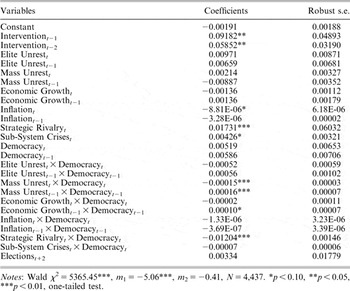
Table 1 and subsequent tables show that all the statistical models fit the data quite well as indicated by highly significant Wald χ 2 statistics. Table 1 also provides first-order and second-order correlations (m 1 and m 2) which suggest that the estimates are consistent. In fact, although m 1 shows the presence of first-order serial correlation, the test statistic for second-order serial correlation (m 2) based on residuals from the first-difference equation is not statistically significant and hence fails to reject the null hypothesis of no second-order autocorrelation. As Arellano and Bond point out, the presence of first-order serial correlation in the differenced residuals does not imply that the estimates are inconsistent; however, the existence of second-order serial correlation does.Footnote 75 Sargan tests for over-identifying restrictions, not reported for space constraints, indicate that these restrictions are correct and that the set of instruments used to estimate the equation is the correct one.
Dynamic Interaction GMM Model of Military Intervention, 1950–96

Notes: Wald χ 2 = 5365.45***, m 1 = −5.06***, m 2 = −0.41, N = 4,437. *p<0.10, **p<0.05, ***p<0.01, one-tailed test.
Table 1 displays results for the dependent variable military intervention. The main effect terms in Table 1 capture a variable’s impact when democracy is set to 0, or when a state is excluded from Doyle’s catalogue of liberal democracies.Footnote 76 We term these actors non-democracies. As Table 1 shows, elite unrest, mass unrest and economic growth are statistically insignificant in non-democracies. The only statistically significant main effect variable is inflation, but its sign is negative. Rising rates of inflation seem to reduce the probability that non-democracies will dispatch troops abroad. These outcomes suggest that non-democratic leaders were not prone to use military force for diversionary purposes from 1950 to 1996.
The same cannot be said for mature democracies. Our interaction terms that include mass unrestt and mass unrestt −1 are statistically significant at the 1 per cent level in our sample of mature democracies. The interaction term for contemporaneous mass unrest is, however, negative, while the interaction term for lagged mass unrest is positive. These outcomes suggest a more complex relationship between popular unrest and diversionary force than is commonly portrayed in the literature. Mature democracies may not have the political capital necessary to launch diversionary military missions at the time that street demonstrations and other public protests are occurring. Once mass unrest dies down, however, it seems that mature democracies may send troops abroad to boost approval ratings that continue to suffer from the popular unrest months before.
Substantive meaning can be given to these outcomes with further computation. The coefficients for our interaction terms indicate the number of units that the slope of the relationship between our dependent variable, military intervention, and our independent variable, mass unrest, changes given a one unit (one year) change in the democracy score. Thus, the coefficient for our first significant interaction term, mass unrestt × democracyt, implies that for each additional year that a democracy lasts, the slope of military intervention decreases by −0.00015 contemporaneously. Following James Jaccard, Robert Turrisi and Choi Wan, we can use this information to calculate the marginal effect of mass unrest on military intervention at any particular age of a democracy.Footnote 77 Because we assume that other variables are constant,Footnote 78 our equation is as follows: IMI = b 0 + b 1Mass Unrestt + b 2Democracyt + b 3 (Mass unrestt × Democracyt) + et. Jaccard, Turrisi and Wan provide the following formula from this equation:

Since we used Britain as an example in our introduction, it provides a useful reference point for our discussion of marginal effects. Britain became a liberal democracy in 1832 according to Doyle’s classification and hence scores 119 in the first year of our dataset, 1950, and 165 in the last year of our dataset, 1996. According to Table 1, b 1 is 0.00214 and b 3 is −0.00015. Replacing these values in the formula yields mass unrestt at 119 = 0.00214 + [(−0.00015) × (119)] and mass unrestt at 165 = 0.00214 + [(−0.00015) × (165)]. We can, however, ignore b 1 or 0.00214 because it is not statistically different from 0 in both cases. Thus, we end up with −0.0179 and −0.0248, respectively. In other words, one episode of mass unrest is associated with an almost 2 per cent decline in the probability that a state that has been a mature democracy for 119 continuous years, as Britain had been in 1950, will use military intervention, holding other variables constant. In a country that has been a democracy for 165 years, as Britain had been in 1996, the percentage rises to almost 2.5 per cent. Thus, as democracies become more mature, as measured by continuous years of existence, they grow less prone to dispatch troops abroad in the midst of mass unrest.
The situation changes in the wake of incidents of mass unrest. Applying the same formula to lagged mass unrest (mass unrestt −1) produces marginal effects of 0.019 and 0.026 for democracies 119 and 165 years old, respectively. It thus seems that as democracies age, and democratic institutions presumably become more entrenched, democratic leaders become increasingly likely to use diversionary force to shore up their political standing in the aftermath of mass unrest. Democracies may need to reach a certain level of maturity before this linear pattern becomes substantively significant, however. A democracy must, for example, be 65 years old before it reaches the substantive threshold of a 1 per cent increase in the probability of diversionary force following each episode of mass unrest.Footnote 79 Only one of the remaining independent variables is related to mature democracies’ military interventions. The lagged interaction term for economic growth is statistically significant at the 10 per cent level, but its positive direction and the statistical insignificance of the main effect variable suggests that mature democrats use force when the economy is growing, not when growth rates are declining.
Our control variables provide further evidence that mature democracies may be more prone to use military force in response to domestic stimuli than other regimes. The statistical significance and positive direction of strategic rivalry and sub-system crisis indicate that leaders in non-democracies dispatch troops overseas in response to external threats rather than to domestic difficulties. These external variables are, in contrast, negative when interacted with mature democracy. The interaction term for strategic rivalry is also statistically significant. Our formula provides marginal effects for strategic rivalryt × democracyt of 0.01731 + [(−0.01204) × (119)] = −1.4155 for 119 year old democracies and 0.01731 + [(−0.01204) × (119)] = −1.9693 for 165 year old democracies. Thus, as democracies become more mature, they grow less likely to use military force abroad in response to the external stimuli of strategic rivalry (or, in this case, an increase in the number of rivals).
These findings thus cast doubt on previous studies which contend that it is the presence of external stimuli, such as crises or rivalries, which explains mature democracies’ decision to use military force. They are, however, consistent with Mitchell and Prins’s finding that democracies have less propensity to divert against rivals than non-democracies.Footnote 80 They may also support Thompson’s contention that the intensity of the rivalry matters as much as the total number of rivalries a state is engaged in.Footnote 81
Our final control variable is elections. It is in the appropriate direction to support Gaubatz’s claim that democracies use military force after an election, but it is not statistically different from 0.Footnote 82 We also assessed one-year and three-year leads after an election and the results were the same. Our findings thus bolster recent studies by DeRouen, Fordham and Meernik, which question the relationship between national elections and the US use of military force.Footnote 83
Overall, the results in Table 1 suggest that leaders of mature democracies are more prone to use military force abroad for domestic reasons, particularly the lingering effects of mass unrest, than non-democratic leaders, who seem to use force abroad solely in response to external stimuli. Although the evidence is far from overwhelming, our results provide support for Hypothesis 1’s claim that mature democrats are more prone to use diversionary intervention than leaders in other regimes. They also have implications for the existing literature. Most importantly, they add to the body of work which concludes that leaders in mature democracies are more inclined than other decision makers to use diversionary force. We might even argue that our findings, along with recent work by Oneal, Tir and others, tip the balance of the evidence in favour of the democratic diversion argument.Footnote 84 Our findings also reinforce Leeds and Davis’s contention that the economy has no impact on democratic diversion, a claim echoed by Mitchell and Prins in their broader cross-national study.Footnote 85 The fact that numerous studies of US diversion have come to the opposite conclusion highlights an important empirical puzzle that remains to be solved by the literature. Finally, our results may give pause to those employing theories, such as Morgan’s, which claim that democratic leaders use diversionary force in response to elite level pressures.Footnote 86 Our outcomes indicate that a complex relationship exits between mass protest and diversion, but no relationship exists between elite unrest and the use of military force abroad in mature democracies. Our results do support one important aspect of Morgan’s theory, though. Mature democrats can only use force when mass protests have subsided, not when the public is still on the streets and thus levels of public support for the leader are low.
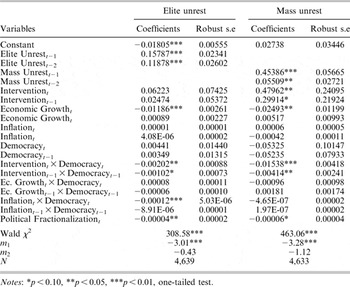
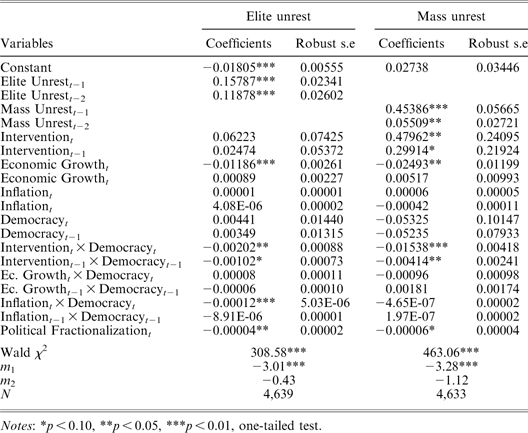
The Domestic Unrest Models (Equations 2a and 2b)
Table 2 presents our first cut at determining whether diversionary force ‘works’. It displays estimates for elite unrest and mass unrest. Our results lend considerable support to Hypothesis 2, which states that mature democrats are more likely than other leaders to reap domestic rewards from using military force abroad. Military intervention seems to have negative domestic repercussions in non-democracies. Both contemporaneous and lagged mass unrest are statistically significant and positive in Table 2. The use of military force abroad thus appears to spark, or at least exacerbate, significant public unrest in non-democracies. One military intervention is likely to increase levels of popular unrest in autocracies by almost 45 per cent contemporaneously and almost by 6 per cent with a lag, holding other factors constant.
Dynamic Interaction GMM Model of Political Unrest, 1950–96
Notes: *p<0.10, **p<0.05, ***p<0.01, one-tailed test.
In contrast, foreign military intervention pays political dividends for democratic leaders. Both contemporaneous and lagged interaction terms of intervention are statistically significant and negative in Table 2. The impact is consistent and large across both of our measures of domestic unrest. Using Britain again as our point of reference, our coefficients yield the following marginal effects: −0.2404 and −0.3333 for elite unrestt in democracies which are 119 and 165 years of age respectively and −0.1214 and −0.1683 for elite unrestt− 1 in democracies at these ages. In a democracy as mature as Britain was in 1996, one military intervention can be expected to reduce levels of elite unrest by 33 per cent contemporaneously and by 17 per cent the year after the intervention. A democracy need only be five years old before foreign military intervention reduces contemporaneous levels of elite unrest by at least 1 per cent.
Military intervention seems to have an even stronger dampening effect on mass unrest in mature democracies. The marginal effects on mass unrestt are −1.351 and −2.0581 for democracies 119 and 165 years old, respectively. For mass unrestt −1, the values are −0.1936 and −0.3839. Thus, when a 119 year old democracy intervenes militarily abroad, levels of contemporaneous mass unrest tend to decline by 135 per cent, holding other variables constant. They decline by 19 per cent the year following a military intervention. To reach the substantive threshold of a 1 per cent decline in levels of contemporaneous mass unrest, a democracy must be 32 years of age.
Although our measure of popular support is not as precise as opinion polls, these findings suggest that some form of rally effect exists in democratic selectorates and winning coalitions after the use of military force. Moreover, these rallies do not dissipate as rapidly as is often portrayed in the literature. Our results are consistent with Giocoma Chiozza and Hein Goemans’s contention that autocrats face a higher hazard of losing office than democratic leaders when they participate in external conflict.Footnote 87 Even though DeRouen only tests for a contemporaneous impact, our empirical results also fit well with his finding that the use of US military force improves presidential approval ratings.Footnote 88
Most of the control variables in Table 2 behave as expected. Economic growth lowers political unrest, though it is not statistically significant in mature democracies. As many recent studies of civil war indicate, political fractionalization is an antidote to political instability.Footnote 89 The only unanticipated result is the significant, negative relationship between inflation and elite unrest in mature democracies. Perhaps sophisticated voters do not tend to hold leaders of mature democracies accountable for inflation, particularly when an independent central bank exists.
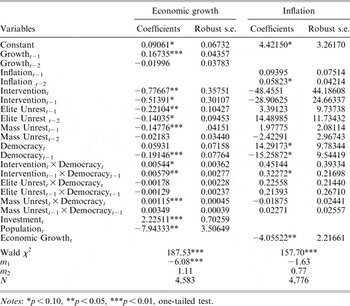
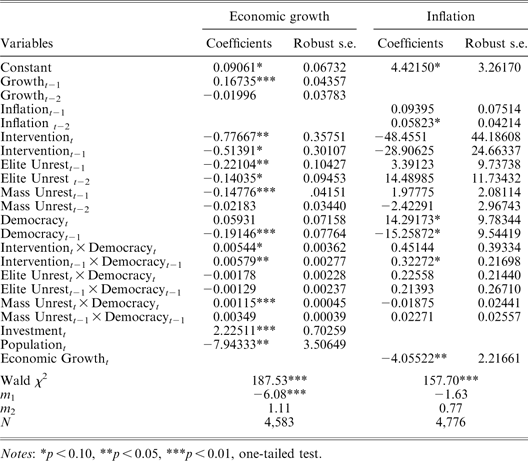
The Economic Performance Models (Equations 3a and 3b)
Table 3 presents our second cut at the question of whether diversionary force ‘works’. It displays our results for economic performance. Our findings again lend support to Hypothesis 2. As the estimate for intervention indicates, foreign military intervention tends to reduce the economic growth rates recorded by non-democratic actors. The effect is substantial, ranging from a 51 per cent decline with a lag to almost a 78 per cent decline contemporaneously.
Dynamic Interaction GMM Model of Economic Performance, 1950–96
Notes: *p<0.10, **p<0.05, ***p<0.01, one-tailed test.
Foreign military intervention tends to have the opposite impact on economic growth rates in mature democracies, as our interaction terms’ statistically significant coefficients illustrate. In a 119 year old democracy, one military intervention abroad tends to lower economic growth by almost 13 per cent contemporaneously (−0.77667 + [(0.00544) × (119)] = −0.129). As a democracy continues to age, however, the contemporaneous impact becomes positive. One military intervention can be expected to boost economic growth by 12 per cent during the year of the intervention in a 165 year old democracy (−0.77667 + [(0.00544) × (165)] = 0.121). Military intervention has a more consistent and substantial effect on growth the year following an intervention. A single military intervention can be expected to increase economic growth by 17.5 per cent the year following an intervention in democracies that are 119 years of age. In 165 year old democracies, economic growth is boosted by a staggering 44 per cent. To reach the substantive threshold of a 1 per cent contemporaneous increase in the growth rate, a democracy must be 145 years old. It need only be 91 years old to enjoy a 1 per cent rise in the growth rate the year following a military intervention.
The economic news is not all good for mature democracies which use military force abroad. Military intervention seems to generate high rates of inflation the year after the troops touch foreign shores, which is not surprising given the surge in economic growth rates. Turning to our control variables, they are in the right direction and are statistically significant in both estimates in Table 3.
These results lend support to William R. Thompson’s claim that external conflict has the potential to stimulate an actor’s economy by increasing consumer and investor confidence and perhaps even production.Footnote 90 Despite the rise in inflation associated with post-intervention growth, they also largely corroborate DeRouen and Peake’s finding that the use of US military force tends to improve popular perceptions of the US economy.Footnote 91 They do little, however, to either confirm or refute the work of Brock Blomberg and Gregory Hess,Footnote 92 perhaps the most notable recent empirical study on the impact the use of military force has on an actor’s economy. Blomberg and Hess find that external conflict tends to harm the economy of the initiating state, but they do not account for actors’ regime types. Table 3 suggests that their findings may be driven by the non-democratic actors in their sample, and that they do not apply to mature democracies.
Comparing Across Mature Democracies
Table 4 captures the reciprocal relationships that exist between military intervention and domestic difficulties in five distinct types of mature democracies: presidential, majoritarian, coalition, minority, and weak party governments. We rely on Lijphart’s and Powell’s classifications to differentiate these regime types within our sample of mature democracies.Footnote 93 Although full models including control variables are estimated, we present only interaction term outcomes in Table 4 for brevity.
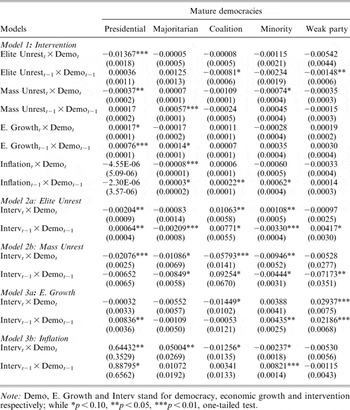
Summary Table: Relationship between Intervention and Domestic Difficulties in Mature Democracies
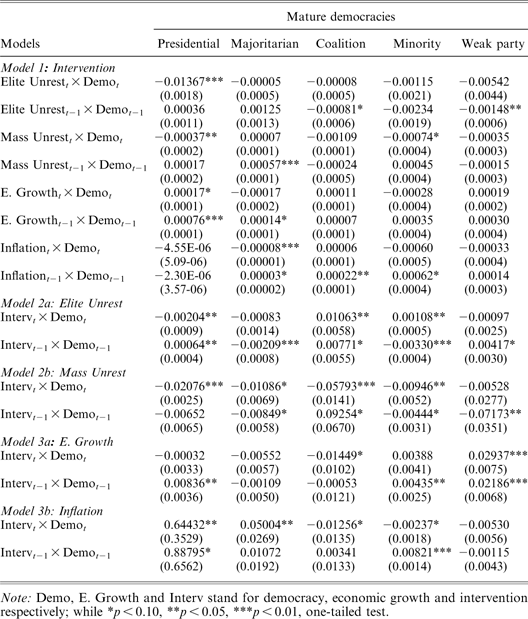
Note: Demo, E. Growth and Interv stand for democracy, economic growth and intervention respectively; while *p<0.10, **p<0.05, ***p<0.01, one-tailed test.
Model 1 in Table 4 seems to contradict Hypothesis 3, which states that leaders in mature presidential democracies and democracies with coalition governments have a greater proclivity to use diversionary force than majoritarian leaders.Footnote 94 It seems that only majoritarian governments are prone to use diversionary force when domestic unrest rises. In the year following an episode of mass unrest, the rate of interventions launched by 165 year old majoritarian democracies increases by approximately 8 per cent.Footnote 95 Majoritarian governments are also prone to use military force abroad the year after prices rise, though the substantive importance of this result is limited. A year after the emergence of inflation, intervention rates by 165 year old majoritarian democracies increase by 0.5 per cent. They also increase in 165 year old coalition governments by 2.1 per cent.
We did not expect majoritarian governments to have such a propensity for diversion. Even though majoritarian leaders operate in comparatively unfettered policy-making environments, they may not be able to address some problems effectively with domestic policy. Or, contrary to the policy availability argument, the relative freedom of manœuvre that they have in policy making may actually allow them to use diversionary force more often than other democratic leaders. The absence of substantial diversionary behaviour in presidential and coalition governments was equally unexpected by our theory, but it lends support to Meernik, Moore and others who contend that the United States does not use diversionary force.Footnote 96
There is little evidence that minority or weak party democracies divert either. Domestic pressures do not seem to compel leaders of weak party governments to send troops abroad, and their counterparts in minority governments only seem to dispatch soldiers overseas the year after a rise in inflation. Intervention rates increase 7 per cent and 10 per cent the year following a rise in prices in 119 year old and 165 year old minority government-led democracies, respectively. These outcomes partly support Hypothesis 4’s claim that minority and weak party governments will have mixed records of diversionary behaviour.
Overall, Models 2 and 3 in Table 4 reinforce our findings for mature democracies as a collective. Military force seems to pay relatively unambiguous domestic dividends for all mature democracies except coalition governments.Footnote 97 Contemporaneous or lagged military intervention reduces levels of elite unrest in mature democracies other than coalition governments. Contemporaneous or lagged military intervention also reduces levels of mass unrest in mature democracies other than coalition governments. Economic growth is stimulated the year following a military intervention in presidential, minority and weak party democracies, although it is accompanied by rising prices in presidential and minority governments. In contrast, elite unrest increases when coalition governments intervene abroad, as does mass unrest the year following the intervention. Economic growth rates decline when coalition governments use external military intervention as well. The only dividends military intervention pays to mature coalition democracies is a contemporaneous decline in mass unrest and inflation, which seem paltry in comparison to the negative ramifications using force abroad has for these governments.
The results in Table 4 have a number of implications for diversionary research. For example, they shed new light on contradictory findings on the relationship between economic difficulties and diversionary force. In broad cross-national studies, Leeds and Davis, Mitchell and Prins find that economic problems had no impact on democracies’ use of military force, but studies of US diversion by DeRouen, Fordham, Patrick James and John R. Oneal, among others, reach the opposite conclusion.Footnote 98 When we group mature democracies into one category as the cross-national studies listed above do, we also find that domestic economic difficulty has no impact on external military force. A different picture emerges, however, when distinct types of mature democracies are analysed. Some types of mature democratic regimes appear to use diversionary force in response to rising inflation. Presidential democracies are not among these diversionary states, though, which suggests that DeRouen, Fordham, James and Oneal may have uncovered yet another example of American exceptionalism.
The results in Table 4 also demonstrate the necessity of differentiating different types of mature democracies in future studies of democratic diversion. They make it clear that leaders in different institutional and political settings respond to distinct domestic stimuli and have varied propensities to use diversionary force. Our results thus suggest a research path on democratic diversion similar to the path Benjamin Fordham lays out for the study of US diversionary force.Footnote 99 Fordham finds that different domestic influences compel Democratic and Republican presidents to use diversionary force. We propose mapping out the distinct institutional and political incentives that political leaders encounter in different democratic political systems with similar theoretical specificity. Particular attention should be paid to the distinction between coalition governments and other democratic regime types, all of which leave executive authority under the control of a single party.
Conclusions
In his seminal review of diversionary research, Jack Levy contends that most diversionary studies are mis-specified because they are unidirectional.Footnote 100 Using the GMM method, we provide properly identified models to test our argument that mature democracies are especially prone to use diversionary force and especially likely to receive domestic political and economic benefits from doing so. Our results lend considerable support to our argument, although some caveats apply.
When mature democracies are studied as a single group, the empirical results support our argument. In our sample of 140 countries from 1950 to 1996, mature democracies are found to use military force for a domestic reason, namely mass unrest, even when we control for the opportunities provided by international crises and strategic rivalries. In contrast, non-democracies use force in response to the international stimuli of crises and rivalries, but not in response to domestic variables. Mature democrats also benefit domestically when they intervene militarily abroad. Levels of elite unrest and mass unrest decline both during and up to a year after the intervention, and economic growth rates increase markedly the year of the intervention as well as the following year. In stark contrast, non-democracies see levels of mass unrest increase by as much as 45 per cent when they intervene abroad, while their economic growth rates plummet by 78 per cent. Non-democratic leaders may thus refrain from using diversionary force because they have domestic policy options that leaders of mature democracies lack, as the policy availability argument contends. They may also, however, realize that using military force abroad tends to generate negative economic and political repercussions in their societies.
Our results on democratic diversion and the domestic dividends that it generates thus seem unambiguous. Analysing different types of mature democracies muddies these outcomes slightly. Contrary to our expectations, majoritarian governments appear to have a propensity for diversionary behaviour, while presidential governments do not. Most types of mature democracies reap domestic rewards for using military force abroad, but not all do. In particular, domestic economic and political difficulties seem to escalate when democracies with coalition governments intervene with military force overseas. It thus seems that only certain types of mature democracies, namely majoritarian and minority governments, have a propensity to both use diversionary force and to benefit domestically from it.Footnote 101
These results indicate how important it is to ‘unpack’ regime types in analyses of diversionary force. What seems like unqualified support for our argument using a time dependent measure of mature democracy becomes more nuanced when we distinguish different democratic regime types. The nuance also brings greater clarity, however, about which specific influences prompt leaders in different democratic systems to divert and the types of domestic benefits these leaders should expect from the use of force abroad. Given the broad swath of states included in our category of non-democracies, it would also be wise to ‘unpack’ these regimes to grasp their diversionary tendencies in future research more effectively. Mark Peceny, Caroline Beer and Shannon Terry-Sanchez’s analysis of different autocratic regimes may offer a useful starting point for this type of study.Footnote 102
While diversionary behaviour clearly varies among democratic regime types, the general finding that mature democracies are more prone to use diversionary force than other states still holds. With the exception of coalition governments, mature democracies are also more likely to gain domestic political and economic benefits when they use military force abroad than non-democracies. Therefore, our contention that the Galtieri government’s involvement in the Malvinas/Falklands War was an aberration but the Thatcher government’s was not is supported by our results. We find that majoritarian democracies are prone to use diversionary force when they encounter domestic economic problems and elite unrest, as the Thatcher government did in 1982. The startling rise of Thatcher’s poll numbers during and after the war also correlates well with our findings of sharply declining levels of mass unrest both the year a majoritarian democracy intervenes and the following year. Though more fine-grained research on the diversionary propensities of different types of democracies clearly needs to be undertaken, this study makes clear that the most liberal, domestically egalitarian states in the international system, mature democracies, also have the greatest predilection for using diversionary force. In fact, the incentives that leaders in certain forms of mature democracy have for using diversionary force seem to increase as the democracy ages, and democratic norms and institutions become more deeply entrenched.
 . More importantly, the orthogonality condition between our regressors and the stochastic term ωit will not be satisfied because of the endogeneity among our dependent variables and the inclusion of lagged intervention and lagged political unrest. Thus, neither a generalized least squares estimator nor a fixed effect estimator can satisfy the orthogonality condition. The solution to achieve orthogonality is to measure all the variables as deviations from their period means and then first difference them to remove ϕi and λt from the error term. Equation 6 is estimated by a dynamic GMM estimator to achieve both goals. The GMM estimator is an instrumental variable estimator equivalent to an efficient three-stage least squares (3SLS) estimator. Despite its virtues, the GMM has two minor drawbacks. First, differencing the variables implies that all time invariant dummies and country constant terms drop from the system. Secondly, because we estimate the model with first differences for the variables and we include lagged values of some endogenous variables, three years have been dropped from the sample. We end up with usable observations from 1953 to 1996 for our 150 countries (see Baltagi, Econometric Analysis of Panel Data).