The Boston Marathon has been held on Patriots’ Day since 1897. On April 15, 2013, at 2:49 PM EDT, 2 explosions occurred approximately 200 yards from the finish line. Tufts Medical Center, a 415-bed academic Level 1 trauma center, was the closest hospital to where the bombs exploded. Shortly after receiving the wounded patients, a suspicious package was discovered in the emergency department (ED). The package was initially identified as an explosive device. This forced an evacuation of our ED at a time when staff was still triaging and treating the victims of the marathon bombing.
As a result, we faced unusual problems. The logistics of safely evacuating patients and personnel while continuing to provide care was the primary concern. Because of the possibility of a building collapse, adjacent areas of the hospital also needed to be evacuated. Access to the operating rooms (ORs) and the intensive care units was severely limited, potentially jeopardizing patient care.
Because these situations are rareReference Alexander 1 even internationally, we believe that it is critical to share our experience as a way to improve protocols. We present our experience with the evacuation itself and the protocols that were proposed afterward to prevent similar incidents in the future. To the best of our knowledge, this is the first occurrence in the United States that an ED had to be evacuated during the response to a terrorist event.
The solutions we implemented can be used by any hospital, irrespective of its designation as a trauma center.
THE INCIDENT
Initial Phase
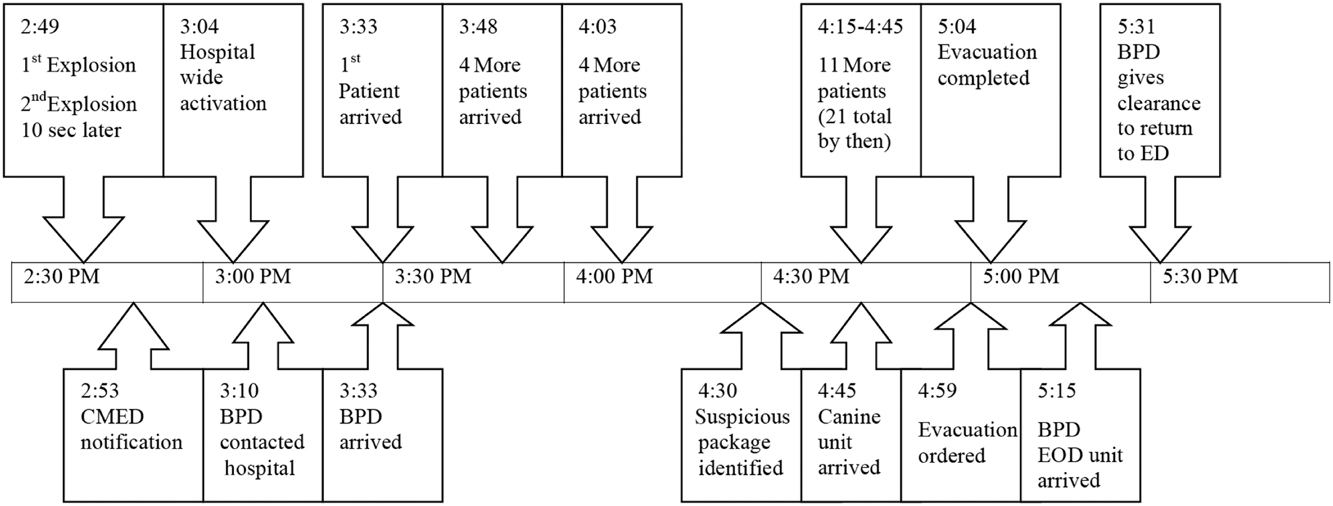
The detailed timeline of the event is shown in Figure 1. At 2:49 PM, an explosion occurred near the finish line. Ten seconds later, a second explosion occurred approximately 1 block away. Four minutes after that, the ED charge nurse received radio notification of the explosions with multiple casualties from the Metro-Boston Central Medical Emergency Direction (CMED), a centralized system coordinating emergency medical service providers and area hospitals. Our trauma surgeon on call was notified via telephone and went immediately to the ED with the backup trauma surgeon and all available surgical residents. At 3:04 PM, the trauma response was activated, notifying a large group of hospital personnel, including but not limited to those in Orthopedic Surgery, Neurosurgery, Radiology, Anesthesiology, Respiratory Therapy, and the OR.
Timeline of the Event. BPD=Boston Police Department; CMED=Metro-Boston Central Medical Emergency Direction; EOD=Explosive Ordinance Disposal Unit.

During the initial phase, the 2 trauma surgeons divided the residents into 4 trauma teams. Each trauma team was then prepositioned into 1 of 4 trauma bays. The trauma surgeons then assigned responsibilities to team members. Each surgeon supervised 2 trauma teams initially alone and later with the help of 1 ED physician. Simultaneously and following an established protocol that was developed on previously published literature, ED personnel transferred all patients present in the ED at the time of CMED notification, to inpatient floors.Reference Stein and Hirshberg 2 - Reference Lucci 7
During these preparations, there were media reports of additional explosions at the John F. Kennedy Presidential Library and Museum. Although these reports were later disproven and the disruption was due to a transformer fire, at the time, the information raised the suspicion for coordinated attacks and brought an additional sense of urgency to the process.
Patient Arrival
The first patient arrived at 3:33 PM, 40 minutes after the explosions. While ambulances were initially directed to multiple hospitals, some of the access routes were closed due to unexpected pedestrian traffic evacuating the scene.Reference Kashuk, Halperin and Caspi 6 Boston Police Department (BPD) officers redirected the ambulances to different hospitals based on the routes available. Five patients arrived in the initial 15 minutes followed by 5 more 15 minutes later. Thirteen patients with less severe injuries arrived over the next 5 hours.
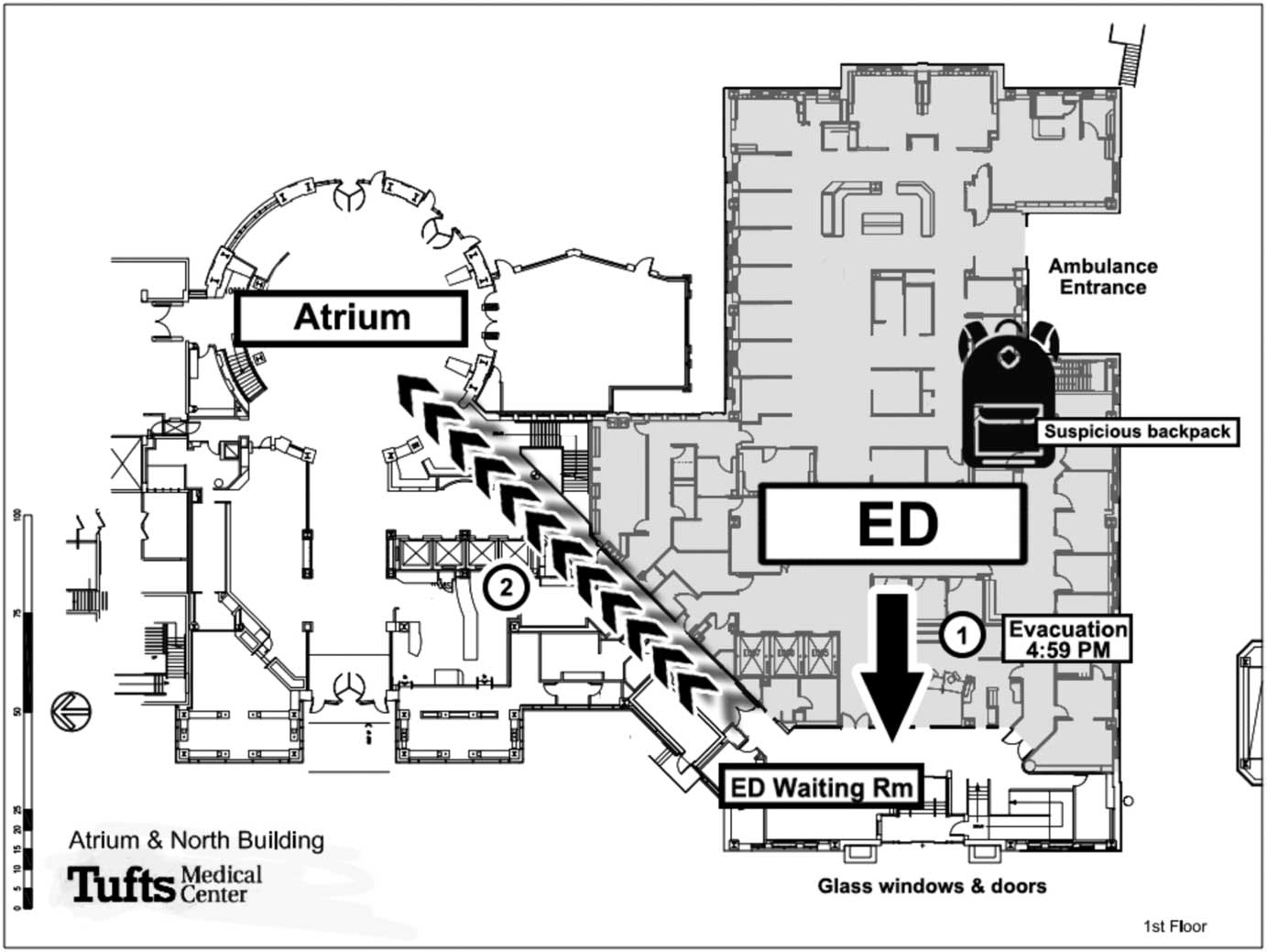
Law enforcement officers began communicating with Tufts ED and security staff within 20 minutes of the explosion, and they arrived at 3:33 PM. Because of concerns of a coordinated attack, BPD officers conducted a visual inspection of the rooms a few minutes later. During this inspection, a previously unidentified package, a large black backpack, was found in 1 of the rooms (Figure 2). A bomb-sniffing dog was promptly brought in to check the package. The inspection was repeated 3 times and, each time, the dog indicated that the backpack contained explosives. This mandated the evacuation of the ED while waiting for the BPD Explosive Ordinance Disposal Unit (Bomb Squad) to arrive.
Evacuation Routes. 1=Evacuation to the emergency department (ED) waiting room; 2=Evacuation to the Atrium building.

Evacuation of the ED
The BPD ordered the evacuation of the ED at 4:59 PM. There were approximately 125–175 people, including personnel and 17 patients, in the ED at the time that the evacuation was ordered. Four patients from the bombing were already in the OR.
The evacuation followed National Counterterrorism Center (NCTC) recommendations. A backpack can contain up to 50 pounds of explosives, for which the NCTC recommends a minimum indoor mandatory evacuation distance of 150 feet. 8
A decision was made to evacuate all patients and personnel to the ED waiting room (see Figure 2). The evacuation itself was conducted calmly and professionally. There was no evidence of panic, even among patients, all of whom were aware of the reason for the evacuation. This process was completed by 5:04 PM.
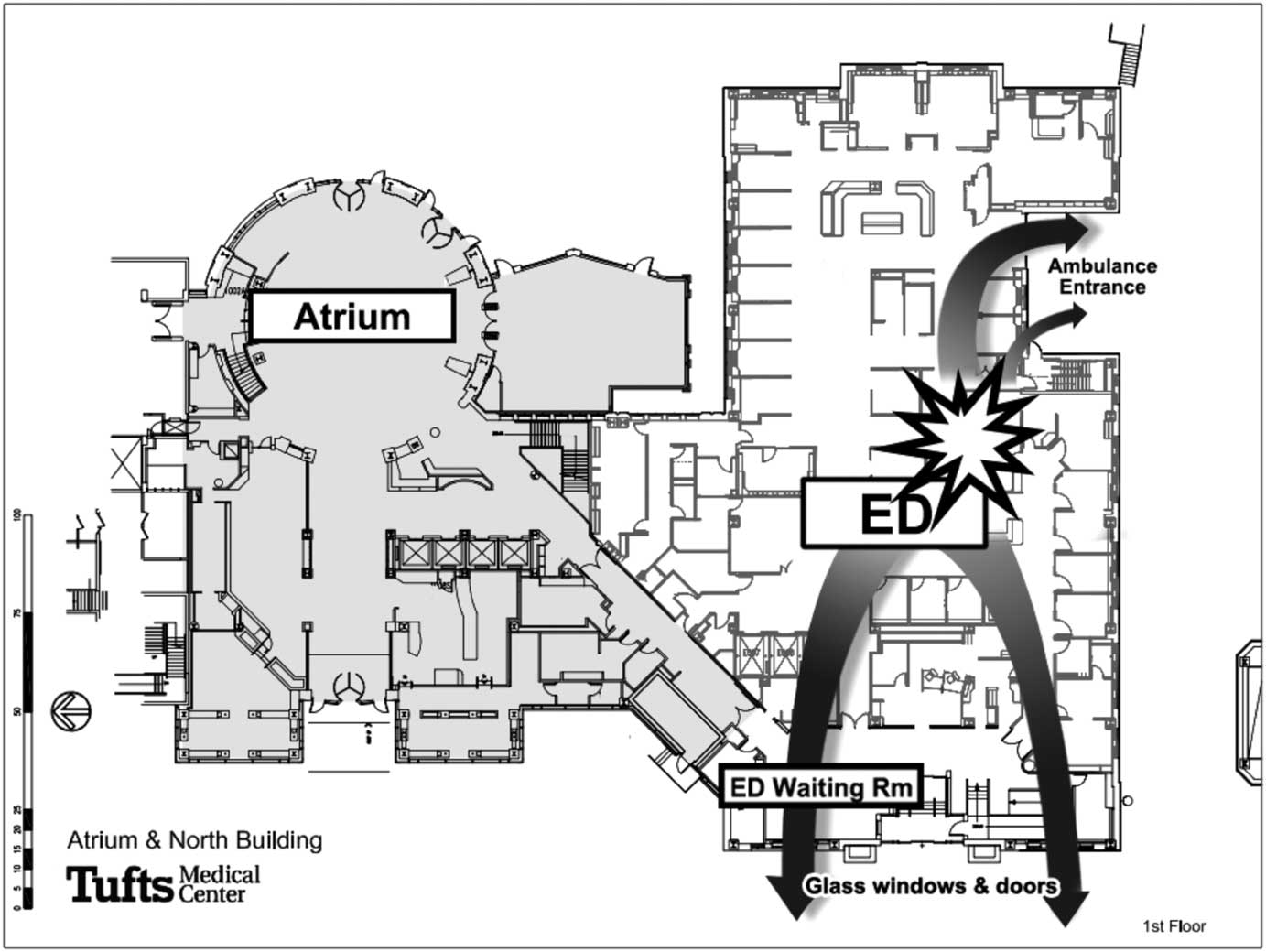
However, 1 of the trauma surgeons, who had previous antiterrorism experience, realized that this was inadequate in this situation. When considering the building construction and layout, an explosion in the ED would have directed a significant air blast toward the ED waiting roomReference Almogy and Rivkind 9 - Reference Ciraulo and Frykberg 11 (Figure 3). Furthermore, the waiting room had high glass windows and panels that, if shattered, would have resulted in severe injuries to both patients and personnel.Reference Mines, Thach and Mallonee 12 - Reference Yonekawa, Hacker and Lehman 15 As a result, the trauma surgeon instructed a further evacuation into the only other available area, the hospital main lobby (Atrium building in Figure 2), in an interconnected but different building.
Direction of the Potential Explosion Blast. ED=emergency department.

Unfortunately, the lobby elevators cannot accommodate a stretcher. The ED elevators, the only set of elevators on the ground floor able to accommodate a stretcher, were within the evacuation perimeter. Other hospital floors or connected buildings were not accessible from the main lobby without the use of stairs or elevators. Although other buildings could have potentially been accessed from the outside, this option was deemed unsafe by the BPD. Thus, the patients were confined to the main lobby area (Atrium in Figure 2). Because these patients were stable, improvised evacuation techniques using the lobby elevators and stairs were not implemented.
Following our institutional evacuation guidelines, portions of the Neonatal Intensive Care Unit and the Urology clinic, located directly above the ED, were also evacuated. The patients, families, and staff were moved to an adjacent area in a different building without incident.
After the BPD Bomb Squad determined that the backpack contained no explosives, they gave clearance to return to the ED at 5:31 PM, 27 minutes after the evacuation. The following sequence of events was determined on a retrospective review of video footage from security cameras. The patient who was initially in the room with a suspicious backpack had an altered mental status. A relative brought the backpack and placed it on the floor. The patient’s relative had left before the BPD officers could interrogate him, and the patient himself was unable to provide any information. Upon examination by the BPD Bomb Squad, the backpack contained clothing and a hair dryer. A consultation with BPD officers suggests that the hair dryer most likely triggered the dog’s response.
CONCURRENT PROBLEMS DURING THE EVACUATION
Lockdown
A lockdown is crucial during certain emergencies to protect life and property while maintaining adequate functioning of the hospital. This is routinely done by establishing a secure perimeter and directing all persons to designated entry and exit points. Security personnel are assigned to these access points.Reference Dorn 16 - 18
When the ED evacuation was ordered at 4:59 PM, a hospital lockdown was initiated by the hospital security and enforced with BPD assistance. Although lockdown exercises are routinely practiced at our institution, the scenario usually centers around a more common indication such as an infant abduction, weapons on the premises, or prisoner elopement. Preparation for a lockdown during an ongoing mass casualty incident (MCI) with patients still arriving and potential terrorists still at large was never done before. Consequently, a total lockdown was instituted where no person was allowed to leave or enter the hospital. As a result, some medical personnel treating the casualties, who evacuated the ED through the ambulance bay, were denied access to return to the hospital. We identified this inability of hospital personnel to move in and out of the hospital buildings for job-related reasons as the first area for improvement.
Overflow of Medical and Ancillary Personnel
As it has been previously reported,Reference Feliciano, Anderson and Rozycki 19 upon learning of the explosions, physicians, nurses, students, social workers, chaplains, and other personnel arrived in the ED to offer help. Similar to on-site risks when responding to a terrorist act, concentrating all personnel responding to an MCI in a small area with multiple points of entry, such as our ED, unnecessarily exposed extra personnel to a secondary device.Reference Kashuk, Halperin and Caspi 6 , 8 , 20 , Reference Paredes Zapata 21 If an explosion had occurred in the ED, the primary teams and potential replacement teams would have been incapacitated. Disabling both primary and backup MCI response teams would have created an even more significant disruption in the care of the wounded.Reference Paredes Zapata 21 , Reference Eckstein 22 The location of the primary and backup trauma teams was recognized as another area for improvement.
Chain of Command
Senior physicians also arrived to the ED creating confusion about the chain of command and contributing to miscommunication. The flow of patients out of the ED was partially disrupted as multiple “leaders” tried to implement simultaneous and potentially contradictory plans.Reference Hogan, Waeckerle, Dire and Lillibridge 23
We have 22 ORs in the Tufts Medical Center. Immediately after receiving notification of an MCI, new elective cases were halted and preparations were made for emergency surgeries.Reference Halpern, Tsai and Arnold 3 , Reference Leissner, Ortega and Beattie 5 Four ORs were ready by the time the first patient arrived. Two additional rooms were available 15 minutes later.
Standard MCI triaging protocols dictate that patients with less serious injuries may have to wait while the most seriously wounded are treated first.Reference Stein and Hirshberg 2 , Reference Leissner, Ortega and Beattie 5 , Reference Holt 24 - Reference Pesik, Keim and Iserson 26 Although the initial 10 patients had serious extremity injuries that required surgery, none of them were immediately life-threatening. Their transfer to the OR was intentionally delayed while waiting for the arrival of patients with possible life-threatening torso or head injuries.
However, this plan was not clearly understood. Some surgeons began insisting early on that their patients needed immediate operative intervention. The trauma surgeons in the ED, however, successfully delayed operations for non-life-threatening injuries until they received confirmation from the Incident Command that all casualties had been evacuated and no further patients with life-threatening injuries were being directed to our hospital. Unfortunately, at this point, a separate decision was made to resume elective surgeries without the trauma surgeons’ knowledge. This caused a delay in operating on at least 1 injured patient.
The control of the patients’ flow in the ED and in the OR during MCI was found as another area for improvement.
Communications
During an MCI, telephone systems can be overloaded by call volume or shut down by law enforcement to prevent remote detonation of an explosive.Reference Hick, Chipman and Loppnow 27 Alphanumeric pages via the Internet can also be unreliable.Reference Xiao, Kim and Gardner 28 , Reference Roccaforte 29
Because our cellular network stopped working during the initial phase of the MCI, hospital personnel started to use the regular telephone to contact loves ones. This caused interruptions on the phone system, which was most significant for calls in. Furthermore, the system was further disrupted by hospital personnel calling the ED to check on the situation and/or to offer help.
Social media played a major role in keeping the hospital personnel informed on the situation at the scene of the explosions.Reference Adini and Peleg 4 , 30 However, a common complaint by hospital employees was the lack of information regarding the situation within the hospital, particularly after initiating the lockdown.
In their search for answers, many went to the ED while others continued to make internal phone calls and to check their e-mail every few minutes. Needless to say that among other things, these types of distractions can affect the care of inpatients.Reference Kashuk, Halperin and Caspi 6
Clear and effective communications with hospital personnel and other areas of the hospital were documented as another area in need for improvement.
Ambulances as a Potential Threat
Multiple ambulances, many of them from private companies, arrived at the ED nearly simultaneously. Terrorists could hijack 1 of these ambulances to deliver an explosive device. 20 , Reference Paredes Zapata 21 Vehicles of this size can carry up to 4,000 pounds of explosives, similar to the amount used in the Oklahoma City bombing in 1995. The NCTC recommends a mandatory outdoor evacuation distance of 2,400 feet in this situation. 8 , Reference Morley and Leslie 31 At Tufts Medical Center, tall buildings closely surround the ambulance bay, creating a layout that would magnify a blast. Detonation of an explosive in the ambulance bay would be catastrophic.
Control of the ambulance flow was identified as another area for improvement.
IMPLEMENTED SOLUTIONS
Multiple debriefings involving physicians, nurses, and hospital leadership from all departments occurred over the subsequent weeks.Reference Adini and Peleg 4 , Reference Magyar and Theophilos 32 , Reference Tami, Bruria and Fabiana 33 The aforementioned problems and others were identified and analyzed. Potential solutions were designed and in the majority of the cases, implemented (Table 1).
Identified Problems and Implemented Solutions

ED=emergency department; MCI=mass casualty incident; OR=operating room.
Lockdown
The lockdown was not instituted early enough and led to a potential threat. Furthermore, it followed the paradigm of a complete lockdown,Reference Dorn 16 - 18 , 34 rather than the necessary partial lockdown.Reference Lucci 7 , 35 The complete lockdown delayed participation of the trauma team members in the event and led to unnecessary loss of time to bring them back to the building.
After discussing this event with law enforcement and hospital administrators, we now institute a partial lockdown immediately after receiving notification of an MCI. All access points, except for a single entrance to the ED, are closed. Armed law enforcement and/or hospital security cover this entrance. During the first several hours of an MCI, any individual is allowed to exit the hospital. However, only new patients and hospital personnel, with hospital-issued photo identification, are allowed to enter. After the acute phase of the MCI is over, these conditions are partially relaxed. Although access is still limited to 1 entrance point, visitors are allowed to enter the hospital after their identity is confirmed. All packages are visually inspected at this single entrance.
Overflow of Medical and Ancillary Personnel
Additionally, as part of the lockdown, hospital security personnel will be placed at all internal access points to the ED. Only a predetermined set of key staff members will be allowed access into the ED.Reference Halpern, Tsai and Arnold 3 These include 1 or 2 trauma surgeons with their residents, 1 or 2 anesthesiology attendings with their residents or nurse anesthetists,Reference Leissner, Ortega and Beattie 5 and 1 orthopedic surgery attending with his or her residents. All other individuals are directed to a sterile/secure holding area in an adjacent building, which is a large auditorium at Tufts Medical Center. This area is close enough that needed personnel can be summoned to the ED in less than 1 minute, but, because of its location, would be relatively immune to a detonation in the ED. Not only does this limit the number of persons affected by a secondary device, but it also prevents overcrowding of the ED by well-intentioned staff. While the trauma teams are positioned in the trauma bays, the initial anesthesia and orthopedic surgery teams remain in a central area of the ED until needed. When one of those teams is called into a trauma bay, a replacement team is selected from the holding area and dispatched to the ED. Other personnel are called from this holding area, as needed.
Chain of Command
A clearly identifiable chain of command is imperative. MCIs require a unique chain of command that must be predetermined and reviewed periodically.Reference Halpern, Tsai and Arnold 3 , Reference Leissner, Ortega and Beattie 5 , Reference Tami, Bruria and Fabiana 33 , Reference Almogy and Rivkind 36 , Reference Halpern, Goldberg, Keng and Koenig 37 To be clear, the MCI chain of command differs from the daily chain of command, and the staff needs to be aware that orders should only be followed when given by MCI officers. At our institution, once notification of an MCI occurs, the MCI chain of command is immediately implemented and control of the OR is transferred to the trauma director (or his or her designee). The trauma director determines the priority of cases during an MCI and when elective cases are stopped or restarted. Initially, we followed the Israeli model of responding to MCIs, where the most senior trauma surgeon is in charge of ED triage while other trauma surgeons operate.Reference Almogy and Rivkind 9 , Reference Almogy and Rivkind 36 However, this system might not be feasible in smaller hospitals where the availability of trauma surgeons might be limited. Even in larger trauma centers, the most experienced trauma surgeon might be needed in the OR. Consequently, ED physicians need to play a major role in our triage process. At our institution, the ED director (or his or her designee) remains in charge of the medical and administrative functions of the ED.Reference Hirshberg, Holcomb and Mattox 38 , 39
Communications
To avoid a possible breakdown in communication during an MCI, interactions between the ED, the holding area, the OR, and other areas of the hospital are now accomplished via 2-way radios.Reference Kashuk, Halperin and Caspi 6 , Reference Hick, Chipman and Loppnow 27 , Reference Halpern, Goldberg, Keng and Koenig 37 Key personnel, such as the surgeon-in-chief, chief of trauma, and others were also issued these radios.
Since the Boston Marathon bombings, the MCI communication strategies and page groups have been refined. As mentioned before, page groups, which contain key individuals such as trauma teams and ancillary staff have been edited and streamlined. Additionally, the comprehensive “disaster” page group, known at Tufts Medical Center as “Code Triage” has also been edited and exercised, allowing only critical stakeholders to receive immediate notification and instruction, thus reducing the potential for crowding, miscommunication, and self-deployment/chain-of-command disruption.
A new policy was developed to address the problem of communication with the hospital personnel updating regarding the event. Tweets and e-mails are sent at a predetermined period of time (initially every 20 minutes), informing the hospital personnel of the current situation. This is done even if there is no new information to report. Individuals have been instructed not to call the hospital after receiving notification but rather listen to news reports or social media.Reference Halpern, Goldberg, Keng and Koenig 37
Ambulances as a Potential Threat
To prevent potential ambulances carrying explosives from reaching the ED, checkpoints with barricades are established immediately after notification of an MCI due to terrorism. Ambulances are to be stopped 1 block away in the street leading to the ED entrance. There, security personnel and/or police would briefly board them and inspect their cargo before allowing them to proceed. Obviously, a suicide attack could still take place at the checkpoint. Although such an explosion would have serious consequences in the surrounding area, its effect on the hospital and the ED would be minimized, particularly when barricades are used as an adjunct.Reference Halpern, Goldberg, Keng and Koenig 37
CONCLUSION
An MCI is an unfamiliar situation that requires uncommon responses. An MCI due to a terrorist event is even more unusual. Many, if not all, of the problems that we experienced at our institution could have been avoided by an early implementation of an appropriate hospital lockdown. This would have prevented the visitor from leaving a package in an empty room, the subsequent misidentification of it as an explosive device, and the ED evacuation. More importantly, if this had been an actual terrorist act, the lockdown would have minimized, if not prevented altogether, the detonation of a secondary device. Finally, an appropriate lockdown would have also prevented overcrowding of the ED, which led to an unclear chain of command and miscommunication.
A predetermined MCI chain of command that is periodically reviewed can facilitate a more efficient hospital-wide response. Because an MCI due to terrorism is unique among MCIs, evacuation plans and communication procedures need to be clearly established and practiced beforehand.
The article was originally presented as a podium presentation at the New England Surgical Society 93rd Annual Meeting in Hartford, CT, on September 21, 2013, and at the Shock Society Annual Meeting in San Diego, CA, on June 4, 2013.
Acknowledgments
We would like to thank Mr Jon Martin and Mr Rob Devlin of Tufts Medical Center, Department of Public Safety, for their assistance in both providing and analyzing surveillance camera footage.
Conflict of Interest
Authors have no conflicts of interest to declare.