Introduction
Englerophytum K.Krause and Synsepalum (A.DC.) Daniell (Chrysophylloideae, Sapotaceae) are two genera of woody trees and shrubs distributed in forest and savannah across tropical Africa (Govaerts et al., Reference Govaerts, Frodin and Pennington2001). The genus Synsepalum is estimated to contain around 35 species and Englerophytum has approximately 19, of which 14 are recognised in the WCSP (2013) and five were added by Gautier et al. (Reference Gautier, Lachenaud, van der Burgt and Kenfack2016). Several members of these genera have edible fruits (e.g. Englerophytum magalismontanum (Sond.) T.D.Penn., Synsepalum afzelii (Engl.) T.D.Penn.) and good-quality wood (S. brevipes (Baker) T.D.Penn., S. msolo (Engl.) T.D.Penn.). Probably the best-known species is the miracle fruit, Synsepalum dulcificum (Schumach. & Thonn.) Daniell, acknowledged worldwide for its ability to turn sour-tasting foods sweet.
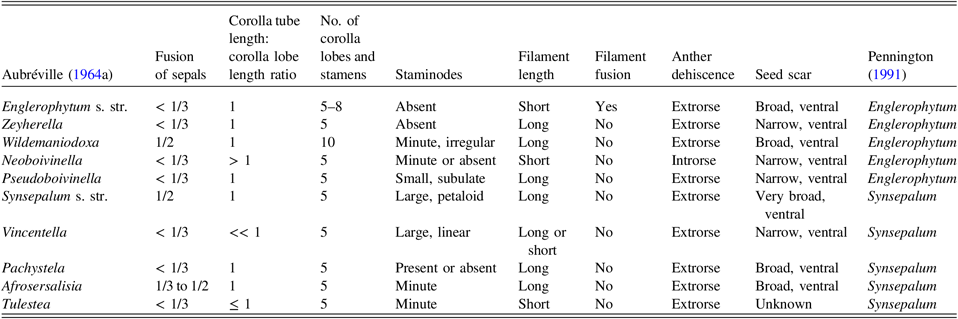
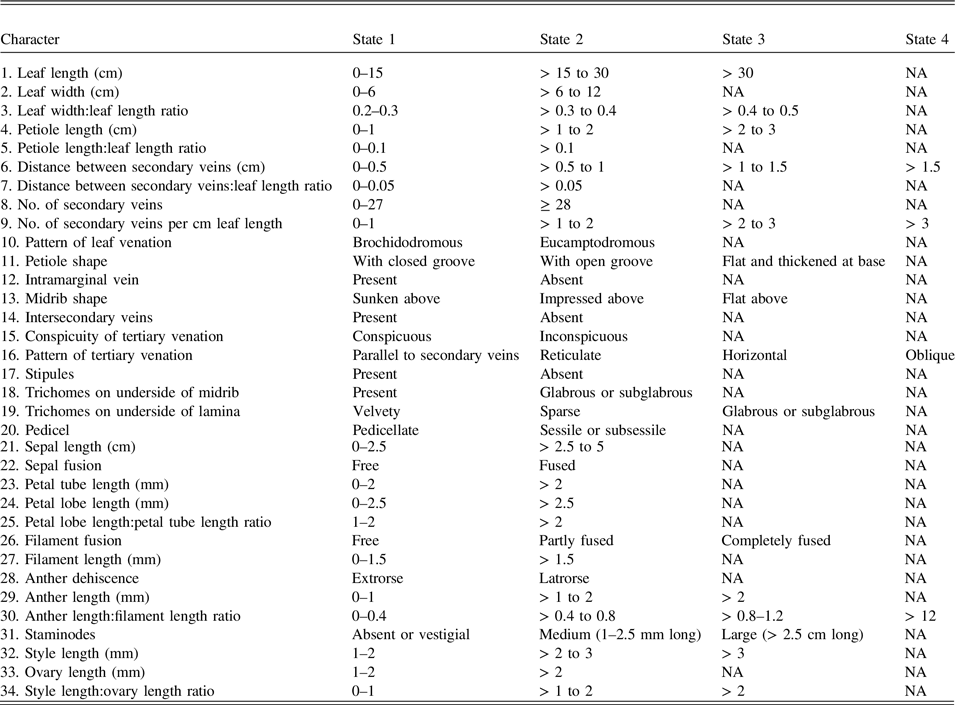
The current generic circumscriptions of Englerophytum and Synsepalum were made by Pennington (Reference Pennington1991) and are based solely on morphological evidence. In his account, Pennington recognises a close relationship between Englerophytum and Synsepalum and highlights their shared characteristics, the most prominent being (i) the frequent presence of stipules, (ii) the 5-merous flower structure, (iii) the irregular presence of staminodes, and (iv) similar seed and embryo. Despite these similarities, Pennington (Reference Pennington1991) split these two genera based on two characters in leaf venation pattern and filament fusion. Englerophytum has striate brochidodromous leaf venation and a tendency for filament fusion. In contrast, Synsepalum usually exhibits eucamptodromous leaf venation patterns and has free filaments. Before Pennington (Reference Pennington1991) there had been several classifications of Sapotaceae (Pierre, Reference Pierre1890; Engler, Reference Engler and Engler1904; Chevalier, Reference Chevalier1943; Meeuse, Reference Meeuse1960; Aubréville, Reference Aubréville1961a, Reference Aubréville1964a; Baehni, Reference Baehni1965). One of the most comprehensive, which was one of the main references before Pennington’s account, was Aubréville’s (Reference Aubréville1964a). In Aubréville’s account, Englerophytum and Synsepalum were much more narrowly circumscribed, and species that are today considered as being part of these genera were placed in other smaller genera. These other genera are presented in Table 1 with the states of a selection of characters used to separate them.
The 10 genera accepted by Aubréville (Reference Aubréville1964a) and included by Pennington (Reference Pennington1991) in Englerophytum and Synsepalum, with a selection of distinctive characters states

The widely divergent views of Pennington and Aubréville resulted from their different approaches towards classification. Aubréville adopted narrow morphogeographical generic concepts, whereas Pennington (Reference Pennington1991) used wider generic concepts and more evidence to ensure that his genera were circumscribed using a suite of characters. However, we note that although Pennington (Reference Pennington1991) did effectively synonymise all Aubréville’s genera into Englerophytum or Synsepalum, he did not publish all the species transfers. In this paper from here onwards we use ‘Englerophytum s. str.’ and ‘Synsepalum s. str.’ to refer to Aubréville’s concepts of the genera and otherwise simply ‘Englerophytum’ and ‘Synsepalum’ for Pennington’s wider concepts.
Recent molecular studies on a few members of Englerophytum and Synsepalum (Swenson & Anderberg, Reference Swenson and Anderberg2005; Swenson et al., Reference Swenson, Richardson and Bartish2008; Bartish et al., Reference Bartish, Antonelli, Richardson and Swenson2011) have shown that these two genera form a strongly supported clade within the subfamily Chrysophylloideae, supporting the inferences of close relatedness made through morphology. However, little is known about the relationships of the members within the clade. Studies by Swenson and colleagues (Swenson & Anderberg, Reference Swenson and Anderberg2005; Swenson et al., Reference Swenson, Richardson and Bartish2008) gave mixed results. Parsimony analysis of combined data from plastid DNA, nuclear DNA and morphology showed species from Englerophytum and Synsepalum segregating into monophyletic subclades, suggesting that the two genera are distinct. However, in trees obtained using either only nuclear DNA or only plastid DNA these genera were not monophyletic.
No study has focused on resolving the relationships within the Englerophytum–Synsepalum (ES) clade. All the molecular data available were obtained indirectly from studies dealing with family relationships and that used few species from the target genera. In this study the nuclear transcribed spacers, together with the 5.8S region and partial 18S and 26S regions of ribosomal DNA (internal transcribed spacer, ITS) and the plastid trnH–psbA region, were sequenced to (i) verify whether the monophyly of the ES clade is supported with a larger species sample, (ii) elucidate relationships within the ES clade, (iii) determine whether molecular data are consistent with the current generic delimitations of Englerophytum and Synsepalum, and (iv) gain insight into the morphological synapomorphies shared by members of the ES clade and in particular its subclades.
Materials and Methods
Plant material
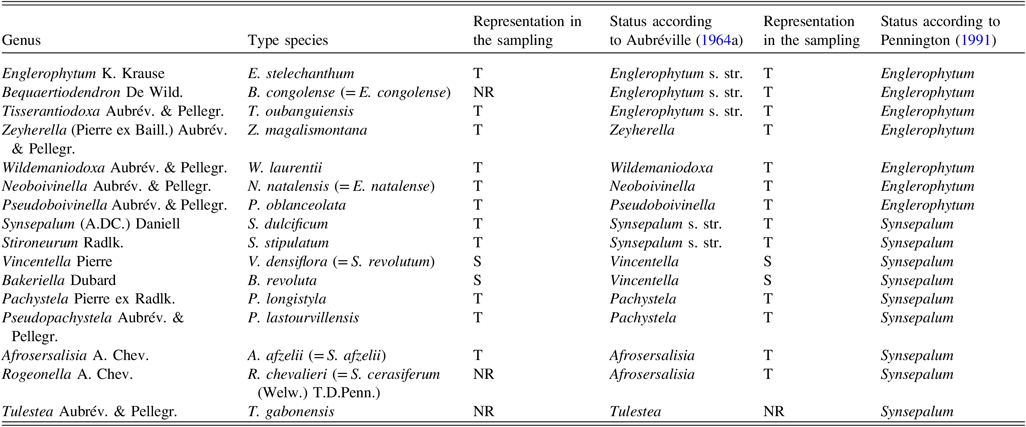
An attempt was made to sample taxa within the ES clade from throughout their geographical range. A total of 41 accessions of either Englerophytum or Synsepalum were sampled for this study. Table 2 shows all genera included by Pennington (Reference Pennington1991) in the complex, with their type species, their acceptance status following Aubréville (Reference Aubréville1964a), and their representation in our sampling. Of the ten genera accepted by Aubréville (Reference Aubréville1964a) in the complex, only Tulestea Aubrév., a small genus of three or four rare species he considered close to Afrosersalisia A.Chev., could not be included. Therefore, nine genera were included in our sampling, eight of which were represented by their type species. We were unfortunately not successful in obtaining DNA from our only sample of Synsepalum revolutum (Baker) T.D.Penn., type species of the genus Vincentella Pierre, but this group was represented by Synsepalum passargei (Engl.) T.D.Penn.
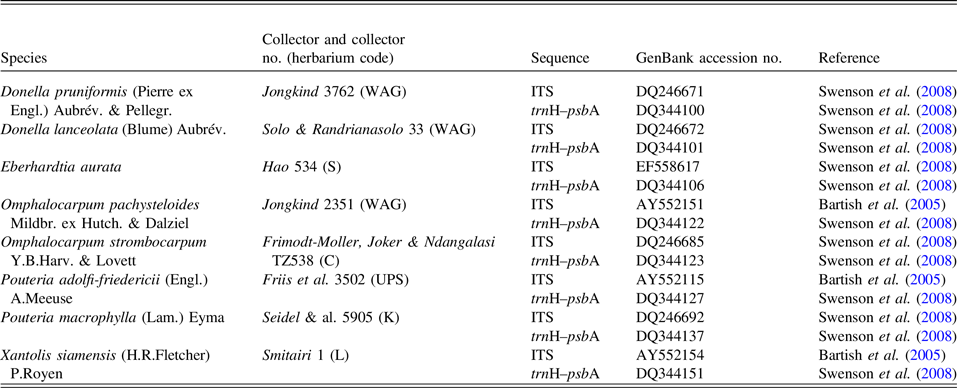
Nine outgroups were selected by reference to Swenson & Anderberg (Reference Swenson and Anderberg2005), Swenson et al. (Reference Swenson, Richardson and Bartish2008) and Bartish et al. (Reference Bartish, Antonelli, Richardson and Swenson2011). Seven outgroups were chosen from the subfamily Chrysophylloideae to provide a subfamilial framework in which to verify the monophyly of the ES clade. The other two outgroups were Xantolis Raf., a sister genus to the Chrysophylloideae, and Eberhardtia aurata (Pierre ex Dubard) Lecomte, which may belong to the subfamily Sarcospermatoideae that is sister to the rest of the family. Table 3 provides information on all the published sequenced accessions, and Table 4 on all those published here.
The 16 genera included by Pennington (Reference Pennington1991) in Englerophytum and Synsepalum, with their type species, their acceptance status following Aubréville (Reference Aubréville1964a), and their representation in our sampling
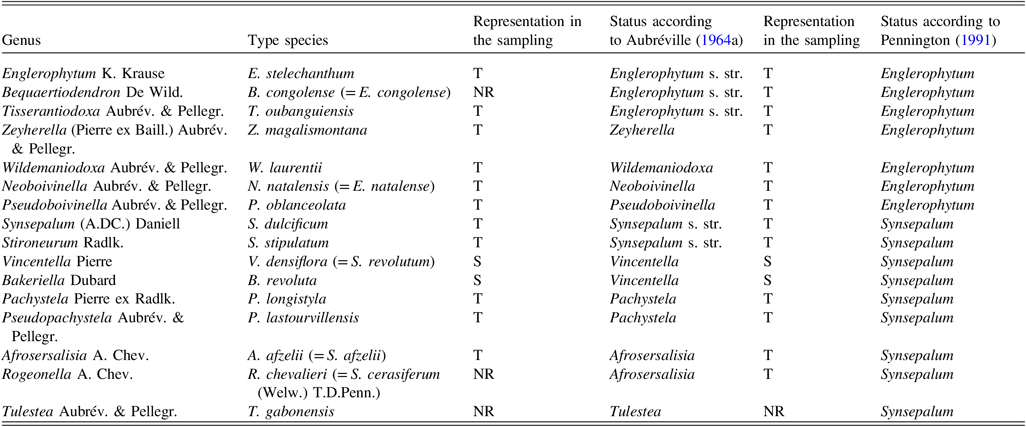
NR, not represented; S, represented but not by its type species; T, represented by its type species.
Details of the outgroup sequences used in the analysis

ITS, internal transcribed spacer.
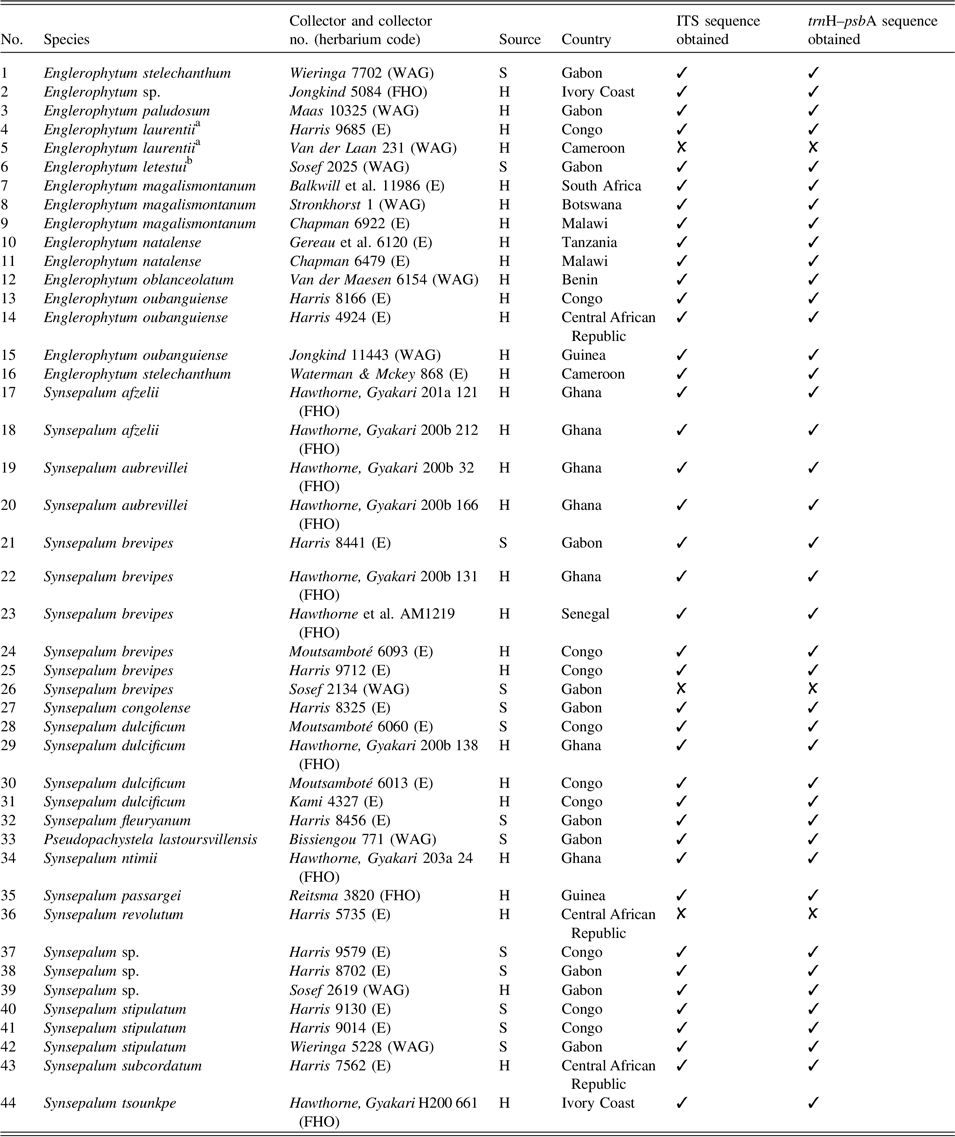
Voucher information for the sequences published in this analysis

a New combination, made in this paper, for Wildemaniodoxa laurentii.
b New combination, made in this paper, for Zeyherella letestui.
✗, No sequence obtained; ✓, sequence obtained; H, herbarium specimen; ITS, internal transcribed spacer; S, silica gel–dried leaf fragment.
DNA extraction, amplification and sequencing
Total genomic DNA was extracted from herbarium and silica gel–dried material by using the DNeasy Plant Mini Kit (Qiagen, Valencia, California, USA). The ITS region was amplified using primers ITS 5p and 8p (Möller & Cronk, Reference Möller and Cronk1997), following the recipe and program of Armstrong (Reference Armstrong2010) but with less BioTaq (0.125 μL). Accessions whose ITS region did not amplify well in the first PCR were subjected to an additional nested PCR using the same recipe and program from Armstrong (Reference Armstrong2010) but with primers ITS1 and ITS4 (White et al., Reference White, Burns, Lee, Taylor, Innis, Gelfand, Sninsky and White1990) and a reduced number of cycles (29). The plastid trnH–psbA region was amplified using the primers trnH and psbA (Hamilton, Reference Hamilton1999). The recipe from Armstrong (Reference Armstrong2010) and the ‘rpl16 program’ of Shaw et al. (Reference Shaw, Lickey, Beck, Farmer, Liu, Miller, Siripun, Winder, Schilling and Small2005) were used.
All the PCR products from both the ITS and the plastid regions were purified using the ExoSAP-IT protocol (GE Healthcare, Chicago, Illinois, USA). They were then run on an ABI 3730 sequencer at the University of Edinburgh’s GenePool facility, using the manufacturer’s protocols. Sequences were then edited in Sequencher version 5.1 (Gene Codes Corporation, Ann Arbor, Michigan, USA) and aligned using BioEdit version 7.2.0 (Hall, Reference Hall1999). An automatic alignment was carried out using Clustal W (Thompson et al., Reference Thompson, Higgins and Gibson1994) and the results were then refined manually. Gaps were coded as additional binary characters using the approach of Simmons & Ochoterena (Reference Simmons and Ochoterena2000).
Phylogenetic analysis
Heuristic parsimony searches were implemented on the ITS, trnH–psbA and combined matrices by using PAUP* version 4.0 (Swofford, Reference Swofford2003). All character states were treated as unordered and equally weighted. The heuristic search was made using tree-bisection reconnection branch swapping with 10,000 random-addition replicates, with a limit of 1,000,000 swaps per replicate. A parsimony bootstrap search, with 1000 replicates, was also performed to obtain bootstrap support (bs) values.
Bayesian analysis was carried out using Mr Bayes version 3.2.1 (Ronquist & Huelsenbeck, Reference Ronquist and Huelsenbeck2003). Before running the Bayesian analysis, jModel Test version 2.1.4 (Darriba et al., Reference Darriba, Taboada, Doallo and Posada2012) was used together with the Bayesian information criterion to select the optimum model of evolution for both the ITS and the plastid sequences. Once the models were chosen, the Markov chain Monte Carlo algorithm was run for 10,000,000 generations, with one cold and three heated chains starting from a random tree and sampling every 1000 generations. Tracer version 1.5 (Rambaut & Drummond, Reference Rambaut and Drummond2009) was used to check for convergence and to estimate burn-in. Trees falling within the burn-in were discarded and the remainder were used to construct either a Bayesian consensus or a maximum clade credibility (MCC) tree.
Before performing combined analyses, trees resulting from the individual region analyses were compared and visually inspected for strongly supported incongruence. Posterior probability (pp) values of ≥ 0.9 and bs values of ≥ 75% were considered to indicate strong support. There were no examples of strongly supported incongruence between trees from either data set.
Morphological mapping
A Leica MZ75 standard binocular dissecting microscope (Leica, Wetzlar, Germany) was used to examine specimens from E, FHO and K, which were then scored for 34 morphological characters (Table 5). We scored a suite of characters used by both Aubréville and Pennington. Delimitation of states of quantitative characters were made in an arbitrary manner based on both examination of specimens and reference to the literature. Some online images of herbarium specimens (at BM, HBG, LISC and P) were also consulted to facilitate scoring of vegetative characters of species that were under-represented in the study material. Whenever floral material was available, this was boiled, dissected and mounted on card for analysis. In cases in which floral material was lacking, floral characters were scored from descriptions in the literature (Lecomte, Reference Lecomte1928; Meeuse, Reference Meeuse1960; Aubréville, Reference Aubréville1961a,b, Reference Aubréville1964a,b; Baehni, Reference Baehni1965; Pennington, Reference Pennington1991; Swenson & Anderberg, Reference Swenson and Anderberg2005).
Once the character matrix was compiled, it was transferred into Mesquite version 2.75 (Maddison & Maddison, Reference Maddison and Maddison2011). Morphological characters were mapped onto the MCC tree from the Bayesian analysis of the combined ITS and trnH–psbA data by using the Parsimony Ancestral States option in Mesquite. The resulting reconstructions were then analysed for morphological congruences and differences.
Character states for all scored morphological characters

NA, not applicable.
Results
No hard incongruence was evident between the ITS and trnH–psbA data sets, so they were combined. Because the plastid region had fewer informative characters than the ITS region, it had relatively less impact on the final topology of the combined tree. The ITS alignment length was 952 bp, with 71% of the variable sites (259) being parsimony-informative. The plastid alignment length was 760 bp; 8.7% of the sites were variable, and only 53% of these were parsimony-informative. The consistency indices (CIs) and retention indices (RIs) showed that the plastid region (CI, 0.9; RI, 0.91) has less homoplasy than the ITS region (CI, 0.65; RI, 0.85). Representative most-parsimonious trees from the parsimony analysis are available from the corresponding author. The ITS analysis generated 16,496 equally most-parsimonious trees; the plastid analysis, 40,000; and the combined analysis, 29,319.
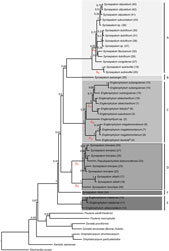
For the Bayesian analysis, the data were split into three partitions, representing the ITS region, the trnH–psbA region and binary gap data. The models chosen were SYM+G for ITS, F81+G for trnH–psbA and F81 for the binary gap data. In preliminary analyses the ITS region was partitioned into ITS1, 5.8S and ITS2. However, when the analysis was run using three ITS partitions, the topologies of the trees derived from the partitioned data analysis (not shown) and those with only one ITS partition were the same, with only very minor changes in support values. Therefore, the simpler model was chosen and the ITS data were not partitioned. The MCC tree from the combined ITS and trnH–psbA analysis is shown in Fig. 1. Trees from the separate Bayesian analyses are available from the corresponding author.
The maximum clade credibility tree from the analysis of the ITS data set, showing the major subclades (clades A–E) within the Englerophytum–Synsepalum clade and their posterior probability values. Specimen numbers are shown in parentheses, thereby linking the specimens to information in Table 4. aNew combination, made in this paper, for Zeyherella letestui. bNew combination, made in this paper, for Wildemaniodoxa laurentii.
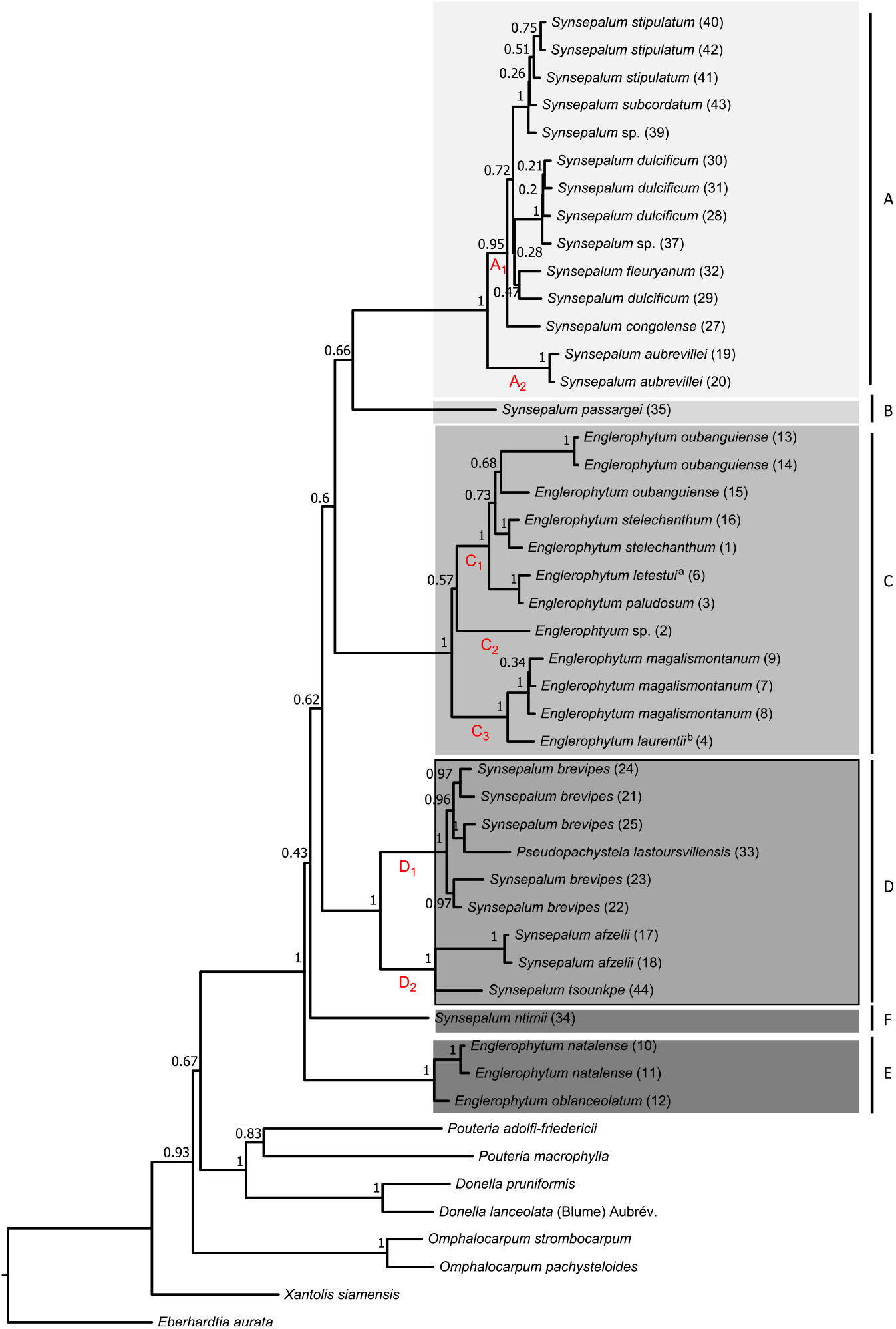
The monophyly of the ES clade was strongly supported in the analysis of the ITS and combined data sets (pp, 1; bs, 99% in all cases; see Fig. 1 and figures available from the corresponding author). However, the resolution in the plastid data set was too low to provide strong support (figures available from the corresponding author). In the plastid tree, the ES clade collapsed into a Chrysophylloideae polytomy in the strict consensus.
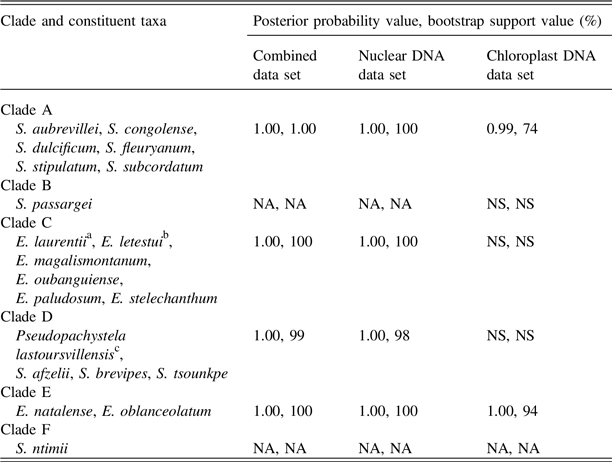
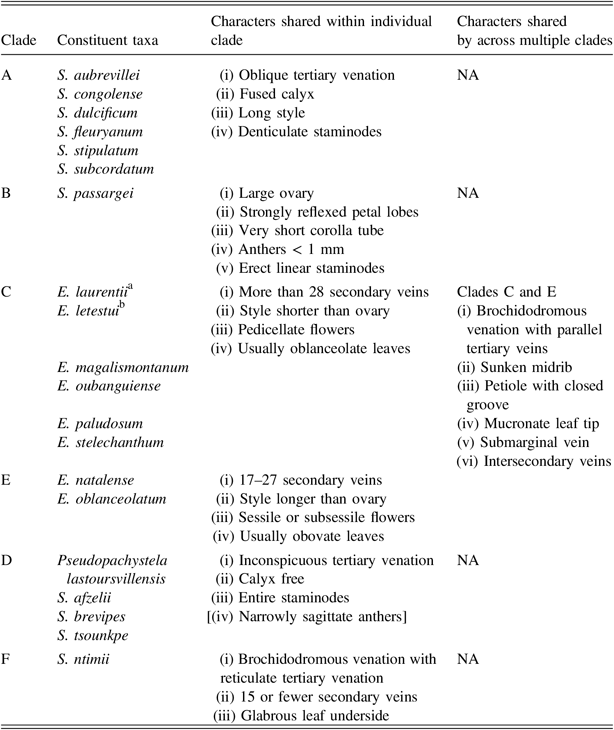
Six major lineages within the ES clade could be identified from the parsimony and Bayesian analysis of the ITS and combined data sets (see Fig. 1 and figures available from the corresponding author). These lineages are labelled clades A–F in the trees and are summarised in Table 6. Four of the lineages (clades A, B, D and F) consist exclusively of species currently accepted as belonging to the genus Synsepalum (although currently there is no combination for Pseudopachystela lastoursvillensis under Synsepalum; see discussion below), whereas the other two (clades C and E) consist of species belonging to Englerophytum (including Wildemaniodoxa laurentii (De Wild.) Aubrév. & Pellegr. and Zeyherella letestui Aubrév. & Pellegr., newly combined below). None of the lineages (i.e. clades A–F) contain a mixture of species from both Englerophytum and Synsepalum. All resolve together in a six-way polytomy at the base of the strongly supported ES clade.
Some of the lineages were also present in the plastid trees. Clade A was particularly well resolved in the plastid data analysis, with a strong pp (0.99) in the Bayesian analysis and a bs of 74% in the parsimony tree. Clade E (pp, 1; bs, 94%) and clade F were also easily distinguishable from other clades in the plastid tree. In contrast, clades B–D were poorly resolved and appeared in a single clade with good support in the Bayesian analysis (pp, 0.97).
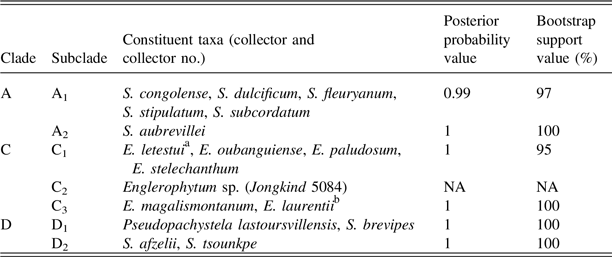
Three of the six major lineages (clades A, C and D) have well-supported subclades (summary provided in Table 7). These were clearly visible in the ITS and combined trees and are indicated by the red labels in Fig. 1. However, because the plastid tree was poorly resolved, the subclades were not mapped onto it. The evolution of several morphological characters that have utility in distinguishing clades A–F from each other are presented in Figs 2 and 3.
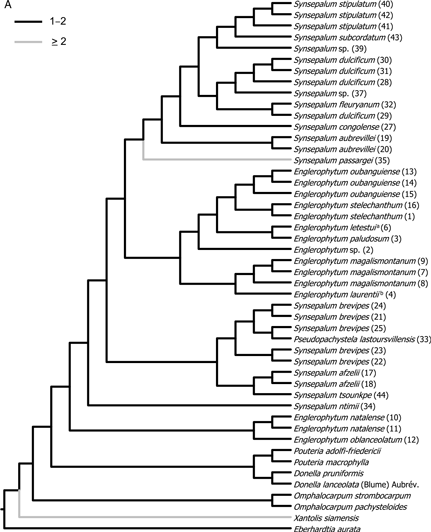
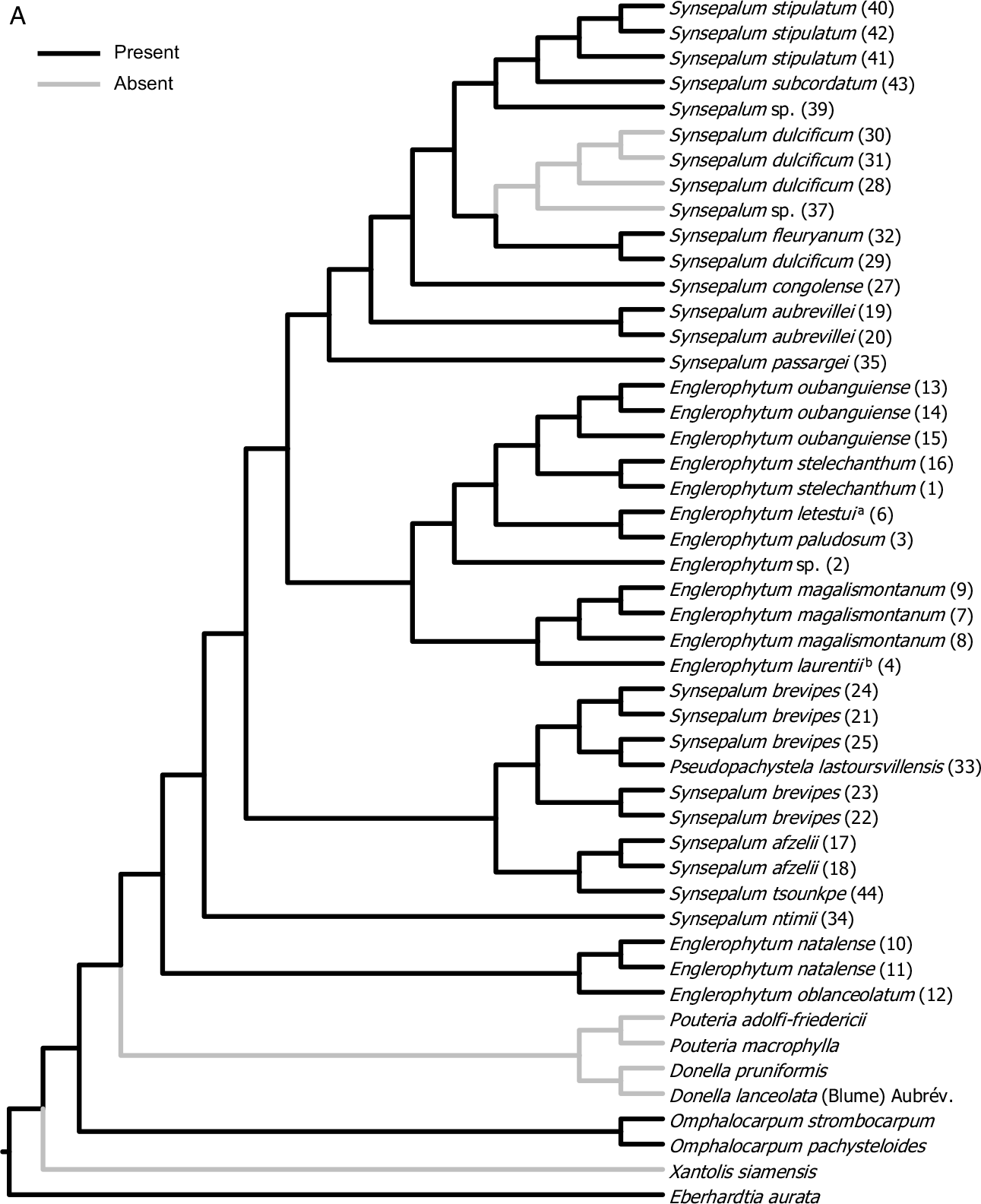
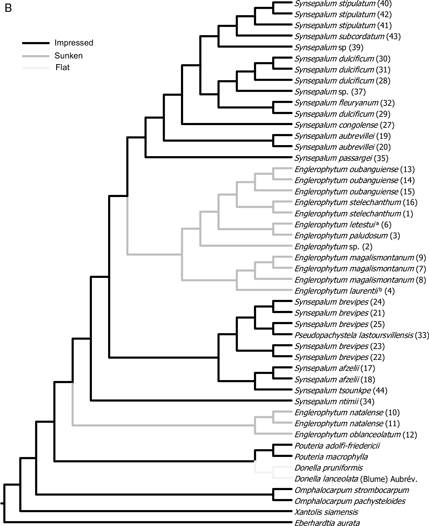
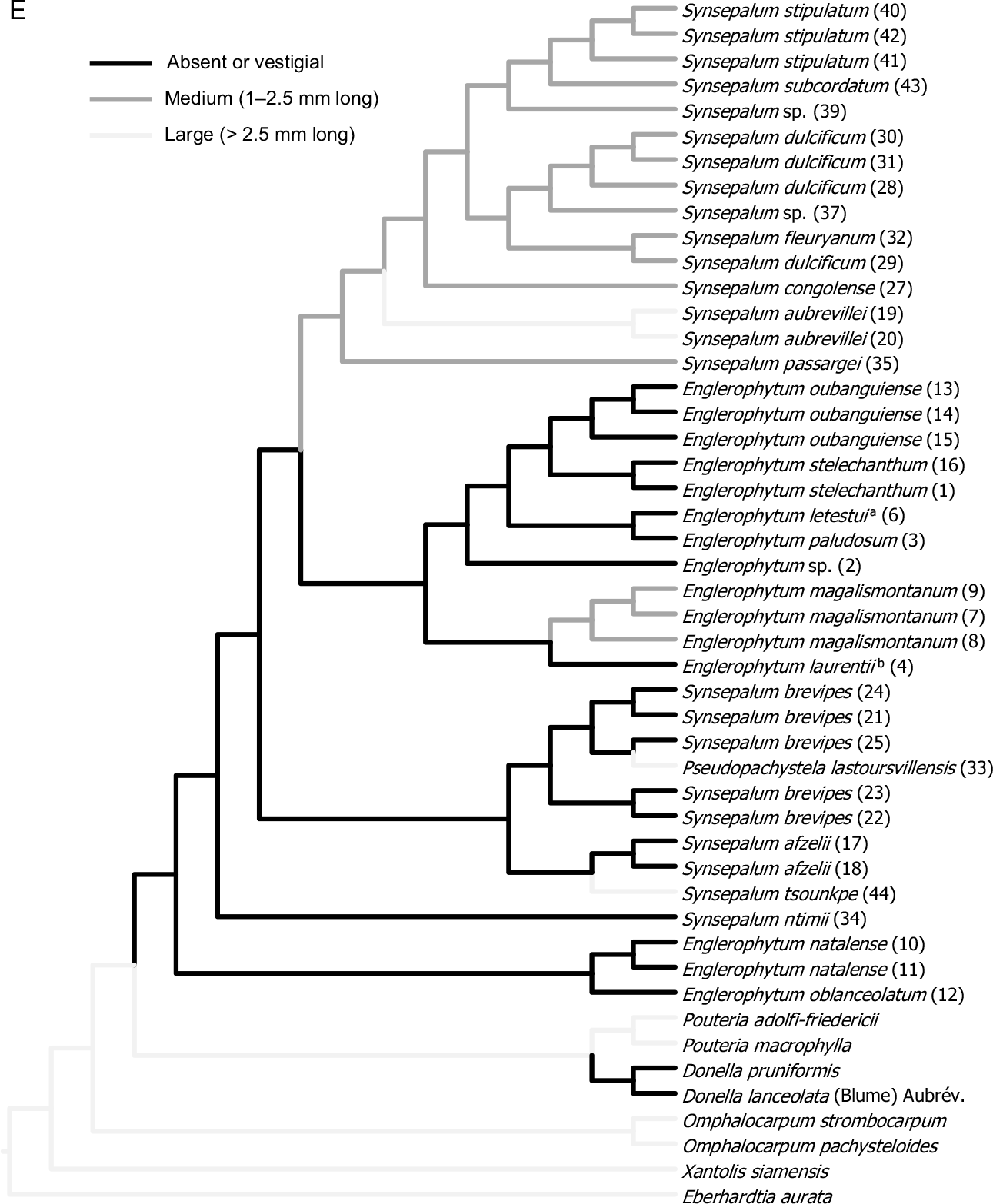
A selection of morphological characters mapped onto the maximum clade credibility tree from the Bayesian analysis of the internal transcribed spacer data. A, Ratio of lobe length to tube length. Specimen numbers are shown in parentheses. aNew combination, made in this paper, for Zeyherella letestui. bNew combination, made in this paper, for Wildemaniodoxa laurentii.

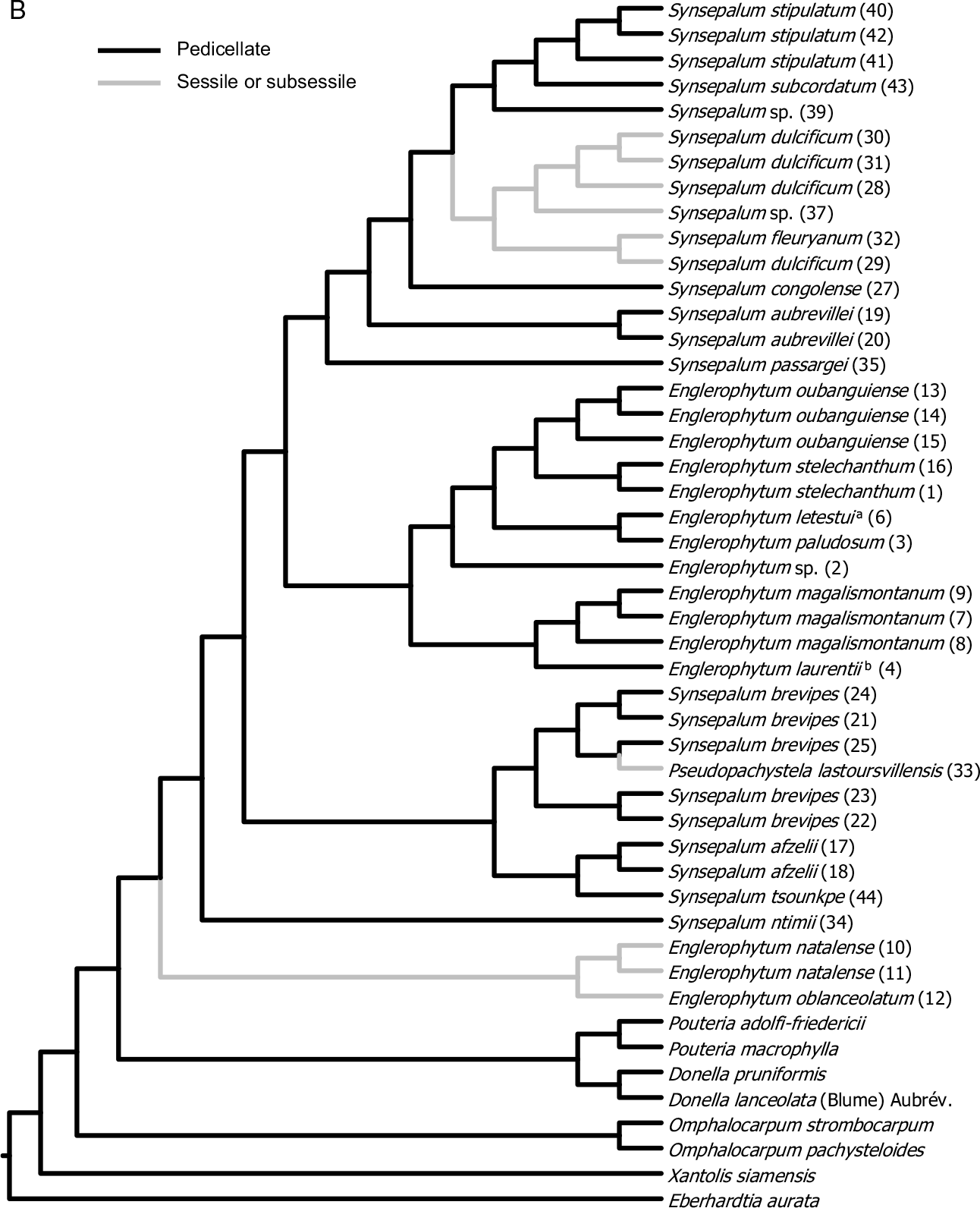
(continued). B, Pedicel. Specimen numbers are shown in parentheses. aNew combination, made in this paper, for Zeyherella letestui. bNew combination, made in this paper, for Wildemaniodoxa laurentii.

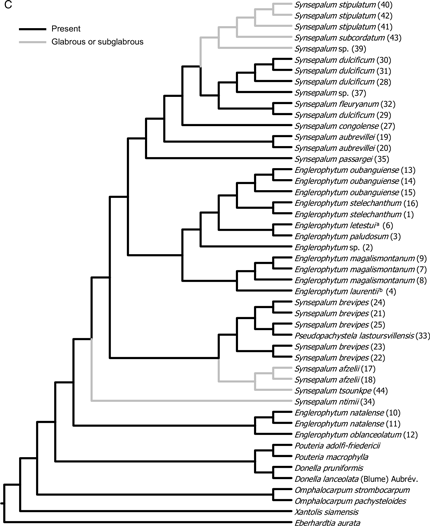
(continued). C, Trichomes on the underside of the midrib. Specimen numbers are shown in parentheses. aNew combination, made in this paper, for Zeyherella letestui. bNew combination, made in this paper, for Wildemaniodoxa laurentii.

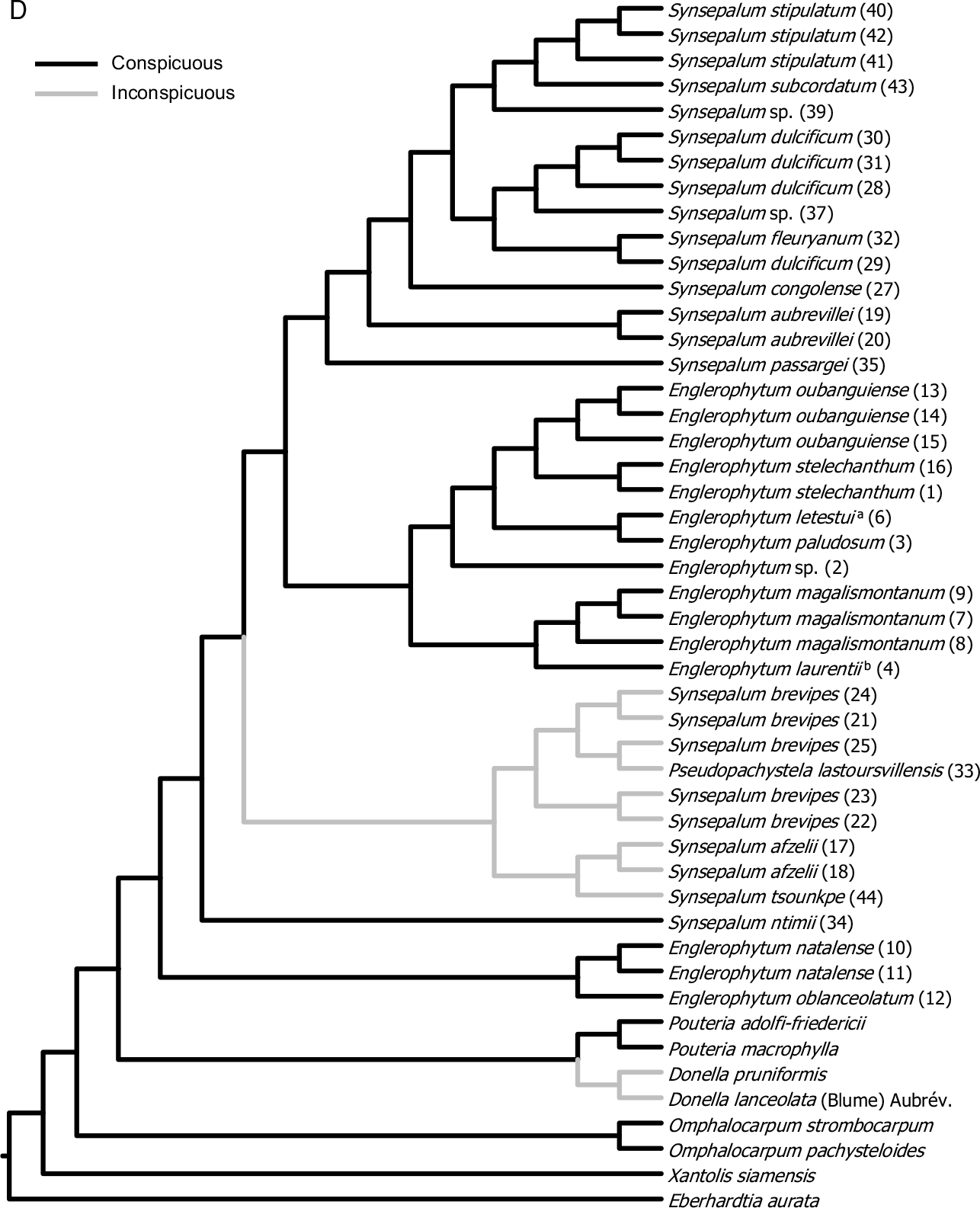
(continued). D, Conspicuity of tertiary venation. Specimen numbers are shown in parentheses. aNew combination, made in this paper, for Zeyherella letestui. bNew combination, made in this paper, for Wildemaniodoxa laurentii.

(continued). E, Number of secondary veins. Specimen numbers are shown in parentheses. aNew combination, made in this paper, for Zeyherella letestui. bNew combination, made in this paper, for Wildemaniodoxa laurentii.

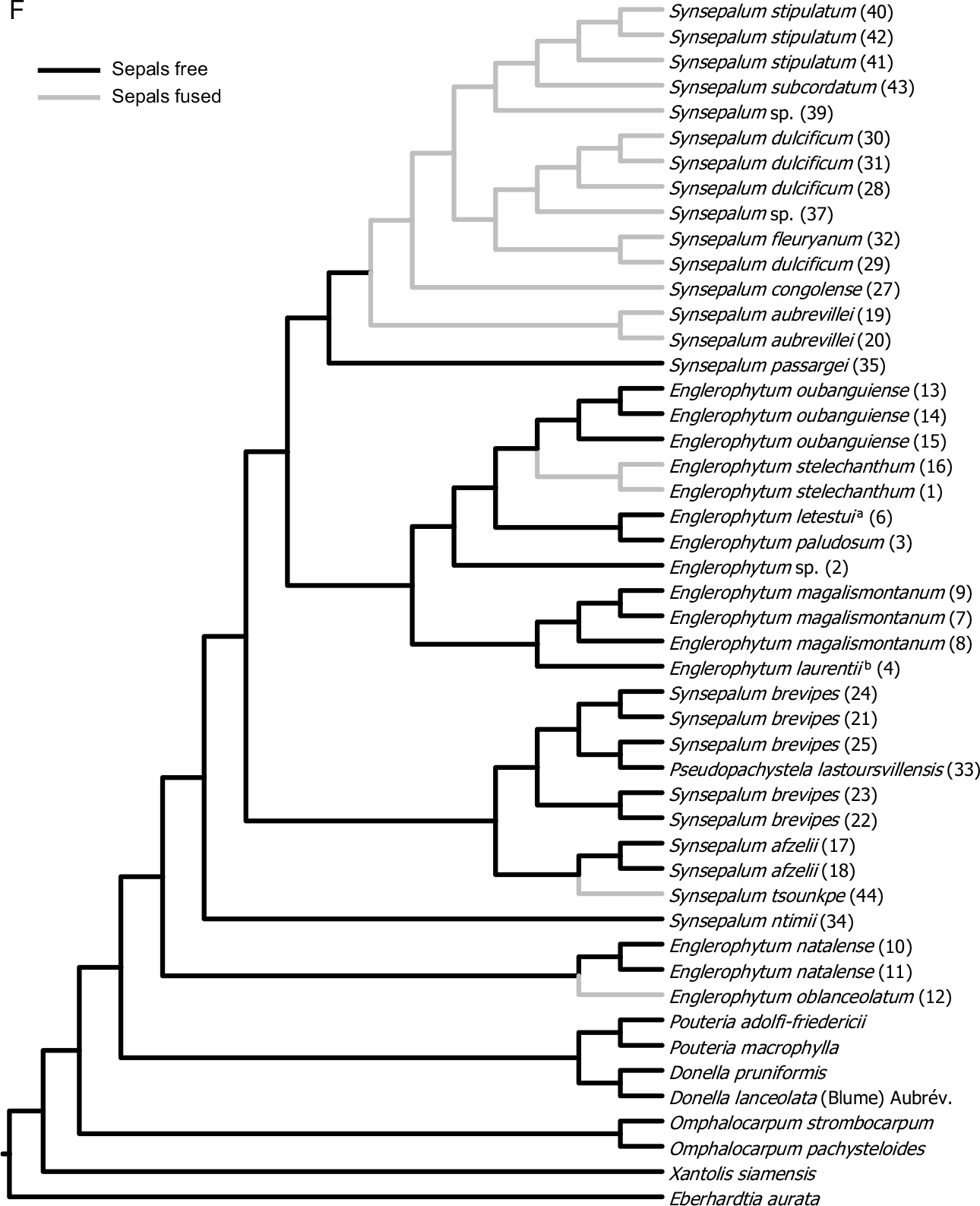
(continued). F, Sepal fusion. Specimen numbers are shown in parentheses. aNew combination, made in this paper, for Zeyherella letestui. bNew combination, made in this paper, for Wildemaniodoxa laurentii.

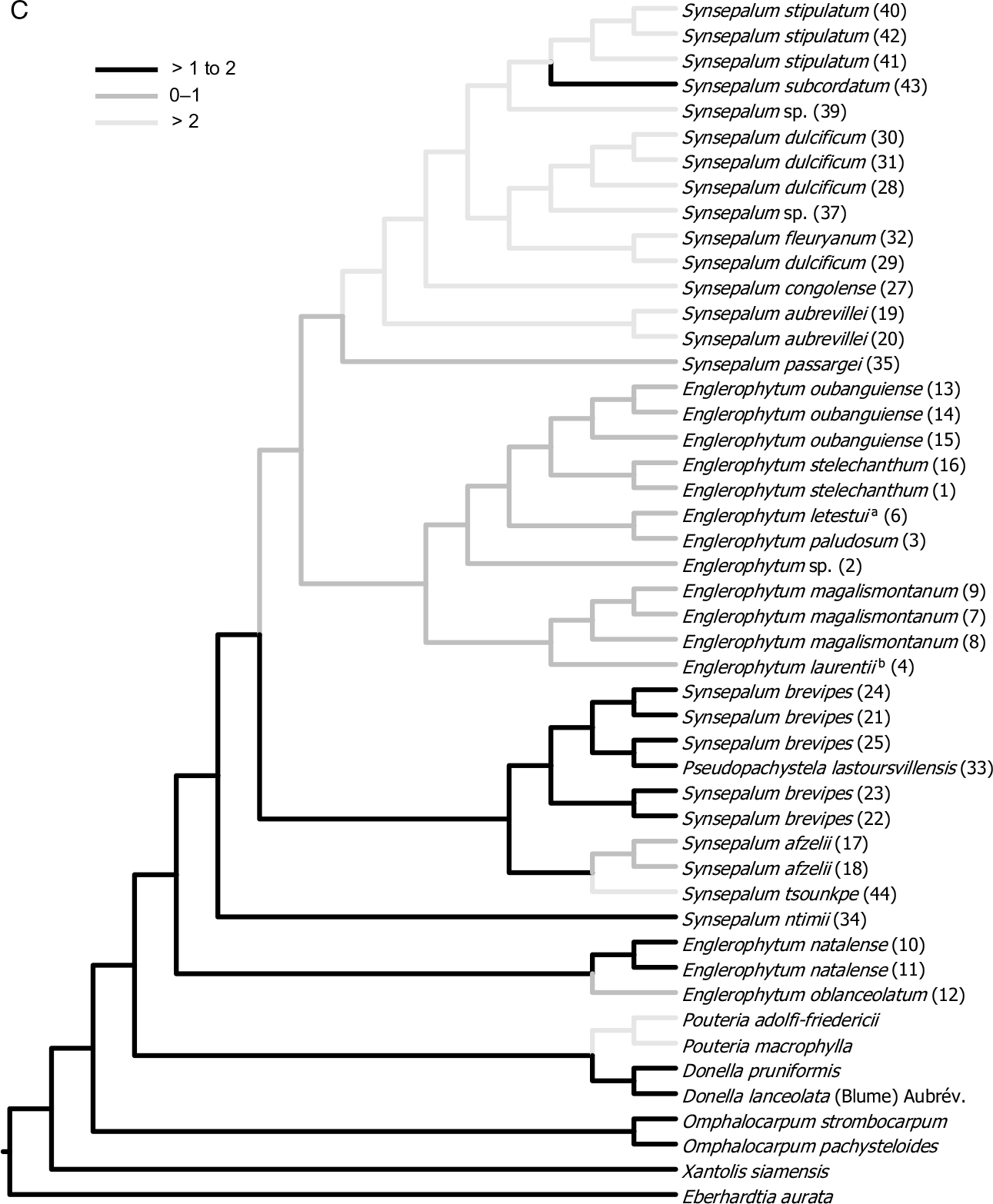
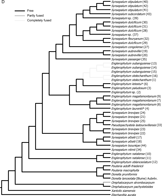
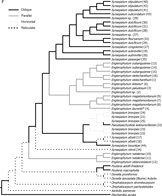
A selection of morphological characters mapped onto the maximum clade credibility tree from the Bayesian analysis of the internal transcribed spacer data. A, Stipules. Specimen numbers are shown in parentheses. aNew combination, made in this paper, for Zeyherella letestui. bNew combination, made in this paper, for Wildemaniodoxa laurentii.

(continued). B, Shape of midrib. Specimen numbers are shown in parentheses. aNew combination, made in this paper, for Zeyherella letestui. bNew combination, made in this paper, for Wildemaniodoxa laurentii.

(continued). C, Ratio of style length to ovary length. Specimen numbers are shown in parentheses. aNew combination, made in this paper, for Zeyherella letestui. bNew combination, made in this paper, for Wildemaniodoxa laurentii.

(continued). D, Filament fusion. Specimen numbers are shown in parentheses. aNew combination, made in this paper, for Zeyherella letestui. bNew combination, made in this paper, for Wildemaniodoxa laurentii.

(continued). E, Staminodes. Specimen numbers are shown in parentheses. aNew combination, made in this paper, for Zeyherella letestui. bNew combination, made in this paper, for Wildemaniodoxa laurentii.

(continued). F, Pattern of tertiary venation. Specimen numbers are shown in parentheses. aNew combination, made in this paper, for Zeyherella letestui. bNew combination, made in this paper, for Wildemaniodoxa laurentii.

The major lineages within the Englerophytum–Synsepalum clade, with their support values

NA, not applicable; NS, not supported.
a New combination, made in this paper, for Wildemaniodoxa laurentii.
b New combination, made in this paper, for Zeyherella letestui.
Subclades of clades A, C and D within the Englerophytum–Synsepalum clade, with their support valuesa

NA, not applicable.
a Taken from the combined trees.
a New combination, made in this paper, for Zeyherella letestui.
b New combination, made in this paper, for Wildemaniodoxa laurentii.
Discussion
The results of the analysis using our nuclear and combined data sets strongly support a monophyletic ES clade. This study does not support the hypothesis that Englerophytum and Synsepalum, as delimited by Pennington (Reference Pennington1991), are monophyletic. Instead of two clades each representing these two genera, our trees showed six major lineages within the more inclusive ES clade (see Fig. 1 and figures available from the corresponding author); four of the lineages contain species exclusively from Synsepalum and two contain species exclusively from Englerophytum. This result can neither confirm nor reject the possibility that the current circumscription is based on monophyly, because there is no support for any of the relationships between the lineages at the base of the ES clade. However, despite not representing two clearly defined lineages, the six major lineages evident from the present analysis still provide useful information on the structure of the ES clade.
Clade A
Clade A consists of six species of Synsepalum: S. aubrevillei (Pellegr.) Aubrév. & Pellegr., S. congolense Lecomte, S. dulcificum (the type species of Synsepalum), S. fleuryanum A.Chev., S. stipulatum (Radlk.) Engl. and S. subcordatum De Wild. They range from small-leaved, short-petioled species such as Synsepalum dulcificum to large-leaved species such as S. aubrevillei and S. subcordatum. Members of clade A have several shared characters that, although variable, distinguish them from species within the other clades.
Species placed within clade A all have transverse-oblique tertiary venation (Fig. 3F); the tertiary veins form an oblique ladder-like pattern between two successive secondary veins. This character is not exclusive to clade A, because it is found in some other species (e.g. Pseudopachystela lastoursvillensis Aubrév. & Pellegr. and Synsepalum tsounkpe Aubrév. & Pellegr. in clade D). However, venation pattern, in combination with other characters, can be useful in providing a unique morphological definition for clade A.
Another shared character of members of clade A is their relatively long style length (≥ 2.5 mm in most of these species). Some have exceptionally long styles (e.g. 7 mm in Synsepalum aubrevillei and S. dulcificum) not found elsewhere in the ES clade. Consequently, because ovary size (approximately 2 mm) shows little variation between species in the ES clade, the ratio of style length to ovary length exceeds 2 in all clade A species except that with the shortest style, Synsepalum subcordatum (1.8 mm).
All members of clade A have prominent (> 1 mm) antisepalous staminodes with denticulate margins. Staminodes in other clades are either small and vestigial (e.g. in Synsepalum afzelii and S. brevipes in clade D) or large but lacking denticulate margins (e.g. in Englerophytum magalismontanum in clade C and Pseudopachystela lastoursvillensis in clade D). Only Pseudopachystela lastoursvillensis and Synsepalum tsounkpe (both clade D) have staminodes that are similar to those of members of clade A.
The most significant shared character in clade A species is the presence of fused sepals, from which the name Synsepalum is derived. All members of this clade have sepals that are fused for at least a third of their length. The fused sepals usually form a tight cup around the petal tube and are very difficult to tease apart without making deep incisions. This character is nearly exclusive to clade A (Fig. 2F). Other than in members of clade A, sepal fusion was present in only three other species in the analysis: Englerophytum stelechanthum Krause (clade C), Synsepalum tsounkpe (clade D) and E. oblanceolatum (S.Moore) T.D.Penn. (clade E). Unfortunately, none of the floral material of the above-mentioned species could be analysed at first hand, so the literature (Moore, Reference Moore1907; Krause, Reference Krause1914; Aubréville, Reference Aubréville1959, Reference Aubréville1961a; Liben, Reference Liben1989) was consulted to obtain the information for sepal fusion.
The extent of sepal fusion in Englerophytum oblanceolatum and E. stelechanthum is difficult to determine from the literature because the relevant descriptions are unclear. In the protologue of Englerophytum oblanceoatum (Moore, Reference Moore1907), the calyx is described as “connate below” (inferne connatis), whereas in that of E. stelechanthum (Krause, Reference Krause1914) the calyx is described as “slightly connate at base” (basi breviter connata). Therefore, it is difficult to say whether the extent of fusion is slight enough to be easily distinguishable from the type of sepal fusion in members of clade A. In contrast, the extent of sepal fusion in Synsepalum tsounkpe is clearly stated in Aubréville’s description of the species Reference Aubréville(1961a). Synsepalum tsounkpe has sepals fused for about half their length, a similar type of fusion to that of the flowers in clade A species. However, despite its morphological similarities, Synsepalum tsounkpe seems, based on molecular data, to be phylogenetically closer to members of clade D.
It is important to note that sepal fusion and some other synapomorphies mentioned here were the basis on which Aubréville (Reference Aubréville1961a) made his generic circumscription of Synsepalum. Consequently, clade A is nearly identical to Aubréville’s circumscription of Synsepalum. In fact, it exclusively contains species from his concept of the genus, the only difference being in the placement of Synsepalum tsounkpe. Morphologically, this species fits into clade A (see Figs 2, 3), and it is also the only species in the phylogenetic tree that has all the characters that define this clade, i.e. oblique tertiary venation pattern, long style, dentate staminodes and fused sepals. Therefore, it is not surprising that it was placed in Synsepalum by Aubréville. However, in this analysis and with strong support, this species appears in clade D as sister to Synsepalum afzelii. In the light of the morphological evidence, there seems to be a need to revisit the placement of Synsepalum tsounkpe in clade D. Unlike other species (e.g. Synsepalum brevipes and S. dulcificum), which were represented by more than one DNA sample in the analysis, S. tsounkpe was represented by only a single exemplar. More samples of this species are needed to confirm its placement.
In summary, clade A in this analysis consists of six species (Synsepalum aubrevillei, S. congolense, S. dulcificum, S. fleuryanum, S. stipulatum and S. subcordatum) that share four consistent morphological characters, i.e. an oblique tertiary venation pattern, a long style, dentate staminodes and fused sepals. This clade, which includes the type species of the genus, shares strong similarities with Aubréville’s delimitation of Synsepalum.
Clade B
Clade B is represented by a single species, Synsepalum passargei. This species has unique floral characteristics not present in any of the other species analysed. It is characterised by an extremely small petal tube (< 1 mm); the tube is so small that in some literature, such as Aubréville (Reference Aubréville1961a), the tube is overlooked and the petals are termed “free”. Owing to the presence of a small tube, the ratio of lobe length to tube length for this species is large (lobes approximately 15 times longer than the tube, Fig. 2A). Additionally, the petals of Synsepalum passargei are unique in that they become strongly reflexed at maturity such that the apices of the corolla lobes nearly touch the pedicel when fully reflexed.
The second most prominent floral character of Synsepalum passargei is its large ovary relative to the size of the flower. The style is rather small, and therefore the ratio of style length to ovary length is less than 1 (Fig. 3C), which is rather unusual in the ES clade other than in clade C.
The androecium of Synsepalum passargei also has unique characters. Unlike the petals, which are reflexed, the alternipetalous staminodes and antepetalous stamens are erect and immediately surround the massive ovary. The staminodes are linear, usually entire and approximately the same length as the petals. The presence of large, linear stamens was used by Aubréville to define Vincentella. The stamens of Synsepalum passargei have the smallest anthers of all the species included in the analysis, measuring less than 1 mm.
In this study, the anther dehiscence of Synsepalum passargei was noted to be latrorse. This observation agrees with depictions of Synsepalum passargei in the Flora of East Tropical Africa (Hemsley, Reference Hemsley1968) but conflicts with other literature (Kupicha, Reference Kupicha1978; Swenson & Anderberg, Reference Swenson and Anderberg2005), in which anther dehiscence is described as extrorse. Further material of the species, preferably fresh, should be analysed to resolve this discrepancy.
Although clade B was represented by only a single species in this analysis, several other species morphologically similar to Synsepalum passargei probably belong to this lineage, and further molecular work is required to verify this. They include Synsepalum brenanii (Heine) T.D.Penn., S. muelleri (Kupicha) T.D.Penn. and S. revolutum, morphologically similar species that have previously been grouped with S. passargei into a single genus, Vincentella, with S. revolutum as its type species (Aubréville & Pellegrin, Reference Aubréville and Pellegrin1934; Meeuse, Reference Meeuse1960; Aubréville, Reference Aubréville1964a; Kupicha, Reference Kupicha1978). This genus was defined by slender pedicels; sepals small, free nearly to the base, later patent or reflexed; corolla tube very short, the lobes many times longer; corolla lobes narrow and strongly reflexed; staminodes alternipetalous, narrowly linear, erect and as long as the corolla lobes; filaments erect, several times longer than the oblong-sagittate, minutely apiculate anthers; and ovary large, ovoid and villous (Meeuse, Reference Meeuse1960). Most of the characteristics of Vincentella apply to Synsepalum passargei in clade B. Two other species, Vincentella ogouensis Aubrév. & Pellegr. and V. ovatostipulata (De Wild.) Aubrév. & Pellegr., which were also classified under Vincentella by Aubréville (Reference Aubréville1965) but which Pennington (Reference Pennington1991) refrained from transferring to Synsepalum, also deserve further study to determine whether they belong to the clade B lineage.
In summary, clade B consists of the single species Synsepalum passargei and is characterised by (i) a reflexed corolla with a very short corolla tube, (ii) a large ovary, (iii) erect stamens with very small anthers (possibly latrorse), and (iv) erect, entire, linear alternipetalous staminodes.
Clades C and E
These two lineages consist solely of species currently belonging to the genus Englerophytum and are treated together because their members share several common morphological characters, especially in their vegetative parts. It is important to note that although clades C and E are collectively easily distinguishable from the other four major lineages, they are very difficult to distinguish from each other.
One of the reasons that Pennington (Reference Pennington1991) grouped all members of clades C and E into Englerophytum was their characteristic leaf facies. Their leaves differ from those of Synsepalum (clades A, B, D and F) in two main aspects: (i) structure of the petiole and main vein, and (ii) pattern of venation. Leaves of Englerophytum have a sunken midrib that forms a channel along the lamina (Fig. 3B). This consequently affects the structure of the petiole as well as the apex of the leaf. The channelled petiole folds in on itself, forming a closed hollow groove, and at the apex the sunken main vein always extends slightly beyond the tip, forming a small mucro. This structure strongly contrasts with that of Synsepalum, in which the leaf has a petiole with an open groove and an impressed midrib, while lacking a mucronate tip. The pattern of venation in Englerophytum (clades C and E) is also very characteristic. The leaves have a brochidodromous (looping) pattern of venation with very closely parallel secondary veins. Owing to the close proximity of the looping veins to the leaf margin, the loops tend to form a submarginal vein. Additionally, all species in clades C and E have parallel intersecondary veins. These veins are situated between and initially of equal thickness to the secondaries but become thinner as they approach the leaf margin. The intersecondaries and secondaries are parallel to the tertiary veins, a pattern that is unique in the ES clade except for Synsepalum ntimii W.D.Hawth. (clade F), which has reticulate tertiary veins.
Although vegetative characters clearly isolate clades C and E from the rest of the ES clade, floral characters are largely uniform within the ES clade. All members of subclades in the ES clade, except for Wildemaniodoxa laurentii and Englerophytum paludosum L.Gaut., Burgt & O.Lachenaud (the latter not represented in this study), have 5-merous flowers, and there is an irregular presence of staminodes and stamens attached at the top of the corolla throat. Therefore, it is more difficult to isolate clades C and E from the other clades by using floral characters.
A unique feature used by Pennington (Reference Pennington1991) to separate Englerophytum from Synsepalum was the tendency towards fusion of the filaments into a cone-like structure enclosing the pistil. However, during the present study it became evident that filament fusion more appropriately defines a specific subgroup within clade C rather than both clades of Englerophytum together (Fig. 3D). This character, considered by Aubréville (Reference Aubréville1961a) as differentiating Englerophytum s. str. from the related Wildemaniodoxa Aubrév. & Pellegr. and Zeyherella (Pierre ex Baill.) Aubrév. & Pellegr., seems to have evolved within clade C. Of the species in our sampling, it is found in only Englerophytum stelechanthum (the type species of Englerophytum) and E. oubanguiense (Aubrév. & Pellegr.) Aubrév. & Pellegr. (see Fig. 3D). Nevertheless, filament fusion is still a very useful character for identification of some species, because it is rare in the ES clade. Other species from Englerophytum also showing filament fusion, and therefore included in Englerophytum s. str. by Aubréville (Reference Aubréville1961a), are E. congolense (De Wild.) Aubrév. & Pellegr. and E. somiferanum Aubrév. Furthermore, four of the five recently described species (Gautier et al., Reference Gautier, Lachenaud, van der Burgt and Kenfack2016) also have fused filaments. All these should be included in a future study.
The remainder of clade C comprises species with free filaments and that were included by Aubréville (Reference Aubréville1961a, Reference Aubréville1964a) in two genera: the monotypic Wildemaniodoxa (W. laurentii), separated on the basis of a 10-merous corolla, 10 stamens and a 10-celled ovary, and Zeyherella (comprising Englerophytum magalismontanum, E. paludosum and Z. letestui). In our study, Wildemaniodoxa laurentii is very close to Englerophytum magalismontanum and probably arose simply by doubling of the number of internal floral parts. Other species in Zeyherella not represented in this study include Z. longepedicellata (De Wild.) Aubrév. & Pellegr. and Z. mayumbensis (Greves) Aubrév. & Pellegr. Further work should focus on sampling these species to determine whether the doubling of number of floral parts evolved more than once in the ES clade. It is, however, important to note that although the two species with fused filaments included in this study group together in subclade C1, this group also contains two species with free filaments, a character found in all members of clade C3 (clade C2 consists of a single unidentified sample for which no flowers were available for examination for filament fusion). Under such a topology, resurrecting Zeyherella based on free filaments or Wildemaniodoxa based on a 10-merous flower would make Englerophytum paraphyletic.
Although there are few differences in vegetative characters between clades C and E, there are two characters that, although not perfectly consistent throughout, might still prove helpful in some cases, namely number of secondary veins and leaf shape. Members of clade E usually have fewer than 28 secondary veins, whereas members of clade C usually have 28 or more (Fig. 2E). Leaf shape also shows some variation, being usually oblanceolate in clade C and obovate in clade E, although some overlap is present.
Distinguishing floral characters are also lacking between these clades. The most consistent differences include pedicel length and the ratio of style length to ovary length. Members of clade E usually have a very short pedicel, which appears sessile or subsessile (Fig. 2B). In contrast, members of clade C have longer pedicels that raise the flower above the flowering branch or away from the trunk for cauliflorous species. The ratio of style length to ovary length varies because members of clade C usually have styles that are shorter than the ovary, whereas in clade E they are longer (see Fig. 3C). Aubréville & Pellegrin (Reference Aubréville and Pellegrin1958) distinguished Englerophytum natalense (Sond.) T.D.Penn. and E. oblanceolatum (both clade E) as having petal lobes shorter than the petal tube. However, in the floral material analysed this character was not immediately evident, and more material is required to confirm it.
It is interesting to note that the two species in clade E have in the past been grouped together based on morphology. Aubréville & Pellegrin (Reference Aubréville and Pellegrin1958) established the genus Boivinella, later changed to Neoboivinella Aubrév. & Pellegr. (Aubréville & Pellegrin, Reference Aubréville and Pellegrin1959), based on it being a later homonym. Boivinella/Neoboivinella contained Englerophytum natalense (the type species) and E. oblanceolatum, as well as E. magalismontanum (later removed from the genus, and clade C in our study). Members of the genus were distinguished by having (i) lobes smaller than the petal tube, (ii) shortly petiolate leaves, (iii) short filaments, (iv) absent or vestigial staminodia, and (v) a wide ventrifixed hilium. However, in a later publication Aubréville (Reference Aubréville1961a) changed the circumscription, leaving only Englerophytum natalense (then Neoboivinella natalensis (Sonder) Aubrév. & Pellegr.) in the genus. Neoboivinella was synonymised with Englerophytum by Pennington (Reference Pennington1991). Englerophytum natalense and E. oblanceolatum (clade E) were also grouped together by Heine & Hemsley (Reference Heine and Hemsley1960) in Bequaertiodendron De Wild., a genus established by De Wildeman (Reference De Wildeman1919) and including several other species now in Englerophytum, its type species being B. congolense De Wild. (= E. congolense). Heine & Hemsley distinguished these species on the basis of seed characters, namely the absence of endosperm and the presence of thick and fleshy planoconvex cotyledons. Bequaertiodendron is now also a synonym of Englerophytum. Should clade E be considered a separate genus, the correct name would be Neoboivinella.
In summary, clades C and E can collectively be distinguished from the rest of the ES clade by their distinctive leaf facies. The distinction between clades C and E is less obvious but the following characters may be useful: (i) leaf shape, (ii) number of secondary veins, (iii) pedicel length, and (iv) ratio of style length to ovary length.
Clade D
Clade D is composed here of four species: Pseudopachystela lastoursvillensis, Synsepalum afzelii, S. brevipes and S. tsounkpe. With the exception of Synsepalum tsounkpe, which has a number of morphological similarities with clade A species, members of this clade share a number of characters. They have inconspicuous tertiary venation (Fig. 2D), the veins being so fine that to determine their pattern, the leaves have to be viewed with transmitted light. This contrasts with leaves from clade A species, whose tertiaries are prominent and easily identifiable. Members of clade D, other than Synsepalum tsounkpe, have free sepals. Although this character is not exclusive to this clade, it is essential to distinguish its members from those of the morphologically similar clade A, in whose species the sepals are fused. A third character shared by all members of clade D except Synsepalum tsounkpe is the presence of staminodes with entire margins. Although Synsepalum afzelii and S. brevipes do not always have staminodes, when present, they are rudimentary with entire margins. Pseudopachystela lastoursvillensis also has staminodes with entire margins, but the staminodes of this species are larger than those of all other members of the clade. Synsepalum tsounkpe differs from the other clade D species in having dentate staminodes.
In the available floral material of Synsepalum afzelii and S. brevipes, the anthers were found to be similarly narrowly sagittate. However, only line drawings of the other species in clade D were available, and it was unclear whether they shared the same anther structure. Therefore, further analysis is required to determine whether all members of this clade have narrowly sagittate anthers.
Clade D splits into two subclades. Subclade D1 consists of Synsepalum brevipes, the type species of Pachystela Pierre ex Radlk., and Pseudopachystela lastourvillensis, the type species of Pseudopachystela Aubrév. & Pellegr. The latter was described by Aubréville (Reference Aubréville1961a) for two Gabonese species then sunk in synonymy with Pachystela three years later (Aubréville, Reference Aubréville1964a) but without publication of the necessary combinations. Subclade D2 consists of Synsepalum afzelii (the type species of Afrosersalisia) and S. tsounkpe (included by Aubréville in his narrow circumscription of Synsepalum based on the morphological characters highlighted above). Further work on species included by Aubréville in Pachystela (Pseudopachystela lastourvillensis, P. oyemensis Aubrév. & Pellegr., Synsepalum msolo, S. pobeguinianum (Dubard) Aké Assi & L.Gaut. and S. seretii (De Wild.) T.D.Penn.) and Afrosersalisia (S. afzelii) is needed before the taxonomy of this group can be finalised.
In summary, members of clade D have the following synapomorphies: (i) inconspicuous tertiary venation, (ii) free sepals, and possibly (iii) narrowly sagittate anthers.
Clade F
Clade F is composed of a single species, Synsepalum ntimii, that it has been suggested could represent an undescribed genus (W. D. Hawthorne, University of Oxford, personal communication, 2013). A short informal description of the species can be found in Hawthorne & Jongkind (Reference Hawthorne and Jongkind2006), and it has since been formally described (Hawthorne, Reference Hawthorne2014).
The leaves of Synsepalum ntimii are clearly distinguishable from those of the other members of the ES clade. They differ from the leaves of other Synsepalum species (clades A, B and D) in their brochidodromous (rather than eucamptodromous) pattern of venation, which they share with the leaves of species in clades C and E. However, unlike the leaves of members of those clades, the leaves of Synsepalum ntimii have an impressed midrib and tertiary veins that are reticulate rather than parallel to the secondaries. Additionally, they have an average of 15 secondary veins, whereas those of members of clades C and E all have more than 15. Another distinguishing feature of Synsepalum ntimii is the glabrous and slightly shiny underside of the leaf, clearly distinguishing it from species of Englerophytum in clades C and E, the leaves of which generally have a velvety indumentum dorsally. The lack of trichomes on the midrib is also very characteristic of the clade F lineage, because these are usually present in members of the ES clade (see Fig. 2C).
Hawthorne was unsure as to which genus would best accommodate this morphologically distinct species (personal communication, 2013), and its morphological uniqueness is indeed corroborated by its phylogenetic position. Of all the species examined, Synsepalum ntimii has the longest branch length in the ITS parsimony tree (figure available from the corresponding author). Hawthorne made the decision to place Synsepalum ntimii in Synsepalum only after Pennington advised him to recognise a very broad generic circumscription of this genus. Further study may reveal that the distinct lineages within the ES clade deserve generic status, in which case Synsepalum ntimii would represent an undescribed genus from tropical West Africa.
In summary, Synsepalum ntimii can be distinguished from the other clades by (i) brochidodromous venation with reticulate secondary venation, (ii) the average number of 15 secondary veins, and (iii) its glabrous, slightly shiny dorsal leaf surface.
Conclusions
A summary of all the major lineages within the ES clade and their diagnostic characters is shown in Table 8. Several lineages identified in this analysis have a number of shared features that enable them to be distinguished. However, more morphological and molecular support is required before it is possible to make final taxonomic decisions regarding the placement of species in this complex. Future studies should focus on resolving the lack of support at the base of the ES clade. This may provide further insights into whether the current circumscription of the genera is correct or if the taxonomy needs revision. Nevertheless, the six lineages we have described here within the ES clade are rather morphologically distinct entities, and if further study reveals additional synapomorphies, consideration should be given to the resurrection of some genera that in the past had very similar circumscriptions to some clades in our phylogenetic tree (e.g. Afrosersalisia, Neoboivinella, Pachystela and Vincentella). Wildemaniodoxa and Zeyherella are confirmed as synonyms of Englerophytum.
Shared characters of the major lineages within the Englerophytum–Synsepalum clade

NA, not applicable.
a New combination, made in this paper, for Wildemaniodoxa laurentii.
b New combination, made in this paper, for Zeyherella letestui.
New combinations
As a result of this study, we propose five new combinations for the species of Wildemaniodoxa and Zeyherella that were not transferred to Englerophytum by Pennington (Reference Pennington1991).
Englerophytum laurentii (De Wild.) L.Gaut., comb. nov.
Chrysophyllum laurentii De Wild., Miss. Em. Laur. 1: 429 (1907).
Wildemaniodoxa laurentii (De Wild.) Aubrév. & Pellegr., Notul. Syst. (Paris) 16: 251 (1961).
Englerophytum laurentii var. lundense (Cavaco) L.Gaut., comb. nov.
Chrysophyllum laurentii var. lundense Cavaco, Comp. Diam. Angola, Public. Cultur. 42: 117 (1959).
Wildemaniodoxa laurentii var. lundensis (Cavaco) Liben, Bull. Jard. Bot. Natl. Belg. 58: 556 (1988).
Englerophytum letestui (Aubrév. & Pellegr.) L.Gaut., comb. nov.
Zeyherella letestui Aubrév. & Pellegr. Notul. Syst. (Paris) 16: 257 (1961), non Englerophytum letestui Aubrév. & Pelleger., Notul. Syst. (Paris) 16: 255 (1961), nom. inval., sine descr. lat.
Englerophytum longepedicellatum (De Wild.) L.Gaut., comb. nov.
Chrysophyllum longepedicellatum De Wild., Miss. Em. Laur. 1: 431 (1907).
Zeyherella longepedicellata (De Wild.) Aubrév. & Pellegr., Notul. Syst. (Paris) 16: 257 (1961).
Englerophytum mayumbense (Greves) L.Gaut., comb. nov.
Sideroxylon mayumbense Greves, J. Bot. 65 (Suppl. 2): 71 (1927).
Zeyherella mayumbensis (Greves) Aubrév. & Pellegr., Notul. Syst. (Paris) 16: 259 (1961).
The two species of Pseudopachystela (P. lastoursvillensis, the type of the genus and included in this study, and P. oyemensis) will have to be combined under Afrosersalisia, Pachystela or Synsepalum depending on the results of further phylogenetic studies and on the generic concepts that are chosen. For now, we have no objective reason to favour any of these solutions, and therefore refrain from making new combinations.
Acknowledgements
Michelle Hart and Laura Forrest of the Molecular Laboratory at the Royal Botanic Garden, Edinburgh, are thanked for providing technical support. This study was the result of a master’s degree research project by the first author that was made possible by support from the Strategic Educational Pathways Scholarship funded by the European Union. Xander van der Burgt, William Hawthorne and Jan Wieringa kindly provided leaf material and data. The Royal Botanic Garden Edinburgh is supported by the Scottish Government’s Rural and Environment Science and Analytical Services Division. We remain grateful in 2019 for the support of the players of People’s Postcode Lottery towards our scientific research in 2018. We also thank anonymous reviewers who contributed to improving the manuscript and the herbaria BR, COI, E, G, MA, MO, P and Z, whose specimens were consulted for this study.