Epic redistributive struggles between the rich and poor lie at the heart of prominent theories of economic development and the emergence of democracy (e.g., Boix Reference Boix2003; Acemoglu and Robinson Reference Acemoglu and Robinson2006). The poor pursue democracy to secure credible redistribution away from wealthy elites; elites, fearing redistribution, but also the costs of revolution, decide whether to repress these efforts or to surrender to them. These theories, and the historical examples of working classes exacting redistributive or political concessions from elites, have been interpreted as suggesting that inequality and redistributive struggles should be central features of development and democratization. Where inequality is high, democracy should be unlikely to emerge, or to emerge and be unstable. Because elites in unequal societies are unwilling to adopt institutions that encourage growth and investment (such as institutions that protect non-elites from predation by elites), incomes should be lower as well.
More recent country experiences do not seem to follow this pattern, however. In contrast to historical experience, many contemporary democracies seem to have emerged without a contest between the organized rich and poor. Correspondingly, redistributive contests between the rich and poor are not particularly notable in many new or poor democracies. Finally, poor democracies, which are also the least stable, do not exhibit particularly high income inequality, relative either to stable, rich democracies or to stable, poor autocracies. This article expands on these puzzles and suggests that a promising strategy to explore them involves examining variations across countries in the degree to which citizens can mobilize for collective action.
The ability to act collectively is an explicit assumption of the analyses in Boix (Reference Boix2003), Acemoglu and Robinson (Reference Acemoglu and Robinson2006), and others. They are clear that their predictions about income distribution and democratization are contingent on elites and non-elites each having the capacity to undertake collective action. Most investigations of these predictions maintain, and do not further examine, this assumption. However, the most striking characteristic of poorer, less stable democracies may not be their greater inequality relative to other countries, as theory suggests would be the case were non-elites and elites capable of collective action. Instead, it may be precisely that large social groups in these countries confront larger obstacles to collective action. One condition that favors collective action is the ability of group leaders to mobilize group members with promises that members will benefit if the mobilization is successful. Evidence presented below on political parties in poorer and richer democracies suggests that this ability is particularly lacking in the former.
A focus on political organization and collective action, while entirely consistent with past research on democratization and development, opens up new lines of inquiry. What drives democratization and instability if large social groups cannot act collectively? Is it inequality, or something else, that explains why collective action is easier in some settings than in others? Or, on the contrary, do obstacles to collective action promote inequality (e.g., by preventing the emergence of institutions that would open economic opportunities to all)? This article offers evidence that these are likely to be important issues in future research on development and democratization.
PUZZLES IN INEQUALITY AND DEMOCRATIZATION
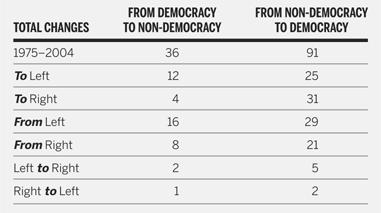
The argument that democratization is a function of inequality and fears of redistribution, conditional on elites and non-elites being able to act collectively, confronts three puzzles. The first is that evidence on recent experiences with regime change, out of or into democracy, shows little evidence of it. One might expect, for example, that if redistributive conflict underlies democratization, then new democracies should be disproportionately governed by left-wing governments, which are most likely to represent the collective interests of the poor, and new non-democracies by right-wing governments. Table 1, from Keefer (Reference Keefer, Boix and Stokes2007a), indicates that this is not typically the case. Of the 36 instances over the period 1975–2004 in which a country went from being governed by competitively elected leaders to non-competitively elected leaders, more of the transitions were to left-wing governments (12 of 32) than to right-wing governments (four of 32). In 91 transitions to democracy, more of the newly democratic governments were right wing (31) than left (25).
Ideology and Regime Change, 1975–2004

Note: Table reprinted from Keefer (Reference Keefer, Boix and Stokes2007a). Information from the Database of Political Institutions (Beck et al. Reference Beck, Clarke, Groff, Keefer and Walsh2000). A country is democratic if executive and legislative elections are coded as most competitive (LIEC = EIEC = 7), and non-democratic otherwise. Ideology comes from the DPI variable coding whether the largest government party is right, left, center, or non-ideological.
The second puzzle is that redistributive conflict between elites and non-elites does not seem to be the main issue driving political mobilization. Kaufman (Reference Kaufman2009) surveys evidence from Latin America indicating, despite high inequality, a surprisingly low correlation between economic class and partisan preference. In some cases, middle-class voters are more likely to vote for left-wing parties than are poor voters; in other cases, apparently left-wing parties woo the poor with clientelist rather than broadly redistributive appeals.
In any case, competitive elections have not ushered in the massive redistribution from rich to poor, the threat of which is thought to prevent democratization in high-inequality countries: taxes, particularly progressive income taxes, are low in Latin America. Moreover, recent efforts in some countries of the region to roll back some features of democracy have been led by apparently left-wing leaders.
African democracies provide starker evidence that redistributive struggles between rich and poor are often not salient in new democracies. Using Afrobarometer data, Keefer (Reference Keefer2009) asks whether a respondent's support for particular political parties is related to whether they agree with the statement that individuals are more responsible for their own welfare than the government, a plausible proxy for respondent preferences for redistribution. If political parties made credible redistributive appeals, one might expect them to attract the support of respondents who believe that governments are responsible for individual welfare; political parties that made credible commitments to resist redistribution should attract the support of respondents who agree that individuals are responsible for their own welfare. In fact, out of 38 parties across 16 countries, for only six parties was this the case. Redistribution from rich to poor appears not to be a salient political issue in these countries.
In arguments linking inequality, redistribution, and democratization, inequality is predicted to be high in less stable (and poorer) democracies and low in more stable (richer) democracies. The third puzzle emerging from contemporary experiences with democratization is that this does not appear to be the case. Comparing approximately 50 richer and 50 poorer countries with competitive elections from 1996–2006 (approximately two observations per country), the Gini coefficient (inequality) is only slightly higher in the poorer countries at 43.5, compared to 40 in richer democracies, and inequality is not, in any case, particularly low in the richer democracies. Even this small difference is likely overstated. Commonly used measures of income inequality already include the effects of redistribution, but the theoretically relevant measures of inequality are pre-redistribution. Since rich democracies redistribute much more than poor democracies, their pre-redistribution Ginis could be higher than in poor democracies.Footnote 1
COLLECTIVE ACTION AND POLITICAL PARTIES IN RICH AND POOR DEMOCRACIES
Cross-country variations in the ability of groups to engage in collective action are one potential explanation for the emergence of puzzles such as these. As the research of Acemoglu and Robinson (Reference Acemoglu and Robinson2006), Boix (Reference Boix2003), and others makes clear, redistributive conflicts depend not only on the level of inequality in a society, but also on the ability of elites and non-elites each to act collectively. Collective action is well known to be difficult and to succeed only under certain circumstances. It is therefore entirely plausible that countries could vary more with respect to the ability of groups to act collectively than with respect to inter-group income disparities. Some evidence summarized in this section suggests that this may plausibly be the case.
Collective action is more difficult if group members cannot coordinate (e.g., to pursue the same political strategy) or if group members cannot make credible commitments to each other (e.g., not to free ride on the efforts of others in the group). In practice, and in the literature, politically influential groups take the form of political parties, unions, religious organizations, armies, or bureaucracies. These groups (more precisely, leaders of these groups) exercise political influence on behalf of group members to the extent that they can coordinate the behavior of group members and credibly commit to the pursuit of group objectives. If they cannot do this, collective action by the group and on behalf of group members is less likely to occur. The term institutionalized conveniently describes groups in which group leaders have the capacity to coordinate actions by group members and the ability to make credible commitments to them.Footnote 2
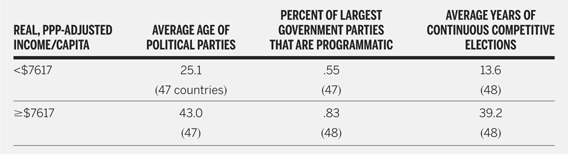
Political parties are of particular interest, as the most direct vehicle through which groups of citizens can influence government decision making. The available evidence on political parties in countries with competitive elections, while not directly capturing institutionalization, nevertheless points to significant heterogeneity that is plausibly related to it. These differences, as Table 2 indicates, are particularly significant between poor and rich democracies—which the earlier discussion suggests do not differ substantially with respect to inequality. The poorest-performing democracies appear to exhibit the weakest capacity of elites and non-elites to engage in redistributive struggles.
Comparing Rich and Poor Democracies in 2006

Note: The table compares richer and poorer countries with competitively elected governments in 2006, where competitive is defined as scores of seven (the maximum) on both the Legislative and Executive Indices of Competitive Elections from the Database of Political Institutions (Beck et al. Reference Beck, Clarke, Groff, Keefer and Walsh2001). The age of political parties, whether the government party is programmatic, and the years of continuous competitive elections are all taken from the DPI; income/capita is from the 2006 World Development Indicators. Countries with no government party are treated are classified as non-programmatic.
First, political parties in poorer democracies are much younger. Parties in richer countries with competitive elections are 43 years old, on average, compared to 25 years in poorer countries. Age is likely to be associated with (unobserved) institutionalization for two reasons: institutionalized parties are likely to survive longer, and older parties are less likely to be run on a personalized (non-institutionalized) basis by the founding leader. Party age goes hand in hand with democratic experience.
Second, and along the same lines, poorer democracies have experienced 13.6 years of continuous competitive elections compared to 39.2 for richer democracies. Keefer (Reference Keefer, Boix and Stokes2007a, Reference Keefer2007b) argues that the starkly different policy choices made by elected governments with fewer years of continuous competitive elections can be explained by their difficulty in mobilizing large segments of the population with credible pre-electoral promises.
The ability of political parties to mobilize support around specific programmatic agendas, such as redistribution, is another indication of institutionalization. In order to maintain a programmatic stance, parties need to select party members who agree with the program and to sanction party members who pursue private agendas at the expense of the party's programmatic identity. A third indication that institutionalized political organization is more limited in poorer democracies is that the largest government party is significantly less likely to be programmatic. The Database of Political Institutions (DPI) classifies slightly more than one-half of the largest government parties in poor democracies as having identifiable positions on the left-right spectrum; more than 88% of democracies in rich democracies can be identified as having a programmatic tendency. This is particularly important because it is precisely along the left-right spectrum that contestation of income redistribution in unequal countries should occur.
In sum, the comparisons in Table 2 suggest that the main difference between rich and poor democracies may not be the political institutions through which countries govern themselves (at least to the extent that they share competitive elections). Rather, they differ most sharply in the nature of the organizations that political competitors use to mobilize electoral support.
INEQUALITY AND INSTITUTIONALIZED POLITICAL ORGANIZATIONS
One implication of the Table 2 comparisons is that political competitors in poor democracies are unable to make broadly credible commitments to citizens. This can be explained in at least three ways. Parties that have not invested in mechanisms to select programmatically compatible candidates are unlikely to be able to make credible commitments to pursue a programmatic agenda. Those parties that vest all authority in a charismatic leader cannot credibly commit even to their own members that leader promises will be kept. Finally, in countries with younger and less programmatic political parties, it is less likely that voters base their electoral decisions on the party affiliation of candidates; the costs of defecting from the party are therefore low, but this means that politicians cannot collectively bind themselves to public policies that require their collective action. Keefer and Vlaicu (Reference Keefer and Vlaicu2008) argue that, in environments where broadly credible commitments are not possible, politicians make credible commitments to those few who do believe their promises, leading to policy biases that are sometimes associated with inequality: policies tilted towards narrow interests at the expense of public interests.
It is possible, however, that the comparisons in Table 2 simply reflect the efforts of elites to use informal means to suppress non-elite efforts to engage in collective action. While this may be the case, there is no evidence that the phenomenon is associated with inequality. In fact, inequality is positively correlated with indicators of party institutionalization: democracies, including poor democracies, with apparently more favorable conditions for the mobilization of large social groups exhibit, if anything, greater inequality than those that do not.
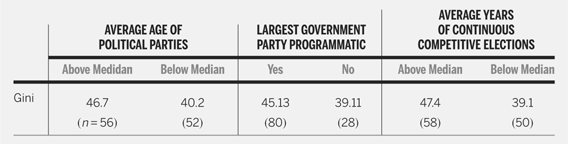
Looking only at countries with competitively elected governments since 1995, greater inequality (a higher Gini coefficient) is significantly associated with more programmatic and older parties, controlling or not for income per capita.Footnote 3 Among countries where the main government party is programmatic, the average Gini coefficient is 42.4, compared to 38.9 in countries where it is not. Looking only at poorer countries, the difference is greater: 46 versus 39.6. The average Gini coefficient over the same period for countries with governments that were not competitively elected was, if anything, lower than in the democracies, at 38.6 (Keefer Reference Keefer, Boix and Stokes2007a).
Table 3 illustrates similar comparisons, focusing only on democracies poorer than the median in every year from 1996–2006 (and limiting the population of countries to those with inequality data). In every case, poor countries with more mature democracies or more institutionalized political parties exhibit significantly greater inequality. These comparisons are (only) suggestive that, first, greater equality does not promote more collective action (at least as manifested in the form of institutionalized political parties); and second, that the interaction of collective action, democratization, and redistribution is likely to be complex and merits greater investigation. For example, the comparisons in Table 3 could be driven by the emergence of institutionalized parties serving the interests of elites. However, if elites were better able to engage in collective action than non-elites, why did they consent to democratization in the first place?
Inequality and Political Parties in Poorer Democracies, 1996–2006

Note: The table compares poorer countries with competitively elected governments over the period 1996–2006 and with data on inequality. See Table 1 notes for definitions of political variables. Observations are country-year, or approximately two observations, on average, for each of the 52 countries represented in the table.
WHY DOES DEMOCRACY EMERGE WHEN COLLECTIVE ACTION IS DIFFICULT?
The evidence above suggests that sharp variations in the formation of institutionalized political organizations more sharply distinguish poor, more unstable democracies from richer, more stable democracies than does income inequality. This observation raises numerous questions. Chief among these, and restating the question that closed the previous section: under what conditions do democracies emerge when collective action, particularly by non-elites, is limited? A natural suspicion is that elites themselves pursue democratization to further elite ends.
Robinson (Reference Robinson2006) reviews numerous theories of elite-led democratization. Collier (Reference Collier1999) argues that democracy arises when members of a heterogeneous elite find it advantageous to expand the franchise to gain support for policy outcomes that other elites oppose. Llavador and Oxoby (Reference Llavador and Oxoby2005) formalize a related argument, that one group of elites achieves the ability to push through a favored policy outcome over the objections of other elites. However, concerned that their political advantage might be fleeting, they instead push for an expansion of the franchise to lock in the participation of new voters who also favor their policy position.
Reform-minded elites are more likely to succeed in this strategy when they can credibly commit to the newly enfranchised that they will pursue policies favorable to them. This is more difficult if they are not organized as an institutionalized political party, however. One characteristic of such a party is that voters can use the party affiliation of candidates, and not simply their individual characteristics, to make electoral choices: institutionalized parties internalize the costs of identifying candidates who adhere to the party line and of punishing those who defy it. Such parties have benefits for candidates, since the enfranchised vote for candidates in part because of their party affiliation, and not only because of their individual characteristics. However, if the party's elected officials fail to implement reform, all party candidates then bear a cost, because the electoral value of their party label drops. This gives all party members an incentive to expel officials from the party who accept side payments from reform opponents or to pass laws to block such side payments (in the extreme, for example, laws that require party-switchers to surrender their seats have this effect).
The evidence from Great Britain in Llavador and Oxoby (Reference Llavador and Oxoby2005) supports the claim that reform elites were able to mobilize the support of the newly enfranchised. However, the absence of institutionalized political parties in contemporary poorer democracies suggests that reform elites confront greater difficulties in mobilizing non-elites. It is less clear that the policy objectives of reform-minded elites explains democratization in these countries.
Lizzeri and Persico (Reference Lizzeri and Persico2004), also using evidence from Great Britain, argue that elites agree to expand the franchise because intra-elite competition is so inefficient. In attempting to win the support of the few citizens who can vote, elites make large transfers to those citizens in the form of private goods (vote buying). Elites decide they would be better off with an expanded franchise that would deliver more public goods, from which they would also benefit. Keefer (Reference Keefer2007b) argues, however, that poor democracies are no better and perhaps worse at providing public goods than poor non-democracies. Table 2 points to an explanation for this: poor democracies—and young democracies—lack institutionalized political parties that would give politicians a collective incentive to internalize the social benefits of better public-good provision.
These examples are certainly insufficient to make the case that existing theories of intra-elite competition are not applicable to the experience of contemporary non-democracies. In fact, it seems most plausible that a focus on democratization as an elite-initiated event could be the most promising explanation of contemporary instances of democratization in poor countries. Future research, however, should ask more specifically how elite-initiated democratization occurs in the absence of institutionalized political parties, because this seems to be a characteristic feature of many poorer, younger democracies.
Specifically, one would like to explain both the observations in Tables 2 and 3. Table 2 suggests that democratization has occurred in poor democracies despite the relative absence of institutionalized political parties, where political competition tends to the clientelist and non-programmatic. The puzzle in Table 3 is that income inequality seems to be higher in democracies with more institutionalized political parties.
One possible explanation for Table 2 is that elites differ in their ability to make clientelist appeals to the disenfranchised. This could be because they can better target appeals or because other elites cannot easily bid for the support of their clients. Those with a clientelism advantage could, as in other theories of elite-driven democratization, favor democratization as a way to cement a transitory political advantage over other elites. One way to examine this prediction is to look at the nature of post-democratization institutions: do they favor the elite group that initiated democratization? Rural elites often enjoy an advantage in using clientelist ties for political advantage. Pakistan is one country where this seems to have been the case; under democracy, rural constituencies were significantly overrepresented in the legislature.
The fact that institutionalized political parties seem to be associated with higher inequality, as in Table 3, is more difficult to understand. It is possible that elite groups differ in the degree to which they are organized into institutionalized parties or other political organizations. If they differ, those who are better organized could again exploit a transitory gain in their political power to push for enfranchisement. They could then use their superior organization to attract the support of some fraction of the newly enfranchised (e.g., a fraction sufficient to achieve a majority), with promises of redistribution away from the unorganized. However, this would only lead to greater inequality, relative to the low-institutionalization democracies, if it results in less redistribution to the newly enfranchised than clientelist-based political competition. The conditions, theoretical and empirical, under which this might occur are unknown.
Stable non-democracies are also susceptible to explanation in the context of collective action. The argument in Gehlbach and Keefer (Reference Gehlbach and Keefer2008), for example, is that where elites are cohesively organized into a large ruling party, private investment is greater. However, an implication of this analysis is that intra-elite conflict is less likely to lead to democratization. First, the party offers benefits (e.g., security from expropriation) that are not available to those who leave the party. Second, the party enjoys organizational advantages that make it difficult for competing organizations to emerge, including those that party defectors might attempt to establish. This second reason also makes non-elite-led democratization less likely to emerge. One can reasonably speculate, therefore, that stable autocracies are those with large institutionalized ruling parties.
ELITE-DRIVEN DEMOCRATIZATION AND INEQUALITY
The earlier discussion concludes that collective action by non-elites is often not observed in poor democracies, suggesting that the necessary condition for inequality to drive democratization—collective action by non-elites—is often not met. Theory is silent about whether inequality plays a role in elite-driven democratization. It does not provide, for example, any particular reason to suspect that intra-elite discord should change with the fraction of societal wealth controlled by elites. Nor is there a theoretical analysis that discusses whether, given elite discord, the probability that one elite group will be better organized or better able to make clientelist appeals to the disenfranchised should change with inequality.
Inequality may affect the consequences of inter-elite discord, however. In a high-inequality setting, the political value of clientelist appeals to the poor may be higher (the poorer are the poor, the more value they attach to small transfers). In such an environment, elites may not form institutionalized political organizations and a transition to democracy would be more likely to result in electoral competition rooted in clientelist appeals. Among many open questions suggested in this article, one is whether the degree to which democratization is sustained and accompanied by economic development depends on whether democratization is the product of non-elite collective action or intra-elite conflict, and if intra-elite conflict, whether the post-democratization electoral strategies of elites rely on clientelist appeals or on institutionalized political parties.
ELITE-DRIVEN DEMOCRATIZATION AND INEQUALITY
The modest ambition of this article has been simply to highlight phenomena related to democratization and the characteristics of democracies in poor countries that do not appear to be addressed in the most prominent strands of either the democratization or the political economy of development literature. One is that conflicts between the forces of the organized left (poor) and organized right (rich) seem to have played a small role in most recent episodes of democratization, at least to the extent that these are reflected in crude measures of political-party institutionalization. Another is the absence of collective action by large social groups in many poor democracies. A third is the unexpected positive association between inequality and one important vehicle for collective action, the institutionalized political party.
The variables underlying these observations are merely indicative, but they are sufficient to justify further research on the role that variations in the cost of collective action play in democratization. This, in turn, has implications for the debate regarding democratization and development. Democratization without well-organized social groups may lead to modes of political competition that promote inefficient policies, targeted at narrow groups at the expense of the poor.
The observations point to the likely importance of intra-elite conflict as a driving force in democratization. However, further research is needed to reconcile this proposition with data that are not, at first glance, consistent with existing theories of such conflict. For example, public-good provision in poor democracies appears to be no better than in poor non-democracies, making it unlikely that an elite group's desire for better public-good provision is not generally the driving force behind democratization in poor democracies. Under what conditions can the enfranchisement of non-elites assist some elite groups in an inter-elite struggle if the non-elites themselves are not organized? What constrains the appeals that elites can make to non-elites when elites themselves are not organized?
Finally, democratization is not always the product of endogenous forces. The three puzzles discussed here could be usefully introduced into debates about the consequences and sustainability of externally imposed or induced democratization. For example, colonial strategies to favor particular groups over others are frequently linked to the subsequent development of colonies after independence. The exact reason that colonial favoritism affects subsequent development is not well worked out, however. The discussion here suggests one avenue that merits greater exploration: favored groups are granted greater scope for collective action.
Collective action is never ignored in the political economy of development and democratization. Frequently, though, collective action is assumed and remains at the periphery of the analysis. The foregoing discussion suggests that the degree to which large groups in society can act collectively may in fact vary substantially and have a strong independent influence on both democratization and development that deserves greater attention.