INTRODUCTION
The spinetail devilray Mobula japanica (Müller & Henle, 1841) is a large zooplanktivorous ray circum-globally distributed within tropical to warm temperate waters (Notarbartolo-di-Sciara, Reference Notarbartolo-di-Sciara1987; White et al., Reference White, Clark, Smith and Bizzarro2006; Couturier et al., 2012). However, detailed information on its distribution and biology remain scarce. This species belongs to the family Myliobatidae, which includes the largest living rays, within which can be found the manta (Manta Bancroft, 1829) and devil (Mobula Rafinesque, 1810) rays. The genus Mobula is currently represented by nine recognized species (Notarbartolo-di-Sciara, Reference Notarbartolo-di-Sciara1987) and Manta by two species (Marshall et al., Reference Marshall, Compagno and Bennett2009). The genera are separated by the position of the mouth, which is located ventrally in Mobula and is terminal in Manta. Mobula japanica is a highly mobile epipelagic ray that reaches 3.1 m disc width (Notarbartolo-di-Sciara, Reference Notarbartolo-di-Sciara1987) and occurs in both shallow-inshore and deeper offshore environments, with seasonal aggregations in highly productive areas, such as the Gulf of California (Notarbartolo-di-Sciara, Reference Notarbartolo-di-Sciara1988).
Although the fishing effort in the south-eastern Pacific Ocean has increased significantly over the past 20 years (Lamilla et al., Reference Lamilla, Bustamante, Roa, Acuña, Concha, Meléndez, López, Aedo, Flores and Vargas-Caro2010), the distribution patterns of myliobatid rays in this region are poorly known. While eagle rays (Myliobatis, Cuvier 1816) and devil rays have been reported in trawl, coastal gill nets and longline catches, relatively little is known about these specimens (Pequeño, Reference Pequeño1989; Lamilla et al., Reference Lamilla, Acuña, Araya, Oliva, Kong, Villaroel, Hernández, Concha, Vögler, Bustamante and Mutschke2005).
Four mobulid species have been confirmed in the south-eastern Pacific Ocean: Mobula munkiana Notarbartolo-di-Sciara, Reference Notarbartolo-di-Sciara1987 can be found from Ecuador to Peru (Bizzarro et al., Reference Bizzarro, Smith and Clark2006); Manta birostris (Walbaum, 1792) occurs between 0° (Ecuador) and 18°S (south Peru) and, although not reported in the literature, the presence of the species in southern locations is possible as M. birostris occurs up to 34°S in the south-western Atlantic (Marshall et al., Reference Marshall, Bennett, Kodja, Hinojosa-Alvarez, Galván-Magaña, Harding, Stevens and Kashiwagi2011) and 35°S in the south-western Pacific Oceans (Kashiwagi et al., Reference Kashiwagi, Marshall, Bennett and Ovenden2011); Mobula thurstoni (Lloyd, 1908) and Mobula tarapacana (Philippi, 1892) are the only mobulid species reported within Chilean waters, with the southernmost record for M. thurstoni at 37°S (Clark et al., Reference Clark, Smith and Bizzarro2006). Historical records of these two Mobula species suggest a small distribution range in the Peru–Chile border region (Beebe & Tee-Van, Reference Beebe and Tee-Van1941; Fowler, Reference Fowler1945; Mann, Reference Mann1954; De Buen, Reference De Buen1959; Pequeño, Reference Pequeño1989). The absence of fishery specimens for these Mobula species has resulted in a paucity of verified biodiversity records for these species, despite unconfirmed anecdotal reports by coastal fishermen (Lamilla et al., Reference Lamilla, Bustamante, Roa, Acuña, Concha, Meléndez, López, Aedo, Flores and Vargas-Caro2010).
This paper presents the first record of M. japanica in the south-eastern Pacific, with one specimen from Bahía Inglesa, Chile.
MATERIALS AND METHODS
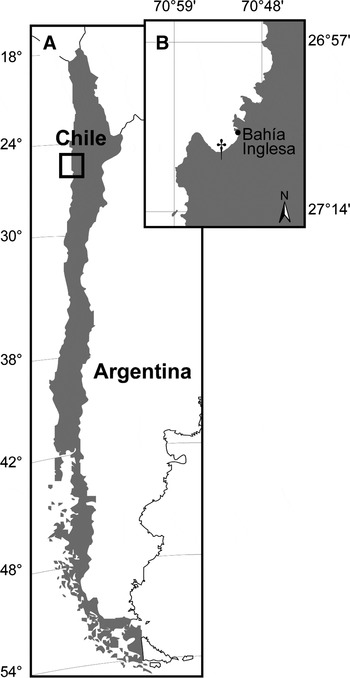
One beached-washed M. japanica was collected near Bahía Inglesa, Chile (27°08′32′′S 70°53′03′′W), in February 2010 (Figure 1). At the time of examination, the specimen was dead, gutted and finned (both pectoral fins removed). No evidence of any fishing gear was observed. Twenty-two morphometric measurements were made on the carcass to the nearest 1 mm following Notarbartolo-di-Sciara (Reference Notarbartolo-di-Sciara1987), and the lateral lobes of the left-side gill filter-plates were counted. The sex was determined by the absence of claspers, but no observations were made of internal organs.
Map of Chile (A) showing location of Bahía Inglesa (B). † indicates collection site of specimen of Mobula japanica.

The body proportions of the specimen are presented as a percentage of disc length, and compared with those of 19 museum specimens from the eastern central Pacific (converted from disc width values provided by Notarbartolo-di-Sciara, Reference Notarbartolo-di-Sciara1987) and a specimen from North Stradbroke Island, Australia (Museum accession number QMI.38137 extracted from Townsend & Kyne, Reference Townsend and Kyne2010). Due to the large size of the carcass, only the head and the first gill filter-plates were preserved and deposited in the Marine Fishes Collection of the Universidad Austral de Chile (IZUA-PM 4058).
Characteristic features of Mobula japanica were extracted from Notarbartolo-di-Sciara (Reference Notarbartolo-di-Sciara1987) and Last & Stevens (Reference Last and Stevens2009), and include: disc broad; dark blue dorsal coloration with occasional lighter shoulder patches; caudal spine; white tip on dorsal fin; very long tail; and spiracles positioned above the plane of pectoral fins.
SYSTEMATICS
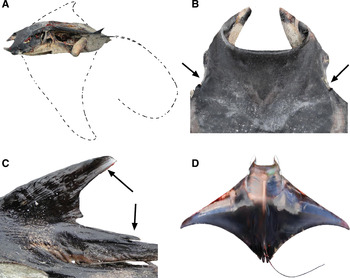
Mobula japanica (IZUA-PM 4058) from Bahía Inglesa, Chile: (A) pectoral fins and tail projection based on Notarbartolo-di-Sciara (Reference Notarbartolo-di-Sciara1987); details of (B) head and (C) dorsal fin; (D) specimen from North Stradbroke Island, Australia (Townsend & Kyne, Reference Townsend and Kyne2010). Arrows indicate the position of spiracles (B), white tip on dorsal fin and spine (C).

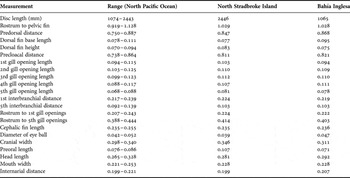
Proportional dimensions as percentage of the disc length for Mobula japanica from North Stradbroke Island, Australia (QMI.38137); and Bahía Inglesa, Chile (IZUA-PM 4058), and range values converted from Notarbartolo-di-Sciara (Reference Notarbartolo-di-Sciara1987).

Cephaloptera japanica Müller & Henle (1841:185)
Cephaloptera japonica Gray (1851: 134)
Aodon japonicus Jordan & Snyder (1901: 43)
Mobula rancureli Cadenat (1959: 1326)
RESULTS AND DISCUSSION
A mid-size (1065 mm disc length) female ray (Figure 2A) was found dead on the beach. The cause of death could not be determined. Morphological measurements of the specimen fell within the ranges provided by Notarbartolo-di-Sciara (Reference Notarbartolo-di-Sciara1987), with the exception of the preoral length, in spite of the differing states of preservation between the specimens (Table 1).
Distinctive features could be identified from the remains, such as the elliptical spiracles located above the level of pectoral fins (Figure 2B), gill filter-plates with 20–24 lateral lobes, the white tip to dorsal fin and an oval-based stinging spine in the base of tail (Figure 2C). Together, these features allow the specimen to be clearly differentiated from other Mobula species reported in the south-eastern Pacific Ocean. Mobula thurstoni has small and circular spiracles, fused gill filter-plates with 15–20 lateral lobes and lacks a caudal spine. Mobula tarapacana has elongated longitudinal spiracles, 50–65 lateral lobes to the gill filter-plates and no caudal spine. Mobula munkiana is the smallest mobulid species, reaching up to 1 m disc width, and has small subcircular spiracles, 50–60 lateral lobes to the gill filter-plates and no caudal spine.
The presence of M. japanica at ~27° southward of its reported distribution may be explained by the absence of rigorous species-specific fishery reports of landings along the coasts of Peru and Chile, making it difficult to differentiate between mobulid species in the area (CPPS, 2010). However, the absence of capture or sighting records in landing statistics, technical reports or local newspapers suggests that M. japanica is rare in Chilean waters. It is possible, however, that this species is caught in gillnet fisheries that target anchovies and sardines in the region. By-catch of other large elasmobranchs, such as the smooth hammerhead Sphyrna zygaena (Linnaeus, 1758) and the Chilean eagle ray Myliobatis chilensis Philippi, 1892, has been observed previously in these fisheries (C. Bustamante, unpublished data). Such large species are usually finned and the carcasses discarded. Whether the specimen examined represents by-catch discard or was stranded on the beach is unknown.
An alternative explanation for the lack of fishery records may be the presence of a strong warm phase of El Niño Southern Oscillation (ENSO) during 2010 (Montecinos et al., Reference Montecinos, Kurgansky, Muñoz and Takahashi2011). The coastal fringe off northern Chile and southern Peru is characterized by upwelling processes (Arntz et al., Reference Arntz, Gallardo, Gutiérrez, Isla, Levin, Mendo, Neira, Rowe, Tarazona and Wolff2006), fuelling the ecosystem with cold waters and high levels of primary production (Barber & Smith, Reference Barber, Smith and Longhurst1981). This cold water mass, normally present all year, may act as a natural barrier to southerly movements of tropical and subtropical fauna (Smith, Reference Smith, Summerhayes, Prell and Emeis1992; Figueroa Reference Figueroa, Castilla and Largier2002). A disruption of this barrier, as occurs with warm phases of the ENSO, can facilitate a latitudinal displacement of tropical fauna allowing migrant species of Panamic origin to invade the Peruvian and Chilean coastal waters (Sielfeld et al., Reference Sielfeld, Laudien, Vargas and Villegas2010). At least 100 tropical fishes labelled as ‘septentrional invaders of the Peru Current' have been documented as ‘alien’ species in latitudes south of their natural distribution range (Mann, Reference Mann1954; Sielfeld et al., Reference Sielfeld, Laudien, Vargas and Villegas2010).
Based on our observations, we confirm the presence of Mobula japanica for the first time in the south-eastern Pacific Ocean. This record from Chilean waters increases the known range of M. japanica, and raises the number of mobulid species recorded in Chilean waters to three along with M. tarapacana and M. thurstoni (Pequeño, Reference Pequeño1989).
ACKNOWLEDGEMENTS
The authors thank all members of the ELASMOLAB involved in ‘Programa de Conservación de Tiburones (PCT)', especially J. Lamilla, for their valuable help with logistics, sampling and dissections. We are very grateful to the fishermen of Asociación Gremial de Pescadores de Caldera and to M. Avalos for their assistance in the field. Additional thanks to W. White who confirmed the species identity as well as two anonymous referees for their useful comments on an earlier version of this manuscript. C. Bustamante was supported by CONICYT–Becas Chile and TUAP–Graduate School of The University of Queensland. This contribution received no specific grant from any funding agency, commercial or not-for-profit sector.