IntroductionFootnote 1
In 1967, UNESCO convened in the town of Timbuktu to preserve and promote Africa’s written legacy.Footnote 2 Timbuktu was chosen as the most representative site of this vibrant intellectual heritage. One of the outcomes of the meeting was the decision to establish in the town a repository for the region’s numerous manuscripts. Six years later, the Centre de Documentation et de Recherches Ahmed Baba (CEDRAB) was opened – re-named, in 2001, Institut des Hautes Études et de Recherches Islamiques – Ahmed-Baba (IHERI–AB).Footnote 3
The UNESCO meeting reflected the cultural ferment around African history that characterized the late colonial and immediate post-colonial period. While the main focus in this phase of African historiography was the study of oral tradition, some scholars, among them the “doyen” of Timbuktu studies John O. Hunwick, employed written sources to make crucial contributions to African history. Many of these studies were based on late nineteenth-early twentieth century editions and French translations of the two Timbuktu chronicles, the Tārīkh al-sūdān (Histoire du Soudan) and the Tārīkh al-fattāsh (La chronique du chercheur).Footnote 4 These chronicles purport to cover the history of West Africa since c. 1100 to the mid-seventeenth century, focusing on the Songhay state (1468–1591), its structure and society, military campaigns and political elites, as well as the scholarly institutions of the towns of Timbuktu and Gao.
As a consequence of the shift from French to English as the dominant language of international scholarship, these chronicles have been translated into English in the last fifteen years: the Tārīkh al-sūdān by Hunwick himself in 1999 and the Tārīkh al-fattāsh by Christopher Wise and Hala Abu Taleb in 2011.Footnote 5 Hunwick’s work is a scholarly annotated translation that represents an excellent synthesis of the most updated scholarship on West African history. By contrast, the recent English translation of the Tārīkh al-fattāsh, essentially meant for a wider, non-specialized audience, is, in the words of Paulo F. de Moraes Farias, “a flawed, in places misleading rendering of the chronicle.”Footnote 6 Indeed, of the two Timbuktu chronicles, it is the Tārīkh al-fattāsh that requires scholars’ attention in the most urgent way, as underlined by Zakari Dramani-Issifou.Footnote 7 That is because the Tārīkh al-fattāsh, in its current edited version, is a puzzling work, full of inconsistencies, problems of authorship, and textual manipulations which are still not fully understood.
Our study inscribes itself in the long tradition of critical scholarship on the Tārīkh al-fattāsh that has followed the first edition and translation in 1913 by Octave V. Houdas and Maurice Delafosse. Through research on Arabic manuscripts in West African and French collections, we have succeeded in locating several hitherto unexplored manuscript materials whose study allows us to untangle some of the textual problems of the Tārīkh al-fattāsh. Our article therefore advances a new theory about the composition of the chronicle generally referred to as Tārīkh al-fattāsh. According to our theory, which substantially differs from the received understanding of this text, Houdas and Delafosseʼs Reference Houdas and Delafosse1913 edition is a literary pastiche that conflates two different chronicles. The first, dating to the seventeenth century, was composed by a certain Ibn al-Mukhtār, i.e. “the son of al-Mukhtār” – as Nehemia Levtzion already suggested in a seminal 1971 article.Footnote 8 This chronicle lacks a title and is incomplete, due to the loss of a number of leaves at the beginning in the two manuscript copies found so far. The second chronicle is a pseudo-epigraphic work, entitled Tārīkh al-fattāsh, apocryphally ascribed to a sixteenth century scholar, Maḥmūd Ka‘ti, but in fact composed in the 1820s by a Fulani scholar called Nūh b. al-Ṭāhir b. Mūsà al-Fulānī. This latter chronicle, though produced by substantially modifying the untitled tārīkh by Ibn al-Mukhtār, is a new original work composed to support the political claims of Aḥmad Lobbo, the founder of the nineteenth-century so-called Fulani Empire of Masina.
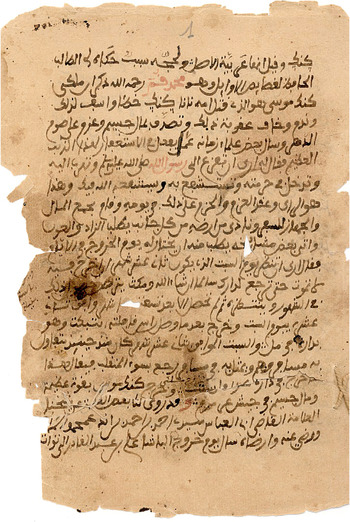
MS A / IHERI–AB 3927, folio 1a/page 1 (Courtesy of the IHERI–AB).

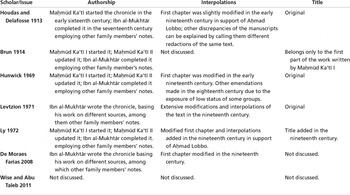
Different theories on the genesis of the Tārīkh al-fattāsh

A Tradition of Critical Studies on the Tārīkh al-fattāsh
After the French occupation of the Niger Bend and the conquest of Timbuktu in late 1893–early 1894, Félix Dubois, a journalist for the French newspaper Le Figaro, visited the town. There he heard of the existence of an important chronicle of the region that was called Tārīkh al-fattāsh. According to the reports he collected, the chronicle was written by one Mahman (sometimes referred to by Dubois as Mahmoud) Koti or Koutou. However, notwithstanding his efforts, Dubois was not able to obtain a copy of the chronicle:
Under the title of Fettassi, Koti edited a history of the kingdoms of Ganata, Songhoi, and Timbuctoo, from their origins until 1554 (950 of Hegira). In spite of the most persistent research, I have not been able to procure more than fragments of this important work. Everyone knows all about it, but no one possesses it; it is the phantom book of the Sudan.Footnote 9
Less than twenty years later, the well-known arabist Octave V. Houdas and his son-in-law, the famous colonial administrator and scholar of African history Maurice Delafosse, received from colonial administrators three manuscripts which they identified as copies of the Tārīkh al-fattāsh. Collating the manuscripts, they edited the resulting Arabic text and translated it into French in 1913. Since then, the Tārīkh al-fattāsh has become one of the most widely exploited sources for the history of West Africa.
However, several scholars have stressed that the Tārīkh al-fattāsh has a complex history which resulted in an edited text that is problematic in many respects, with regards to its authorship, title, textual variants, editorial manipulations, and historical inconsistencies. The first substantial contribution to the study of the Tārīkh al-fattāsh’s textual history is the introduction to the French translation.Footnote 10 Houdas and Delafosse did not only edit and translate the text, in keeping with the prevailing climate of translating Arabic works by classical orientalists, but they also carefully described the manuscripts which preserved it, and addressed several issues linked to the history of the chronicle and its authorship.
Houdas and Delafosse employed three manuscripts, named MS A, MS B – actually a copy of MS A – and MS C. They argued that the three manuscripts were characterized by substantial discrepancies, and represented two different redactions of the same text. MS A is mutilated in the first pages and includes only an incomplete text lacking its beginning. MS B, being a copy of MS A, also preserves the work only partially. MS C is complete and represents, according to Houdas and Delafosse, the whole text, from the beginning of the work, in which the title and the name of the author are revealed, to its end. In addition, MS C also includes other passages which do not appear in the other two copies of the chronicle.
According to Houdas and Delafosse, the discrepancies among the manuscripts they employed are the result of the complex textual history of the chronicle. Originally, following their theory, the work was begun in 1519 by a Timbuktu scholar, whose full name was Maḥmūd Ka‘ti b. al-ḥājj al-Mutawakkil Ka‘ti (d. 1593). This chronicle was updated by the latter’s grandson, known only as Ibn al-Mukhtār (fl. 1664–1665), who compiled the final version in the second half of the seventeenth century by incorporating notes left by other members of the Ka‘ti family. Eventually, Houdas and Delafosse concluded, the first chapter of the chronicle was “slightly modified” in the early nineteenth century by the addition of a prophecy aimed at conferring spiritual and political legitimacy to Aḥmad b. Muḥammad Būbū al-Fulānī, better known as Aḥmad Lobbo (d. 1845), the founder of the Fulani Empire of Masina.Footnote 11
This prophecy, supposedly predicting Aḥmad Lobbo’s arrival, was allegedly foretold, according to MS C, in the late fifteenth century and conveyed to the Songhay ruler Askiyà Muḥammad (d. 1538). During his trip to Mecca and his stay in the sacred places of Islam, Askiyà Muḥammad was informed four times about Aḥmad Lobbo’s advent: by a certain sharīf from Mecca called al-ʿAbbās, by the well-known Egyptian polymath Jalāl al-Dīn al-Suyūṭī (d. 1505), by the North African scholar ‘Abd al-Karīm al-Maghīlī (d. 1504–1505), and by Shamharūsh, the chief of the jinns.Footnote 12 These eminent personalities invested Askiyà Muḥammad with the role of rightful caliph of West Africa, and informed him that he was the eleventh of twelve caliphs mentioned by the prophet of Islam Muḥammad in a famous ḥadīth.Footnote 13 After Askiyà Muḥammadʼs reign, the prophecy continues, Islam would fall into decline in West Africa until, at the beginning of the thirteenth century of the hijra (nineteenth century CE), his successor, and last of the twelve caliphs before the arrival of the mahdī, would arrive to restore the faith: he would be a certain Aḥmad from the Sangare tribe in Sebera, Masina. Easily identifiable as Aḥmad Lobbo, this caliph would have thus have inherited from Askiyà Muḥammad the legitimate claim to the caliphate as well as several tribes in servile status which belonged to the crown.
Following the theory advanced by Houdas and Delafosse, MS C (with the addition of the prophecy) represents a copy of the work in the form circulated by Aḥmad Lobbo. They also argued that MS A – and its copy MS B – is a version of the chronicle which did not conform to the nineteenth century vulgata and, because it had not included the prophecy, it was deprived of its first part due to the censorship of the agents of Aḥmad Lobbo.
Houdas and Delafosse thus recognized that the Tārīkh al-fattāsh had gone through several textual manipulations. Nonetheless, they had little doubt about the authenticity of the chronicle they edited and translated: “We find ourselves in the possession of all the elements necessary to reconstruct, more or less completely, a first order work on the history of the Soudan.”Footnote 14
The 1913 edition and translation were reviewed shortly afterward by Joseph Brun, who cast doubt on the conclusion that the edited chronicle corresponds to the complete original one.Footnote 15 His contribution mainly focused on problems of authorship and on the extraordinarily long life of Maḥmūd Ka‘ti, as it reportedly emerges from the edited text: born in 1468, Maḥmūd Ka‘ti would have died in 1593 at the age of 125 years. Brun accordingly argued for the existence of two Maḥmūd Ka‘tis involved in the production of the Tārīkh al-fattāsh. According to his hypothesis, the first Maḥmūd Ka‘ti, born in 1468 and died in 1552–1553, was the initiator of the chronicle, the “indisputable author” of a work titled Tārīkh al-fattāsh. This chronicle, Brun suggests, corresponded most likely to the first five or six chapters of the edited text.Footnote 16 Maḥmūd Ka‘ti Iʼs work, following his hypothesis, was then continued by a homonymous relative of his who was born during the reign of Askiyà Muḥammad (1493–1529) and who died in 1593. Lastly, Brun suggested that the seventeenth-century Ibn al-Mukhtār was the final “revisor” of the chronicle in the form represented by the edited text.Footnote 17
More than fifty years later, John Hunwick expanded and substantiated Brun’s argument about the existence of two Maḥmūd Ka‘tis.Footnote 18 Furthermore, Hunwick listed all the passages present in MS C and absent in MS A, highlighting two main divergences: the prophecy concerning the twelfth caliph, already exposed as a nineteenth century forgery by Dubois, Houdas, and Delafosse, and some information on the servile castes that had escaped the attention of the previous scholars of the Tārīkh al-fattāsh. While briefly dismissing the prophecy as a textual stratagem to legitimate Aḥmad Lobbo’s power, Hunwick’s attention focused on the issue of the servile groups also mentioned exclusively in MS C. Without offering further proof, Hunwick stated that these references were part of the original sixteenth century chronicle, expurgated from it sometime in the eighteenth century “by someone other than Shaikh Aḥmad [i.e. Aḥmad Lobbo].”Footnote 19 Thus, MS A would be a copy of the original chronicle expurgated of some reference to servile groups. The reason for removing these passages was, according to Hunwick, that people of servile origins had obtained positions of prominence after the Moroccan conquest of the Songhay state in 1591, in accordance with the oral tradition recorded by Dubois.Footnote 20 Eventually, then, at the time of the addition of the new first chapter including the prophecy in support of Aḥmad Lobbo, the copy being used must have contained the unexpurgated passages on the servile castes, so that this information re-emerged.Footnote 21 Notwithstanding his acknowledgement of the fact that the first chapter of the Tārīkh al-fattāsh had been rewritten at the time of Aḥmad Lobbo, Hunwick stated that the section in which the author discloses his identity, the title and the subsequent lines in which the author sets forth his aims is, “certainly genuine.”Footnote 22
A few years later, Nehemia Levtzion published a path-breaking study on the Tārīkh al-fattāsh.Footnote 23 Critical of both Houdas and Delafosse, on the one hand, as well as Brun and Hunwick on the other, Levtzion argued that the Tārīkh al-Fattāsh is, in essence, the result of two separate moments of production: a seventeenth-century work exclusively written by Ibn al-Mukhtār, plus some textual interpolations added on behalf of Aḥmad Lobbo and thus dating back to the first half of the nineteenth century. Levtzion further suggested that the different manuscripts used by Houdas and Delafosse for their edition of the Tārīkh al-Fattāsh embody these two moments of production. While MS A represents an incomplete copy of the original chronicle by Ibn al-Mukhtār, MS C represents the new vulgata of the work circulated in the early nineteenth century by Aḥmad Lobbo’s entourage, as already advanced by Houdas and Delafosse.
By carefully analyzing the edited Arabic text, Levtzion argued that the passages absent from MS A but present in MS C were all interpolations of the nineteenth century regarding issues of legitimization and of slavery. As the result of this theory, he convincingly suggested that Maḥmūd Ka‘ti did not have a life of extreme longevity nor was he the author of the chronicle, not even of its first section. Employing exclusively the evidence from MS A, the “original chronicle” according to Levtzion, and from the Tārīkh al-sūdān, a more plausible biography of Maḥmūd Ka‘ti emerges: a scholar born sometime during Askiyà Muḥammad’s reign, most likely in the 1510s, associated with Askiyà Dawūd b. Askiyà Muḥammad (r. 1549–1583), and who died in 1593. His association with the writing of the chronicle, and all the evidence of him as a late-fifteenth – early-sixteenth century figure, Levtzion concluded, are derived from MS C. As a consequence, these sections are nineteenth century additions whose main aim was to make Maḥmūd Ka‘ti a reliable eyewitness of the prophecy foretelling the Aḥmad Lobbo’s role as rightful caliph of West Africa:
[T]he author of the additional sections of MS C (…) laboured hard to make the TF [i.e. Tārīkh al-Fattāsh] bear evidence on the expected coming of the twelfth caliph, namely Shehu Ahmadu [i.e. Aḥmad Lobbo], an heir to the eleventh caliph, Muḥammad Askia. In order to render the evidence about the prophecy more convincing, the [alleged] author MK [i.e. Maḥmūd Ka‘ti] should have been in the company of Muḥammad Askia in Mecca.Footnote 24
Maḥmūd Ka‘ti was therefore not the author of the chronicle, according to Levtzion, Rather, he left some historical notes, as did some of his descendants. These notes were eventually collected and collated into the Tārīkh al-fattāsh, which was written exclusively by Ibn al-Mukhtār in the seventeenth century.Footnote 25 The text then had some legitimizing passages added to it in the nineteenth century at the behest of Aḥmad Lobbo.
Levtzion’s argument also focused extensively on the very important second appendix of Houdas and Delafosse’s edition of the Tārīkh al-fattāsh. The appendix is a chronicle by itself, written by an author who does not disclose his name, but who says that he wrote it at the request of Askiyà Dawūd b. Hārūn (d. 1654). The latter reigned in Timbuktu between 1657–1669, under the tutelage of the Armas.Footnote 26 Thus, the second appendix is, following Levtzion’s theory, a text contemporary to that of Ibn al-Mukhtār’s Tārīkh al-fattāsh. By comparing the appendix with MS A, Levtzion showed that the two texts overlap in most of their passages, often verbatim. Furthermore, the beginning of the text reproduced in the appendix covers the events which chronologically precede the section where MS A starts, i.e. the history of the Songhay dynasties of the Zā and Shī (or Zuwā and Sunni according to the form employed in the Tarīkh al-sūdān),Footnote 27 in the midst of which MS A begins its narrative. Levtzion thus suggested that “it is very likely that the first part of the appendix represents the first missing first part of MS A.”Footnote 28 Any remaining differences between the two texts can be explained by the fact that the appendix “might represent an earlier version of the chronicle, which was later revised.”Footnote 29
Levtzion’s article concludes with an analysis of the content of the sections of the edited text contained only in MS C. As already underlined by Hunwick, Levtzion identifies two main issues in the interpolations from the nineteenth century: the claim for the caliphate and the mention of servile groups or castes. Regarding the caliphate, Levtzion briefly argues that the insertion of the prophecy into the Tārīkh al-fattāsh is to be understood in the context of the tension over the designation of the legitimate caliph of West Africa and competition between the Fulani Masina Empire of Aḥmad Lobbo and the regional power usually referred to as the Sokoto Caliphate.Footnote 30 As for the issue of the servile groups, the last issue dealt with by Levtzion, MS C clearly imposes the status of slaves of the crown on West African “castes” or endogamous artisanal groups (griots, blacksmiths, and leatherworkers) who could not be reduced to servile status.
Just one year after Levtzion’s article appeared, Madina Ly published another important contribution on the Tārīkh al-fattāsh but without having been able to consult the Levtzion’s contribution.Footnote 31 Ly’s study is a detailed review of all the problematic issues characterizing the chronicle, from the manuscripts used for the edition to the issue of authorship, passing through the analysis of the appendices and of the topics discussed in the narrative. Ly accepted the theory originally put forward by Brun, that there were three main authors involved in the production of the Tārīkh al-fattāsh: Maḥmūd Ka‘ti I, Maḥmūd Ka‘ti II, and Ibn al-Mukhtār. A substantial part of Ly’s article is devoted to an extensive review of the contents of chronicle and the attribution of each section to one of the three alleged authors. In the course of producing this analysis, Ly exposed that several parts of the edited text are actually nineteenth century interpolations. To date, Ly’s article still represents the only comprehensive analysis of the Tārīkh al-fattāsh and the only contribution which explicitly suggests that Tārīkh al-fattāsh may not have been the name of the original chronicle, but part of the nineteenth century interpolation.Footnote 32
More recently, Paulo de Moraes Farias, while accepting completely Levtzionʼs theory on the history of the Tārīkh al-fattāsh, has revolutionized the scholarly approach to the Timbuktu chronicle tradition in general.Footnote 33 He identifies the chronicles characteristic of Timbuktu in the seventeenth century as constituting a literary genre novel to the region, each designed to provide a coherent narrative of the different regions of the West African Sahel from a distant mythical past to the days of the authors: an exercise unprecedented elsewhere in West Africa. For de Moraes Farias, the chronicles do not represent merely naïve records of raw events by passive transmitters. The chronicles are components of an elaborate historiographical program, part of a sophisticated political project carried out by historians exercising political agency. He calls this:
[a] project of reconciliation between three elites, aimed at a closer, less unequal political integration of each of them with the others. These three elites were the Arma military and political class themselves (who needed definitively to legitimise their power), the Askiya lineages (now deprived by the Moroccan invasion of independent sovereign power over the region, but still playing significant political roles in it) and the urban patriciate of Timbuktu and Jenne (to which the tarikh writers belonged, and which had much suffered from the invasion but still retained considerable influence and literate skills useful to the Arma administration).Footnote 34
In short, de Moraes Farias argues that the chronicles as a genre of literature could have emerged only in the second half of the seventeenth century as a response to a political crisis, meaning the Moroccan invasion and the subsequent destruction of the Songhay state with its traditional authorities. However, the ambitious joint project of the chroniclers failed because of the changing political environment. By the end of the seventeenth century, the possibility of a unified state in the Niger bend under the domination of the Arma disappeared due to internal struggles among the Arma themselves and the increasing power of the Tuareg of the region.
The most recent contribution to the study of the Tārikh al-fattāsh is Christopher Wise and Hala Abu Taleb’s above-mentioned translation into English.Footnote 35 The English translators seem to be aware of the scholarly literature on the Tārikh al-fattāsh; the introduction, solely authored by Wise, clearly refers to Houdas-Delafosse’s and Hunwick’s work.Footnote 36 Similarly, the bibliography shows that the translators are acquainted with Levtzion’s contribution.Footnote 37 However, the current English translation of the Tārīkh al-fattāsh does not follow in the footsteps of this century-old tradition of critical scholarship and completely fails in adding anything to the state of our knowledge on the chronicle. On the contrary it undermines the results achieved by scholars who have worked on the Tārīkh al-fattāsh by circulating an uncritical translation of the chronicle.
Wise’s statement, that “the modest goal of this book is to introduce an important, but neglected document to the English speaking world in the belief that Houdas and Delafosse’s edited text is itself historically significant,”Footnote 38 does not mitigate this fact. Moreover, Wise’s acknowledgment that “the Ta’rīkh al-fattāsh is important for its intrinsic literary merit as well as its obvious historical value” is ironically contradicted by the two translators’ failure to put the chronicle into its historical context and their decision to preface it with an essentialist and exoticizing introduction.Footnote 39
On the basis of the preceding review of the critical scholarship produced on the Tārīkh al-fattāsh, we can summarize the main problems that scholars have identified relating to its authorship, the interpolations that occurred after the writing of the “original” chronicle, and the significance of the title. Who wrote the chronicle? Was it modified in later contexts? If originally written by Maḥmūd Ka‘ti at the beginning of the sixteenth century, as most scholars accept, it would have been updated by other scholars from the same Ka‘ti family until Ibn al-Mukhtār compiled the final version in the seventeenth century. Then, at the time of Aḥmad Lobbo in the 1820s, a new version replaced the “original” one that is now lost. However, if Levtzion is correct in his interpretation, the Tārīkh al-fattāsh was written in the seventeenth century, but the nineteenth century interventions were much more extensive than a single substitution in the beginning section; the work of the nineteenth-century interpolator affected the whole text. Hunwick also argued that some passages had been removed from the main text, which had thus gone through other processes of revision, well before the interpolations made at the time of Aḥmad Lobbo. And the title? Does it refer to the original chronicle or not?
In other words, the mystery of the Tārikh al-fattāsh’s puzzled history remains to be solved. Several questions are still waiting to be answered in a definitive way.
And precisely because of its historical significance, the process of the chronicle’s redaction has to be clarified. The only route to address this, and to produce a new understanding of the chronicle’s contents and meanings, passes through the recovery and analysis of its Arabic manuscripts.
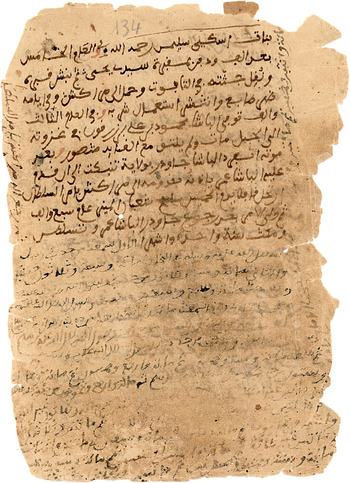
MS A / IHERI–AB 3927, folio 67b/page 134 (Courtesy of the IHERI–AB).

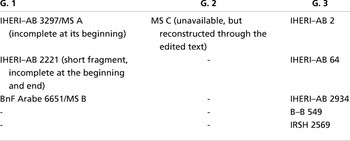
Different groups of manuscripts of the Tārīkh al-fattāsh

New Materials for the Study of the Tārīkh al-fattāsh and the “Rediscovery” of MS A
The mid-1990s witnessed the opening up of West African libraries. Filled with thousands of manuscripts, these libraries have provided researchers with new materials that enable us to revise and improve on older scholarship on the Timbuktu chronicles. Hunwick’s above-mentioned translation of the Tārīkh al-sūdān is a result of the availability of such new manuscripts. His work is a substantial improvement on the text edited and translated into French by Houdas; Hunwick employed four manuscripts that were unknown to the original translator. Furthermore Hunwick’s annotations of the text are the outcome of updated research on the history of West Africa as well as Hunwick’s own extensive knowledge. Finally, his erudite “Songhay: An Interpretative Essay,” which prefaces the translation, offers an updated introduction to Middle Niger history up to the seventeenth century. The result is a crucial new work that is indispensable for an effective re-reading of the Tārīkh al-sūdān and its context in pre-1700 West African history. It provides an example of the potential benefits to be gained from re-working an old and outdated translation and stands in sharp contrast to the misleading English translation of the Tārīkh al-fattāsh provided by Wise and Abu Taleb. Can new research on the Tārīkh al-fattāsh based on the analysis of unexplored Arabic manuscripts yield comparable outcomes that shed light on the unsolved problems of this chronicle?
Almost all the scholars who have worked on the Tārīkh al-fattāsh have underlined the necessity of recovering the actual manuscripts employed for the 1913 edition, in order to address the problematic aspects of its redaction. Yet a long-standing assumption holds that only MS B is still available, preserved at the Bibliothéque Nationale de France in Paris, under the call number Arabe 6651. It consists of 123 folios, 21 lines/page, most likely bound after its arrival in France.Footnote 40 As for MS A and MS C, Levtzion reported that they disappeared after the publication of the Arabic edited text in 1913: “Unfortunately nothing is known about the location of the two more important manuscripts.”Footnote 41
However, our extensive exploration of West African manuscript collections has resulted in the “rediscovery” of MS A and in the discovery of several other copies of the chronicle in Mali, Niger, and Ghana.
Hitherto unnoticed is the fact that MS A has been stored at IHERI–AB with the shelfmark n° 3927.Footnote 42 The manuscript consists of seventy unbound leaves of 22x17 cm with a written surface of 14x10 cm. It displays approximately twenty lines per page, and is written in dark brown ink with red rubrications (see Figure 1). The pagination in “Arabic” numerals has been added on the top margin of the manuscript in pencil (maybe in the mid-1990s during the cataloguing of the IHERI–AB manuscripts). The general state of the manuscript is good and the text is always easily legible.
From a textual point of view, the manuscript is a miscellany written by the same hand, composed of the main text of the chronicle followed by three isolated fragments, exactly matching the description of MS A according to Houdas and Delafosse.Footnote 43
Main text – The first sixty-seven leaves (pages 1–134) correspond to most of the edited text of the Tārīkh al-fattāsh, from the last line of page 32 to the end of the work at page 184. In fact, the text of IHERI–AB 3927 corresponds exactly with that of MS A, as reconstructed on the basis of the critical apparatus of the edition, which reports variant readings in the different manuscripts, omissions etc.
Isolated leaf 1 – Folio 68 (pages 135–136) corresponds to the isolated leaf whose text is sparsely incorporated in the first chapter of the edited Tārīkh al-fattāsh between page 12 and page 31. Only the first line of this leaf is missing in the edited Tārīkh al-fattāsh:

[l.1] This is the remainder of the biography of Asikyà Muḥammad; he died – May God show him mercy – [l.2] isolated, blind and repentant.
By taking into consideration these two lines, we can discard Houdas and Delafosseʼs suggestion that isolated leaf 1 is part of the lost first part of MS A.Footnote 45 The biography of Asikyà Muḥammad to which the text of line one refers only appears in the chronicle as chapter six, implying that this leaf should be placed after chapter six itself.Footnote 46
Isolated leaf 2 – Folio 69 (pages 137–138) completely corresponds to the first appendix of Houdas and Delafosse’s edition of the Tārīkh al-fattāsh (pages 185–186 of the Arabic text/pages 322–325 translation).
Isolated leaf 3 – Folio 70 (pages 139–140) is a fragment of the Tārīkh al-sūdān, describing a rebellion of the people of Jenne against the Arma in 1064/1654.Footnote 47 It corresponds to the page 316/line 1 – page 317/line 15 of the Arabic text of the Tārīkh al-sūdān or to pages 477/line 17 to 480/line 9 of the French translation. Indeed, Houdas and Delafosse identified one of the three leaves as a fragment of the Tārīkh al-sūdān: “[M]anuscript A contains in the end three loose leaves, written in the same hand of the body of the work, of which one is a fragment from the Tarikh al-sūdān.”Footnote 48
Other extra-textual elements confirm the identification of IHERI–AB 3927 with MS A of Houdas and Delafosse. First of all, all the marginal notes referred to by the editors are found consistently in IHERI–AB 3927. Furthermore, a short text of half a page, written in black ink and in a different hand from the main text appears also at the end of the main text of IHERI–AB 3927. This text has almost completely faded away, but among the few words legible are letter numbers, the word ḥadīth and the name of the well-known ḥadīth compiler al-Bukhārī (d. 256/870). The latter’s name suggests that this text is the same as the one referred to in the edited Tārīkh al-fattāsh. Accordig to Houdas and Delafosse, MS A ends, after the chronicle, with a quotation from al-Bukhārī which occupies two and a half pages.Footnote 49 The discrepancy in the number of pages – two and a half pages mentioned by Houdas and Delafosse against half a page found in IHERI–AB 3927 – may be explained by the loss of a leaf, i.e. 2 pages, after the publication of the edition and the translation. Finally, some notes in the edition of the Tārīkh al-fattāsh refer to peculiar features of the materiality of MS A. One example suffices: IHERI–AB 3927 has on its first folio a string – used to keep together the bottom part of the leaf – that is broken. In a footnote of the edited text, we read that “the reading of the passage is doubtful in MS A, which carries a tear in this place.”Footnote 50
All these similarities between IHERI–AB 3927 and MS A, as can be gauged from the Introduction and the critical apparatus of the text edited by Houdas and Delafosse, make a strong case for the claim that IHERI–AB 3927 is actually MS A.Footnote 51
The Search for MS C
By identifying IHERI–AB 3927 as MS A and knowing that BnF Arabe 6651 is MS B, the only source-text employed by Houdas and Delafosse in their edition of the chronicle which remains unlocated is MS C. Although our attempt to locate MS C has failed so far, it has resulted in the discovery of six related manuscripts previously unexplored: from IHERI–AB the five call numbers 2, 64, 2221, 2934, and a copy of the chronicle found in the village of Banikan, close to Tindirma, upstream from Timbuktu and stored in the village at the Boukhary Library with the call number 549 (henceforth B–B 54); and a sixth manuscript at the Institut des Recherches en Sciences Humaines of Niamey, call number 2569 (henceforth IRSH 2569).Footnote 52
The substantial textual discrepancies between MS A and MS C, pointed out by Levtzion in his above-mentioned article, prompted us to arrange the extant copies of the Tārīkh al-fattāsh in groups of manuscripts. The first group, which we will call G. 1, comprising MS A and MS B, includes also a fragment of the chronicle, included in the composite manuscript IHERI–AB 2221.
IHERI–AB 2221 consists of twelve unbound folios written in dark brown ink. Its dimensions are 22x15 cm with a written surface of 17x11 cm and twenty to twenty-nine lines per page. The manuscript includes three different texts: a fragment of the Tārīkh al-fattāsh, a fragment of the Diwān al-mulūk fī salāṭīn al-sūdān,Footnote 53 and an excerpt of verses from an anonymous referential poem from the ta‘līm al-muta’allim by Burhān al-Dīn al-Zarnūjī (d. 1223).Footnote 54 The fragment of the Tārīkh al-fattāsh occupies the first five folios, but the leaves are not in order. The correct order is: f. 1b – f. 1a – f. 4a – f. 4b – f. 5b – f. 5a – f. 3b – f. 3a – f. 2b – f. 2a. The text covers the section of the edited text of the Tārīkh al-fattāsh from page 43/line 8 to page 61/line 5. The fragment follows the text of MS A, with the exception of the first ten lines. These lines primarily deal with a narrative of Kankan Mūsà, the famous ruler of Mali, abstracted from the Tārīkh al-fattāsh itself.
Unfortunately, as pointed out above, MS C has not been found, nor are there any other copies of the chronicle which follow its “virtual” text, as can be reconstructed from the critical apparatus of the edition of the Tārīkh al-fattāsh by Houdas and Delafosse. This means that the second group of manuscripts, G. 2, currently consists only of this “virtual” text of MS C.
The remaining manuscripts at our disposal, i.e. IHERI–AB 2, IHERI–AB 64, IHERI–AB 2934, B–B 549, and IRSH 2569 do not follow the text of MS A or that of MS C. Rather, they follow the edited published text, to the extent of reproducing the emendations of the original three manuscripts, and have to be dated after 1913 when the Arabic text was edited by Houdas and Delafosse. A telling example is their verbatim reproduction of the arrangement of the last lines of the edited text, which, at a close examination of IHERI–AB 3927/MS A, is mistaken. An examination of the sequence of reading of lines 10 and 11 of page 134, i.e. the last two lines of the main text, in connection with a line that appears on the left margin of the page, shows a mistake in Houdas and Delafosse’s edition. According to them, line 10 flows into line 11, followed by the marginal note (henceforth MN):

[l.10] After the return [to Marrakesh] of Jawdar, al-bāsha ‘Umar assumed the command [in Timbuktu] and ruled; [l. 11] he remained there for one year and some months [MN] after which he returned to Marrakesh on the order of the sultan [Aḥmad al-Manṣūr].
Houdas and Delafosse seem to be uncertain of the arrangement of the sentences as can be gauged from the critical apparatus of the edited text. In the footnote, they point out that the marginal note is missing in MS B; however, in MS C it is written after tasalṭana and before wa-makatha.Footnote 55
MS C is correct in this respect, and we argue that line 10 is followed by the marginal note, and then comes line 11. First of all, this reading is confirmed by the fact that the line in the margin is visually located next to tasalṭana originating next to that verb, as usually happens in manuscripts from West Africa. Secondly, the copyist would have had enough space to write the note in the margin immediately after the last word of line 11, had he intended to insert marginal sentence there – the additional text in black ink was in fact added later; that he did not do so suggests that for the copyist the marginal note follows line 10.
Consequently, our reading of this last passage of the chronicle is:

[l.10] After the return [to Marrakesh] of Jawdar, al-bāsha “Umar assumed the command [in Timbuktu] and ruled. [MN] He thereafter returned to Marrakesh on the order of the Sultan [Aḥmad al-Manṣūr]. [l. 11] He [al-bāsha] ‘Umar remained there for one year and some months.
This arrangement is further confirmed by the style of the literature of tarājim (sing. tarjama, biographies) and wafayāt (sing wafāt, obituaries) from the region. The formula wa-makatha is always used to introduce the last sentence in which the author summarizes the extent of time in which the character described occupied a specific position, such as sultanate, imamate of a mosque, position of qāḍī, etc. (see Figure 2).Footnote 56
Furthermore, IHERI–AB 64, 2934, and B–B 541 reproduce the first appendix of the edited text, attributed (without any explanation) to one of Maḥmūd Ka‘ti’s grandsons, and IHERI–AB 2, 64, and 2934, and IRSH 2569 display the colophon reproduced in the footnote of the edited text, in fact the colophon of MS C only.Footnote 57 Being manuscript copies of the edited text, they can be arranged under a third group called G. 3. The following chart summarizes the situation of the available manuscripts of the Tārīkh al-fattāsh and arranges them according to the three groups referred to above.
In addition to these manuscripts, there exist several more copies of the chronicle that we have not been able to collect yet. At least one other copy is available in IHERI–AB, with the call number 8378.Footnote 58 Since the catalogue only covers the first nine thousand items, of a total of about forty thousand, it is not possible to exclude the presence of other manuscript copies of the chronicle.Footnote 59 However, IHERI–AB is not the only Timbuktu collection hosting copies of the Tārīkh al-fattāsh. According to its recent hand-list, the Fondo Ka‘ti, the collection of the alleged descendants of Maḥmūd Ka‘ti, houses a complete copy (Fondo Kati 68), and a fragment of the chronicle consisting of a single isolated folio (Fondo Kati 11982).Footnote 60 Furthermore, the possible existence of other copies among the manuscripts of SAVAMA–DCI has been mentioned to one author of the present article.Footnote 61
More surprisingly, some private collections in northern Ghana host different copies of the chronicle: in Obuasi, Ashante region, Limān al-hāj Abd al-Mūmin collection, n° 36; in Aboabo, Kumasi, Ashanti region, Aḥmad Bāba al Wā’iz collection, n° 185; in Salaghawi, Salagha, ‘Ali ibn Muḥammmad Barau collection, n° 157; in Kete Krachi, Volta region, ‘Umar ibn Bakr collection, n° 702; in Dyinyama, Ashanti region, ‘Abd al-’Azīz Ramaḍān collection, n° 53; in Lamashegu, Tamale, Ustaḍh Adam Collection, n° 52.Footnote 62
Rather than waiting to complete the assemblage of all these handwritten copies of the Tārīkh al-fattāsh, we have started reading the two manuscripts which do not represent a copy of the edited text, i.e. MS A/IHERI–AB 3927 and IHERI–AB 2221. By analyzing these two texts and comparing them with the virtual text of MS C and the edited one, it is already possible to address some of the problematic issues of the chronicle.
From the Tārīkh Ibn al-Mukhtār to the Nineteenth Century Pseudo-Epigraphic Work Tārīkh al-fattāsh
The study of the three fragmentary copies of the text of G.1, meaning MS A/IHERI–AB 3927, MS B/BnF 6651, and IHERI–AB 2221, fully confirms Levtzion’s intuition that the chronicle preserved in these manuscripts is a “coherent work of history” written by “one author – Ibn al-Mukhtār, second half of the seventeenth century – and not a product of three successive generations” or more as accepted by other scholars.Footnote 63
However, the title of this chronicle is nowhere to be found in the surviving fragments of the text of G.1. There is no evidence that Ibn al-Mukhtār’s work was ever called Tārīkh al-fattāsh and his chronicle remains so far untitled. Until a complete manuscript of the text of G.1 is found, if extant, it is convenient to simply rename the seventeenth-century work, for the lack of a better title, Tārīkh Ibn al-Mūkhtār, literally “The chronicle of Ibn al-Mukhtār.”
On the other hand, Levtzion relied too confidently on the critical apparatus of the edition that he called “excellent.”Footnote 64 A comparison between the notes to the edited Arabic text and MS A/IHERI–AB 3297 proves Levtzion incorrect in this respect, showing that the critical apparatus is not always accurate and clear. As a consequence, Levtzion misunderstood the peculiar relationship which exists between the Tārīkh Ibn al-Mūkhtār and the text of G.2 – i.e. the virtual text of MS C. Levtzion states that “all the text of MS A is incorporated in MS C, but the latter includes also additional sections, passages and phrases.”Footnote 65 In other words, he assumes that the text of MS C is simply an amplified version of the Tārīkh Ibn al-Mūkhtār, meaning a version of the chronicle by Ibn al-Mukhtār to which forged textual interpolations were added, according to Levtzionʼs theory, in the nineteenth century. In reality, the study of the manuscripts reveals a much more complicated relationship between the different texts.
The writer who reworked the Tārīkh Ibn al-Mukhtār to produce the text of MS C not only added new passages, some up to several printed pages long, as Levtzion suggested. Sometimes whole sentences, sometimes entire lengthy paragraphs of Ibn al-Mukhtārʼs chronicle were in fact expurgated from the text in order to produce MS C. The extent of this emendation can be proved in several ways. A telling example that sheds light on the process of reworking the seventeenth-century chronicle is the story of foundation of the town of Tindirma.
The Tārīkh Ibn al-Mukhtār briefly sketches the event. Tindirma was founded under Askiyà Muḥammad in 902/1496–1497:

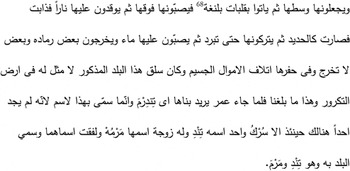
In that year, i.e. 902, Tindirmah was founded. It was called by this name because he [Kanfāri ‘Umar] did not find anyone there except for a Sorko whose name was Tind. He had a wife whose name was Marmah. The two names were joined and the place was named by it: Tind and Marma.
The text of MS C records a story about the foundation of the city that diverges substantially from the one recorded in the Tārīkh Ibn al-Mukhtār.
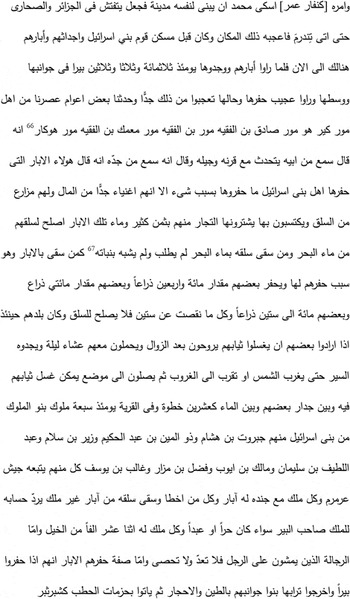
Askiya Muḥammad instructed him [Kanfāri ‘Umar] to build a city for himself. So he [Kanfāri ‘Umar] began searching among the islands and deserts until he came to Tindirma. The place pleased him. Before that time, however, it [Tindirma] was the dwelling place of the people of Banū Isrā’īl.Footnote 69 Their graves and wells are there until now. When they [the entourage of Kanfāri ʻUmar] discovered the wells, which at the time they found them numbering 333 all over the outskirts and centre of the city, they were very much astonished at the marvel of the digging and their disposition.
Some of our contemporaries from the family of Mūri Kuyra, namely Mūri Ṣādiq, the son of al-faqīh Mūri b. al-faqih Mūri Maʻmak b. al-faqih Mūri Hawghāru, narrated to us that he had heard [what follows] from his father when the latter was speaking to his peers and contemporaries. He [al-faqīh Mūri] said that he had heard from his grandfather that the wells the people of Banū Isrā’īl dug was the cause of their abundant wealth. They had fields of chard through which they earned [their wealth because] merchants would buy the chard from them for a high price.
The water of the wells was better for their chard than river water. Anyone who would water his chard with river water would not have a demand for it [by traders] nor would his crops be like those watered with the [water from the] wells. That was the reason for their digging the wells. Some of them they dug to a depth of one hundred and forty arms’ length, some two hundred arms’ length, while others one hundred and sixty arms’ length. All those less than sixty arms’ length depth were not suitable for the chard.
Their land at the time was as such that if some of them had wanted to wash their clothes, they would leave after midday carrying with them their supper and would hurry up walking until sunset or close to sunset to arrive to a spot where it was possible to wash their clothes. [On the contrary] between the wall of some of them and the water was like twenty steps apart.
In the village at the time were seven kings, descendent of the kings of Banū Isrā’īl. Jabrūt bin Hishām, Dhū al-Mayn b. ‘Abd al-Ḥakīm, Zīr b. Salam, ‘Abd al-Laṭīf b. Sulaymān, Mālik b. Ayūb, Faḍl b. Mazār, and Ghālib b. Yūsuf. Everyone of them had a huge army following them and every king with his soldiers possessed wells. Whoever erred by watering his chard from someone else’s well gave his yield to the owner of the well [he had mistakenly watered his chard from], whether that person was free or a slave. Every king had twelve thousand horses. As for the infantry soldiers, those who walk by foot, they could not be counted.
As for the description of the digging of their wells, whenever they dug a well and took out its sand, they would build the sides with clay and stones. Then they would come with logs of wood as the tiéber-tiéber Footnote 70 placing them in the centre of the wells. They would then bring a [qalba is a measure for quantity] of balanga Footnote 71 which they would pour on top of it. Then they would light fire over it until it smelted and turned iron-like. They would leave it to cool after which they would pour water over it extracting some ashes [from it] while leaving some. They wasted much wealth in digging big wells. The chard of this region mentioned had no equal anywhere in Takrūr. This is what came to our knowledge.
Tindirma was called by this name because he [Kanfāri ‘Umar] came intending to build it up, but did not find anyone there except for a Sorko whose name was Tind. He had a wife whose name was Marmah, the two names were joined and the place was name by it: Tind and Marma.
Which one of the two accounts about the foundation of Tindirma is more historically accurate is impossible to say in absence of any other evidence – and it is actually not relevant to the present discussion.Footnote 72 However, the above example shows the extent of the manipulation to the Tārīkh Ibn al-Mukhtār that produced the text preserved in MS C: a very short and simple passage was removed to make space for a lengthy story which completely differs from the original one.
Our analysis of the sections that were removed from the Tārīkh Ibn al-Mukhtār or added to it substantiates another of Levtzionʼs arguments, that the modification of Ibn al-Mukhtārʼs work has to be ascribed to the nineteenth century Fulani Empire of the Masina.Footnote 73 Letʼs focus again on the foundation of Tindirma, for example. Levtzion, as already mentioned above, convincingly argues that MS C ascribes the chronicle to Maḥmūd Kaʻti, and transforms this author into a companion of Askiyà Muḥammad during his 1496 pilgrimage. However, the text of MS C also refers to Maḥmūd Kaʻti as native of Tindirma.Footnote 74 Leaving in place the story of the foundation of the town as recorded in the Tārīkh Ibn al-Mukhtār would have resulted in an obvious anachronism: Maḥmūd Kaʻti could have never been born in Tindirma in 1468, because the city was only founded, according to the Tārīkh Ibn al-Mukhtār, in 1496–1497. In order to avoid this contradiction, the author of the text of MS C removed the story of the foundation of Tindirma as reported by Ibn al-Mukhtār, and replaced it with another one in which the same city is portrayed as an ancient site, the abode of an old Jewish community. In this way, the author of the text of MS C makes it plausible that Maḥmūd Kaʻti was born in Tindirma well before the date of its foundation as related in the Tārīkh Ibn al-Mukhtār.
However, Houdas and Delafosse place the two different stories in sequence; the editors tried to reconcile the two narratives of the foundation of Tindirma by adding an “en effet” (in fact), absent in the original Arabic text, thus giving the reader the impression that the second story is a qualification of the first, instead of a completely different one.Footnote 75 This yields one of the many contradictions of the Arabic text they confected: Tindirma, following the edited text, was a town founded in 1496–1497, but, at the same time, it was already existing. The combination of the two contradictory stories about the foundation of Tindirma is the result of Houdas and Delafosse’s firm belief that they had two different recensions of the same text, as can be gauged from their footnote referring to a passage “omitted” in two manuscripts (MS A and MS B) and restored by employing another manuscript (MS C).Footnote 76 In other words, Houdas and Delafosse, as it emerges from this example, did not only juxtapose almost all the diverging passages of the two works, but they tried in their translation to level the differences and the contradictions of the texts preserved in the manuscripts they had. This resulted in an attempt, often failed, to reconcile the Tārīkh Ibn al-Mukhtār and the text of MS C.
Another telling example of how the divergences between these two texts were reconciled by Houdas and Delafosse comes from a section about the epoch when Maḥmūd Kaʻti was born. Brun had already focused his attention on the following sentence:

The sentence is translated by Houdas and Delafosse as “[d]u vivant de l’askia Mohammed naquirent: Mohammed ben Mohammed ben Saïd... [et] le juriconsulte et câdi Mahmoûd ben El-Hâjj El-Motaouakkel Kâti” – or, in English “[d]uring the life of Askiyà Muḥammad were born: Muḥammad b. Muḥammad b. Saʻīd... [and] the jurist and qāḍī Maḥmūd b. al-ḥājj al-Mutawakkil Kaʻti.”Footnote 78 Brun underlines that the sentence is not correctly translated, since the expression fī ayyām should have been translated as “during the reign” of Askiyà Muḥammad (1493–1529) and not “during the life,” i.e. “du vivant” (c. 1450–1538).Footnote 79 Hunwick also stresses that the translation is not accurate and confirms Brun’s opinion.Footnote 80
Levtzion advances a new argument for the translation of this passage. He underlines that Houdas and Delafosse did not misunderstand the sentence, but they translated it in a way that could have avoided a contradiction. In the edited text, Levtzion continues, there is a reference to Maḥmūd Kaʻti being born about 1468. As a consequence, by translating fī ayyām as “during the reign” of Askiyà Muḥammad an incongruence would have arisen: Maḥmūd Kaʻti would have been born before Askiyà Muḥammad’s reign, in a passage of the chronicle, and, at the same time, during his reign, in another. Thus, Houdas and Delafosse adjusted their translation to fix the contradiction translating fī ayyām Askiyà Muḥammad as “during the life of Askiyà Muḥammad.”
However, the incongruence is the result of their edition, not of the original texts. Reading the Tārīkh Ibn al-Mukhtār and MS C as separate texts, there is no contradiction at all. Tārīkh Ibn al-Mukhtār records exclusively that Maḥmūd Kaʻti was born during Askiyà Muḥammadʼs reign. On the contrary, MS C, in the effort to transform Maḥmūd Kaʻti into a contemporary of Askiyà Muḥammad, pushes back his date of birth to 1468 in a newly added section.Footnote 81 The author of MS C, aware of the contradiction that would have emerged by leaving the reference to Maḥmūd Kaʻti as born under the reign of Askiyà Muḥammad, in the passage introduced by fī ayyām, changed the formerʼs name into Maḥmūd S.M.B. (perhaps the Fulani name Samba). However, Houdas and Delafosse “fixed” the emendation and “corrected” the name into Maḥmūd Kaʻti, relegating the nineteenth century name Maḥmūd S.M.B. in the footnote.Footnote 82
What emerges from the comparison between the two works is that the seventeenth-century chronicle by Ibn al-Mukhtār was substantially transformed in the nineteenth-century by propaganda in support of the Fulani State of the Masina and Aḥmad Lobbo. This process of transformation of the first chronicle into the second alters completely the Tārīkh Ibn al-Mukhtār to the point that the text of MS C becomes something new and inherently different.
We therefore argue that the nineteenth- century text is not simply a different recension of the Tārīkh Ibn al-Mukhtār, but becomes a new text, in other words, a new chronicle. The latter work has its own (apocryphal) author, Maḥmūd Kaʻti – and not the seventeenth-century Ibn al-Mukhtār; it was produced to respond to a recognizable socio-political context, the rise of the Fulani Masina Empire – different from the seventeenth-century Timbuktu under the Arma domination that stimulated the writing of the Tārīkh Ibn al-Mukhtār. As such, it has its own coherence – a coherence that is only disrupted by the work of Houdas and Delafosse; and, after a close look, it has its own author and title.
As for the author, no study has ever been devoted to the person who fabricated the nineteenth-century apocryphal chronicle. When Dubois visited Timbuktu, he referred to “an influential marabout” as the inventor of the prophecy at “the instigation of” Aḥmad Lobbo.Footnote 83 However, the identity of this “marabout” remains unknown. Later, some other scholars advanced the idea that the forger could have been a Fulani scholar named Nūḥ b. al-Ṭāhir on the basis of the association of his name with a propaganda pamphlet in support of Aḥmad Lobbo which extensively quotes from the nineteenth-century forged text. To our best knowledge, this opinion was first adopted by Michael Abitbol and then reproduced, sometimes cautiously, by other scholars.Footnote 84
This supposition is confirmed by a manuscript preserved in the de Gironcourt collection of West African Arabic manuscripts at the Institut de France in Paris.Footnote 85
This document is a short chronicle only available in the copy preserved at the Institut de France manuscript under the call number ms. 2410 (174).Footnote 86 The manuscript consists of six leaves – of which only four contain the Arabic text, the others being left blank or with some annotations by George de Gironcourt – 22x16 cm in size and a written surface of 16x10 cm. It was copied by Harouna Alfaga, a Songhay scribe, in Sinder on 4 June 1912.Footnote 87
After the basmala, the chronicle gives the name of its author, Nūḥ b. al-Ṭāhir b. Mūsà in the form provided by the document, and its title:

In the name of God, the Most Merciful and the Most Compassionate. This is the chronicle of the needful one, Nūḥ b. al-Ṭāhir b. Mūsà, disciple of shaykh sīdi al-Mukhtār al-Kuntī. I call it The Chronicle of the Inquisitive Researcher on the Information of the Lands and Armies, the Elite, and the Mention of the Incidents of Takrūr, the Relevant Events and the Differentiation of the Lineages of Slaves from the Freeborn.
From this point to its end, the chronicle is identical in wording to the first chapter of the edited text Tārīkh al-Fattāsh, pages 11, line 3 – 15, line 10, i.e. the prophecy regarding Aḥmad Lobbo that is only present, as already established, in the nineteenth-century apocryphal work. However, the first two lines distinguish the chronicle from the edited text by ascribing the narration of prophecy, not to Maḥmūd Ka‘tī, but to Nūḥ b. al-Ṭāhir. The latter is extensively referred to by Amadou Hampaté Ba as a close counselor of Aḥmad Lobbo, but is generally neglected in the existing scholarly literature.
However, a biography of Nūḥ b. al-Ṭāhir can be drawn from an unpublished PhD dissertation by the Malian scholar Mohammed Diagayété, and from a chapter by Ali K. Diallo in the ISESCO volume Culture et civilisation islamique: Mali.Footnote 88 His full name is Alfa Nūḥ b. al-Ṭāhir Balkū b. Abī Bakr b. Mūsà al-Fulānī. He was born in 1151/1738 in Dari, in the region of Fittouga, midway between Timbuktu and the Masina, into an affluent Muslim family which held political and spiritual power in the region. He learned the Qur’ān from young age in the kuttāb (elementary school), thereafter he became a shepherd.
One day, at the age of forty, while grazing his flock around Timbuktu, he decided to pursue the path of knowledge (‘ilm) and gnostic insight (ma’rifa). He shaved his head and moved to the town of Arawān where he became a student of ‘Alī b. al-Najīb (mid-eighteenth century) for a number of years. He then attached himself to one of the latter’s students, the well-known al-Mukhtār b. Aḥmad b. Abī Bakr al-Kuntī (d. 1811) under whose tutelage he completed his studies and received his ijāzā. He then joined for three years ‘Uthmān b. Fūdī (d. 1817) in modern Nigeria. ‘Uthmān b. Fūdī, impressed by Nūḥ b. al-Ṭāhir’s knowledge, instructed him to go to the Masina against his original decision to travel to Mecca to perform the pilgrimage.
When Nūḥ b. al-Ṭāhir left ‘Uthmān b. Fūdī, he returned to al-Mukhtār al-Kuntī, instead of heading for Masina. Upon the demise of the latter, Nūḥ b. al-Ṭāhir remained with Muḥammad, the eldest son and successor of al-Mukhtār al-Kuntī (d. 1825–1826). In 1820, Muḥammad b. al-Mukhtār al-Kuntī sent him to serve as an advisor to Fulani ruler, Guéladjo Hambodedjo (d. after 1855), who by then had already acknowledged the dominance of the nascent Masina state.
One of Nūḥ b. al-Ṭāhir’s services to Guéladjo Hambodedjo was the handling his official correspondence, a duty in which he excelled. His correspondence caught the personal attention of Aḥmad Lobbo who appointed, after Guéladjo Hambodedjo’s rebellion, Nūḥ b. al-Ṭāhir, as adviser and confident. The ruler of Masina also appointed Nūḥ b. al-Ṭāhir chief of the batu mawdu, the Consultative Council composed of forty “ulamā” that was in charge of affairs in the Masina. Very soon, Nūḥ b. al-Ṭāhir became the second most powerful personality of the state. He continued to serve Aḥmad b. Aḥmad Lobbo (d. 1853), second leader of the Masina, and supported his son Aḥmad b. Aḥmad b. Aḥmad Lobbo (d. 1862) in light of the disputes around the succession. Nūḥ b. al-Ṭāhir retired in Niakongo in 1852, where he died in 1860 at the reported age of 122. However, his body was returned to Ḥamdullāhi, and he was buried next to Aḥmad Lobbo.
Apart from establishing Nūḥ b. al-Ṭāhir’s authorship of the nineteenth century chronicle, the short de Gironcourt document is unambiguous in its ascription of the title Tārīkh al-fattāsh fī ahbār al-buldān wa-l-juyūsh wa-akābir al-nās wa-dhikr waqā’i al-Takrūr wa-’iẓām al-umūr wa-tafrīq ansāb al-’abīd min al-aḥrār to the same Nūḥ b. al-Ṭāhir. The full title in itself is very telling – see quote above. The title highlights the two elements of Aḥmad Lobbo’s propaganda: the prophecy, clearly among the most important events of West African history, and slavery. The instrumental character of the title strongly suggests that it is also related to the nineteenth-century propaganda circulating in support of the Fulani Empire of Masina, as already suggested by Ly.Footnote 89
However, this short chronicle, extremely valuable in identifying the name of the real author of the Tārīkh al-fattāsh and in establishing that the title belongs to the nineteenth century work and not to the chronicle by Ibn al-Muktār, would seriously threaten the ingeniousness of the prophecy as a literary invention to support Aḥmad Lobbo’s claims. The chronicle explicitly refers to Nūḥ b. al-Ṭāhir, a seminal figure of the Fulani Empire of the Masina – the second in command – as its author and the one who coined its title. The explicit mention of Nūḥ b. al-Ṭāhir would have been a clear impediment for the dissemination of the prophecy and its eventual reception among Muslims of the region who would have immediately recognized that the prophecy was a nineteenth century forgery. However, it is plausible therefore to argue that the Council of Forty, including Aḥmad Lobbo and Nūḥ b. al-Ṭāhir himself, decided against the circulation of this short chronicle, and this would explain the existence of only one extant copy of the chronicle found to date, the manuscript deposited at the Institut de France. However, this did not prevent Nūḥ b. al-Ṭāhir from utilizing his invention of the prophecy in other ways. As we have already demonstrated, the prophecy and several other instrumental passages in support of Aḥmad Lobbo were written and embedded in the pre-existing Tārīkh Ibn al-Mukhtār and a new chronicle, the Tārīkh al-fattāsh, was produced.
Although the complete copy of the Tārīkh al-fattāsh did not apparently circulate widely, and this might explain the reason we have not yet found any copy of it, what really circulated was a document of propaganda authored by Nūḥ b. al-Ṭāhir which has long citations from the chronicle as well as some legal documents that used the Tārīkh al-fattāsh as a legal precedent to enslave some West African groups.Footnote 90 Furthermore, a later chronicle of which three fragments are stored in the de Gironcourt collection, written by Muḥammad b. Muḥammad b. Muḥammad b. ʻUthmān (b. c. 1855), quotes extensively the Tārīkh al-fattāsh.Footnote 91 In sum, the full Tārīkh al-fattāsh was supposed to be a well-known, but elusive, work, in order to cover the trickery of Nūḥ b. al-Tāhir. As Simone Simonini, the skilled forger who is the main character of the most recent novel by Umberto Eco, states: “Where possible, the original must not be seen but only talked about, without reference to any precise source.”Footnote 92 This is what had happened in nineteenth century West Africa: the Tārīkh al-fattāsh remained a phantom book, until Dubois heard of it, French administrators started looking for it, Houdas and Delafosse edited it conflating it with the older Tārīkh Ibn al-Mukhtār, and West African scholars copied the edited text into new manuscripts.
Conclusion
The year 2013 marked the centenary of the edition and translation into French of one of the most important written sources for the reconstruction of pre-colonial African history: the Tārīkh al-fattāsh – or La chronique du chercheur, as its title appears in the translation. However, as the literature review covered in this article shows, the edition of the chronicle is unreliable and reveals several problematic issues, from its author/s to textual manipulation. The major obstacle for a better understanding of the Tārīkh al-fattāsh has been the disappearance of the manuscripts employed for the 1913 edition and the absence of other copies.
In this article, on the basis of our study of several unexplored Arabic manuscripts among them the “rediscovered” IHERI–AB 3927/MS A, we formulate a new theory on the complex literary history of the chronicle which sharply differs from previous theories of the chronicle. We have expanded on the findings of Nehemia Levtzion. The latter advanced in his crucial contribution on the topic that the edited text “combines two separate texts, the original seventeenth-century chronicle, and the forged nineteenth-century additions.”Footnote 93 We pushed forward his theory and argued that the edition of the text conflates in fact two different works. The first is the seventeenth-century chronicle we call the Tārīkh Ibn al-Mukhtār, or the chronicle of Ibn al-Mukhtār, from the name of the author of a work that has only survived in incomplete fragments and whose title is lost. The second is the pseudo-epigraphic nineteenth-century Tārīkh al-fattāsh written by Nūḥ b. al-Ṭāhir, one of the counselors of Aḥmad Lobbo, the founder of the Fulani Masina Empire, but apocryphally ascribed to the sixteenth-century scholar Maḥmūd Ka‘ti.
The nineteenth-century Tārīkh al-fattāsh project also urges us to question the theory of Paulo de Moraes Farias on the nature of the Timbuktu chronicles. His main argument, that the chronicles, far from being simple narratives, are political-ideological projects serving the nineteenth-century Timbuktu milieu is valid and crucial to interpreting the chronicles as a literary genre. However, the theory has to be revised in its time frame. De Moraes Fariasʼ novel reading of Timbuktu’s chronicle tradition stops, rather abruptly, with the seventeenth century, thus suggesting that post-seventeenth century West African scholars did not produce chronicles with similar political and ideological characteristics. Our study complicates this conclusion. Rather, we argue that de Moraesʼ theory is likewise applicable to West Africa’s post-seventeenth century chronicles. De Moraes Farias’ theory fits well with the case of the seventeenth-century Tārīkh Ibn al-Mukhtār, but also sets the framework for understanding similar and novel political projects, such as the role of the Tarikh al-fattāsh in the nineteenth century Fulani Empire of Masina, which inscribes Aḥmad Lobbo into the chain of classical rulers of West Africa.Footnote 94
However, in order to produce a comprehensive study of the history and the relationship between the seventeenth-century Tārīkh Ibn al-Mukhtār and the nineteenth-century Tārīkh al-Fattāsh, their authorship, ideological backgrounds, circulation and reception, the two works must be fully dis-entangled. As Madina Ly highlighted in her abovementioned contribution: “[O]nly a new edition, based on the study of all the manuscripts and the fragments, might bring new hopefully definite solutions.”Footnote 95 We are happy to announce that a new edition of the Tārīkh Ibn al-Mukhtār and the Tārīkh al-Fattāsh, as well as some other auxiliary texts relevant to the history of these chronicles, is under preparation.
Mauro Nobili is Assistant Professor in African History at the University of Illinois at Urbana-Champaign. He is also Honorary Research Associate at the Tombouctou Manuscripts Project, Huma, University of Cape Town. He is a specialist of West African History and his particular research focuses on Arabic manuscript culture and Islam in Africa. He published the Catalogue des manuscrits arabes du fonds de Gironcourt (Afrique de l’Ouest) de l’Institut de France (2013), as well as several articles on the Arabic script styles in West African manuscripts. He is currently working on a book on the Tārīkh al-fattāsh and preparing a new edition and English translation. E-mail: nobili@illinois.edu
Mohamed Shahid Mathee is Lecturer in the Department of Religion Studies at the University of Johannesburg. He is a specialist of West African history, his niche area being the social history of Timbuktu during the colonial era. In addition to his work on Timbuktu’s fatwas, he is currently working on local Arabic chronicles. E-mail: smathee@uj.ac.za