Implications
Mixed feed incorporating broken rice is used for horses but estimates of its nutritive value are based on determinations using rice by-products in pig, ruminant and poultry feeds. The importance and the novelty of this experiment is that similar studies carried out on horses in Europe are not available in the scientific literature, but only dated works performed in Australia with different rice cultivars on different livestock species. The present study updates the chemical composition and digestion coefficients of Italian broken rice for horses. Our results should enable companies to produce well-rationed mixed feeds for horses.
Introduction
Rice (Oryza sativa) is the seed of an annual plant belonging to the Gramineae family, one of the most widespread grain crops in the world. Indeed, in 2010, rice was the grain with the second-highest worldwide production, behind maize. Italy produces large amounts of rice, especially in the North. Consequently, many by-products of the rice cleaning process are available for livestock use. Among these, broken rice separated out after the polishing stage has the same chemical composition as polished rice; even though the quantities available are not very high, this by-product is a palatable, energy-rich and easily utilized feed. Another characteristic of this by-product is that it has a low-protein content but of high quality: its protein is richer in lysine than that of other major cereals.
In literature, studies on broken rice digestibility in horses are very limited and also dated, so very few data are available. Rice-based pellets incorporating rice pollard and broken rice are fed to horses, and the energy values are based on determinations using rice by-products in pig, ruminant and poultry feeds (Farrell and Warren, Reference Farrell and Warren1982). McCarthy et al. (Reference McCarthy, Savage, Jeffcott, Caple, Watson and Hutton1989) pointed out that rice milling by-products are high in energy for horses and that broken rice is highly digestible.
Broken rice has been widely used as a high-energy horse feed in Australia for many years and ground rice hulls have been used successfully in horse feeds with low energy content at 25% inclusion in the pelleted part of the ration. Previous research carried out in Australia (McMeniman et al., Reference McMeniman, Porter and Hutton1990) determined the chemical composition, digestibility and digestible energy (DE) content of cracked rice and rice pollard included in horse rations. No similar studies have been carried out in Europe.
Determination of apparent digestibility in horses by in vivo trial based on total collection of feces is still considered the best method due to its accuracy (De Marco et al., Reference De Marco, Miraglia, Peiretti and Bergero2012). Nevertheless, it does have its limits, concerning the direct use of animals, the planning of the experimental procedure and considerable experimentation costs.
In vitro digestibility techniques using enzymes and incubation lengths that simulate in vivo digestion can be used to predict in vivo dry matter (DM) and organic matter (OM) digestibility with reasonable accuracy, thus avoiding the need to perform trials with animals and providing results in less time. Among the various in vitro methods, the pepsin-cellulase technique is one of the most tested, in particular by INRA researchers, highlighting its suitability both in ruminants (Aufrère and Michalet-Doreau, Reference Aufrère and Michalet-Doreau1988) and horses (Miraglia and Tisserand, Reference Miraglia and Tisserand1985). These authors reported that OM digestibility with the pepsin-cellulase method was highly correlated (R=0.978 and 0.943, respectively for ruminants and horses) with in vivo digestibility values either for forages and concentrates.
This study was undertaken to investigate the apparent digestibility of broken rice in horses using total collection of feces and in vitro pepsin-cellulase technique and to provide updated and more accurate digestion coefficients for this by-product when fed to horses.
Material and methods
Animals, diets and experimental design
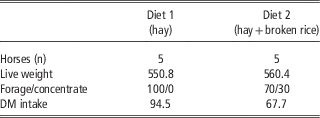
The in vivo digestibility trial was performed using five adult geldings, weighing 555.6 kg on average (Table 1). The horses were fed at a feeding level of 1.2 according to INRA requirements (Martin-Rosset, Reference Martin-Rosset2012), since the horses performed light exercise made up of a daily 20 min walk. The horses were dewormed (Equalan; Merck, Rahway, New Jersey, USA) before the experiment and were individually stabled in 4×3 m2 boxes with shavings as litter and with free access to water using an anti-waste corner feeder (120 cm long and 70 cm deep) in each box. First, hay was given as the only feedstuff; second, the experimental diet consisted of 70% of the same hay plus 30% of broken rice on a DM basis. The two experimental period lasted 20 days, made up of 14 days of adaptation to the diet, followed by 6 days of total collection of feces. A suitable device (horse diaper) was used, allowing feces to be collected separately from urine and allowing the horses to roam around freely in digestibility boxes.
Live weight (kg) of horses fed experimental diets and intake level (g DM/kg W0.75)

DM=dry matter.
Sampling and analytical determinations
Total collection of feces was carried out daily at 0800 and at 1600 h during the last 6 days. Total individual daily feces were weighed, mixed, and then a 10% daily sample was kept at −30°C pending analysis. The 6-day cumulative feces samples from each horse were dried to constant weight for at least 2 days in a forced-draft oven at 65°C and then pooled to obtain representative samples. The horses were daily supplied with half of their rations at 0900 h and the remaining half at 1700 h. The hay and broken rice were sampled daily immediately before being fed to the horses and then pooled to obtain representative samples. Individual diet quantities were weighed daily during the 6-day collection period.
The feed samples were dried for 8 h at 105°C to determine the DM content. All the samples were ground in a 1 mm screen Cyclotec mill. Dried feed and feces samples were analyzed for CP, ether extract and ash, according to Association of Official Analytical Chemists (AOAC) (2004). The OM content was calculated using the sample ash content. The gross energy (GE) was measured using an adiabatic calorimeter bomb (IKA C7000; Staufen, Germany). NDF, ADF and ADL were determined using a fiber analyzer (Fibersac 24; Ankom Technology Corp., Macedon, New York, USA), following the Ankom Technology Method and corrected for residual ash. The NDF of broken rice was analyzed with α-amylase. The in vitro determination was conducted on the same feed samples (hay and broken rice) collected during the in vivo trial using the pepsin-cellulase technique, applying the method proposed by Aufrère and Michalet-Doreau (Reference Aufrère and Michalet-Doreau1988) for both feeds (forages and concentrates). All analytical measurements were replicated three times.
Calculations and statistical analyses
The in vivo digestion coefficients for the two experimental diets (hay alone and hay plus broken rice) were determined for DM, OM, CP and GE on the basis of total collection of feces for each horse and for each diet according to Martin-Rosset (Reference Martin-Rosset2012). Assuming no associative effects, the digestibility of broken rice was calculated for DM, OM, GE, CP according to Martin-Rosset and Dulphy (Reference Martin-Rosset and Dulphy1987):
 $${\rm d}\rm C=(dR- 0.7 dH)/0.3$$
where dC is the concentrate digestibility in percentage, dR the ration digestibility, dH the hay digestibility, f the percentage of forage compared with DM in the ration and c the percentage of the concentrate compared with DM in the ration.
The in vitro DM and OM digestion coefficients of hay and broken rice were determined as proposed by Aufrère and Michalet-Doreau (Reference Aufrère and Michalet-Doreau1988), while the digestion coefficients of Diet 2 (hay+broken rice) for the same parameters were calculated according to the DM proportion in the diet (70/30). The individual horse was considered as the experimental unit. The in vivo apparent digestion coefficients of the two diets were analyzed by means of a within-subjects one-way ANOVA, in order to underline the effect of concentrate supplementation on the same horse, using R open source programming language (R Development Core Team, 2012). Significance was accepted for P-values<0.05.
Results and discussion
The intake levels of the trials are reported in Table 1. The intake of horses fed the diet with hay alone was higher than that of horses fed hay plus broken rice. No refusal was observed during the trials. Table 2 shows the chemical composition of the two experimental diets and of broken rice. The hay used was a lowland first-cut meadow hay, typical of the hay that can be found in Northern Italian stud farms. The CP and NDF content of the hay were 7.5% and 56.1%, respectively. The chemical composition of the broken rice was characterized by a CP content of 9.6%, low fibrous fraction content and a GE content of 17.8 MJ/kg DM. In literature, the GE content of broken rice ranges from 15.6 to 18.4 MJ/kg DM (McCarthy et al., Reference McCarthy, Savage, Jeffcott, Caple, Watson and Hutton1989; McMeniman et al., Reference McMeniman, Porter and Hutton1990; INRA, 2012). This high energy variability may certainly be attributed to environmental influences, fertilizer treatments, degree of milling and storage conditions. Furthermore, another important factor that could affect the chemical and nutritional composition of this by-product is breeding variety. The main source of energy in broken rice is starch; its content reported in INRA tables (INRA, 2012) is 88.2% DM for broken rice and 86.8% DM for cargo rice. The amount of starch as well as the enzymatic degradability of the starch are important parameters to evaluate the inclusion of broken rice into horse diets, because the starch in white rice appears to be largely resistant to enzyme attack (Richards et al., Reference Richards, Choct, Hinch and Rowe2003). Starch not digested by enzymes in the small intestine could enter the cecum and undergo bacterial fermentation leading to a reduction in energy utilization (Ellis and Hill, Reference Ellis and Hill2005). The fermentation of starch in the hindgut can lead to changes in the microbial profiles and increase the volatile fatty acid and lactic acid concentrations, a situation that may lead to hindgut acidosis (Julliand et al., Reference Julliand, De Fombelle and Varloud2006). The problem associated with the high levels of starch in the concentrate can be managed by both the imposition of a maximum starch inclusion rate and a recommended minimum fiber intake per day (Ellis and Hill, Reference Ellis and Hill2005).
Chemical composition (% DM) and GE content of the diets and broken rice

GE=gross energy; DM=dry matter; OM=organic matter; EE=ether extract.
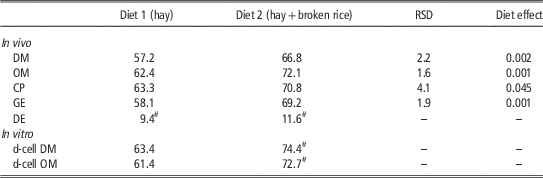
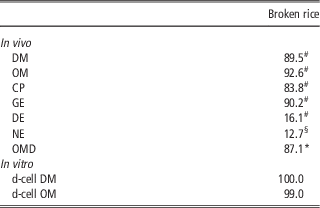
Tables 3 and 4 show the in vivo and in vitro digestion coefficients and the DE content of experimental diets and broken rice alone, respectively. As expected, the use of broken rice added to the hay in Diet 2 improves the ration digestibility for all the parameters studied compared with Diet 1; indeed, the digestibility of Diet 2 was significantly higher respectively for DM (P=0.002), OM (P=0.001), CP (P=0.045) and GE (P=0.001). The DM and OM digestibility of broken rice was 89.5% and 92.6%, respectively, showing that this by-product is highly digestible. McCarthy et al. (Reference McCarthy, Savage, Jeffcott, Caple, Watson and Hutton1989) tested various types of rice by-products on horses, including broken rice and found similar values to those obtained in the present experimentation, 88.7% and 90.1% for DM and OM, respectively.
In vivo digestion coefficients (%), DE (MJ/kg DM) and in vitro digestion coefficients (%) of experimental diets

DE=digestible energy; DM=dry matter; OM=organic matter; GE=gross energy; d-cell DM=pepsin-cellulase digestibility of DM; d-cell OM=pepsin-cellulase digestibility of OM.
# Calculated from the rate of each ingredient in the diet as reported by Martin-Rosset and Dulphy (Reference Martin-Rosset and Dulphy1987).
In vivo digestion coefficients (%), DE (MJ/kg DM), NE (MJ/kg DM) and in vitro digestion coefficients (%) of broken rice alone

DE=digestible energy; DM=dry matter; OM=organic matter; GE=gross energy; NE=net energy; OMD=organic matter digestibility; d-cell DM=pepsin-cellulase digestibility of DM; d-cell OM=pepsin-cellulase digestibility of OM.
# As calculated and reported by Martin-Rosset and Dulphy (Reference Martin-Rosset and Dulphy1987) for in vivo digestion coefficient.
§ As calculated and reported by Martin-Rosset (Reference Martin-Rosset2012) for NE value.
* Predicted by Martin-Rosset (Reference Martin-Rosset2012) equation for simple concentrates.
The high digestibility of broken rice was confirmed by the pepsin-cellulase method, in which the in vitro digestion coefficients for DM and OM were 100% and 99%, respectively. Slightly higher values for DM digestibility than for OM digestibility using the pepsin-cellulase method are reported in literature (Miraglia and Tisserand, Reference Miraglia and Tisserand1985). Nevertheless, these digestion values are 10.5% and 6.5% higher than those calculated in vivo for DM and OM, respectively. Norman et al. (Reference Norman, Masters, Wilmot and Rintoul2008) used a method with bags that overestimates the OM digestibility results of 10%. This overestimation may arise from the method itself or from the particle size due to the pore size of the bag. Aufrère and Michalet-Doreau (Reference Aufrère and Michalet-Doreau1988) pointed out an overestimation of the digestion coefficients by the pepsin-cellulase technique for feeds rich in high digestible fiber. The work of Opatpatanakit et al. (Reference Opatpatanakit, Kellaway, Lean, Annison and Kirby1995) suggests that in cereal grain–forage mixtures, the nature of associative effects (synergistic v. antagonistic) depends on the ratio of incorporation, the species of cereal, and the species of forage in the mixture.
DE values for rice pollard and broken rice have also been determined for horses at the University of Queensland, where it was found that broken rice was almost completely digestible and had a DE content of 18.2 MJ/kg DM (McMeniman et al., Reference McMeniman, Porter and Hutton1990). This latter value was considerably higher than that reported by McCarthy et al. (Reference McCarthy, Savage, Jeffcott, Caple, Watson and Hutton1989) for the same product. The low value (13.3 MJ/kg DM) found by the latter authors was associated with poor palatability and acceptance of the trial diets by the horses and by coprophagia (McCarthy et al., Reference McCarthy, Savage, Jeffcott, Caple, Watson and Hutton1989). The broken rice tested in our work showed a DE content of 16.1 MJ/kg DM that was close to the value of 15.7 MJ/kg DM given in INRA tables (INRA, 2012) for this by-product. These differences in DE content could be attributed to the different chemical composition and energy content of this by-product. The in vivo OM digestibility of this by-product was predicted using the equation proposed by Martin-Rosset (Reference Martin-Rosset2012) for treated simple concentrates. The value obtained is 87.1%, that is lower than the value observed (92.6%). The equation proposed for cereals used in ruminants (Aufrère and Michalet-Doreau, Reference Aufrère and Michalet-Doreau1988) gives an even closer value of 91.8%.
In conclusion, the addition of broken rice to hay increases ration digestibility in horses. In order to optimize activities of microorganisms and then prevent any digestive disturbances in the large intestine, further investigations on the apparent digestibility of rations supplemented with different levels of broken rice are needed to determine the optimum threshold of rice to be incorporated in the diet.
Acknowledgment
The authors wish to thank Dr. J. Aufrère and A. Le Morvan (INRA, Saint-Genès Champanelle, France) for their assistance during the trial with the pepsin-cellulase technique and Prof. W. Martin-Rosset for paper revision.