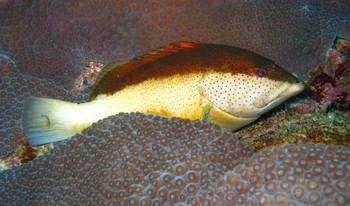
Albeit coney Cephalopholis fulva (Linnaeus, 1758) presents a range of colour variations (the red phase, the uniformly brown or bicoloured phase and the xanthic phase), only recently abnormal pigmentation has been reported in this species from a single individual displaying melanism on the posterior half of the body (Simon et al., Reference Simon, Joyeux and Macieira2009). To this anomalous specimen captured in 2006 by angling on the inner continental shelf of south-eastern Brazil are now added two underwater records of possible melanic individuals at locations 800 km and 2000 km north–north-east of the first. One 23 cm specimen was photographed at Fernando de Noronha Archipelago (03°50′25.3″S 32°24′40.7″W) at a depth of 4 m in September 2008 (Figure 1A) and another 15 cm specimen was photographed at Camamu Bay (13°55′16.4″S 38°56′07.7″W) at a depth of 12 m in April 2007 (CLS Sampaio, personal communication; Figure 1B). The melanic portion of both individuals was restricted to the head (Figure 1 A, B). General morphology, body condition and swimming mode were normal. Other coneys observed in the same sites had normal coloration (Figure 2).
Melanic Cephalopholis fulva at Fernando de Noronha Archipelago (A) and at Camamu Bay (B), Brazil. Photographs by J.L. Gasparini (A) and C.L.S. Sampaio (B).

A normally pigmented Cephalopholis fulva in the bicoloured phase photographed at Fernando de Noronha Archipelago. Photograph by J.L. Gasparini.

The coney is a species abundant in the tropical and subtropical western Atlantic and it has been heavily exploited along the Brazilian coast in the past years (Klippel et al., Reference Klippel, Martins, Olavo, Costa, Peres, Costa, Martins and Olavo2005). Fishing has been held responsible for reduction in abundance, modification in the bathymetric distribution and alterations in the social structure of some Brazilian populations of coney (Coelho, Reference Coelho2001) but what causes melanism in this species is unknown. This abnormality appears to be either more common than previously thought or, alternatively, is becoming more common.
However, because the two anomalous individuals share an extremely similar colour pattern, a third hypothesis is the existence of an undescribed colour phase distinct from (or intermediate between) the uniformly dark brown phase and the bicoloured phase. In fact, the transition between these two colour phases is known to occur due to excitement or normal diel changes (Nemtzov et al., Reference Nemtzov, Kajiura and Lompart1993) but has never been recorded.
ACKNOWLEDGEMENTS
We are grateful to C.L.S. Sampaio who sent us the picture of the Camamu Bay specimen and R.M. Macieira and O.J. Luiz Jr for critically reading the manuscript. O.J. Luiz Jr also provided the opportunity for field observations at Fernando de Noronha Archipelago.