Hand hygiene decreases the incidence of healthcare–associated infections.Reference Munoz-Price and Birnbach 1 As a specialty, anesthesiology has made important strides in improving patient safety during the perioperative period, but hand hygiene practices of anesthesia providers in the operating room remain inadequate.Reference Biddle and Shah 2 , Reference Munoz-Price, Lubarsky and Arheart 3 Among medical specialists, anesthesiologists may be among the worst performers in hand hygiene.Reference Pittet, Simon, Hugonnet, Pessoa-Silva, Sauvan and Perneger 4 Loftus et alReference Loftus, Koff and Birnbach 5 recently demonstrated that bacterial transmission in the anesthesia work area might be associated with a higher rate of 30-day postoperative infections, which may affect up to 16% of patients undergoing surgery.Reference Loftus, Koff and Birnbach 5 Additionally, the hands of anesthesia providers frequently carry bacterial pathogens and have been associated with contamination of intravenous stopcock sets.Reference Loftus, Muffly and Brown 6 The high density of tasks performed during the first hour of anesthesia care may be a barrier to adequate hand hygiene practices.Reference Munoz-Price, Riley and Banks 7
Tasks that contribute to the high task density of the first hour of anesthesia care include infusing medications intravenously, manipulating the airway, configuring the anesthesia work station, and placing intravascular lines. We aimed to evaluate whether a recurrent visual electronic hygiene reminder could increase the frequency of hand hygiene events.
METHODS
This observational study was performed at Jackson Memorial Hospital, an urban 1,000-bed hospital in Miami, Florida. We randomly selected 20 second-year anesthesia residents, this cohort was then randomized into 2 groups: one group started with the intervention and the other group comprised the control. In each group, 10 residents were observed over 1 hour during the control and intervention periods. Within 1–5 days after the original observation, these study participants were observed a second time in the opposite group. Observations were performed by authors D.R.A. and A.M., starting at the time of entry to the operating room. The observer was seated inside the room within view of the anesthesiology resident, but the purpose of the study was concealed from the resident for the duration of study. The intervention consisted of an electronic visual reminder stating, “Please Sanitize Your Hands,” which was shown for 60 seconds every 15 minutes on a monitor immediately adjacent to the vital signs display. Each study participant was exposed to the reminder 4 times over 1 hour per observation. Participants in the control group were not exposed to any visual reminders. During intervention and control observations, hand sanitizer was placed on the anesthesia machine. With the goal of maintaining a similar task density, the surgical cases were limited to elective upper and lower extremity orthopedic surgeries with an American Society of Anesthesiologists’ physical status score of 1–3.
Statistical Analysis
We used a generalized linear mixed model to analyze a 2×2 crossover design. We began with a Poisson model using total hand hygiene as the outcome with group (ie, reminder first vs reminder second), time (1 vs 2), and their interaction as fixed effects. The random term was the subject nested within group. A heterogeneous compound symmetric covariance matrix was used to represent the correlated data structure. The interaction of group with time was significant (P=.011), indicating a carryover effect; namely, the order of presentation had an effect on the outcome. Therefore, we ran a second Poisson model using the first observation only. SAS 9.3 (SAS Institute, Cary, NC) was used for all analyses.
RESULTS
We evaluated 20 second-year anesthesiology residents over 2 months. Residents had a mean age of 31±2 years, and 60% were male. The interaction between reminder and sex was not significant (reminder, P=.966; sex, P=.972; and interaction, P=.970), so this variable was dropped. The subsequent analysis showed that the reminder was significant (P=.006), but sex was not significant (P=.919).
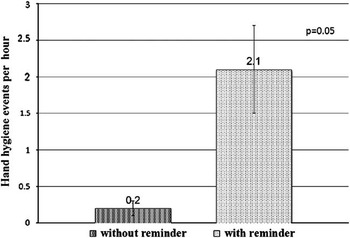
The group that started in the control arm had a total of 2 hand hygiene events during 10 hours of observation and 21 hand hygiene events during 10 hours of intervention (0.2±0.1 vs 2.1±0.6 [mean±standard error], respectively; P=.05) (Figure 1). The group that started with the intervention first had a total of 21 hand hygiene events during 10 hours of intervention and 23 hand hygiene events as the subsequent control group (Table 1). Given the substantial carryover effect, the second group was not included in the final analysis; thus, the advantage of a crossover trial was lost.
Hand hygiene events per hour performed by anesthesia residents in the intervention group, ie, no reminder followed by a simple, periodic, visual hand-hygiene reminder.

Total Number of Hand Hygiene Events Performed by Anesthesia Residents With or Without a Visual Reminder Recorded During 10 Hours of Observation

DISCUSSION
We implemented an electronic reminder that was successful at increasing the hand hygiene rate. Interestingly, when used initially, the reminders produced a behavioral effect in the subsequent observation. Future trials could use a longer washout period to account for the carryover effect. A study by Koff et alReference Koff, Loftus and Burchman 8 reported that hand hygiene 7 to 8 times per hour reduced stopcock contamination from 32.8% to 7.5%.
Future studies could use existing eye-tracking technology or surveys to assess whether the anesthesia providers saw the hand hygiene reminder. Moreover, our visual hand hygiene reminder was not associated with sound, which might have also helped attract the anesthesia provider’s attention to the screen. Whether a recurrent visual hand hygiene reminder would eventually succumb to alarm fatigue has not yet been determined. Furthermore, future studies could use existing hardware such as the electronic anesthesia record and the vital sign displays to show hand hygiene reminders.
Nevo et alReference Nevo, Fitzpatrick and Thomas 9 found that, compared to other visual cues studied such as flickering lights and line-of-sight placement of the sanitzer dispenser, the most significant increase in hand hygiene events occurred when informing participants of a surveillance system. Although difficult to implement, this strategy could be further explored in future larger studies. In our study, the number of hand hygiene events during the first hour of anesthesia care remained dismally low in spite of periodic visual reminders. Additional and complementary strategies must be explored to improve hand hygiene among anesthesia providers in the ongoing effort to reduce healthcare–associated infections.
ACKNOWLEDGMENTS
Financial support: S.M.P. receives speaker fees from Ecolab and consulting fees from Xenex and Clorox.
Potential conflicts of interest: All authors report no conflicts of interest relevant to this article.