


Introduction
Salkovskis (Reference Salkovskis1985, Reference Salkovskis1989) was the first to develop a cognitive model of OCD in which responsibility attitudes and interpretations had the core feature in the development and the maintenance of the disorder. According to this model, the occurrence and/or content of the intrusions are interpreted as indicating that the person might be responsible for harm to oneself and/or others. This model not only deals with factors related to the maintenance of the disorder but also delineates factors, which might be influential in the development of OCD. The misinterpretations of intrusions arise from learned assumptions (responsibility beliefs about harm), which depend on early experiences. When the responsibility assumptions, which make the person more prone to develop obsessional problems, are activated by a critical incident, the intrusive thoughts are misinterpreted as indicating personal responsibility for harm (Salkovskis et al., Reference Salkovskis, Wroe, Gledhill, Morrison, Forrester and Richards2000).
The relationship between inflated perception of responsibility and OCD symptoms has been investigated in many studies with clinical and non-clinical samples, and in experimental studies. Results from these studies have been consistent with the model of Salkovskis, indicating the association between inflated responsibility beliefs and OCD (Altin and Karanci, Reference Altin and Karanci2008; Freeston, Ladouceur, Gagnon and Thibodeau, Reference Freestone, Ladouceur, Gagnon and Thibodeau1993; Freeston, Ladouceur, Thibodeau and Gagnon, Reference Freestone, Ladouceur, Thibodeau and Gagnon1992; Ladouceur et al., Reference Ladouceur, Rheaume, Freeston, Aublet, Jean and Lachance1995; Laudouceur, Rheaume and Aublet, Reference Ladouceur, Rheaume and Aublet1997; Lawrence and Williams, Reference Lawrence and Williams2011; Lopatka and Rachman, Reference Lopatka and Rachman1995; Matthews, Reynolds and Derisley, Reference Matthews, Reynolds and Derisley2007; Rachman, Reference Rachman1993; Rheaume, Ladouceur, Freeston and Letarte, Reference Rheaume, Ladouceur, Freeston and Letarte1995; Shafran, Reference Shafran1997; Yorulmaz, Karanci, Bastug, Kisa and Goka, Reference Yorulmaz2008; Yorulmaz, Altin and Karanci, Reference Altin and Karanci2008). Barrett and Healy (Reference Barrett and Healy2003) found that OCD children reported significantly higher ratings of responsibility for OCD-relevant threat in comparison to non-clinic children. Similarly, Libby, Reynolds, Derisley and Clark (Reference Libby, Shirley, Derisley and Clark2004) reported that young people with OCD had significantly higher scores on inflated responsibility and inflated responsibility independently predicted OCD symptom severity.
The origins and the development of distorted beliefs related to inflated responsibility, which makes the person more vulnerable to obsessive compulsive symptoms, have not been yet systematically studied. A meta- analysis of 47 studies (McLeod, Wood and Weisz, Reference McLeod, Wood and Weisz2007) showed that parental control was more strongly associated with child anxiety than was parental rejection. The results of the parent-child interactions in laboratory tasks showed that greater observed parental control was consistently linked with more child shyness and a higher risk for meeting criteria for an anxiety disorder in children and adolescents (Wood, McLeod, Sigman, Hwang and Chu, Reference Wood, McLeod, Sigman, Hwang and Chu2003). In a study with a student sample, psychologically manipulative and controlling parenting style was found to be associated with OCD symptoms. (Ayçiçeği, Harris and Dinn, Reference Ayçiçeği, Harris and Dinn2002). Although there are mixed results obtained from clinical samples (Hafner, 1988; cited in Alonso et al., Reference Alonso, Menchon, Mataix-Cols, Pifarre, Urretavizcaya and Crespo2004; Turgeon, O’Connor, Marchand and Freeston, Reference Turgeon, O’Connor, Marchand and Freeston2002), in general, studies show that parents of OCD patients, as well as parents of individuals displaying sub-clinical OC symptoms, are overprotective, perfectionist, demanding, critical and employ guilt induction in their parenting style. Both Coles and Schofield (Reference Coles and Schofield2008) and Lawrence and Williams (Reference Lawrence and Williams2011) provided support for specific childhood experiences to the development of responsibility beliefs and proposed some pathways to the development of inflated responsibility.
Overprotective type of parenting style might play a role in the development of OCD through an increase in responsibility attitudes. Salkovskis, Shafran, Rachman and Freeston (Reference Salkovskis, Shafran, Rachman and Freeston1999) proposed that the world is perceived as threatening and dangerous and the self is perceived as incompetent to deal with such danger due to the parental overprotection and control. Sometimes over protection and control can combine with repeated parental criticism of the child because of the failures to take necessary precautions to prevent potential dangers. Moreover, in overprotective type of parenting style, parental behaviours may also model fearfulness, caution and avoidance behaviours and may reinforce threat interpretations. Therefore, early parent child interactions and continuous experiences of overprotection, control, and criticism can be a developmental factor that makes the person more vulnerable to develop OCD.
Many measures have been proposed for assessing parental rearing behaviours; some of them involve direct observations, the others require retrospective recall by either parents and/or their children. s-EMBU (Perris, Jacobsson, Lindström, von Knorring and Perris, Reference Perris, Jacobsson, Lindström, von Knorring and Perris1980) is among the most widely used measure for the assessment of adult perceptions of their parents’ rearing behaviours in childhood. Although retrospective reports have been criticized since they may not provide a reliable measure of actual parenting behaviours (Holden and Edwards, Reference Holden and Edwards1989), previous findings of the studies that used EMBU suggested that retrospective reports can be accepted as the measure of phenomenological impact of parental rearing behaviours, and they do not threaten the reliability and validity of findings obtained (Arrindell, Emmelkamp, Brilman and Monsma, Reference Arrindell, Emmelkamp, Brilman and Monsma1983).
In the cognitive explanation of OCD, occurrence of a particular incident or a series of incidents might have the effect of activating the pre-existing assumptions related to responsibility. In particular, if the quality of the event fits to the distorted responsibility assumptions, this would then lead to the neutralizing or avoidance behaviours in order to prevent harm to oneself or others. In addition to this, for people who have already been predisposed for OCD, situational increase in the level of responsibility can also be a precipitating factor (Salkovskis et al., Reference Salkovskis, Shafran, Rachman and Freeston1999). Studies showed that OCD patients reported more total life events (Brown, Juster, Heimberg and Winning, Reference Brown, Juster, Heimberg and Winning1998) and more stressful life events (McKeon, Roa and Mann, Reference McKeon, Roa and Mann1984) than normal controls. Therefore, if the person has vulnerability for developing OCD, a life event could be a potential precipitating factor for the development of OCD and/or triggering the existing symptoms.
The main aim of this study is to examine the vulnerability factors of OCS in a non-clinical student sample on the basis of Salkovskis’ cognitive model of OCD. Specifically, the study aimed to: a) examine the role of perceived parental rearing behaviours, responsibility attitudes, and life events in predicting OCS; b) evaluate the mediator role of responsibility attitudes in the relationship between perceived parental rearing behaviours and OCS: c) find out the specificity of these variables to OCS by examining the relationship of the same variables to depression and trait anxiety.
Method
Participants
A total of 300 university students from various departments of Middle East Technical University, Ankara, Turkey, participated in this study. The sample consisted of 153 (51%) males and 147 (49%) females with a mean age of 19.55 years (SD = 1.79; range: 17–27 years). Among the subjects, 123 (41.1%) were living with their families, 38 (12.7%) were living with friends or alone, and 138 (46.2%) were living in the dormitory.
Instruments and procedure
Padua Inventory-Washington State University Revision (PI-WSUR) (Burns, Keortge, Formea and Sternberger, Reference Burns, Keortge, Formea and Sternberger1996) was used in order to assess the level of OCS; 39 self-report items are rated on a 5-point Likert type scale. Five factors of the inventory were obsessional thoughts of harm to self/others, obsessional impulses of harm to self/others, checking compulsions, contamination obsessions and washing compulsions, and dressing/grooming compulsions. The reliability and validity study of the Turkish version of PI-WSUR in a university student sample revealed similar factor structure with a total internal consistency coefficient of .93. Test-retest reliability coefficient was .86 for the total scale. For the concurrent validity, the correlation coefficient between the total scores of PI-WSUR and Maudsley Obsessive Compulsive Inventory (MOCI) was .76. Thought Action-Fusion Scale (TAF), and TAF-Morality and TAF-Likelihood subscales also had high and/or moderate correlations with the total scale and its subscales (Yorulmaz et al., Reference Yorulmaz, Karanci, Baştuğ, Kısa, Göka and Dirik2007).
General attitudes and beliefs related to responsibility and harm concern in OCS were assessed via Responsibility Attitudes Scale (RAS), which was developed by Salkovskis et al. (Reference Salkovskis, Wroe, Gledhill, Morrison, Forrester and Richards2000). RAS is a 7-point Likert type scale with 26 items. The higher score obtained from the scale indicates higher responsibility attitudes. The scale was adapted into Turkish by Yorulmaz (Reference Yorulmaz2002). Cronbach alpha coefficient of RAS was found to be .88, and the test-retest and split half reliabilities were .55 and .86, respectively. In terms of concurrent validity, the correlation coefficient between RAS and MOCI was .60, and in terms of construct validity, low and high obsessive compulsive symptom groups were found to be significantly different in terms of their RAS scores.
In order to assess the subjects’ perceptions of their parents’ child rearing behaviours, short-EMBU was used (Arrindell et al., Reference Arrindell, Sanavio, Aguilar, Sica, Hatzichristou and Eisemann1999). It is a 23-item short form scale, which was developed from the original 81-item version (Perris et al., Reference Perris, Jacobsson, Lindström, von Knorring and Perris1980). The items are responded separately for perceived mother's and father's behaviours towards the subject. s-EMBU has three factors: Rejection, Emotional Warmth, and (Over) Protection. Higher scores indicate higher perceived parental rearing behaviours in that specific subscale. In the adaptation study of the Turkish version of s-EMBU, alpha coefficients for mother Rejection, Emotional Warmth, and (Over) Protection were found to be .80, .76, and .76, respectively. For the fathers, the alpha coefficients for Rejection, Emotional Warmth, and (Over) Protection were found to be .82, .79, and .79 respectively. The correlations between s-EMBU subscales and short-Bem Sex Role Inventory (Bem, Reference Bem1981) supported concurrent validity (Karanci et al., Reference Karancı, Abdel-Khalek, Glavak, Richter, Bridges and Dirik2006).
In order to assess negative life events, Life Events Inventory for University Students (LEIU) was used (Dinç, Reference Dinç2001). In this 54-item scale, the frequencies of the life events and the intensity of the event or the stress caused by the event are scored from 1 to 5. The scale has two factors named as “achievement related life events” and “social life events”, with alpha coefficients of .88 and .86, respectively. Internal consistency for the total scale was .90 (Dinç, Reference Dinç2001).
The level of depressive symptoms was assessed by Beck Depression Inventory (BDI) (Beck, Steer and Garbin, Reference Beck, Steer and Garbin1988). The Turkish form has the Cronbach alpha and split-half reliabilities of .74 and .74, respectively. The scale was found to be highly correlated with the depression subscale of MMPI (Hisli, Reference Hisli1988, Reference Hisli1989).
In order to assess the anxiety levels of the subjects, trait form of STAI (STAI-T) (Spielberg, Gorsuch and Lushere, Reference Spielberg, Gorsuch and Lushene1970), a 20-item self-report scale, was used. The Turkish form has the internal consistency ranging from .83 to .87, and test-retest reliability between .71 and .86 (Öner and Le Compte, Reference Öner and Le Comte1985).
Statistical analysis
Before the analyses, the cases were checked for the assumptions of multivariate statistics and normality test. Several hierarchical multiple regression analyses were conducted to examine the research questions. Besides examining the predictors of OCS, the way of how or why a predictor affects the OCS was investigated by using mediation analysis (Baron and Kenny, Reference Baron and Kenny1986). In order to satisfy the criteria of mediation analysis, the following assumptions must be met: first, perceived parental rearing behaviours and responsibility attitudes should significantly predict OCS; second, perceived parental rearing behaviours should significantly predict responsibility attitudes to be able to call responsibility attitudes as a mediator; finally, the effects of perceived parental rearing behaviours on OCS should become non-significant or decrease significantly when responsibility attitudes enter into the regression equation.
Results
Hierarchical multiple regression analyses were conducted to test the proposed hypothesis that perceived parental overprotection, responsibility attitudes and life events would significantly predict OCS, and responsibility attitudes would be a mediator between perceived parental overprotection and OCS.
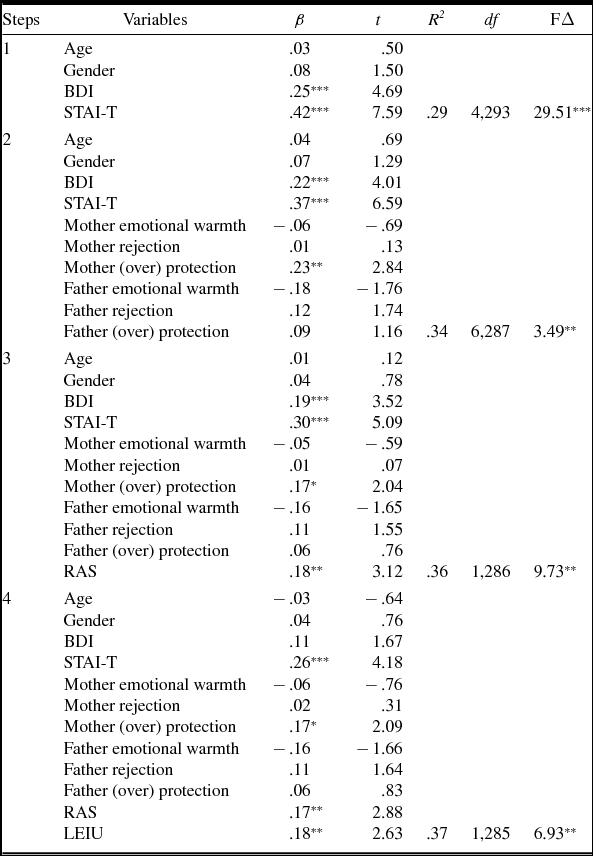
Two regression analyses were conducted in order to check the assumptions of mediation analysis as recommended by Baron and Kenny (Reference Baron and Kenny1986). In the first regression analysis, age, gender, depression, and trait anxiety scores were entered into the equation in the first step as control variables, in the second step, subscale scores of s-EMBU, in the third step, responsibility attitudes scores, and in the fourth step life events scores were entered into the equation. The OCS scores obtained from PI-WSUR were used as dependent variable. As can be seen from Table 1, in the second step, only Mother (Over) Protection (β = .23, p < .01) had significant direct effect on OCS. In the third step, responsibility attitudes (β = .18, p < .01), and finally, in the fourth step, life events (β = .18, p < .01) significantly predicted OCS. Significant direct effects of mother (over) protection (in the second step) and responsibility attitudes (in the third step) on OCS satisfied the first and second criteria of the mediation analysis (Baron and Kenny, Reference Baron and Kenny1986).
Predictors of obsessive compulsive symptomatology

***p < .001; **p < .01; *p < .05
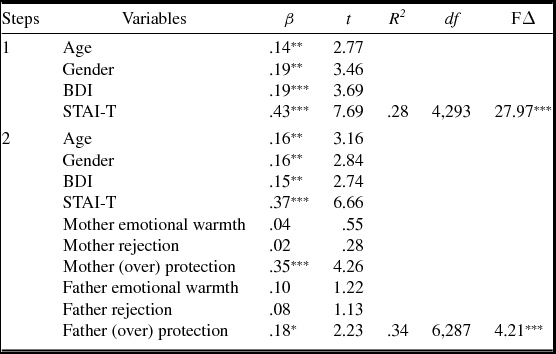
The results of the second regression analysis (see Table 2) showed that among the perceived parental rearing behaviours only Mother (Over) Protection (β = .35, p < .001) and Father (Over) Protection (β = .18, p < .05) significantly predicted the responsibility attitudes. Since the Father (Over) Protection did not have a significant direct effect on OCS (not satisfying first criterion, see Table 1) only mother (Over) protection satisfied the assumptions of mediation analysis since it had significant direct effects on both responsibility attitudes and OCS.
Predictors of responsibility attitudes

***p < .001; **p < .01; *p < .05
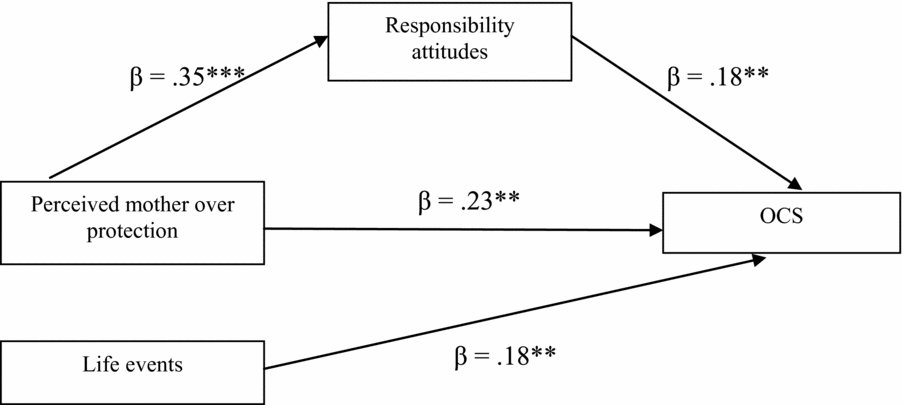
In order to satisfy the fourth criterion of the mediation analysis, in the first regression analysis (see Table 1), the effect of Mother (Over) Protection on OCS should decrease significantly or become non-significant when responsibility attitudes was entered into the equation in the third step. As can be seen from Table 1, the direct effect of Mother (Over) Protection (β = .23, p < .01) on OCS in the second step was reduced (β = .17, p < .01) in the third step when responsibility attitudes were entered into the equation. In order to test whether this reduction was significant or not, Sobel test (Preacher and Leonardelli, Reference Preacher and Leonardelli2006) was used. The significant z-result (z = 2.61, p < .01) showed that the effect of Mother (Over) Protection on OCS decreased significantly when responsibility attitudes entered into the regression equation, satisfying the fourth criterion of the mediation analysis. In other words, responsibility attitudes partially mediated the relationship between Mother (Over) Protection and OCS. The indirect effect of Mother (Over) Protection via responsibility attitudes was .09, and the total causal effect was .26.
The results of the regression analysis showed that perceived mother overprotection, responsibility attitudes and life events were all significant predictors of OCS. Moreover, responsibility attitudes were predicted only by perceived parental (over) protection. In terms of OCS, one of the important findings was the mediator role of the responsibility attitudes; indicating that perceived mother overprotection affected OCS by increasing the responsibility attitudes in the subject. The predictors of OCS and the mediational relationship are depicted in Figure 1.
Predictors of OCS

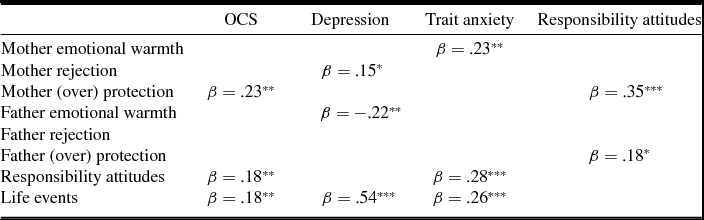
In order to evaluate the specificity of the findings to OCS, the same regression analyses were repeated to examine the predictor role of these variables for depression and trait anxiety by treating them as dependent variables. The significant predictors for all of the dependent variables are summarized in Table 3. The predictive role of perceived mother overprotection was found to be OCS specific. While responsibility attitudes were found to be a common predictor for OCS and trait anxiety, its mediator role was OCS specific. OCS, depression and trait anxiety were all significantly predicted by life events.
Summary of the significant predictors for all dependent variables

***p < .001; **p < .01; *p < .05
Discussion
Before the discussion of the findings, some methodological issues should be addressed in order to evaluate the current findings with caution. First, the current study had a non-experimental, cross-sectional design; therefore the results of the analysis were correlational in nature. Therefore, in order to determine the impact of parental rearing behaviours and responsibility attitudes on the development of obsessional problems, longitudinal designs are necessary for more reliable and valid assessment of these variables. The second limitation is related to the sample characteristics of the study. A university student sample was used in the study and therefore the age and education level of the subjects were within a very limited range. The study therefore needs to be replicated in an adult sample representing different ages. The third limitation of the study is related to the retrospective reports of parental rearing behaviours. In this study, the effects of a memory bias or mood congruent memory bias cannot be disregarded. A large proportion of the sample is living at home with their parents, and therefore participants’ current experiences with their parents are highly likely to influence their retrospective reports. Future studies can minimize these possible limitations by using multiple informants such as subjects’ self-reports and data obtained from parents. Finally, the sample was not a clinical one. Although the review studies (Gibbs, Reference Gibbs1996) showed that findings from non-clinical and clinical samples in OCD research are highly similar, the findings of the present study should be evaluated cautiously and need to be replicated with a clinical sample consisting of OCD patients, patients with other anxiety disorders, and depressive patients.
One of the aims of this study was to examine the responsibility attitudes as a vulnerability factor for OCS. The positive relationship between responsibility attitudes and OCS, indicating that higher levels of responsibility attitudes are associated with higher levels of obsessive compulsive symptoms, supported the cognitive explanation of OCD, which proposes that if the intrusive thoughts are filtered through a schema dominated by responsibility and fear of causing harm, then this leads to the misinterpretation of the intrusive thought.
Another aim of this study was to examine perceived parental rearing behaviours as a vulnerability factor for OCS. Regression analysis supported the hypothesis that perceived parental overprotection is a significant predictor for OCS. Subjects who reported more perceived mother overprotection tended to have more OCS, after controlling for the effects of depression and trait anxiety. The finding of the present study about the significant effect of perceived mother overprotection in the prediction of OCS is consistent with the findings in the literature (McLeod et al., Reference McLeod, Wood and Weisz2007; Wood et al., Reference Wood, McLeod, Sigman, Hwang and Chu2003; Ayçiçeği et al., Reference Ayçiçeği, Harris and Dinn2002; Turgeon et al., Reference Turgeon, O’Connor, Marchand and Freeston2002).
One of the most important aims of the current study was to examine and clarify the pathway of the vulnerability factors for OCS. Specifically, it was proposed that perceived parental overprotection would have an effect on OCS through responsibility attitudes. This hypothesis was supported by mediation analysis indicating that perceived mother overprotection had an effect on OCS through responsibility attitudes. In other words, higher levels of perceived mother overprotection lead to higher levels of OCS by increasing responsibility attitudes in the subject. This was one of the most important findings of the present study because it contributes to the explanation of “how” perceived mother overprotection leads to the development of OCS. This proposed pathway was a striking verification of the cognitive model of OCD (Salkovskis, Reference Salkovskis1985, Reference Salkovskis1989; Salkovskis et al., Reference Salkovskis, Shafran, Rachman and Freeston1999). Overprotective, controlling and critical type of parenting style (e.g. being fearful and anxious for the child's safety, intrusive, over-involved, excessive criticism of the child because of his failures to take necessary precautions to prevent potential dangers), may lead the child to perceive the world as threatening, dangerous, but at the same time controllable, and perceive himself as incompetent to deal with such danger. This kind of repeated parent-child interactions might be one of the developmental vulnerability factors for obsessional problems.
In addition to the developmental and cognitive vulnerability factors of OCS, the study also aimed to investigate the predictive role of life events as environmental factors for OCS. Life events were found to be a significant predictor for OCS, after controlling for the effects of depression and trait anxiety. This finding is consistent with the findings of other studies in the literature (Brown et al., Reference Brown, Juster, Heimberg and Winning1998; McKeon et al., Reference McKeon, Roa and Mann1984). In this study the subjects were asked to evaluate the frequency of the events and the level of stress caused by the events; however, the features of the events and their specificity for OCS were not examined. In future studies, specific quality of the life events, such as whether they are perceived as controllable or not, the interaction of specific life events with responsibility attitudes can be studied in detail; however, this was not within the scope of the current study.
The specificity of the above findings to OCS was mostly in line with the expectations. For depression, subjects who perceived their mother's rearing behaviours as more rejecting and father's rearing behaviours as less emotionally warm tended to have more depressive symptoms. On the other hand, perceived mother emotional warmth was positively related to trait anxiety, indicating that subjects who had more trait anxiety tended to perceive their mother's rearing behaviours as more emotionally warm. These findings indicated the specific importance of perceived mother overprotection for OCS, and to the distinction between OCS, trait anxiety and depression in terms of their developmental risk factors. In terms of responsibility attitudes, both OCS and trait anxiety, but not depression, were significantly predicted by responsibility attitudes. These findings indicated to a clear distinction between anxiety and depressive symptoms in terms of their specific cognitive components. In addition to this, although responsibility attitudes seemed to contribute to the explanation of both OCS and trait anxiety, the mediator role of responsibility attitudes was OCS specific. This is an important finding of the present study that shows specific cognitive mechanisms only mediate the relationship between specific developmental risk factors and specific psychological symptoms.
In conclusion, therapeutic strategies based on targeting inflated responsibility appraisals, developing adequate perceptions of personal responsibility, and questioning the developmental experiences that may contribute to the challenging, modifying and correcting the faulty assumptions might be a promising treatment for OCD.



Comments
No Comments have been published for this article.