I. INTRODUCTION
The mechanical properties of polymers are dependent predominantly on the testing temperatures due to their viscoelastic nature. Epoxy-based polymers exhibit a relatively high modulus at low temperatures, and a reduction in modulus by several orders of magnitude at temperatures above their glass transition temperature (T g). This drop in modulus is accompanied by a larger strain-to-failure with increasing temperatures. Based on this trend, the material changes from brittle to ductile, maximal toughness typically occurs at a testing temperature in the vicinity of T g, where the chains are becoming more mobile allowing the network to sustain larger strains without losing much strength. Reference Smith1,Reference Smith2 At temperatures above T g, materials exhibit rubber-like behavior. Since the amplitude of vibrational motion becomes greater at these temperatures, it leads to the distortion of the cross-linked network and hence results in a drastic reduction in failure strain. Reference Chia-Tai, Yip and Chiang3 Epoxies are widely used as the matrices of choice for structural applications and are normally used in a variety of environmental conditions which cover a wide range of temperatures from room temperature (RT) to elevated temperatures. Also, it is essential to elaborate the effectiveness of nanoparticles in epoxies throughout a wide range of temperatures for specified applications. However, before such applications can be attempted, the critical mechanical performance of epoxy nanocomposites at both low and high temperatures must be thoroughly understood.
It is evident that carbon nanotubes (CNTs) can be used to reinforce the polymer for improved mechanical properties. Two main issues that are critical to effectively improve the material properties of polymers by adding CNTs as filler are the interfacial bonding and proper dispersion of the individual CNTs in the polymeric matrix. Investigations focusing on the interfacial bonding between the nanotube and polymer matrix have been performed by many authors. Reference Barber, Cohen and Wagner4,Reference Gojny, Nastalczyk, Roslaniec and Schulte5 Several studies have reported on the mechanical properties of CNT-reinforced polymer nanocomposites where the CNTs were used without surface modification. Reference Gojny, Wichmann, Fiedler and Schulte6,Reference Gojny, Wichmann, Kopke, Fiedler and Schulte7 These studies showed an increase in the elastic modulus of the composite at relatively low nanotube concentrations (<1% by weight).
Only a few authors have reported on effects of temperature on mechanical properties of epoxy and other thermoplastic composites. With regard to research studies on epoxy system, McClung et al. Reference McClung, Tandon and Baur8 studied the strain rate and temperature-dependent tensile properties of an epoxy-based shape memory polymer (Veriflex-E) and found that maximum failure strain was obtained near T g. Effect of deformation temperature on the failure strain and shape memory behavior of epoxy network was reported by Diane. Reference Diane and Rousseau9 The results suggested that the failure strain was 3–5 fold higher at the onset of T g than that above T g. Smith et al. Reference Smith, Sawicki, Hyjek, Downey and Gall10,Reference Smith, Temenoff and Gall11 studied the effect of T g on the toughness of photopolymerizable methacrylate networks under physiological conditions. They also studied the stress–strain behavior and toughness of various thermoplastic polymer networks at different temperatures for biomedical applications. They noticed that the toughness was maximum at a temperature T ≤ T g. Laua et al. Reference Laua and Qiang12 reported on flexural properties of CNT/epoxy composites pretreated in different environments. They concluded that the flexural strength decreased with conditioning which was related to the structural inhomogeneity as well as weak interfacial bonding between matrix and nanotubes. However, to date, hardly any literature is available on studies related to temperature-dependent tensile properties of epoxy-CNT nanocomposites.
Hence, in the present work, unmodified and CNT-epoxy nanocomposites were prepared and tested for their tensile stress–strain behavior in their “glassy” as well as “rubbery” regimes, apart from their intermediate viscoelastic regimes.
II. MATERIALS AND METHODS
The 1% and 2% multiwalled CNT (MWCNT) predispersed epoxy resin (Araldite LY-556 based on Bisphenol A) and hardener HY-951 (aliphatic amine) were obtained from Chemapol Industries, Mumbai. The MWCNTs used have been produced by chemical vapor deposition method. They are ∼95% pure, 20–30 μm in length and 10–20 nm in diameter (according to the manufacturer's datasheet).
The predispersed MWCNT in epoxy resin was first sonicated using a high-intensity ultra sonicator (Ultrasonic cleaner Model 1200, Vibronics Private Ltd, Navi Mumbai, India) for one hour. Later, the required quantity of predispersed CNT was measured into a beaker and this was again sonicated for 7 min at 40% amplitude using a probe sonicator (Model No. VCX 130, Sonics & Materials Inc., Newtown, CT). The MWCNT predispersed epoxy resin and hardener were completely vacuum degassed at 80 °C for 1 h to remove the air bubbles. After cooling to RT, hardener was added to this mixture and again sonicated for 3 min.
This mixture was poured slowly into a metallic mold and allowed to cure at RT for 24 h. The unmodified epoxy castings were also prepared. The unmodified and CNT modified epoxy castings were post cured in steps (50 °C – ½ h, 70 °C – 1 h, 85 °C – 2 h). Tensile and dynamic mechanical analysis (DMA) test specimens were obtained using water jet machining. Before subjecting to tests, the specimens were thermally cycled 6 times between 25 °C and 100 °C so as to remove the thermal strains accumulated during fabrication.
A. DMA
Viscoelastic properties (storage modulus, loss modulus, and tan δ) were determined using a dynamic mechanical analyzer (Model Q 800, TA Instruments, Woodland, CA) for unmodified and CNT modified specimens with dimensions of 65 mm × 10 mm × 2.5 mm. The test was performed in single cantilever bending mode at a frequency of 1 Hz, amplitude of 15 N/m2, and at a heating rate of 3 °C/min from 25 °C to 150 °C.
B. Static tensile test
The static tensile tests were conducted on universal testing machine 5500R having load cell capacity of 10 tonnes and surrounded by an environmental chamber with an optical window for making observations inside the chamber. For elevated temperature testing, K type noncontact thermocouple was placed near the test specimen in the chamber to measure the sample temperature.
Dog bone-shaped test specimens (as per ASTM-D 638, Type IV specifications) were used for all the tensile tests. The tests were conducted at a cross head speed of 0.5 mm/min and an extensometer was mounted at 25 mm gage length to measure the tensile strain. Both unmodified and CNT modified epoxy specimens were tested at temperatures below and above T g. Tensile modulus was obtained from the slope of the initial linear portion of the stress–strain curve, while toughness was calculated as the area under the stress–strain curve.
C. Morphology
Fracture surfaces of the tensile tested specimens were examined using field emission scanning electron microscopy (FESEM, SUPRA 40 VP with Gemini column, Carl Zeiss, Germany) to identify the failure mechanisms.
III. RESULTS AND DISCUSSIONS
A. DMA
The dynamic mechanical properties of the unmodified and CNT modified epoxy samples were determined over a range of temperatures. The plots of storage modulus (E′), loss modulus (E″), and tan δ versus temperature are shown in Figs. 1(a)–1(c), respectively. The peak of tan δ (ratio of loss modulus to storage modulus) curve was taken as T g. With reference to the DMA curves shown in Figs. 1(a)–1(c), five temperatures were selected for examining the tensile response. The basis for selecting these five temperatures is as follows:
DMA plots of (a) unmodified, (b) 1% CNT modified, and (c) 2% CNT modified epoxy.

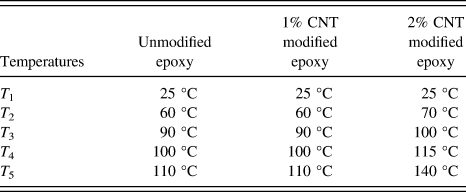
The lowest temperature (T 1), which corresponds to the RT “glassy” state; the temperature (T 2), where storage modulus begins to decrease gradually; the loss modulus peak (T 3); the tan δ peak (T 4); and the highest temperature (T 5) which corresponds to the “rubbery” state where the storage modulus reaches a relatively steady value. The selected temperatures of both unmodified and CNT modified epoxy system were shown in Table I.
Temperatures selected at different regimes.

From Figs. 1(a) and 1(b), it is observed that there is a 16% increase in the storage modulus at glassy state due to the addition of 1% CNT, while T g remains the same.
From Fig. 1(c), it is observed that storage modulus in glassy state has slightly reduced as compared with the unmodified epoxy system. However, for temperatures between 75 °C and 120 °C, the storage modulus is higher than that of the unmodified epoxy, evidencing an increased thermal stability of the nanocomposite. The figure also reveals that the T g = 115 °C, which is higher than that of unmodified epoxy. The significant increase in T g for the 2% CNT/epoxy nanocomposite indicates that the nanotubes tend to restrict the mobility of the polymer chains in the matrix. It is also observed that nanocomposites show a gradual decrease in the tan δ peak height with increasing MWCNT loading. Since tan δ is a measure of the relative energy distribution in the sample, i.e., it is the ratio between the dissipated energy and the elastic energy of the system, its values decrease due to the more pronounced increase of the storage modulus as compared with that of the loss modulus. Reference Abdalla, Dean, David, Nyairo, Robinson and Thompson13 Also the increase in width of the tan δ peak with CNT addition suggests a broader distribution of relaxation times presumably due to more nanotube polymer interactions, and hence restricted mobility. Reference Gojny and Schulte14
The DMA results of both unmodified and CNT modified epoxy system were summarized and shown in Table II.
DMA test results at different temperatures.

B. Effect of temperature on tensile behavior
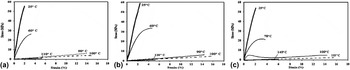
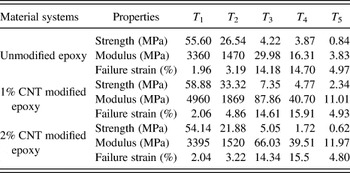
The influence of testing temperature on stress–strain behavior was examined by performing tensile tests at different temperatures. Representative stress–strain curves at selected temperatures are shown in Figs. 2(a)–2(c) for unmodified, 1% CNT modified, and 2% CNT modified epoxy system, respectively. Also Table III summarizes the tensile test results.
Stress–strain curve of (a) unmodified, (b) 1% CNT modified, and (c) 2% CNT modified epoxy.

Tensile test results at different temperatures.

From these results, it has been noticed that as compared with the unmodified epoxy system, the tensile strength slightly increased and modulus improved significantly by the addition of 1% CNT in the entire range of temperatures considered. In the case of 2% CNT nanocomposite, the tensile strength slightly decreased while the modulus remained the same as compared with the unmodified epoxy system. This may possibly be attributed to two factors namely, higher viscosity during processing resulting in formation of voids, which act as stress concentrators, as well as poor interfacial bonding between nanotubes and the matrix, which is reflected in the SEM photographs as well. At lower temperatures, both unmodified and CNT modified epoxy systems exhibit brittle behavior. At temperatures ≥90 °C, both unmodified and 1% CNT modified epoxy system exhibit ductile behavior without yielding. However, at 100 °C, 2% CNT modified epoxy system exhibits a ductile behavior with yielding. Further, as the temperature increases and approaches the T g (viscoelastic region), the epoxy system becomes plasticized, with a significant drop in modulus and strength. Above T g, the system shows a drastic reduction in the strength and modulus. Thus, based on the tensile tests at different temperatures, it is evident that 1% CNT-epoxy nanocomposites possess the highest strength and modulus at all test temperatures.
With respect to the failure strains of the three systems at different temperatures, a close observation reveals that the strain levels increase with temperature and reach a maximum value at T g in both unmodified and CNT modified epoxy systems. Increasing the testing temperature from RT to the vicinity of T g leads to a 7–8 fold improvement in failure strain. Any further increase in the temperature above T g leads to a drastic reduction in the failure strain. This could possibly be attributed to the combined effect of significant reduction in intermolecular forces as well as distortion of the cross-linked network due to the rise in amplitude of vibrational motion of the polymer molecules. Reference Chia-Tai, Yip and Chiang3,Reference Di Prima, Lesniewski, Gall, McDowell, Sanderson and Campbell15,Reference Yakacki, Willis, Luders and Gall16
C. Effect of temperature on toughness
The toughness obtained from stress–strain curve (Fig. 2), failure stain, and tan δ plotted against temperature for both unmodified and CNT modified epoxy system are shown in Figs. 3(a)–3(c), to bring out significant correlations amongst them. From Fig. 3(a), it is noticed that failure strain is maximum in the vicinity of T g but toughness is maximum much below T g (i.e., at 25 °C) in the case of unmodified epoxy. With regard to CNT modified epoxies [Figs. 3(b) and 3(c)], failure strain is maximum in the vicinity of T g and also maximum toughness is seen to occur at the temperature below T g (i.e., at 60 °C). This is attributed to the viscoelastic nature of the polymer chains, wherein molecular vibrations begin to increase allowing the chains to stretch without much loss in their load carrying capacity. Reference Sekhar Samal17–Reference Vincent20 In addition, the toughness values of CNT modified epoxies are higher than those of the unmodified epoxy at temperatures below T g.
The temperature effect on the failure strain, toughness, and tan δ curve of (a) unmodified, (b) 1% CNT modified, and (c) 2% CNT modified epoxy.

D. Fracture surface analysis
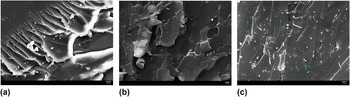
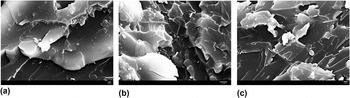
The fracture surfaces of composites give first information about failure mechanism and influence of MWCNT on failure process. Figures 4(a)–4(c) show FESEM images of the tensile fracture surfaces of unmodified and CNT modified epoxy specimens at RT. The fracture surface of unmodified epoxy displayed small river-like patterns along the crack propagation direction with a relatively smooth surface, representing a typical brittle fracture behavior as shown in Fig. 4(a). The surface features of 1% and 2% CNT-epoxy nanocomposites are rough as compared with those of neat epoxy [Figs. 4(b) and 4(c)]. More specifically, in the case of 1% CNT-epoxy composite [Fig. 4(b)], peaks and valleys were seen along the direction of crack propagation. The presence of well-dispersed CNTs indicates that cracks bypassed these CNTs, creating a fracture surface rougher than that of the neat epoxy. Reference Ma, Liu, Zhang, Wang, Wang, Wang, Wong, Tang, Hong, Paik and Kim21
FESEM images of the fractured surfaces of (a) unmodified, (b) 1% CNT, and (c) 2% CNT modified epoxy system at 25 °C.

Figure 4(c) shows that MWCNTs were well dispersed in 2% CNT/epoxy composites as well. In particular, the figure reveals the cleavage plane with several voids and holes created by CNT pull-out (marked in the figure). These could have led to the decrease in strength of 2% CNT/epoxy composite. A careful observation of the fractured surface morphology also shows that longer CNTs were pulled out from the matrix, thus confirming the poor interfacial bonding between the surfaces of nanotubes and surrounding matrix. Reference Lau and Hui22–Reference Sandler, Shaffer, Prasse, Bauhofer, Schulte and Windle24
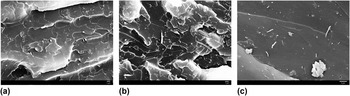
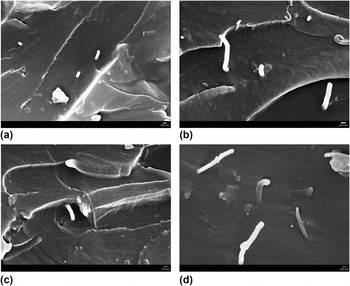
Figures 5(a)–5(c) followed by Figs. 6(a)–6(c) show the fractured surfaces of 1% and 2% CNT modified epoxy at higher temperatures. It is observed that the failure mechanism changed from CNT fracture to CNT pull-out when the testing temperature increased due to increased ductility in the matrix. Reference Jen and Huang25 This emphasizes that the polymer matrix loses its ability to adhere to the CNTs as the temperature increases. The presence of irregular ridges, spread across the fractured surface of the nanocomposites also confirms the ductile nature. In particular, a closer visual examination of the FESEM images [Figs. 7(a)–7(d)] at higher magnification reveals that the lengths of the pulled-out CNTs on the fracture surfaces of 1% and 2% CNT-epoxy nanocomposites increased with the testing temperature, Reference Jen and Huang25 clearly indicating that the adhesion strength between the CNT surfaces and the epoxy matrix has markedly reduced, thus possibly leading to reduction in mechanical performance. However, addition of 1% CNT into the epoxy matrix has resulted in better mechanical properties as compared with unmodified epoxy system at all test temperatures.
FESEM images of the fractured surfaces of 1% CNT modified epoxy system at (a) 60 °C, (b) 100 °C, and (c) 110 °C.

FESEM images of the fractured surfaces of 2% CNT modified epoxy system at (a) 70 °C, (b) 115 °C, and (c) 140 °C.

High magnification FESEM images of the fractured surfaces of 1% and 2% CNT modified epoxy systems. (a) 1% CNT at 100°C; (b) 1% CNT at 110°C; (c) 2% CNT at 115°C; (d) 2% CNT at 140°C.

IV. CONCLUSIONS
The unmodified and CNT modified epoxy nanocomposites were prepared and subjected to tensile tests at predetermined temperatures selected from DMA. Based on the results obtained, the following conclusions were drawn.
At all temperatures, addition of 1% CNTs considerably improves the tensile strength and modulus of neat epoxy. However, embedding 2% CNTs into the epoxy matrix has an adverse effect on the mechanical behavior.
In all the three cases, for tests conducted at temperatures in the vicinity of T g, a significant drop in modulus and strength was evident, together with a 7–8 fold enhancement of failure strain. However, above T g, apart from the drop in modulus and strength, even the failure strain showed a drastic reduction that is attributed to significant reduction in intermolecular forces and possible distortion of the crosslinked network above T g.
Temperature-dependent toughness behavior revealed that maximum toughness occurs below T g for both unmodified and CNT modified epoxy systems. Further, it was noticed that the toughness of CNT modified epoxy systems was higher than that of unmodified epoxy system at temperatures below T g. Specifically, the toughness of 1% CNT-epoxy system was comparatively higher than that of 2% CNT-epoxy system.
It is clear from fractographic analysis of CNT-epoxy nanocomposites that the failure mechanism changed from CNT fracture to CNT pull-out at higher test temperatures due to reduced adhesion strength between the CNT surfaces and the epoxy matrix.
Thus, based on the DMA and tensile test results of unmodified and CNT modified epoxy systems conducted at different prespecified temperatures, the storage modulus and tensile behavior of 1% CNT-epoxy nanocomposites are found to be most optimum.
ACKNOWLEDGMENTS
Authors are thankful to their colleagues Mr. A. Sri Ganesh, Mr. D. Baskey, and Mr. Siju Thomas for support during these studies. They are also thankful to Dr. Siddaramaiah, Mr. Raghavendra Barki, and Mr. Chiranjeevi, SJCE, Mysore for DMA tests.