The single ventricle refers to a physiopathological situation in which a single functional ventricle provides pulmonary and systemic flow in parallel.
From an anatomical point of view, this situation is encountered in a multitude of malformations such as tricuspid atresia, hypoplastic left heart syndrome, certain forms of double-outlet right ventricle or double-inlet left ventricle, and unbalanced complete atrioventricular canal defect.
These anatomical configurations are not accessible to biventricular repair and require a Fontan-type surgery by a cavo-pulmonary connection, in order to restore a “serial” circulatory system by separating the pulmonary and systemic circuits.
The clinical presentations depend on the anatomic lesions and the pulmonary flow (cyanosis or heart failure), and determine the surgery to perform: early palliative surgery may be necessary, either to reduce the pulmonary flow (banding of the pulmonary artery) or to increase it (systemic-pulmonary anastomosis). The total cavo-pulmonary connection can be done in one surgical event. Nevertheless, most often (for technical reasons, such as the weak weight of the child, or for physiological reasons, in older children to ensure a better haemodynamical adaptation) this total cavo-pulmonary connection has to be done in two stages with initially a superior or partial cavo-pulmonary connection and in a second event, a totalisation of the cavo-pulmonary connection by performing the inferior cavo-pulmonary connection.
The management of a child with a functionally single ventricle requires long-term medical follow-up, from diagnosis to totalisation of the cavo-pulmonary connection, and beyond. While such global care is the rule in Western countries, it is impossible in countries that do not have paediatric cardiac surgery, like most of the developing countries. Humanitarian associations such as Mécénat-Chirurgie Cardiaque 1 can therefore be involved in the care of children with severe heart diseases, like single ventricle.
The principle of Mécénat-Chirurgie Cardiaque is to bring children to France to be operated and supported until their possible return to their country of origin. This method of humanitarian care was chosen to treat children from all countries, even the poorest, in which hospitals sometimes do not even have the guarantee of electricity or even running water. Other humanitarian organisations treat children in their countries without transferring them, but this type of care is often impossible for the most difficult surgeries, especially those requiring a close post-operative follow-up such as Fontan surgery.
Regardless of the complexity of the surgery and post-operative follow-up, the central question of our work is the feasibility of the long-term care – ideally up to the total cavo-pulmonary connection – of these children by a humanitarian association. The follow-up after the return to the countries of origin is the core of the long-term results.
Objectives
The purpose of this study is to determine whether managing children with a single ventricle in a humanitarian setting improves survival rates, despite monitoring difficulties, thereby also establishing legitimacy.
Material and methods
Methods
This is a retrospective study of all children with a single ventricle, from developing countries, and managed by the Mécénat-Chirurgie Cardiaque association since its creation in 1996.
Mécénat-Chirurgie Cardiaque is a humanitarian association created to allow children suffering from cardiac malformations to come to France and to be operated on when they cannot be treated in their country of origin for lack of financial means and techniques.
We analysed the long-term global survival, according to the type of single-ventricle condition, whether or not surgery was performed, and what type of surgical procedure was used.
The follow-up after the return home to the country of origin is ensured by the medical antenna of Mécénat-Chirurgie Cardiaque, in connection with the corresponding doctors in those countries.
Population
We have retrospectively reviewed all cases of children with a single ventricle sent to Mécénat-Chirurgie Cardiaque since its creation in 1996. The travel of children to France for their surgical management by Mécénat-Chirurgie Cardiaque is decided jointly with the corresponding cardiologists in the native country.
For this type of surgery, which aims at a functional improvement of the children and leads ideally to the realisation of a total cavo-pulmonary connection, a first screening is carried out solely on the examination of the medical file, favouring the a priori favourable forms (good ventricular systolic function, absence of atrioventricular valve regurgitation, low pulmonary pressure, and good pulmonary branches). Once the project is accepted, Mécénat-Chirurgie Cardiaque organises the arrival of the child in France, where it receives a hospital evaluation in one of the French centres of congenital cardiac surgery, with the following:
A clinical evaluation for signs of pulmonary overload (dyspnoea, sweating, intercostal tirage, hepatomegaly, poor weight gain, poor food intake) or, on the contrary, pulmonary hypoperfusion (cyanosis, finger clubbing, low saturation, polycythemia).
A chest X-ray.
A Doppler echocardiography with two expert exams for each child.
If necessary, a hemodynamic evaluation and/or a chest CT scan (examinations left at the discretion of each centre).
Operability and the type of surgery are decided at the end of this hospital evaluation. Generally, banding was selected for young children who had clinical pulmonary overflow without valvular insufficiency; anastomosis was selected for children who had a deep cyanosis, and whose pulmonary arteries were too small to receive a partial (or – a fortiori – total) cavo-pulmonary connection; and partial cavo-pulmonary connection was selected for children who had low pulmonary pressure, large pulmonary arteries, no valvular insufficiency, but were too small (<10 kg) to receive a total cavo-pulmonary connection.
Pre-operative data and immediate post-operative data were collected retrospectively from our centralised database, based on medical records. The late monitoring after the return of the children to their country of origin was assured by direct contact (telephone, mail, or electronic mail) with our correspondents in those countries (cardiologists or paramedical) twice a year for each child by our permanent medical staff.
Statistical analysis
Statistical analysis was performed with Stata 10.1 software (StataCorp LCC, College Station, Texas, United States of America). The qualitative variables are given in numbers and percentages. Numeric variables are described by their mean, median, and standard deviation. Percentage comparisons are made with Chi-2 or Fisher’s exact test for small numbers and mean comparisons with the Student’s t-test. The survival analysis was made using the Kaplan–Meier actuarial method, and the comparison between groups with log-rank test. The tests are considered significant if p ≤ 0.05.
Results
Population
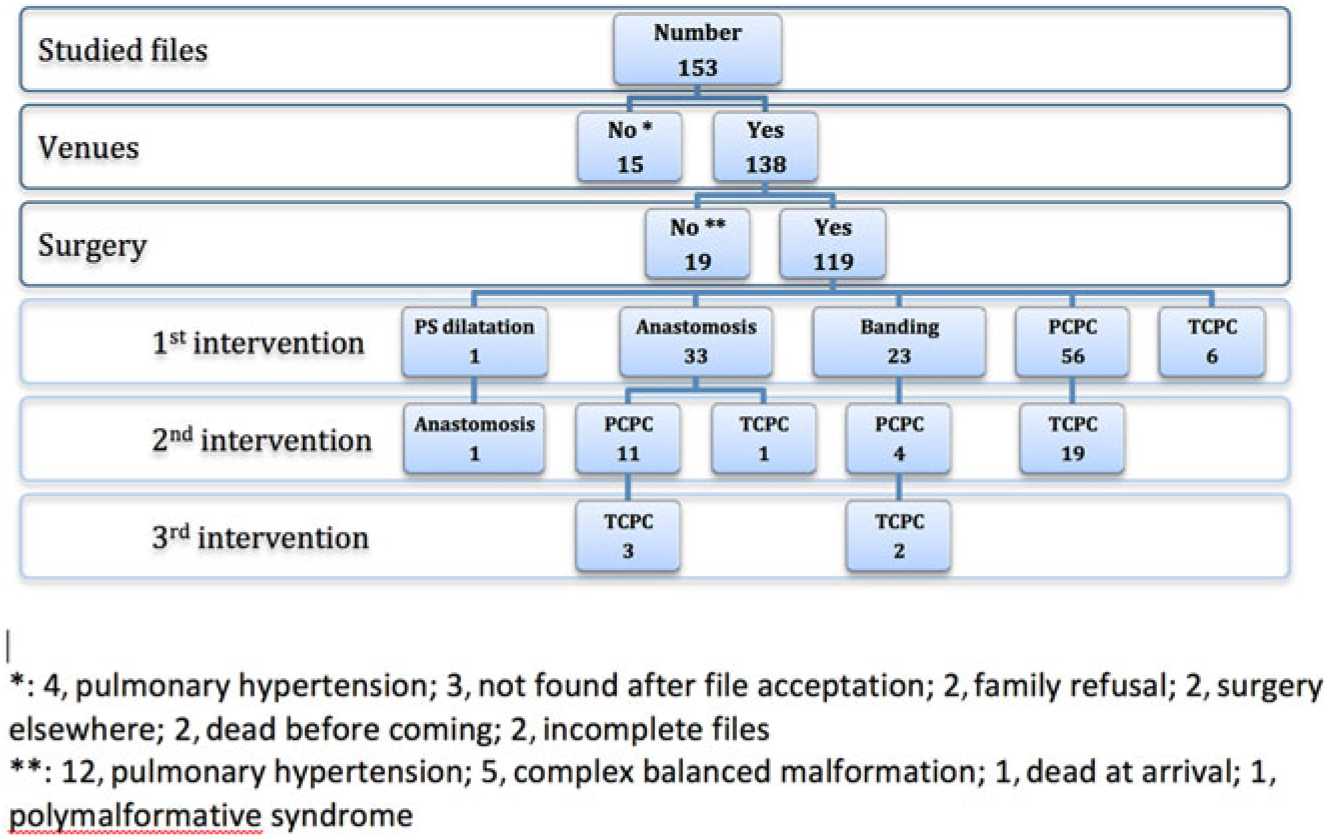
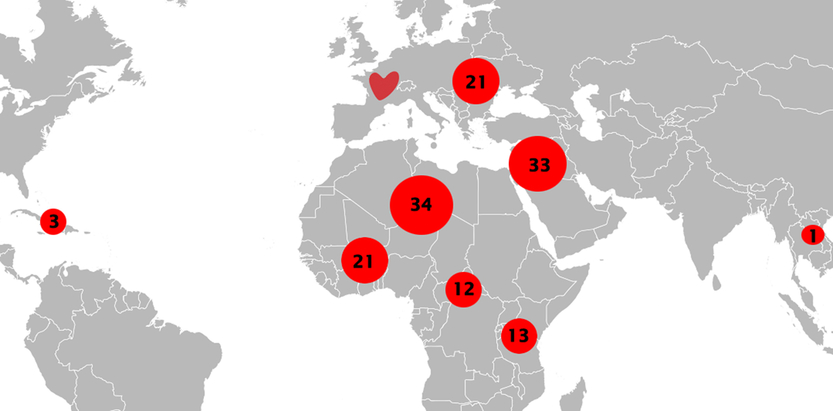
Since 1996, among 153 potential children proposed by our correspondents, 138 children (90 boys, 48 girls) with single ventricle have been cared for by Mécénat-Chirurgie Cardiaque (Fig 1). Most are from Africa (sub-Saharan Africa, 46/138 – 33%; North Africa, 34/138 – 25%), but also from the Middle East, 33/138 – 24%; Eastern Europe, 21/138 – 15%; Haiti 3/138 – 2%; and Southeast Asia 1/138 – 0.7% (Fig 2).
Children’s flow chart. PCPC = partial cavo-pulmonary connection; PS = pulmonary stenosis; TCPC = total cavo-pulmonary connection.

Children’s country of origin.

Initial characteristics
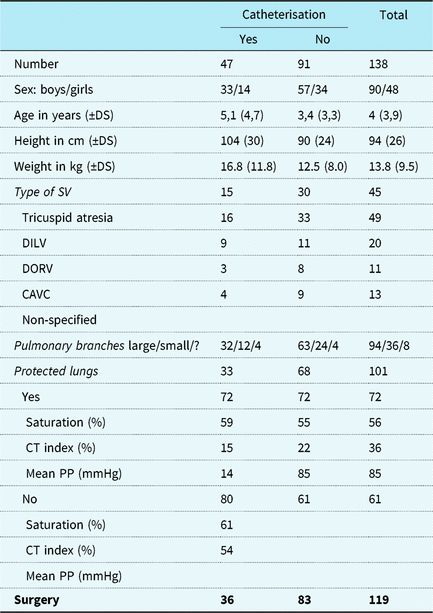
The characteristics of the population are detailed in Table 1.
Initial characteristics

SD = Standard Deviation; CAVC = complete atrio-ventricular canal defect; CT index = cardiothoracic index; DILV = double inlet left ventricle; DORV = double-outlet right ventricle; PP = pulmonary pressure; SV = single ventricle.
Of the 138 children, 19 did not have operations: 1 died on arrival in France before the hospital report; 12 because of a pulmonary arterial pressure that does not allow a cavo-pulmonary connection (generally mean pulmonary pressure above 16–18 mmHg); 5 because of a balanced complex heart disease, making the surgical benefit uncertain; and 1 due to a severe polymalformative syndrome.
Out of them, 91 children did not need a haemodynamical examination before the surgical indication: the clinical symptomatology, the thorax radiography, and the cardiac echography were sufficient for the decision; 47 children who needed a haemodynamical examination were meanly older (5.1 versus 3.4 years; p = 0.02), and had a more difficult symptomatology for the decision than the group that did not need one (more cardiomegaly when the lungs were protected, and more cyanosis when the lungs were not).
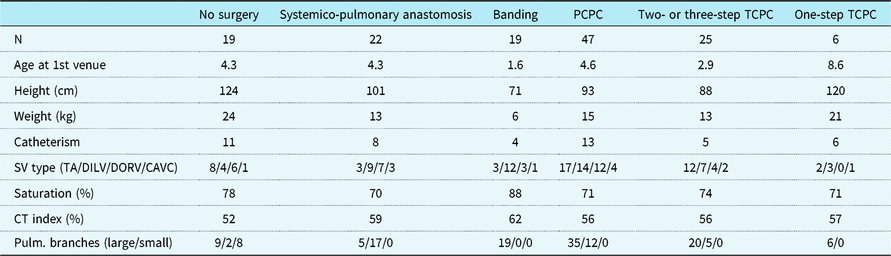
Table 2 details the initial characteristics of children according to the last surgical step performed. The six children who achieved the total cavo-pulmonary connection in one step were older, but had a favourable clinical and anatomical presentation (sufficient weight, low saturation without cardiomegaly, and large pulmonary branches). All the six had a haemodynamical examination before surgery, with a pulmonary pressure allowing the one-step surgery.
Initial characteristics of the children by the last achieved surgical step

CAVC = complete atrio-ventricular canal defect; CT index = cardiothoracic index; DILV = double-inlet left ventricle; DORV = double-outlet right ventricle; PCPC = partial cavo-pulmonary connection; SV = single ventricle; TA = tricuspid atresia; TCPC = total cavo-pulmonary connection.
Surgical procedures
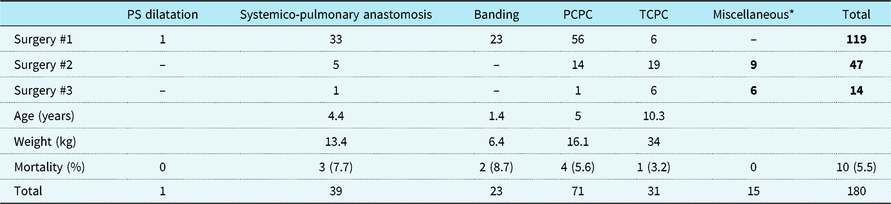
In total, 119 children who underwent surgery had a total of 180 surgical procedures (Table 3); 47 children underwent a second surgery after a mean follow-up of 4 years 2 months and 14 were operated on for a third time after an average of 6 years 7 months after their first visit to France.
Surgery

PCPC = partial cavo-pulmonary connection; PS = pulmonary stenosis; TCPC = total cavo-pulmonary connection.
* Pleural or pericardial drainage atrio-ventricular valve surgery (valvuloplasty or valve replacement), pacemaker, mediastinitis, etc.
With a mean follow-up of 5 years and 7 months, of the 119 children operated on, 41 children received a palliative only (systemic-pulmonary anastomosis, 22; banding, 19), 47 a partial cavo-pulmonary connection (including 10 after a palliative), and 31 a total cavo-pulmonary connection (6 in one stage at a mean age of 8 years 8 months; 19 in two stages – post-palliative or post-partial cavo-pulmonary connection; and 6 in three stages). All but two total cavo-pulmonary connection procedures were extra-cardiac conduits; one had an intra-atrial baffle; and one had an intra-atrial tube, with fenestration because of a mean pulmonary pressure at 20 mmHg during the surgery. Fenestration was done in two other children with extra-cardiac tube: one because of an associated plasty of the pulmonary bifurcation and one because of the complex heart disease (heterotaxis in a small child). Reparative surgery was necessary for pleural or pericardial effusion nine times; for valvoplasty or replacement of the atrio-ventricular valve three times; for pacemaker implantation, montage revision, or mediastinitis once.
The mean age at the time of surgery was 1.4 years at banding, 4.3 years at systemic-pulmonary anastomosis, 5 years at partial cavo-pulmonary connection, and 10.3 years at total cavo-pulmonary connection. The mean time between the first medical intervention in France and the completion of a total cavo-pulmonary connection is almost 8 years.
Immediate follow-up (Table 4)
In-hospital stay (days)

PCPC = partial cavo-pulmonary connection; PS = pulmonary stenosis; TCPC = total cavo-pulmonary connection.
The mean hospital stay for the first surgery was 12.8 days (+/−8.8). For total cavo-pulmonary connection, in one, two, or three stages, the total cumulative in-hospital stay was 28.7 days.
The total operative mortality was 10/180 (5.6%): 3/39 for anastomosis (7.7%), 2/23 for banding (8.7%), 4/71 for partial cavo-pulmonary connection (5.6%), and 1/31 for total cavo-pulmonary connection (3.2%).
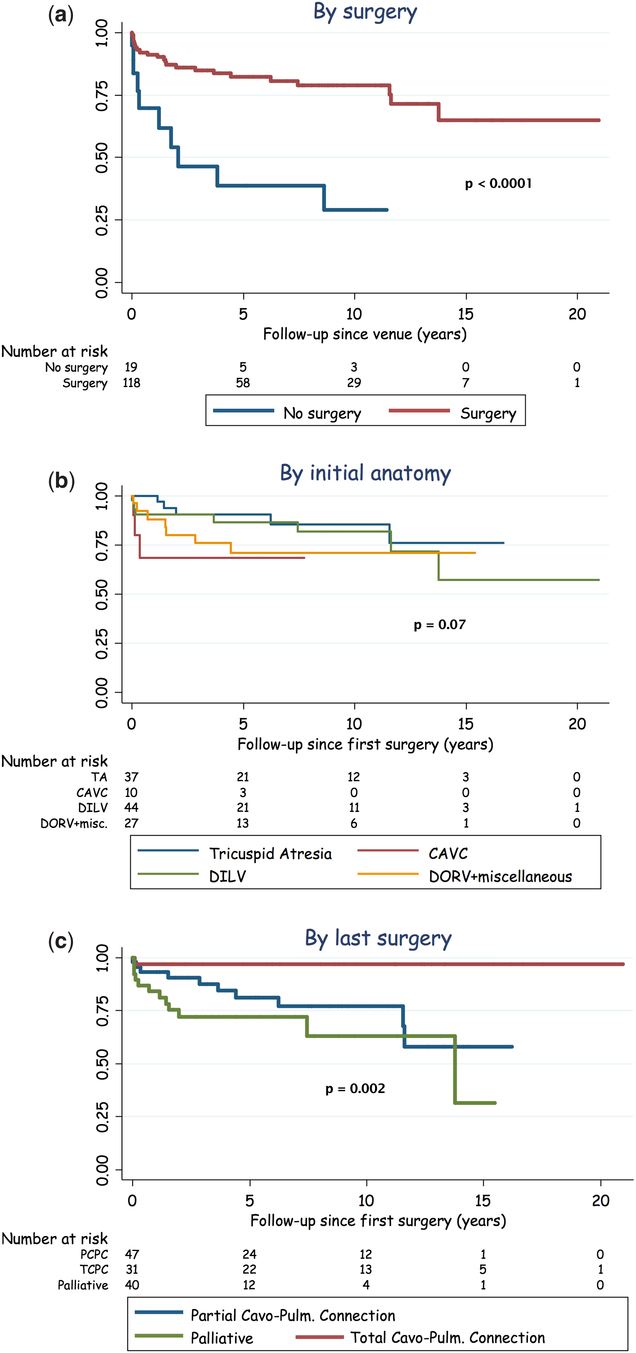
Long-term follow-up and survival (Fig 3)
Actuarial survival according to (a) whether or not surgery was performed; (b) the initial anatomy performed; and (c) the final surgery performed. TA = tricuspid atresia; DILV = double-inlet left ventricle; DORV = double-outlet right ventricle; CAVC = complete atrio-ventricular canal defect; PCPC = partial cavo-pulmonary connection; TCPC = total cavo-pulmonary connection.

Survival data are the only ones that are almost complete. Quality of life and social or functional statuses are very difficult data to collect in the countries of origin, and answers are mostly incomplete or non-existent.
The follow-up provided by the local doctors is dependent on the conditions specific to each country, and does not respond to such periodicity as in our Western countries. Generally, if news is regularly requested by our organisations staff, local doctors contact us only when the children are getting worse.
The mean follow-up since the first medical care is 5 years and 7 months, and 3 years and 10 months since the last medical care; 18 children (13%) are lost to follow-up and 33 (23.9%) children died after a mean follow-up since receiving care of 2 years and 8 months.
Overall actuarial survival is 82.3% at 5 years and 79% at 10 years for children receiving operations, significantly higher than for those not receiving operations (39% at 5 years and 29% at 10 years); p < 0.0001 (Fig 3a).
Among the children who benefited a surgery, initial anatomy seems to be a prognostic factor for mortality (Fig 3b): survival is better in the group of tricuspid atresia or double-inlet left ventricle (left-type single ventricle) than in the complete atrio-ventricular canal defect or double-outlet right ventricle (right-type single ventricle), although the difference is not statistically significant (p = 0.07), due to the lack of power of the study, given the too small number in each sub-group.
The presence of large pulmonary arteries (versus small pulmonary arteries) is not statistically related to a better prognosis (p = 0.33).
For children who had only palliative care (pulmonary banding or systemic-pulmonary anastomosis), the survival rate at 5 and 10 years is 72 and 63%, respectively; for children with partial cavo-pulmonary connection, survival is 81% at 5 years and 77% at 10 years; while for children who have benefited from a total cavo-pulmonary connection (in 1, 2, or 3 stages), the 10-year survival rate is 97%; p = 0.002 (Fig 3c).
It is important to note that, because of the difficulty of monitoring anticoagulant therapy in these countries, children who have benefited from a total cavo-pulmonary connection returned to their country with aspirin and not vitamin K antagonists, even the two, who did not receive extra-cardiac conduits.
Discussion
Since 1996, the date of the creation of Mécénat-Chirurgie Cardiaque, of the 138 children admitted to France for a single-ventricle surgery, 119 (86%) have had one or more surgeries.
The purpose of this work was multiple:
1) To determine whether the care of children with a single ventricle was possible and legitimate in the humanitarian context.
With a follow-up of almost 6 years, and only 13% lost to follow-up, the level of follow-up of children supported by Mécénat-Chirurgie Cardiaque is in line with that of the French university hospitals and international studiesReference D’Udekem, Iyengar and Galati 2 and demonstrates the effectiveness of the networks put in place between Mécénat-Chirurgie Cardiaque and the referents of the countries sending their children to us, despite the geographical distance and the difficulties encountered locally. The care of these children who sometimes require two or three interventionsReference Davies and Pizarro 3 should not be hampered by the fear of insufficient follow-up due to remoteness. Nevertheless, in the children who underwent a total cavo-pulmonary connection, the delay between the first medical intervention in France and the completion of the cavo-pulmonary connection was long (almost 8 years), when the current strategy suggests a delay of 2 years until completion. This long delay can be explained by the limited number of children that Mécénat-Chirurgie Cardiaque can care every year; this number is limited by the cost of each surgery, so we must make choices about the order of the children’s arrival. If the clinical condition of the children allows it, we often choose to wait, so that we can take care of other children who cannot wait (Tetralogy of Fallot with anoxic spells, Ventricular Septal Defect with pulmonary hypertension, for example). The delay between two surgeries in the same child, if its clinical status allows it, may therefore be longer than usual.
2) To analyse the long-term survival of these children.
If children that underwent no surgery (most often due to pulmonary arterial hypertension, or pulmonary pressure that does not allow univentricular correction) have poor survival (62% at 1 year and 39% at 5 years), the survival of children who were able to benefit from an intervention (91.1, 82.3, and 79% at 1, 5, and 10 years, respectively) is comparable to that observed in the literature for more favoured populations.Reference Downing, Allen and Glatz4–Reference Alsaied, Bokma and Engel6 Therefore, the screening of the children in their country of origin seems to be the biggest challenge to permit all the children to be managed before the pulmonary pressure prohibits the surgery. The feasibility of a total cavo-pulmonary connection is a major marker of survival: indeed, if the overall survival of the cohort is 77% at 5 years and 72% at 10 years, it is greater than 95% at 10 years in children who have benefited from a total cavo-pulmonary connection (either immediately or after one or more surgical procedures), compared to 63% without total cavo-pulmonary connection. Long-term management should therefore aim for surgical intervention as soon as it is feasible, requiring follow-up of children in their home countries together with follow-up by the Mécénat-Chirurgie Cardiaque medical team.
3) To determine whether there were more favourable forms than others.
In our cohort, the presence of large pulmonary arteries is not statistically related to a better prognosis, even if there is a trend (p = 0.33), contrary to the data of the literature.Reference Senzaki, Isoda, Ishizawa and Hishi 7 This can be explained by the late management of the children (because of a delayed diagnosis). Those with initially good pulmonary tracts, but without early banding, develop early pulmonary resistance, and therefore surgical results are mediocre.Reference Gewillig and Brown 8, Reference Egbe, Connolly and Miranda 9 The results are in favour of a better prognosis when the single ventricle is of the left-type (tricuspid atresia, or double-inlet left ventricle). These results are in agreement with the literature data, with a rather favourable prognosis in case of double-inlet left ventricle,Reference Alsoufi, McCracken, Kanter, Shashidharan and Kogon 10 as opposed to the right-type single ventricle,Reference McGuirk, Winlaw and Langley 11, Reference Hosein, Clarke and McGuirk 12 or heterotaxis with complete atrio-ventricular canal defect.Reference Alsoufi, McCracken and Schlosser 13
Conclusion
The prognosis of children with single ventricle originating from countries without cardiac surgery and managed by the Mécénat-Chirurgie Cardiaque association is generally satisfactory, especially in left-type single ventricle. Nevertheless, the action of Mécénat-Chirurgie Cardiaque with these children should aim for the earliest possible management, in order to preserve the pulmonary vascular bed, in order to be able to consider a total cavo-pulmonary connection, which will offer an excellent prognosis to the child. The close follow-up between the Mécénat-Chirurgie Cardiaque medical team and the corresponding cardiologists in the children’s home countries is the key to these positive outcomes for this complex congenital heart disease.
Acknowledgements
The authors thank Marion Saint-Picq who ensures in Mécénat-Chirurgie Cardiaque the follow-up of the children after their return in home country. They also Cécile Coignet and Cindy McCreary who ensured the proofreading of the text.
Financial Support
This research received no specific grant from any funding agency, commercial or not-for-profit sectors.
Conflict of interest
None.