INTRODUCTION
Traces of human activity are commonly found in many European caves. There are three primary motivations for the presence Neolithic people in caves that were recognized: the use of cave spaces as dwellings; the use for periodic sheltering of cattle; and the use of caves for ritual/cult purposes, for example Peša (Reference Peša2014). It can be assumed that a large part of the caves with preserved drawings or markings was used for the latter reason. The “artistic style” of the Neolithic/Eneolithic differs significantly from the realistic Palaeolithic drawings, and it is encountered mainly in southern Europe. The Italian cave La Grotta dei Cervi (Deer Cave) near Porto Badisco in the Apulia region is a typical Neolithic gallery, in which stylized figural scenes of hunting and other activities have been preserved, as well as abstract patterns reminiscent of phosphenes—optical phenomena of biochemical or neurological origin induced, for instance, by hallucinogenic substances (Leone Reference Leone2009). The dating of the site to the Neolithic is based solely on the presence of archaeological finds (Leone Reference Leone2009). Similar drawings can be found in the Bulgarian caves Magura and Bailovo (Stoev and Maglova Reference Stoev, Maglova and Ruggles2014). Magura’s drawings were created by fossilized bat guano. According to the 14C measurement, the material dates to the period around 3600 BC (Kunov et al. Reference Kunov, Arnaudov and Molnár2014). In Central Europe, rather simpler features predominate. Kateřinská Cave shows similarities to Domica Cave, Ardovská Cave, Silická Ladnica Cave, and Praslen Cave in Slovakia (Šefčáková Reference Šefčáková2017). Using radiocarbon (14C) measurement, the drawings preserved in Domica Cave were dated to the late Mesolithic and Neolithic–Eneolithic, while the drawings in Ardovská Cave to the Bronze Age–Hallstatt Period and La Tène–Roman Period (Šefčáková and Levchenko Reference Šefčáková and Levchenko2018). Up until now, the only Czech Eneolithic drawing had been found in Býčí Skála Cave (Bull Rock Cave), part of the Moravian Karst. 14C analysis performed in 2005 dated three samples from Býčí Skála Cave to the Middle Eneolithic 3100–2925 BC, 2930–2885 BC and 3630–3360 BC (Svoboda et al. Reference Svoboda, van der Plicht and Balák2005; Svoboda and van der Plicht Reference Svoboda and van der Plicht2007; Golec Reference Golec2020). Now, even older drawings have been found in Kateřinská Cave of the same karst system, with 14C analysis, never previously applied there.
Sampling for 14C dating is performed typically by scraping parts of the cave drawing, which often results in its at least partial degradation. This study introduces a gentler wipe-sampling method, which allows us to preserve the contours of the graffiti.
MATERIALS AND METHODS
Archaeological Situation of Kateřinská Cave
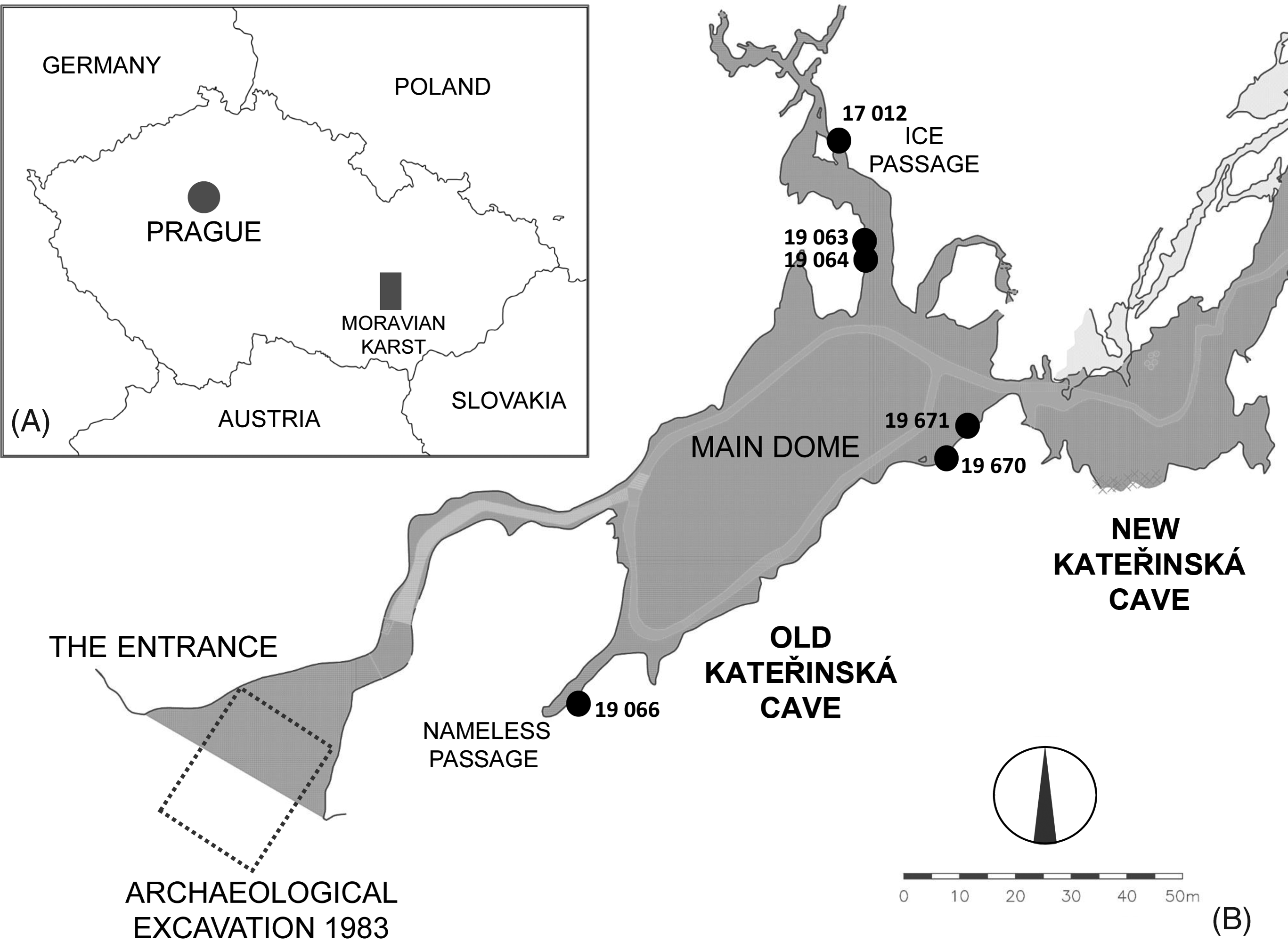
The Moravian Karst is the largest and most developed karst area in the Czech Republic (Figure 1A). Devonian limestones cover a continuous area of 75 km2, with 1134 currently known caves (Balák Reference Balák2009). Kateřinská Cave is one of the few large caves (Figure 1B). It has been known for centuries for its high Gothic-shaped portal. Archaeological research works have been conducted repeatedly in the entrance to the cave since the second half of the 19th century. Behind the entrance portal, there is a low-vaulted entry hall of 60 m in length, which opens into the massive Main Dome with dimensions of 95 × 42 × 23 m, the so-called Old Kateřinská Cave. Many inscriptions and signatures document numerous visits to the cave from the 18th century. There is an extensive “signature centre” in the back part of the Ice Passage. The Main Dome branches into several dead-end corridors. In 1909, a continuation into the large New Kateřinská Cave was discovered in the eastern back parts of the Main Dome.
Map of the Czech Republic and location of the Moravian Karst (A); sampling points in Kateřinská Cave (B).

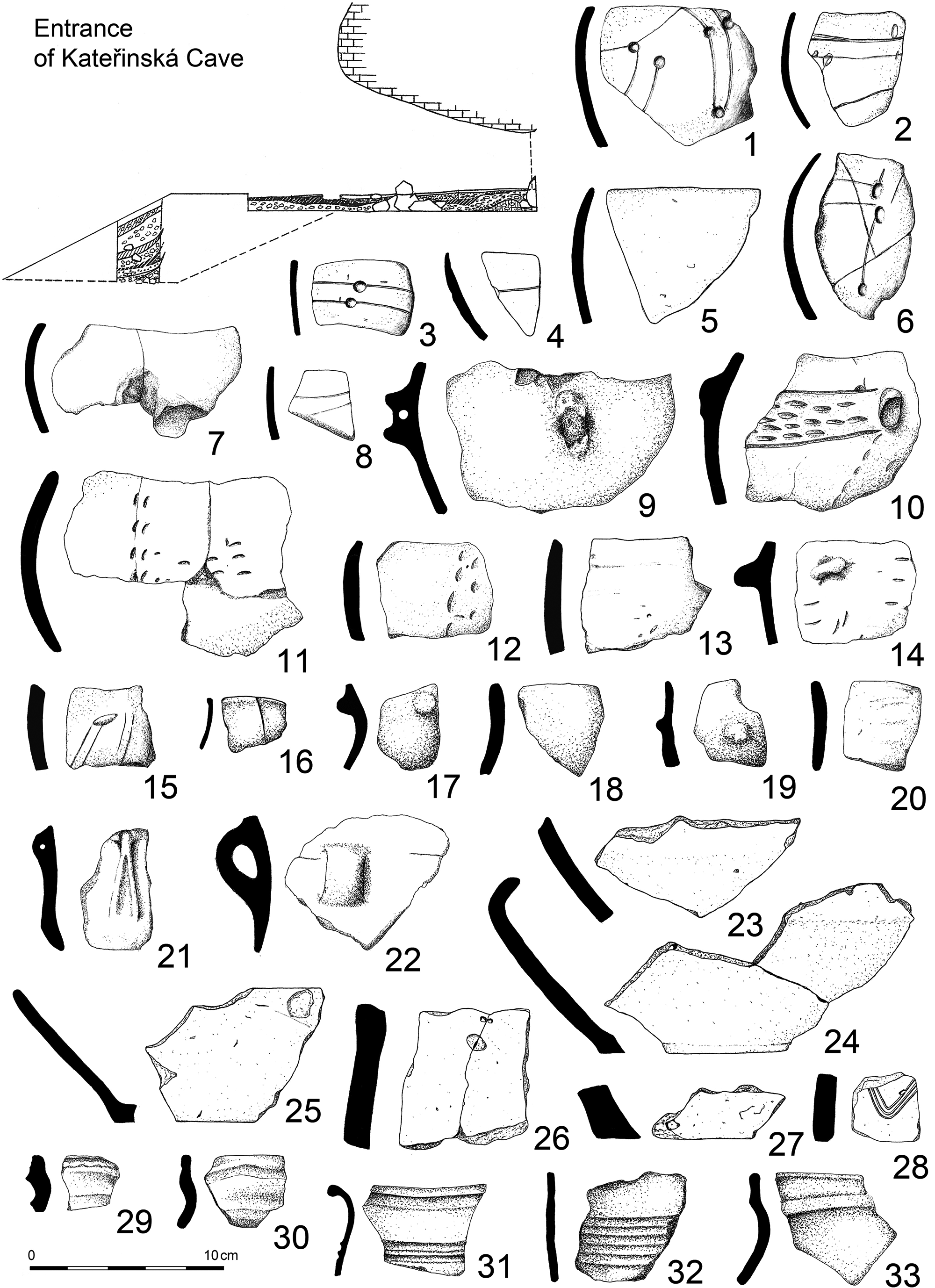
The caves of the Moravian Karst had been repeatedly used as a settlement since the Middle Palaeolithic and gained further utilization during the post-Palaeolithic periods. For Kateřinská Cave, this has been proved by pottery found in different layers at the entrance of the cave (Geislerová et al. Reference Geislerová, Seitl, Svoboda and Svobodová1986). The pottery falls in a varied spectrum dated from prehistory (with identified findings from the Neolithic, Eneolithic, Bronze Age, and Hallstatt Period), through Protohistory (La Tène and Roman Period), Middle Ages, up to Modern Age; the details are introduced in Figure 2. No pottery has ever been found deeper inside the cave; therefore, the newly discovered graffiti represent significant progress in the research of human activity in this locality.
Pottery recovered at the entrance of Kateřinská Cave. The archaeological site, including the layers, is introduced in the upper-left corner of the figure (after Geislerová et al. Reference Geislerová, Seitl, Svoboda and Svobodová1986). The drawing of each sherd is accompanied by a black-depicted profile and marked with a number. The periods of their origin were identified as Early Neolithic (1–15), Late Neolithic/Early Eneolithic (16–20), Early Eneolithic (21), Early Bronze Age (22), Hallstatt Period (23–25), La Tène Period (26–27), Roman Period (28), Early Middle Ages (29–30), and High and Late Middle Ages (31–33).

Sampling Sites
Sampling and documentation of charcoal lines and patterns in Kateřinská Cave began in 2016 and have continued to the present day. We present six samplings in total, three from the Ice Passage, one from the “Nameless Passage” and two from the Main Dome (Table 1).
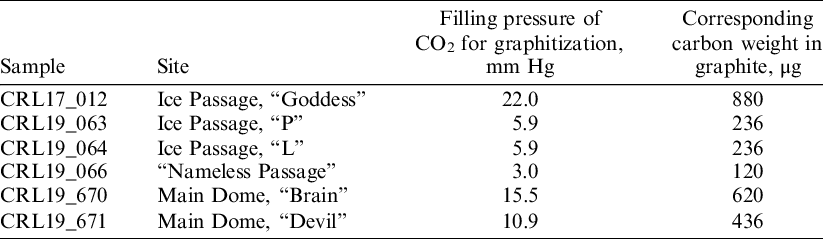
Six samples from different sampling sites in Kateřinská Cave together with filling pressure of graphitized CO2 and corresponding carbon weight.

Analytical Methods
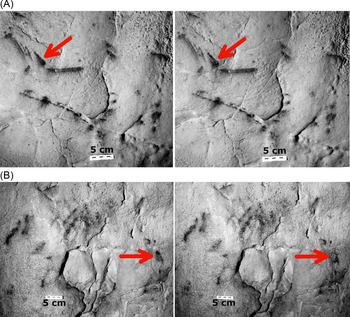
A new wipe-sampling method of fine charcoal particles has been employed, using quartz wool swabs pretreated in diluted HCl and heated in the air (550°C). Each drawing was gently wiped for about 10 min with a swab soaked again in the diluted HCl. This enabled us to control the amount of the pigment being wiped away and thus to preserve at least a part of it on the cave wall. Figure 3 illustrates the extent to which the drawing has been preserved after the sampling. Figure 3A shows an almost ideal case, where a charcoal-rich drawing has maintained its contours. Figure 3B illustrates the worse case, where the original drawing contained a lesser amount of the charcoal and therefore the sampling was more damaging. However, the pigment remained preserved at the bottom of the protrusions of the cave wall. The quartz wool swabs containing the sampled material were stored in 20-mL glass vials. In the laboratory, each swab with the sampled material was leached repeatedly in 0.5 M HCl followed by 0.1 M NaOH and demineralized water and finally in 0.01 M HCl (Gupta and Polach Reference Gupta and Polach1985; Jull et al. Reference Jull, Burr, Beck, Hodgins, Biddulph, Gann, Hatheway, Lange and Lifton2006). Subsequently, the samples were dried at 60°C to reach constant weight. After pretreatment, the dry samples (SiO2 with fine charcoal particles) together with a small amount of CuO were torch sealed under a dynamic vacuum into quartz glass tubes and combusted at 900ºC. By using liquid nitrogen, the combusted samples were transferred to the Pyrex tubes prefilled with powdered Zn and Fe and sealed. The dedicated apparatus has a vacuum below 0.5 Pa. The maximal filling pressure of CO2 transferred to the Pyrex tube was 40 mm Hg, which corresponds to 1.6 mg of carbon. The actual filling pressures and the corresponding carbon amounts of the samples are summarized in Table 1. Subsequently, the samples were graphitized using metallic zinc as a sole reduction agent (Rinyu et al. Reference Rinyu, Molnár, Major, Nagy, Veres, Kimák, Wacker and Synal2013, Reference Rinyu, Orsovszki, Futó, Veres and Molnár2015; Orsovszki and Rinyu Reference Orsovszki and Rinyu2015). Measurement of graphites was performed at the MICADAS system in the Hertelendi Laboratory of Environmental Studies (DebA), ATOMKI HAS in Debrecen, Hungary (Molnár et al. Reference Molnár, Janovics, Major, Orsovszki, Gönczi, Veres, Leonard, Castle, Lange, Wacker, Hajdas and Jull2013a, Reference Molnár, Rinyu, Veres, Seiler, Wacker and Synal2013b; Handlos et al. Reference Handlos, Svetlik, Horáčková, Fejgl, Kotik, Brychova, Megisova and Marecova2018; Svetlik et al. Reference Svetlik, Jull, Molnár, Povinec, Kolář, Demján, Pachnerova Brabcova, Brychova, Dreslerová, Rybníček and Simek2019).
Examples of graffiti sampled in Kateřinská Cave: the sample CRL19_063 (A) and the sample CRL19_064 (B). The photographs were taken before (left) and after (right) the sampling, thus illustrating preservation status.

Calibration
The results of acceleratory mass spectrometry (AMS) measurement were reported in years of Conventional 14C Age (CRA) following the Stuiver and Polach convention (Reference Stuiver and Polach1977). Calibration was performed by the software OxCal 4.4 with the 14C calibration curve IntCal20 (Bronk Ramsey Reference Bronk Ramsey2009; Reimer et al. Reference Reimer, Austin and Bard2020). If the calibrated age with 95% probability falls in several intervals with similar probabilities, they are merged into a single combined interval. If there is a main interval with prevailing probability, other intervals are omitted.
RESULTS AND DISCUSSION
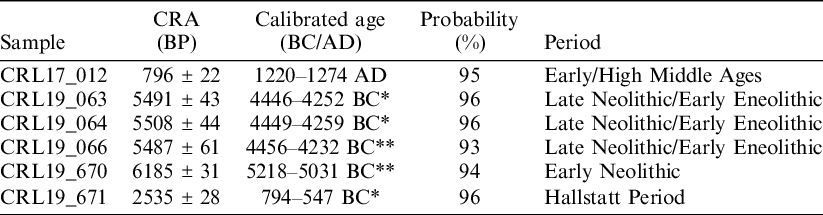
The results are summarized in Table 2. The uncertainties of 14C analysis (CRA) correspond to 68% probability; the probabilities of the calibrated ages are listed.
Results of 14C dating of samples with origin in Neolithic, Eneolithic, Hallstatt Period, and Middle Ages in the Kateřinská Cave (the uncertainties of 14C analysis correspond to 68% probability, the intervals of the calibrated age correspond to the listed probabilities).

* Combined interval.
** Main interval.
The 14C analysis of the graffiti in Kateřinská Cave provided dates (Table 1) that correspond to some periods dated using the ceramics found at the cave entrance. The sample from the Main Dome called “Brain” (CRL 19_670) dates to the Early Neolithic.
Another three samples from the Ice Passage “P”, “L” and the “Nameless Passage” (CRL 19_063, 19_064, 19_066) correspond to the transition between the Late Neolithic and Early Eneolithic. All these specimens are dated older than the graffiti preserved in Býčí Skála Cave dated to the Middle Eneolithic, which had previously been considered as the oldest in the Czech Republic. Observed 14C activities of these three samples are without significant difference. It can be stated, that this group provided very reliable results due to good accordance, despite small carbon quantity which was processed using a graphitization routine. The carbon amount corresponding to the sample CRL19_066 was 120 µg only (Table 1). Such a small sample, which could be suggested for direct CO2 measurement using gas ion source, made it possible to verify the lower limit of the graphitization procedure used in our CRL laboratory on a real sample. The carbon weight of approximately 120 µg obtained from a sample is currently considered by our laboratory to be the minimum needed for the graphitization process.
The sample “Devil” (CRL 19_671) from the Main Dome corresponds to the Hallstatt Period and the sample “Goddess” (CRL 17_012) from the Ice Passage to the transition between the Early and High Middle Ages. These four periods (Early Neolithic, Late Neolithic/Early Eneolithic, Hallstatt and Middle Ages) have been previously identified with pottery found at the cave entrance (Figure 2). This agreement between the dating methods provides important mutual validation and gives the method and the results a high degree of credibility.
The Moravian Karst influenced settlement strategies, which completely changed with the onset of the Neolithic. The first farmers established permanent settlements on fertile loess soils near watercourses, which provided conditions suitable for the development of productive agriculture. Although in the margins of interest, the caves were used repeatedly, most likely as temporary campsites on long-distance roads, temporary residences for prospectors looking for, perhaps, stone raw materials, or as ritual sites. In addition to the utilitarian function, since the Neolithic the rituals associated with the Great Mother, and the caves as a symbol of a mother’s womb, can also be expected. Penetration into the depths of the cave might have been carried out by the light of torches, the remains of which probably served to create the graffiti.
The used wipe sampling of charcoal from the cave drawings allows the controlled preservation of the original contours on the sampled area. The examined drawing can be sampled from two relatively spaced points and the results of the 14C analyses could then be compared to verify the success of decontamination of samples by the acid/alkali/acid procedure. If decontamination is insufficient, it is improbable that both the samples would be affected equally. We can further increase the effectivity of this comparison by repeating or extending the pretreatment of one of these sub-samples. However, the need to provide a sufficient amount of datable material for AMS measurements remains a significant problem, even in future sampling.
CONCLUSION
Given the age of the ceramic finds and taking into account the three results from the Late Neolithic and Early Eneolithic transition (reporting 14C activities without statistically significant differences, thus disturbing influences can be considered unlikely), the wipe sampling together with the subsequent pretreatment procedure seems to provide relevant information.
The graffiti preserved in the deeper parts of Kateřinská Cave in the Moravian Karst were dated to four periods: the Early Neolithic, the Late Neolithic/Early Eneolithic, the Hallstatt Period, and the Early/High Middle Ages. Archaeological research of the entrance to Kateřinská Cave has proved eight periods, four of which correspond to the 14C dates obtained. The discovery of the graffiti proved human activity deep in the cave.
ACKNOWLEDGMENTS
The authors gratefully acknowledge the financial support of the MEYS CR granted to UP in Olomouc (IGA_FF_2021_014), “Společnost v historickém vývoji od pravěku po moderní věk V.–VI.”. This publication was supported by OP RDE, MEYS, under the project “Ultra-trace isotope research in social and environmental studies using accelerator mass spectrometry”, Reg. No. CZ.02.1.01/0.0/0.0/16_019/0000728.