INTRODUCTION
“Traditional” foodways could be defined as food and drink preparation, production, and consumption practices considered to be part of cultural heritage. Producers and state agencies in continental Europe have been particularly active both in seeking heritage status for local foodways through intangible cultural heritage (ICH) inventories or inscriptions on the United Nations Educational, Scientific and Cultural Organization (UNESCO) lists and by registering intellectual property (IP) rights over “traditional” products. The 2003 UNESCO Convention for the Safeguarding of the Intangible Cultural Heritage (CSICH) is an international instrument ratified by nearly 180 states members of UNESCO, including all European Union (EU) member states except the United Kingdom (UK).Footnote 1 It is aimed at safeguarding ICH, defined to include a wide range of cultural practices constantly recreated and transmitted “from generation to generation” within communities and groups, for whom it is part of their heritage and on whom it “confers a sense of identity and continuity.”Footnote 2 Inscription on the CSICH’s international listsFootnote 3 aims to promote safeguarding by recognizing the value of the element to the “communities, groups and individuals” who practice and transmit the heritage, thereby also illustrating the value of the diversity of ICH in general to the world.
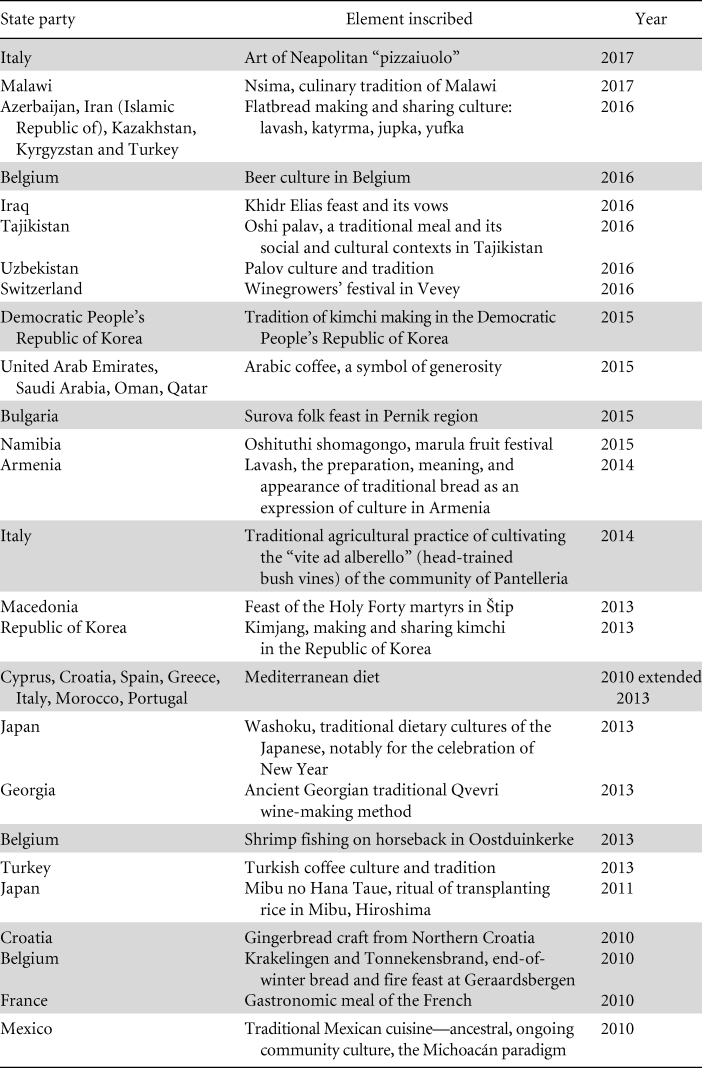
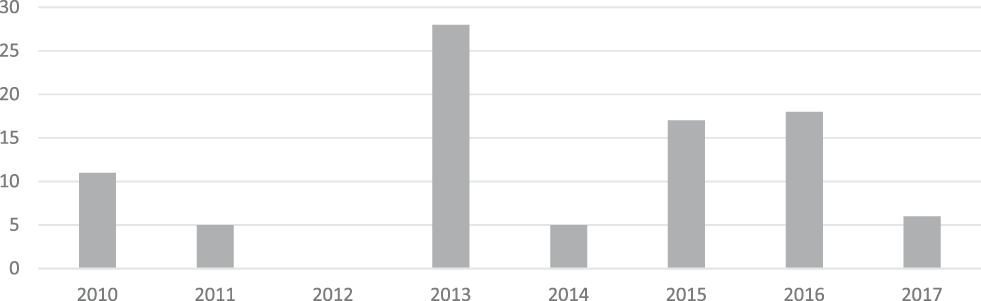
European countries such as France and Italy have played a significant role in the campaign for foodways as such to be considered as ICH under the CSICH.Footnote 4 The domains of ICH identified in the Convention (Article 2.2) do not expressly mention foodways, so there was initially a lack of clarity about whether they would be eligible for inscription on the international lists of the CSICH in their own right (not just as part of a broader festive tradition, for example). The Intergovernmental Committee for the Safeguarding of the Intangible Cultural Heritage (CSICH Committee) now accepts that foodways can be inscribed on the lists of the CSICH as ICH elements. Since 2010, a considerable number of food- and drink-related ICH elements have been inscribed on the Representative List of the Intangible Cultural Heritage of Humanity” (Representative List), which incorporates the Masterpieces of the Oral and Intangible Heritage of Humanity designation (see Table 1).Footnote 5 Such nominations (proposed by the states parties to the CSICH) represented 28 percent of total annual inscriptions in 2013 and 18 percent in 2016 (see Figure 1). Europe currently has the majority of food and drink-related inscriptions on the Representative List (see Table 1).
Inscriptions on the UNESCO Representative List between 2010 and 2017 with food- and drink-related titles (inscriptions from EU member states highlighted)

Food- or drink-related inscriptions (by title) as a percentage of total inscriptions per year on the UNESCO Representative List, 2010–17.

Globally, the EU has also been at the forefront of promoting protection for the product names of wines, spirits, and agricultural products, placing considerable emphasis on promoting “traditional” food production methods in rural areas—for example, through EU Regulation 1151/2012 on Quality Schemes for Agricultural Products and Foodstuffs (Quality Schemes Regulation).Footnote 6 The Quality Schemes Regulation sets up a number of schemes for intellectual property (IP) rights protection of agricultural product designations, including two indications of geographical origin (IGOs)—the Protected Designation of Origin (PDO) and the Protected Geographical Indication (PGI)—and another quality scheme, the Traditional Specialties Guaranteed (TSG) scheme.Footnote 7 These schemes provide IP protection for product names associated with set conditions, such as a link to a geographical origin.
Neapolitan Pizza Making
The case of Neapolitan pizza making provides an interesting case of parallel protection for heritage and IP rights in Europe. A politician from the Neapolitan electoral district in Italy, Alfonso Pecoraro Scanio, tells the story that, while he was minister of agriculture in 2000, he was astonished to hear that US trade officials had asked their Italian counterparts: “How do you say ‘pizza’ in Italian?” Scanio took the view that Italians, and Neapolitans, in particular, were responsible for spreading knowledge about pizza making across the world and should effectively lay claim to their heritage.Footnote 8 However, in the following year, his attempt to place Italian pizza on UNESCO’s Masterpieces of the Oral and Intangible Heritage of Humanity met with opposition. On the one hand, “pizza” did not fit UNESCO’s criteria for the Masterpieces designation because it is a food product rather than a “popular and traditional cultural expression.”Footnote 9 On the other hand, the suggestion that pizza could be “heritage” was opposed both by those who drew a distinction between “high” and “low” culture and by those who challenged the expansion of the concept of “heritage” beyond monuments, natural wonders, and historical objects.Footnote 10
While minister of the environment in 2006–08, Scanio continued his efforts to have pizza listed on what was now known as the Representative List under the CSICH, which incorporated the Masterpieces. He was also involved in having the designation “Pizza Napoletana” registered under the TSG scheme in 2010.Footnote 11 A nomination file for the “traditional art” of the Neapolitan pizzaiuolo languished on the waiting list at UNESCO for several years before being resubmitted in 2015 without the moniker “traditional.”Footnote 12 After a robust public campaign using the hashtag #pizzaUnesco,Footnote 13 and a petition to the Italian National Commission for UNESCO in which Scanio lamented the economic damage caused by “false ‘Made in Italy’ advertising,”Footnote 14 the “art of Neapolitan ‘pizzaiuolo’” was nominated for inclusion on the Representative List in 2015Footnote 15 and inscribed (that is, included) on the list by the CSICH Committee in 2017. One of the “preservation and protection” measures mentioned in the nomination file is the TSG registration.Footnote 16
This article uses the case of Neapolitan pizza making to explore how the TSG scheme and the CSICH relate to each other and how they are being used to promote the economic value of products such as “traditionally made” pizza. In the first section, the article situates the analysis within the literature on safeguarding and the role of IP protection. In the second section, it describes the TSG scheme in the context of the Quality Schemes Regulation and, in the third section, compares it to the CSICH. Finally, the article analyzes the TSG specification for “Pizza Napoletana” alongside the nomination file for “the art of Neapolitan ‘pizzaiuolo’” to explore how the instruments are being used to promote the value of the product.
FOODWAYS, HERITAGE, AND INTELLECTUAL PROPERTY: ANALYTICAL APPROACHES
Much of the academic debate on the role of inscriptions on the lists of the CSICH (or, indeed, “heritagization” in general) and on the role of IP protection in safeguarding has focused on the risks and realities of “misappropriation” of this heritage by the state or powerful commercial actors. This is a significant issue to consider, but the story of pizza making as heritage is more than just the story of the relative power of Scanio, state agencies, and producers. Misappropriation is difficult to assess (who are the “true” stewards of heritage, anyway?) and difficult to address. In developing more finely tuned analyses, looking to solutions to achieve greater equity and benefit to small-scale producers, we could pay more attention to other factors, such as the role of multiple kinds of heritage labeling and IP protection in the economics of “traditional” foodways.Footnote 17
It is true that, in many cases, inscription on the lists of the CSICH, as on the World Heritage List, is linked to state tourism policy and cultural diplomacy or soft power strategies.Footnote 18 These are often thinly disguised claims of ownership. Turkey and Armenia, for example, have clashed over their separate claims to keşkek (harissa, a ritual meal made of minced meat and crushed wheat), dolma (tolma, stuffed vine leaves), and lavash (a flatbread widely eaten in the region) as national dishes.Footnote 19 The trend toward “gastronationalism” has received considerable attention from researchers,Footnote 20 along with broader interest in the role of commercial enterprises and civil society actors in “heritage entrepreneurship.”Footnote 21 The “Mediterranean diet” nomination, for example, was promoted by national agriculture ministries to promote the interests of the commercial olive oil industry.Footnote 22 Richard Pfeilstetter argues that ICH inscriptions such as the Mediterranean diet provide opportunities not for the democratization of elite heritage but, instead, for synergistic appropriation thereof by political, economic, and academic elites: “[a] complementary relationship between ethnic identity discourse (exploited politically), the nutritional–environmental discourse (exploited economically) and the heritage discourse (exploited academically).”Footnote 23 This kind of appropriation may threaten community stewardship over their foodways and hamper continued practice and transmission.Footnote 24
The CSICH does not confer any new rights on communities with respect to their ICH or, indeed, on other parties.Footnote 25 Nevertheless, the CSICH’s operational directives suggest that IP rights can support communities in asserting their rights as the stewards of their heritage (thus avoiding “misappropriation” and “misrepresentation”).Footnote 26 The idea is that this can benefit communities and encourage them to practice and transmit their ICH in the future if problems (to be defined by practitioners) including “over-commercialization” or “commodification” can be avoided.Footnote 27 This is one of the ways in which ICH safeguarding can (supposedly) contribute to sustainable development.Footnote 28 Yet there has been little detailed discussion within the ambit of the CSICH to date about the relationship between IP rights protection and safeguarding and how it can benefit practitioners of ICH. This is a pity because many ICH nominations to the international lists of the CSICH—from Europe and elsewhere—have IP protections registered for associated practices and products.Footnote 29
Academic analysis of the relationship between ICH safeguarding and IP protection in general suggests that, while IP protection could have positive benefits,Footnote 30 there may also be conflicts between the aims of these different kinds of legal instruments and their implementation in specific cases. “Heritage” and “community” are socially and politically constructed ideas that are determined by negotiation and affected by the balance of power and interests among stakeholders. Thus, representations of the same ICH element could differ depending on the legal or regulatory context. Miranda Forsyth has shown how, in the case of Samoan tattooing, the practitioner communities can be framed differently too: rather narrowly (as tattoo artists) under sui generis legislation protecting IP rights over “traditional knowledge” and rather broadly (as tattoo artists and local community members who have tattoos) under the CSICH. This can cause conflict over who makes decisions and who benefits from the protection of the same ICH element.Footnote 31
In understanding how IP protection could contribute to the safeguarding of foodways as heritage, much of the analytical attention has focused on IGOs because maintaining links to geographical location provides a kind of proxy for maintaining links with local communities, an important part of safeguarding under the CSICH. The use of IGOs presents both opportunities and challenges. Involving local communities (including smaller producers) in drafting specifications for IGOs can emphasize “collective investment in processes, intergenerational knowledge transmission and historic associations with regions.”Footnote 32 Where this is not done, IGO registration can be part of what Cristina Grasseni calls the construction of “commodity-heritage” artifacts.Footnote 33 It can entrench inequalities and favor the interests of state agencies who control enforcement and large producers who control IGO specifications.Footnote 34
Registering IGOs without taking account of the needs of local producers could also restrict innovation.Footnote 35 IGO specifications can over-standardize “traditional” practices, restrict normal variation and change, and thereby exclude some producers, who used to make the product, from continuing to use the name.Footnote 36 In the case of Serrano cheeses in Brazil, for example, local producers were not involved in drafting the IGO specification, resulting in inappropriate standardization of production methods and in local producers being sidelined.Footnote 37 In the case of Chevrotin cheese, the standardization of production through the IGO specification forced some producers in the French Alps to change their working methods or stop using the name.Footnote 38 Thus, in considering the safeguarding benefits of registering IGOs, it is very important to consider how specifications are drafted and how this impacts producers.
This article suggests that in analyzing the role of IP protection in relation to ICH practice and transmission, it may be useful to consider products generated from ICH practice as credence goods. “Traditional” foods, for example, could be classed as “credence goods”; the way in which they are made, or their ingredients, give them value. Credence goods are “goods for which the buyer’s decision making is dominated by concerns about credence characteristics and thus about the seller’s credentials.”Footnote 39 It is difficult for consumers, even after the consumption of the goods, to determine whether these “credence attributes” are present or not, without incurring high costs. Therefore, credence attributes can be effectively signaled by controlling the use of a specific designation, or name, for the goods.
Stefano Pascucci argues that the relationship of trust, shared values, and cooperation between producers and consumers (what he calls “food community networks”) has been an important contributor to the growth of markets in credence goods.Footnote 40 This is consistent with the finding by Robert Kreuzbauer and Joshua Keller that consumer determination of “authenticity” in regard to cultural products depends not just on the identification of rules (that is, the recipe and method for “traditional” pizza making) but also the agency control of the producer (that is, whether the pizza maker is sufficiently experienced to follow the “traditional” method?) and their intention (that is, whether they are making the pizza according to that tradition in this instance?).Footnote 41 Further research is needed to determine whether the particular cultural economics driving the establishment of “traditional” or “heritage” status for credence goods such as specialty food products would also encourage a focus on the relationship between producers, products, and places in specifications or nominations.
Exploring the concept of credence value and its connection to ideas of “authenticity” could assist in a critical interpretation of the CSICH. Under the Convention, the use of the term “authenticity” has been discouraged to avoid the problem of external experts imposing their own views of ICH practice on communities who practice it. Nevertheless, the idea of community-defined authenticity remains very central to the validation of ICH as heritage under the Convention. “Communities concerned” are supposed to indicate in the description of the element what the essential features of the traditional practice are. This may suggest what aspects will be maintained over time and what may be allowed to change.Footnote 42 The maintenance of a connection with this community of practice is an essential feature of the idea of ICH safeguarding under the Convention.
THE TSG SCHEME AND ITS PLACE WITHIN THE QUALITY SCHEMES REGULATION
Although academic understanding of the interface between IP rights protection and cultural heritage safeguarding is growing,Footnote 43 there has been little research on the TSG scheme.Footnote 44 This is curious because the TSG scheme specifically aims “to safeguard traditional methods of production and recipes”Footnote 45 transmitted “between generations.”Footnote 46 What role could the TSG scheme play in helping small-scale producers sustain “traditional” foodways?
Like IGOs and collective trademarks, the TSG scheme awards a “collective exclusive right to use a registered trade sign”—in this case, the name of a food or drink product so, for the purposes of this article, we will treat it as a form of IP protection.Footnote 47 Although the TSG scheme differs from the PDO and PGI schemes, the economic mechanism by which it is supposed to benefit producers is similar. The idea is that “traditional methods of [food or drink] production and recipes” will be safeguarded because TSG designations (“traditional” names for foodstuffs of “special” or “traditional” character)Footnote 48 will communicate to consumers the “value-adding attributes” arising out of the specified method of production.Footnote 49 Consumers will not be confused by misleading labels on mass-produced products,Footnote 50 therefore reducing unfair competitionFootnote 51 or “passing off.”Footnote 52 “Traditionally” made food products will be distinguished from other goods, so they can fetch higher prices and support the associated food preparation processes.Footnote 53 Producers, especially small-scale rural producers, can then be “rewarded fairly” (that is, charge more) for their products.Footnote 54
The TSG scheme sits rather uncomfortably within the Quality Schemes Regulation partly because, unlike the PDO and PGI designations, the TSG designation is not, strictly speaking, an indicator of geographical origin. The monopoly conferred over the use of the TSG designation is linked to a “traditional” method of production or recipe that is outlined in the specification.Footnote 55 Registering a TSG requires documenting the specification of its method of production or recipe, the “specific character” (what makes the product distinctive from others in the same category), and its “traditional character.”Footnote 56 “Traditional character” is not defined, but Article 3 of the Quality Schemes Regulation defines “traditional” as “proven usage on the domestic market for a period that allows transmission between generations; this period is to be at least 30 years.”
An explanation for the existence of the TSG category within the Quality Schemes Regulation may be found in an agreement on the protection of the designations for cheese that was signed in Stresa in 1951.Footnote 57 States parties to the agreement were Austria, France, Italy, the Netherlands, and Switzerland.Footnote 58 The Stresa Convention distinguished between names for cheeses that were restricted to those made in certain geographical areas (such as Roquefort and Pecorino)Footnote 59 and those names that were considered semi-generic and could therefore be manufactured and marketed anywhere as long as they were made according to specific criteria (such as Camembert and Provolone).Footnote 60 The Certificate of Special Character (CSC) scheme, which was the predecessor of the TSG scheme, effectively “imported” Article 4 of the Stresa Convention into the Quality Schemes Regulation.Footnote 61 This accommodated semi-generic designations that were not closely linked to a place.
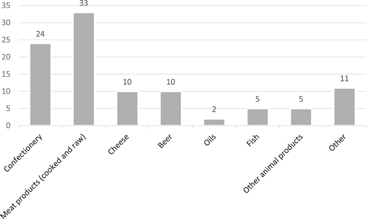
To date (June 2018), only 58 registrations have been made under the TSG scheme; most producers choose to register designations under the PGI scheme (737 registrations) or the PDO scheme (634 registrations).Footnote 62 For example, “Camembert de Normandie” was registered as a PDO rather than “Camembert” as a TSG.Footnote 63 The relative unpopularity of the TSG scheme has inspired suggestions that it be dropped from the Quality Schemes Regulation altogether,Footnote 64 but it continues to attract some interest from producers. The Database of Origin and Registration shows that TSGs are generally used for food products that do not have a specific geographical connection and products whose designations cannot be registered under the PDO and PGI schemes for other reasons.Footnote 65 TSG registrations are dominated by meat products (cooked, smoked, and so on) and confectionery, followed by cheese and beer (see Figure 2).
TSG registrations in the Database of Origin and Registration, by product type (% of total), June 2018 (n = 58).

The limited use of the scheme is linked to the fact that protection offered by TSG registration is weaker than that for PDOs and PGIs; this weakness has both legal and economic dimensions.Footnote 66 First, Article 24 of the Quality Schemes Regulation protects registered PDO, PGI, and TSG designations against “any misuse, imitation or evocation, or against any other practice liable to mislead the consumer.” PGO and PGI designations, however, enjoy additional protection under Article 24—that is, protection against “any direct or indirect commercial use of a registered name in respect of products not covered by the registration.”Footnote 67 The lack of such a provision for TSGs means that protection of the name is limited to its use for the product for which the recipe is registered. Rights established under the TSG scheme are also considered subordinate to other IP rights, including those established under the PDO and PGI schemes.Footnote 68 In this regard, it should be noted that there may be difficulties enforcing all of these rights. Benedetta Ubertazzi points out that the existing patchwork of legal protection for IGOs does not currently enable easy enforcement of rights in cases of transnational misappropriation, even where bilateral or multilateral treaties are in place between states.Footnote 69
Second, although the TSG scheme allows the registration of generic or semi-generic designations, it gives them little effective protection.Footnote 70 The Quality Schemes Regulation defines “generic terms” as “the names of products which, although relating to the place, region or country where the product was originally produced or marketed, have become the common name of a product in the Union.”Footnote 71 “Generic” product names such as “Pizza Napoletana” or “Boerenkaas” (farmer’s cheese) are thus not registrable as PDOs or PGIs but only as TSGs. Article 13(2) of the Regulation protects PDO and PGI designations against becoming generic,Footnote 72 but it does not offer such protection to TSGs, perhaps because they are considered generic or semi-generic already. Determining whether a TSG designation is “generic” or not matters because the Regulation does “not affect the use of terms that are generic in the [European] Union.”Footnote 73 This means that where designations registered as (part of) a TSG are considered generic, their use is not controlled by the Regulation; only producers using the TSG name and logo alongside the generic name are required to follow the specification.
Under the two predecessors to the Quality Schemes Regulation (and the prior CSC scheme),Footnote 74 there was a choice of two-tier protection: TSG designations could be protected either as a stand-alone term (for example, as “Boerenkaas”) or “without reservation of the name”—that is, designations were only protected where accompanied by the TSG label (for example, as “Boerenkaas TSG”). This latter approach was chosen in cases where designations were in widespread use elsewhere as generic terms for products, such as for “Neapolitan pizza.” This two-tier system was ostensibly removed under the Regulation, but it is effectively retained through the provisions in Article 41. Also, where an opposition to a TSG registration shows that the submitted name “is also used in another Member State or in a third country,” for example, the Commission may require that the name of the TSG is to be “accompanied by the claim “made following the tradition of” immediately followed by the name of a country or a region thereof.”Footnote 75 This makes the process of TSG registration very vulnerable to opposition (that is, it can be objected to) since many designations are generic.Footnote 76
Finally, the TSG scheme offers producers no geographical limitation on potential competitors. It is true that the link between location and IGO registration has weakened in recent years, and PGI registration requires only part of the process of production to happen in the place of origin,Footnote 77 but the registration and use of a TSG requires no link at all to a specific place of production of the product. In drafting the TSG specification, producers have to reveal the way in which it has been “traditionally” made; the use of the designation is then available to anyone who follows the specification. Thus, by registering a TSG, producers face the prospect of attracting an unlimited number of competitors from any region and making the production method available to be used by them.Footnote 78 Registering a PDO or PGI does not require producers to reveal the production method in such detail, and the geographical scope necessarily limits competitors.
This does not make the TSG scheme very attractive to large commercial producers, which may prefer other mechanisms for IP protection (such as collective trademarks) even though they are more costly. Andrea Tosato points out that, while the registration of TSGs can help producers to differentiate their products from others, it will not necessarily benefit small-scale local producers either. In fact, he argues that the registration of a TSG may encourage “delocalisation of the production of TSG products” as producers of any kind based in any location can use the “traditional” registered name as long as they use a specific recipe given in the specification.Footnote 79 Publication of this recipe, he argues, can discourage innovation and diversification, hampering creativity among producers, which is an important part of the safeguarding process under the CSICH.Footnote 80 In the case of the “Birmingham Balti” TSG application from the UK, producers argued that specifying a single recipe for the Balti sauce did not reflect diversity among producers, would reveal their trade secrets, and would prevent innovation. The application was refused by the European Commission because the producers did not provide a recipe.Footnote 81 The problem of over-standardization, already identified as a danger in IGO specifications, is particularly acute in the case of TSGs because it is the recipe, rather than the origin of ingredients or the locus of production, that creates standards against which compliance can be assessed.
To understand the parallel use of the TSG scheme and ICH nominations, it is helpful to compare it with the CSICH and its system of listing.
COMPARING THE TSG SCHEME AND THE CSICH
The TSG scheme and the CSICH both aim to support safeguarding of “traditional” practices and, specifically, in the case of the TSG, methods of food production. However, the two instruments define safeguarding in slightly different ways and have divergent legal effects. In this section, we briefly outline those similarities and differences.
Safeguarding Foodways
The CSICH recognizes “the importance of the intangible cultural heritage as a mainspring of cultural diversity and a guarantee of sustainable development” and aims to safeguard it.Footnote 82 The aims of the Quality Schemes Regulation are similar, focusing on preserving “traditional” methods of production as part of the EU’s “living cultural and gastronomic heritage.”Footnote 83 Established within the framework of the EU’s Common Agricultural Policy, the Regulation aims to protect “the diversity of the agricultural production in the Union” that gives “a competitive advantage to the Union’s producers and [makes] a major contribution to its living cultural and gastronomic heritage.”Footnote 84 Nevertheless, the two instruments take a slightly different approach to safeguarding. The CSICH defines safeguarding as maintaining continued practice and transmission of ICH, placing specific emphasis on maintaining its meaning and value within the communities and groups who consider it part of their cultural identity.Footnote 85 One of the ways in which the CSICH seeks to promote safeguarding is through inventorying or listing of “ICH elements,” involving communities.Footnote 86 This process is intended to raise awareness about what is to be protected and why and to help develop appropriate actions to be taken.
What safeguarding means under the Quality Schemes Regulation, and specifically in respect to the TSG, is somewhat different. The TSG scheme may promote a method of production that meets the specification but not necessarily its continued practice and transmission by any specific group or, in fact, any creative changes over time. The TSG will only protect the use of (product) names and not know-how or methods of production as such; recipes are revealed in the specification and available for use by anyone. Thus, it is conceivable that a food production method (and name) alienated from those producer or consumer groups that have always used it, and deployed in a factory completely outside of the original context, might be seen as “safeguarded” under the TSG scheme but not under the CSICH.
Legal and Economic Effects
The registration of designations under the TSG scheme and inscription on the lists of the CSICH have different legal effects. The CSICH does not confer any new rights on communities with respect to their ICH,Footnote 87 nor does it limit the practice of the ICH. In contrast, the Quality Schemes Regulation gives legal protection over registered TSG designations, although, as we have seen above, this protection is limited, especially with respect to generic names. Like TSG designations, many of the names used for ICH foodways (such as lavash, for a flatbread)Footnote 88 inscribed on the lists of the CSICH would be considered generic or semi-generic (see Table 1). The CSICH permits ICH elements from different locations or countries to be inscribed with the same or a similar name on its international lists. The CSICH’s operational directives (ODs) encourage multinational nominations because much ICH is practiced across national borders,Footnote 89 although, of course, where states wish to make nationalistic claims to food heritage, they do not make use of this mechanism.Footnote 90 Thus, in a number of cases, the same ICH element, such as the making of lavash, is nominated by different states and separately inscribed on the Lists of the CSICH (see Table 1).
The protection of IP rights in regard to generic names such as “Pizza Napoletana” under the TSG scheme is thus weak, and the inscription of such elements on the lists of the CSICH provides no legal protection at all. Nevertheless, both TSG registrations and UNESCO inscriptions may enhance the credence value of products simply by labeling certain kinds of production methods as “traditional” and providing a narrative of “authentic” origin. Fabio Parasecoli notes that, while IP protection of food names does help some producers in the EU achieve higher prices for “traditional” food products, other approaches can also achieve the same economic ends.Footnote 91 For example, the association of products with networks such as organic farmers’ markets, fair trade, and “slow food” labeling systemsFootnote 92 reduces the costs to consumers of determining credence attributes.Footnote 93
Labeling and quality schemes administered by trusted agencies (such as the EU or UNESCO) could thus be used to establish the nature of specific credence attributes as signals of “authenticity,” even where the law cannot be used to prevent the use of product designations where these credence attributes are not present (for example, for products such as frozen pizza made in a factory). There are in fact some restrictions on the use of the UNESCO ICH emblem because of concerns about over-commercialization,Footnote 94 so products produced using a method described in an ICH inscription cannot necessarily be marketed using that emblem; nevertheless, the product marketing could refer to the inscription. Within the EU, the promotion of the PDO, PGI, and TSG labels themselves within the EU has also recently become an area of focus,Footnote 95 although TSG as a logo is still much less well known than the UNESCO logos. The UNESCO “brand” itself is considered of high status.Footnote 96
In conclusion, the TSG scheme and the CSICH have different legal effects, but neither TSG registration nor ICH inscription can prevent widespread use of recipes or generic names of “traditional” foodways. Both may nevertheless help to raise the value of “traditional” food products in the eyes of consumers by providing trusted signposts about what credence attributes matter, for example, by identifying the importance of making Neapolitan pizza by hand.
The Process of Registration and Inscription
The state is involved in the process of TSG registration or ICH inscription, and (in the case of the Quality Schemes Regulation) the enforcement of rights, alongside producer groups. Under the CSICH, the state makes nominations to the ICH lists, through the UNESCO Secretariat, to the CSICH Committee and its Evaluation Body.Footnote 97 Under the Regulation, the state also plays a significant role in applications for registration and in their enforcement post-registration.Footnote 98 After registration at the national level, it is approved by the European Commission.Footnote 99 The Regulation allows for the registration of designations from non-EU countries as well as those within the EU as long as they have a national system of protection.Footnote 100 Products using the designation have to be certified by an independent product conformity certification body in the country of first registration. If a producer in another part of the world wishes to obtain certification, this can be done by a local organization approved by their state.Footnote 101 In EU states that promote the Regulation, such as Italy or France, state agencies and non-governmental organizations advise producers on the drafting of specifications.Footnote 102
According to the CSICH, ICH nominations have to be drafted with the involvement and consent of communities concerned—that is, with “traditional” food producers and consumers in the case in question.Footnote 103 Of course, this requirement has limited effect in practice as applicants (state agencies) choose who to consult and whose consent to obtain,Footnote 104 but states are constrained somewhat by public opinion (communities can write letters of complaint to the CSICH Committee via UNESCO). There is no independent review by the CSICH Committee of claims made by states that they have adequately identified and involved the relevant “communities.”Footnote 105
Producer groups are frequently involved in drafting specifications under the Quality Schemes Regulation because they can provide information about the production methods required.Footnote 106 The drafting of the specification can help to address real and perceived threats to producers in the commercial environment and, thus, benefit them.Footnote 107 As we have discussed above, where state, and large commercial enterprises, control the drafting of specifications, this may marginalize and/or disadvantage traditional producer groups.Footnote 108 However, much depends on how the specifications are actually drafted. To explore the use of the Regulation and the CSICH in the “pizza” case, we will now compare the TSG specification for Pizza Napoletana and the ICH nomination file for the art of Neapolitan pizza making.
COMPARING THE TSG SPECIFICATION AND THE ICH NOMINATION FILE
Art and Product
The requirements for the registration of TSGs,Footnote 109 and the inscription of ICH elements,Footnote 110 on the international lists differ; the latter following the criteria set out in the ODs.Footnote 111 As Chiara Bortolotto explains, the original Masterpieces proposal in 2001 was for the “pizza” product; this was amended to focus on the “art” of making pizza because of the focus on protecting cultural practices under both the Masterpieces criteria and the CSICH itself.Footnote 112 The first thing that strikes a reader comparing the ICH nomination form for “the art of Neapolitan ‘pizzaiuolo’” and the TSG specification for “Pizza Napoletana” is this very difference in the representation of what is being protected. In the former, the abilities (“art”) of specific pizzaiuoli are the focus of protection, whereas, in the latter, the focus is on the product itself and on what constitutes that product (ingredients and method).
The pizzaiuolo nomination file describes four different phases of making the pizza, focusing on the making, shaping, topping, and baking of the dough by the pizzaiuoli and bakers; the “Pizza Napoletana” TSG specification includes not only this information about process but also has much more detailed guidelines on the composition of the dough and the topping. The ICH nomination pays much greater attention to the cultural practices (such as songs or engagement with consumers) that accompany production.
Nevertheless, the ICH nomination and TSG specification both manage to emphasize the importance of the pizza chef who plays a present and active role in production. The way in which the method of making pizza is described in both documents emphasizes the need for expert production and handling of the dough, before baking in a wood-fired oven at the site of production. This affirms the link between the producer and the (handmade) product. It favors freshly made pizza over frozen pizza and signals to consumers that restaurants where they can see the pizza chefs making and tossing the dough offer a product of higher credence value.
If adequately promoted, both an ICH inscription and TSG designation for pizza making could thus help to establish the credence attributes associated with “traditional” pizza making and boost the status and earnings of pizzaiuoli who adopt this “traditional” way of making pizza. Much depends, however, on who is considered an expert and on what basis, and how much creative leeway, they are considered to have in performing their art.
Experts from Naples
The ICH nomination form asks about the geographical scope of the ICH element because specific communities need to be identified and involved in safeguarding.Footnote 113 ICH elements are frequently linked to geographical locations in the name of the element used in the nomination (see Table 1). The delineation of the “community” is usually linked to a specific geographical area in the nomination file, but the file may also mention whether the element is present elsewhere (practiced in a diaspora community, for example).
While references to geography in PDO or PGI specifications also help to make a link to a traditional producer or consumer community,Footnote 114 a geographical link is not required in the TSG specification and would have no legal effect. Nevertheless, TSG designations (both in the designations chosen and the historical evidence provided in specifications) often refer to specific geographical areas, as evidenced in the Database of Origin and Registration.Footnote 115 This could symbolically evoke the strength of PDO or PGI protection by suggesting that there is a place of “authentic” origin. The TSG specification also asks for details of the “applicant group,” which is considered to comprise the producers under the Quality Schemes Regulation. Recital 57 of the Regulation specifically notes the importance of involving producer groups in making applications and enforcing rights in TSGs. Locating producer groups in specific places (such as Naples) can also help to create a narrative geographical association for a TSG.
The TSG specification and ICH nomination both make reference to people who are experts in the art of pizza making (referred to respectively as “pizzaioli” in the Italian for the TSG specification and as “pizzaiuoli” in the Neapolitan dialect for the ICH nomination). There are no specific rights given to these experts, even under the TSG scheme, of course, but they are given status and credibility as artisans and “traditional producers” through the nomination and specification document. Antonio Mattozzi suggests that acquiring TSG status has improved the professional standing of the pizzaioli, who were often confused with wine shopkeepers or bakers and not organized into guilds like other artisans in the nineteenth century and whose product was long considered a simple food of the poor.Footnote 116 The ICH nomination could perform a similar function, with minor variations in emphasis.
The ICH nomination claims that the knowledge of the art is held by about 3,000 pizzaiuoli “who live and perform in Naples” and who are members of an association such as “the Association of Neapolitan Pizzaiuolo [sic], the most representative and the focal association of the bearers of this art.”Footnote 117 Registration of the name as a TSG cannot limit the practice to a specific group of chefs, but the “specific character” of the product in the specification is narratively linked to the “the skill and experience of the artisan.”Footnote 118 Also, in the section on “traditional character,” the specification refers to an earlier 1984 specification drawn up by the “pizzaioli Napoletani” (pizza chefs of Naples), “signed by the whole profession,” and witnessed by a notary from Naples as evidence of the stability of the recipe over time.Footnote 119
While the ICH nomination acknowledges the expertise of apprentices and bakers as well as “every family in Naples reproducing the art in its own home,” who are “considered as bearer[s] of the element,” in the TSG specification, no reference is made to Neapolitan families, the apprenticeship system, or to a separate group of bakers. The baking is considered the work of the pizzaioli in the TSG specification, in contrast to the ICH nomination, where the pizzaiuolo seems to pass the task to a separate baking expert who also operates the oven.
The ICH nomination and the TSG specification both acknowledge pizzaiuoli elsewhere in the world, while retaining the idea that the “authentic” home of the foodway is in Naples. While Naples is considered the center of the community of ICH practitioners, the role and expertise of pizzaiuoli “outside Naples” is also acknowledged.Footnote 120 Given the importance of diaspora communities in many ICH foodways such as these, and, specifically, in the case of pizza, which has become popular around the world,Footnote 121 it is entirely appropriate—from an ICH safeguarding perspective—to strike such a balance between respect for generational knowledge within a specific group and its sharing with others. The TSG specification does not refer to a diaspora of chefs out of Naples, as the ICH nomination does, but, rather, to the diaspora of pizzerias. It suggests that the name “pizzeria Napoletana,” or, indeed, a term like “Pizza Napoletana,” evokes the “link with Naples, where for more than 300 years this product has retained its authenticity.”Footnote 122 The TSG specification thus narratively re-localizes the name “Pizza Napoletana” in Naples, even as registration makes the use of the designation legally available to all who follow the recipe.
Thus, while the TSG specification gives no monopoly rights over the designation to producers from Naples, it firmly suggests—most prominently but not exclusively through the name “Pizza Napoletana” itself—that those Neapolitan pizza chefs and their methods are the “authentic” source and heart of the recipe. The ICH nomination also links the locus of expertise and stewardship over the heritage very clearly to Naples and again includes “Neapolitan” in the name of the element.
Creativity and Continuity
As already indicated, TSG specifications require statements of “specific character” (physical properties) and “traditional character” of the product.Footnote 123 Establishing the product’s traditional character” involves providing evidence of the historical depth of the tradition, but the level of detail required is minimal; every aspect of the proposed specification does not seem to require a historical precedent. In comparison, ICH nominations do not require specific information about the antiquity or “authenticity” of the element. The CSICH Committee has advised that “the description of the element should not focus on historical aspects, but rather on an element’s current social functions and their actual meanings for the communities concerned” and not some external judgment of value.Footnote 124 However, historical information is often included to make the link between the ICH elements and the communities that are identified in the file and frequently are used to justify claims to stewardship over ICH elements.Footnote 125 This may be an attempt to establish the bona fides of the link between the nominating state, the communities or groups concerned, and the element.
The pizzaiuolo nomination file acknowledges changes in the practice over time—the art “kept up with the times”Footnote 126—whereas the “Pizza Napoletana” TSG specification emphasizes continuity and stability in the product composition over time. In the ICH nomination, basil, tomato, and mozzarella are mentioned briefly as options used in the topping;Footnote 127 their quantities or specific properties are not specified. Greater attention is paid to the way in which pizzaiuoli place topping ingredients on the pizza than to the ingredients themselves in describing the element.Footnote 128 The TSG specification refers to a product specification from 1984, mentioned above.Footnote 129 It lists specific amounts of each ingredient and prescribes the use of certain kinds of ingredients for each topping. This kind of requirement could benefit a specific geographical region, if ingredients that are usually or only made in that region, such as TSG mozzarella, are specified. Germany objected to the requirement that only a type of flour produced in Italy could be used in the draft specification, so this was removed.Footnote 130
The CSICH explicitly acknowledges that some forms of ICH practice change substantially over time as they are adapted to current contexts.Footnote 131 The CSICH thus requires regular updating of ICH inventoriesFootnote 132 and regular reporting on inscribed elements,Footnote 133 although it has no specific procedure to update nomination files with this information. In contrast, the TSG specification has to give a specific recipe or method for making the product. The TSG scheme depends on the recipe given in the specification remaining the same over time, because it is used to determine which producers are allowed to use the designation. It performs a regulatory function that the ICH inscription does not. Any “essential” change to the TSG recipe would be regarded as a non-minor change under Article 53 and would trigger a reapplication.Footnote 134
As a nod to flexibility, the “Pizza Napoletana” TSG specification gives three possible sets of ingredients for the pizza toppings in three exact recipes. Conventionally, these variations might be described as Pizza Marinara, Pizza Margherita, and Pizza Napoletana, but the terms “Pizza Marinara” and “Pizza Margherita” are not used in the specification. Instead, these types of pizza are subsumed under “Pizza Napoletana.” Thus, the TSG specification represents an artificially exact recipe as the norm and collapses several different types of pizza into one. The TSG specification does not reflect the names normally used by pizza chefs, nor does it express the range of creativity among pizza chefs—toppings are a source of considerable variation.Footnote 135 No such exactitude is required in the ICH nomination form, where no recipes have to be given and where changes in toppings for the pizza are expected at every turn.
Infringement, however, is unlikely to result in any legal action. The use of “Pizza Napoletana,” a rather generic designation, cannot be controlled very tightly, even in Italy where the enforcement agency would act most strongly against misuse. Perhaps as an acknowledgment of the widespread generic use of the term, the “Pizza Napoletana” TSG was originally registered without reservation of the name, which allowed registered names to continue to be used on products not complying with the specification provided that there was no reference to “TSG” on the label.Footnote 136 Thus, it is hard to see how pizzaiuoli in Naples making their “Pizza Napoletana” in a different way could be censured. Even if frozen pizzas were being sold as “Pizza Napoletana” or Neapolitan pizza, enforcement might be difficult unless they call it “Pizza Napoletana TSG.” Even now, the TSG specification only refers to the Italian version of the name, and not its translations, although it is protected against evocation under Article 24 of the Quality Schemes Regulation.Footnote 137
The above analysis of the nomination and specification files in the “pizza” case suggests that the CSICH and the Quality Schemes Regulation are being used in similar ways, both slightly at a tangent to the stated aims of the instrument. For example, the historical and geographical evidence provided for registration and inscription goes beyond the requirements of each form, linking products, producers, and place of origin even where (most evidently, in the case of the TSG) this is not required.Footnote 138 Nevertheless, there are differences. The collapsing of Pizza Marinara and Pizza Margherita varieties into the Pizza Napoletana recipe is inconsistent with history and current practice and differs from the approach taken in the nomination file. The decision to draft the specification in this way is curious because registration of the TSG in any case provides very little effective IP protection for the registered designation. It also reduces the credibility of the other claims made in the file—that is, that it describes “traditional” pizza making.
CONCLUSION
This article has analyzed the parallel protection of “Pizza Napoletana” as a TSG under the Quality Schemes Regulation of the EU and of “the art of Neapolitan ‘pizzaiuolo,’” inscribed on the Representative List of the CSICH. This can be understood as part of a broader trend toward parallel protection of foodways under heritage and IP law in Europe and increasingly also elsewhere. The CSICH and the TSG scheme identify “traditional” foodways as different kinds of cultural property: as social practices and as methods of production, respectively. The former aims to safeguard ICH by encouraging the continuity of practice and transmission (including innovation) within producer or consumer groups who consider it part of their cultural heritage. The latter aims to safeguard a “traditional” method of production by protecting the use of (product) names relating to specific recipes, but it does not link safeguarding to the continued use of the recipe in the original context. The CSICH and the TSG scheme thus have similar stated aims but different understandings of what constitutes safeguarding and different mechanisms and effects.
The article uses the “pizza” case to examine the similarities and differences between the two instruments and how they are being used. It is an attempt to move beyond an analytical focus in much of the current literature on the nature and extent of “misappropriation” of cultural practices by the state or commercial interests. In the “pizza” case, state agencies (and the politician Alfonso Pecoraro Scanio, in particular) certainly played a major role in the TSG registration and UNESCO inscription, but the pizzaiuoli, apprentices, and bakers of Naples (and beyond) were also involved in the process as “heritage entrepreneurs” and may benefit from it. Misappropriation is a useful way of representing the unequal nature of contestation over who defines and controls heritage, but it provides a rather blunt analytical tool for exploring the real-world use of instruments for its “safeguarding,” and identifying solutions in which there can be multiple beneficiaries.
The CSICH and the Quality Schemes Regulation do not offer much in the way of legally enforceable IP protections. No IP protection is given to ICH elements inscribed on the lists of the CSICH. Under the TSG scheme, registered designations do enjoy some legal protection against misuse, but the protection afforded to generic designations such as “Pizza Napoletana” under the TSG scheme is relatively weak. It is difficult and expensive to enforce these rights in cases of transboundary misappropriation, which will be legion in this case.
What may be of greater importance to producers is the association with the EU (TSG) and UNESCO brands. This analysis suggests that the use of the CSICH and the TSG scheme could benefit pizza makers primarily by providing institutional (UNESCO and EU) validation for the idea that pizza hand made in a certain way by experts from Naples is “traditional.” This could help Neapolitans (and perhaps Italians in general) reassert symbolic stewardship over the practice. It could also elevate the credence value of “traditional” products or practices, justify higher prices, and limit competitors. This article suggests that these kinds of branding considerations may motivate the preparation of nomination files and specifications, although they are not stated aims or mechanisms of the CSICH and the Quality Schemes Regulation. In fact, the CSICH does not mention “authenticity” as a criterion in ICH safeguarding, and the Regulation focuses very clearly on IP rights protection as the main vehicle for achieving economic gains.
In support of this thesis, the article demonstrates that the ICH nomination and TSG specification forms have been used to link product, place, and people in a surprisingly similar way, in spite of the different aims and requirements of the two instruments. Both forms emphasize the way in which pizzaiuoli in Naples (and bakers) make the product by hand using fresh dough and a wood-fired oven. The TSG application form asks more questions about history (to establish the notion of “traditional character’) than about geography (because a TSG is not supposed to be limited to a locus of production). Nevertheless, the explanation of “traditional character” and the chosen designation “Pizza Napoletana” are used to locate the history of pizza making firmly in the area of Naples. The ICH nomination form asks more questions about geography (where the community concerned is located) than about history (avoiding questions about the antiquity of a changing practice). However, the file emphasizes the importance of the history of pizza making in Naples.
One of the main points of difference between the two forms is the requirement for a fixed recipe on the TSG specification form. Fixing a recipe can prevent innovation in foodways. It could also harm local producers by revealing trade secrets or de-localizing production, allowing anyone to access and use the recipe as well as the designation.Footnote 139 In the case of pizza making, the recipe is already widely known and has been heavily edited in its journey around the world, and there is no need for secrecy. The Pizza Napoletana TSG specification names three restricted options for toppings that do not reflect common usage or the representation of toppings as a point of creative choice in the ICH nomination. There is no reason why the specification could not have been written in a different way, representing only the toppings normally attributed to Pizza Napoletana, and broadening the scope has provided little additional protection. In fact, the way in which the current specification has been drafted may reduce the credibility of the TSG registration and its ability to set the credence attributes of the product.
More comparative research needs to be done on the instruments for heritage safeguarding and IP protection as well as on the operationalization of those instruments in inscriptions and registrations. Parallel protection applied to the same heritage practices (as in the case analyzed in this article) provides a unique opportunity for comparison. This can help us to reach a more nuanced understanding of the social, political, and economic drivers behind the use of these instruments and their effects, moving beyond identifying winners and losers in the fight to control “ownership.” It can also help us to suggest ways in which instruments for heritage safeguarding and IP protection (including the drafting of nomination files and specifications) could be used more effectively and equitably in the future.
ACKNOWLEDGMENTS:
Thanks to Dev Ganjee for his comments on an early version of this article and to Chiara Bortolotto, Benedetta Ubertazzi, Raul Matta, and the anonymous reviewers of the International Journal of Cultural Property for their comments on the current version.