Introduction
As many as one in two older adults in Europe carry debt and almost one in three older adults are burdened by the repayment of loans and instalment purchases (Lewin-Epstein and Semyonov, Reference Lewin-Epstein and Semyonov2016; Eurostat, 2019b). Debt burden can be measured in both objective and subjective terms (Keese, Reference Keese2012). Objective debt burden is based on financial indicators, such as a household's debt-to-income (DTI) ratio (Dalton et al., Reference Dalton, Dalton, Gillice and Langdon2016); whereas subjective debt burden reflects the psychological distress caused by financial debt (Keese, Reference Keese2012; Yabroff et al., Reference Yabroff, Dowling, Guy Jr GPG, Banegas, Davidoff, Han, Virgo, McNeel, Chawla, Blanch-Hartigan, Kent, Li, Rodriguez, Moor, Zheng, Jemal and Ekwueme2016). Evidence suggests that out-of-pocket medical expenses, limited access to jobs and rising costs of living contribute to the growing debt burden in older age (Joint Center for Housing Studies of Harvard University, 2016; Büttner et al., Reference Büttner, König, Löbner, Briest, Konnopka, Dietz, Riedel-Heller and Singer2019). For example, German data show that older adults’ debt amount and DTI ratio are the highest among those households that use debt advisory services (Destatis, 2019). Adults aged 65–70 who use debt advisory services carry an average debt of €45,211 (€42,193 for age 70 and older). On average, it would take this age group 45 months’ worth of income to pay off the debt (39 months for the 70 and older age group), while the average across all age groups is 28 months (Destatis, 2019).
In addition to debt, loneliness is also an issue of concern in older age, because it is widespread and has been associated with significant mental and physical health problems as well as with increased risk of premature death (for a review, see Holwerda et al., Reference Holwerda, Van Tilburg, Deeg, Schutter, Van, Dekker, Stek, Beekman and Schoevers2016; Burholt et al., Reference Burholt, Winter, Aartsen, Constantinou, Dahlberg, Feliciano, Gierveld, Regenmortel and Waldegrave2020). Social loneliness reflects the perceived absence of a broader, engaging social network (Cacioppo and Cacioppo, Reference Cacioppo and Cacioppo2014; Jivraj et al., Reference Jivraj, Nazroo and Barnes2016), while emotional loneliness reflects the perceived absence of an intimate relationship with a spouse, partner or best friend (De Jong Gierveld and Van Tilburg, Reference De Jong and Van Tilburg2010; De Koning et al., Reference De Koning, Stathi and Richards2017). Social activities that could be implemented to prevent social loneliness may be costly. They may require payment for transportation expenses, shared meals or entrance fees, and are often cut first in the case of financial problems (Deutsch et al., Reference Deutsch, Guio, Pomati and Silber2015; Vandermeerschen et al., Reference Vandermeerschen, Van Regenmortel and Scheerder2017). Emotional wellbeing, in contrast, is largely independent of people's material position (Kahneman and Deaton, Reference Kahneman and Deaton2010). Emotional loneliness, which tends to be prevented by having a good-quality close relationship may be less directly dependent on financial resources than maintaining a broad range of social ties (Hawkley et al., Reference Hawkley, Hughes, Waite, Masi, Thisted and Cacioppo2008; De Jong Gierveld and Van Tilburg, Reference De Jong and Van Tilburg2010). Thus, there is reason to suspect that social and emotional loneliness are differentially associated with objective and subjective debt burden.
Loneliness and objective financial burden
The role of households’ financial situations has received limited attention in the loneliness literature. Only a small number of studies have examined household income and assets as predictors of loneliness in older age (see review in Hawkley and Kocherginsky, Reference Hawkley and Kocherginsky2018). This literature documents that lower assets and lower income are associated with higher reported levels of loneliness among older adults (Jivraj et al., Reference Jivraj, Nazroo and Barnes2016; Hawkley and Kocherginsky, Reference Hawkley and Kocherginsky2018).
Furthermore, households with greater net wealth quintiles report less loneliness according to the revised University of California at Los Angeles loneliness scale, which does not distinguish between social and emotional loneliness (Niedzwiedz et al., Reference Niedzwiedz, Richardson, Tunstall, Shortt, Mitchell and Pearce2016). The same inverse association is reported across several waves of the English Longitudinal Study of Ageing, with lower wealth, poorer health and lower education showing similar effect sizes in predicting social loneliness (Jivraj et al., Reference Jivraj, Nazroo and Barnes2016). In European countries, older adults in the lowest income quartile or quintile are more likely to report persistent loneliness (Vozikaki et al., Reference Vozikaki, Papadaki, Linardakis and Philalithis2018). Vozikaki et al. (Reference Vozikaki, Papadaki, Linardakis and Philalithis2018), using the Center for Epidemiological Studies Depression (CES-D) Scale, asks participants to respond to a single item, ‘I felt lonely.’ This study, and several others examining loneliness in individual European countries (e.g. Drennan et al. Reference Drennan, Treacy, Butler, Byrne, Fealy, Frazer and Irving2008 for Ireland), aligns with findings for older adults in the United States of America (USA) based on the Health and Retirement Study (Theeke, Reference Theeke2010) and the Chicago Health, Aging and Social Relations Study (Hawkley et al., Reference Hawkley, Hughes, Waite, Masi, Thisted and Cacioppo2008).
Furthermore, a recent literature review of both quantitative and qualitative studies suggests that lack of financial resources limits the extent to which older adults participate in the social life of their communities (Burholt et al., Reference Burholt, Winter, Aartsen, Constantinou, Dahlberg, Feliciano, Gierveld, Regenmortel and Waldegrave2020). Failing resources and social withdrawal have also been used to explain the link between poverty and social loneliness (for a review, see Hansen and Slagsvold, Reference Hansen and Slagsvold2016). However, these studies do not examine emotional loneliness, nor do they examine the role of debt in the experience of social and emotional loneliness.
Loneliness and subjective financial burden
Traditionally, subjective measures of financial burden have been used to assess the link from older adults’ financial situation to loneliness and its components (i.e. Fokkema et al., Reference Fokkema, Gierveld and Dykstra2012; Dahlberg and McKee, Reference Dahlberg and McKee2014; De Jong Gierveld et al., Reference De Jong, Keating and Fast2015). A study across 14 European countries, for example, shows that people who reported difficulties with current income demonstrated higher levels of loneliness (Fokkema et al., Reference Fokkema, Gierveld and Dykstra2012). However, only the single CES-D Scale item was used, which does not allow the distinction between social and emotional loneliness. In a sample of older adults in the United Kingdom, a subjective measure of income inadequacy is associated with both social and emotional loneliness (Dahlberg and McKee, Reference Dahlberg and McKee2014). A similar result was found in Canada, where researchers, using a scale that measured social and emotional loneliness, reported that adults who had experienced a financial shock in the past year demonstrated a higher level of loneliness (De Jong Gierveld et al., Reference De Jong, Keating and Fast2015). In a study of older adults in rural Britain, a subjective measure of perceived financial problems is associated with higher odds of emotional loneliness but also, unexpectedly, with lower odds of social loneliness (De Koning et al., Reference De Koning, Stathi and Richards2017). The authors posit that this result may reflect the benefit of living in tighter-knit rural communities (De Koning et al., Reference De Koning, Stathi and Richards2017). To our knowledge, studies have yet to identify the role of objective debt burden or specific financial problems.
Potential social and psychological mediators of the debt-to-loneliness relationship
Debt burden and loneliness in older age have received significant attention in the literature, but the potential underlying pathways are not well understood. Both social and psychological pathways could underlie the relationship. Indeed, social and emotional loneliness have been linked to lower social and psychological resources, such as social network size and stress exposure (e.g. Hawkley et al., Reference Hawkley, Hughes, Waite, Masi, Thisted and Cacioppo2008; De Jong Gierveld et al., Reference De Jong, Keating and Fast2015; De Koning et al., Reference De Koning, Stathi and Richards2017). Similarly, objective and subjective debt burden have been shown to impact these social and psychological resources adversely (e.g. Lusardi, Reference Lusardi2012; Keene et al., Reference Keene, Cowan and Castro Baker2015). Debt burden is associated with depression and anxiety in older adults of higher and lower socio-economic status, and in ways distinct from general measures of economic hardship (Drentea and Reynolds, Reference Drentea and Reynolds2015).
The literature on household finances and loneliness suggests a potential social pathway linking debt and loneliness. Having debt, such as mortgage debt, personal loans or credit card balances, leads to monthly recurring debt payments (e.g. Butrica and Karamcheva, Reference Butrica and Karamcheva2018, Reference Butrica and Karamcheva2019). These payments lower the discretionary income available to older adults, unless financial assets are dissolved to repay the debt. Yet decades of research document that older adults are reluctant to liquidate assets, such as home equity (e.g. Poterba et al., Reference Poterba, Venti and Wise2011). In order to meet debt repayment obligations, older adults on a fixed income may decide to cut non-necessary expenses, such as going out to participate in leisure or educational activities, or socialising with family and friends (Lusardi et al., Reference Lusardi, Mitchell and Oggero2018; National Council on Aging, 2018). Even if they want to stay socially active, liquidity constraints resulting from debt can limit individuals’ abilities to pay for transportation, activities away from home and other expenses associated with a social life (Green-LaPierre et al., Reference Green-LaPierre, Williams, Glanville, Norris, Hunter and Watt2012).
European data indicate that a significant number of older adults carry debt. About 5 per cent (Slovenia) to 55 per cent (Denmark) of older adults in Europe carry mortgage debt and 5 per cent (Switzerland) to 30 per cent (Luxembourg) carry non-housing debt, such as credit card balances or consumer loans, based on an analysis of 2013 data from the Survey of Health, Ageing and Retirement in Europe (Lewin-Epstein and Semyonov, Reference Lewin-Epstein and Semyonov2016; Hiilamo and Grundy, Reference Hiilamo and Grundy2020). Among older Dutch households, close to 50 per cent report mortgage debt and about 7–8 per cent report non-housing debt in these data (Lewin-Epstein and Semyonov, Reference Lewin-Epstein and Semyonov2016).
In addition to reduced social activity, the literature on household finances and loneliness suggests a potential psychological pathway that links debt and loneliness. Debt can lead to feelings of financial stress (Dunn and Mirzaie, Reference Dunn and Mirzaie2016), which have been shown to express themselves as anxiety and depression in a number of studies (Drentea, Reference Drentea2000; Hiilamo and Grundy, Reference Hiilamo and Grundy2020). Both anxiety and depression are associated with loneliness (O'Luanaigh and Lawlor, Reference O'Luanaigh and Lawlor2008; Smith and Victor, Reference Smith and Victor2019). From a theoretical perspective, depressed individuals are more likely to express hostility and are less able to engage in the active management of social ties. Due to feelings of hopelessness and sadness, they tend not to initiate contact and are less likely to respond to invitations or attend social gatherings. Furthermore, as research documents, loneliness and depression can be mutually reinforcing, creating a negative bidirectional spiral (Hsueh et al., Reference Hsueh, Chen, Hsiao and Lin2019). While they tend to be better at managing negative emotion in social interactions than people in younger age groups (Charles and Carstensen, Reference Charles and Carstensen2003), the increased likelihood of being on a fixed income combined with debt can lead to detrimental mental health effects in older adults (Keese, Reference Keese2012). From a clinical perspective, an ageing body is less able to reduce the physiological burden of stress (Charles and Carstensen, Reference Charles and Carstensen2003). Difficulty sleeping can further worsen the mental health effects of stress over time, particularly among older adults (MacLeod et al., Reference MacLeod, Musich, Kraemer and Wicker2018). Moreover, the sensitivity to stigma and feelings of shame that are often associated with debt support a causal relationship between debt and loneliness. In a German sample, greater subjective debt burden is associated with older age because it is less common and ‘natural’ to have debt late in life (Keese, Reference Keese2012). Interviews with older home-owners during the recent housing crisis in the USA suggest that fear of mortgage default can diminish the pride and status associated with home-ownership and intensify debt stress (Keene et al., Reference Keene, Cowan and Castro Baker2015). Based on this literature, we expect that anxiety and depression serve as mechanisms that mediate the relationships between objective and subjective debt burden and social and emotional loneliness.
In addition to these potential mediator variables, a number of psychological and socio-economic variables have been shown in previous literature to be related to loneliness and are therefore included in our study as control measures. Psychological controls include self-efficacy and mastery, which are well-established predictors of lower levels of loneliness with effect sizes similar to demographic measures (Suanet and Van Tilburg, Reference Suanet and Van Tilburg2019). Self-efficacy measures the willingness to initiate behaviour, the willingness to expend effort in completing the behaviour and the persistence in the face of adversity (Bosscher and Smit, Reference Bosscher and Smit1998). Mastery assesses to what extent individuals feel in control of their lives (Pearlin and Schooler, Reference Pearlin and Schooler1978). Established socio-economic predictors of higher levels of loneliness include older age (Dykstra, Reference Dykstra2009), female gender (Beal, Reference Beal2006), lower educational attainment (Hawkley et al., Reference Hawkley, Hughes, Waite, Masi, Thisted and Cacioppo2008), non-married status (Victor et al., Reference Victor, Scambler, Bowling and Bond2005), living alone (Yeh and Lo, Reference Yeh and Lo2004) and not holding a job (Lauder et al., Reference Lauder, Sharkey and Mummery2004).
Research questions
The current study investigates objective and subjective debt burden as predictors of social and emotional loneliness. We also examine the potential role that social participation, social network size, anxiety and depression play in alleviating or lessening that social and emotional loneliness. Additionally, we control for standard measures of psychological and socio-demographic sample characteristics in our analyses. Data for the analysis come from the Longitudinal Aging Study Amsterdam (LASA), a longitudinal panel of older adults in the Netherlands (Huisman et al., Reference Huisman, Poppelaars, van der Horst, Beekman, Brug, van Tilburg and Deeg2011; Hoogendijk et al., Reference Hoogendijk, Deeg, Poppelaars, van der Horst, Broese van Groenou, Comijs, Pasman, van Schoor, Suanet, Thomése, van Tilburg, Visser and Huisman2016). Using Dutch data is further justified by the fact that Dutch households have among the highest debt levels in Europe (Organisation for Economic Co-operation and Development, 2019). The specific research questions are:
(1) How do older adults who experience subjective and objective debt burdens differ in terms of social and emotional loneliness from older adults who do not experience debt burdens?
(2) Is social loneliness (emotional loneliness) associated with objective and subjective debt burden, controlling for psychological and socio-economic characteristics?
(3) Do social participation, social network size, anxiety and depression mediate the relationships between subjective and objective debt burden and social and emotional loneliness?
Method
Data source and sample
We use data obtained from the LASA. This nationally representative survey effort collects stratified random samples of men and women born between 1908 and 1957 (for detailed information, see Huisman et al., Reference Huisman, Poppelaars, van der Horst, Beekman, Brug, van Tilburg and Deeg2011; Hoogendijk et al., Reference Hoogendijk, Deeg, Poppelaars, van der Horst, Broese van Groenou, Comijs, Pasman, van Schoor, Suanet, Thomése, van Tilburg, Visser and Huisman2016). We use data from the 2015/2016 survey, which is the 11th wave of this data collection effort. LASA started in 1992/1993 as a longitudinal multi-disciplinary research programme on the social, physical, cognitive and emotional functioning of older adults in the Netherlands (Huisman et al., Reference Huisman, Poppelaars, van der Horst, Beekman, Brug, van Tilburg and Deeg2011). Psychological measures, social participation measures and socio-demographic controls are collected in the main, face-to-face interview. We use the 2015/2016 wave of LASA because data about indebtedness have been collected only in this wave through a separate leave-behind survey and 1,608 of the 1,770 total respondents (91%) completed it.
Social and emotional loneliness
Five items of the 11-item De Jong Gierveld Loneliness Scale are used to measure social loneliness (Van Tilburg et al., Reference Van Tilburg, Havens and de Jong2004) on a three-point scale (coded as 1 = no, 2 = more or less, 3 = yes). Following previous research (De Jong Gierveld and Kamphuis, Reference De Jong and Kamphuis1985; De Jong Gierveld and Van Tilburg, Reference De Jong and Van Tilburg2010), positive and neutral responses (yes, more or less) are coded as 1; negative responses are coded as 0. As a result, the summed score for social loneliness ranges from 0 to 5. Example items for social loneliness include: ‘There is always someone I can talk to about my day-to-day problems’ or ‘There are plenty of people I can lean on when I have problems’. Internal consistency is acceptable (Cronbach's α = 0.77).
Additionally, six items are used to measure emotional loneliness, using the same response scale and dummy-coding. Here the summed score ranges from 0 to 6. Example items for emotional loneliness include: ‘I miss having a really close friend’ and ‘I experience a general sense of emptiness’. Internal consistency is acceptable (Cronbach's α = 0.83). A binary measure of social and emotional loneliness is used in the descriptives table, following the mental health literature (Brown et al., Reference Brown, Mitchell and Ailshire2020). The binary measure is coded as 1 if a respondent has a score of 1 or higher on the social or emotional loneliness scale. Detailed variable information is provided in Table S1 in the online supplementary material.
Objective and subjective debt burden
The measure of objective debt burden is the DTI ratio of a household, a common measure of objective debt burden (Dalton et al., Reference Dalton, Dalton, Gillice and Langdon2016). It is constructed based on two questions. First, we use a question about repayment amounts, which asks ‘How much money do you spend every month on debt repayment? If you don't know the exact amount, please give us your best estimate.’ Responses are provided in an open-ended box in euros per month. The question is adapted from the German Socio-Economic Panel, Wave 2013, Q34 (Deutsches Institut für Wirtschaftsforschung (DIW), 2019). Respondents who indicated no debt are coded as having repayment amounts of €0. Responses to this question range from €0 to 2,000, and are then divided by the responses to the monthly household income question using the mid-points of the income categories plus the lower bound of the top category to create the DTI ratio. Monthly household income is collected in 24 narrow categories, each spanning €226, such as from €1,816 to 2,042. The top category is €5,446 or more (3.7% of the sample). The DTI variable ranges from 0 to 0.93.
The question measuring subjective debt burden is only asked of participants who indicated they hold any debt. Whether or not an older adult holds debt is elicited with the question ‘Are you, or is someone in your household, currently paying back loans and interest on loans that you took out for consumer purchases or other expenditures?’ Response options include ‘yes’ (coded as 1 in this study), ‘no’ (coded as 0) and ‘don't know’ (coded as missing). Affirmative responses are followed up with the subjective debt burden question; all others skipped to the next questionnaire section. The question is adapted from the German Socio-Economic Panel, Wave 2013, Q33 (DIW, 2019).
The subjective debt burden question asks ‘How difficult is it for your household to repay these loans?’ Response options are ‘keeping up, no difficulties’ (coded as 1 in this study), ‘keeping up, struggle from time to time’ (coded as 2), ‘keeping up, constant struggle’ (coded as 3), ‘falling behind further and further’ (coded as 4) and ‘we are so far behind that we have real problems’ (coded as 5). ‘Don't know’ responses and refusals are coded as missing. Respondents who do not have debt are coded as 1. The question is adapted from the German Socio-Economic Panel, Wave 2013, Q4400 (DIW, 2019) and the European Union Statistics on Income and Living Conditions (Eurostat, 2019a).
The number of non-mortgage types of loans are elicited with the question, ‘Which of the following types of credit and loans do you currently have?’ The response options include credit card, personal loan, short-term credit, loans from family, friends or acquaintances, and other loans. The number of affirmative responses is added up and ranges from 0 to 6. The question is adapted from the Dutch National Bank Household Survey (Dutch National Bank, 2019). Detailed variable information is provided in Table S1 in the online supplementary material.
Potential mediators
The analysis accounts for social and psychological variables that may serve as potential mediators of the relationship between debt burden and loneliness. These include social participation and network size, anxiety and depression.
Social participation includes seven types of leisure activities in which respondents may be currently participating (Broese van Groenou and Deeg, Reference Broese van Groenou and Deeg2010), including visiting a cultural institution (cinema, museum, exhibition, gallery, stage show, concert, ballet or opera); going out on an excursion (to the forest, heath, dunes, nature or amusement park, recreation, zoo or buildings of interest); participating in a social cultural centre, society, club or community centre or club nights, billiards, card or bingo nights; going out to a café, restaurant or dance hall; carrying out sports activities outdoors (e.g. swimming, hiking, biking, fishing or football); attending sport events and games; and going shopping for pleasure. Response options range from almost never (coded as 1 in this study) to every day (coded as 7). The total number of selected activities ranges from 7 to 35.
Network size reflected the core socially active relationships of the older adult as well as the outer layers of their larger network (Van Tilburg, Reference Van Tilburg1998). The variable is a count of the number of individuals age 18 and older with whom the respondent is in touch regularly and who are important to the respondent. The measure ranges from 0 to 70.
To measure anxiety, the study uses the seven items of the Hospital Anxiety Depression Scale (HADS-A), which enquires about feelings of restlessness, tension or panic over the past four weeks (Zigmund and Snaith, Reference Zigmund and Snaith1983; Spinhoven et al., Reference Spinhoven, Ormel, Sloekers, Kempen, Speckens and van Hemert1997). Depression is measured with the CES-D Scale (Radloff, Reference Radloff1977; Beekman et al., Reference Beekman, Deeg, Van Limbeek, Braam, De Vries and Van Tilburg1997). The 20 items cover depressive symptomatology experienced in the past week. Response options for both scales include rarely or never (coded here as 0), some of the time (coded as 1), occasionally (coded as 2), and mostly or always (coded as 3). The anxiety variable ranges from 0 to 20 and the depression variable from 0 to 39; both show acceptable internal consistency (anxiety: α = 0.787; depression: α = 0.86). Further information is provided in Table S2 in the online supplementary material.
Control variables
Control variables include psychological and socio-economic variables. The psychological control variables include self-efficacy and mastery, which are well-established predictors of loneliness and tend to show an association with loneliness that is similar to demographic controls, such as marital status (Suanet and Van Tilburg, Reference Suanet and Van Tilburg2019). Levels of self-efficacy are assessed with the 12-item Bosscher and Smit (Reference Bosscher and Smit1998) General Self-Efficacy Scale (GSES-12). An example item includes: ‘When I decide to do something, I go right to work on it.’ Mastery is measured by the seven-item Pearlin Mastery Scale (Pearlin and Schooler, Reference Pearlin and Schooler1978). An example item includes: ‘What happens to me in the future mostly depends on me.’ Responses for both measures are provided on a five-point Likert scale ranging from strongly disagree (coded as 1) to strongly agree (coded as 5). The summed perceived self-efficacy score ranges from 23 to 60 and the summed mastery score from 11 to 35. The scales show acceptable internal consistency (self-efficacy: Cronbach's α = 0.94; mastery: Cronbach's α = 0.74). Detailed variable information is provided in Table S3 in the online supplementary material.
The socio-demographic variables characterise the respondent and the respondent's household. Binary measures include gender (male = 1, female = 0), marital status (married, partnered = 1, never married, divorced, widowhood = 0), holding a paid job at present (yes = 1, no = 0), owner of the primary residence (yes = 1, no = 0). Categorical variables include nine education categories (elementary not completed = 1, elementary education = 2, lower vocational education = 3, general intermediate education = 4, intermediate vocation education = 5, general secondary education = 6, higher vocational education = 7, college education = 8, university education = 9) and 24 monthly income categories (€454–567 = 1 to €4,992–5,445 = 23, and €5,446 or more = 24). Continuous variables include age (range: 58–98) and the number of household members (range: 0–6). Detailed variable information is provided in Table S4 in the online supplementary material.
Sample characteristics
About half of our sample is male, about two-thirds are married or partnered, and the average age is 70 years. Most participants live alone or in two-person households with about two-thirds being home-owners. The typical educational attainment is an intermediate vocational degree. About a quarter of the sample has employment. The average household income is €2,560. The prevailing debt is mortgage debt; only 7 per cent of respondents carry other debt types. The prevalence of mortgage debt in older age in the Netherlands is largely due to the tax deductibility of mortgage interest payments, interest-only mortgages and contractual savings mortgages which tend to delay principal repayment (European Central Bank, 2019). Among participants who report having debt, the average monthly debt repayment amount is €356 and they have a DTI ratio of 13 per cent, which lenders consider manageable (Dalton et al., Reference Dalton, Dalton, Gillice and Langdon2016). The sample is not weighted because this study is primarily concerned about the relationship between loneliness and debt burden, rather than in statements about the prevalence of both measures in the Netherlands (for this information, see Hoogendijk et al., Reference Hoogendijk, Deeg, Poppelaars, van der Horst, Broese van Groenou, Comijs, Pasman, van Schoor, Suanet, Thomése, van Tilburg, Visser and Huisman2016).
Data analysis
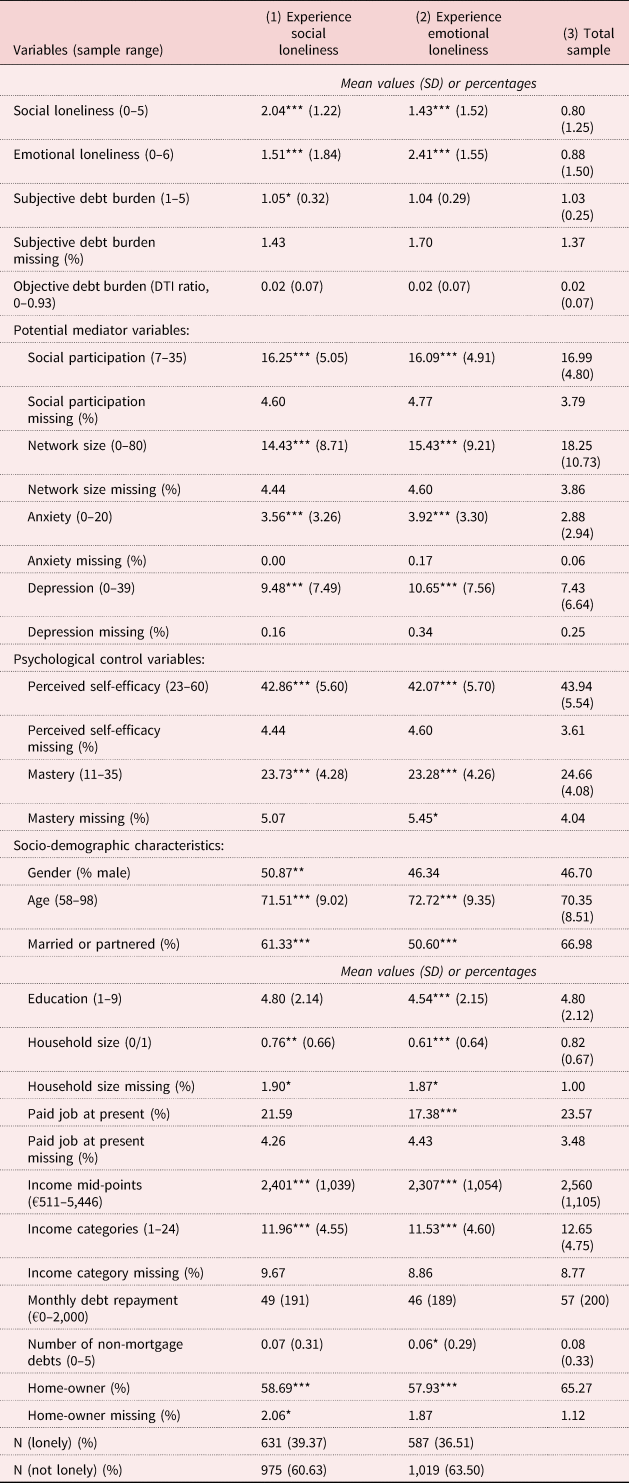
Missing values are treated in the following ways. Missing values in the dependent variables, social and emotional loneliness, are not replaced. Of the 1,606 respondents who reported this information on the leave-behind survey, income has the highest number of missing values (8.77%). All other missing values are below 5 per cent (see Table 1, column 3). We use a common approach for small datasets (see e.g. Acock, Reference Acock2005), which replaces missing values with zero (binary measures) or the mean (categorical, continuous measures) and adds a binary (1 = missing value; 0 = value not missing) indicator variable to account for the replacement in the regression analysis.
Descriptive statistics of variables used in the analysis for those who experience social and emotional loneliness and for the full sample

Notes: Total N = 1,608. Columns 1 and 2 indicate significant means differences between older adults who experience social or emotional loneliness (means shown in the table) and those who do not (means not shown in the table). SD: standard deviation. DTI: debt-to-income.
Significance levels: * p < 0.05, ** p < 0.01, *** p < 0.001.
To examine Research Question 1, t-tests were used to examine the difference between the means of our focal measures, potential mediator variables and control variables among older adults who experience social and emotional loneliness and those who do not. Bivariate correlation analysis (Pearson's r) is used to assess the correlation of loneliness, debt burden and potential mediator variables. The analysis for Research Questions 2 and 3 is based on linear ordinary least squares (OLS) regression analysis. Social loneliness and emotional loneliness serve as the dependent variables. For Research Question 2, each loneliness variable is regressed on objective and subjective debt burden, controlling for the sample's psychological and socio-demographic characteristics. For Research Question 3, the four potential social and psychological mediators are added to the regression models. In a robustness test, we limit the sample to survey respondents who indicated that they hold debt, and repeat correlation, regression and mediation analyses. This sample consists of 258 respondents. Tests for multicollinearity indicate that values for the variance inflation factor are below 10 for the variables in the regression specifications. Only the binary indicators of missing values show above 10 values for the variance inflation factor for both dependent variables, indicating that they are redundant as a predictor.
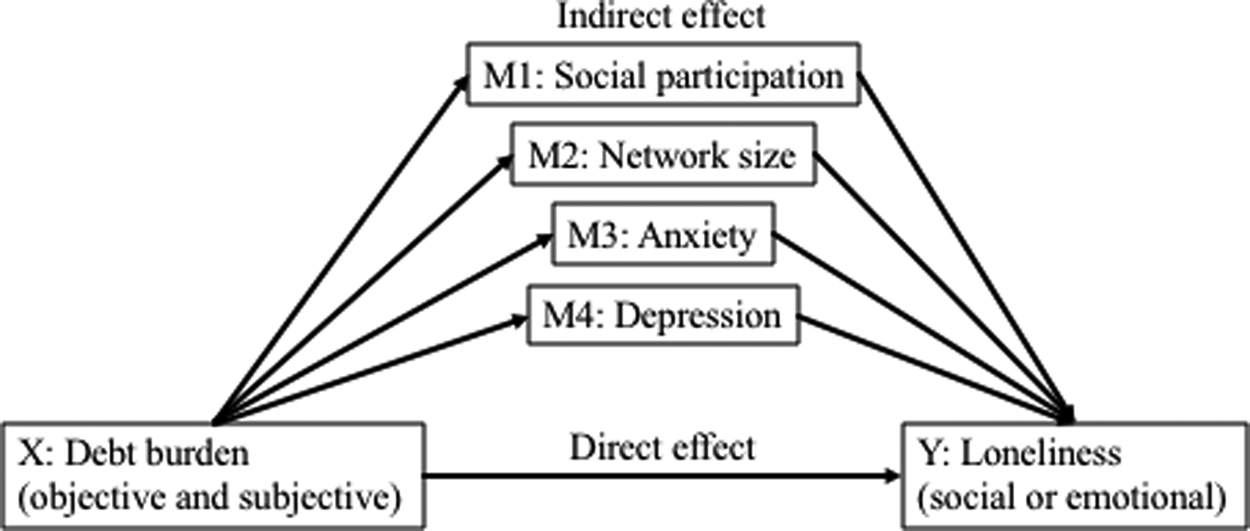
To test for mediation formally, we use the PROCESS macro for SPSS, which is a path analysis modelling tool for OLS and logistic regression (Hayes, Reference Hayes2017). Figure 1 illustrates PROCESS model number 4 (Hayes, Reference Hayes2017), where social loneliness served as Y, subjective loan burden as X, social participation as M1, network size as M2, anxiety as M3 and depression as M4, controlling for the sample's psychological and socio-demographic characteristics. The analysis uses a bootstrapping procedure (5,000 bootstrapped samples) to identify the indirect, mediating effects of the four explanatory variables. Due to collinearity among the binary missing values variables, they are removed from the PROCESS procedure.
Paths of the mediation analysis.

The following indices are used to evaluate model fit: F value, change in F value and adjusted R 2 in the main regression models and indirect effects of X on Y in the mediation model. Our threshold is significant at the 1 per cent significance level for F values, and for bootstrap confidence intervals to not include zero in the mediation model. All analyses are performed using IBM SPSS 25.
Results
How do older adults who experience subjective and objective debt burdens differ in terms of social and emotional loneliness from older adults who do not experience debt burdens?
The first analysis examines descriptive differences in the financial characteristics between older adults who experience social and emotional loneliness and those who do not. Table 1 gives the sample means or percentages for older adults who experience social loneliness (column 1) and emotional loneliness (column 2). The first two columns also include flags for significant means differences between those who experience social or emotional loneliness and those who do not. Column 3 shows the means or percentages for the total sample.
As seen in Table 1, older adults who experience social or emotional loneliness differ only slightly in their financial burdens from older adults who do not. Older adults who experience social loneliness report higher subjective debt burden, but the objective debt burden is similar between the two types of loneliness. Older adults who experience emotional loneliness report similar levels of subjective debt burden and objective debt burden to those who experience social loneliness. In addition, social and emotional loneliness are both associated with lower social participation, smaller network size, and higher levels of anxiety and depression at p < 0.001.
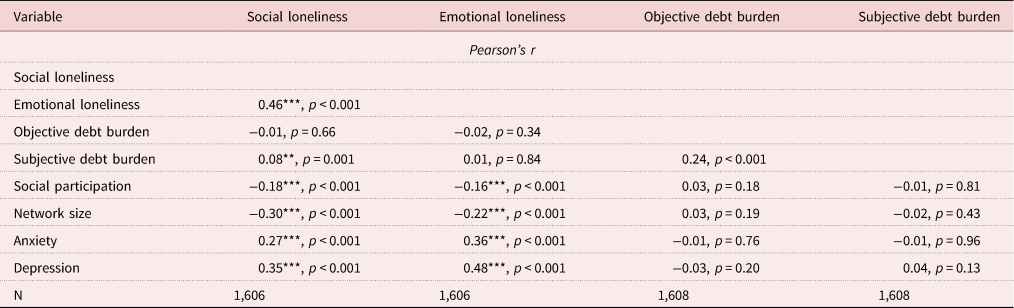
Table 2 shows the results of a correlation analysis of social and emotional loneliness, and subjective and objective debt burden. Social loneliness is correlated with subjective debt burden, but not with objective debt burden, measured as DTI ratio. Emotional loneliness is not correlated with either debt measure. The correlation coefficients of social and emotional loneliness and the four potential mediator variables are statistically significant, confirming previous literature. In contrast, the correlation coefficients of subjective and objective debt burden and the four potential mediator variables are close to zero, indicating that the two measures of debt burden represent concepts that are independent of these explanatory variables.
Correlation coefficients of social and emotional loneliness and objective and subjective debt burden with potential mediators

Note: N = 1,606.
Significance levels: ** p < 0.01, *** p < 0.001.
Are social loneliness and emotional loneliness associated with objective and subjective debt burden, controlling for psychological and socio-economic characteristics?
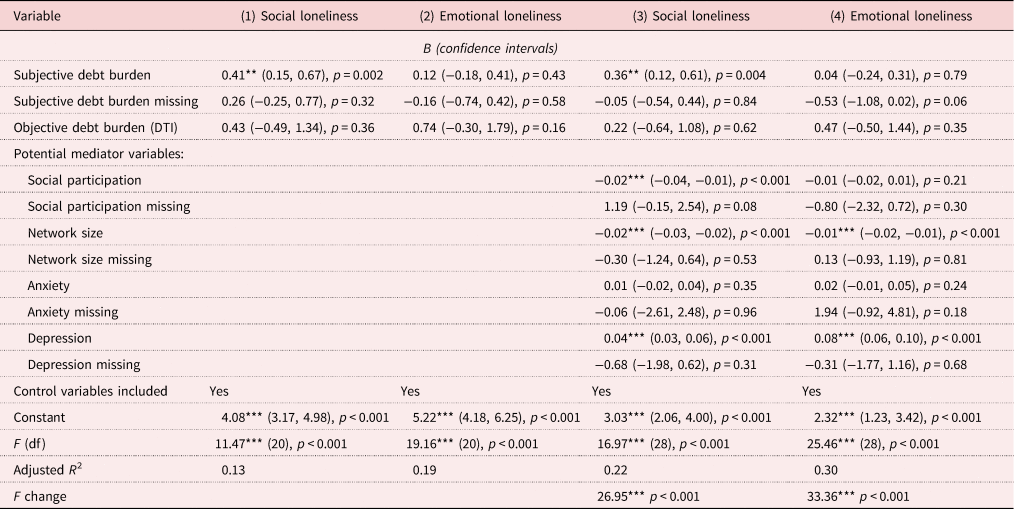
First, we regress social loneliness on the psychological and socio-demographic control variables. These focal results are presented in column 1 of Table 3 and the full results are in Table S5 in the online supplementary material. The association of subjective debt burden and social loneliness is significant and positive. The two psychological control variables, mastery with and self-efficacy, are negatively related to social loneliness, as expected. Additionally, socio-demographic characteristics related to greater social loneliness include male gender, higher educational attainment, lower income and not owning a home.
Parameter estimates (standard error) from ordinary least squares regression of social and emotional loneliness on subjective and objective debt burden, potential mediator variables, psychological and socio-demographic control variables

Notes: N = 1,606. The full results are shown in Table S5 in the online supplementary material. Control variables: mastery, self-efficacy, gender, age, married or partnered, education, household size, paid job at present, income categories, number non-mortgage debts and home-owner. DTI: debt-to-income. df: degrees of freedom.
Significance levels: ** p < 0.01, *** p < 0.001.
Regressions predicting emotional loneliness are shown in column 2 of Table 3. There is a positive but insignificant relationship of objective and subjective debt burden with emotional loneliness. The detailed results in Table S5 in the online supplementary material show that mastery, self-efficacy and female gender are inversely related to emotional loneliness, paralleling the findings for social loneliness. As might be expected, participants who reported not being married or partnered and those in smaller households are more likely to experience higher levels of emotional loneliness, while these two measures are unrelated to social loneliness. We also find a positive association between higher educational attainment and social loneliness in the regression. Following an approach suggested in Hawkley et al. (Reference Hawkley, Hughes, Waite, Masi, Thisted and Cacioppo2008), descriptive analysis showed that the importance of having people within respondents’ networks that are important to them is similar across the nine educational levels, with a small means difference of 1.31 people from the lowest education level (mean = 17.89; standard deviation (SD) = 3.61) to the highest (mean = 19.20; SD = 9.09).
Do social participation, social network size, anxiety and depression mediate the relationships between subjective and objective debt burden and social and emotional loneliness?
To investigate Research Question 3, the four potential mediator variables are added to the regression specification for Research Question 2. The focal results for social and emotional loneliness are shown in, respectively, columns 3 and 4 of Table 3; the full results are shown in Table S5 in the online supplementary material. With regard to predicting social loneliness, the coefficient of subjective debt burden has p < 0.001 and is only slightly smaller compared the baseline specification in column 1. The adjusted R 2 increases from 0.12 to 0.22, indicating that the four social and psychological variables increase the explanatory power of the regression specification. The finding indicates a robust relationship between subjective debt burden and social loneliness, independent of the four potential mediator variables. Each of these four variables, social participation, network size, depression and anxiety, all show a significant negative relationship with social loneliness.
In column 4 of Table 3 and Table S5 in the online supplementary material, emotional loneliness serves as the dependent variable. Objective and subjective debt burden are found to both be positively but not significantly related to emotional loneliness.Footnote 1 Among the four potential mediator variables, a smaller network size and a higher degree of depression are associated with emotional loneliness. As expected, social participation is not associated with emotional loneliness. Similar to the results for social loneliness, the adjusted R 2 increases from 0.19 to 0.30 when adding the four mediator variables, indicating that the four variables strengthen the explanatory power of the regression specification.
Results of the mediation analyses show that social participation, social network size, anxiety and depression do not mediate the relationships between subjective and objective debt burden and social and emotional loneliness. These results are shown in Table S6 in the online supplementary material.
Robustness of findings
In an alternative specification, we test the robustness of the findings by limiting the sample to survey respondents who indicated that they hold debt, and repeated correlation, regression and mediation analyses. This sample consists of 258 respondents. The results of the borrower-only sample are shown in Tables S7 and S8 in the online supplementary material. The direction of correlation and regression results is similar to the full sample. The regression results for the borrower-only sample show that the relationship of subjective and objective debt burden to social and emotional loneliness is similar to that of the full sample. The coefficients of the explanatory and control variables are similar in size and direction as in the full sample regression. The strength of the relationships is weaker due to the small sample size of the borrowers compared to the full sample, see Table S4 in the online supplementary material. Mediation tests on both social and emotional loneliness confirmed the findings of the full sample. Specifically, social participation, social network size, anxiety and depression do not mediate the relationships between subjective and objective debt burden and social and emotional loneliness.
Discussion
This research examined the effect of objective and subjective debt burden on social and emotional loneliness among older adults in the Netherlands. We investigated whether social and emotional loneliness are associated with objective and subjective debt burden and tested whether the associations are mediated by social and psychological variables. To the best of our knowledge, this is the first study to examine the role of debt in loneliness in older age, and we have three main findings. First, t-tests indicate that older adults who report social loneliness show higher levels of subjective debt burden than those who do not report social loneliness. In contrast, there is no difference in subjective debt burden among older adults who experience emotional loneliness. Objective debt burden does not differ between older adults who experience social or emotional loneliness and those who do not. Second, regression results show that subjective debt burden serves as a predictor of social loneliness, but not objective debt burden. We found that neither subjective nor objective debt burden are related to emotional loneliness. Third, mediation analysis indicates that social participation, social network size, anxiety and depression do not mediate the relationships of objective and subjective debt burden to social and emotional loneliness, confirming a direct relationship between subjective debt burden and social loneliness.
Limitations
As with any study, limitations should be considered. First, this research relies on cross-sectional analysis and caution should be used when results are interpreted. Future research should consider longitudinal designs instead of cross-sectional designs to assess better the causal relationship of social loneliness and subjective debt burden. Second, the data are collected in the Netherlands only and during a single year of relative economic stability (2015). Therefore, the results only reflect the experiences of older adults in this country at this point in time. Caution is warranted when transferring the findings to older adults living in other countries and facing other macro-economic circumstances, although the general mechanisms linking debt to loneliness may be more broadly applicable. Third, we focus on household income rather than wealth because LASA does not collect wealth measures. For this reason, we cannot examine a debt-to-assets measure even though wealth can be a stronger predictor of financial wellbeing than income in older, retired households. Fourth, we limit the examination of potential mediators to those with strongest theoretical and empirical support. A number of other potential mediators could be considered, including social support mechanisms and social security programmes available to older adults.
Implications for research
The results of the current study point to three implications for future research. First, our findings – that different debt burden indicators can be more or less associated with different loneliness outcomes – advance our understanding of financial hardship in older age. As such, our study extends prior research that documents the association of social loneliness with perceptions of income inadequacy or a worsened financial situation (Dahlberg and McKee, Reference Dahlberg and McKee2014; De Jong Gierveld et al., Reference De Jong, Keating and Fast2015). We identify the crucial role that worry about debt plays in this relationship. Building on the stress process theory (Pearlin et al., Reference Pearlin, Menaghan, Lieberman and Mullen1981), recent research on debt stress indicates a direct association of debt stress with mental health (Drentea and Reynolds, Reference Drentea and Reynolds2015). Drawing on this framework, our findings point to the impact of subjective debt burden on social loneliness, thereby illustrating the importance of further investigation of the ‘social meanings of debt’, which are currently poorly understood (Drentea and Reynolds, Reference Drentea and Reynolds2015: 29). Further studies are needed to investigate the reasons for the impact of debt burdens on loneliness, including potential methodological issues such as residual confounding.
A second implication is the finding that objective debt burden is not related to social loneliness, which aligns with findings in the emotional wellbeing literature, specifically Kahneman and Deaton (Reference Kahneman and Deaton2010). This research finds a lack of association of emotional with financial wellbeing above a certain income level (for a review, see also Kapteyn et al., Reference Kapteyn, Lee, Tassot, Vonkova and Zamarro2015). Our study extends these insights to the experience of indebtedness and points to the need for further research to identify whether certain levels or types of debt are likely to be related to social loneliness. It may be argued that the type of debt we studied contributed to the lack of association we found with social loneliness. The majority of debt held by study participants is mortgage debt, which is typically held for decades and it is collateralised, and secured by the house (Moulton et al., Reference Moulton, Samek, Loibl and Collins2015). Housing economics research has shown that these characteristics of mortgage debt explain why mortgage debt creates the lowest amount of financial distress of all types of consumer debt (Dunn and Mirzaie, Reference Dunn and Mirzaie2016). Future research should investigate if the same association holds for older adults who have repaid their mortgage or do not own a home, and are burdened with non-collateralised debt types, such as credit card debt.
A third implication of the current study points to the direct association of subjective debt burden and social loneliness. The relationship is mediated by neither social network, social participation, anxiety nor depression, and it is robust to the inclusion of psychological and socio-economic control variables. The direct effect of debt parallels the direct effect of income on loneliness (Hawkley and Kocherginsky, Reference Hawkley and Kocherginsky2018). A useful avenue for future research would be to deconstruct subjective debt burden into components suggested in qualitative research, such as shame, guilt, anger, and feelings of discomfort and recognition (Marston et al., Reference Marston, Banks and Zhang2018). This approach may be particularly fruitful in cross-country comparison, following the approach in the poverty literature (Walker et al., Reference Walker, Kyomuhendo, Chase, Choudhry, Gubrium, Jo, Lødemel, Mathew, Mwiine, Pellissery and Ming2013). Our study also adds nuance to a groundbreaking study by Netemeyer et al. (Reference Netemeyer, Warmath, Fernandes and JGL2018) that has identified subjective financial wellbeing to be as much a predictor of overall wellbeing as factors such as physical and mental health, job satisfaction and relationship satisfaction. We echo Netemeyer et al. (Reference Netemeyer, Warmath, Fernandes and JGL2018) by showing that it is important to separate subjective financial perceptions from objective, as they may give us better windows into the underlying mechanisms.
A fourth implication for future research is the need to examine the causality of the subjective debt burden-to-social loneliness relationship. For one, literature on loneliness suggests that social loneliness is initiated by the debt-burdened individual, due to emotions such as guilt, anger or shame (Marston et al., Reference Marston, Banks and Zhang2018). In addition, because having debt in older age is not as ‘natural’ or common as in younger age groups, older adults may feel more burdened by it (Keese, Reference Keese2012). On the other hand, social contact theory suggests that the social environment may also initiate the isolation of the debt-burdened individual through peer rejection (Pettigrew and Tropp, Reference Pettigrew and Tropp2006). Debt-related worries can lead older adults to behave in ways that do not align with peer expectations. The psychology of scarcity has shown that liquidity constraints can express themselves in nervousness, memory loss and near-term tunnel vision (Shah et al., Reference Shah, Mullainathan and Shafir2012; Mani et al., Reference Mani, Mullainathan, Shafir and Zhao2013; Haushofer and Fehr, Reference Haushofer and Fehr2014). This behaviour may lead to peer rejection as documented in loneliness studies among adults with cognitive disabilities (Gilmore and Cuskelly, Reference Gilmore and Cuskelly2014). The peer-induced perspective may be supported by our finding that if an older adult has debt, but feels unburdened, social integration and embeddedness do not suffer.
Implications for practice
For practice, the findings of this study indicate that subjective debt burden in older age, such as expressions of distress or worry, can serve as a meaningful predictor of the social integration and embeddedness of older adults. As suggested in this study, financial worries can be associated with mortgage debt in older age, although this type of debt is typically associated with low debt stress (Dunn and Mirzaie, Reference Dunn and Mirzaie2016). These older adults, who are distressed by their debt burden, may benefit from additional resources and support that assist them in managing and repaying their debt. This support could be provided by consumer credit counselling or debt advisory services, lenders or even government agencies that service older adults.
Supplementary material
The supplementary material for this article can be found at https://doi.org/10.1017/S0144686X21000325.
Data
This study is based on data from the Longitudinal Aging Study Amsterdam, which is largely funded by the Dutch Ministry of Health, Welfare and Sport.
Author contributions
All authors collaborated on the development of the study design and analyses, with CL conducting the statistical analyses. All authors contributed to the drafting of the manuscript, provided critical comments throughout the writing process and approved the version to be published.
Financial support
The Longitudinal Aging Study Amsterdam is supported by a grant from the Netherlands Ministry of Health Welfare and Sports, Directorate of Long-Term Care. The authors further gratefully acknowledge a Marie Curie International Incoming Fellowship from the Marie Curie Actions of the European Commission, Research Executive Agency (FP7-PEOPLE-2012-IIF #330462, Bruine de Bruin, Loibl), generous funding from the Leeds University Business School’s Center for Decision Research (Bruine de Bruin, Loibl) and The Ohio State University College of Education and Human Ecology Strategic Initiatives and International Affairs International Research Grants (Loibl), and an Early Career Fellowship of The Leverhulme Trust, U.K. (McNair).
Conflict of interest
The authors declare no conflicts of interest.
Ethical standards
The Longitudinal Aging Study Amsterdam (LASA) has received approval by the medical ethics committee of the VU University Medical Center. Signed informed consent was obtained from all study participants. For the present study, the permission to use data was obtained from the LASA steering group using the official analysis proposal form (https://www.lasa-vu.nl/data/availability_data/availability_data.htm).