After decades of authoritarian rule, the third wave of democracy swept across Africa's shores during the late 1980s and early 1990s. Elections – a stalwart of democracy and an important indication of democratic development – have now been held in more than 40 African countries. According to Lindberg (Reference Lindberg2006), the quality of elections over this period has been gradually increasing. Between 1999 and 2003, approximately 63 per cent of elections were considered free and fair, up slightly from 58 per cent during the period between 1990 and 1993 (ibid.: 63). Lindberg (Reference Lindberg2006: 140) concludes that elections, regardless of how flawed they are, have a ‘strong positive effect on the expansion of civil liberties’ over time and often lead to a deepening of democracy.
Lindberg's analysis offers reason to be optimistic about democracy's chances in Africa; however, there are still some puzzling trends. For example, very few elections have produced executive turnover. Since 1989, only 12 countries in sub-Saharan Africa have experienced executive turnover (Cheesman Reference Cheesman2010). Furthermore, since 1989 approximately 75 per cent of legislative elections in Africa have produced single party rule (Erdmann and Basedau Reference Erdmann and Basedau2007). Many authors have previously noted this trend towards single or dominant party rule in Africa's democracies (Manning Reference Manning2005; Mozaffar and Scarritt Reference Mozaffar and Scarritt2005; Van de Walle Reference Van de Walle2003). In assessing the methods that others have used to count and categorize party systems in sub-Saharan Africa, Bogaards (Reference Bogaards2004) argues that dominant party systems are rapidly becoming the norm.
While dominant party rule has been associated with authoritarianism and its variants, many of the countries in sub-Saharan Africa that are operating under dominant party rule are by many other indicators considered to be democratic. Based on Freedom House's designation of a country as an ‘electoral democracy’, currently nine of sub-Saharan Africa's 43 countries have been democratic for at least the past 10 years. Of these more ‘stable’ democracies, three (Botswana, Namibia and South Africa) have dominant party systems based on Sartori's criteria of three successive legislative majorities (Sartori Reference Sartori1976). Other countries such as Lesotho, Senegal and Zambia may be heading towards dominant party status but have not yet held three successive democratic elections (they have had two each) and thus do not (yet) qualify. Botswana best exemplifies dominant party rule in sub-Saharan Africa: since independence in 1966, the Botswana Democratic Party (BDP) is the only party to have governed Botswana. The BDP's share of legislative seats has ranged from 90 per cent in the 1970s and 1980s to a ‘low’ of 67 per cent in the 1990s.
Given that many of sub-Saharan Africa's democracies are currently operating under or on the verge of dominant party rule, it is of the utmost importance that we fully understand the functioning of democratic elections under these types of systems. Dominant party rule may mean a lack of competition at all stages and phases of the electoral process; it may mean limited or restricted competition; it may be that vibrant competition can be found at micro levels; or it may be that competition and deliberation in dominant party systems are found in other stages of the electoral process – the primary phase or in nomination decisions, for example. The fact that we do not know with any measure of certainty which of the above is the case suggests further research on this topic is warranted.
The purpose of this article, then, is to examine in detail the nature of elections under Botswana's dominant party system. A closer look at the competitiveness of Botswana's elections reveals a more complex picture than previous research has been able to acknowledge. When one looks at elections at the micro level – examining the competitiveness of elections across constituencies and rates of legislator turnover – one finds significant levels of competition in Botswana, and these levels have been increasing over time.
The reasons why we care about the quality of democracy and the competitiveness of elections have much to do with the theoretical implications of competition. Many researchers believe that competition forces politicians and political parties to respond to the electorate (Dahl Reference Dahl1971; Downs Reference Downs1957; Powell Reference Powell2000; Strom Reference Strom1990). Furthermore, when government fails to respond effectively, elections provide the citizenry with a mechanism to hold elected officials accountable and turn them out of office. Turnover does not necessarily signify competitiveness but it does represent voter displeasure and may induce responsiveness from new legislators in much the same way that a highly competitive contest that returns an incumbent to office would. For these two specific reasons – responsiveness and accountability – we care about the quality of elections and the outcomes they produce. It has been argued that dominant party systems lack accountability (Bogaards Reference Bogaards2000) and responsiveness (Stasavage Reference Stasavage2005). Thus, it is with these two features of competitive elections in mind that I will undertake to scrutinize elections in Botswana.
This type of analysis is limited to countries that use first-past-the-post, or plurality, electoral rules for two reasons: one theoretical and one methodological. First, the nature of competition differs significantly between plurality and proportional electoral systems. Under plurality rules, there is a winner-takes-all mentality as there is only one winner per constituency. The top vote-getter is awarded the seat. The second top vote-getter receives nothing. Under proportional representation (PR), however, parties are awarded seats based on the percentage of the vote they receive and the number of seats available in a given district or constituency. There is not a single ‘winner’ and ‘loser’ per se, as all parties that receive a minimum threshold of votes will be awarded legislative seats based on the proportion of votes that they have received. Second, there are immeasurable facets of competition under proportional representation systems. According to Blais and Lago (Reference Blais and Lago2009), there are no studies which have measured competitiveness at the constituency level in proportional representation systems. In addition, with regard to closed-list proportional representation systems (the only type of PR system found in sub-Saharan Africa), turnover is determined by the party when it compiles its list and is removed from the voters’ control. This means that there is no obvious way to calculate turnover and incumbency under closed-list proportional representation systems. It also means that the accountability mechanism differs substantially between the two types of systems.
This article proceeds as follows: first, it examines the literature on dominant party systems in order to examine the concept and its relevance to political development in Botswana. It then turns to the political history of Botswana in order to demonstrate the nature of elections over time under a dominant party system. After looking at the broad, national-level trends with regard to both interparty and intraparty competition, I disaggregate electoral outcomes to exploit the variation at the subnational level by calculating the margin of victory between the first and second top vote-getters and averaging this across constituencies to obtain a clearer picture of the electoral environment in Botswana. In this way we are able to calculate the number of constituencies that can be considered competitive and to examine this trend over time. We can also address the accountability of elections by examining rates of incumbency and turnover across several elections. Finally, the article places electoral outcomes in a comparative perspective by looking at elections in other African democracies. By doing so, it demonstrates the diversity of micro-level electoral outcomes under both dominant and multiparty systems. The findings of this article have significant implications for the ways in which researchers examine electoral outcomes across different party systems.
Dominant party systems
Sartori (Reference Sartori1976: 195), one of the pre-eminent theorists on parties and party systems, defines a dominant party system (although he prefers the term predominant party system) as ‘a more-than-one-party system in which rotation does not occur’. His definition also includes a specific threshold of seats (absolute majority), which he relaxes in order to account for countries that do not operate under the absolute majority principle. Additionally, he incorporates a temporal component (three consecutive elections) in order to add precision and utility to the concept. Classic examples of dominant party rule produced by democratic elections include the Liberal Democratic Party in Japan, which has ruled almost exclusively since 1955; the Social Democratic Party in Sweden, which controlled the Swedish government from the mid-1930s until 1976; the Labour Party and its predecessor in Israel, which dominated elections from 1948 until the late 1970s; and the Christian Democrats in Italy, who ruled for close to 50 years from 1944 until the early 1990s.
The initial formation and assumption of power by dominant parties often follows a traumatic event such as a revolution or war, of which there is no shortage in Africa (Giliomee and Simkins Reference Giliomee and Simkins1999). The African National Congress (ANC) in South Africa, for example, came to power as a result of a negotiated transition to democracy from apartheid rule. The South West Africa People's Organization (SWAPO) in Namibia came to power after a lengthy struggle for independence from South Africa. In Botswana, the BDP came to power following the country's independence from British colonial rule.
Recent theorists have focused on the mechanisms that perpetuate dominant party rule. Books by Scheiner (Reference Scheiner2006), Greene (Reference Greene2007) and Spiess (Reference Spiess2009) each offer a different explanation for long-term dominant party rule. Briefly, their collective arguments can be summed up as: clientelism and fiscal centralization (Scheiner Reference Scheiner2006); ideological centrism and resource imbalances at the party level (Greene Reference Greene2007); and elite-level electoral strategies (Spiess Reference Spiess2009). The divergence in the causal mechanisms each author emphasizes is most likely due to the variation found in each author's case selection: Japan in the case of Schiener, Mexico in the case of Greene, and South Africa and India in the case of Spiess. It should be noted that while Greene largely discusses autocratic dominant party rule in the case of Mexico, he extends his study to democratic dominant party rule in Botswana and argues that the causal mechanisms operate similarly in both cases.
Moving away from causation, and looking more broadly at regime transitions, some have argued that dominant party systems may be a phase that countries experience on the road to democratic consolidation. Pempel (Reference Pempel1990), citing the examples of Israel, Italy, Japan and Sweden, argues that dominant parties may smooth the transition from autocracy to consolidated democracy. In addition, he cautions that extreme fragmentation and fierce competition can destabilize fragile, newly democratizing countries; thus, in some cases, dominant parties may be desirable. However, Du Toit (Reference Du Toit1999) argues that the conditions that encouraged the transition to full-fledged democracy under dominant party systems in Israel, Italy, Japan and Sweden are absent in most African states. Namely, extreme ethnic/linguistic/religious heterogeneity coupled with economic underdevelopment and generally weak state structures make most African states unlikely candidates for the more benign assessment of dominant party systems as a phase in the transition to liberal democracy.
Africa has a significant history of single party rule in non-democratic settings. During the decades following independence from colonial rule, some countries, including Ghana (under Kwame Nkrumah), Tanzania (under Julius Nyerere), Senegal (under Leopold Senghor) and Kenya (under Joma Kenyatta), instituted single party states in which only one party was, either by law or by extra- judicial means (opposition co-optation, manipulation, intimidation, excessive registration fees and regulations, and so on), allowed to form and participate in the electoral process. Africa's single party systems – while decidedly non-democratic since various restrictions on competition were in place – may provide us with some insight into the functioning of today's democratic dominant party systems. Throup (Reference Throup1993) argues that there were significant levels of competition, turnover and responsiveness of the single party state in Kenya under Kenya African National Union (KANU) rule, and perhaps higher levels of all three after the resumption of multiparty politics in the early 1990s. Gertzel et al. (Reference Gertzel, Baylies and Szeftel1984) report similar findings under Zambia's single party state of the 1970s and 1980s.
Much of the competitiveness noted in these types of systems is related to the incidence of factionalism in the single party state. According to Panebianco (Reference Panebianco1988), political parties can be divided into factions (which he defines as ‘strongly organized groups’) or tendencies (‘loosely organized groups’). The types of divisions found within parties determine their internal cohesion, with highly factionalized parties being considerably less cohesive than those with tendencies. In Zambia, extreme factionalism was cited by the ruling party (the United National Independence Party – UNIP) as one of the main contributing factors in the introduction of a single party state in the 1970s: the single party state was argued to be the solution to factional fighting within UNIP (Gertzel et al.: Reference Gertzel, Baylies and Szeftel1984). Bienen (Reference Bienen1974) also noted significant factions within Kenya's ruling party (KANU); however, he argued that the factions within KANU provided Kenya's single party state with a semblance of competitiveness. Further, because opposition parties were of little threat to the single party state, factions within KANU felt free to oppose and vote openly against government-sponsored legislation (Bienen 1974: 84). Thus, in single party states, competition in the form of factionalism often emerges, but this type of competition can be considered to occur at elite levels and, when elections are neither free nor fair, does not offer citizens much in the way of accountability or input.
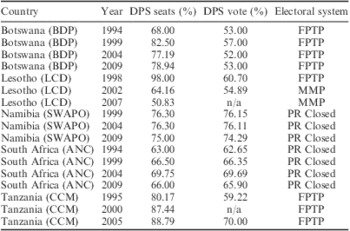
Table 1 reports election results for five countries in sub-Saharan Africa that have dominant party systems or are poised to become dominant party systems: Botswana, Lesotho, Namibia, South Africa and Tanzania. SWAPO in Namibia received 75 per cent of the national-level vote in the 2009 election while the BDP in Botswana received 53 per cent of the national vote in the 2009 election and the Lesotho Congress Party (LCD) received 55 per cent of the popular vote in 2002.
Electoral Results under Dominant Party Systems (DPS) in Sub-Saharan Africa

Note: FPTP = first past the post; PR = proportional representation; MMP = mixed-member proportional.
However, due to the disproportionality commonly associated with first-past-the-post systems, there is a huge discrepancy between the percentage of the vote that the dominant party received at the national level and its percentage of seats in the legislature in countries such as Botswana and Tanzania. Both types of electoral systems are equally likely to produce dominant party rule, but we can consider dominant party rule under proportional representation to be a form of ‘natural’ dominance whereas dominant party systems that are the product of plurality systems can be considered ‘manufactured’ (see Lijphart Reference Lijphart1994). Thus, we can distinguish between ‘natural’ dominant party systems – those in which it is strong public support that gives a given party a large mandate – and ‘manufactured’ dominant party systems – those in which the electoral rules disproportionately reward a given party, despite its marginal or slightly-more-than-majority support from the voters. Additionally, Table 1 should also make it clear that there is not a straightforward relationship between electoral system and party system in sub-Saharan Africa as dominant parties are found in countries using first-past-the-post, mixed and proportional representation systems.
Due to the lack of alternation between parties, some theorists argue that dominant party systems, regardless of the quality of elections, cannot, by definition, be considered democratic (Przeworski et al. Reference Przeworski, Alvarez, Cheibub and Limongi2000). Others argue that it is not the party system that determines whether a regime is democratic or autocratic but rather the presence of free and fair elections. The debate over whether a dominant party system can or should be considered democratic centres around whether one adopts a procedural or substantive definition of democracy. The procedural definition includes only the presence of democratic institutions (namely, elections), whereas the substantive approach incorporates the outcomes produced by democratic institutions (namely, party alternation) as part of the definition.
In sum, when we are discussing and classifying dominant party systems, we are broadly grouping divergent electoral outcomes based solely on which party controls government – specifically, whether a single party controls government without alternation or rotation to another party. We are not directly speaking to the competitiveness of elections or the magnitude of electoral victories. We are explicitly not taking into account whether electoral pressures are placed on dominant parties or whether or not accountability and/or responsiveness are occurring. We are simply noting who controls the national government apparatus.
By looking at electoral outcomes from a different perspective, this article offers an approach that might help shed light on this debate. Examining electoral competitiveness and turnover combines the procedural and substantive approaches by describing in detail the nature of elections but does not place proscriptions on aggregate outcomes that can be affected by factors such as electoral system and geographic concentration of partisans. Dominant party rule can be produced by elections in which competition is heavily restricted and by elections that are widely deemed as free and fair; thus, by looking at constituency-level competitiveness, we are better able to speak to the democratic quality of elections than if we were to focus solely on party alternation at the national level.
Dominance in Botswana
Botswana (formerly Bechuanaland) was a British protectorate until 1966, when it was granted independence. Unlike many of its geographic counterparts, in its more than 40 years of independent rule, Botswana has never experienced civil war, regime change, military rule or any manner of ‘hostile takeover’ of government. It is often held up as an anomalous case: a stable and relatively successful outlier hidden among sub-Saharan Africa's notoriously tempestuous post-colonial histories. One of the poorest countries in the world in the 1960s, until recently, Botswana has seen significant positive economic growth almost every year. According to Acemoglu et al. (Reference Acemoglu, Johnson and Robinson2003: 80), Botswana's consistent economic growth over the past 35 years has outpaced not only every other African country but also every other country in the world.
Botswana also has a solid record of political freedom and respect for political and civil rights. Freedom House (2010), which releases scores tabulating a country's protection of political rights and civil rights, has classified Botswana as ‘free’ since 1974. According to Transparency International's Country Study Report (2008), Botswana is considered the least corrupt African country. Despite this rosy picture, there are some significant problems facing Botswana: it is still poor by global standards, unemployment is estimated at roughly 20 per cent and poverty is concentrated in rural areas (World Bank 2010).
Botswana has a unitary system, with most government power localized in the central government; there are, however, provisions for local government. Elections to local government are held concurrently with national elections. Members of the National Assembly are elected from single member districts according to simple plurality rules. By law, the Delimitation Commission must convene a minimum of once every 10 years to redraw constituencies based on changes in population reported by the census (Constitution of Botswana 1966: section 64). When Botswana held its first election in 1965 (the year before full independence), there were 31 constituencies; there are currently 57 constituencies.
Parties and Elections in Botswana
The Bechuanaland/Botswana Democratic Party was formed in 1961. It was led by Seretse Khama, a former hereditary chief of the Bamangwato tribe. While pursing his studies at Oxford University, Khama met and married a white woman. Because of this and due to pressure from the South African government, he was exiled by the British colonial administration during the 1950s. He was allowed to return in 1956, but only after he renounced his chieftainship. He then became very active in pre-independence politics. Stevens and Speed (Reference Stevens and Speed1977) have argued that the main cleavage underpinning the formation of parties in the 1960s was the divide between the chiefs/traditional politics in Botswana and the newly emerging modern politicians such as Khama.
Botswana's first elections, held in 1965 prior to full independence, gave the BDP a resounding victory: it won 28 out of 31 seats with nearly 80 per cent of the total vote. The Botswana People's Party (BPP) won the remaining three seats. Turnout was estimated at approximately 75 per cent (African Elections Database 2010). Seretse Khama was elected as Botswana's first president by parliament. The BDP, it has been reported, enjoyed the tacit support of the British colonial administration (Mokopakgosi and Molomo Reference Mokopakgosi and Molomo2000; Nengwekhulu Reference Nengwekhulu1979); in fact, Molutsi (Reference Molutsi1991) argues that the British found the BPP too radical and undemocratic to rule Botswana and so supported the BDP, which may have contributed to the party's initial electoral success.
After the elections of 1965 but before full independence in 1966, the Botswana National Front (BNF) was formed by Dr Kenneth Koma, who had recently returned from Russia after completing his doctorate in political studies (Polhemus Reference Polhemus1983: 402). The intention behind the formation of the BNF was to ‘reconcile warring elements of BPP to create a progressive block to bring down the neo-colonial BDP’ (Mokopakgosi and Molomo Reference Mokopakgosi and Molomo2000: 5).
The first few years of independence were tumultuous. Botswana's second elections were scheduled for 1970, but Khama called early elections for 1969 as his government was feeling pressure due to economic problems and development issues that had emerged over the first few years of independence, including those associated with a prolonged drought that had adversely affected the country (Maudeni Reference Maudeni2005: 6). During the 1969 elections, in which the BDP again won a resounding majority (24 out of 31 seats), there was some evidence of discontent as Vice President Quett Masire lost his seat to a rival BNF candidate and former chief. The 1969 elections were viewed as a failure by the BDP because the opposition was able to increase its share of seats in parliament, winning seven out of 31 constituencies (Danevad Reference Danevad1995). Parson (Reference Parson1990) attributes the BDP's relative ‘failure’ in the election of 1969 to several factors, including animosity between chiefs and the BDP and the lack of an appreciable change in living standards between 1965 and 1969. Maudeni (2005: 7) points out that while the BDP could have abandoned elections after its perceived defeat in 1969, it instead responded by making some small changes to the country's electoral laws – disallowing chiefs from immediately entering politics after retiring from their position and rescinding the provision that the president must stand for election.
To characterize partisan competition in the post-independence period in Botswana, the BDP is most certainly the dominant feature of every election; however, according to Charlton (Reference Charlton1993), elections became truly competitive in the mid-1980s. In addition, there has been significant growth in the number of opposition parties in the 1980s and 1990s. In 1989, there were six opposition parties, nine in 1994 and 15 in 1999 – although only five contested elections (Mpabanga Reference Mpabanga2000: 55). Directly after the 1999 election, Lekorwe (Reference Lekorwe2000) called Botswana a two-party system, with competition focused between the BDP and BNF. Subsequent elections in the 2000s called this conclusion into question, as voter support increased for the Botswana Congress Party (BCP – a former faction of the BNF that broke away in 1998) and decreased for the BNF. By the election of 2009, the BCP and BNF were almost equal in the amount of support that they received (19 and 21 per cent, respectively). Some authors argue that the fragmentation of opposition parties contributes to the maintenance of a dominant party system (Greene Reference Greene2007; Throup Reference Throup1993). Furthermore, the opposition parties in general operate at a severe disadvantage due to the fact that they do not have the access to state resources (media, patronage, and so on) that the ruling or dominant party does; so much so that Levitsky and Way (Reference Levitsky and Way2010) argue that dominant party systems such as that found in Botswana should be considered a form of electoral authoritarianism.
Elections in Botswana: a closer look
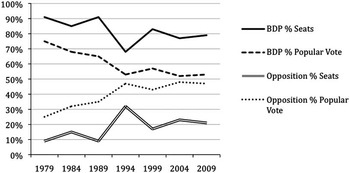
It is true that Botswana's political landscape has been dominated by the BDP, but the dominance of BDP seat share in parliament only tells part of the story. Electoral outcomes in Botswana are considerably more complicated. An examination of the percentage of the vote each party receives demonstrates this. There has been a steady decline in the percentage of the vote that the BDP has received since 1979 (see Figure 1). The BDP received over 75 per cent of all votes cast in 1979, 68 per cent in 1984 and 65 per cent in 1989. In 1994, BDP support dropped precipitously to 53 per cent. Voter support for the BDP has remained close to 50 per cent since then. However, due to the disproportionality associated with first-past-the-post electoral rules, the BDP has won anywhere from 68 to 83 per cent of the seats in the National Assembly while polling the support of approximately 50 per cent of the voters.
Botswana's Elections: Percentage of Seats and Popular Vote by Party

Furthermore, the above analysis is still focusing on macro-level electoral trends. Since the 1980s, the major parties in Botswana have used a primary system in order to determine candidate nominations. Primaries – elections held within a given party – provide another opportunity to create competition within a political system. Additionally, both the BDP and BNF have disparate groups, or factions, which vie for control of the party and further complicate the picture. Molomo (Reference Molomo2000) argues that the majority of partisan competition in Botswana is, in fact, intraparty competition. Therefore, the following sections examine competition from multiple angles: intraparty, interparty and across constituencies.
Intraparty competition and factionalism
Primaries were instituted in the 1980s for the BDP and the BNF (Sebudubudu and Osei-Hwedie Reference Sebudubudu and Osei-Hwedie2005). The BDP held its first primaries before the 1984 election, while the BNF adopted primaries in anticipation of the 1989 election. According to Charlton (Reference Charlton1993: 358), anticipating increased competition from opposition parties, the BDP instituted a primary system in order to ensure that candidates ‘would remain responsive to their increasingly demanding electorates’. Both the BDP and BNF have argued that the introduction of primaries has been a major contributor to the factionalism that each party has experienced (Mokopakgosi and Molomo Reference Mokopakgosi and Molomo2000: 14).
Until changes implemented prior to the 2004 election, the primary process in the BDP was non-binding. The Central Committee retained the exclusive right to select candidates and used the primary results as merely a guideline (Mokopakgosi and Molomo: 15). The primary season was particularly contentious after the introduction of the BDP's new primary system, ‘Bulela Ditswe’ (literally, open to it all) in 2003 which allowed all party members to participate. Several sitting BDP MPs were defeated in the primary (Sebudubudu Reference Sebudubudu2004). The BNF held its own primaries, which also saw a few sitting MPs defeated (Sebudubudu 2004).
Related to the primary system (and perhaps a product of it as well), factionalism within political parties represents yet another form of informal competitiveness. In the early 1980s significant problems associated with factionalism in the BDP began to emerge. A new faction of the party led by Daniel K. Kwelagobe argued that the BDP should court the electorate more aggressively through grassroots campaigning and an increased focus on constituency service (Charlton Reference Charlton1993: 358). The older, more traditional, faction (known as the Merafthe faction) believed that the party could easily campaign on previous accomplishments. Two explosive reports released by the government contributed greatly to this division. The Kgabo Report, released in 1991, exposed land allocation irregularities in Mogoditshane and led to the resignation of two ministers, including Kwelagobe. The Christie Report, released one year later, in 1992, implicated another two ministers from the Kwelagobe faction. Consequently, the Kwelagobe faction believed that the Merafthe faction was behind both investigations and the findings of corruption. According to Mokopakgosi and Molomo (Reference Mokopakgosi and Molomo2000: 12), the primaries held before the 1994 general elections were between candidates ‘sponsored along this great divide’.
It has been alleged that party elites manipulated the 1997 elections to the party's Central Committee in order to accommodate the warring factions within the party (Molomo Reference Molomo2000). The 1997 Schlemmer Report argued that factionalism caused the electoral decline of 1994 and that the party should bring in a new leader to unify the party (Mokopakgosi and Molomo Reference Molomo2000: 12). The BDP selected Ian Khama to lead the party. In 2003 the BDP again experienced intense factionalism and faced accusations by members that the BDP secretariat was favouring some candidates over others (Sebudubudu and Oswei-Hwedie 2005).
There are currently two distinct factions within the BDP born out of the previous factions: the A-Team, of which Ian Khama is a member, and the Barata-phati, of which Daniel Kwelagobe and current acting Secretary General Wynter Mmolotsi are members. Numerous news reports in the days leading up to and after the 2009 election discussed the politicking that was occurring between the two factions. Members of the Barata-phati faction had accused the president of campaigning on behalf of A-Team candidates and of neglecting their candidates (Ganetsang Reference Ganetsang2009). President Ian Khama's appointment of Pono Moatlhodi as deputy speaker of parliament after the election was considered a politically shrewd move to address some of the concerns of the Barata-phati, as Moatlhodi is a particularly outspoken member of the Barata-phati faction (Owino Reference Owino2009). His appointment may have also been motivated by the fact that the Barata-phati won control of Francistown, Botswana's second largest city behind the capital Gaborone (Botswana Gazette 2009).
On 27 April 2010, the Barata-phati faction formally split from the BDP and formed the Botswana Movement for Democracy (BMD). Sydney Pilane, spokesperson for the BMD, stated that the aim of the new party was to protect democracy in Botswana from the autocratic leanings of Ian Khama (IOL News 2010). While not a newly ‘elected’ party, the BMD does represent a significant change in Botswana's politics and one that will be monitored closely in the future.
As is evidenced by the tremendous number of splinter parties formed as offshoots of the BNF (there are at least seven splinter parties, including the BCP), it should be obvious that the BNF has struggled with factionalism over the years. There has been a long-standing schism in the BNF between true socialist and social democrats which came to a head in 1997. Ideological divisions between the socialists and traditionalists are to blame for much of the fracturing that the BNF has experienced (Osei-Hwedie Reference Osei-Hwedie2001). The departure and subsequent formation of the BCP has, to some extent, abated the extreme factionalism that the BNF experienced in the 1990s. There is, however, still some antagonism between the current president of the BNF, Otsweletse Moupo, and various members. He has, in fact, expelled several members.
Interparty competition
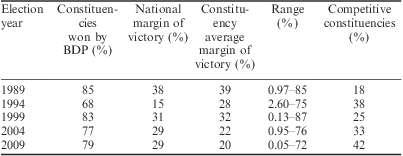
Thus far the discussion of elections has focused on trends at the national level. When the national election returns are disaggregated, we can examine the competiveness of parties within and across Botswana's constituencies. As Table 2 reports, the average margin of victory between the first and second top vote-getters has been decreasing over time: from 38.6 per cent in 1989 to 20.2 per cent in the election in 2009. In some constituencies, the BDP wins by a huge and dominant margin of victory – upwards of 85 per cent in Tswapong South (a notorious stronghold of the BDP, located in central Botswana) in 1989. In other constituencies, the races are much closer. During the same election, the BDP won the constituencies of Tati East and Tati West by less than 5 per cent. Turning to the 2009 election, the BDP won the constituencies of Serowe North East and Serowe North West by margins of 72 per cent and 67 per cent, respectively. Other constituencies such as Ngami, Gaborone North and South East North were won by margins of less than 3 per cent.
Competitiveness of Legislative Elections in Botswana by Constituency
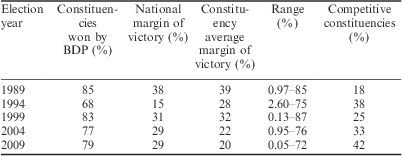
Source: Data taken from election reports issued by the Botswana Independent Electoral Commission.
The number of competitive constituencies has also been increasing over time. For the purposes of this article, I consider constituencies with a margin of victory equal to or less than 10 per cent to be competitive. A margin of victory in this range represents an election that is difficult to predict with any certainty before the election and one in which a future electoral victory is by no means guaranteed. Researchers who study American politics typically use a 10 or 20 per cent threshold, or one that is comparable (55 per cent of the total vote or less, 60 per cent of the total vote or less) to denote a competitive election (Hirsch Reference Hirsch2003; Ray and Havick Reference Ray and Havick1981; Weber et al. Reference Weber, Tucker and Brace1991).
Over time, the number of competitive constituencies in Botswana has dramatically increased. Whereas in 1989 only 17.5 per cent of constituencies could be considered competitive (that is, winning by a margin of 10 per cent or less), in 2009 roughly 42 per cent of constituencies were won by a competitive margin. When we compare the number of competitive elections in Botswana to those typically found in more developed and consolidated democracies such as the US (typically 10 to 20 per cent of constituencies are competitive), Botswana appears to have better than average levels of competitive elections.Footnote 1
In order to place the competitiveness of Botswana's elections in a broader context, it is necessary to examine micro-level competitiveness in several other countries. As discussed above, due to the nature of competition and the measures used, I am only able to compare countries with similar electoral systems – namely, those that use plurality rules or first-past-the-post electoral systems. There were a few criteria used in selecting the cases for analysis, including the freeness and fairness of elections and the use of plurality electoral rules. Several countries (Benin, Mali, Mozambique and Senegal) use some version of proportional representation. Small island countries with small populations (Cape Verde, the Seychelles) were also excluded from the sample. Finally, a lack of available data precluded Madagascar and Malawi. I also chose not to focus only on those countries designated as ‘free’ by Freedom House but also included the results from countries designated as ‘partly free’ if and only if election monitors deemed the election free and fair. The purpose of examining these cases is to get a fuller understanding of how competitive elections are in different types of regimes.
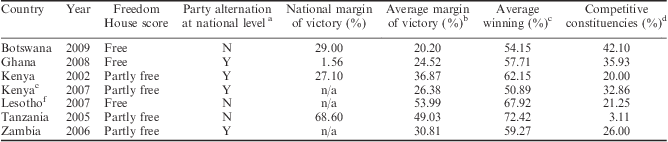
Tanzania, which holds elections in which opposition parties are legally allowed to run but have no reasonable expectation of electoral success, has an average margin of victory of approximately 50 per cent compared to Botswana's 20.2 per cent (see Table 3). Looking at the percentage of competitive constituencies, it has significantly fewer competitive constituencies (3.1 per cent) than Botswana (42.1 per cent). Botswana also outperforms Lesotho, another country considered to have a dominant party system. Ghana, a two-party system that has experienced party alternation at the national level between the National Democratic Conference and the National People's Party as a result of the 2000 election, experienced a similar average margin of victory to Botswana's but almost half as many competitive constituencies. Zambia, which experienced alternation in power from UNIP to the Movement for Multiparty Democracy rule as a result of its first democratic elections in 1991, exhibits a slightly higher average margin of victory (30.8 per cent) and fewer competitive constituencies (26 per cent). Kenya, rated as partly free, is an interesting case. The 2002 elections were considered relatively free and fair with an average margin of victory across constituencies of 36.9 per cent and approximately half (20 per cent) the competitive constituencies of Botswana. However, the 2007 elections, which were marred by significant post-electoral violence and allegations of vote rigging (and ultimately resulted in the adoption of a new constitution and new electoral laws) were seemingly more competitive, judging by the percentage of competitive constituencies (32.9). It is possible, though, that this number would have been even higher had vote rigging and electoral violence not occurred. Nonetheless, at the very least, we can observe that the competitiveness of elections increased from 2002 to 2007.
Competitiveness Across Six Sub-Saharan African Countries
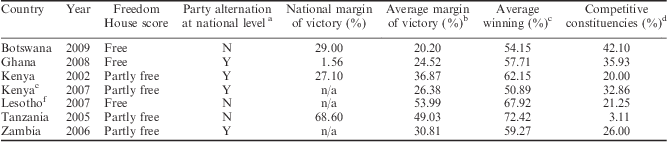
Notes: aDuring the country's tenure of democracy, has alternation occurred at the national level?
bCalculated as the percentage of vote received by the top vote-getter minus the percentage of the vote received by the second voter-getter. This is the average across all constituencies of a given country.
cPercentage of vote the winning candidate received averaged across all constituencies of a given country.
dPercentage of all constituencies that can be considered competitive where competitive is operationalized as a margin of victory that is less than or equal to 10 per cent.
eKenya's 2007 election was marred by significant violence and allegations of vote-rigging.
fLesotho adopted a mixed-member electoral system after the 1999 election. These figures are based on data from the constituencies that used the plurality electoral system.
According to average Polity IV scores – one of the most frequently cited measures of democracy – Tanzania is reported to be an autocratic regime, Kenya and Zambia are considered to be marginal cases that may or may not be moving towards democracy, while Botswana, Lesotho and Ghana are all considered to be democratic. Thus there appears to be no obvious connection between regime type, competitiveness and party system. The only tentative conclusion that could be drawn is that electoral competitiveness appears to be a trend that increases over time, regardless of party system.
Incumbency and turnover
It remains to be seen how incumbency advantage plays out in Botswana. For example, there was considerable legislator turnover between Botswana's 1994 and 1999 elections. In slightly more than 50 per cent of the constituencies, elections produced a new legislator. In only 16 of the 40 constituencies did a legislator win both the 1994 and 1999 elections. After the introduction of 17 new constituencies for the 2004 election, of the 16 previous incumbents, seven retained their seats in the 2004 election, three lost outright, and six legislative incumbents chose not to run again. So, in a dominant party system, only seven members out of 57 had served since 1994 or longer. In the 2009 election, approximately 46 per cent of constituencies experienced legislator turnover. There is some evidence that incumbency was also low in earlier elections: as of 1993, MPs had served an average of 11.7 years (or slightly more than two terms) in office (Charlton Reference Charlton1993). These figures indicate high levels of turnover and a lower rate of incumbency than is seen in the more established two-party and multiparty democracies (Cox and Katz Reference Cox and Katz1996; Mayhew Reference Mayhew1974).
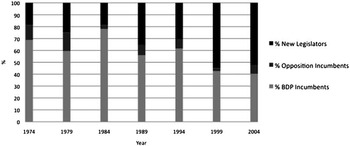
Figure 2 shows the percentage of incumbents returned to office during each election from 1974 to 2009. There is significantly more turnover and a lower rate of incumbency than is typically seen in the more established two-party and multiparty democracies (Cox and Katz Reference Cox and Katz1996). In the US, for example, incumbents win, on average, anywhere from 80 to 90 per cent of elections (Abramowitz et al. Reference Abramowitz, Alexander and Gunning2006). Compare this to the approximately 56 per cent found in Botswana's 2009 election. Furthermore, there has been a marked decline in the number of BDP and opposition party incumbents that have served in the National Assembly since 1974. This runs counter to many of the findings on incumbency advantage in US elections, which has been steadily increasing over the years (Cox and Katz Reference Cox and Katz1996; Mayhew 1974).
Turnover and Incumbency in Botswana

One can also point to significant defeats of incumbent candidates in Botswana's elections. During the 1994 election, three senior cabinet members were defeated: Archie Mogwe (mineral resources and water affairs); Kebathlamang Morake (agriculture); and Ray Molomo (education) (Wiseman and Charlton Reference Wiseman and Charlton1995). In the 2009 election, roughly 20 per cent of constituencies (11) saw an incumbent legislator defeated in the election. This includes both BDP and opposition party legislators.
These figures for Botswana can be compared to incumbency and turnover levels in Ghana, a country considered to be democratic in the procedural sense of the definition due to the turnover of political power from the National Democratic Congress (NDC) to the New Patriotic Party (NPP) in the 2000 election. The levels of incumbent re-election and defeat produced by each respective country's most recent election are virtually the same. The percentage of new legislators elected to office is also virtually the same. Thus, the accountability mechanism in Botswana appears to be operating in much the same way as the accountability mechanism in a more ‘traditionally’ defined democracy.
Party-level incumbency in Botswana adheres to more traditional understandings of electoral behaviour. In legislative elections held in 1994 and 1999, in 32 of the 40 constituencies, the same party won both elections. Due to the increase in constituencies, it is difficult to estimate with any certainty the level of incumbency success to the 2004 elections. Roughly speaking, 13 of the 40 constituencies experienced party alternation from election to election. The majority, however, saw the same party – that is not to say the same individual legislator – win all three successive elections. Between the 2004 and 2009 elections, 22 per cent of constituencies (or 13 out of 57) experienced party alternation.
It was possible to calculate incumbency advantage rates using Gelman and King's formula (Reference Gelman and King1990: 1153) in which incumbency advantage is defined as ‘the vote proportion gained by a party due to running an incumbent candidate in a district election’. The formula incorporates both the effect of the personal advantage afforded an incumbent candidate and the effect of the partisan advantage due to incumbent candidates generally being of higher quality than open seat candidates. Their equation is as follows:
 $$ E(v2) = a + {{B}_1}{{V}_1} + {{B}_2}{{V}_2} + {{B}_3}{{R}_2}\,*\,{{P}_2} $$
whereV 1=the percentage of vote received by one party (in this case the BDP) in time t1,
Incumbency and Turnover in Botswana and Ghana

Note: aMeaning that no incumbents ran for office.
V 2 = the percentage of vote received by one party (in this case the BDP) in time t2,
P 2 = 1 if the BDP wins election 1, and −1 if an opposition party wins, and R 2 = 1 if a BDP incumbent runs for election, 0 if no incumbent runs, and −1 if an opposition party incumbent runs.
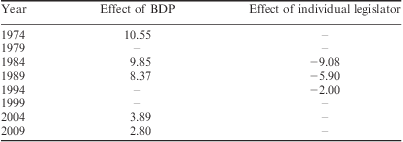
The regression results for the above equation can be found in Table 5 for each election year from 1974 until 2009. In some years (1979, 1989 and 1999) there were no significant incumbency advantages. In the years that incumbency was found to be significant, it demonstrates a noticeable decreasing trend over time. In the most recent election, the incumbency advantage associated with the BDP was approximately 2.8 percentage points, down from 10.5 per cent in 1974. Again, the literature on US incumbency advantage reports the opposite finding – that incumbency advantage has been increasing over time (Cox and Katz Reference Cox and Katz1996, Reference Cox and Katz2002).
Incumbency Advantage in Botswana's Elections, 1974–2009
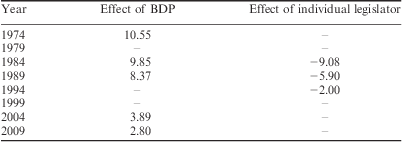
Note: Results based on linear regression estimates. Cells with – indicate insignificant findings.
Discussion
The above examination of Botswana's elections demonstrates that there is more competition and turnover produced by a dominant party system than might be expected. There is evidence of significant interparty and intraparty competition. Furthermore, the competitiveness of elections has been steadily increasing over time, and the number of incumbent legislators has been decreasing. Both of these are desirable trends and both suggest a deepening of democracy in Botswana. When compared to other sub-Saharan African democracies, elections in Botswana are substantially more competitive than those of its dominant party counterparts (Zambia and Tanzania) and marginally more competitive than a two-party democratic system (Ghana). Additionally, the level of legislator turnover in Botswana is roughly equivalent to that found in Ghana.
There are two main reasons why we care about competitiveness and turnover produced by democratic elections: responsiveness and accountability. As of the most recent election in 2009, almost one-half of Botswana's constituencies experienced competitive elections where the margin of victory was within a relatively tight range that suggests a relatively tight race. The competitiveness of elections at the constituency level should induce legislators to be responsive to voters’ demands. As the editor of the Botswana Gazette (2009) noted shortly after the election: ‘For those who won with narrow margins maybe it's a big signal of “displeasure” by the people and you have to harness your modus operandi to win the trust of the electorate for 2014!’
With regard to turnover, there are signs that this is also occurring. In the most recent election, incumbent legislators were defeated approximately 20 per cent of the time. Turnover as the result of incumbent defeat represents, in its purest form, the accountability mechanism of elections. This turnover is in addition to the turnover that is produced by the primary system. Thus it seems that a ‘dominant party system’ is approximating the kind of democratic outcomes that, theoretically, signify substantive democracy.
There are two conclusions from the above analysis that have implications for how we approach the study of elections and democracy. First, the dominant party label may not be as useful as previous research has suggested. It is an ambiguous label that masks important levels of competition and turnover. Second, looking at subnational variation in electoral outcomes provides us with a more refined measure of electoral competitiveness than aggregate-level election returns and is able to reveal more information about the nature and quality of elections.
Finally, there are democratic implications related to how we analyse elections and at which level(s) we measure and observe electoral outcomes. Should we focus on national-level outcomes only or incorporate subnational electoral trends when analysing and assessing elections? Furthermore, is competition an indicator of democracy or its byproduct? If competition was low or declining, would this affect our assessment of Botswana's regime type? Perhaps the focus for scholars should be to examine the causes of subnational electoral competitiveness and to find ways to induce more competitiveness. If in a first-past-the-post system with a fragmented opposition competition is still occurring and increasing, we need to be looking at ways to account for and encourage these trends.