Introduction
Though Captain Robert Falcon Scott and his Norwegian rival Roald Amundsen never met, certain crew members of Scott's Terra Nova had an unexpected encounter in Antarctica with Amundsen and the men of his ship Fram. This meeting occurred on 4 February 1911, when Terra Nova left the British base of Cape Evans to sail along the coast to find a suitable location on King Edward VII Land for the British ‘eastern party’, a six-man team led by Lieutenant Victor Campbell, to establish their own separate base for exploration. This plan had to be altered (and Campbell's party renamed as the ‘northern party’) when Terra Nova could not land directly on King Edward VII Land due to an absence of suitable landing-places: their last hope of gaining a base in that area was destroyed when they entered the ‘Bay of Whales’, 100 nautical miles away, to find to their surprise that Amundsen had unexpectedly established the Norwegian expedition base, Framheim, in that location.
British expedition member George Abbott remarked in his journal for 4 February that the British ‘would have landed in the Bay of Whales, as it was the only possible place to land stores etc along the Barrier; but of course as the Norwegians are there we are leaving them a clear field’ (Hooper Reference Hooper2011: 84). Expedition doctor G.M. Levick confirmed Abbott's verdict in his own journal: ‘[T]he “Fram” is in possession of our only possible landing place on the Barrier, and we have therefore to give up the idea of landing on it’ (Levick Reference Levick2012: 70). Though Amundsen offered the British the chance to remain in the area alongside the Norwegians, Campbell had to decline. Two separate expeditions in the same region risked the wasteful duplication of surveying and scientific results, whilst a British-Norwegian collaboration risked being perceived negatively back in Britain as Campbell's having given assistance to Scott's foreign rivals for the south pole. Neither scenario was in the British interest, so Campbell had no realistic choice but to distance himself from Amundsen and find a new area to explore.
The writer Roland Huntford in his double-biography Scott and Amundsen, also alternatively titled The last place on earth (Huntford Reference Huntford1979, Reference Huntford2002), relates an anecdote that during the Norwegian-British meeting Lieutenant Campbell deliberately misled Amundsen about the British expedition's progress across the Great Ice Barrier; from this, some writers have inferred that this ultimately led Amundsen to make a misjudgement in starting his own polar trek unfeasibly early in September 1911. Huntford can read Norwegian, and consulted the original journals of Fram's crew members. Polar scholars who could not visit the Norwegian archives were hence at a disadvantage when writing on Amundsen, and for decades Huntford's narrative has been the chief source for English-language factual information on the Fram-Terra Nova encounter. However, in 2011 the Fram Museum published an unabridged English translation of Amundsen's expedition journal, and Norwegian-language editions of other Fram expedition members’ journals, all edited by Geir O. Kløver. Thanks to this initiative, readers are now able to examine the Norwegian side of the encounter using primary sources. The ‘terra firma’ tale is at present given no substantiation from a contemporary British or Norwegian archive source: furthermore the encounter, if it even happened, cannot have negatively affected Amundsen's plans. This myth, therefore, should be removed from future factual accounts of the expeditions.
The ‘terra firma’ tale
Huntford relates a narrative of Campbell's being so bitter at the Norwegians’ arrival in the Bay of Whales that he determined upon revenge. According to this story, Campbell decided to play a psychological game with Amundsen when the latter made enquiries about the British expedition's transportation:
Campbell was in a mood of bitter dejection at the collapse of all his hopes… He took Amundsen's question about the motor sledges as an opportunity to vent his feelings. ‘One of them,’ he said enigmatically, ‘is already on terra firma.’ Campbell was thinking of the sledge reposing at the bottom of McMurdo Sound. But Amundsen, as indeed was the intention, understood it to mean that the sledge had already crossed the Barrier and possibly reached the Beardmore Glacier. The Norwegians were silent for a moment, neither requesting nor receiving elucidation. Shortly afterwards, they rose to leave (Huntford Reference Huntford1979: 345, Reference Huntford2002: 330)
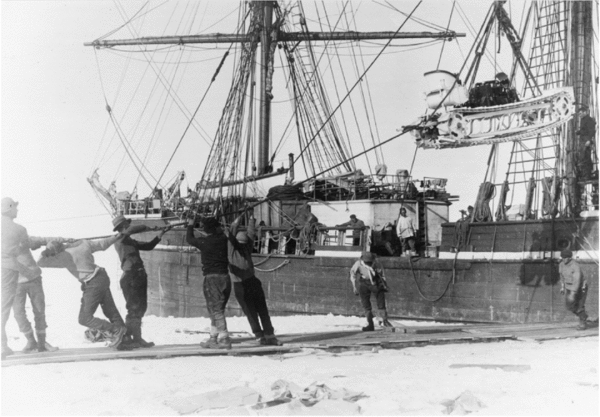
According to this, Campbell had in mind the British expedition's unfortunate loss of one of the three experimental motor sledges (Fig 1), which broke through thin ice during unloading from Terra Nova on 8 January 1911 and was irretrievably lost at the bottom of McMurdo Sound (Scott Reference Scott1913: 73–74). However, Campbell apparently intended (‘as indeed was the intention’) to frighten Amundsen with a mysterious statement which played upon the Norwegian polar explorer's general understanding of the Great Ice Barrier as nothing but ice, with ‘terra firma’ (solid ground, in this case a rock foundation) beginning again at the Beardmore Glacier, 437 miles into the continent's interior. This story of Campbell's statement, and its mistaken reception by Amundsen, has been repeated in secondary historical narratives as recently as 2012:
King, P. (editor) Scott's last journey (1999): Due to a misunderstanding the Norwegians were given the impression that Scott's motor sledges, whose value Amundsen over-rated, were already operating and might have reached the Beardmore Glacier (King Reference King1999: 78)
Langner, Scott and Amundsen: duel in the ice (Reference Langner2007): Casually, Amundsen asked about the motorised sledges. ‘One of them,’ Campbell replied, ‘is already on terra firma.’ This worried Amundsen; if one sledge was already on dry land, that must mean that it had been used successfully on the ice, and had perhaps already reached the Beardmore Glacier (Langner Reference Langner2007: 132)
MacPhee, Race to the end (Reference MacPhee2010): ‘One of them,’ [Campbell] replied in reference to the sledges, ‘is already on terra firma’. Amundsen and his men fell silent… Why not let Amundsen and his men consider the implications of a petrol-powered sledge speeding off to the Pole, even if it was a fantasy? Sniggering over their slender psychological victory, Campbell and his men turned Terra Nova onto a course back to McMurdo Sound (MacPhee Reference MacPhee2010: 92)
Thyvold, Roald Amundsen (Reference Thyvold2010): [The Norwegians] were told that one of [the sledges] was already on firm ground, which they took to mean that the British Party had already crossed the formidable Ross Barrier and was now on the [Antarctic] continent proper… The truth was that the British officer concerned had chosen his words with care. One of the sledges had gone through the ice and was resting on the seabed, which was technically terra firma. Deceitful though it was, this unwelcome news… shocked the Norwegians (Thyvold Reference Thyvold2010: 39–40)
Knopp, Der Wettlauf zum Südpol (Reference Knopp2012): When Amundsen casually inquired about the snowmobiles, the Englishman replied ambiguously that one of them was already on ‘terra firma’, on solid ground. Campbell meant the sledge which had sunk in McMurdo Sound… But his rival was able to understand this as if a sledge might already have conquered the ice barrier and advanced to the polar plateau [Als Amundsen sich beiläufig nach den Motorschlitten erkundigte, entgegnete der Englander vieldeutig, dass einer von ihnen bereits auf ‘terra firma’, auf dem Festland, sei. Campbell meinte den Schlitten, der im McMurdo-Sund versunken war… Doch sein Gegenüber konnte es so verstehen, als ob ein Schlitten womöglich bereits die Eisbarriere überwunden hätte und zum Polarplateau vorgedrungen wäre] (Knopp Reference Knopp2012: 119–120)
Turney, 1912: the year the world discovered Antarctica (Reference Turney2012): [Amundsen] asked Campbell about [the motor sledges] and the reply did nothing to calm his fears: one of them was already on ‘terra firma’. Campbell was referring to the sledge lost on the seabed, but he was not going to give the Norwegian the satisfaction of knowing it. Amundsen and his men reportedly fell silent (Turney Reference Turney2012: 121)
Herbert Ponting. Getting the ill fated caterpillar tractor off the ship, 8 January 1911. Image copyright Royal Geographical Society, London.

The earliest source I can find for this tale is Huntford's Scott and Amundsen (Reference Huntford1979). I can at present find no account in Norwegian or British contemporary eyewitness accounts of this Campbell-Amundsen conversation, nor any pre-1979 account which supports the statement that Amundsen ‘understood [the phrase ‘terra firma’] to mean that the sledge had already crossed the Barrier and possibly reached the Beardmore Glacier’ (Huntford Reference Huntford1979: 345, Reference Huntford2002: 330). Indeed, Amundsen's journal entry for 4 February 1911 notes no displeasure at the British party's behaviour: ‘They were exceptionally amiable’ (Kløver Reference Kløver2010a: 135). It is difficult to understand Amundsen's using such an unambiguously positive phrase for Campbell's behaviour had Campbell behaved in the manner described in Huntford's narrative. The reported silence from the Norwegians is also objectively puzzling. One would expect the intelligent and pragmatic Amundsen to ask for further clarification regarding this enigmatic ‘terra firma’ comment, rather than remaining silent and indulging in distressing mental speculation.
Furthermore, the diary kept by the Fram’s captain, Thorvald Nilsen, reveals that on 4 February 1911 the Norwegians knew from the British that ‘They [the British] have lost their best automobile 200 fathoms down through the ice’ [De havde paa isen paa 200 favne mistet sin bedste automobil] (Kløver Reference Kløver2011a: 105). This is corroborated by the journal of Fram crew member Ludvig Hansen, who states that the British expedition brought ‘dogs, horses and 3 automobiles’ [hunder, hester og 3 automobiler] and adds, ‘They lost the best of their cars in the ice’ [Den beste av bilene hadde de mistet i isen] (Kløver Reference Kløver2011b: 44). These journal entries accurately record what had occurred at Cape Evans on 8 January 1911. Scott himself corroborates this being the ‘best’ motor sledge in his own journal entry for 8 January: ‘it's a big blow to know that one of the two best motors… now lies at the bottom of the sea’ (Scott Reference Scott1913: 73). As historian Katherine Lambert remarks, with regards to Nilsen's journal entry concerning the lost motor sledge, ‘Amundsen must have been profoundly relieved to hear this snippet of news’ (Lambert Reference Lambert2002: 50).
However, the absence of this information from Huntford's narrative could allow the reader to assume that Amundsen was never told this news, and that Campbell's enigmatic remark about a sledge being ‘already on terra firma’ automatically triggered Amundsen's belief that its destination was the foot of the Beardmore Glacier rather than the sea-bed. Huntford has unquestionably consulted Nilsen's diary: he quotes, and accurately translates, Nilsen's 4 February 1911 comment on the Terra Nova, ‘I must confess it did not look very inviting’ [Jeg maa tilstaa det saa ikke svært indbydende ut] (Kløver Reference Kløver2011a: 105–106; Huntford Reference Huntford1979: 344, Reference Huntford2002: 329). However, Huntford appears to have overlooked Nilsen's 4 February 1911 comment about the best British ‘automobil’ having been lost 200 fathoms down. This is a serious oversight, as it is impossible to believe that the men would not have communicated this highly encouraging news of the British motor sledge's loss to their leader Amundsen. If Amundsen had even for a moment believed that a British motor sledge being located on ‘terra firma’ might have meant the foot of the Beardmore, the news of their rivals’ specific misfortune would have corrected this misconception immediately.
One must ask, furthermore, why Amundsen would have automatically leapt to the conclusion that a throwaway reference to ‘terra firma’ must have meant, not the rock foundation of the British bases at Cape Evans and Hut Point (the simplest and most obvious conclusion), but the rock foundation of the foot of the Beardmore Glacier 437 statute miles away, and that one of Scott's motor sledges must have already travelled across the Great Ice Barrier to reach the foot of the Beardmore Glacier. (The distance here is calculated from the British expedition member William Lashly's tables, found in his 1911 journals: he calculated the distance from Cape Evans to Lower Glacier Depot to be 379.5 geographical miles (Ellis Reference Ellis1969: 141), which translates to 437 statute miles.)
To believe this, Amundsen would have had to have leapt to the far-fetched conclusion that the entire 874-mile round trip to and from the Beardmore Glacier could have been completed in slightly over three weeks. Since the British had landed at Cape Evans on 4 January 1911 and Campbell had left base on 28 January, the British party would have had to have made a 437-mile journey from Cape Evans on 4 January across the Great Ice Barrier in 12 days to reach the Transantarctic Mountains on 16 January. (This hypothetical departure date of 4 January is predicated upon the further unlikely assumption that, upon landing at Cape Evans, the British had not even stopped to take stock and explore their immediate surroundings for potential hazards, but that Scott had instead sent men off that same day across the Great Ice Barrier with pre-packed supplies on motor sledges.) With the journey to the Beardmore completed in a mere 12 days, and with one motor sledge left at the Beardmore's foot, the British would have needed to transfer across to an accompanying motor sledge, then make the 437-mile return journey back to base within 11 days in order to give Campbell this news on 27 January at the latest, before the Terra Nova departed from base in the early hours of 28 January to sail up to King Edward VII Land. To complete a round trip of 874 miles in 23 days would require these motor sledges to have been travelling at a constant speed of 38 miles per day, without delays caused by mechanical/servicing needs, poor weather, detours necessitated by crevasses, or erroneous navigation. (Dog-teams could not have assisted in this hypothetical journey of 4–27 January 1911 to the Beardmore and back: Scott's dogs had just endured months of sea travel with little exercise, and needed training on land to get them used to working in teams.) Furthermore, an interview with Terra Nova expedition engineer Bernard Day in September 1910 gives the true capabilities of the motor sledges: ‘Their top speed is 3 1/2 [3.5] miles per hour, being designed for walking speed only, as the party will travel on foot’ (Sydney Morning Herald, 19 September 1910: 8). The sledges were designed to cover a realistic distance for walkers, 15–20 miles per day at the most, so the notion that an Edwardian-era motor sledge in the polar regions could have successfully covered 38 miles per day for 23 consecutive days is not credible.
Moreover, from the words ‘one of them is already on terra firma’ Amundsen would have had to have taken the meaning that the British would have taken a motor sledge out to the Beardmore Glacier only to have then left it there, subject to extremely low temperatures over the Antarctic winter. Unless the motor sledge had broken down irreparably (something which would surely have cheered Amundsen), it is hard to understand the rationale for not taking the motor sledge back to base. Indeed, by employing two experimental motor sledges immediately in January 1911, using up the expedition's limited stocks of fuel and spare parts to send these sledges off on an arguably frivolous test mission, Scott would have been risking the loss of useful transport for his crucial polar journey starting in October–November 1911. It is difficult to see why Amundsen would have immediately leapt to the conclusion that Scott would have acted in this way.
The terra firma tale is fundamentally illogical when examined closely, yet in polar history it has been used to present Amundsen as deeply concerned about this misleading message, even to the extent of his judgement being affected. In both his double-biography (Huntford Reference Huntford1979, Reference Huntford2002) and in his compilation of selected extracts from British and Norwegian expedition journals, Race for the South Pole (Huntford Reference Huntford2010), Huntford depicts Amundsen as deeply worried about the British motor sledges:
A terrible fear had exploded in Amundsen. Might the motor sledges not at the last moment rob him of the victory? Would the cunning of some faceless technician yet destroy the dedication of a lifetime? (Huntford Reference Huntford1979: 345, Reference Huntford2002: 331)
The one doubt was those motor sledges of Scott’s. Amundsen never spoke of them, nor did he encourage discussion, but they were beginning to prey on his mind (Huntford Reference Huntford1979: 359, Reference Huntford2002: 344)
Underneath the self-confidence ran the worry about Scott, or rather Scott's motor sledges. As winter waned and the sense of time passing welled up, Amundsen began to fret over the dangers of being beaten to the post […] He could almost hear the English motor sledges stuttering far ahead over the Barrier already on the way to the Pole (Huntford Reference Huntford1979: 392, 393, Reference Huntford2002: 375, 376)
Not only Amundsen, but also his companions, were now growing restive beneath their habitual calm. They imagined Scott's motor sledges, impervious to the weather, already on their way (Huntford Reference Huntford2010: 30)
[A] dismal atmosphere… was not helped by the threat of Scott, or rather his motor-sledges, that continued to haunt the hut at the Bay of Whales (Huntford Reference Huntford2010: 50)
Huntford states in his double-biography that ‘Amundsen never spoke of [the motor-sledges]’ and offers no quotations to support the claim that Amundsen was concerned by the British motor sledges. Indeed, Huntford even appears to contradict himself elsewhere in his 2010 book, when he states of Amundsen's preparations:
Amundsen had a technical bent, but understood the limitations of technology. He eschewed motorized snow transport, because it was still too unreliable, and in the polar environment, at the limits of survival, he could not accept another risk, so he stuck to the proven method of dogs and skis (Huntford Reference Huntford2010: 14)
Huntford appears to be stating here that Amundsen in 1910 had made a decision not to bring motorised vehicles for his expedition, judging them ‘too unreliable’. Such a conclusion tallies with Tor Bomann-Larsen's biography of Amundsen, which states that Amundsen had been approached by two separate engineers, both offering the concept of specially-designed motor sledges, and that Amundsen had not taken up these offers (Bomann-Larsen Reference Bomann-Larsen2011: 62). With regard to Scott's three motor sledges, modern research indicates that a wealthy patron, Lord Howard de Walden, backed their development and allowed Scott use of them for his expedition (Seymour Reference Seymour2012: 9). Scott's experimental motor sledges were therefore a supplement to his main transport of ponies and dogs, and it would be erroneous to suggest that Scott relied primarily upon them.
In 1910, polar mechanized transport was still in its infancy. Ernest Shackleton had famously brought a motor car, a ’12–15 horsepower New Arrol-Johnston’, to Antarctica during his 1907–1909 Nimrod expedition (Shackleton Reference Shackleton2000: 15), but it was used only for short local journeys around base. Shackleton's own verdict in his 1909 expedition memoir was: ‘The trials of the motor car… had proved that it could not travel over a soft snow surface (…) I was satisfied that, with the Barrier in its then condition, no wheeled vehicle could travel over it’ (Shackleton Reference Shackleton2000: 159, 160). It is also possible that, before his departure from Norway in August 1910, Amundsen had heard of the return to France in June of the French explorer Jean Charcot, and his failed attempt to use motorised sledges in Antarctica during his 1908–1910 Pourquoi-Pas? expedition: due to Adelaide Island's irregular surface, the motorised sledges could not be used and ‘all the journeys were made by sea or on foot’ (Aubert and others Reference Aubert, Skelton and Frenot2014: 35). Shackleton's and Charcot's unsuccessful precedents undermine the proposition that Amundsen in 1911 should have reacted with immediate fear to the news that Scott had brought motor vehicles.
Amundsen's own contemporary record must be taken as the most reliable indication of his mindset and emotions. When Amundsen mentions the British motor vehicles in his contemporary expedition journal, it is not with concern but with scepticism that they will be able to travel any great distance:
[13 February 1911] For us on skis it was the most wonderful going. How men and horses will get along on this kind of surface is beyond me. Not to mention automobiles (Kløver Reference Kløver2010a: 137)
This journal entry was unfortunately not included in Huntford's Race for the South Pole. Amundsen's words, ‘Not to mention automobiles’ (‘Automobil ikke at tale om’ (Kløver Reference Kløver2010b: 134)), indicates that Amundsen, in February 1911, believed Scott's motor vehicles [‘automobiles’] to have been even less of a threat to his polar plans than Scott's ponies [‘horses’]. This journal entry indicates that if Campbell ever had hinted at the motor sledges’ impressive progress to Amundsen on 4 February, nine days afterwards Amundsen was evidently unconcerned by Scott's motor transport.
Indeed, the specific vocabulary used at the time by Amundsen, Hansen and Nilsen (automobil(er): motor car(s) and bilene: cars) in preference to the more usual phrases motorslaeden or motoriserte sleder (motorised sledges) may even indicate that the Norwegians had a false mental picture of Scott's vehicles. In March 1910 Scott visited Fefor in Norway to test his newly-designed motor sledges, which were described in the contemporary Norwegian-language media as ‘Motorslaeden’ (for example Morgenbladet (Oslo, Norway) 1 March 1910: 2, 7). However, in contemporary records Amundsen and his men use Norwegian-language vocabulary which usually refers to motor cars. Why did the Norwegians not use the specific vocabulary indicating motor sledges? My hypothesis is that the Norwegians misunderstood British conversations, and, in the absence of visual aids, erroneously concluded that Scott had brought motor cars instead of motor sledges. Polar researcher Sarah Airriess has pointed out (personal communication, 15 March 2015) that the British sometimes used the word ‘car’ amongst themselves to describe a motor sledge (Cherry-Garrard Reference Cherry-Garrard1994: 94, 322–323, 332). It is therefore feasible that the Norwegians heard the British using the word ‘car’ in reference to their vehicles and believed Scott to have brought, not newly-designed motor sledges with caterpillar treads, but wheeled motor cars. Shackleton's motor car had proved of little use in the polar regions in 1909; if Amundsen believed that Scott had followed Shackleton's precedent and brought motor cars to the Antarctic, his dismissive tone towards Scott's ‘automobil’ in his journal becomes even more understandable.
However, Huntford does not address the Norwegians’ specific vocabulary or the possibility of Amundsen's having had a flawed understanding of Scott's vehicles. He presents instead the narrative that Amundsen clearly understood these vehicles to be motor sledges, and that Amundsen was deeply concerned by Campbell's enigmatic ‘terra firma’ comment. This argument has the effect of mitigating Amundsen's later behaviour. Specifically, it helps excuse his rash decision to set off to the Pole as early as 8 September: in the event, the extreme cold caused some debilitation in the party and necessitated a premature return to base. One writer has already made an explicit connection between Campbell's earlier words and Amundsen's later actions: ‘Deceitful though it was, [Campbell’s] unwelcome news so shocked the Norwegians that, a few months later, their own expedition nearly came to grief as a consequence’ (Thyvold Reference Thyvold2010: 40). In narrative terms, the suggestion that Campbell's comment triggered Amundsen's later misjudgements makes Amundsen appear a victim, and places the ultimate blame upon Campbell for having engaged in deception.
One may witness this neat dramatic structure in action in the dramatist Trevor Griffiths’ screenplay of Huntford's book, televised in 1985 as The last place on earth (Griffiths Reference Griffiths1985) and subsequently published as Judgement over the dead (Griffiths Reference Griffiths1986). First comes the scene between Amundsen and Campbell at Framheim:
AMUNDSEN: I was noting the absence of motorsledges. I imagine Scott has use of them for his principal work.
CAMPBELL: That's right. (PAUSE. AMUNDSEN WAITS FOR MORE. CAMPBELL KNOWS IT) As a matter of fact, we have already put one of them on terra firma.
Amundsen looks away, towards the Barrier and the distant sky-line (Terra Firma? Ross Island? The Beardmore Glacier?) Campbell watches closely (Griffiths Reference Griffiths1986: 147–148)
In the television series (though not in the published script) there follows Amundsen's rumination to a companion that the British ‘have a motorsledge on terra firma. Does that mean on the land four hundred yards from the ship, or four hundred miles further south, on the Beardmore Glacier? It's all ice between’ (Griffiths Reference Griffiths1985). Later Amundsen is seen attempting to sleep whilst the words ‘one of the motor sledges is already on terra firma… terra firma… terra firma’ resound in his head (Griffiths Reference Griffiths1985). In the published script, this scene is described as ‘Amundsen dreams… Campbell's face appears. Out of synch, he says, “One of the motor sledges is already on terra firma…”’ (Griffiths Reference Griffiths1986: 152). In this way the drama encourages the audience to associate the phrase ‘terra firma’ with Campbell's deception and the consequent disturbance of Amundsen's rest. The dramatic payoff comes in a speech by Amundsen to his men in June 1911, where he uses a relief map to explain his decision to make ‘the earliest possible start in September’. Here Amundsen states: “Scott has motors, three of them: one… possibly already here (HE POINTS TO THE FOOT OF THE BEARDMORE) four hundred miles south… on terra firma” (Griffiths Reference Griffiths1986: 170).
From this dialogue (which in the drama is silently accepted by the crew, not questioned or challenged) it would appear that Griffiths’ fictionalised Amundsen is impractical enough to believe that, upon arriving at the Beardmore Glacier on their polar journey in late 1911, the British would have been able to successfully dig out a motorised sledge which had been left standing on ice for at least nine months. Furthermore, from the stress laid on the motor sledge's ‘already’ being there, Amundsen's assumption appears to be that the motor sledge's flathead combustion engine would have easily started into life again (without modern antifreeze) despite such long exposure to extreme Barrier temperatures. The ‘terra firma’ myth requires its audience to believe in Amundsen's genuinely worried reaction to Campbell's maliciously misleading statement. Remove the story of Campbell's successful deception of Amundsen from the record (since Amundsen's own journal is openly dismissive of the British ‘automobiles’) and Amundsen is consequently given no external impetus to justify his too-early start for the pole.
Without this sympathetic explanation for Amundsen's actions, posterity's judgement becomes a little harsher on Amundsen, as this error nearly led to a Norwegian death, that of Lieutenant Kristian Prestrud. After the decision was taken to abandon this first attempt and return to base, Prestrud, suffering from a frostbitten heel, was left behind alone on the Barrier on 16 September by his leader Amundsen (who joined the fastest sledge back to base). Prestrud's dogs failed (Bonmann-Larsen Reference Bomann-Larsen2011: 103): it was fellow expedition member Hjalmar Johansen's independent decision to wait behind for Prestrud, and his care in bringing him back to base eight and a half hours after Amundsen's arrival, which in Huntford's words ‘probably saved [Prestrud’s] life’ (Huntford Reference Huntford1979: 410, Reference Huntford2002: 392). Amundsen later justified himself in his journal by stating that he had not known of Prestrud's frostbitten heel, and that had he done so, he would have sent Prestrud on ahead (Kløver Reference Kløver2010a: 284). However, Amundsen as leader should have made it his priority to organise matters to ensure that the slowest party was not left behind alone. Instead, by joining the fastest sledge and leaving men behind him he allowed the retreat to become, in Huntford's description, ‘every man for himself, a flight, pell-mell, from the cold’ (Huntford Reference Huntford1979: 409, Reference Huntford2002: 391).
Johansen upbraided Amundsen publicly for his actions the following day. Amundsen took offence, and at first reacted by excluding Johansen not only from his polar team but from the expedition completely, writing in his journal on 20 September, three days after Johansen's and Prestrud's return, ‘Naturally after what has taken place, he is completely barred from the 3rd Fram voyage’ (Kløver Reference Kløver2010a: 285). Later, Amundsen allowed Johansen, as a ‘private person’, to take part in a separate expedition to King Edward VII Land, but he placed Johansen (an experienced polar veteran who had accompanied Fridtjof Nansen in the Arctic) in a subordinate position to the inexperienced Prestrud in a three-man team (Bomann-Larsen Reference Bomann-Larsen2011: 104). The intention appears to have been to humiliate Johansen. For Amundsen to crush Johansen for his outburst suggests insecurity: when one considers what Johansen had done for him and his expedition, it suggests a lack of proportion as well. In September 1911 Amundsen had unquestionably made a serious error in leaving Prestrud alone on the Ice Barrier to fend for himself, and had Johansen not saved Prestrud's life the young man's death would certainly have cast a shadow over Amundsen's expedition and led to uncomfortable questions for Amundsen upon his return to civilisation. Properly seen, Johansen deserved to be thanked for rescuing Prestrud, not excluded or belittled. However, if one believes that Amundsen's mental state in September 1911 had been seriously affected by Campbell's supposed ‘terra firma’ deception back on 4 February, then one might be inclined to make allowances for Amundsen's actions even at this point.
The ‘terra firma’ myth is hence remarkably versatile: by presenting Amundsen as the misled victim of Campbell's malice, it implicitly blames Campbell for having triggered Amundsen's most serious misjudgements. However, the real-life Amundsen was not misled in September 1911. Back in February the Norwegians knew that ‘the best’ of the British vehicles was not at the Beardmore, but on the sea-bed. Therefore those who wish to find a sympathetic explanation for Amundsen's ‘false start’ cannot claim that the British-Norwegian meeting of 4 February 1911 could have directly impaired Amundsen's plans for the south pole. With regard to his own motivation, Amundsen states in his journal entry for 17 September 1911 that his early start lay in the fact that, after assessing previous Antarctic meteorological data, he thought the temperatures might improve upon journeying further south. ‘When I decided to go southwards so early in September, it was because I thought it possible that we could find better temperatures in on the barrier than here… We couldn't know without trying’ (Kløver Reference Kløver2010a: 284). Amundsen's motivation for starting early is explicitly expressed here: his stated reason is unusual, given that inland temperatures are usually lower than those on the coast, but he does not mention any concern over the British vehicles.
It is most probable that the fundamental reason for Amundsen's departing so early was that he had to reach the pole before Scott. He had not declared his plans openly in advance, but had allowed everyone to believe until the last possible moment that he was proceeding to the Arctic. Had Amundsen failed to beat the British to the South Pole after this deception, he would have lost both money and reputation. It is understandable that his determination to be first at the pole led Amundsen to make some errors; however, the ultimate blame for Amundsen's ‘false start’, and its aftermath, cannot reasonably be placed on a ‘hidden motivation’ of deep concern over Scott's possession of motor sledges.
On the hazards of attributing ‘hidden motivations’ without evidence, and of using unsourced anecdotes in a historical study
At present the story of Campbell's deliberately misleading statement to Amundsen (‘one of them is already on terra firma’) appears to be an unsourced anecdote. However, the following is clear from the evidence:
1) From contemporary records, the Norwegians knew on 4 February 1911 that one of three British motor vehicles was on the sea-bed, having been lost through thin ice, and was therefore not at the Beardmore Glacier;
2) Contemporary Norwegian journals, including Amundsen’s, use the words automobil(er) and bilene, both usually terms for motor cars, to describe the British motor transport, which suggests that the Norwegians erroneously believed that the British had brought motor cars (previously unsuccessful in Antarctica) rather than motor sledges;
3) It is unrealistic to suggest that a knowledgeable polar explorer in 1911 would have readily believed that a Edwardian-era motor vehicle, either a car or a sledge, could have successfully covered 874 miles in polar conditions within a mere 23 days.
The element of identifiable myth lies in many modern secondary historians’ attribution to Amundsen of a supposed sincere belief, as a result of his meeting with Campbell, that the British motor sledges posed a serious threat to Norwegian plans for the pole. This appears to have originated with Huntford's Reference Huntford1979 narrative, which states that ‘a terrible fear had exploded in Amundsen’ and that the British motor sledges ‘prey[ed] on his mind’, though Amundsen's own journals do not indicate such concern. This attribution to Amundsen of a hidden motivation (fear of the motor sledges) has had some impact: even polar historians who do not explicitly repeat the ‘terra firma’ tale have used Amundsen's supposed fear of the British motor sledges as an explanation for his false early start (for example Crane Reference Crane2006: 510; Bomann-Larsen Reference Bomann-Larsen2011: 102; Hooper Reference Hooper2011: 155), and such an explanation has the effect of implicitly excusing Amundsen's actions, placing ultimate blame on distress supposedly caused by his British rivals’ new technology. The attribution of impaired judgement to Amundsen hence effectively distracts from an objectively critical analysis of his errors: his decision to leave too early for the pole in bitter weather; his leaving many of his men behind on the Ice Barrier instead of organising their safe return to base; the near-death of Prestrud, and Amundsen's subsequent overly harsh treatment of Prestrud's rescuer Johansen.
This example is a clear demonstration of the importance of perceived motivation when forming a judgement, and indeed the practice of history often involves the historian's attempting to ascribe psychological motivation for a historical figure's actions. As historian John Tosh remarks:
[T]he historian also requires imagination. This term… is not intended to convey the idea of sustained creative invention… The point is rather that any attempt to recreate the past presupposes an exercise of imagination, because the past is never completely captured in the documents which it left behind… Matters of motive and mentality frequently fall into this category (Tosh Reference Tosh2002: 158–159).
What is needed is certainly not invention (the preserve of fiction), but rather an empathetic approach that is consistent with, and clearly references, the available primary documentation. Readers of history enjoy the reassurance and sense of intimacy which comes with an explanation of a historical figure's reasoning: consequently, historians are often driven to ‘make sense’ of their subjects’ actions by speculating on their thought-processes during crucial events. However, the biographer's attribution of a ‘hidden motivation’ to their subject often carries greater moral weight than readers may realise. An instance of unworthy behaviour can often be excused by citing mitigating circumstances; conversely, an apparently noble action can be rendered despicable if a base or criminal motivation is proposed. Hence explicit reference to primary evidence when suggesting motivation helps ensure that any proposed ‘hidden motivation’ is as consistent as possible with both context and the subject's general character.
One example, I would suggest, of an erroneous and arguably detrimental ‘hidden motivation’ would be Huntford's charge that Scott silently urged the frostbitten Captain Lawrence Oates to kill himself (‘Poor Oates, indeed. He sat there in the tent, Scott staring at him, with the unspoken expectation of the supreme sacrifice’ (Huntford Reference Huntford1979: 535, Reference Huntford2002: 549)). There is no documentary evidence from eyewitnesses to support this scenario: Huntford later stated that here he had used not written archive evidence but his ‘intuition’ (Fiennes Reference Fiennes2004: 418). Huntford's unsubstantiated ‘intuition’, that Scott stared at the suffering Oates expecting him to make ‘the supreme sacrifice’, gives the reader a poor impression of Scott's morality. It also distracts from the fact that after Oates’ disclosure of his frostbitten foot (from 2–16 March 1912) Scott still made every effort to keep Oates as part of the polar party. This gave Oates the best chance of being rescued by the dog-teams expected to come out from base to intercept the polar party on the Great Ice Barrier according to Scott's written orders of October 1911 (Evans Reference Evans1949: 186–188; May Reference May2012). Unfortunately Huntford's book erroneously presented Scott's early written orders of October 1911 as last-minute verbal orders dated January 1912: Huntford stated incorrectly that these orders were not only never written down but that they were ultimately never delivered to base, which gives the reader the inaccurate impression that the men at base in February 1912 were wholly ignorant of Scott's wishes for the dog teams to come out to meet the polar party. However, when Scott's written orders of October 1911, and his evident anticipation of the dog teams’ arrival (shown in entries in Scott's own journal), are reinstated within the narrative, this new information gives a more accurate insight into Scott's thought processes during March 1912. Scott allowed the frostbitten Oates to remain in the party because he apparently hoped that the dogs would arrive from base in time to meet them. Far from wanting Oates dead, it appears that Scott and his companions risked their own safety and timely progress because they were motivated by a wish for Oates to survive. Indeed, Huntford's ‘intuition’ that Scott silently shamed Oates into committing suicide does not take into account the written testimonies of Dr Edward A. Wilson, a member of the polar party who asserted in his last letters to friends and family that the expedition's ‘record is clean’ (Lane and others Reference Lane, Boneham and Smith2012: 48–49, 53, 58–59)). Wilson, a devout Christian, was unlikely to have misrepresented the party's collective moral record with death imminent. Clear reference to contemporary documents hence offers a more solid approach than unsubstantiated ‘intuition’.
Since Huntford has ascribed a motivation to Amundsen of ‘a terrible fear’ of the British motor sledges, and underpinned this with the Campbell-Amundsen conversation, it is imperative to locate the earliest primary evidence source for the Campbell-Amundsen conversation. Where did it come from? In his original edition of 1979 Huntford included some references and endnotes, though no primary evidence is cited for the ‘terra firma’ story. Sadly, the 1979 references and endnotes were removed in the subsequent editions of 1983 and 1999. In his 1979 bibliography Huntford stated that he had consulted collections and archives in Europe, Canada, the USA, South America, Australia and New Zealand, and cited publications, documents and newspaper archives in several languages: English, Norwegian, Swedish, Danish, French, German, Italian and Brazilian Portuguese. Huntford's Reference Huntford1979 bibliography comprised no fewer than 298 books (Huntford Reference Huntford1979: 611–620), the archives of 37 newspapers and 17 periodicals (Huntford Reference Huntford1979: 620–621, 622), 12 archives holding collections of press cuttings (Huntford Reference Huntford1979: 621–622), at least 127 articles and monographs (Huntford Reference Huntford1979: 622–628), the logs from 12 ships (Huntford Reference Huntford1979: 628), diaries and journals from 47 people (Huntford Reference Huntford1979: 628–630), 48 collections containing ‘unpublished sources’ (Huntford Reference Huntford1979: 627–628), and collections of correspondence, some extensive, from 65 individuals and organisations (Huntford Reference Huntford1979: 630–635). The entirety of Huntford's cited sources must run into tens of thousands of pages (millions even, if entire newspaper archives are factored in).
It is not the present writer's responsibility to read (or to employ translators to read) the whole of every single page of every single item listed in Huntford's vast Reference Huntford1979 bibliography in a search for the origins of unsourced stories in his narrative. It is, however, Huntford's responsibility to provide clearly-referenced earlier sources for these stories so that, like any other historical evidence, these sources can be easily located, properly evaluated in context and objectively judged as reliable or unreliable.
One unsubstantiated anecdote has already led to an influential error in polar scholarship. Scott's written orders of October 1911, reproduced in Evans’ 1921 memoir South with Scott (Evans Reference Evans1949: 187–188) were mistakenly presented in Huntford's narrative in 1979 as verbal orders of January 1912, delivered as a last-minute afterthought by Scott to Lieutenant E.R.G.R. Evans (Huntford Reference Huntford1979: 476, Reference Huntford2002: 457) and supposedly ‘forgotten’ and never delivered to base due to Evans’ scurvy (Huntford Reference Huntford1979: 537, Reference Huntford2002: 520). Because no reference had been given for this story of Scott's last-minute ‘verbal’ orders of January 1912, readers were unable to check that this version of events had a basis in primary evidence. This error (which unfortunately distracts posterity's attention from the failure at base to follow Scott's written orders) was trusted and repeated by a number of polar scholars for over thirty years before being corrected in 2012 (May Reference May2012: 77–79).
Similarly, in his book Huntford stated that Scott's wife Kathleen had ‘exerted her forceful and fascinating personality’ on Admiralty officers and had ‘wangled for her husband an Admiralty appointment’ in 1908 (Huntford Reference Huntford1979: 242–243, Reference Huntford2002: 231). This was an error: archival research shows that in reality Kathleen did not use any personal influence on officers and indeed refused the Admiralty's job offer on her husband's behalf (Lewis and May Reference Lewis and May2013: 124–125). Another mistake occurred when Huntford suggested, without citing evidence, that Oates actively wished to go to Siberia in 1910 to assist with the ponies’ purchase: ‘Oates… had joined the expedition as a horse expert and so presumed that he would have a hand in their choice’ (Huntford Reference Huntford1979: 324, Reference Huntford2002: 310). Because Scott supposedly did not think of sending Oates to Siberia, the blame for the purchase of poor-quality ponies is subsequently laid at Scott's door. However, testimony from eyewitnesses reveals a completely different story. Scott in fact specifically requested Oates in June 1910 to travel to Siberia to assist the purchaser, Cecil Meares (an ex-cavalry NCO who publicly claimed knowledge of horses) with the animals’ transportation down to New Zealand. However, Oates refused Scott's request; this in turn meant that the only available replacement, Wilfrid Bruce (who knew nothing about horses) travelled to Siberia instead and was unable to recognise the problem with the ponies in time to warn Scott (May and Lewis Reference May and Lewis2015).
These specific examples of past errors demonstrate the need for non-fiction historical narratives to clearly indicate the verifiable primary evidence which forms the foundation for their statements. The clear citation of verifiable primary evidence helps to provide a ‘safety-net’ for the historian: as a demonstration of their good faith, such clear citation ensures that they cannot be fairly blamed for conclusions based on sources later found to be dubious or factually erroneous. Unfortunately, the ‘terra firma’ tale cannot be traced to a source at present. This tale has already led one writer to label Campbell's behaviour ‘deceitful’ (Thyvold Reference Thyvold2010: 40). Since Campbell's posthumous reputation is therefore at stake, it would be helpful if Huntford could identify the written archive source where he found the dialogue for Campbell, ‘One of them is already on terra firma’, quoted verbatim in his book. When this is done, polar historians will be able to access the source and judge its accuracy.
Modern historical studies of Scott and the Terra Nova expedition, such as those by Ranulph Fiennes (Fiennes Reference Fiennes2004) and David Crane (Crane Reference Crane2006), are scrupulous in citing their exact references for quotations. I would therefore recommend that, for the next edition of his joint Scott and Amundsen biography, should there be one, Huntford should follow Fiennes’ and Crane's high standards of reference. Huntford has already issued three editions of his work, the original edition in 1979 and two revisions in 1983 and 1999, with fourteen re-issues or impressions of his book from 1979 to 1999 (Rosove Reference Rosove2001: 204–205). A new revision would therefore be welcome. In this new revision, Huntford should not only restore the 1979 edition endnotes later omitted from his 1983 and 1999 editions, but update these endnotes extensively, giving titles, dates and page numbers to indicate the original document or pre-1979 published source for every quotation and anecdote referenced (and, in the case of documents, the specific individuals in possession of these documents, or the archives where these documents may be consulted). As his books on Scott and Amundsen have influenced popular understanding of both explorers, Huntford's explicit identification of his sources would greatly assist future generations in determining the accuracy of certain stories associated with Scott's and Amundsen's expeditions, and help ensure that polar historians remain on ‘terra firma’, solid ground.
Acknowledgements
Thanks to Professor William Barr; George Lewis; Dr Peter May; Sarah Airriess; Jacqui Brocker; Berit Larsson; Hilary Shibata; Professor Thea Lindquist; the Royal Geographical Society, London for permission to use Ponting's photograph; the National Library of Australia's ‘Trove’ historic newspaper database (http://trove.nla.gov.au/); the National Library of Norway (http://www.nb.no/). This article is dedicated to Chris and Annie Wilson.