Isolated ventricular septal defect and atrial septal defect account for almost 1/4th of the CHDs in children. Closure of the ventricular septal defect or atrial septal defect is recommended in the case of intractable congestive heart failure, growth failure, pulmonary hypertension, or significant left-to-right shunt. Echocardiography is commonly used in paediatric cardiology practice, and the main indications for the decision of closure determined by echocardiography are excessive pulmonary blood flow (Qp/Qs >1.5 or 2) and pulmonary hypertension. Although echocardiography is mostly used to calculate the ratio of pulmonary blood flow to systemic blood flow (Qp/Qs) and pulmonary arterial pressure, cardiac catheterisation is still the gold standard diagnostic technique.Reference Moss and Adams 1
Brain natriuretic peptides are neurohormones mainly secreted from the ventricular myocardium in response to increased wall stress and ventricular stretch, and they play a role in the regulation of blood pressure, circulating volume, and sodium balance.Reference Stein and Levin 2 , Reference Berger, Huelsman and Strecker 3 Plasma brain natriuretic peptide measurement is simple, relatively inexpensive, non-invasive, and observer-independent; it is used to support diagnosis, to monitor the treatment, and it contributes to risk assessment in the management of heart failure, as a biomarker in adult patients.Reference Maisel, Krishnaswamy and Nowak 4 , Reference de Lemos, McGuire and Drazner 5 Furthermore, there are numerous studies on the clinical use of brain natriuretic peptide in children with CHD leading to a haemodynamically significant left-to-right shunt.Reference Kunii, Kamada and Ohtsuki 6 – Reference Kavga, Varlamis and Giannopoulos 10 In these studies, a positive correlation was found between brain natriuretic peptide and Qp/Qs calculated by using echocardiographic parameters; however, there are limited numbers of studies investigating the correlation between brain natriuretic peptide and cardiac catheterisation, which is the gold standard method for haemodynamic assessment of the defect.Reference Schoen, Zimmermann and Kittner 11 – Reference Jan, Fu, Hwang and Lin 13 In this study, the relationship between brain natriuretic peptide and invasive haemodynamic parameters was analysed in children with isolated congenital atrial septal defect or ventricular septal defect. Thus, it was investigated that whether a rapid bedside determination of the brain natriuretic peptide level would estimate the significance of the shunt and the optimal timing for the closure of the defect. As far as we know, this prospective controlled, cross-sectional cardiac catheterisation study contains the largest paediatric patient population reported in the literature on this topic.
Materials and methods
Study populations
The present study was carried out in the Pediatric Cardiology Department between August, 2010 and September, 2013. This study was approved by the Ethical Committee of Erciyes University Medical Faculty, and written informed consent for each child was obtained from their parents.
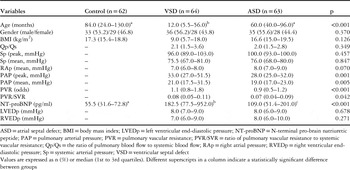
A total of 64 consecutive patients with ventricular septal defects and 63 patients with atrial septal defects who underwent a cardiac catheterisation for percutaneous closure and/or pre-operative haemodynamic study were enrolled in the study. Patients with isolated ventricular septal defect or atrial septal defect aged between 1 month and 12 years were included in the study. Echocardiographic exclusion criteria were as follows: significant ventricular outflow tract obstruction, significant atrioventricular or semilunar valve regurgitation – that is, exceeding a moderate degree of regurgitation – a left ventricular ejection fraction <50%. The patients younger than 1 month of age were excluded from the study on the grounds that post-partum circulatory changes might affect the N-terminal pro-brain natriuretic peptide levels. Similarly, those older than 16 years of age were also excluded from the study, as their N-terminal pro-brain natriuretic peptide levels reflect those of adults. Likewise, patients with a history of significant arrhythmia, chronic lung disease, anaemia, and abnormal renal function were excluded from the study; 62 age- and sex-matched healthy children referred to our clinic due to a murmur and who had a normal transthoracic echocardiogram were included in the study as control group. Baseline clinical, haemodynamic, and laboratory features of both control and patient groups are summarised in Table 1.
Clinical, haemodynamic, and laboratory characteristics of study populations.

ASD=atrial septal defect; BMI=body mass index; LVEDp=left ventricular end-diastolic pressure; NT-proBNP=N-terminal pro-brain natriuretic peptide; PAP=pulmonary arterial pressure; PVR=pulmonary vascular resistance; PVR/SVR=ratio of pulmonary vascular resistance to systemic vascular resistance; Qp/Qs=the ratio of pulmonary blood flow to systemic blood flow; RAp=right atrial pressure; RVEDp=right ventricular end-diastolic pressure; Sp=systemic arterial pressure; VSD=ventricular septal defect
Values are expressed as n (%) or median (1st to 3rd quartiles). Different superscripts in a column indicate a statistically significant difference between groups
N-terminal pro-brain natriuretic peptide analysis
To determine the peptide levels, blood samples were taken from the participants via a peripheral venous puncture in the supine position and collected in tubes containing ethylenediaminetetraacetate in the catheterisation laboratory before the cardiac catheterisation. N-terminal pro-brain natriuretic peptide level was measured by electrochemiluminescence immunoassay with the Elecsys system 101/2010 (Roche, Mannheim, Germany). Elecsys pro-brain natriuretic peptide contains polyclonal antibodies that recognise epitopes located on the N-terminal part (1–76) of the pro-brain natriuretic peptide (1–108). No cross-reactivity was reported with brain natriuretic peptide.
Echocardiographic and haemodynamic study
Echocardiographic studies were performed using a GE-System V (GE Vivid 7, Horten, Norway), equipped with 3–5 MHz probe, within 1 month before cardiac catheterisation by a single experienced paediatric cardiologist. Cardiac catheterisation procedure was planned before the transcatheter closure or possible surgery in patients with a significant left-to-right shunt (Qp/Qs ratio ⩾1.5) based on echocardiography or any other indication for closure. The locations of the ventricular septal defects were as follows: perimembranous in 43 patients, trabecular in seven patients, inlet in five patients, outlet muscular in three patients, and multiple ventricular septal defects in six patients. The types of the atrial septal defects were as follows: the secundum type in 56 patients, primum type in two patients, superior caval type in four patients, and inferior caval type in one patient.
Cardiac catheterisation
In all patients, cardiac catheterisation was performed for the closure of the septal defect or to measure haemodynamic variables – in particular, pulmonary vascular resistance – by the surgeon’s request in patients with concomitant pulmonary hypertension. Haemodynamic study and percutaneous closure were performed under sedation and local anaesthesia. The procedure included the measurements of pressure (systolic and diastolic and/or mean) and the oxygen saturations in the superior caval vein, inferior caval vein, right atrium, pulmonary artery, right ventricle, pulmonary vein – or pulmonary capillary wedge pressure – left ventricle, and the aorta. The Qp/Qs was calculated according to the Fick principle. N-terminal pro-brain natriuretic peptide samples were obtained at room air during the cardiac catheterisation.
Statistical analysis
Shapiro–Wilk’s test was used, and histogram and q-q plots were examined to assess data normality. Mann–Whitney U and Kruskal–Wallis tests were used to compare differences for continuous variables. Siegel–Castellan test was used for multiple comparisons. Values are expressed as median and 1st to 3rd quartiles. In addition, receiving operating characteristic curves were used to identify the predictive accuracy of pro-brain natriuretic peptide on significant shunt with invasive haemodynamic study. Pearson correlation coefficients were calculated to test the correlation between pro-brain natriuretic peptide and invasive haemodynamic parameters. Areas under curves were calculated with 95% confidence intervals. Youden’s index was used to determine optimum cut-off values. Sensitivity, specificity, positive and negative predictive values, and accuracy rates were calculated with 95% confidence intervals for each cut-off value. The κ test was also used to assess the agreement between pro-brain natriuretic peptide test results and Qp/Qs gold standard values. Analyses were conducted using R 3.0.1 software, whereas a p value<5% was considered as statistically significant.
Results
A total of 64 children (36 males, 28 females) with a mean age of 33.3±37.2 months who had ventricular septal defects and 63 children (35 males, 28 females) with a mean age of 72.1±42.7 months who had atrial septal defects were included in the study. In the present study, because patients with ventricular septal defect required intervention at younger ages than atrial septal defect patients, the expected mean age was lower in the ventricular septal defect group. The clinical, demographic, and invasive haemodynamic variables and the plasma brain natriuretic peptide levels of all the patients and control individuals are listed in Table 1.
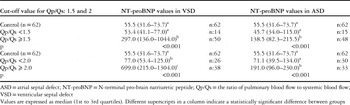
In the literature, some researchers accepted Qp/Qs ratio⩾1.5 as significant shunt in ventricular septal defect or atrial septal defect patients;Reference de Lemos, McGuire and Drazner 5 , Reference Kunii, Kamada and Ohtsuki 6 , Reference Sanders, Yeager and Williams 14 , Reference Holmstrom, Hall and Thaulow 18 , Reference Cantinotti, Law and Vittorini 21 however, some determined the significant shunt as Qp/Qs⩾2.Reference Oyamada, Toyono and Shimada 7 , Reference Jan, Fu, Hwang and Lin 13 Therefore, we performed statistical analysis according to both Qp/Qs ratio values (Table 2). When the Qp/Qs ⩾1.5 was accepted as the significant shunt, the difference between these patient groups in mean N-terminal pro-brain natriuretic peptide values was found statistically significant (53.4 versus 297.0 pg/ml for the ventricular septal defect groups, 45.7 versus 138.5 pg/ml for the atrial septal defect groups; p<0.001; Table 2).The mean N-terminal pro-brain natriuretic peptide levels of both atrial septal defect and ventricular septal defect patients with Qp/Qs<2 and ⩾2.0 was statistically significant (p<0.001, Table 2); however, no statistically significant difference was found between the mean N-terminal pro-brain natriuretic peptide value of the control group and those of the atrial septal defect and ventricular septal defect patients with insignificant shunt (Qp/Qs <1.5).
Comparison of proBNP values of the groups with Qp/Qs⩾1.5 and ⩾2.0 cut-off values for VSD and ASD, respectively.

ASD=atrial septal defect; NT-proBNP=N-terminal pro-brain natriuretic peptide; Qp/Qs=the ratio of pulmonary blood flow to systemic blood flow; VSD=ventricular septal defect
Values are expressed as median (1st to 3rd quartiles). Different superscripts in a column indicate a statistically significant difference between groups
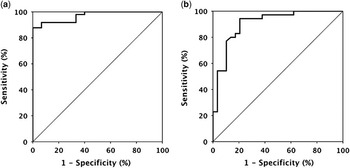
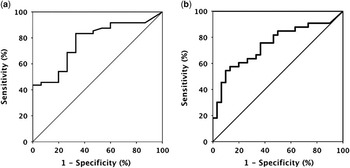
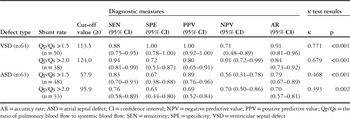
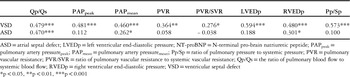
According to receiving operating characteristic analysis, a plasma N-terminal pro-brain natriuretic peptide concentration of 113.5 pg/ml was determined as the cut-off point to identify patients with a Qp/Qs ratio of ⩾1.5 in patients with ventricular septal defect; a plasma N-terminal pro-brain natriuretic peptide concentration of 57.9 pg/ml was determined as the cut-off point in patients with atrial septal defects. At a plasma concentration of 113.5 pg/ml, N-terminal pro-brain natriuretic peptide had a sensitivity of 88%, a specificity of 100%, positive predictive value of 100%, and negative predictive value of 71% in ventricular septal defect patients. At a plasma concentrations of 57.9 pg/ml, N-terminal pro-brain natriuretic peptide had a sensitivity of 83%, a specificity of 67%, positive predictive value of 89%, and negative predictive value of 56% in atrial septal defect patients (Table 3; Fig 1a and b). The cut-off N-terminal pro-brain natriuretic peptide levels were determined to estimate a Qp/Qs ratio⩾2 (ventricular septal defect: 124 pg/ml; atrial septal defect: 95.9 pg/ml), (Table 3; Fig 2a and b). Furthermore, there was a positive and significant correlation between N-terminal pro-brain natriuretic peptide levels and shunt magnitude in both defect types (p<0.001, Table 4).
ROC curves for NT-proBNP variable in identifying Qp/Qs. For VSD, Qp/Qs cut-off value: 1.5, AUC: 0.97 (0.93–1.00) ( a ); for VSD, cut-off value: 2.0, AUC: 0.91 (0.83–0.98) ( b ). AUC=areas under curves; NT-proBNP=N-terminal pro-brain natriuretic peptide; Qp/Qs=the ratio of pulmonary blood flow to systemic blood flow; ROC=receiving operating characteristic; VSD=ventricular septal defect.

ROC curves for NT-proBNP variable in identifying Qp/Qs. For ASD, cut-off value: 1.5, AUC: 0.77 (0.65–0.90) ( a ); for ASD, cut-off value: 2.0, AUC: 0.74 (0.62–0.87) ( b ). ASD=atrial septal defect; AUC=areas under curves; NT-proBNP=N-terminal pro-brain natriuretic peptide; Qp/Qs=the ratio of pulmonary blood flow to systemic blood flow; ROC=receiving operating characteristic.

Statistical diagnostic measures and κ test results in identifying significant shunt.

AR=accuracy rate; ASD=atrial septal defect; CI=confidence interval; NPV=negative predictive value; PPV=positive predictive value; Qp/Qs=the ratio of pulmonary blood flow to systemic blood flow; SEN=sensitivity; SPE=specificity; VSD=ventricular septal defect
Correlation statistics (r) between NT-proBNP and haemodynamic parameters in patients with VSD and ASD.

ASD=atrial septal defect; LVEDp=left ventricular end-diastolic pressure; NT-proBNP=N-terminal pro-brain natriuretic peptide; PAPpeak=pulmonary artery pressurepeak; PAPmean=pulmonary artery pressuremean; Pp/Sp=ratio of pulmonary pressure to systemic pressure; PVR=pulmonary vascular resistance; PVR/SVR=ratio of pulmonary vascular resistance to systemic vascular resistance; Qp/Qs=the ratio of pulmonary blood flow to systemic blood flow; RVEDp=right ventricular end-diastolic pressure; VSD=ventricular septal defect
*p<0.05, **p<0.01, ***p<0.001
Invasive measurements of pulmonary artery pressuremean peak – pulmonary vascular resistance, ratio of pulmonary vascular resistance to systemic vascular resistance, and the ratio of pulmonary blood flow to systemic blood flow (Qp/Qs) of ventricular septal defect patients were significantly higher than those of atrial septal defect patients (p<0.05). Moreover, the mean serum level of N-terminal pro-brain natriuretic peptide was also higher in the ventricular septal defect group in comparison with the atrial septal defect patients (p<0.05, Table 1).
A moderate positive correlation (p<0.001) was found between the N-terminal pro-brain natriuretic peptide levels and Qp/Qs (r: 0.479), pulmonary artery pressuremean peak (r: 0.481–0.460), the ratio of peak pulmonary pressure to peak systemic pressure (r: 0.573), and left ventricular end-diastolic pressure (r: 0.594); a weak positive correlation (p<0.01) was found between N-terminal pro-brain natriuretic peptide levels and pulmonary vascular resistance (r: 0.364) and ratio (r: 0.276) in the ventricular septal defect group. A moderate positive linear correlation (p<0.001) was found between the N-terminal pro-brain natriuretic peptide levels and Qp/Qs ratio (r: 0.470); a weak positive correlation was found between the N-terminal pro-brain natriuretic peptide levels with pulmonary artery pressuremean (r: 0.262) and right ventricular end-diastolic pressure (r: 0.301) in the atrial septal defect group. No statistically significant relationship was found between the N-terminal pro-brain natriuretic peptide levels and other invasive haemodynamic parameters such as pulmonary artery pressurepeak, pulmonary vascular resistance, the ratio of pulmonary vascular resistance to systemic vascular resistance, and the ratio of peak pulmonary pressure to peak systemic pressure in the atrial septal defect group (Table 4).
Discussion
In the present study, we found a significant positive correlation between the plasma N-terminal pro-brain natriuretic peptide levels and the magnitude of the shunt in both atrial septal defect and ventricular septal defect patients. We determined that the N-terminal pro-brain natriuretic peptide levels might estimate the significance of the shunt in both atrial septal defect and ventricular septal defect patients with high precision. Thus, an N-terminal pro-brain natriuretic peptide level of ⩾113.5 pg/ml in patients with ventricular septal defect may indicate the significance of the shunt and may act as a marker for referring the patient to a paediatric cardiologist or surgeon. Similarly, in atrial septal defect patients, an N-terminal pro-brain natriuretic peptide level of ⩾57.9 pg/ml may indicate a significant shunt and the necessity for the closure of the defect. These cut-off points of N-terminal pro-brain natriuretic peptide determined by this study for both ventricular septal defect and atrial septal defect were found to have a high sensitivity (88 and 83%, respectively), high specificity (100 and 67%, respectively), and high positive predictive values (100 and 89%, respectively) in demonstrating the volume overload and significant shunt.
Systemic and pulmonary blood flows as well as the flow ratio (Qp/Qs) can be measured non-invasively with Doppler velocity and two-dimensional echocardiography, as previously defined;Reference Sanders, Yeager and Williams 14 , Reference Boehrer, Lange, Willard, Grayburn and Hillis 15 however, cardiac catheterisation is the gold standard method for haemodynamic assessment of intra-cardiac shunt. The most powerful aspect of this study is that the haemodynamic parameters measured by cardiac catheterisation were included with N-terminal pro-brain natriuretic peptide values.
The N-terminal pro-brain natriuretic peptide is a molecule released together with brain natriuretic peptide from the precursor peptide pro-brain natriuretic peptide. It has been studied that the serum levels of N-terminal pro-brain natriuretic peptide are sensitive for detecting cardiac failure and are more sensitive and specific than brain natriuretic peptide for the diagnosis of cardiac failure.Reference Lainchbury, Campbell, Frampton, Yandle, Nicholls and Richards 16 , Reference Seino, Ogawa and Yamashita 17 In addition, their levels are sensitive to the treatment of CHD, shunts, cardiomyopathies, and heart failure. In the studies conducted on patients with ventricular septal defect,Reference Kunii, Kamada and Ohtsuki 6 – Reference Kavga, Varlamis and Giannopoulos 10 atrial septal defect,Reference Kunii, Kamada and Ohtsuki 6 – Reference Ozhan, Albayrak, Uzun, Ordu, Kaya and Yazici 8 , Reference Schoen, Zimmermann and Kittner 11 and patent ductus arteriosus,Reference Holmstrom, Hall and Thaulow 18 it was suggested that the magnitude of shunting through these defects is a major determinant of plasma brain natriuretic peptide in children based on echocardiographic assessments of shunt severity. In spite of this fact, there are limited numbers of catheterisation studies assessing the relationship between the severity of the shunt and N-terminal pro-brain natriuretic peptide levels in the literature. A significant positive correlation was found between the Qp/Qs ratio calculated by cardiac catheterisation and the natriuretic peptide levels in all of these studies.Reference Schoen, Zimmermann and Kittner 11 – Reference Jan, Fu, Hwang and Lin 13
In atrial septal defect and ventricular septal defect patients, the pulmonary artery pressure, pulmonary vascular resistance, and the ratio of pulmonary vascular resistance to systemic vascular resistance also provide important information on the haemodynamics of the disease as much as the determination of the magnitude of the shunt. These parameters measured during cardiac catheterisation are of critical importance in the estimation of mortality and morbidity and the management of the defect, as the mortality of the surgical and transcatheter closure is closely related to increased pulmonary arterial pressure and high pulmonary vascular resistance. Previous investigators have shown that the brain natriuretic peptide is closely related to functional impairment and increased mortality rates in patients with idiopathic pulmonary hypertension.Reference Leuchte, Holzapfel and Baumgartner 19 Moreover, previous studies have also reported that the brain natriuretic peptide is an excellent marker for detecting the presence of pulmonary hypertension in patients with various diseases.Reference Kavga, Varlamis and Giannopoulos 10 , Reference Boehrer, Lange, Willard, Grayburn and Hillis 15 A statistically significant positive correlation between the brain natriuretic peptide levels and pulmonary artery pressure, pulmonary vascular resistance, and the ratio of pulmonary vascular resistance to systemic vascular resistance was reported in a study conducted in children with ventricular septal defects.Reference Suda, Matsumura and Matsumoto 12 Schoen et al Reference Schoen, Zimmermann and Kittner 11 determined a statistically significant positive correlation between the serum levels of N-terminal pro-brain natriuretic peptide and right ventricular end-diastolic pressure, right ventricular systolic pressure, and right atrial pressure, which is consistent with our study.
In our study, we noted significant positive correlation between serum levels of N-terminal pro-brain natriuretic peptide, pulmonary artery pressuremean, and right ventricular end-diastolic pressure in patients with atrial septal defects (Table 4). This result may be related to the less-prominent changes in pulmonary vascular bed in atrial septal defect patients. It has been shown that the right ventricle and pulmonary arteries are under a higher pressure load in patients with ventricular septal defect compared with patients with atrial septal defects because of pulmonary hypertension.Reference de Lemos, McGuire and Drazner 5 , Reference Kunii, Kamada and Ohtsuki 6 , Reference Jan, Fu, Hwang and Lin 13 , Reference Cantinotti, Law and Vittorini 21
It has been widely demonstrated that diseases characterised by right volume overload – that is atrial septal defect – show on average the lowest brain natriuretic peptide values compared with CHDs characterised by left ventricle overload – that is ventricular septal defect.Reference Mir, Marohn and Läer 20 , Reference Cantinotti, Law and Vittorini 21 Although the Qp/Qs ratio, which is a good indicator of volume overload in the ventricles, was similar, the N-terminal pro-brain natriuretic peptide level was higher in ventricular septal defect patients, in accordance with the literature (Table 1).
The main limitation of this study was the large interval between age group and N-terminal pro-brain natriuretic peptide levels of patients, and consequently the use of median values – 1st to 3rd quartiles – in the tables and in some of the statistical calculations. Nevertheless, the reason for that was the need of early intervention for ventricular septal defect than for atrial septal defect patients. Although we have not included neonates in our study, N-terminal pro-brain natriuretic peptide levels may have varied depending on age in the present study population; therefore, study participants can be divided into sub-groups according to age in the further multi-centric, large population studies. Another limitation of this study was that the serum levels of N-terminal pro-brain natriuretic peptide were not analysed after surgical or transcatheter closure of the defect for the follow-up; therefore, its role in the follow-up of the patients with atrial septal defect or ventricular septal defect cannot be discussed. Large multi-centre prospective studies are required in the future on this subject.
Conclusion
The present study suggests that serum N-terminal pro-brain natriuretic peptide levels reflect the severity of disease in patients with left–right ventricular volume overload in ventricular septal defect or atrial septal defect. An N-terminal pro-brain natriuretic peptide level ⩾113.5 in ventricular septal defect and ⩾57.9 pg/ml in atrial septal defect can be useful as an indicator for referral of the patient to a paediatric cardiologist or surgeon for transcatheter or surgical intervention. In conclusion, N-terminal pro-brain natriuretic peptide levels could be utilised along with other variables in the determination of the timing of surgery in patients with septal defects.
Acknowledgements
The local ethics committee of the university approved the study (protocol number: 2013/534).
Financial Support
This research received no specific grant from any funding agency in the public, commercial, or not-for-profit sectors.
Conflicts of Interest
None.