On a Saturday afternoon in 1963, Daniel Malé and his wife Adelina Cossa hosted a party to celebrate the completion of their new home.Footnote 1 The house was built a few feet from the house of Malé’s parents, on a fenced plot the Malé family had long rented in Chamanculo, the most densely populated of Lourenço Marques's flood-prone outlying neighborhoods, called the subúrbios. Malé called everyone to attention, and he read a prepared speech.
The ambition of every man is to have his own house. Among us natives, this ambition becomes even greater – it is in fact a major concern – because it is customary for us to marry only after having built a roof under which we can raise a family. There was a time when a shack was enough, and this is why, without being able to afford much, I built a shack of reeds. These days, however, as one struggles to build a roof, one does so with better financial conditions. Thus, at the cost of many sacrifices and with the help of others, such as the help of my employer, present here, who contributed with windows, doors, and wood beams, and the help of my brother-in-law, who offered his services as a stonemason, and my own effort, I managed, six years after getting married, to replace the old house of reeds with a house of stone, which still seems a dream to me, a gift from God.
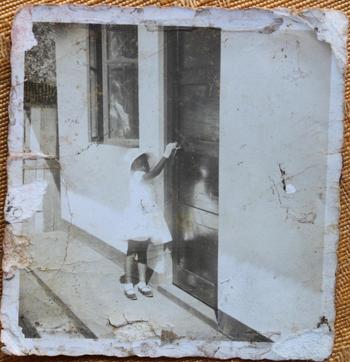
Rute, the couple's six-year-old daughter, was dressed all in white for the occasion, and with a gloved hand she turned the handle of the front door, officially inaugurating the home as open for living (Fig. 1).
Rute Malé inaugurates her family's new concrete-block house, built ‘clandestinely’, Chamanculo, 1963. Source: Daniel Malé.

Daniel Malé did not give the impression that he had anything to hide. Yet his house of stone, by which he meant a house of concrete block, was according to municipal officials a ‘clandestine’ construction. In the 1960s the municipality revived long-dormant regulations that prohibited building in concrete or in any other permanent materials in the subúrbios of Lourenço Marques since these were unplanned areas designated for eventual expansion of the formalized, predominantly European city core, often called the City of Cement.Footnote 2 Neglected by the municipality and lacking in the most basic infrastructure, the subúrbios were places of squalor and pervasive disease. Three quarters of the city lived in these neighborhoods, including the vast majority of its African population.Footnote 3 Residents were not squatters, not in a strict sense. They paid an annual rent to a private landowner for the privilege of a plot to build on, but from the perspective of the municipality they were living there on sufferance. One could build in reeds, called caniço, as most did, and for this reason the subúrbios were also called, collectively, the ‘caniço’. Because even black Mozambicans of greater means were effectively shut out of the City of Cement, they too lived in the caniço, but instead of reed houses they tended to build wood-framed houses paneled in zinc. In these neighborhoods one could even lay concrete foundations so long as the slab did not project too far above the ground. Such housing solutions were considered sufficiently ‘precarious’. But municipal officials saw houses built out of concrete blocks or ceramic blocks (which were sometimes used in addition to concrete) as potential obstacles to the development and infrastructure plans that they hoped to draw up.
If caught, the consequences could be severe. The fines for building in permanent materials could easily exceed several months’ salary. Failure to pay fines or to comply with the relevant codes might ultimately result in demolition. A fine was a serious blow for a household that had scrimped on everyday expenses for years, as many did, in order to stock up on the necessary building materials and to hire a stonemason. Malé, for instance, worked the counter of a downtown watch store. Cossa, his wife, did not earn a wage. Demolition, if it came to that, would have been catastrophic. From 1961 to 1971, Lourenço Marques municipal police served violation notices to more than two thousand homeowners for building so-called clandestine structures.Footnote 4 More than 95 per cent of the actions were against houses located in the subúrbios. Yet, despite the risk, several thousand caniço residents went ahead and built masonry homes. Some did so discreetly, hiding block walls behind zinc panels. Others, such as Daniel Malé and Adelina Cossa, built more brazenly.
This article is about house construction in the subúrbios of Lourenço Marques (today's Maputo) during the final years of Portuguese rule. It foregrounds what historians usually render as background: neighborhood landscapes of the kind that have long dominated African cities and that are often thought of as undifferentiated, ahistorical ‘slums’. Histories of the built environment in colonial-era African cities have largely focused on the intentions of European architects and planners, and their large-scale undertakings.Footnote 5 On urban margins, however, in places often better characterized by government neglect than by government imposition, people planned and executed their own, more modest projects. Building a house incrementally, expanding it over lifetimes and generations, has long been one of the fundamental preoccupations of urban life. More than a matter of survival, it embodies some of people's highest aspirations for themselves and their children.Footnote 6 In the African neighborhoods of colonial cities, construction in permanent materials, on what was in many senses tenuous ground, amounted to a ‘claim to belonging’ when circumstances mostly dictated otherwise.Footnote 7 The research for this article was part of a wider study of housing in Maputo from the late 1940s to the present, which was based primarily on more than one hundred interviews conducted in the city's neighborhoods, including with a number of stonemasons. It also makes use of a sampling of approximately 150 ‘clandestine works’ files located at the Maputo buildings department, as well as documents and photographs archived in the trunks and suitcases of some of the people who were interviewed.
Frantz Fanon famously described the typical settler-colonial city as divided brutally in two.Footnote 8 One part, the ‘white folks’ sector’, was ‘built to last, all stone and steel’. The other part, ‘the “native” quarters, the shanty town, the Medina, the reservation’, was a place ‘that crouches and cowers, a sector on its knees, a sector that is prostrate’. Simplifications like Fanon's make salient the fundamental inequalities of colonial rule, such as the kind that shaped Lourenço Marques. The making of urban space, however, was and is a necessarily multilateral affair. As Laurent Fourchard has observed, scholars’ emphasis on European-imposed planning schemes, particularly racial segregation, has limited the spatial turn in African urban history to a dichotomy of colonizer versus colonized that ‘omits the agency of African societies, their capacity to overcome such divisions, to ignore them or even to imagine them differently’.Footnote 9 Some have addressed the initiative of African home-dwellers historically, notably in South Africa, where apartheid in its built form was contested at many scales.Footnote 10 The residents of many government-built township houses reconfigured them to give them a personal touch, for instance, and people risked violent removal to build shantytowns in areas where permanent black settlement was prohibited – ‘activism by other means’, argues Anne-Maria Makhulu.Footnote 11 In his work on British planning in the ‘Other Side’ neighborhoods of Zanzibar's Stone Town, Garth Myers highlighted homebuilders who resisted officials’ attempts to suppress their traditional building methods and land tenure practices.Footnote 12 Every city has its own story to tell. The masonry houses of the subúrbios of Lourenço Marques were not an assertion of longstanding cultural practice, as was the case in Zanzibar, nor were they anything like the government-built homes of South Africa's townships or the makeshift shanties of South Africa's informal settlements. When people in Maputo are asked today about the clandestine projects they began in the late colonial period, they speak of them much as Daniel Malé did in 1963, and surely as homebuilders everywhere do: as an achievement secured through hard work, patience, good sense, and God's grace. They also proudly speak of their houses as ‘modern’.Footnote 13
These illegal masonry houses were, in fact, similar in many respects to houses being built by many poor and working-class Portuguese households nearby, also in the subúrbios and also illegally. All cities in Africa intended primarily for white settlement had their racial ‘grey zones’; though most Africans in the cities of Mozambique and Angola lived in dramatically different conditions than Europeans, possibly more Africans made their homes in closer proximity to more Europeans than most anywhere else.Footnote 14 With the economic surge in the Portuguese territories in the 1960s, the closeness was becoming more than a matter of physical distance. The rising ambitions of many African workers, including many people of relatively modest means, began to overlap with those of lower-income whites in ways not seen in most settler-colonial cities outside of Portuguese Africa. Mozambique's capital, that is, was racially segregated, but it cannot be understood only as segregated. I argue that through clandestine masonry construction, people in late colonial Lourenço Marques began to overcome divisions that had long defined the city: City of Cement and subúrbio, formal and informal, permanent and precarious, European and African. As Fourchard might put it, clandestine homebuilders imagined difference differently.
Clandestine housing in Lourenço Marques and the crackdown that targeted it thus help reveal some of the peculiarities of Portuguese Africa, and its politics of race, during the last years of colonial rule. Scholars who address this period tend to focus on nationalist mobilization and the anticolonial movements that took to arms in Portugal's African territories. These were years of war, but there was so much to the 1960s and early 1970s, and to urban life, that cannot be plotted on a timeline of independence. In Portugal's African cities these were also years of rapid economic growth, and many Africans, especially men, were able to take advantage of better wages, better workplace conditions, and an expanding jobs market.Footnote 15 Their mounting expectations did not evolve into the kind of persistent labor unrest or mass political organization witnessed in industrializing cities of British and French Africa during the 1940s and 1950s.Footnote 16 Censors and Portugal's security apparatus stifled meaningful dissent, and for discontent to be voiced it had to be from exile.Footnote 17 Instead, other urban politics emerged, the kind that few would have called ‘politics’.Footnote 18 Challenging the boundaries of race in late colonial Lourenço Marques took form as a struggle over the shape, and often the material, of urban space. Concrete was the substance and universal symbol of development. But concrete, like the full promise of development itself, was being reserved for the benefit of a relative few.
At stake was not just a vision of the modern city, but of a modern society, and what it meant to belong to one. The rising skyline of the City of Cement was central to Portugal's image of itself in Africa.Footnote 19 It sustained conceits of white prestige and the regime's claims to being a modernizing force. The image ran aground in the subúrbios, which for decades were explained away as temporary, a problem to be resolved at some future date by government housing initiatives, infrastructure, and careful planning along rational lines. Substandard concrete-block houses threatened that future by hardening the chaotic suburban streetscape into place. At the same time, they blurred the distinction many Portuguese imagined between European order and the notional African bush.
Clandestine masonry builders, for their part, saw little reason to wait for a future that never seemed to come. They rarely thought of their projects in overtly political or even confrontational terms. Yet in making progress towards permanence, material comfort, and a secure future for their families, they defied expectations that, as Africans, they live in perpetual precariousness.
THE CLANDESTINE NEIGHBORHOOD
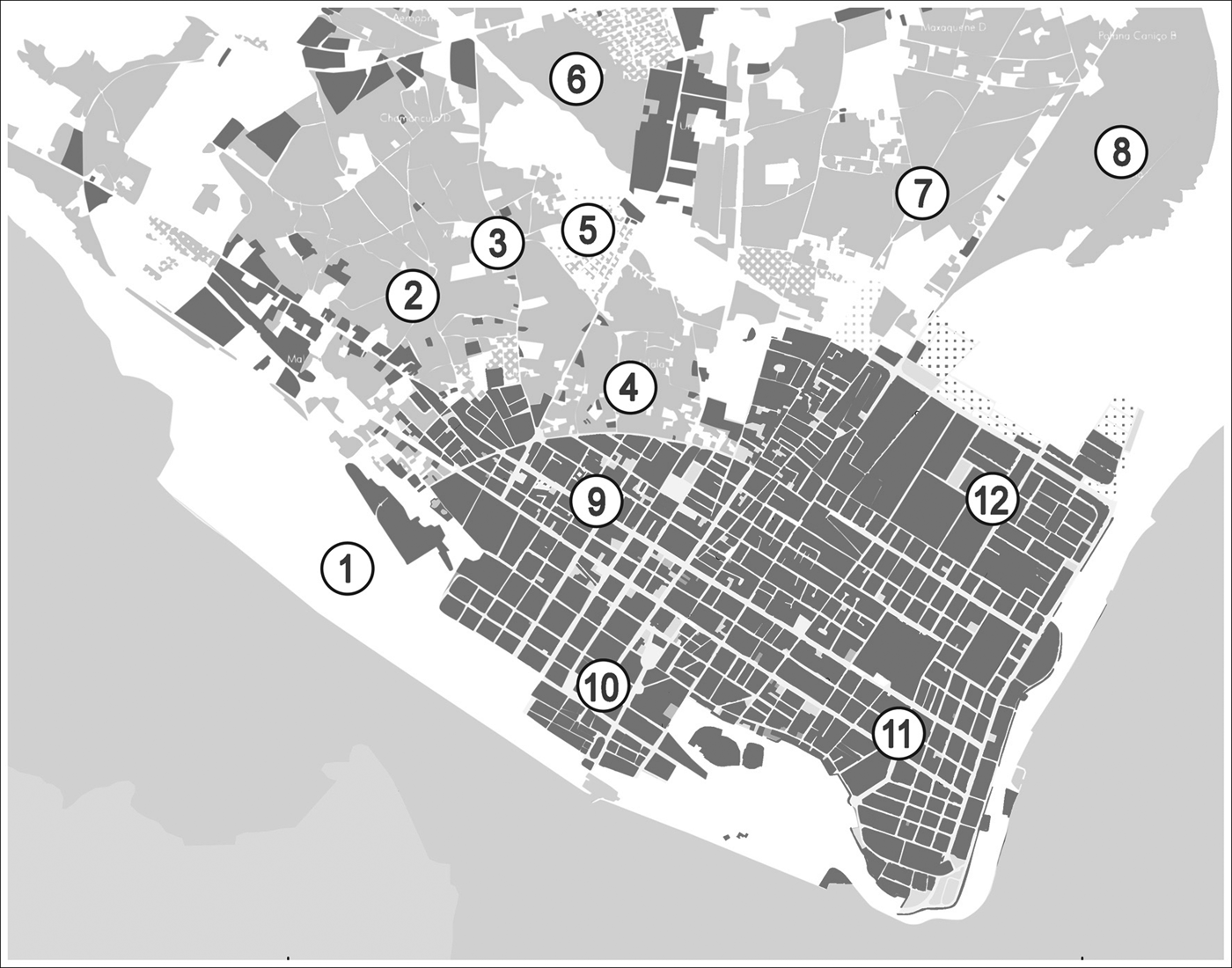
The traditional boundary between the city of Lourenço Marques and its subúrbios was a curving street, originally plotted in the late nineteenth century.Footnote 20 Forming an arc roughly two kilometers from downtown, the curve set an outer limit to municipal infrastructure. For much of the twentieth century it also came to define the difference between European and African lives (Fig. 2). The densest African neighborhoods developed just outside the curve, in low-lying areas that were absent paved roads, sewage and drainage systems, and trash removal. The neighborhoods were also subject to frequent flooding and cholera outbreaks. Due to the high concentration of reed structures, people lived in fear of frequent fires, which consumed a dozen or more homes at a time.Footnote 21 Because the boundary was drawn when Lourenço Marques was still relatively small, these neighborhoods were in easy walking distance from some of the more affluent European neighborhoods. By the 1960s, reed houses came up nearly flush against the City of Cement. People on both sides of the curve keenly felt the contrast.Footnote 22
Lourenço Marques and its neighborhoods, 1960–75. Credit: Luciana Justiniani Hees, adapted from C. D. Henriques, Maputo: cinco décadas de mudança territorial (Lisboa, 2008). Key: (1) Port and rail facilities. Subúrbios (light shading) – (2) Chamanculo; (3) Xipamanine; (4) Mafalala; (5) Munhuana; (6) Aeroporto; (7) Maxaquene; (8) Polana Caniço. City of Cement (dark shading) – (9) Alto Maé; (10) Baixa (downtown); (11) Polana; (12) Sommershield.

Unlike in most other colonial cities with large settler populations, there was no wide ‘buffer zone’ or ‘cordon sanitaire’ separating the white population of Lourenço Marques from other groups. Segregation did not depend on overtly racial housing laws. Rather, building codes that penalized precarious construction within the curve had by the 1930s pushed most black Mozambicans outside the curve.Footnote 23 Decades of policies and practices that suppressed African wages through forced labor, pay ceilings, and job preferences for whites, continued to put rent within the curve beyond the reach of most Africans, to say nothing of home purchase or construction there. By 1960, the 20,000 black Mozambicans living in the City of Cement were mostly domestic workers housed in austere servants’ quarters.Footnote 24 As for the relative few who could afford an apartment in the City of Cement, landlords simply refused to rent to them.
To others the racial boundaries were more porous. Several thousand people of mixed race lived on either side of the border of city and subúrbios, with most of those within the curve living in Alto Maé, a diverse neighborhood along the boundary that was also home to many working-class whites and people of South Asian descent.Footnote 25 The downtown commercial district was largely a South Asian neighborhood. Racial divisions were even less salient within the subúrbios themselves. According to the 1960 census, more than 9,000 whites – almost a quarter of the city's European population – were living in Munhuana, the administrative unit that corresponded with most of the subúrbios. Many were likely living in permanent construction recently developed on suburban plots, some of it authorized, some of it not. Others were living in wood-and-zinc or even reed houses.Footnote 26 All had African neighbors either next door or nearby. A number of Portuguese and Asian men in the subúrbios lived with African companions.Footnote 27
During the 1960s, Portugal's intensified efforts to maintain its African possessions utterly transformed the character of Lourenço Marques. Portuguese troops began mobilizing in Lourenço Marques following the 1961 insurrection in Angola, and in 1964, when FRELIMO launched its guerrilla campaign for independence, in Mozambique's north, Lourenço Marques became something of an armed camp. PIDE, the political police, expanded its network of informants throughout the city, fostering a generalized climate of mutual suspicion. Portugal also pursued an economic development strategy, in many ways similar to the earlier efforts of other colonial powers to head off pressures to decolonize.Footnote 28 In the 1950s and 1960s, Lisbon lifted controls first on local industry and then on foreign investment. It also promoted a new wave of Portuguese migration to the territory. Lourenço Marques was a boomtown, fueled by military and development spending, industrial growth, a thriving tourism trade, and a service sector that swelled to meet the needs of the influx of military personnel and technical specialists and settlers.Footnote 29 The population of the capital more than doubled between 1960 and 1970, to more than 380,000.Footnote 30 The avenues of the City of Cement bristled with new apartment towers, often built on speculation and cheap, government-backed construction loans, constituting a kind of political stagecraft.Footnote 31 For the regime and also for many European settlers, the new skyline of Lourenço Marques was a powerful visible symbol, perhaps the symbol, of the Portuguese commitment to staying in Mozambique.Footnote 32
At the same time, Lisbon rolled out policies designed to win over more Africans to Portuguese rule.Footnote 33 In 1961, it abolished the notorious indigenato system that had for decades subjected much of the Mozambican population to periodic terms of forced labor, and in later years spending was boosted to construct more primary schools and health clinics. Facing international condemnation for refusing to withdraw from Africa, Portugal answered that it was a single, multiracial, multicontinental nation whose laws were colorblind.Footnote 34 The word ‘native’ was struck from official discourse and replaced by ‘autochthon’ and ‘the economically infirm’. Claims to being a peaceable racial paradise were not limited to official propaganda. Memories of Portuguese who lived in Lourenço Marques in the 1960s and 1970s are often tinged with nostalgia for a city lacking in the tense open racism of apartheid Johannesburg.Footnote 35 The picture of easy racial intermingling, often focused on the relationships of white men and African women, required a narrow lens. Censors prevented any discussion in the press of the labor exploitation or the racial inequities upon which the colonial economy was based. Images of the caniço, for instance, were in the 1960s almost absent from the pages of local newspapers.Footnote 36 Meanwhile, the political police tended to treat claims of racism as acts of subversion.Footnote 37 Many black Mozambicans remember a City of Cement that could feel like hostile territory.Footnote 38 Just as in Kenya and Rhodesia, African revolt tended to harden local Europeans of various backgrounds into a unified white caste.Footnote 39
The economics of Lourenço Marques real estate, however, exposed dangerous fractures in white social cohesion, particularly the continuing presence of many Portuguese in the caniço.Footnote 40 Confronted with this embarrassment, the government moved many poor Portuguese from the caniço into subsidized housing in Matola, a new industrial satellite city about ten kilometers from Lourenço Marques. Yet there were still many working-class whites who, not able to afford a house in the increasingly expensive City of Cement, sought to build in the subúrbios. One of the few local controversies that censors allowed to see print during this time involved the Bairro do Aeroporto – the Airport Neighborhood – an unauthorized development in the subúrbios where scores of Portuguese were building clandestine masonry houses. In the late 1950s, a private real estate concern had divided a large parcel of land adjoining the airport into a grid of unpaved streets, expelled the people who had been living there in reed dwellings, and began selling inexpensive lots on which buyers could build masonry homes.Footnote 41 Many of the builders were low-ranking civil servants, not a few of them police officers. Many of the buyers were South Asian and of mixed race, and there were also a handful of black homebuilders, including noted artists Malangatana and Alberto Chissano.Footnote 42 A kind of informal segregation prevailed within the Bairro do Aeroporto. Blacks were only able to purchase properties in the corner of the development that abutted Lagoas (‘Lagoons’), an area of the caniço notorious for its particularly unhealthy conditions and concentration of brothels.
Given its location and its demographics, the Bairro do Aeroporto incidentally looked something like the ‘pluri-racial’ communities that some in Lisbon hoped to establish in Africa.Footnote 43 A 1962 proposal generated at the Overseas Ministry envisioned neighborhood units in which Europeans and ‘evolved’ Africans lived side-by-side with less evolved ‘autochthons’.Footnote 44 The proposal reflected the paternalistic orientation of the regime's reformist wing: the less evolved would reside in rustic houses of traditional materials, as befitted their degree of evolution, and civilized neighbors would, by their example, ease the transition of villagers into modern, individualistic urban life. On the ground in Lourenço Marques, however, officials saw the unauthorized Bairro, wedged between the airport and the most unpleasant parts of the caniço, as a serious threat to the urban order. Beginning in late 1961, the municipality threatened to demolish the entire development.
Officially, the issue was that the ‘Bairro Clandestino’, as it was sometimes called, violated Lourenço Marques's recently updated building code.Footnote 45 Such codes had been emanating from Lisbon since the 1930s, as the regime sought to modernize the cities within Portugal's many borders.Footnote 46 The clear intention of the 1960 legislation in Lourenço Marques was to maintain standards of construction within the City of Cement. The deeper anxieties of municipal authorities, however, lay beyond the curve, and the Bairro Clandestino, with its dirt streets, its substandard houses, and its lack of electricity or water provision, became the first target of the code enforcement apparatus. The controversy played out in the local press for several years, pitting those who defended the rule of law against those who decried bureaucratic red tape and appealed to economic fairness. One advocate for the illicit homebuilders used language usually reserved to glorify the Portuguese colonizers of the late nineteenth century. Clandestine homebuilders ‘perhaps unthinkingly launch[ed] themselves on the adventure of having a home and of maintaining themselves in this land’, he wrote.Footnote 47 But the true blame rested with bureaucrats, who were throwing up obstacles ‘so that this land doesn't advance’. The municipality eventually relented. It retracted its demolition threat and agreed to supply the neighborhood with street illumination and public fountains, if not direct water service or electricity. Streets remained unpaved.Footnote 48
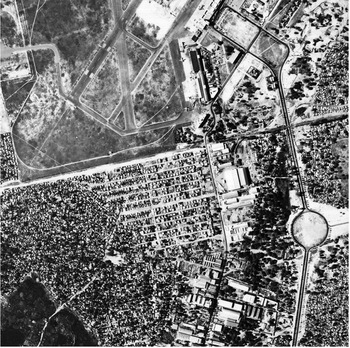
Coverage of the controversy minimized the glaring fact that the development blended into the caniço (Fig. 3). Yet it was the very proximity of the caniço, both physically and symbolically, that likely prompted the code enforcement blitz, as the Bairro Clandestino threatened the carefully cultivated image of Lourenço Marques as a ‘corner of Europe’ in Africa.Footnote 49 Portuguese families with heads of household in respectable employment (such as police officers) were living in houses in conditions that occupied an unsettling middle ground between the precariousness of African urban life and the ideal of modern urbanization – orderly, salubrious, and rational according to prevailing ideas and ideologies of urban planning.Footnote 50 Nor did the local press make mention of the crackdown in other parts of the subúrbios that the Bairro Clandestino precipitated. Hundreds of African residents in the caniço were also building in permanent materials, and following the Bairro Clandestino episode they started getting punished for it. By 1965, the annual number of violation notices reached 295, more than double the 122 violations in 1962, peaked at 358 in 1969, and then dropped to 154 in 1970, the last full year for which colonial-era registries are available. In the 1960s, conflict or discontent in African neighborhoods tended to be downplayed in local media, or outright censored. To officials at the municipality, however, the problem was evident: it was increasingly unclear where the city ended and the caniço began.
Aerial image of the Bairro Clandestino, just below the center of the picture, wedged between the airport and the caniço, 1969. Source: Ministério da Terra, Ambiente, e Desenvolvimento Rural.

Despite the enforced silences surrounding the issue, the newspaper O Brado Africano, long a voice of elite African opinion, seemed eager to draw the connection between the Africans building in masonry in the caniço, whose tribulations it was constrained from discussing, and the mostly white homebuilders of the Bairro Clandestino, whose clash with the municipality was a subject of public debate. The newspaper's 1964 commentary on the Bairro Clandestino reads as a veiled critique of the treatment of the homebuilders in the neighborhoods that were home to much of O Brado Africano’s readership. Editors argued that, while the Bairro Clandestino was illegal, it was not ‘opportune to punish those who, with God knows what sacrifices, built their homes, sometimes little by little, with their own hands’.Footnote 51 The homebuilders had not broken laws deliberately, or because of a rebellious spirit. Rather they had seized the opportunity to make a home that was ‘truly theirs’. ‘And those buildings arose, by the dozens, by the hundreds, because many are those who had and continue to have that very human aspiration.’ For the editors of O Brado Africano, defense of the aspirations embodied in the construction of the Bairro Clandestino amounted to an assertion of their own.
THE PERFORMANCE OF ABJECTNESS
When African homebuilders were caught building in permanent materials, their responses to municipal authorities were very different from the defiant grievances of homebuilders in the Bairro Clandestino. Those accused of building clandestinely were given an opportunity to explain why they had transgressed the law, and the case files for code violations are full of such statements. Dictated to municipal clerks, they read as the scripts of people who know that their audience expects them to know their place. The accused played the part of the lowly supplicant, and played it with feeling. All pleaded ignorance of the law. Almost all pleaded poverty. Petitioners often portrayed themselves as the sole earner responsible for many family members. Most explained the decision to build in permanent materials as a matter of life and death, given the fires that terrorized everyone living in the caniço. Chamanculo resident António Almone, married with five children, explained that he had been living with his family in a reed house, but ‘one day there was a fire that burned my whole house down and I was left with nothing, only my children were saved, and on the same land where there was a fire there were houses made of blocks and these houses escaped the fire.’Footnote 52 Alice Malendya, a 48-year-old domestic worker living in Chamanculo, testified that she ‘built a modest house with the little money that her deceased husband left her, seeking thus to secure a roof for her children’ and that a harsh penalty would ‘destroy completely her ability to reserve for her little children the little that their father left them’.Footnote 53
Claims of poverty and fears of conflagration required no exaggeration. These were the everyday realities of life in the caniço. But by playing to the sympathies of the municipal officials in this way the accused portrayed the building of his or her masonry house as if it were little more than a desperate act of survival. Perhaps the most poignant moment in each appeal to leniency – poignant because of the self-effacement it demanded – was when transgressors described their houses. In nearly every case the homeowner was moved before an unseen audience of officials to diminish what amounted to one of the principal achievements of his or her working life and perhaps that of many family members. The house, no matter its size, was frequently referred to in the statements of the accused as a casita or casazinha – a little house. António Samora Sebanhana, a 62-year-old toolmaker for the railroad, erected a six-room concrete-block house – larger than most other homes in the neighborhood of Mafalala – but he stressed to officials that it was of the ‘cafreal type’, ‘little more than a cafreal construction’, ‘a dwelling for an autochthon of very feeble economic possibilities’.Footnote 54 (Cafre is the Portuguese equivalent of ‘kaffir’.) The house that Sebanhana characterized as a crudely built hut was valued by the commission at 10,000 escudos, roughly the equivalent of what Sebanhana earned in a year.
Similarly, Alice Malendya's ‘modest house’, built to ‘secure a roof’ for her three children, had seven rooms. A 21-year-old café employee named Inácio Manjate stated ‘my only goal was the shelter of the people of my family in my charge’. The report in his case file notes that the structure was not built initially as a house, but as a cantina, a combination of grocery and pub – that is, a business enterprise.Footnote 55 And when Daniel Malé received his notice of violation, he explained to officials that ‘owing to his advanced age’ – he was 32 when he made the statement – he was improving his ‘casita’ for his eventual retirement, and he feared the dangers of living in reeds. ‘As I have three children, I remain overloaded by the care of my mother, who is a widow, so you can see the difficulties I have in supporting such burdens.’Footnote 56 Just five years before, as a seemingly much younger man, Malé had thrown a party to celebrate a house that was ‘a source of great happiness’, a ‘dream’ realized through his own effort and the efforts of those close to him.Footnote 57
Occasionally, the transgressor was more self-assured. Essau Ezequia Maninguane, a 27-year-old secretarial assistant at the Agriculture Ministry, adopted a notably officious tone.Footnote 58 He reminded officials that the government faced a housing crisis, and that furthermore ‘these days the level of development represents a very important factor’ – meaning the higher development of Africans. Equating one's decision to build in concrete to climbing the evolutionary ladder of civilization – ideals expressed by Portuguese policymakers – may have been spoken in pride, but it also may have been a sarcastic jab at official hypocrisy.
Some said they were led to believe that permanent construction was permissible by the fact that so many others seemed to be doing it. One resident of Chamanculo ‘saw many constructions of the same type being erected with a great naturalness and greater calm, which seemed to the petitioner not to have whatever impediment’.Footnote 59 It was this very normalization of masonry construction that gave officials reason to worry. As it was, there were just too many cases to process. More than once in the late 1960s a municipal official noted in a case file that he could not yet schedule an evaluation of the house in question ‘given that there are many hundreds of cases in identical conditions’.Footnote 60 How many people in fact built clandestinely in block is difficult to estimate. An aerial survey conducted in late 1966 counted 1,753 masonry structures in the densest part of the subúrbios.Footnote 61 This figure represented only about 5 per cent out of the total of 33,351 structures in the surveyed area, and likely included masonry structures other than residences. But the number and proportion of houses in permanent materials likely increased substantially over the following decade. And the survey figure did not capture, because airborne cameras could not, the number of houses whose blocks were masked by zinc panels or even reeds.
THE MASONRY IMPERATIVE
Many residents of the Lourenço Marques subúrbios, particularly men, were in the 1960s benefiting to varying degrees from new jobs at factories, hotels, and shop counters. Building the rapidly rising skyline of the City of Cement was now one of the capital's most important industries, and in 1968 an estimated 11,000 African men were working in construction.Footnote 62 For many in Mozambique, Lisbon's reforms during this time were largely cosmetic. For many in the subúrbios of Lourenço Marques, there were rewards, enough for many to sample some of the city's blossoming consumer culture. Growth, however, also had its negative consequences. Infrastructural projects in the subúrbios, largely built to serve the growing Portuguese population, displaced hundreds of households in these neighborhoods, so that security of tenure had never felt so tenuous.Footnote 63 Nonetheless, with more resources now at their disposal, people ventured to build more dignified homes – despite the looming threat of removal, and illicitly in the eyes of the law.
Living in the City of Cement never registered high in the aspirations of most suburban dwellers. But cement did. Through a government program, a number of African civil servants managed to secure title to a plot and build a masonry house in one of the neighborhoods of Matola, among white and South Asian homeowners.Footnote 64 A home in the City of Cement was for black Mozambicans essentially unimaginable. Matola, however, while it made for a longer commute, was closer to possible. There, from the 1960s onward, the sons and daughters of the suburban elite, if they were able to surmount the considerable bureaucratic obstacles involved, lived in decent masonry houses with yards ample enough to raise some animals and grow vegetables. The jaunty, high-peaked roofs of many Matola houses became a hallmark of modern living, and in the half-century since have never gone out of style.Footnote 65
Most residents of the subúrbios could only dream of living in Matola, but they could afford at least a sack or two of cement mix, which they used to lay a thin floor for their house. Those with more resources would plaster their reed walls with cement, which municipal authorities deemed acceptable.Footnote 66 The plaster helped insulate reeds against wind and rot, and it also gave one's house what was considered a more modern, dignified look. A well-applied cement finish could pass as masonry, and even officials were fooled. Police circulating through neighborhoods were known to puncture plastered walls with an iron rod on occasion, testing to see whether the homeowner had dared build in concrete block. Cement, however, is not very durable unless mixed with stone aggregate to become concrete. With time, a chunk of the thin cement shell would break off, and then another, revealing the reeds within, like the straw jutting from a scarecrow's shirt, and one was forced to acknowledge that a plastered reed wall was a poor imitation of the real thing.
In the late 1950s, Chamanculo resident Jaime Tembe, an employee at an auto parts store, plastered the walls of his reed house.Footnote 67 In 1964, now a father of four, Tembe feared that the fragile cement might break off and harm his children, and he decided he wanted a house of more solid materials. Tembe proceeded in typical fashion. He built a wood-framed, zinc-paneled structure, and for the interior divisions he erected walls of concrete block. Unlike Daniel Malé and Adelina Cossa's house, where the transgression was on display for anyone to see, an illicit interior was often masked by a legal exterior. With many of Tembe's neighbors in Chamanculo working as laborers on downtown construction sites, there was no shortage of builders available to do the job. Tembe consulted one such builder, his cousin, and the two discussed how many rooms were needed, what the dimensions would be, and what materials Tembe would need to purchase. No plans were drawn up, but this is not to say the project lacked planning. A half century later, Tembe could recall the quantity and cost of each material, including the prices for each of the half-dozen different lengths of zinc panels. Tembe's memory was impressively precise, but more to the point is that most people interviewed recently about houses they built in the 1960s and 1970s could still recall what they paid for building materials decades before. Construction in the subúrbios has never been a rash act. For the next two years Tembe ‘tightened the belt a little’ in order to procure the necessary materials, and he built a shed to store them. At a time when few had bank accounts, building materials were one of the ways one invested in the future. The construction process was often a long one, subject to any number of interruptions due to cash flow problems, family emergency, or flooding, and moreover houses were expanded room by room over time. There may have been a clear beginning to these projects, but there was no clear end.
The case files for those who were caught in the act of illegal construction give an idea of the people who risked building in masonry. Approximately 80 per cent of the accused were male, and in the sampled files most of the men were identified as married. This is not to say that women did not play an important role in the planning and construction of the family house. Rather, men were presumed by officials (and often by the men themselves) to be the head of household, and made responsible for the illegal construction, even when in some cases wives and other members of the household financed much of the project, such as through the sale of produce and traditional brews. In recent interviews, men were frequently put forward as the sole spokespeople regarding construction of the house. Single women, however, were named in the files as transgressors almost as often as single men, giving perhaps a greater indication of the energies that women in general devoted to house construction. Despite much less access to waged work, and often burdened with the responsibility of sheltering children – an onus that single men usually did not share – single women often belonged to female-only lending clubs that helped them stock up on building materials.Footnote 68 As Jeanne Penvenne observes, ‘Autonomy, a measure of control over one's living space, a secure home, however simple, was a central component of women's strategies to control their lives’ – a means of avoiding living with men solely out of necessity.Footnote 69
The owners of clandestine masonry homes were not necessarily the caniço elite, so-called ‘assimilados’. Even to use the term ‘middle class’ would obscure the complexity of living situations, where one household could shelter people living in vastly different conditions, and where all suffered from various deprivations. Some builders were of mixed race, and perhaps enjoyed greater connections to Portuguese associates and kin. Many builders, such as Daniel Malé, could count on some help from an employer, or Portuguese ‘godparents’.Footnote 70 Clandestine homebuilders were railroad employees, factory workers, truck drivers, schoolteachers, and employees at cafés and at retail stores. Those few on what was for Africans the highest rung of the colonial-era wage hierarchy – government clerks, nurses, and bookkeepers, for example – turn up in the case files much less often, perhaps because they had the means and connections to ward off police and building inspectors, or perhaps because those in this relatively small group were moving to Matola.
More than any other reason, people mentioned their children when explaining their decision to take the risks of investing in permanent construction.Footnote 71 A masonry house protected one's children from the dangers of climate and fire, and it also ensured them greater comfort and a valuable inheritance. Parents were also concerned about their own comfort; construction of a masonry house often took place simultaneously with the purchase of new furniture. One ought not to reduce these house projects to pure calculation.Footnote 72 Among the reasons Daniel Malé wanted to build in concrete, he said, was that he simply thought it was ‘beautiful’. A beautiful house, then as now, was for the most part one that was well-constructed, showed no cracks, and had many rooms. There was a great deal of uniformity among houses, both inside and out, and, in fact, conformity. If they were painted at all, masonry houses tended to be painted white, unlike the vibrant, multicolored neighborhoods in so many other cities in southern Africa and elsewhere.Footnote 73 Building such a house was about taking established steps to success and to modern living by dutifully assembling a kit of pre-selected parts. It was not an opportunity for creative distinction and standing out among one's neighbors. Claudia Gastrow argues that, for homebuilders in the musseques of Luanda in recent decades, concrete block served as the basis of claims to urban citizenship precisely because it was permanent: ‘[T]heir houses could no longer simply be dismissed as “anarchic” but had to be taken seriously as objects of good urbanism, through which demands and rights could be articulated.’Footnote 74 Homebuilders of late colonial Lourenço Marques, however, could not entertain such expectations relative to authorities. Masonry construction was less a confident assertion of permanence than a hopeful approximation of it.Footnote 75
The clandestine case files do not tell neat narratives. A number of cases appear to have been resolved in ways that were not recorded, or perhaps never resolved at all – and one might fill in the blanks with stories of pardon, bribery, and varying degrees of bureaucratic incompetence and disinterest.Footnote 76 Furthermore, not everyone in the subúrbios who built in permanent materials in the 1960s and early 1970s thought of themselves as taking the same risk. When Daniel Malé was caught, in 1968, five years after inaugurating his house with a party, he had his employer on hand to help bail him out. The two went together to the building inspection office, paid ‘something’, and the matter was quickly resolved.
If enforcement of the masonry ban in the subúrbios, uneven though it was, stemmed from the need to preserve the image of the modern city and the pretense of the law, it was also a show of force and a means of intimidation. Lourenço Marques may have been far from combat zones, but to Portuguese officials the miserable conditions and labyrinthine streetscape of the city's subúrbios now represented more than a public health threat, as they had for decades: they were also an incubator of potential insurgent activity. Lisbon feared what it could not see, and in 1964 PIDE staged a raid of suspected subversives in the caniço, arresting dozens and crushing FRELIMO's nascent Lourenço Marques front.Footnote 77 Infrastructural improvements in the subúrbios, such as the paving of some of the handful of drivable roads and the installation of streetlamps, were widely understood as motivated not by the government's desire to improve conditions for the people who lived there, but as means of enhancing police surveillance. New anxieties suffused suburban life. Neighbors suspected neighbors as potential informants.
Despite the regime's infiltration of African neighborhoods, they remained largely illegible to municipal officials.Footnote 78 Addresses were virtually non-existent. When the municipality registered a housing code violation in the subúrbios, for instance, and served notice to the alleged transgressor, the location of the house was identified in the case file by the nearest cantina, bakery, lamppost, or factory. In one file, an official left a note saying that he could not follow-up with a code violator because he had lost his way trying to find the house.Footnote 79 Forty and fifty years afterward, masonry homebuilders pointed to the relative invisibility that the subúrbios allowed their projects. The real threat, many said, came not from building inspectors or police happening upon one's illegal house or construction site. The greater danger was being turned in by a jealous neighbor who was envious of the prosperity represented by an improved house.Footnote 80 Files show that it was common for five, six, or seven years to pass from the time one built one's clandestine house to the time one was caught, even for those houses lacking a zinc-panel disguise. As homebuilders calculated risk, the law could sometimes seem very far away.
NEITHER SOLID NOR PRECARIOUS
In 1965, a few years after the enforcement push began, the municipality refashioned the rules. Just as the Bairro do Aeroporto was spared the bulldozer, homeowners in other parts of the subúrbios who were caught building in permanent materials were now offered an opportunity to keep their houses intact.Footnote 81 Political expediency rather than goodwill likely explains the decision: the demolition of hundreds of masonry houses would have needlessly exacerbated the discontent that displacements in the subúrbios due to development were already stirring up.Footnote 82 But the rules change was not amnesty. Clandestine homebuilders unable to escape their predicament with a bribe or some other quick means were now subjected to an arduous process seemingly devised for little purpose other than to enshrine their second-class status. The municipality sent a team of technical experts to the house in question to evaluate the quality of its construction and its estimated cost, resulting in lengthy, detailed reports. Homebuilders had to secure permissions from various entities and submit plans and elevations for the house. The case files are replete with blueprints for many houses no more elaborate than a large tool shed. Perhaps the most onerous burden for the homeowner was paying the fine and accumulated back taxes. Fines could total many months’ salary or more, and transgressors entered into years-long installment plans to pay them off. The process often lasted years, sometimes a decade (if the case were ever closed) with demolition always a possibility if the requisite steps were not followed. In the seemingly rare instance that the municipality did demolish an illegally built masonry house, it was usually because the transgressor declared outright that he would rather lose the house than pay the fine. Most housebuilders could not afford to factor a potential fine into the costs of construction.
The absurdity of the ordeal was revealed in technical evaluations that almost invariably characterized a house as being both of sound construction and ‘of clearly provisional character’. That is, the house was built solidly enough not to collapse, but not so solidly built as to hinder demolition. These ambiguous judgments undermined the logic of the entire enforcement effort. If masonry houses were ‘of clearly provisional character’, just as houses of reed and of wood-and-zinc were understood to be, then theoretically they did not violate the ban on permanent construction in the subúrbios. Racial condescension pervaded the process. Nearly all evaluations determined that the house was ‘intended for the habitation of autochthons’ or ‘for native use’ or sufficient ‘for native habits’. Once the homeowner in violation completed all the necessary steps, he was awarded what was called ‘precarious title’. This did little more than affirm the status quo: the house was permitted to stand until future development required a tear down. And if it did, the homebuilder agreed to forego compensation.
In the early 1970s, a different climate prevailed in the subúrbios of Lourenço Marques than a decade earlier. Fear of PIDE was as widespread as it had been, but in recent interviews people recalled that police and administrators had by then dispensed with pettier forms of harassment. The precipitous drop in enforcement actions against clandestine constructions between 1969 and 1970 may have been the result of a sobered municipality. The city council now had a black member representing the subúrbios, Leonardo Samissone Bocucha, and in 1972 he was asked by a reporter what he thought the solution should be for conditions in the caniço.Footnote 83 He replied that the answer ought to be the same for blacks as it had been for whites – though he managed to say so without explicitly mentioning race. ‘I'm going to say again that all these problems will only have a solution when the reeds that constitute the habitations of the majority of the 360,000 residents of the subúrbios are substituted by cement or another material that guarantees an acceptable level of hygiene’, Bocucha said. ‘Whenever that happens, the issue you are referring to, that is sanitation, would be resolved as it has been in the large buildings of the City of Concrete.’
In 1972, Alfredo Manjate, a schoolteacher, decided to put to the test his own convictions about equal treatment before the law.Footnote 84 In his part of Chamanculo he saw that white and South Asian merchants cavalierly built their shops in permanent materials, apparently without the proper permissions, and so he went ahead and hired a stonemason to build him and his family a masonry house.Footnote 85 As the walls of the house got higher, and visible from the street, his neighbors said he was foolish to risk spending so much on something that he would eventually have to tear down. Police threatened him directly. A common police practice, however, was to let people build until the walls reached roof-level. The eventual fine would be higher that way, and the distress for the homeowner more acute. Manjate ignored the warning. He gambled that independence would happen before the house was completed, and either by intent or by coincidence, his timing was almost perfect. The walls were finished a few months after the April 1974 ‘Carnation Revolution’ in Lisbon, which toppled the regime, ended 48 years of Portuguese dictatorship, and precipitated Mozambique's independence the following year.
For all the nonchalance that many people today attributed to their clandestine building activities of a half century before, there were still plenty of others at the time who had been more cautious – people who in the last decade or so of Portuguese rule had considered building in permanent materials, but had then decided against it. Perhaps thousands pent up their ambitions, so that one almost immediate consequence of the Lisbon coup was a sudden burst of concrete-block construction in the subúrbios.Footnote 86 Neither the transitional government nor the FRELIMO regime that assumed full power in 1975 lifted the ban on masonry, but nor did the municipality demonstrate much interest in enforcing it; other concerns were considered more pressing.Footnote 87 The window of opportunity lasted only a few years, however, due to the shortages in the city of all building materials and the increased difficulty in transporting them.Footnote 88 Not until the 1990s, following the end of a long civil war, did masonry construction pick up again in earnest, so that today it is by far the predominant form of construction in the subúrbios. Those who are not building in concrete are thinking about building in concrete, and even many with minimal resources are storing up concrete blocks for the day they can start building.
CONCLUSION
In the early 1970s, the city's clandestine economy was a favorite topic of the local press: pirate taxi cabs, unlicensed cafés, illegal gambling houses, falsified lottery tickets, padded construction budgets, and contraband sales of wine, matches, produce, fine clothing, automobiles, and foreign currency.Footnote 89 As in Portugal itself, municipal officials in Mozambique used the legalism of ‘clandestine’ to characterize inconvenient realities as deviations from the rule, even when the deviations were quite prevalent and visible and the idealized norm difficult to locate.Footnote 90 Normal, not political, is how the builders of clandestine masonry houses understood their activities to be, but this is what made them inconvenient. Refusing to wait their turn at enjoying the rewards of development, they helped erode the many barriers, physical and otherwise, that kept city distinct from subúrbio. The challenge they posed came not in open protest, nor even in words, but in the form of concrete. Simply building what was considered a modern house – one without too many cracks – the desire of most anyone with the means to do so, was under the circumstances a thoroughly political act.