Introduction
Sleep problems commonly co-occur with externalizing behaviours, such as aggression and rule breaking. In childhood, sleep problems have been found to predict later emotional and behavioural problems (Aronen et al. Reference Aronen, Paavonen, Fjallberg, Soininen and Torronen2000; Gregory & O'Connor, Reference Gregory and O'Connor2002; Gregory et al. Reference Gregory, Eley, O'Connor and Plomin2004, Reference Gregory, van der Ende, Willis and Verhulst2008) and, in adolescence, sleep difficulties are associated with poor behavioural regulation and aggression (Wolfson & Carskadon, Reference Wolfson and Carskadon1998; Ireland & Culpin, Reference Ireland and Culpin2006). Other sleep parameters, such as diurnal preference (morningness versus eveningness), have also been associated with externalizing behaviours. For example, in adolescents, a preference for eveningness is associated with antisocial behaviour (ASB) in boys and with relational aggression in girls (Susman et al. Reference Susman, Dockray, Schiefelbein, Herwehe, Heaton and Dorn2007). In adults, however, few studies have examined associations between sleep and externalizing behaviours. One of the few studies that has addressed this issue demonstrated that aggressive men with antisocial personality disorder reported poorer sleep quality than did controls and that higher scores on an aggression questionnaire were significantly correlated with measures of poor sleep quality (Semiz et al. Reference Semiz, Algul, Basoglu, Ates, Ebrinc, Cetin, Gunes and Gunay2008). Yet studies investigating the relationship between normative sleep patterns and externalizing behaviours in healthy adults are scarce.
The apparent co-morbidity between sleep and externalizing behaviours suggests that similar processes may account for their co-occurrence. Identifying contributory factors will help us to understand the mechanisms underlying these behaviours. More explicit links between sleep and externalizing behaviours could suggest that biological mechanisms contribute to their co-morbidity. It is possible that shared genetic influences contribute to the complex associations between sleep and externalizing behaviour phenotypes. For example, a polymorphism of the monoamine oxidase-A gene is related to both poor sleep quality (Brummett et al. Reference Brummett, Krystal, Siegler, Kuhn, Surwit, Zuchner, Ashley-Koch, Barefoot and Williams2007b) and trait aggression (Alia-Klein et al. Reference Alia-Klein, Goldstein, Kriplani, Logan, Tomasi, Williams, Telang, Shumay, Biegon, Craig, Henn, Wang, Volkow and Fowler2008). Similarly, variations of serotonin have been associated with poor sleep quality (Brummett et al. Reference Brummett, Krystal, Ashley-Koch, Kuhn, Zuchner, Siegler, Barefoot, Ballard, Gwyther and Williams2007a) and violence (Moffitt et al. Reference Moffitt, Brammer, Caspi, Fawcett, Raleigh, Yuwiler and Silva1998) and it is possible that serotonin plays a role in the co-occurrence between phenotypes. Yet, it is also possible that associations between sleep and externalizing behaviours are in part influenced by environmental factors such as low socio-economic status or family conflict – problems that are associated with both phenotypes (for example, Foshee et al. Reference Foshee, Ennett, Bauman and Suchindran2005; Gregory et al. Reference Gregory, Caspi, Moffitt and Poulton2006; Mezick et al. Reference Mezick, Matthews, Hall, Strollo, Buysse, Kamarck, Owens and Reis2008). Studies specifically investigating whether there are shared genetic and environmental factors between diurnal preference, sleep quality and externalizing behaviours, however, are absent. Understanding the links between these phenotypes may be useful for the treatment of both sleep and externalizing problems. Treating sleep disturbances has positive effects on later behavioural problems (Dahl et al. Reference Dahl, Pelham and Wierson1991) and so knowledge of the underlying causes of these associations may be informative for the development of treatment programmes. Furthermore, identifying similarities between phenotypes will further the search for specific factors influencing such traits, since knowledge regarding specific genes/environments influencing one phenotype will be useful with regard to other phenotypes with which it is associated.
Given the importance of understanding associations between sleep and externalizing difficulties and the paucity of research addressing this issue, the present study investigated the aetiology of the associations between diurnal preference, sleep quality and externalizing behaviours in a sample of young adult twins. We aimed to: (1) assess the strength of the associations between phenotypes; (2) determine the extent to which genetic and environmental influences on the phenotypes are common versus unique; (3) examine the extent to which genes and environments contribute to the phenotypic correlations.
Methods
Participants
The present analyses focus on wave 4 of the G1219 and G1219Twins longitudinal studies. G1219 initially comprised adolescent offspring of adults from a large-scale population-based study (GENESiS; Sham et al. Reference Sham, Sterne, Purcell, Cherny, Webster, Rijsdijk, Asherson, Ball, Craig, Eley, Goldberg, Gray, Mann, Owen and Plomin2000). Approximately 9000 families were contacted and asked to take part in either G1219 or another study of hyperactivity in younger children, of whom a total of 3600 families (40%) responded to at least one of the invitations (see Eley et al. Reference Eley, Liang, Plomin, Sham, Sterne, Williamson and Purcell2004 for more details). The G1219Twins is a random selection of live twin births born between 1985 and 1988 identified by the UK Office of National Statistics. Health authorities and general practitioners then contacted families (n=4000), of whom 2947 families received the packs (Lau et al. Reference Lau, Rijsdijk and Eley2006) and 1381 twin pairs responded (47% of the sample that received the information, 35% of the entire original sample). At wave 1 of data collection (which took place between 1999 and 2002), 3640 respondents aged between 12 and 19 years participated in the study (which combines individuals from the G1219 and G1219Twins samples). Informed consent was obtained from parents/guardians of all adolescents <16 years and from the adolescents themselves when ⩾16 years old. Ethical approval for different stages of this study has been provided by the Research Ethics Committees of the Institute of Psychiatry, South London and Maudsley NHS Trust and Goldsmiths, University of London. At wave 2, data were available from 2646 individuals (73% of the original sample at wave 1), whilst corresponding figures for wave 3 were 1777 adolescents (49% of the original sample at wave 1). At wave 4 (which took place in 2007), a total of 1556 individuals participated (61% of those contacted for participation at this wave).
Zygosity was established through a questionnaire measure completed by mothers at waves 2 and 3, assessing physical similarity between twins (Cohen et al. Reference Cohen, Dibble, Grawe and Pollin1975). If there was disagreement between zygosity ratings at the two waves, DNA was obtained (n=26 pairs) before final classifications were made.
At wave 4, 61.5% of the sample were female and the mode age was 20 (range 18–27) years. The 1556 individuals came from 896 families: 75 monozygotic (MZ) male (65 complete) pairs; 76 dizygotic (DZ) male (53 complete) pairs; 155 MZ female (125 complete) pairs; 138 DZ female (111 complete) pairs; 232 DZ opposite sex (163 complete) pairs; 44 male–male sibling (Sib) (28 complete) pairs; 68 female–female Sib (44 complete) pairs; 89 opposite sex Sib (56 complete) pairs. Sib type was uncertain for a remaining 19 (15 complete) pairs. Where information from one twin/Sib in a pair was missing, raw maximum likelihood estimation in Mx was used to handle the incomplete data.
In the whole G1219 sample, levels of parental education were somewhat higher (39% educated to A-level or above) than in a large nationally represented sample of parents (Meltzer et al. Reference Meltzer, Gatward, Goodman and Ford2000), where 32% were educated to A-level or above. G1219 parents were also somewhat more likely to own their own houses (82%) than in the nationally representative sample (68%). Furthermore, responders at wave 4 compared with drop-outs were more likely to have higher levels of parental education, their parents were more likely to own their own houses and were more likely to be female than male. To reduce the impact of any initial response bias associated with educational level, housing tenure and sex, the sample was re-weighted so that lower weights were assigned to individuals from over-represented categories and higher weights to individuals from under-represented categories in the sample relative to the population distribution. The weights were created to be family-general, such that in model-fitting analyses, the weights did not incur any additional individual-specific effects between members of the same family. The weight used in analyses also corrected for the effects of additional attrition between waves 1 and 4 (further details are available upon request).
Measures
Diurnal preference
The Morningness–Eveningness Questionnaire (MEQ; Horne & Östberg, Reference Horne and Östberg1976) is amongst the most widely used measures for assessing diurnal preference and was adopted for use in this study. The MEQ is a 19-item self-report questionnaire that assesses individual preference in the timing of daytime activities, sleeping habits, hours of peak performance and times of ‘feeling best’ and maximum alertness. Responses are used to give a total score on the morningness–eveningness dimension ranging from 16 to 86. Higher scores indicate greater ‘morningness’. For the present analyses, however, the total MEQ scale was reversed so that a higher score indicated greater eveningness. This technique was employed so that we could decompose a positive correlation in our analyses for ease of interpretation for the reader. The MEQ demonstrated good internal reliability in the present sample (Cronbach's a=0.78). For further details of the validity of the MEQ in the present study, please see a previous report from this study (Barclay et al. Reference Barclay, Eley, Buysse, Archer and Gregory2010).
Sleep quality
Sleep disturbance over the past month was assessed using the Pittsburgh Sleep Quality Index (PSQI; Buysse et al. Reference Buysse, Reynolds, Monk, Berman and Kupfer1989), which is a widely used questionnaire measure containing 18 items. Questions tap a range of aspects of sleep quality and can be used to derive seven component scores (subjective sleep quality, sleep latency, sleep duration, habitual sleep efficiency, sleep disturbances, use of sleep medications, daytime dysfunction) as well as a global score. The PSQI global score is used here as an overall measure of sleep quality. Higher scores indicate poorer sleep quality. The PSQI global score has demonstrated good psychometric properties for the present sample (a=0.71).
Externalizing behaviours
Externalizing behaviours were assessed using items from the aggression and rule-breaking subscales of the ‘Adult Self-Report’ form (Achenbach & Rescorla, Reference Achenbach and Rescorla2003). Participants are required to respond to statements about themselves at present or during the last 6 months on a 3-point scale (‘not true’ to ‘very true’). The aggression subscale includes 15 items that tap a range of behaviours (for example, ‘I argue a lot’, ‘I physically attack people’, ‘I get in many fights’, etc.). However, this subscale includes items that assess depressive-type symptoms (for example, ‘I get upset too easily’). Because of the known associations between sleep and depression (Ford & Kamerow, Reference Ford and Kamerow1989), we excluded these items so that the resulting associations were not confounded by associations with depression. Furthermore, we included two additional items that were previously utilized in versions of the questionnaire designed for younger age groups (Achenbach, Reference Achenbach1991), as these were considered still relevant to the age group under study (‘I damage or destroy my own things’ and ‘I damage or destroy things belonging to others’). The rule-breaking subscale includes 14 items encompassing a range of behaviours (for example, ‘I lie or cheat’). One item from this scale (‘I have trouble keeping a job’) was excluded from this scale as some participants were continuing further education and so this item was not considered appropriate. The aggression and rule-breaking subscales were combined to form an overall ‘externalizing behaviours’ scale. Scores on the externalizing scale have a range of 0 to 50. Higher scores indicate greater externalizing symptoms. The externalizing scale demonstrated good reliability in the present sample (a=0.85).
Statistical analyses
Data preparation
The externalizing behaviours scale demonstrated expected positive skew [skew=1.63 (s.e.=0.09)] and so was log transformed prior to analysis, successfully reducing skew [skew=−0.33 (s.e.=0.09)]. Skew was not problematic for MEQ or PSQI [MEQ skew=−0.17, (s.e.=0.09); PSQI skew=0.98, (s.e.=0.09)]. Prior to analysis, data were regressed on age and sex, as is standard in twin modelling (McGue & Bouchard, Reference McGue and Bouchard1984). Furthermore, outliers of ⩾3 s.d. above and below the mean were omitted since extreme scores can substantially influence results (in total, data from 38 participants were excluded for this reason). All analyses focus on the transformed variables (except for descriptive statistics). Analyses were also re-run on raw (untransformed) data and without excluding outliers, without noteworthy differences in results (unreported).
Phenotypic and twin correlations
Twin studies compare the similarity within MZ twin pairs with the similarity within DZ twin pairs and full Sib to estimate genetic influences on traits. Since MZ twins share 100% of their genes whilst DZ twins and Sibs share on average half of their segregating genes, this information can be used to estimate the relative contribution of four sources of variance impacting on a phenotype: additive genetic influences (A) (where alleles at a locus ‘add up’ to influence behaviour); non-additive genetic influences (D) (where one allele dominates to influence behaviour); shared environmental influences (C) (environmental influences that act to make twins similar); non-shared environmental influences, (E) (environmental influences acting to make twins within a pair different, in addition to measurement error). First, we assessed the phenotypic correlations between pairs of variables within individuals. Second, we assessed the cross-twin/Sib within-trait correlations (e.g. diurnal preferencetwin1 and diurnal preferencetwin2) and cross-twin/Sib cross-trait correlations (e.g. diurnal preferencetwin1 and externalizing behaviourstwin2), for each sex–zygosity group separately. The power to distinguish between different sources of variance causing the phenotypic correlations is derived from the cross-twin/Sib cross-trait correlations. Significant cross-twin/Sib cross-trait correlations imply that these common aetiological influences are familial. Whether these familial influences are genetic or environmental in origin is indicated by the MZ:DZ/Sib ratio of these correlations. If the association between traits in MZ pairs is greater than DZ/Sib pairs, additive genetic influences are implied. If, however, the MZ pair association is more than double that of the DZ/Sib pairs, non-additive genetic influences are implied. However, such a pattern of correlations may be indicative of a sibling interaction effect rather than non-additive genetic factors – that is, that the behaviour of one twin has an effect on the behaviour of the co-twin. A negative interaction would mean that one twin's behaviour reduces the same behaviour in the co-twin; whereas, a positive interaction would indicate that one twin's behaviour influences a similar behaviour in the co-twin. The presence of a sibling interaction effect is distinguished from non-additive genetic effects by observing extremely low (or negative) DZ/Sib correlations compared with MZ correlations, in combination with significantly larger variances for DZ compared with MZ twins for a phenotype; whereas the variances between MZ and DZ twins are expected to be similar in the presence of non-additive genetic effects. Similar MZ/DZ/Sib correlations imply that shared-environmental influences are important. Non-significant cross-twin/Sib cross-trait correlations imply that the common aetiological influences on the associations between phenotypes are due to individual specific environment, not familial effects.
Model fitting analyses
To determine the extent to which genetic and environmental contributions influence the three phenotypes and the associations between them, multivariate genetic model fitting analyses were carried out using Mx (Neale, Reference Neale1997), a widely used statistical programme for analysing genetically sensitive data, using maximum likelihood estimation. A saturated model, which estimates the maximum number of parameters required to describe the variance–covariance matrix and means of observed variables, was first fitted to the data followed by the genetic models. The fit statistic provided by Mx for raw data modelling is −2LL (minus twice the log likelihood of the observations). The −2LL value in itself provides no information on fit; however, the difference between −2LL for the saturated and genetic models is distributed as χ2 and so provides a relative fit of the data. A non-significant difference in fit between the saturated and genetic models indicates that the genetic model provides a good description of the data. An additional measure of fit is provided by Akaike's Information Criterion (AIC) [calculated as Δχ2−2×Δdf), which accounts for the number of parameters estimated and the goodness-of-fit. Good fit is indicated by lower, negative values of AIC (Neale et al. Reference Neale, Heath, Hewitt, Eaves and Fulker1989).
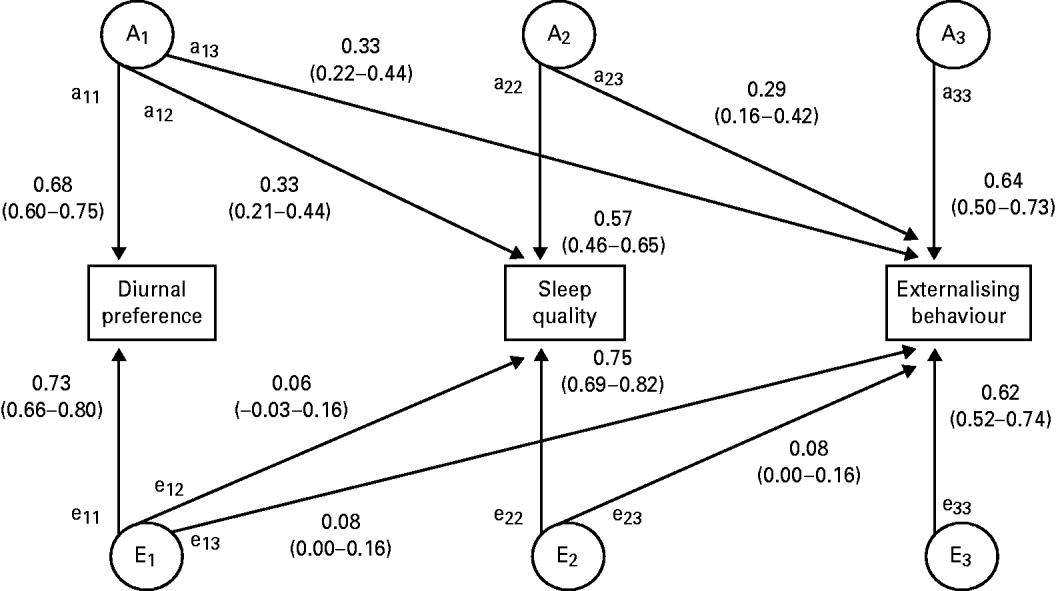
A Cholesky decomposition was used to model the three phenotypes, diurnal preference, sleep quality and externalizing behaviours, simultaneously. This model decomposes the variances and covariances between the phenotypes into common (shared between the phenotypes) and unique (specific to each phenotype) genetic and environmental components (see Fig. 1 for an example of an AE model). This model provides us with three pieces of information. First, it indicates the genetic influences common to all phenotypes (A1), those common to sleep quality and externalizing (A2) and those unique to externalizing (A3). This information can be used to calculate the proportion of overall genetic influence on externalizing behaviours shared with diurnal preference and sleep quality: (a132)/(a132+a232+a332); shared with sleep quality and externalizing independent of that shared with diurnal preference: (a232)/(a132+a232+a332); unique to externalizing: (a332)/(a132+a232+a332). Similarly, the environmental influences are included in the model. Second, the phenotypic correlations between the phenotypes can be calculated from the Cholesky model as follows:


where dp is diurnal preference, eb is externalizing behaviours, sq is sleep quality. Third, the proportions of the phenotypic correlations accounted for by genetic factors can then be calculated from the unsquared parameter estimates as follows:

The same principles apply for calculating the proportions of the non-shared environmental factors accounting for the phenotypic associations.
Multivariate Cholesky decomposition with parameter estimates [95% confidence intervals (CI)] from best-fitting model for one twin only. A, additive genetic influence; E, non-shared environmental influence. Figure displays unsquared parameter estimates, which can be squared to indicate relative proportions of variance (%). The extent to which genetic influences account for the correlations between variables can be calculated as follows: (a11∗a13)/r(diurnal preference and externalizing behaviours); (a12∗a13)+(a22∗a23)/r(sleep quality and externalizing behaviours). The same principles apply for calculating the relative proportions of variance accounted for by non-shared environmental influences.

The ordering of the variables in the Cholesky model is important as it determines how the variance between the variables is partitioned. As a result, a separate Cholesky model with sleep quality in the first position and diurnal preference in the second was also run. This allowed us to determine one additional piece of information, the extent of genetic influences common to diurnal preference and externalizing, independent of that shared with sleep quality.
Initially, the parameter estimates were free to vary between males and females. Nested models were then run, which constrained the estimates to be equal across sex. Furthermore, models in which certain parameters were dropped (e.g. C) were run in order to determine their significance. Additionally, a sibling interaction path (s) was added to the externalizing variable within the multivariate model since we observed significantly greater variances for DZ compared with MZ twins, in combination with greater MZ compared with DZ correlations for this variable. The most parsimonious model, and that which provided the best fit compared with the saturated and alternative models, was selected for interpretation. Likelihood-based 95% confidence intervals (CI) on the parameter estimates were obtained in order to determine their precision.
Results
Descriptive statistics
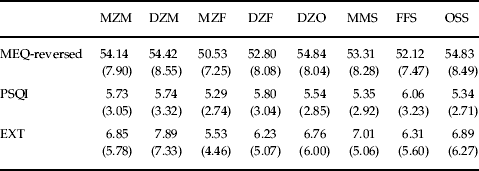
Table 1 shows the means (s.d.) of scores on morningness-eveningness, sleep quality and externalizing behaviours by sex and zygosity. There were significant mean sex differences in diurnal preference and mean and s.d. sex differences in externalizing behaviours [fit of models where means (and s.d. in externalizing) between sexes were free to vary compared with models where these parameters were equated: Δχ2=25.70, Δdf=1, p<0.01; and Δχ2=57.06, Δdf=2, p<0.01, respectively]. Males reported greater eveningness and more externalizing behaviours than females. Furthermore, there were significant differences in the s.d. for externalizing behaviour by zygosity group (fit of model where s.d. between zygosity groups were free to vary compared with a model in which these parameters were equated: Δχ2=13.76, Δdf=2, p<0.01). DZ variances were significantly greater than MZ variances. Such a pattern, in combination with extremely low DZ/Sib compared with MZ correlations, implies that a sibling interaction effect may be present. There were no significant sex or zygosity differences for sleep quality (all p's>0.05).
Raw means (s.d.) of MEQ, PSQI and externalizing

MEQ, Morningness and Eveningness Questionnaire (this scale has been reverse coded so a higher score represents greater eveningness); PSQI, Pittsburgh Sleep Quality Index; EXT, externalizing scale from adult self-report; MZ, monozygotic twins; DZ, dizygotic twins; S, non-twin sibling pairs; M, males; F, females; O, opposite-sex pairs. All analyses focus on raw (i.e. untransformed) variables. Means (s.d.) were obtained from Mx and incorporated a weight to account for selection bias and attrition. Means for twins 1 and 2 were equated so that one estimate was obtained for both individuals within a pair.
Phenotypic and twin correlations
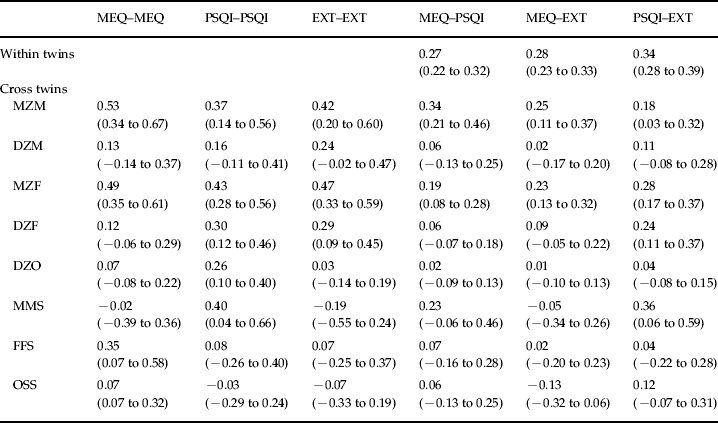
There were significant moderate correlations between diurnal preference and externalizing behaviours, and sleep quality and externalizing behaviours (r=0.28, 95% CI 0.23–0.33 and r=0.34, 95% CI 0.28–0.39, respectively). Cross-twin within-trait (e.g. diurnal preferencetwin1 and diurnal preferencetwin2) and cross-twin cross-trait correlations (e.g. diurnal preferencetwin1 and externalizing behaviourstwin2) by sex and zygosity are displayed in Table 2. For example, there was a significant cross-twin cross-trait correlation of 0.25 for the association between diurnal preference and externalizing behaviours for MZ male twins. In general, the MZ cross-twin cross-trait correlations were more than double that of the DZ/Sib correlations for the associations between diurnal preference and sleep quality and between diurnal preference and externalizing behaviours, indicating that non-additive genetic influences may be important for explaining the associations between phenotypes. However, this may be an indication of sibling interaction. In contrast, the DZ/Sib correlations for sleep quality and externalizing behaviours did not show this pattern, suggesting that additive genetic influence may be important. Of consideration, the relatively low DZ/Sib correlations and non-significant and wide CI suggest that we have limited power to distinguish the relative importance of A, D and C for the associations between the phenotypes.
Phenotypic correlations [including 95% confidence intervals (CI)] for MZ, DZ and siblings
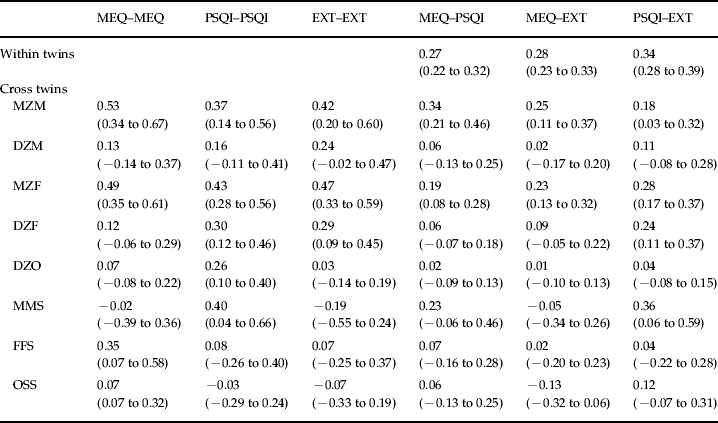
MEQ, Morningness and Eveningness Questionnaire (this scale has been reverse coded so a higher score represents greater eveningness); PSQI, Pittsburgh Sleep Quality Index; EXT, externalizing scale from adult self-report; MZ twins, monozygotic; DZ, dizygotic twins; S, non-twin sibling pairs; M, males; F, females; O, opposite-sex pairs.
All analyses focus on transformed variables. All estimates were obtained from Mx and incorporated a weight to account for selection bias and attrition. Correlations were constrained to be equal where appropriate. For example, the within-twin cross-trait correlations were averaged over the entire sample, since the genetic model does not assume any zygosity differences on this association. Furthermore, the cross-twin cross-trait correlations (e.g. sleep quality in twin 1 and externalizing in twin 2) were constrained to be equal for both combinations of randomly selected twins (e.g. externalizing in twin 1 and sleep quality in twin 2).
Multivariate genetic model – Cholesky decomposition
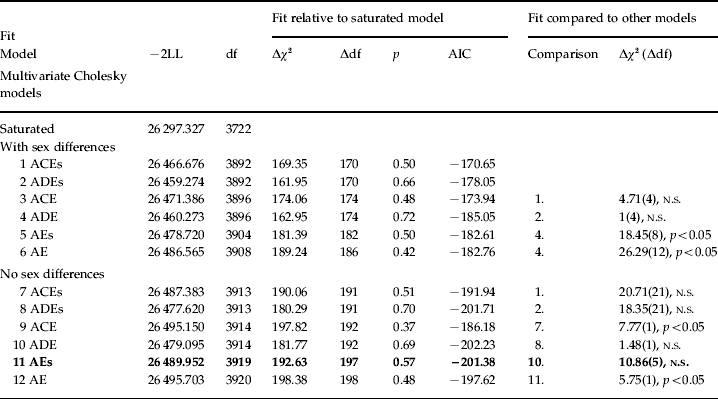
As we observed variance (s.d.) differences between the zygosity groups for the externalizing scale, a sibling interaction path (s) was added to the multivariate model. Table 3 displays the model fitting information from the multivariate models. The best-fitting model was an AEs model with no sex differences. Including the sibling interaction provided a significantly better fit to the data. The sibling interaction was −0.10 (95% CI −0.16 to −0.02) indicating that the higher one twin's score on the externalizing scale, the lower the score for the co-twin. Fig. 1 displays the Cholesky components partitioned into the unsquared parameter estimates shared between the phenotypes and those unique to each phenotype. This model shows that 18% [(0.332)/(0.332+0.292+0.642)] of the genetic influence on externalizing behaviours is shared with diurnal preference and sleep quality (A1), 14% [(0.292)/(0.332+0.292+0.642)] shared with sleep quality (A2) and the remaining 68% [(0.642)/(0.332+0.292+0.642)] is unique to externalizing behaviours (A3). The non-shared environmental influences common to all phenotypes were small and non-significant (2%). In the re-ordered Cholesky model with sleep quality entered first, we were able to determine that 3% [(0.142)/(0.422+0.142+0.642)] of the genetic influences on externalizing were shared with diurnal preference independent of that shared with sleep quality (not shown in Fig. 1 – details available on request from first author).
Fit statistics for multivariate genetic model fitting analyses
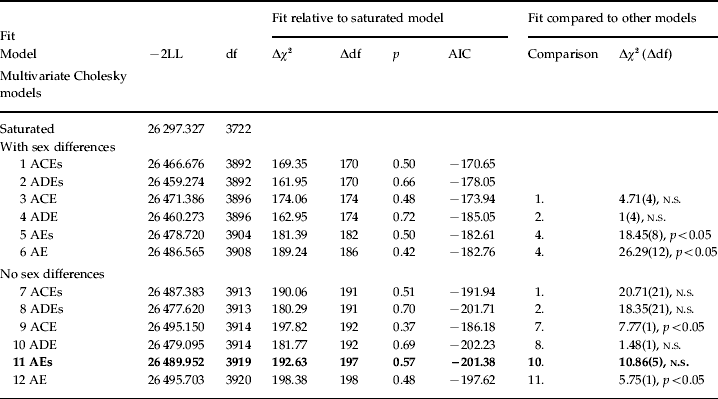
A, Additive genetic influences; C, shared environmental influences; D, non-additive genetic influences; E, non-shared environmental influences; s, sibling interaction effect; −2LL, −2∗(log likelihood); df, degrees of freedom; Δχ2 and Δdf, change in χ2 statistic and corresponding degrees of freedom (computed as the difference in likelihood and df between each model and the saturated model); AIC, Akaike's Information Criterion statistic (calculated as χ2−2df).
Best-fitting model is shown in bold. All analyses focus on transformed variables. All estimates were obtained from Mx and incorporated a weight to account for initial selection bias and selective attrition.
The proportions of the associations between phenotypes accounted for by additive genetic and non-shared environmental influences are shown in Table 4. In general, additive genetic influences accounted for a large proportion (around 80%) of the associations between phenotypes (e.g. for the association between sleep quality and externalizing behaviour: (0.33∗0.33)+(0.57∗0.29)/0.34=0.81.
Proportions [with 95% confidence intervals (CI)] of the phenotypic associations accounted for by additive genetic and non-shared environmental influences from the multivariate analysis

A, Additive genetic influence; E, non-shared environmental influence.
All analyses focus on transformed variables. All estimates were obtained from Mx and incorporated a weight to account for selection bias and attrition.
Discussion
The present study demonstrates that a preference for eveningness and poor sleep quality are associated with externalizing behaviours in a community sample of young adults. Furthermore, we show that the associations between phenotypes are attributable to common genetic influences with little influence of environmental factors.
Limitations
Before discussing these findings, a number of limitations should be considered. The first concerns the measures we used. We relied on self-report when asking about externalizing behaviours, including those that may encompass breaking the law. Individuals may be less prone to disclose information about illicit behaviours, which may underestimate our measure of externalizing behaviours. Similarly, we relied on self-report to determine diurnal preference and sleep quality with no objective measures of sleep. However, the MEQ and PSQI are widely employed and show good psychometric properties (for example, MEQ: Smith et al. Reference Smith, Reilly and Midkiff1989; Anderson et al. Reference Anderson, Petros, Beckwith, Mitchell and Fritz1991; Chelminski et al. Reference Chelminski, Ferraro, Pertros and Plaud1997 and for the PSQI: Buysse et al. Reference Buysse, Reynolds, Monk, Berman and Kupfer1989; Backhaus et al. Reference Backhaus, Junghanns, Broocks, Riemann and Hohagen2002). Despite this, it is possible that the associations found between the variables may be partially accounted for by shared method variance. Simple techniques for evaluating circadian phase and sleep, such as wrist actigraphy and simplified ambulatory electroencephalogram monitors, may be useful additions to behavioural genetic studies in the future.
A second limitation concerns the cross-sectional nature of the present study. Although the G1219 study is now in its fourth wave, data on sleep are only available at one time point. This means that we are unable to draw conclusions as to the direction of effects. Longitudinal analyses, which will be possible if sleep data are collected in future waves of the present study, are necessary in order to make such inferences.
A final note worthy of consideration is that using twins to draw conclusions about the general population has been criticized on numerous grounds, including the possibility that twins may be unrepresentative of non-twins. Other challenges to twin studies should be considered when interpreting the results of this investigation (for a discussion of this issue, see Plomin et al. Reference Plomin, DeFries, McClearn and McGuffin2008).
Phenotypic associations between diurnal preference, sleep quality and externalizing behaviours
Diurnal preference and sleep quality were significantly associated with externalizing behaviours, such that eveningness and poor sleep quality were correlated with greater externalizing behaviours. This is in keeping with the literature, which has suggested that evening-types may exhibit more behavioural and emotional problems and have more unstable life-style habits than morning-types (Giannotti et al. Reference Giannotti, Cortesi, Sebastiani and Ottaviano2002; Monk et al. Reference Monk, Buysse, Potts, DeGrazia and Kupfer2004). Furthermore, this confirms what has already been noted in adolescents, whereby eveningness was associated with greater ASB symptoms (Susman et al. Reference Susman, Dockray, Schiefelbein, Herwehe, Heaton and Dorn2007). It is possible that since ASBs may occur during the evening, these behaviours may be performed by individuals holding a preference for night-time activity – in accordance with their circadian rhythm. Additionally, those who reported more externalizing symptoms were more likely to experience poorer sleep quality than those scoring lower on these measures. This is in accordance with previous studies, which have shown that incarcerated individuals and those with personality disorders who commit aggressive acts have poorer sleep quality than individuals scoring lower on measures of ASB (Lindberg et al. Reference Lindberg, Tani, Appelberg, Stenberg, Naukkarinen, Rimon, Porkka-Heiskanen and Virkkunen2003; Ireland & Culpin, Reference Ireland and Culpin2006; Semiz et al. Reference Semiz, Algul, Basoglu, Ates, Ebrinc, Cetin, Gunes and Gunay2008). The present study extends this finding to members of the general population.
Sibling interaction
For the externalizing variable, the pattern of results indicated the presence of a negative sibling interaction effect. This finding suggests that the presence of externalizing behaviour in one twin is associated with lower levels of such behaviours in the co-twin. A previous study also found greater variances for DZ compared with MZ twins for externalizing behaviour (Button et al. Reference Button, Lau, Maughan and Eley2008), indicating the possible presence of a sibling interaction effect. These findings suggest that the behaviour of the co-twin should be taken into account when examining aetiological influences on ASB.
Genetic and environmental influences on the association between diurnal preference and externalizing behaviours
The reasons why a preference for eveningness is associated with externalizing behaviours has not been examined before. We found that around 18% of the genetic factors influencing externalizing behaviours were common to those influencing diurnal preference and sleep quality. This suggests that to some extent the same genes were influencing all three phenotypes. Furthermore, there was a small amount of genetic influence common to diurnal preference and externalizing behaviours that was distinct from sleep quality. Non-shared environmental influences common to all three phenotypes, however, were small and non-significant, indicating that distinct environmental factors influence sleep and externalizing behaviours.
Genetic influences accounted for a substantial proportion of the covariance between these phenotypes, with little influence of the non-shared environment. This suggests that the association between diurnal preference and externalizing behaviours is largely genetically mediated. Mechanisms that could account for these genetic correlations may include the functioning of the cortisol system. Evening-types have been found to have lower cortisol levels in the first hour after waking than morning-types (Kudielka et al. Reference Kudielka, Federenko, Hellhammer and Wust2006) and individuals with low baseline concentrations of salivary cortisol have been shown to exhibit more aggressive behaviours than those with higher concentrations (McBurnett et al. Reference McBurnett, Lahey, Rathouz and Loeber2000; Pajer et al. Reference Pajer, Gardner, Rubin, Perel and Neal2001). Since cortisol appears to be important for both diurnal preference and externalizing behaviours, it could be postulated that genes controlling the secretion of cortisol may contribute to the association between these phenotypes. However, the exact function of cortisol in the relationship between sleep and externalizing behaviours needs further elucidation. An alternative explanation for the pattern of results could be that, rather than genes directly influencing the association between diurnal preference and externalizing behaviours, the pathway by which these traits are associated may be mediated by intermediate variables. For example, individuals who prefer the night hours have more opportunities to engage in ASB. Activities such as consuming alcohol may be more likely in ‘evening-types’ and alcohol consumption is an activity that is known to predispose to ASB (Miczek et al. Reference Miczek, Fish, de Almeida, Faccidomo and Debold2004).
Genetic and environmental influences on the association between sleep quality and externalizing behaviours
Around 14% of the genetic factors influencing externalizing behaviours were common to those influencing sleep quality, independent of those also shared with diurnal preference. This suggests that, although there are some genes shared between all phenotypes, there are some genetic influences specific to sleep quality and externalizing behaviours. This finding may guide molecular genetic research aimed at identifying specific genes impacting both sleep quality and externalizing behaviours, as those genes already known to influence one behaviour may be worth exploring as to their role in the other behaviour. Common non-shared environmental influences, again, were minimal. This finding adheres to a pattern often seen in developmental psychopathology, of ‘general genes’ and ‘specific non-shared environments’ (Eley, Reference Eley1997). For a variety of phenotypes, there is often a common genetic component influencing the associations between certain behaviours, but the environmental influences upon them are often unique. As a result, common genes yet novel environmental influences should be sought with regard to the phenotypes under investigation.
The association between sleep quality and externalizing behaviours was largely accounted for by genetic influences, with little influence of the non-shared environment. This suggests that reasons why some aggressive individuals may experience poorer sleep quality could be based partly on genotype variations. However, an alternative explanation is that the association between sleep quality and externalizing behaviours, as with diurnal preference, is mediated by intermediate variables. For example, it is possible that an antisocial life-style leads to an increased experience of stressful life events or family conflict – which are known to be associated with sleep disturbances (Healey et al. Reference Healey, Kales, Monroe, Bixler, Chamberlin and Soldatos1981; Gregory et al. Reference Gregory, Caspi, Moffitt and Poulton2006; Vahtera et al. Reference Vahtera, Kivimaeki, Hublin, Korkeila, Suominen, Paunio and Koskenvuo2007; Hall et al. Reference Hall, Buysse, Nofzinger, Reynolds, Thompson, Mazumdar and Monk2008). In other words, individuals who are genetically prone to aggressive behaviour may elicit environments that impact sleep quality. This is an example of gene–environment correlation and would support the view that, although sleep and externalizing behaviours share common genetic influences, the associations between them are indirect. Drawing on the sleep deprivation literature, it could also be hypothesized that a lack of sleep increases risk for engaging in ASB as a result of increased irritability, impulsivity and changes in cognitive functioning. This is in accordance with experimental data, which have shown that sleep loss is associated with deficits in decision making (Killgore et al. Reference Killgore, Balkin and Wesensten2006) and inhibitory control (Heuer et al. Reference Heuer, Kohlisch and Klein2005), restlessness and emotional fluctuation (Roth et al. Reference Roth, Kramer and Lutz1976). As a result, a genetic predisposition to poor sleep may contribute to the exhibition of externalizing behaviours via these intermediate variables. This highlights the need to specifically test for gene–environment correlation in order to determine the extent to which genetic links between sleep and externalizing behaviours are direct and indirect.
Acknowledgements
Waves 1–3 of the G1219 study were supported by grants from the WT Grant Foundation, the University of London Central Research fund and a Medical Research Council Training Fellowship and Career Development Award to T. C. Eley. Wave 4 of the G1219 study was supported by grants from the Economic and Social Research Council (RES-000–22–2206) and the Institute of Social Psychiatry to A. M. Gregory, who is currently supported by a Leverhulme Research Fellowship. N. L. Barclay is supported by an ESRC studentship. B. Maughan is supported by the Medical Research Council. We thank the families for their participation as well as numerous staff and students from the Social Genetic Developmental Psychiatry Centre, Institute of Psychiatry, London and Goldsmiths, University of London.
Declaration of Interest
None.