Implications
Beef cows offered metabolizable protein (MP) at 150% of requirements from a moderately abundant, rumen-undegradable protein source had increased ovulatory follicle diameter, antral follicle counts (AFC) and corpus luteum (CL) development compared with 125% MP. These data indicate that increasing concentrations of excess CP around the time of ovulation do not negatively impact reproductive function in beef cows as previously hypothesized. To the contrary, some aspects of reproduction may be enhanced by excess CP, which may be linked to altered amino acid (AA) profiles in the bloodstream; however, further research is necessary to determine which specific AAs should be fed to improve reproductive performance.
Introduction
When high protein feedstuffs are supplemented as an energy source to beef cows, total dietary protein may likely exceed 150% of National Research Council (NRC) requirements (Gunn et al., Reference Gunn, Lemenager and Bridges2014c). This is of particular concern as excess dietary protein has been associated with reduced fertility in dairy cattle (Butler et al., Reference Butler, Calaman and Beam1996) as abundance of ammonia and urea in the reproductive tract alters uterine pH (Elrod and Butler, Reference Elrod and Butler1993) making a less favorable environment for embryo development. However, more recent studies have demonstrated that supplementation of distillers grains as an energy source, resulting in excess dietary protein, may be beneficial to reproductive performance of primiparous beef heifers (Gunn et al., Reference Gunn, Lemenager and Bridges2014c) and pregnancy rates of beef cows (Gunn et al., Reference Gunn, Lemenager and Bridges2014a).
More specifically, when moderately rumen undegradable protein (RUP) source (62% RUP) was offered to equal ~150% of NRC MP requirements ovulatory follicle diameter of non-lactating beef cows were enhanced (Gunn et al., Reference Gunn, Schoonmaker, Lemenager and Bridges2014b; Geppert et al., Reference Geppert, Meyer, Perry and Gunn2016). However, research is warranted to determine if amount of excess MP from a RUP feedstuff differentially affects ovarian function of beef cows. Therefore, the objective of this experiment was to determine if the amount of excess dietary protein (125% MP v. 150% MP) from a moderately rumen undegradable feedstuff affected ovarian function of beef cows consuming processed corn stalks. We hypothesized that increasing the amount of excess MP would enhance ovulatory follicle diameter, CL development, hormone profile and alter AA profile around the time of ovulation, compared with excess MP at a decreased supplementation rate.
Material and methods
Animals and diets
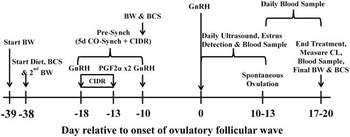
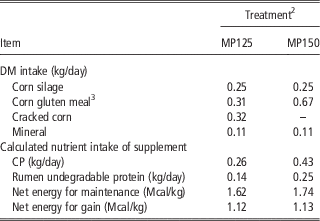
All protocols and procedures used were approved by the Iowa State University Institutional Animal Care and Use Committee. The project was conducted at Zumwalt Station Research Unit in Ames, Iowa from May 2014 to July 2014. In order to evaluate the effects of excess amounts of MP from a moderately undegradable protein source on ovarian function around ovulation, 16 non-pregnant, non-lactating, cycling, Angus and Angus-Simmental multiparous beef cows were used. Cows were stratified by age (6.36±2 years), body condition score (BCS; 4.93±0.34 (1=emaciated, 9=obese; Wagner et al., Reference Wagner, Lusby, Oltjen, Kakestraw, Wettermann and Walters1988)) and BW (552±36 kg) and allotted to 1 of 2 isocaloric dietary supplements differing in amount of excess MP inclusion and fed at a rate of 1 kg/animal per day (Table 1). All cows were offered ad libitum access to low quality forage (processed corn stalks; 6% CP and 80% NDF) and individually supplemented once daily with a moderately undegradable protein supplement (corn gluten meal: 62% RUP) for 60 days (Figure 1). Diets were formulated so that when supplements were combined with estimated ad libitum corn stalk consumption, total dietary MP would be: (1) 125% (MP125) or (2) 150% (MP150) of requirements (NRC, 2000). Diet formulation was based on near-infrared spectroscopy feedstuff analysis before study initiation (Dairyland Laboratories Inc., Arcadia, WI, USA) and designed to maintain similar cow BW and BCS throughout the study. Although diets were not isonitrogenous, balancing diets using MP also ensured that the rumen degradable protein (RDP) requirements were met or exceeded for cows in both treatments.
Experimental design for dietary treatments (MP125=125% metabolizable protein (MP) corn gluten meal; MP150=150% corn gluten meal outlining daily tasks and data collected relative to onset of ovulatory follicular wave in beef cows. Protein supplementation and ad libitum corn stalks began on day−38 and were offered until day 37, for a total of 60 days. BCS=body condition score; CIDR=controlled intravaginal drug releasing device; CL=corpus luteum; GnRH=gonadotropin releasing hormone; PGF2α =prostaglandin F2α .

Supplement provided to beef cows consuming ad libitum corn stalksFootnote 1

DM=dry matter.
1 Corn stalk nutrient analysis (% DM basis): 51% TDN; 6% CP; 50% ADF; 80% NDF. When combined with estimated corn stalk intake, total dietary metabolizable protein (MP) intake for MP125 and MP150=570 and 680 g/day, respectively. Requirement for 590 kg cow (average starting weight of cows enrolled in study)=455 g/day for maintenance (NRC, 2000).
2 Treatment included ad libitum access to corn stalks, followed by daily supplementation of MP at 125% (MP125) or 150% (MP150) of MP requirements for non-pregnant, non-lactating multiparous beef cows.
3 Nutrient analysis (% DM basis): 67% CP, 62% rumen undegradable protein, 2.4% fat.
Cows were allowed ad libitum access to processed corn stalks (51% total digestible nutrients (TDN); 50% ADF; 80% NDF and 6% CP) in a pen setting (three pens). Corn stalk intake was estimated using the following formula (NRC, 2000) for non-pregnant beef cows: dry matter intake=((Shrunk BW0.75×(0.04997×net energy for maintenance2+0.03840)/net energy for maintenance)×(temperature adjustment)×(mud adjustment)), where adjustments for temperature and mud were 1 and 1, respectively. Although corn stalk refusal was unable to be accurately quantified due to feeding system, corn stalk delivery was similar across all pens and exceeded estimated intake.
Daily individual supplementation took place at 0800 h inside a facility where 10 side-by-side stanchions were located. All cows from one treatment (n=8) were restrained in stanchions and allowed to consume supplement individually. Cows were allowed adequate time to consume supplement while daily samples and measurements were being recorded. After supplement consumption and data collection (<1 h), cows were released from stanchions and commingled in for corn stalk consumption.
Performance characterization
Initial BCS was assessed on the day before trial initiation and was recorded as the average of scores from two trained investigators throughout all time points. In addition, initial BW was recorded as the average BW measured on the day before and the first day of the trial, before supplement delivery. Additional BCS and BW were taken once monthly, with BW being averaged on 2 consecutive days before treatment delivery when cows had restricted access to corn stalks for 12 h before BW collection to minimize variation in gut fill. Final BCS was taken on the last day of supplementation, and final BW was taken before supplementation on the day before and the last day of the study.
Pre-synchronization
Treatment experimental design is outlined in Figure 1. After 20 days of initiating dietary treatments, cows were synchronized with the 5-day CO-synch+controlled intravaginal drug release (CIDR) protocol. At synchronization initiation cows were administered 100 µg of gonadotropin releasing hormone (GnRH, Cystorelin; Merial Limited, Duluth, GA, USA) and received a CIDR (Zoetis Animal Health, Florham Park, NJ, USA). After 5 days, the CIDR was removed, 25 mg prostaglandin F2α (PGF2α , Lutalyse; Zoetis Animal Health, New York, NY, USA) was administered and an Estrotect heat detection aid (Rockway Inc., Spring Valley, WI, USA) was placed on the tailhead of each cow. A second 25-mg dose of PGF2α was administered 8 h after CIDR removal to ensure complete luteolysis of the young, accessory CL induced by the first administration of GnRH (Bridges et al., Reference Bridges, Mussard, Burke and Day2012). Estrus detection was performed for 72 h following CIDR removal by trained personnel. Cows were monitored for visual estrus twice daily for 30 min each at 0630 and 1700 h. After 72 h of CIDR removal and initial PGF2α injection, all cows received 100 µg GnRH, and heat detection aid activity was recorded and removed.
Ovarian follicular wave characterization
After 10 days of synchronization protocol completion, 100 µg of GnRH was administered to initiate growth of a new follicular wave. Beginning at GnRH administration and daily thereafter at 0800 h, cows were subject to transrectal ultrasonography (Ibex Portable Ultrasound, variable MHz linear array transducer; E.I. Medical Imaging, Loveland, CO, USA) for complete characterization of a single follicular wave. Location and size of all antral follicles ⩾3 mm in diameter were recorded each day by drawing sketches of each ovary. Transrectal ultrasound examinations were performed by the same investigator for the duration of the ultrasound period, and estrus was detection was performed twice daily by trained personnel at 0630 and 1700 h with the aid of heat detector patches (Rockway Inc.). All follicle measurements were made using the internal caliper function of the ultrasound, with final reported follicle diameters being the average of the greatest two cross-sectional perpendicular measurements of the follicle.
Day of dominance and size at dominance were categorized on the day which the largest growing follicle was at least 8 mm in diameter and at least 1 mm larger in diameter than any other growing follicle of the same wave (Ginther et al., Reference Ginther, Kot, Kulick and Wiltbank1997). The dominant follicle was documented as the largest growing follicle in the wave of interest, and the secondary follicle was the second largest growing follicle in the same wave. Duration of dominance was retrospectively determined as the number of days from attainment of dominance until day of ovulation. Daily ovarian ultrasound ended upon successful ovulation as confirmed by disappearance of the ovulatory follicle from the wave of interest, preceded by visual display of estrus.
When estrus and subsequent ovulation were both confirmed, ultrasound measurements were halted until 7 days post-estrus, when ultrasound was performed once again to measure the total CL volume. Volume of the CL was determined using the internal caliper function of the ultrasound and formula for a rotary ellipsoid (V=4/3 Π ab 2, where a=longitudinal axis and b=transverse axis). If lacuna(e) was present, the volume was calculated as previously stated and then subtracted from the total CL volume. After final CL measurement, dietary treatments ended.
Day of spontaneous luteolysis during the ovulatory follicle wave was retrospectively determined via radioimmunoassay (RIA) and defined as the day on which circulating progesterone concentrations were <50% of the concentration on the previous day (Ginther et al., Reference Ginther, Silva, Araujo and Beg2007). This also allowed ovulatory follicle size at spontaneous luteolysis and growth from luteolysis to ovulation to be determined. Length of proestrus was also retrospectively determined as the hours between spontaneous luteolysis and expression of estrus. Wave emergence was tracked by tracing the dominant follicle back to a cohort of follicles ⩽4 mm in diameter, and wave length was calculated as total days from wave emergence to ovulation. AFC were totaled daily and all days were averaged to calculate average AFC of the entire wave.
Plasma analyses
During the 20-day dietary adaptation period, coccygeal blood samples were collected at time of feeding twice weekly (Monday and Thursday), and plasma was stored for later analysis for plasma urea nitrogen (PUN) concentration. During the ultrasound period until final CL measurement 7 days post-estrus, coccygeal blood samples were taken daily for plasma analysis of PUN, estradiol-17β and progesterone concentrations. Approximately 4 ml of blood was collected via coccygeal venipuncture in a 6 ml EDTA vacutainer (10.8 mg of EDTA; BD Vacutainer; Becton, Dickinson and Co., Franklin Lakes, NJ, USA) and immediately placed on ice. Samples were centrifuged at 1750×g for 25 min at 4°C, and plasma was recovered and transferred into 5 ml polystyrene tubes and frozen at −20°C until respective analyses were conducted.
Plasma samples collected during the ultrasound period were analyzed for circulating progesterone concentrations to determine day of spontaneous luteolysis and subsequent CL progesterone secretion. Concentrations were determined using a commercially available RIA kit (Coat-A-Count; Siemens Healthcare Diagnostics Inc., Los Angeles, CA, USA). Across three assays, the average intra-assay CV was 1.2%, with the inter-assay CV from pooled samples containing 0.59 and 5.82 ng/ml, was 9.8% and 6.7%, respectively. Average sensitivity across the assays were 0.14 ng/ml (95% confidence interval). Plasma samples collected from the day of spontaneous luteolysis until ovulation were analyzed for circulating concentrations of estradiol-17β via RIA at South Dakota State University following methods described by Perry and Perry (Reference Perry, Smith, Roberts, MacNeil and Geary2008). Across three assays, the average intra-assay CV was 4.5% and the average inter-assay CV from a pooled serum sample containing 7.9 pg/ml was 8%. The average sensitivity across three assays was 0.49 pg/ml (95% confidence interval).
Plasma samples were analyzed for PUN using a commercially available assay (Urea Nitrogen Procedure No. 0580; Stanbio Laboratory, Boerne, TX, USA). Samples and standards were prepared, loaded into a 96-well plate and read on an Eon Microplate Spectrophotometer at 520 nm (BioTek Instruments Inc., Winooski, VT, USA). Across eight assays, the average intra-assay CV was 5.3%, with an inter-assay CV from pooled serum containing 7.49 mg/dl of urea N was 10.9%. Preprandial blood samples taken at treatment initiation and around time of estrus (day 15) were analyzed for circulating AA concentrations at North Dakota State University (Fargo, ND, USA) via methods of ultra performance liquid chromatography (Lemley et al., Reference Lemley, Camacho, Meyer, Kapphahn, Caton and Vonnahme2013).
Statistical analysis
Data were analyzed using the MIXED procedure of SAS 9.3 (SAS Institute Inc., Cary, NC, USA), with the main effect of treatment and experimental unit of animal. For ovarian follicular wave characteristics, hormone and metabolite analyses, the covariates of age and individual change in BW were included in the model as covariates. The MIXED procedures of SAS for REPEATED measures were utilized to analyze ovulatory follicle growth, progesterone and PUN concentrations. The covariance structures compound symmetry, heterogeneous compound symmetry, autoregressive order one, unstructured and ante-dependence were compared. The covariance structure resulting in the smallest Bayesian information criterion was used for the final analyses. The effects of treatment and day, as well as the interaction of treatment and day were analyzed in the model. Length of time from visual display of estrus to final CL measurement was also run as a covariate in the repeated analyses; however, it was removed from the model due to insignificance (P>0.10). The simple effects within day were determined using the slice function of SAS. The correlation procedure of SAS was used to determine relationships among variables of interest. For all analyses, significance was noted at P⩽0.05, with tendencies identified at P>0.05 and ⩽0.10. It should be noted two cows from the MP125 treatment and three cows from the MP150 treatment failed to reach progesterone concentrations >1 ng/ml after ovulation; therefore, all data from those five cows were removed from the study.
Results
Performance and ovulatory follicle wave characteristics
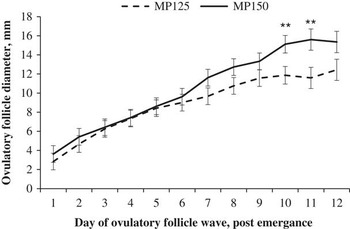
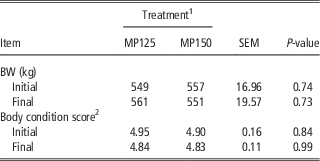
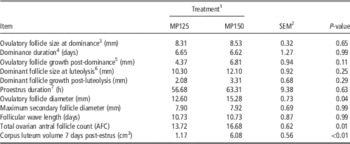
Performance characteristics of BW and BCS are presented in Table 2. As designed, BW and BCS were similar (P⩾0.74) between treatments at initiation of the study. Furthermore, with use of isocaloric dietary treatments, final BW and BCS were not different (P⩾0.73) at the conclusion of the trial. Ovulatory follicle wave and CL characteristics are presented in Table 3. The preovulatory follicle parameters of wave length, day of luteolysis; size at dominance, duration of dominance and growth post-dominance as well as size at spontaneous luteolysis, growth post-luteolysis and duration of proestrus were not different (P⩾0.11) between treatments. However, cows from the MP150 treatment had greater maximum ovulatory follicle diameter (P=0.04) and average AFC (P=0.01) compared with the MP125 treatment. In addition, there was a significant (P<0.02) treatment×day interaction for ovulatory follicle size post-emergence, as cows from MP150 treatment had larger (P⩽0.05) ovulatory follicles on days 10 and 11 post-emergence than MP125 cows (Figure. 2). Lastly, CL volume 7 days post-estrus was greater (P<0.01) in MP150 than MP125 treatment cows. Ovulatory follicle size was positively correlated to CL volume (P=0.03, r=0.64).
Effect of excess amounts of metabolizable protein (MP) supplementation (MP125=125% and MP150=150% of requirements) on ovulatory follicle diameter in beef cows. A treatment×day interaction (P<0.02) was observed. P-values for treatment and day were 0.13 and <0.001, respectively. Days on which ovulatory follicle diameter was significantly different between treatments (P⩽0.05) denoted with **.

Effects of excess amounts of metabolizable protein (MP) supplementation on BW and body condition score in beef cows

1 Treatment included ad libitum access to corn stalks, followed by daily supplementation of MP at 125% (MP125) or 150% (MP150) of MP requirements for non-pregnant, non-lactating multiparous beef cows.
2 Scale of 1=emaciated to 9=obese, Wagner et al. (Reference Wagner, Lusby, Oltjen, Kakestraw, Wettermann and Walters1988).
Effects of excess amounts of metabolizable protein (MP) supplementation on ovulatory follicle wave and corpus luteum characteristics in beef cows

1 Treatment included ad libitum access to corn stalks, followed by daily supplementation of metabolizable protein (MP) at 125% (MP125) or 150% (MP150) of requirements for non-pregnant, non-lactating multiparous beef cows.
2 Greater SEM presented (MP125: n=6; MP150: n=5).
3 Dominance obtained when largest growing follicle was at least 1 mm larger than any other growing follicle and at least 8 mm in diameter.
4 Period between attainment of dominance until ovulation.
5 Growth of ovulatory follicle between dominance and ovulation.
6 Luteolysis defined as first day on which circulating progesterone concentrations were <50% of previous day concentration.
7 Period between luteolysis and expression of estrus.
Plasma analyses
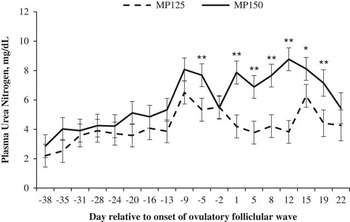
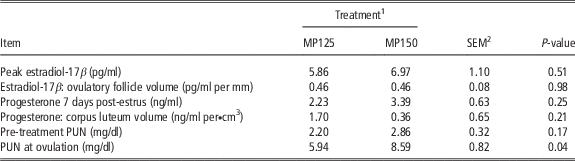
Circulating estradiol concentrations at luteolysis, as well as peak concentration before onset of estrus were not different between dietary treatments (P⩾0.51; Table 4). Furthermore, when the ratio of estradiol to ovulatory follicle volume was assessed, no difference between treatments existed (P=0.98). In addition, circulating progesterone and the ratio of progesterone to CL volume were not different (P⩾0.21) due to dietary treatment. Peak concentrations of estradiol were not related to dominant follicle size (P=0.21); however, progesterone concentrations 7 days post estrus tended to be positively associated with CL volume (P=0.07; r=0.56). Initial PUN concentrations were not different (P=0.17; Table 4) between treatments. However, there was a treatment×day interaction detected (P<0.01; Figure. 3), as PUN concentrations were greater (P<0.05) in MP150 compared with MP125 cows after onset of the ovulatory follicular wave.
Effect of excess amounts of metabolizable supplementation (MP; MP125=125% and MP150=150% of requirements) on circulating plasma urea N (PUN) concentrations in beef cows. There was a treatment×day interaction (P<0.001) observed. P-values for treatment and day were 0.02 and <0.001, respectively. Days on which PUN was different between treatments (P⩽0.05 and P<0.10) are denoted by ** and *, respectively.

Effects of excess amounts of metabolizable protein (MP) supplementation on estradiol, progesterone and plasma urea nitrogen concentrations in beef cows

PUN=plasma urea nitrogen.
1 Treatment included ad libitum access to corn stalks, followed by daily supplementation of MP at 125% (MP125) or 150% (MP150) of requirements for non-pregnant, non-lactating multiparous beef cows.
2 Greater SEM presented (MP125: n=6; MP150: n=5).
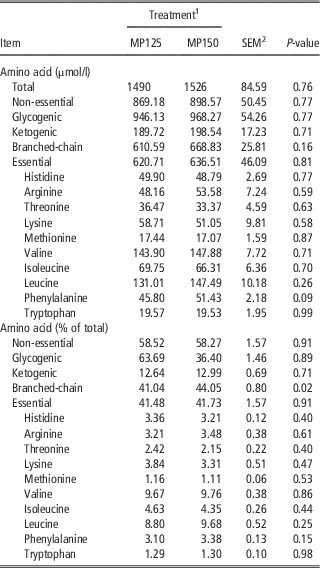
AA concentrations at the time of ovulation are located in Table 5. At trial initiation before protein supplementation, total AA, as well as total essential AA and non-essential AA were similar (P⩾0.81; data not shown) between dietary treatments. Also at trial initiation, when samples were analyzed as a percent of total AA, data was not different (P>0.14) between treatments. At ovulation, plasma samples showed no difference (P⩾0.77) in total circulating AA or total essential and non-essential AA concentrations between treatments. However, circulating total phenylalanine tended to be greater (P=0.09) in the MP150 than MP125 treatment. In addition, when expressed as a percent of total AA, branched-chain amino acids (BCAA) were greater (P=0.02) in MP150 compared with MP125.
Effects of excess amounts of metabolizable protein (MP) supplementation on circulating amino acid concentrations at ovulation in beef cows

1 Treatment included ad libitum access to corn stalks, followed by daily supplementation of MP at 125% (MP125) or 150% (MP150) of requirements for non-pregnant, non-lactating multiparous beef cows.
2 Greater SEM presented (MP125: n=6; MP150: n=5).
Discussion
The objective of this study was to determine if MP fed at 125% of MP requirements from a moderately undegradable source would have similar effects on beef cow ovarian function as supplementation at 150%. Diets containing increased CP have historically resulted in elevated circulation of urea N. This may be of concern as PUN concentrations above 19 mg/dl have been associated with suppressed conception and pregnancy rates in dairy cows (Butler et al., Reference Butler, Calaman and Beam1996). However, feeding CP at 150% of NRC requirements has not been shown to result in PUN exceeding 19 mg/dl in beef cattle (Rusche et al., Reference Rusche, Cochran, Corah, Stevenson, Harmon, Brandt and Minton1993; Gunn et al., Reference Gunn, Lemenager and Bridges2014c). Although PUN varies with feeding and collection time, these studies showed no negative associations between PUN and reproductive parameters.
Few studies have explored the relationship between excess RUP, PUN and reproductive parameters in beef cattle. However, it was recently elucidated that excess CP from a more concentrated rumen undegradable feedstuff (150% RUP via corn gluten meal) enhanced ovulatory follicle size of non-lactating females compared with 150% MP from a more degradable source (soybean meal; Geppert et al., Reference Geppert, Meyer, Perry and Gunn2016). Gunn et al. (Reference Gunn, Schoonmaker, Lemenager and Bridges2014b) also reported enhanced ovulatory follicle diameter, AFC and estradiol concentrations from cows fed 150% MP when compared with 100% MP.
In the present study, supplementation of RUP at 150% of requirements resulted in greater PUN circulation than 125% after 40 days of supplementation, which was expected. Nonetheless, while PUN concentrations were elevated compared with baseline in both treatments after supplementation, circulating PUN was still relatively low compared with concentrations known to be associated with decreased reproductive performance which is likely due to preprandial collection of blood samples for PUN analysis.
Ovulatory follicle wave characteristics
Previous studies reported that excess CP supplementation yielded larger ovulatory follicles in lactating cows (Lents et al., Reference Lents, White, Ciccioli, Wettemann, Spicer and Lalman2008) and first-calf heifers (Gunn et al., Reference Gunn, Lemenager and Bridges2014c). In agreement with the current study, recent research in our lab (Gunn et al., Reference Gunn, Schoonmaker, Lemenager and Bridges2014b; Geppert et al., Reference Geppert, Meyer, Perry and Gunn2016) reported that excess CP sourced from corn gluten meal, a moderately abundant RUP source, supplemented at 150% of NRC MP requirements enhanced ovulatory follicle size compared with diets containing 100% of MP requirements from gluten meal and 150% of MP requirements from soybean meal (64% RDP) in non-lactating, non-pregnant beef cows, respectively. Ovulatory follicle size has been associated with enhanced pregnancy success, as spontaneous ovulation of large follicles in beef heifers were more likely to result in a pregnancy than females ovulating smaller follicles (Perry et al., Reference Perry, Smith, Lucy, Green, Parks, MacNeil, Roberts and Geary2007). However, pregnancy success may not be correlated with follicle size when spontaneous ovulation occurs (Perry et al., Reference Perry and Perry2005). The disconnect between spontaneous ovulation beef heifers v. cows could be due to differences in age and stage of development of the females. Thus, non-lactating beef cows having reduced nutrient demands when compared with developing heifers may be able to utilize excess MP to increase ovarian follicular development.
Greater ovulatory follicle diameter could potentially be due to the increased proportion of bypass protein in MP150 v. MP125, increasing circulating insulin concentrations which have been previously associated with enhanced dominant follicle size (Ciccioli et al., Reference Ciccioli, Wettemann, Spicer, Lents, White and Keisler2003), and working through growth hormone (GH) and IGF-1 pathways to control follicular growth (Silva et al., Reference Silva, Figueiredo and Van Den Hurk2009). However, this is speculative as insulin, GH and IGF-1 was not measured in the present study.
It has been previously demonstrated, as is here, that excess dietary RUP supplementation yields greater average AFC (Gunn et al., Reference Gunn, Schoonmaker, Lemenager and Bridges2014b). Greater AFC may result in improved fertility due to improved oocyte competence compared with lower AFC cows (Ireland et al., Reference Ireland, Smith, Scheetz, Jimenez-Krassel, Folger, Ireland, Mossa, Lonergan and Evans2011). However, the exact mechanism of how AFC is mediated is unknown. Cushman et al. (Reference Cushman, McNeel and Freetly2014) suggested that AFC may be predetermined before birth, and may also be influenced through developmental programming. Yet, to our knowledge this study and research by Gunn et al. (Reference Gunn, Schoonmaker, Lemenager and Bridges2014b) are the first reports suggesting that postnatal diet may alter AFC. While initial AFC measurements were not taken in either of the previously mentioned studies, similar AFC results in two separate experiments is intriguing. Because the primordial germ cell population is established before birth, enhancing follicle recruitment or AFC may shorten the reproductive lifespan of a female by depleting the follicular reserve more quickly. Yet, as AFC begins decreasing in bovine females after 5 years of age (Cushman et al., Reference Cushman, Allan, Kuehn, Snelling, Cupp and Freetly2009), perhaps excess protein fed at 150% MP requirements may be beneficial to follicular recruitment in females past peak AFC production by increasing IGF-1 and FSH receptors, aiding the transition from secondary to antral follicles (Silva et al., Reference Silva, Figueiredo and Van Den Hurk2009).
Cows induced to ovulate large follicles have been reported to develop larger CL compared with cows induced to ovulate small follicles (Vasconcelos et al., Reference Vasconcelos, Sartori, Oliveira, Guenther and Wiltbank2001). As the CL develops from the granulosa and theca cells of the ovulatory follicle, larger follicles tend to have more follicular cells and greater estradiol exposure which influence the developing luteal tissue after ovulation (Atkins et al., Reference Atkins, Smith, MacNeil, Jinks, Abreu, Alexander and Geary2013). Smaller CL development in MP125 cows was expected after ovulating smaller follicles. However, normal development of the CL is also dependent on blood flow which is also associated with AA (arginine) through nitric oxide production (Tamanini, et al., Reference Tamanini, Basini, Grasselli and Tirelli2003). Although we hypothesized that differences in CL volume may be due to circulating AA, the lack of differences in arginine and its metabolites (citrulline and ornithine, data not shown) do not support this hypothesis.
Hormones and amino acids
Hormones
Given differing ovulatory follicle sizes, it was surprising that we did not observe a difference in estradiol concentrations due to treatment. One would expect greater circulating estradiol concentrations at ovulation of the larger follicles (Vasconcelos et al., Reference Vasconcelos, Sartori, Oliveira, Guenther and Wiltbank2001; Perry et al., Reference Perry and Perry2005; Busch et al., Reference Busch, Atkins, Bader, Schafer, Patterson, Geary and Smith2008); however, similar proestrus intervals between treatments may have mitigated differences in estradiol production (Bridges et al., Reference Bridges, Ahola, Brauner, Cruppe, Currin, Day, Gunn, Jaeger, Lake, Lamb, Marquezini, Peel, Radunz, Stevenson and Whittier2010). In addition, as size of the ovulatory follicle has been associated with subsequent CL volume (Vasconcelos et al., Reference Vasconcelos, Sartori, Oliveira, Guenther and Wiltbank2001), a correlation between CL volume and circulating progesterone has also been observed in beef cows (Echternkamp et al., Reference Echternkamp, Cushman and Allan2009). However, regardless of follicle and CL size in the present study, no difference in subsequent circulating progesterone was observed, potentially due to altered vascularization of the subsequent CL (Tamanini and De Ambrogi, Reference Tamanini and De Ambrogi2004) and hormone priming (McNatty et al., Reference McNatty, Gibb, Dobson, Thurley and Findlay1981) altering luteal formation in both treatments (Busch et al., Reference Busch, Atkins, Bader, Schafer, Patterson, Geary and Smith2008).
Despite the lack of differences in estradiol and progesterone concentrations, the decreased production of essential hormones in both treatments is slightly concerning as certain concentrations must be present in order to successfully maintain normal estrous cycles and attain pregnancy. As a positive correlation between estradiol concentration at estrus and subsequent progesterone concentration at 7 days post-estrus exists (Jinks et al., Reference Jinks, Smith, Atkins, Pohler, Perry, MacNeil, Roberts, Waterman, Alexander and Gear2012), it was not surprising that hormone concentrations followed similar patterns in the current study. Other authors have observed no alterations to hormone production after excess RUP supplementation (Gunn et al., Reference Gunn, Schoonmaker, Lemenager and Bridges2014b; Geppert et al., Reference Geppert, Meyer, Perry and Gunn2016); therefore, suppressed estradiol and progesterone concentrations regardless of treatment in this study may have been due to seasonal effects of heat stress as reviewed by Rensis and Scaramuzzi (Reference Rensis and Scaramuzzi2003).
Amino acids
Recent research in our lab has demonstrated that excess CP is capable of shifting circulating AA concentrations in beef cows consuming low quality forage (Geppert et al., Reference Geppert, Meyer, Perry and Gunn2016). In particular, increased leucine in the aforementioned study and BCAA in the current study may influence ovarian function. Specifically, greater BCAA in circulation has been shown to enhance ovarian tissue synthesis through the mechanistic target of rapamycin activation pathway (Greiwe et al., Reference Greiwe, Kwon, McDaniel and Semenkovich2001), as observed in bovine luteal tissue (Zhang et al., Reference Zhang, Debing, Dingzhong and Zhengchao2011). However, as this is one of this first reports on the relationship between AA and ovarian function in beef cows, further investigation into these and other mechanisms is warranted.
Conclusion
In summary, feeding excess RUP at 125% and 150% MP resulted in differential effects on ovarian reproductive parameters. While circulating hormone concentrations were similar between treatments, ovulatory follicle and CL parameters were enhanced by excess RUP at 150% of MP requirements compared with 125%. Furthermore, cows fed 150% MP had greater BCAA circulation, which may have a potential role in the increased growth of ovulatory follicles and CL development. Therefore, supplementation of CP at 150% of NRC MP requirements from a moderately undegradable protein source appears to enhance growth of the ovulatory follicle and the subsequent CL compared with MP supplementation at 125% of requirements. While effects of excess RUP at the ovarian level were assessed here, a continuation of this study should be conducted to further investigate the impacts of excess MP from a moderately RUP on overall fertility.
Acknowledgments
The authors wish to thank David Bruene, Sam Lei, Marsha Kapphahn, Allie Lundberg, Cassie Elliott and Shannon Ure for their assistance with animal care, data collection and lab analyses.