





No CrossRef data available.
Article contents
Tinkering beyond the present: The importance of future thinking for cultural complexity
Published online by Cambridge University Press: 18 September 2026
Abstract
Chater and Christensen propose a short-sighted tinkerer’s local adjustments are repurposed to support the spontaneous organization of complex cultures. We commend their conceptualization of innovation by recombination but challenge the tinkerer’s myopic focus, which contrasts with humans’ rich capacity for prospective thought. We suggest humans’ farsightedness facilitates their remarkable capacity for complex and diverse cultures.
Information
- Type
- Open Peer Commentary
- Information
- Copyright
- © The Author(s), 2026. Published by Cambridge University Press
References
Baird, B., Smallwood, J., & Schooler, J. W. (2011). Back to the future: Autobiographical planning and the functionality of mind-wandering. Consciousness and Cognition, 20
(4), 1604–1611. https://doi.org/10.1016/j.concog.2011.08.007
CrossRefGoogle Scholar
Corballis, M. C. (2019). Language, memory, and mental time travel: An evolutionary perspective. Frontiers in Human Neuroscience, 13, 217. https://doi.org/10.3389/fnhum.2019.00217
CrossRefGoogle ScholarPubMed
Cui, G., Ren, Y., & Zhou, X. (2025). Language as a modulator to cognitive and neurological systems. Acta Psychologica, 254, 104803. https://doi.org/10.1016/j.actpsy.2025.104803
CrossRefGoogle ScholarPubMed
D’Argembeau, A., Renaud, O., & Van Der Linden, M. (2011). Frequency, characteristics and functions of future-oriented thoughts in daily life. Applied Cognitive Psychology, 25
(1), 96–103. https://doi.org/10.1002/acp.1647
CrossRefGoogle Scholar
Dawkins, R. (1986). The blind watchmaker: Why the evidence of evolution reveals a universe without design. W. W. Norton & Company.Google Scholar
Fowler, Z., Law, K. F., Bontkes, O. R., Srivastava, A., Oveis, C., Palombo, D. J., & O’Connor, B. B. (2026). Co-imagination fosters shared emotions of future experiences. Emotion. Advance online publication. https://doi.org/10.1037/emo0001659
CrossRefGoogle ScholarPubMed
Fowler, Z., Palombo, D. J., Madan, C. R., & O’Connor, B. B. (2024). Collaborative imagination synchronizes representations of the future and fosters social connection in the present. Proceedings of the National Academy of Sciences of the United States of America, 121
(25), e2318292121. https://doi.org/10.1073/pnas.2318292121
CrossRefGoogle ScholarPubMed
Mesoudi, A. (2008). Foresight in cultural evolution. Biology and Philosophy, 23
(2), 243–255.10.1007/s10539-007-9097-3CrossRefGoogle Scholar
Ockerby, Z., Redshaw, J., & Suddendorf, T. (2025). A key to innovation: When do children begin to recognize and manufacture solutions to future problems? Developmental Psychology, 62
(
3
), 532–543. https://doi.org/10.1037/dev0001926.CrossRefGoogle ScholarPubMed
Rösch, S. A., Stramaccia, D. F., & Benoit, R. G. (2022). Promoting farsighted decisions via episodic future thinking: A meta-analysis. Journal of Experimental Psychology: General, 151
(7), 1606–1635. https://doi.org/10.1037/xge0001148.CrossRefGoogle ScholarPubMed
Stawarczyk, D., Cassol, H., & D’Argembeau, A. (2013). Phenomenology of future-oriented mind-wandering episodes. Frontiers in Psychology, 4, 425. https://doi.org/10.3389/fpsyg.2013.00425
CrossRefGoogle ScholarPubMed
Suddendorf, T. (2013). The gap: The science of what separates us from other animals. Basic Books.Google Scholar
Suddendorf, T., Bulley, A., & Miloyan, B. (2018). Prospection and natural selection. Current Opinion in Behavioral Sciences, 24, 26–31. https://doi.org/10.1016/j.cobeha.2018.01.019
CrossRefGoogle Scholar
Suddendorf, T., & Corballis, M. C. (2010). Behavioural evidence for mental time travel in nonhuman animals. Behavioural Brain Research, 215
(2), 292–298. https://doi.org/10.1016/j.bbr.2009.11.044
CrossRefGoogle ScholarPubMed
Szpunar, P. M., & Szpunar, K. K. (2016). Collective future thought: Concept, function, and implications for collective memory studies. Memory Studies, 9
(4), 376–389. https://doi.org/10.1177/17506980156156
CrossRefGoogle Scholar
Thakral, P. P., Yang, A. C., Addis, D. R., & Schacter, D. L. (2021). Divergent thinking and constructing future events: Dissociating old from new ideas. Memory, 29
(6), 729–743. https://doi.org/10.1080/09658211.2021.1940205
CrossRefGoogle ScholarPubMed
Tulving, E. (2002). Chronesthesia: Awareness of subjective time. In Stuss, D. T., & Knight, R. C. (Eds.), Principles of frontal lobe functions (pp. 311–325). Oxford University Press.10.1093/acprof:oso/9780195134971.003.0020CrossRefGoogle Scholar
Vale, G. L., Flynn, E. G., & Kendal, R. L. (2012). Cumulative culture and future thinking: Is mental time travel a prerequisite to cumulative cultural evolution? Learning and Motivation, 43
(4), 220–230. https://doi.org/10.1016/j.lmot.2012.05.010.CrossRefGoogle Scholar
Vale, G. L., Coughlin, C., & Brosnan, S. F. (2022). The importance of thinking about the future in culture and cumulative cultural evolution. Philosophical Transactions of the Royal Society of London. Series B, Biological Sciences, 377
(1866), 20210349. https://doi.org/10.1098/rstb.2021.0349
CrossRefGoogle ScholarPubMed
Williams, B. A., Fitzsimmons, P. M., Lewis, L. M., Tornos, J., Kimmel, L., True, J. M., Siwik, P. J., Ryall, M., & Mullett, K. (2026). The 100 days mission: A perspective on accelerating vaccine manufacturing for future pandemics. BMC Glob Public Health, 4
(1), 29. https://doi.org/10.1186/s44263-026-00262-1
CrossRefGoogle ScholarPubMed
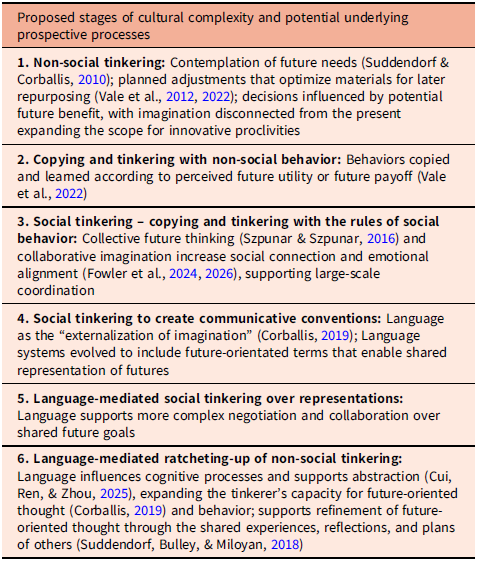
Table 1. The six stages of cultural complexity proposed by Chater and Christiansen and the prospective processes that may support and expand themTable 1 long description.
Target article
Related commentaries (25)
Cognitive practices and the transformation of the social tinkerer
Cooperative goals must be selected by groups before tinkering begins
Cultural complexity is multifaceted: Variations in social tinkering
Normative commitments constrain the scope of cultural tinkering
Sequence representation and cultural systems are necessary for cumulative culture
Stage fright: Why cultural evolution is diversification, not progression
Tinkering beyond the present: The importance of future thinking for cultural complexity
 You have
Access
Chater and Christiansen introduce “social tinkering” as the primary driver of cultural complexity, accounting for the sophisticated knowledge, technologies, and institutions that characterize modern human life. Adapting Richard Dawkins’ (Reference Dawkins1986) “blind watchmaker” metaphor, the authors propose that cultural complexity results from “sighted” social tinkering: accumulation through cycles of ad hoc, momentary, and local adjustments of past solutions that spontaneously organize into sophisticated systems.
While we credit the authors’ bottom-up portrayal of cultural complexity as a series of cumulative tweaks, we intentionally set aside their broader conceptualization of cultural evolution. Instead, our commentary focuses on the framework’s agnosticism toward the role prospective thought can play in driving these modifications. By restricting tinkering to solving “immediate challenges” in the “here and now,” we believe that the model is narrow in scope. This temporal myopia neglects the fundamental human capacity to decouple from the present to contemplate and plan for the future. One of many consequences is the trajectory of culture is then skewed by a present bias. By omitting prospective cognition, the authors risk providing a partial rather than functional map of cultural change.
The link between prospective cognition and culture is not new. Tulving (Reference Tulving, Stuss and Knight2002) argued that the capacity to consciously experience the subjective time in which we live, including our “future,” is a fundamental precondition for adapting cultural environments, not just for ourselves but for generations to come. Far from the reactive patching of the “short-sighted” model, this orientation allows individuals to recognize the future utility of innovations, ensuring their refinement for long-term retention (Suddendorf, Reference Suddendorf2013). By leveraging inhibitory control and cognitive flexibility, tinkerers can weigh novel solutions against future outcomes (Vale, Flynn, & Kendal, Reference Vale, Flynn and Kendal2012). We suggest this shift toward flexible invention and implementation according to future potential is a primary driver of cultural complexity, constituting one of the essential “sights” that guides social tinkering, leaving its mark on each of the proposed stages of cultural complexification (Table 1).
The six stages of cultural complexity proposed by Chater and Christiansen and the prospective processes that may support and expand them
Table 1. Long description
A table with six rows and two columns. The first column lists the stages of cultural complexity, and the second column describes the potential underlying prospective processes. Row 1: Non-social tinkering, Contemplation of future needs, planned adjustments that optimize materials for later repurposing, decisions influenced by potential future benefit, with imagination disconnected from the present expanding the scope for innovative proclivities. Row 2: Copying and tinkering with non-social behavior, Behaviors copied and learned according to perceived future utility or future payoff. Row 3: Social tinkering – copying and tinkering with the rules of social behavior, Collective future thinking and collaborative imagination increase social connection and emotional alignment, supporting large-scale coordination. Row 4: Social tinkering to create communicative conventions, Language as the externalization of imagination, Language systems evolved to include future-oriented terms that enable shared representation of futures. Row 5: Language-mediated social tinkering over representations, Language supports more complex negotiation and collaboration over shared future goals. Row 6: Language-mediated ratcheting-up of non-social tinkering, Language influences cognitive processes and supports abstraction, expanding tinkerer’s capacity for future-oriented thought and behavior, supports refinement of future-oriented thought through the shared experiences, reflections, and plans of others.
Note: While immediate anticipation and prediction fall under the umbrella of prospective thought, we focus on processes involving more distal timepoints.
Indeed, Chater and Christiansen’s focus on short-sighted tinkering is challenged by evidence that humans dedicate substantial cognitive resources to prospective thought. Nearly half of all mind-wandering episodes are future-oriented (Stawarczyk, Cassol, & D’Argembeau, Reference Stawarczyk, Cassol and D’Argembeau2013), with individuals averaging roughly 59 future thoughts daily (D’Argembeau, Renaud, & Van Der Linden, Reference D’Argembeau, Renaud and Van Der Linden2011). These future thoughts, which often involve autobiographical planning (Baird, Smallwood, & Schooler, Reference Baird, Smallwood and Schooler2011), are largely realistic/concrete and more intentional than non-future-oriented thoughts (Stawarczyk et al., Reference Stawarczyk, Cassol and D’Argembeau2013) and may change the way humans innovate. The positive association between future event imagination and human generation of new ideas (Thakral et al., Reference Thakral, Yang, Addis and Schacter2021) underscores this potential role in innovation. We believe this significant investment in future-oriented thoughts, coupled with the features of these thoughts, means that prospection may not be peripheral but central to cultural change. Consequently, we suggest the social tinkerer operates across a cognitive spectrum spanning retrospective, short-sighted, and far-sighted thoughts.
Of the proposed six stages of cultural complexity, for the first “non-social tinkering stage,” the adaptive benefits of prospective thought or “foresight” are clear; the ability to contemplate future needs allows a tinkerer to act (invent or learn) preemptively to secure or avoid specific outcomes (Suddendorf & Corballis, Reference Suddendorf and Corballis2010). Such prospection facilitates complex, planned adjustments that optimize materials for later use and repurposing (Vale et al., Reference Vale, Flynn and Kendal2012, Vale, Coughlin, & Brosnan Reference Vale, Coughlin and Brosnan2022). Recent developmental evidence supports this, showing older children sometimes design and build tools to satisfy both immediate and anticipated subsequent needs (Ockerby, Redshaw, & Suddendorf, Reference Ockerby, Redshaw and Suddendorf2025). Rather than being limited to reactive innovation, the tinkerer can leverage the simulation of future outcomes to drive farsighted innovations that prioritize distal challenges (see Rösch et al., Reference Rösch, Stramaccia and Benoit2022 for a relevant meta-analysis). This ability prepares humans for probable future events as well as more immediate ones.
At later social stages, foresight may also dictate which behavioral adjustments individuals choose to learn, copy, or institutionalize (Vale et al., Reference Vale, Flynn and Kendal2012, Reference Vale, Coughlin and Brosnan2022). The success of this social tinkering depends on selective transmission processes, where tinkerers may evaluate the value of social information based on its perceived future utility rather than its immediate accessibility (Vale et al., Reference Vale, Coughlin and Brosnan2022). Beyond selective transmission, prospection shapes complex social interactions through collective future thinking (Szpunar & Szpunar, Reference Szpunar and Szpunar2016) and collaborative imagination (Fowler et al., Reference Fowler, Palombo, Madan and O’Connor2024). These processes may underpin the co-creation of shared hypothetical experiences that foster the social connection and emotional alignment integral for large-scale coordination (Fowler et al., Reference Fowler, Palombo, Madan and O’Connor2024, Reference Fowler, Law, Bontkes, Srivastava, Oveis, Palombo and O’Connor2026). By synchronizing individual representations of a shared future, collaborative imagination may motivate farsighted collective decisions (Fowler et al., Reference Fowler, Law, Bontkes, Srivastava, Oveis, Palombo and O’Connor2026), ultimately providing the cognitive scaffolding for heightened cultural complexity and enduring cultural systems.
Finally, integrating foresight into the normative landscape allows for a shift from reactive to proactive social systems. While Chater and Christiansen emphasize the utility of ad-hoc tweaks to rules and laws, a reliance on retrospective remediation ensures that legal frameworks remain in a state of temporal lag, perpetually addressing past infractions. In contrast, incorporating prospective cognition into social systems enables their proactive calibration. This allows for both teleological and in-the-moment refinements, ensuring that social coordination is proactively maintained in the face of future risks and vulnerabilities. Collective efforts such as the 100 Days Mission for rapid vaccine development against hypothetical pathogens (Williams et al., Reference Williams, Fitzsimmons, Lewis, Tornos, Kimmel, True, Siwik, Ryall and Mullett2026) demonstrate how human culture proactively organizes to mitigate anticipated, rather than immediate, threats.
In summary, the “social tinkering” metaphor effectively captures the incremental nature of cultural growth yet risks reductionism by casting humans as primarily reactive problem-solvers. Although cultural refinement can occur in the absence of explicit foresight, and prospection is often probabilistic rather than predictive (Mesoudi, Reference Mesoudi2008), a robust functional map of cultural change must acknowledge that humans’ rich social environments are proactively shaped by a species living in imagined futures as much as the immediate present or past. The social tinkerer is more than an agent of the “here and now”; their capacity for prospective thought provides cognitive scaffolding for the complexity Chater and Christiansen seek to explain. We invite a shift in research focus that considers how varying temporal horizons of thought interact with social tinkering, thereby tightening the fit between cognitive models and the observed complexity of human culture.
Acknowledgements
C. Coughlin used ChatGPT for the following: To improve the language and readability of the commentary proposal (e.g., phrasing suggestions and improvements, clarity and concision assistance, grammar checks); to summarize and/or interpret portions of the target article; to assist with the language and readability of the commentary (e.g., grammar checks, reducing word count).
Financial support
This research received no specific grant from any funding agency, commercial or not-for-profit sectors.
Competing interests
The authors declare none.
Author contributions
G.L.V.: conceptualization, writing – original draft, writing – reviewing and editing. C.C.: conceptualization, writing – original draft, writing – reviewing and editing.