




No CrossRef data available.
Article contents
When adolescents disagree with others about their symptoms: Differences in attachment organization as an explanation of discrepancies between adolescent, parent, and peer reports of behavior problems
Published online by Cambridge University Press: 12 May 2005
Abstract
This study examined whether attachment theory could be used to shed light on the often high degree of discordance between self- and observer ratings of behavioral functioning and symptomatology. Interview-based assessments of attachment organization, using the Adult Attachment Interview, were examined as predictors of the lack of agreement between self- and other reports of behavioral and emotional problems among 176 moderately at-risk adolescents. Lack of agreement was measured in terms of concordance of adolescent and parent or close friend report on equivalent measures of behavioral and emotional adjustment. Insecure–dismissing attachment was linked to less agreement in absolute terms between self- and mother reports of externalizing symptoms, and between adolescent and close friend reports of behavioral conduct. Insecure–preoccupied attachment was associated with higher levels of adolescent reporting of internalizing and externalizing symptoms relative to parent reports of adolescent symptomatology. The findings suggest that attachment organization may be one factor that accounts for individual differences in the degree of discordance between self- and other reports of symptoms in adolescence.
Information
- Type
- Research Article
- Information
- Copyright
- © 2005 Cambridge University Press
The frequently high degree of discrepancy between self-ratings and observer reports of behavioral adjustment and psychosocial functioning is a classic and long-term hindrance to both clinical research and clinical intervention (Frank, Van Egeren, Fortier, & Chase, 2000; Tarullo, Richardson, Radke–Yarrow, & Martinez, 1995; Youngstrom, Loeber, & Stouthamer–Loeber, 2000). Reporter discrepancies apply particularly to work with children and adolescents for whom multiple, conflicting reports are often available (Achenbach & McConaughy, 1997; Achenbach, McConaughy, & Howell, 1987). Concordance among cross-informants is particularly low for adolescents, especially for reports of internalizing symptoms (Achenbach et al., 1987). Understanding the factors that could account for these low correlations is crucial for finding ways to reconcile conflicting information from diverse sources, for improving the accuracy of diagnostic formulations involving adolescents, and for understanding the emergence and manifestation of psychopathology in social contexts. The aim of the current study was to investigate the extent to which adolescents' attachment organization accounts for individual differences in lack of agreement between self- and parent/close friend reports of psychosocial adjustment.
Life span attachment theory suggests a means of understanding the links between the ways that individuals experience psychological distress and the ways that they communicate their experience of distress to others. Bowlby (1969, 1973, 1982) conceptualized internal working models of attachment as being fundamentally oriented around the ways that individuals handle and communicate distress (e.g., attachment needs) in relation to those with whom they have close relationships. From this perspective, the attachment system is “activated” under conditions of stress, and at those times, established patterns for handling such distress within close relationships are likely to prevail. The distress that accompanies psychological symptoms would seem likely to activate the attachment system and call into play existing, organized patterns for handling and communicating such experiences.
Individual differences in attachment organization are important because they can be conceptualized in terms of the emotional and cognitive strategies that individuals have developed to cope with perceived threat or significant distress (Cassidy, 1994). These strategies are believed to emerge in infancy and childhood from variations in the physical and psychological sensitivity and availability of a primary caregiver as a safe haven in times of need (Ainsworth, Blehar, Waters, & Wall, 1978; Bowlby, 1973). In theory, children develop coping strategies for managing their own distress (e.g., being hurt or upset) on the basis of how parents respond to their physical and psychological needs (Contreras & Kerns, 2000). Although attachment theory was first developed to understand young children's bonds to their parents, it is now recognized that there is some consistency in patterns of individual differences in attachment organization in adolescence and adulthood (Waters, Hamilton, & Weinfield, 2000; Zimmerman & Becker–Stoll, 2002). Beyond childhood, organized patterns of processing such attachment-related affect and memories appear to have important implications for adult social behavior (Dozier, Lomax, Tyrell, & Lee, 2001; Kobak & Ferenz–Gillies, 1995; Kobak, Ferenz–Gillies, Everhart, & Seabrook, 1994).
According to attachment theory, a child who experiences consistent caregiver warmth and availability develops a secure attachment organization. Individuals with secure working models trust that attachment figures will provide a safe haven with comfort and support when the child feels distressed. As a result, these children learn that it is adaptive to seek support and communicate openly about distress, without either exaggerating or minimizing its intensity (Bretherton, 1987). Findings from a number of studies indicate that attachment organization is related to individual differences in strategies for regulating and communicating about negative affect. For instance, secure adolescents display more open and positive expression of emotion and are more functionally engaged in problem discussions with parents (Becker–Stoll, Deluis, & Scheitenberger, 2001; Kobak, Cole, Ferenz–Gillies, Fleming, & Gamble, 1993). Research suggests that adults who self-report secure attachment styles are skilled at seeking and providing emotional support with romantic partners in anxiety-provoking situations (Simpson, Rholes, & Nelligan, 1992). These findings are consistent with the hypothesis that adolescents with secure working models of attachment are more likely to directly and clearly express negative emotions, including distress over psychological symptoms, because they have learned over time to trust that attachment figures will be responsive, sensitive, and provide support. In addition, there is reason to suspect that parents of secure adolescents are more attuned to their children's distress. In fact, mothers' awareness of their adolescents' self-perceptions is a strong predictor of adolescent attachment security (Allen, McElhaney, Land, Kuperminc, Moore, & O'Beirne–Kelley, 2003). As a result, secure individuals would be expected to have the least degree of discrepancy between their own and others' reports about their psychological symptoms.
Conversely, when working models of attachment forecast either inconsistent or insensitive responses from a caregiver, children may develop alternative, dysfunctional strategies for regulating negative affect and attachment-related behavior (Main, 1990). Unlike adolescents with secure internal working models of attachment, adolescents who have developed insecure attachment organizations may either fail to elicit support about distress or elicit support about symptoms by using maladaptive strategies. Theoretically, an insecure–dismissing attachment organization develops when a child experiences predominantly unavailable or insensitive reactions from a primary caregiver. Because individuals with dismissing working models of attachment expect rejection from attachment figures, they may develop deactivating strategies for regulating and communicating negative affect as a means of minimizing potential conflict with attachment figures (Ainsworth, 1984; Bowlby, 1982; Cassidy & Kobak, 1988).
A dismissing attachment organization may lead children and adolescents to minimize the degree to which they report their distress and difficulties to others. Kobak and Sceery (1988) found that young adults with a dismissing attachment organization did not differ from secure individuals in their reports of perceived social competence and distress. However, peers reported that dismissing individuals were less socially competent and more distressed, and dismissing individuals reported more loneliness and lack of support in their relationships. Research has also demonstrated that dismissing adolescents report less self-disclosure to significant others (Mikulincer & Nachson, 1991) and display withdrawal and emotional disengagement in negotiating conflicts with parents (Becker–Stoll et al., 2001; Kobak et al., 1993). Among adults with significant levels of psychopathology, dismissing attachment has also been associated with self-reports of minimal psychological distress. Pianta, Egeland, and Adam (1996) found that high-risk, low-income women with a dismissing attachment organization emphasized independence and reported the least psychiatric distress on a personality inventory in comparison to secure and preoccupied women. In addition, a study by Dozier and Lee (1995) indicated that dismissing adults with serious psychopathological disorders reported significantly fewer symptoms in comparison to ratings by psychological experts. Physiological studies reveal that dismissing individuals' actual experiences of negative affect may differ from their self-reports of minimal distress (Dozier & Kobak, 1992). These findings provide support for the notion that adolescents with an insecure–dismissing attachment organization utilize deactivating strategies to regulate negative affect and may communicate less distress to attachment figures and friends. Consequently, it is expected that adolescents with a more insecure–dismissing attachment organization will minimize psychological symptoms in comparison to others' reports.
Moreover, parents of insecure–dismissing adolescents may be less sensitive, responsive, and attuned to their children's distress (Allen et al., 2003). In addition, the quality of communication between dismissing adolescents and their close friends has been characterized by more avoidance of discussing emotions and feelings about problems (Berger, 2003). Poor quality of communication between dismissing adolescents and their parents and friends may leave these close others guessing or making inferences about dismissing adolescents' psychological adjustment based on little information. Consequently, a more insecure–dismissing attachment organization appears likely to be linked to greater discrepancies, in absolute magnitude, between self- and other reports of psychological symptoms, although this link has never been empirically assessed.
An insecure–preoccupied attachment organization may be cultivated through experiences of inconsistent or intrusive caregiving. In theory, individuals with preoccupied working models of attachment forecast inconsistent reactions from caregivers in response to expressions of distress. Consequently, behaving in response to this intermittent reinforcement, preoccupied individuals may utilize hyperactivating strategies to regulate and communicate negative affect in an effort to elicit attention from attachment figures (Allen & Land, 1999). These individuals would be most likely to strongly report, and even to exaggerate, any internal symptom of distress. Among high-risk, low-income women, for example, a preoccupied attachment organization was associated with the highest self-reported symptomatology on a personality inventory in comparison to secure and dismissing women (Pianta et al., 1996). Moreover, Dozier and Lee (1995) found that preoccupied adults with serious, debilitating psychopathological disorders reported significantly more symptoms in comparison to clinician ratings. In addition, research has indicated that individuals who self-report preoccupied attachment styles display heightened, dysfunctional expressions of distress with romantic partners (Simpson, Rholes, & Phillips, 1996). Although based only on research with adults, these initial findings suggest that adolescents with an insecure–preoccupied attachment organization may amplify experiences of psychological distress.
Taken together, findings from a number of studies suggest that attachment organization may be related to adolescents' communication of psychological adjustment to significant others, and thus, the agreement between their self- and other report of emotional and behavioral problems. The present study sought to apply this theoretical approach to understanding a fundamental theoretical and practical problem in understanding adolescent psychopathology: the discrepancies that often appear between adolescent self-report and parents' and close friends' reports of psychosocial adjustment and behavioral functioning. First, we hypothesized that a relatively more insecure (vs. secure) adolescent attachment organization would be associated with greater disparity between adolescent self- and other report. Second, we hypothesized specifically that adolescents with a more insecure–dismissing attachment organization would perceive themselves as less symptomatic in comparison to parents' and peers' perceptions. We also predicted that relatively more insecure–dismissing adolescent attachment would be associated with greater disparity between self- and other report in absolute terms. Third, we hypothesized that adolescents with a more insecure–preoccupied attachment organization would perceive themselves as more symptomatic relative to parents' and close friends' perceptions. These questions were examined in an ethnically and socioeconomically diverse sample of moderately at-risk 9th and 10th graders, selected to permit assessments of adolescents across a range of levels of functioning, and in particular, to permit assessment of adolescents reporting psychological symptoms at levels great enough to be substantively meaningful.
Method
Participants
The current study collected data from 95 male and 81 female adolescents, their mothers (n = 146), their fathers (n = 52), and their close friends (n = 120), as part of a longitudinal study of adolescent psychosocial functioning in the family and with peers. In the present investigation, data from the first wave of data collection were explored. Adolescents were approximately 16 years of age (M = 15.93, SD = 0.81), with a range from 14 to 17 years. The self-identified racial/ethnic background of the sample was 60% European American, 39% African American, and 2% other. Thirty percent of adolescents were living with both biological parents. The median family income was $25,000 (range = <$5,000 to >$60,000), and parents' median education level was a high school diploma with some training after high school (range was from less than an eighth grade education to completion of an advanced degree).
Adolescents were recruited from primarily the 9th and 10th grades of two public school systems that represented rural, suburban, and urban populations. Participants were selected for inclusion in the study based on the presence of at least one of four possible academic risk factors: (a) failing a single course for a single marking period, (b) any lifetime history of grade retention, (c) 10 or more absences in one marking period, and (d) any history of school suspension. These broad selection criteria were established to sample a sizable range of adolescents who could be identified from academic records as having the potential for future academic and social difficulties, including adolescents already experiencing serious difficulties and those who were performing adequately with only occasional, minor problems. As intended, these criteria identified approximately one half of all 9th- and 10th-grade students as eligible for the study.
Each teen was also asked to name several friends who knew him or her well; two peers were recruited for each adolescent participant in the study. Close friends filled out measures concerning 120 of the target adolescents. Peer participants were approximately 16 years (M = 16.32, SD = 1.37) and had known participating teens for an average of 5 years (M = 5.21, SD = 3.73).
Procedure
After adolescents who met study criteria were identified, letters were sent to each family explaining the investigation as an ongoing study of the lives of teens and families. These initial explanatory letters were then followed by phone calls to families who indicated a willingness to be further contacted. If both the teen and the parent(s) agreed to participate in the study, the family was scheduled to come to our offices for two 3-hr sessions. Approximately 50% of approached families agreed to participate. Families were paid a total of $105 for their participation. At each session, active, informed consent was obtained from parents and teens. In the initial introduction and throughout both sessions, confidentiality was assured to all family members, and adolescents were told that their parents would not be informed about any of the answers that they provided. Participants' data were protected by a Confidentiality Certificate issued by the US Department of Health and Human Services, which protected information from subpoena by federal, state, and local courts.
Active consent was also obtained from both peers and parents of peers participating in the study. Peers were paid $10 to come in separately for a 1-hr session, during which they completed written questionnaires and used Q-sort techniques to rate the target adolescents in the study. As with study participants, peers were assured that all information would be kept confidential and in particular, were told that study participants would not learn of their questionnaire responses.
Measures
Adult Attachment Interview (AAI) and Q-set
This structured interview (George, Kaplan, & Main, 1996) probes individuals' descriptions of their childhood relationships with parents in both abstract terms and with requests for specific supporting memories. For example, participants were asked to list five words describing their early childhood relationships with each parent and then to describe specific episodes that reflected those words. Other questions focused on specific instances of upset, separation, loss, trauma, and rejection. Finally, the interviewer asked participants to provide more integrative descriptions of changes in relationships with parents from childhood to adolescence, as well as descriptions of the current state of those relationships. The interview consisted of 18 questions and lasted 1 hr on average. Slight adaptations to the adult version were made to make the questions more natural and easily understandable for an adolescent population (Ward & Carlson, 1995). Interviews were audiotaped and transcribed for coding.
It is important to note that the attachment literature distinguishes between two views of attachment-related experiences: conscious attachment styles (assessed by self-report measures) and unconscious or internal working models of attachment (assessed by attachment interviews; Furman, Simon, Shaffer, & Bouchey, 2002; Furman & Wehner, 1994). The existing data suggest that attachment styles and internal working models of attachment are only moderately related (Crowell, Fraley, & Shaver, 1999; Shaver, Belsky, & Brennan, 2000), and more research is needed to investigate whether these two different methodologies measure the same construct (Jacobvitz, Curran, & Moller, 2002). The present study utilized the AAI to assess adolescents' internal working models or their state of mind with respect to attachment. Although attachment styles are also clearly important, some attachment theorists contend that internal working models tap defensive strategies that may not surface by using self-report measures (Furman & Wehner, 1994; Jacobvitz et al., 2002; Main & Goldwyn, in press), and it is these attachment states of mind that have been most consistently related to infant attachment as assessed in the Strange Situation.
The AAI Q-Set
This Q-set (Kobak et al., 1993) was designed to closely parallel the AAI classification system (Main & Goldwyn, in press) but to yield continuous measures of qualities of attachment organization. Research has demonstrated that the data produced by the system can be reduced via an algorithm to classifications that largely agree with three-category ratings from the AAI classification system (Borman–Spurrell, Allen, Hauser, Carter, & Cole–Detke, 1995; Kobak et al., 1993). However, the present study utilized the full continuous measures made available by the Q-set. Each rater reads a transcript and provides a Q-sort description by assigning 100 items into nine categories ranging from most to least characteristic of the interview, using a forced distribution. All interviews were blindly rated by at least two coders with extensive training in both the Q-sort and the Main AAI classification system.
These Q-sorts were then compared with dimensional prototype sorts for: insecure–dismissing strategies, reflecting inability or unwillingness to recount attachment experiences, idealization of attachment figures that is discordant with reported experiences, and lack of evidence of valuing attachment; and insecure–preoccupied strategies, reflecting either rambling, extensive but ultimately unfocused discourse about attachment experiences or angry preoccupation with attachment figures. A third conceptual category, secure strategies, was also coded, but given that it was both conceptually and empirically encompassed by the inverse of the two insecure categories described above (e.g., it displayed a multiple R of .96 with the inverse of the other two measures), the two distinct markers of insecurity were used for further analysis as providing the most parsimonious picture of adolescents' attachment states of mind. These dimensions had been previously validated (Kobak et al., 1993), and using them, Kobak and colleagues report being able to capture classifications from the AAI classification system with good accuracy. Although this system was designed to yield continuous measures of qualities of attachment organization rather than replicate classifications from the Main and Goldwyn (in press) system, when scale scores were reduced to the corresponding dismissing, preoccupied, and autonomous (autonomous is the classification term that parallels secure in Kobak's system) classifications by simply using the largest Q-scale score above .20 as the primary classification (Kobak et al., 1993) and compared to a subsample (N = 76) of AAIs classified by an independent coder with well-established reliability in classifying AAIs (U. Wartner), 74% of adolescents in this sample received identical codes (κ = .56, p < .001), and 84% matched in terms of security versus insecurity (κ = .68). Nonetheless, the present study utilized continuous measures of qualities of attachment organization, such that each individual received a score on insecure–dismissing and insecure–preoccupied scales. The correlation of the 100 items of an individual's Q-sort with each dimension (range = −1.00 to 1.00) were then taken as the participant's scale score for that dimension. The Spearman–Brown reliabilities for the final scale scores were .89 and .82 for the insecure–dismissing and insecure–preoccupied scales, respectively.
Adolescent and parent report of adolescent internalizing and externalizing symptoms
Mothers and fathers reported their adolescents' internalizing (M = 11.16, SD = 8.21, range = 0.00–38.00 and M = 10.08, SD = 7.92, range = 0.00–40.75, mothers and fathers, respectively) and externalizing (M = 15.21, SD = 10.07, range = 0.00–53.00 and M = 13.31, SD = 8.68, range = 0.00–39.00, mothers and fathers, respectively) problem behaviors using the 120-item Child Behavior Checklist (Achenbach & Edelbrock, 1983). In terms of national norms, T scores (M = 50, SD = 10) were approximately 1 standard deviation above the mean for mothers' and fathers' reports of internalizing (T = 61 and 60, respectively) and externalizing (T = 62 and 60, respectively) symptoms. This measure has been widely used in research and clinical applications with samples of normal and clinically referred youths and shows good evidence of reliability and validity (Achenbach & Edelbrock, 1979, 1981). For our purposes, we used the internalizing and externalizing scales to assess parents' perceptions of their adolescents' symptomatic behavior.
Adolescents completed the Youth Self-Report, which is a well-validated and normed companion measure to the Child Behavior Checklist that measures problematic adolescent behaviors (Achenbach, 1991). The Youth Self-Report and the Child Behavior Checklist are readily comparable, as each measure compares the respondents' reports to normative data. Adolescents were asked to rate how well a variety of descriptions of symptomatic behaviors applied to them during the previous 6 months, on a scale of 0 = not true, 1 = somewhat or sometimes true, and 2 = very or often true. The internalizing and externalizing scales were used to assess adolescents' self-perceptions of symptomatic behavior (M = 13.20, SD = 8.96, range = 1.00–46.00 and M = 16.30, SD = 8.19, range = 1.00–41.00, internalizing and externalizing, respectively). In terms of national norms, T scores (M = 50, SD = 10) were approximately 1 standard deviation above the mean for internalizing (T = 57) and externalizing (T = 60) symptoms.
Raw score comparisons of parent report of adolescent symptoms on the Child Behavior Checklist and adolescent report of symptoms on the Youth Self-Report were used to assess whether adolescents' perceived themselves as more or less symptomatic than parents' perceived their adolescents. Raw scores were used because we were interested in comparing adolescents' and parents' reports of symptoms to each other, which could not be done with T scores that were normed with respect to different populations for adolescents and parents.
Adolescent and close friend report of adolescent behavior conduct
Adolescents also completed the Behavior Conduct Scale of the Adolescent Self-Perception Profile (Harter, 1988). This scale consists of five items and was designed to assess the degree to which the adolescent likes the way s/he behaves, does the right thing, acts the way s/he is supposed to, and avoids getting in trouble (M = 2.64, SD = 0.61, range = 1.0–4.0). The adolescent is first asked to choose which kind of teenager is more like him or her. For example, “Some teenagers usually act the way they are supposed to,” but “Other teenagers often don't act the way they are supposed to.” Then, adolescents are asked to decide whether the statement is “sort of true” or “really true” for them. This format was designed to reduce the effects of social desirability. Scores for each item range from 1 to 4, with 1 representing the most negative response and 4 representing the most positive response. An individual's score is determined by averaging their responses across the five items. The scale has demonstrated acceptable levels of internal consistency (αs > .79).
Peers completed a parallel version of the Behavior Conduct Scale of the Adolescent Self-Perception Profile (Harter, 1988) described above, which was altered so that peers completed it as they thought it best described the target adolescent in the study. The same rating scales and summing procedures described above were used to produce the final peer scales (M = 2.73, SD = 0.60, range = 1.4–4.0).
Lack of agreement between adolescent and other report
Lack of agreement between adolescent and mother report, adolescent and father report, and adolescent and close friend report was measured using a difference score model. This method was chosen because it offers a straightforward and conceptually appealing approach to the measurement of concordance of self- and other report. Using this difference score model, a simple, directionally sensitive difference of adolescent report minus other report was calculated to retain the direction of effect allowing us to determine if the adolescent overrated behavior problems relative to their mothers, fathers, and peers (henceforth referred to as the directional difference between reporters). In addition, the absolute difference of adolescent report minus other report was calculated to assess the lack of agreement in absolute magnitude of adolescent versus other report of adolescent adjustment.
Results
Preliminary analyses
Descriptives and zero-order correlations
The means and standard deviations for directional and absolute differences of adolescent self- and mother/father report of adolescent internalizing and externalizing symptoms and close friend report of adolescent behavior conduct are presented in Table 1. We also examined the demographic effects of adolescent gender, racial/ethnic minority status, and family income for each measure used in this study. Adolescent gender, racial/ethnic minority status, and family income were significantly related to several outcomes of interest, and thus these demographic variables were included in all further analyses.
Means and standard deviations for lack of agreement between adolescent and other report of adolescent internalizing and externalizing symptoms and behavior conduct

For descriptive purposes, simple univariate correlations were examined between adolescent attachment prototypes and adolescent, parent, and close friend report of adolescent symptoms (Table 2). More insecure–dismissing attachment showed a trend relation to father report of internalizing symptoms and mother report of externalizing symptoms. Fathers of more dismissing teens tended to perceive their adolescents as having more internalizing symptoms, whereas mothers of more dismissing teens tended to report that their adolescents had more externalizing symptoms. Conversely, greater insecure–preoccupation with attachment was associated with adolescents' reports of more internalizing and externalizing symptoms. A more insecure–preoccupied adolescent attachment was also negatively related to peer report of adolescent behavior conduct. More preoccupied adolescents had friends who perceived them as having poorer behavior conduct.
Correlations of adolescent attachment to adolescent and other report of internalizing and externalizing symptoms and behavior conduct

Table 3 presents the correlations between insecure–dismissing and insecure–preoccupied attachment prototypes and lack of agreement between adolescent and other report. A more insecure–dismissing attachment organization was related to greater absolute lack of agreement between adolescent and maternal reports of adolescent externalizing symptoms. In addition, a more dismissing attachment organization was related to greater absolute disparities between adolescent and close friend reports of adolescent behavior conduct. Insecure–dismissing adolescents' reports of externalizing symptoms did not reflect a consistent pattern of underreporting with respect to maternal or peer reports, but rather more dismissing attachment was associated with greater absolute discrepancies (both positive and negative) with respect to both maternal and peer reports of behavior. Adolescents with more insecure–preoccupied working models of attachment showed a somewhat different pattern (see Table 3). A more insecure–preoccupied attachment organization was associated with greater directional lack of agreement between adolescent and mother and father reports of adolescent internalizing and externalizing symptoms. Preoccupation was also associated with greater absolute lack of agreement between adolescent and father report of internalizing and externalizing symptoms and between adolescent and mother report of externalizing symptoms. More preoccupied adolescents reported more internalizing and externalizing symptoms than either mothers or fathers reported about them. Preoccupation was not associated with lack of agreement between adolescent and close friend report of behavior conduct. Each of these correlations is explored further below.
Correlations of adolescent attachment to lack of agreement between adolescent and other report of internalizing and externalizing symptoms and behavior conduct

Primary analyses
A major aim of the present study was to examine relations between continuous measures of adolescent insecure attachment organization and lack of agreement between adolescent and other report of adolescent psychosocial functioning. A series of hierarchical linear regressions was performed using lack of agreement between adolescent and other reports (i.e., mother, father, close friend) of adolescent adjustment as the dependent variables. First, the adolescent's gender, racial/ethnic minority status, and family income level were entered as a block into the regression equation.1
These demographic variables were controlled for because earlier analyses indicated that gender, racial/ethnic minority status, and family income were significantly associated with several measures of symptoms and adolescent attachment organization.
We also examined attachment organization as a predictor of absolute differences between adolescent and other report of adolescent adjustment after controlling for directional differences, demographic variables, and baseline levels of symptomatology. This set of analyses addressed whether the relation between attachment organization and greater discrepancies between self- and other reports of adolescent psychosocial functioning might simply reflect a general bias toward over- or underreporting symptoms. In general, attachment organization did not predict lack of agreement when directional differences were entered first into the equation. One exception: a dismissing attachment organization remained a significant predictor of lack of agreement between adolescent and close friend report of behavior conduct even after accounting for the directional difference score. Details regarding these analyses are available from the first author.
Relations between adolescent attachment and lack of agreement between adolescent and mother report
Insecure–dismissing attachment was first examined as a predictor of absolute lack of agreement between adolescent and mother reports of adolescents' externalizing behaviors. After accounting for demographics and adolescent level of externalizing symptoms, insecure–dismissing attachment did not remain a significant predictor of the absolute difference of adolescent and mother report of externalizing symptoms.
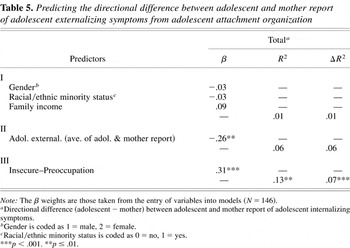
As presented in Tables 4 and 5, insecure–preoccupied attachment organization predicted the directional difference between adolescent and mother reports of adolescent internalizing and externalizing symptoms even after accounting for demographic variables and baseline levels of symptomatology (ΔR2 = .06 and .07 for internalizing and externalizing behaviors, respectively). Adolescents with a stronger preoccupied state of mind with respect to attachment were more likely to report higher levels of internalizing and externalizing symptoms in comparison to their mothers' reports about them. Preoccupation was not a significant predictor of the absolute difference between adolescent and mother report of adolescent externalizing symptoms.
Predicting the directional difference between adolescent and mother report of adolescent internalizing symptoms from adolescent attachment organization

Predicting the directional difference between adolescent and mother report of adolescent externalizing symptoms from adolescent attachment organization

Relations between adolescent attachment and lack of agreement between adolescent and father report
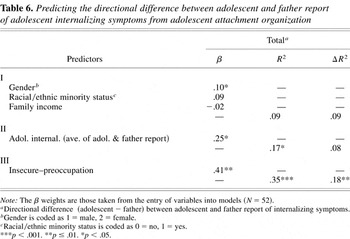
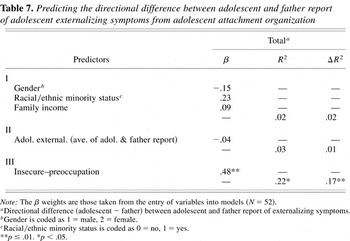
A similar pattern of findings was observed using father reports of adolescent symptomatology. As presented in Table 6, an insecure–preoccupied attachment organization remained a significant predictor of the directional difference between adolescent and father reports of internalizing behaviors even after accounting for demographic effects and adolescents' level of internalizing symptoms (ΔR2 = .18). Similarly, using directional difference scores, insecure–preoccupied attachment predicted directional lack of agreement between adolescent and father report of adolescent externalizing behaviors, again controlling for demographics and adolescents' levels of symptomatology (see Table 7). In this case, preoccupation accounted for a significant change in R2 of 17%. Insecure–preoccupied attachment did not predict the absolute lack of agreement between adolescent and father report of internalizing or externalizing symptoms. As expected, more insecure–preoccupied adolescents were more likely to report higher degrees of internalizing and externalizing behaviors than their fathers' reported about them. As before, no significant effects were observed for a more insecure–dismissing attachment strategy using either directional or absolute difference scores.
Predicting the directional difference between adolescent and father report of adolescent internalizing symptoms from adolescent attachment organization

Predicting the directional difference between adolescent and father report of adolescent externalizing symptoms from adolescent attachment organization

Relations between adolescent attachment and lack of agreement between adolescent and close friend report
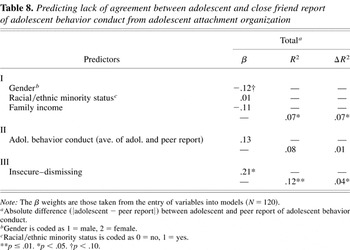
Results predicting lack of agreement between adolescent and close friend report using absolute difference scores are presented in Table 8. Insecure–dismissing adolescents' reports of their own behavior conduct were more likely to be discrepant in absolute magnitude (higher or lower) from close friends' reports of behavior conduct. A more insecure–dismissing attachment organization remained a significant predictor of the absolute lack of agreement between adolescent and peer report of adolescent behavior conduct even after partialling out demographic effects and accounting for adolescents' levels of behavior conduct. In this instance, a more insecure–dismissing attachment organization explained approximately 4% of the variance in the degree of disagreement between adolescent and close friend report of behavior conduct. In contrast to the findings found with mothers and fathers in this sample, no significant results were observed for preoccupation or using directional difference scores as the dependent variable.
Predicting lack of agreement between adolescent and close friend report of adolescent behavior conduct from adolescent attachment organization

As a post hoc analysis, we examined whether any of the observed effects of attachment in predicting reporter discrepancies might differ for those adolescents who were high versus low in levels of symptomatology. We did this by including an interaction term at the end of each of the models presented above in which level of symptoms (assessed as the mean of the two informants' reports) interacted with insecure–preoccupied or insecure–dismissing attachment organization in the model. In no case was this interaction significant. These results indicate that the findings reported above were consistent across different levels of symptoms.
Discussion
The purpose of the current study was to investigate how and to what extent attachment theory may help account for discrepancies between self- and other reports of psychosocial adjustment in adolescence. First, we hypothesized that adolescents with more insecure working models of attachment would report symptoms that were less congruent with significant others' reports about their adjustment. Consistent with this hypothesis, adolescents with relatively more insecure (vs. secure) attachment organization were likely to report symptoms that were less in agreement with others' reports about them. Second, we hypothesized specifically that adolescent insecure–dismissal of attachment would be associated with adolescent underreporting of symptoms in comparison to parent and peer report of adolescent adjustment; we also predicted that more insecure–dismissal of attachment would be related to greater disagreement in absolute terms between adolescents and others. Contrary to our expectations, adolescent insecure–dismissing attachment was only related to absolute lack of agreement of adolescent and mother and adolescent and peer report of externalizing adjustment, rather than being consistently biased toward under- (or over-) reporting symptoms. Third, we predicted that relatively more insecure–preoccupied working models of attachment would be related to adolescent overreporting of symptoms in comparison to other report. As expected, more insecure–preoccupied attachment was associated with higher levels of adolescent reporting of internalizing and externalizing symptoms relative to parent reports of adolescent symptomatology. However, preoccupation was not associated with greater lack of agreement between adolescent and close friend reports of behavior conduct.
Although previous research has demonstrated generally low agreement among cross-informant reports of adolescent adjustment with both clinic-referred and nonreferred community samples (Achenbach et al.,1987; Edelbrock, Costello, Dulcan, Conover, & Kalas, 1986; Forehand, Frame, Wierson, Armistead, & Kemptom, 1991; Rey, Schrader, & Morris–Yates, 1992), the findings of the current investigation suggest that these discrepancies may not be random, but rather may in part be related to adolescent attachment organization. Individual differences in adolescent attachment organization, reflected in characteristic strategies for regulating and communicating about negative affect in interpersonal relationships, account for some of the variability in lack of agreement between self- and other report of adolescents' distress.
An insecure–dismissing attachment organization was associated with adolescents' reporting symptoms that significantly differed in absolute terms from close friend reports of adolescent behavior conduct. There was no relation of dismissing attachment organization toward either a specific underreporting or overreporting bias (e.g., discrepancies could reflect either adolescent underreporting or overreporting of symptoms relative to close friend reports). In addition, the linkage between dismissing attachment and lack of agreement between self- and close friend report did not merely reflect individual differences in adolescents' behavior conduct because dismissing attachment predicted disparity of adolescent and close friend report after accounting for adolescents' levels of behavior conduct. A similar pattern was found with respect to adolescent and mother reports of adolescent externalizing behavior. An insecure–dismissing attachment organization was associated with absolute lack of agreement between adolescent and mother report of externalizing symptoms. Although this finding remained after accounting for demographic factors, it was not significant in the most conservative analyses that also accounted for individual differences in adolescents' levels of externalizing behavior. These findings suggest that insecure–dismissing attachment displayed a somewhat tenuous relationship to the overall level of agreement of adolescent and mother report of adolescents' externalizing adjustment. That these results were nonsignificant after accounting for the adolescent's externalizing symptoms is not surprising, as externalizing behavior has been previously linked to insecure–dismissing attachment (Allen, Moore, Kuperminc, & Bell, 1998; Rosenstein & Horowitz, 1996). Thus, the findings may reflect that youths who are highly externalizing or insecurely attached both are likely to yield more discrepant reports of their externalizing behavior, and that the externalizing behavior and insecure–dismissing attachment are to some extent confounded.
These patterns are consistent with research suggesting that insecure–dismissing adolescents may employ deactivating strategies for regulating negative affect and communicating about distress. Dismissing adolescents may have a tendency to not express or consciously acknowledge negative emotions and/or behaviors to mothers and close friends. In addition, because individuals with a dismissing attachment organization, in theory, characteristically devalue the importance of close relationships and emphasize autonomy and separateness at the expense of intimacy and connectedness (Cassidy & Kobak, 1988; Main, 1990; Main, Kaplan, & Cassidy, 1985), it may be difficult for persons close to dismissing individuals to judge how that person is feeling or behaving. Because a dismissing attachment organization may lead an adolescent to be emotionally cut off from parents and close friends, mothers and peers may thus be poor judges of dismissing adolescent's distress and behavior problems. Poor quality of emotional communication between dismissing teens and others may result in mothers and close friends making observations about dismissing adolescents' externalizing symptoms based on little information. In fact, Berger (2003) found that more dismissing adolescents avoided talking about problems and communicating about feelings during discussions with close friends.
These findings are also consistent with research suggesting that rejecting parenting, which has been linked to an insecure–dismissing attachment organization, is associated with lack of attention to and understanding of one's own emotional reactions (Cicchetti & Aber 1986). Correspondingly, the association between dismissing attachment and greater absolute discrepancy between adolescents' and mothers' reports of externalizing symptoms might reflect characteristics of parenting. Research suggests that mothers' sensitivity to and awareness of their adolescents' self-perceptions is a unique predictor of attachment security (Allen et al., 2003). Said differently, mothers who are less responsive, supportive, and attuned to their teenagers' emotions and feelings tend to have adolescents with a more insecure attachment organization. Thus, disagreement between more dismissing adolescents' and their mothers' reports may arise because mothers are poor at monitoring and attending to their children's difficulties.
It is noteworthy that the current study did not find a directional bias toward underreporting in the lack of agreement between dismissing adolescents' reports and their mothers' and close friends' reports of adjustment, indicating that insecure–dismissing teens were simply more likely to differ from others in their reports, rather than to be consistently biased toward higher or lower levels of reported problems. In contrast, Dozier and Lee (1995) found that dismissing adults with significant psychopathology underreported symptoms in comparison to clinicians' judgments. These discrepant findings may reflect Dozier and Lee's use of a far more seriously disturbed sample (hospitalized adults) for whom minimization of even extreme levels of distress may have had secondary functions (e.g., ending the hospitalization) or reflect extreme defensive processes. One possibility is that if dismissing individuals tend to minimize their apparent distress, experts may be able to more consistently see through these efforts, and thus provide consistently higher ratings of symptoms. Mothers and peers, in contrast, function as lay observers who may in some instances detect underlying distress that is being minimized, but who in other instances may accept the minimization and idealized approach to affect that characterize a dismissing attachment organization and thus may be relatively unaware of a dismissing individual's symptoms.
Adolescent insecure–preoccupation with attachment was consistently associated with a tendency to report higher levels of internalizing and externalizing symptoms in comparison to parent reports. Interestingly, preoccupied attachment was only associated with adolescents', but not parents', reports of internalizing and externalizing symptoms. Moreover, although preoccupation is generally associated with greater psychosocial difficulties in adolescence (Allen et al., 1998; Allen & Land, 1999; Kobak, Sudler, & Gamble, 1991; Rosenstein & Horowitz, 1996), preoccupation predicted a bias toward adolescents' reporting more symptoms than observers, even after accounting for levels of internalizing or externalizing symptoms. As expected, this result is consistent with research describing a preoccupied attachment organization as characterized by heightened or hyperactivated expressions of distress (Cassidy & Berlin, 1994; Dozier & Lee, 1995; Pianta et al., 1996). One explanation is that preoccupied adolescents have distorted self-perceptions of inflated internal distress and behavior problems. Adolescents employing preoccupied attachment strategies may chronically deal with distress by exaggerating internalizing or externalizing symptoms in an attempt to elicit a response from caregivers (Allen & Land, 1999). Alternatively, it may be that insecure–preoccupied adolescents actually experience higher levels of felt distress than other individuals, but are not generally effective at conveying this distress to others.
The current study did not find that insecure–preoccupation was related to lack of agreement between adolescent and close friend reports of behavior conduct. This null finding raises the alternative (but not mutually exclusive) possibility that lack of agreement between adolescent and parent report of preoccupied adolescents' symptoms reflects maladaptive communication between insecure adolescents and their parents. In fact, attachment theory would suggest that heightened, dysfunctional communication of distress by more preoccupied adolescents would be most likely to occur with primary attachment figures (e.g., parents). Parents of preoccupied adolescents may underestimate their son's or daughter's distress, in part, because the adolescent does not give them accurate information about their symptoms. In addition, variations in characteristics of parenting may contribute to greater discrepancies in adolescents' and parents' reports of symptoms. Poor parental monitoring and lack of awareness and sensitivity to children's difficulties, which are known to be associated with adolescent attachment insecurity (Allen et al., 2003), may explain the greater disagreement between more preoccupied adolescents' and their parents' reports of symptoms.
Consistent with prior research (Achenbach & McConaughy, 1997; Yeh & Weisz, 2001), these findings not only suggest a great deal of discordance between self- and other reports of behavioral functioning, but they begin to suggest a way of understanding such discordance. Specifically, these findings indicate that an adolescents' attachment organization could be one factor that accounts for individual differences in the level of agreement between adolescent and other reports of emotional and behavioral problems. Researchers and clinicians should be aware that discrepant self- and other reports of distress and problem behavior are not distributed randomly within the population, but may be tied to specific patterns of insecure adolescent attachment organization. Strong discrepancies between adolescents and their parents' reports about adjustment may tell us something about an adolescent's attachment development. These results imply that when discrepancies are observed, understanding the ways in which attachment needs may be linked to the biased presentation of symptoms will be essential in deriving techniques for handling discrepancies that are more sophisticated than simply summing or averaging across reporters. Future research is now needed, for example, to address the question of whether parent, close friend, or self-reports about adolescents' psychosocial adjustment are most likely to be of theoretical and clinical usefulness for different adolescents.
From a different perspective, the present findings suggest that discrepancies between self- and other reports of symptoms in adolescence, rather than just being a nuisance to researchers and clinicians, may yield highly specific information about the personality organization of the primary reporter, qualities of parenting, and/or the characteristics of communication among reporters (e.g., adolescents and parents). Although it is unlikely that most clinicians, or even most researchers, will employ AAI methodologies to sort out reporting discrepancies, these discrepancies routinely arise for clinicians and researchers in daily practice. Insight into strong discrepancies between adolescent and other reporters may provide information about actual or probable attachment status of adolescents in therapy, which is receiving increasing attention as a therapeutic mode (e.g., Hayes, Castonguay, & Goldfried, 1996; Marvin, 1992). The current results suggest a framework within attachment theory for beginning to interpret and utilize this information. From this perspective, apparent adolescent overreporting or parental minimization of symptoms appears as an indicator of the presence of an insecure–preoccupied attachment organization. For example, if the present results receive further confirmation and replication, it may be clinically useful to know that an adolescent who highly overreports his or her level of symptoms relative to parental reports may be more likely to be preoccupied with attachment experiences, and to be using high levels of symptom reporting as a way to “activate” the attachment system and gain reassurance from attachment figures. In addition, awareness of this linkage may allow clinicians to utilize evidence that preoccupied adolescents may be excessively stressed by the autonomy challenges of adolescence, and that such stresses are more likely to emerge indirectly via behavioral symptoms than via direct communication (Allen & Land, 1999; Allen, Marsh, McFarland, McElhaney, Land, Jodl, & Peck, 2002). In sum, the findings of the present study indicate not just a way of beginning to overcome obstacles provided by discordances across observers, but also a way of beginning to use such discordances for clinical or research purposes. A recent study by Hawley and Weisz (2003) suggested that therapists overwhelmingly rely on parent (instead of self-) reports of child and adolescent adjustment to identify target problems and to formulate treatment goals, despite little agreement among cross-informants about children and adolescents' emotional and behavioral problems. Further research aimed at understanding conflicting information from diverse sources is critical for improving the accuracy of diagnostic formulations involving adolescents.
Several limitations to this study also warrant mention. Because this study utilized cross-sectional data, the direction of any causal relations among attachment and reporter discrepancies cannot be conclusively established. Thus, although there is some evidence of continuity in attachment organization over time, it remains quite possible that other third variables such as quality of relationship communication or characteristics of parenting might influence both adolescent attachment organization and self- versus other report discrepancies. For example, future work could examine whether parental monitoring and awareness of child difficulties mediates the relationship between adolescent attachment and discrepancies between adolescent and parent reports.
It should also be noted that this study was framed in terms of predictions from two aspects of insecure attachment organization, which are the conceptual and empirical mirror image of attachment security. We chose to focus on insecure–attachment organization and discrepancies because understanding how dismissing and preoccupied attachment relate to reporter discrepancies is highly pertinent to clinicians, as there is a strong overrepresentation of insecure attachment organization in clinical populations (van IJzendoorn & Bakermans–Kranenburg, 1996). Although it did not make sense to present these largely redundant mirror image data regarding security, it should be recognized that results regarding insecurity, particularly insecure dismissal of attachment, can also be interpreted in terms of security. For instance, adolescents with more secure attachment organizations evidenced lower discrepancies in absolute magnitude between self- and peer reports of behavior conduct.
Moreover, although the current study controlled for adolescent levels of symptoms, it could be important to examine the role of parental symptoms in determining reporter discrepancies. Parental depression, for example, has been tied to parental biases toward more negative reports of child symptoms (e.g., Briggs–Gowan, Carter, & Schwab–Stone, 1996; Chi & Hinshaw, 2002; Chilcoat & Breslau, 1997; Richters, 1992). Interestingly, a recent study found that the relationship between maternal attachment status and parenting behavior varied as a function of maternal depressive symptoms (Adam, Gunnar, & Tanaka, 2004). In addition, the sample used in the current investigation was a moderately at-risk, community sample, thus limiting the generalizability of the findings to a normal or clinical population. Another shortcoming of the present study was that using Q-sort prototype scores of adolescent attachment did not permit us to examine the potential impact of unresolved/disorganized attachment status on reporter discrepancies. Although past research suggests that primary attachment characteristics (i.e., secure, dismissing, preoccupied) are a better predictor of patterns of symptom reporting than unresolved/disorganized status (Pianta, Egeland, & Adam, 1996), additional studies could examine whether being unresolved/disorganized with respect to attachment influences reporter discrepancies.
Finally, the present study could not determine whether lack of agreement between adolescent and other report actually reflected (a) inaccurate adolescent self-perception, (b) inaccuracy on the part of the other reporter, or (c) a combination of the preceding alternatives. Future studies could begin to address this issue by incorporating expert assessment of adolescent internalizing and externalizing symptoms, and comparing expert reports to adolescent self-, parent, and close friend reports. In addition, research is needed to investigate which sources are the most useful in terms of predictive power for future adolescent emotional and behavioral adjustment. In this way, research can begin to move beyond a state of being vexed by reporter discrepancies to one in which such discrepancies are understood and used to advance our understanding of adolescent psychopathology.
References
REFERENCES
Achenbach, T. M.
(1991).
Manual for the Youth Self-Report and 1991 Profile.
Burlington, VT:
University of Vermont, Department of Psychiatry.
Achenbach, T. M., &
Edelbrock, C. S.
(1979).
The child behavior profile: II. Boys aged 12–16 and girls aged
6–11 and 12–16.
Journal of Consulting and Clinical Psychology
47,
223–233.Google Scholar
Achenbach, T. M., &
Edelbrock, C. S.
(1981).
Behavioral problems and competencies reported by parents of normal
and disturbed children aged four through sixteen.
Monographs of the Society for Research in Child Development
46(1, Serial No. 188).Google Scholar
Achenbach, T. M., &
Edelbrock, C. S.
(1983).
Manual for the Child Behavior Checklist.
Burlington, VT:
University of Vermont, Department of Psychiatry.
Achenbach, T. M., &
McConaughy, S. H.
(1997).
Empirically based assessment of child and adolescent
psychopathology: Practical applications
(2nd ed.).
Thousand Oaks, CA:
Sage.
Achenbach, T. M.,
McConaughy, S. H., &
Howell, C. T.
(1987).
Child/adolescent behavioral and emotional problems: Implications
of cross-informant correlations for situational specificity.
Psychological Bulletin
101,
213–232.Google Scholar
Adam, E. K.,
Gunnar, M. R., &
Tanaka, A.
(2004).
Adult attachment, parent emotion, and observed parenting behavior:
Mediator and moderator models.
Child Development
75,
110–122.Google Scholar
Ainsworth, M. S.
(1984).
Attachment. In
N. S. Endler &
J. McV. Hunt (Eds.),
Personality and the behavior disorders (pp.
559–602).
New York:
Wiley.
Ainsworth, M. S.,
Blehar, M. C.,
Waters, E., &
Wall, S.
(1978).
Patterns of attachment: A psychological study of the strange
situation.
Mahwah, NJ:
Erlbaum.
Allen, J. P., &
Land, D.
(1999).
Attachment in adolescence. In
J. Cassidy &
P. R. Shaver (Eds.),
Handbook of attachment: Theory, research, and clinical
applications (pp.
319–335).
New York:
Guilford Press.
Allen, J. P.,
Marsh, P. A.,
McFarland, F. C.,
McElhaney, K. B.,
Land, D. J.,
Jodl, K. M., &
Peck, S.
(2002).
Attachment and autonomy as predictors of the development of social
skills and deviance during mid-adolescence.
Journal of Consulting and Clinical Psychology
70,
56–66.Google Scholar
Allen, J. P.,
McElhaney, K. B.,
Land, D. J.,
Kuperminc, G. P.,
Moore, C. M., &
O'Beirne–Kelley, H.
(2003).
A secure base in adolescence: Markers of attachment security in the
mother–adolescent relationship.
Child Development
74,
292–307.Google Scholar
Allen, J. P.,
Moore, C.,
Kuperminc, G., &
Bell, K.
(1998).
Attachment and adolescent psychosocial functioning.
Child Development
69,
1406–1419.Google Scholar
Becker–Stoll, F.,
Deluis, A., &
Scheitenberger, S.
(2001).
Adolescents' nonverbal emotional expressions during negotiation
of a disagreement with their mothers: An attachment approach.
International Journal of Behavioral Development
25,
344–353.Google Scholar
Berger, L. E.
(2003).
Attachment organization and communication during
adolescent–close friend interactions.
Unpublished master's thesis,
University of Denver.
Borman–Spurrell, E.,
Allen, J. P.,
Hauser, S. T.,
Carter, A., &
Cole–Detke, H. C.
(1995).
Assessing adult attachment: A comparison of interview-based and
self-report methods.
Unpublished manuscript.
Bowlby, J.
(1969).
Attachment and loss: Vol. 1. Attachment.
New York:
Basic Books.
Bowlby, J.
(1973).
Attachment and loss: Vol. 2. Separation.
New York:
Basic Books.
Bowlby, J.
(1982).
Attachment and loss: Vol. 3. Loss, sadness and depression.
New York:
Basic Books.
Bretherton, I.
(1987).
New perspectives on attachment relations: Security, communication,
and internal working models. In
J. D. Osofsky (Ed.),
Handbook of infant development
(2nd ed., pp.
1061–1100).
Oxford:
Wiley.
Briggs–Gowan, M. J.,
Carter, A. S., &
Schwab–Stone, M.
(1996).
Discrepancies among mother, child, and teacher reports: Examining
the contributions of maternal depression and anxiety.
Journal of Abnormal Child Psychology
24,
749–765.Google Scholar
Cassidy, J.
(1994).
Emotion regulation: Influences of attachment relationships.
Monographs of the Society for Research in Child Development
59,
228–233.Google Scholar
Cassidy, J., &
Berlin, L. J.
(1994).
The insecure/ambivalent pattern of attachment: Theory and
research.
Child Development
65,
971–981.Google Scholar
Cassidy, J., &
Kobak, R. R.
(1988).
Avoidance and its relation to other defensive processes. In
J. Belsky and
T. Nezworski (Eds.),
Clinical implications of attachment: Child psychology (pp.
300–323).
Hillsdale, NJ:
Erlbaum.
Chi, T., &
Hinshaw, S. P.
(2002).
Mother–child relationships of children with ADHD: The role of
maternal depressive symptoms and depression-related distortions.
Journal of Abnormal Child Psychology
30,
387–400.Google Scholar
Chilcoat, H. D., &
Breslau, N.
(1997).
Does psychiatric history bias mothers' reports? An application
of a new analytic approach.
Journal of the American Academy of Child and Adolescent
Psychiatry
36,
971–979.Google Scholar
Cicchetti, D., &
Aber, C. L.
(1986).
Early precursors of later depression: An organizational
perspective.
Advances in Infancy Research
4,
87–137.Google Scholar
Contreras, J. M., &
Kerns, K. A.
(2000).
Emotion regulation processes: Explaining links between
parent–child attachment and peer relationships. In
K. A. Kerns,
J. M. Contreras, &
A. M. Neal–Barrett (Eds.),
Family and peers: Linking two social worlds (pp.
1–25).
Westport, CT:
Praeger.
Crowell, J. A.,
Fraley, R. C., &
Shaver, P. R.
(1999).
Measurement of individual differences in adolescent and adult
attachment. In
J. Cassidy &
P. R. Shaver (Eds.),
Handbook of attachment: Theory, research and clinical
applications (pp.
434–465).
New York:
Guilford Press.
Dozier, M., &
Kobak, R. R.
(1992).
Psychophysiology in attachment interviews: Converging evidence for
deactivating strategies.
Child Development
63,
1473–1480.Google Scholar
Dozier, M., &
Lee, S. W.
(1995).
Discrepancies between self- and other-report of psychiatric
symptomatology: Effects of dismissing attachment strategies.
Development and Psychopathology
7,
217–226.Google Scholar
Dozier, M.,
Lomax, L.,
Tyrell, C. L., &
Lee, S. W.
(2001).
The challenge of treatment for clients with dismissing states of
mind.
Attachment and Human Development
3,
62–76.Google Scholar
Edelbrock, C.,
Costello, A. J.,
Dulcan, M. K.,
Conover, N. C., &
Kalas, R.
(1986).
Parent–child agreement on child psychiatric symptoms assessed
via structured interview.
Journal of Child Psychology and Psychiatry
27,
181–190.Google Scholar
Forehand, R.,
Frame, C. L.,
Wierson, M.,
Armistead, L., &
Kemptom, T.
(1991).
Assessment of incarcerated juvenile delinquents: Agreement across
raters and approaches to psychopathology.
Journal of Psychopathology and Behavioral Assessment
13,
17–25.Google Scholar
Frank, S. J.,
Van Egeren, L. A.,
Fortier, J. L., &
Chase, P.
(2000).
Structural, relative, and absolute agreement between parents'
and adolescent inpatients' reports of adolescent functional
impairment.
Journal of Abnormal Child Psychology
28,
395–402.Google Scholar
Furman, W.,
Simon, V. A.,
Shaffer, L., &
Bouchey, H. A.
(2002).
Adolescents' working models and styles for relationships with
parents, friends, and romantic partners.
Child Development
73,
241–255.Google Scholar
Furman, W., &
Wehner, E. A.
(1994).
Romantic views: Toward a theory of adolescent romantic
relationships. In
R. Montemayor,
G. R. Adams, &
T. P. Gullota (Eds.),
Advances in adolescent development: Personal relationships during
adolescence
(Vol. 6, pp.
168–195).
Thousand Oaks, CA:
Sage.
George, C.,
Kaplan, N., &
Main, M.
(1996).
Adult Attachment Interview.
Unpublished manuscript
(3rd ed.),
University of California, Berkeley, Department of Psychology.
Harter, S.
(1988).
Manual for the adolescent self-perception profile.
Denver, CO:
Author.
Hawley, K. M., &
Weisz, J. R.
(2003).
Child, parent, and therapist (dis)agreement on target problems in
outpatient therapy: The therapist's dilemma and its
implications.
Journal of Consulting and Clinical Psychology
71,
62–70.Google Scholar
Hayes, A. M.,
Castonguay, L. G., &
Goldfried, M. R.
(1996).
Effectiveness of targeting the vulnerability factors of depression
in cognitive therapy.
Journal of Consulting and Clinical Psychology
64,
623–627.Google Scholar
Jacobvitz, D.,
Curran, M., &
Moller, N.
(2002).
Measurement of adult attachment: The place of self-report and
interview methodologies.
Attachment and Human Development
4,
207–215.Google Scholar
Kenny, D. A.
(1994).
Interpersonal perception.
New York:
Guilford Press.
Kobak, R. R.,
Cole, H. E.,
Ferenz–Gillies, R.,
Fleming, W. S., &
Gamble, W.
(1993).
Attachment and emotion regulation during mother–teen
problem-solving: A control theory analysis.
Child Development
64,
231–245.Google Scholar
Kobak, R., &
Ferenz–Gillies, R.
(1995).
Emotion regulation and depressive symptoms during adolescence: A
functionalist perspective.
Development and Psychopathology
7,
183–192.Google Scholar
Kobak, R.,
Ferenz–Gillies, R.,
Everhart, E., &
Seabrook, L.
(1994).
Maternal attachment strategies and emotion regulation with
adolescent offspring.
Journal of Research on Adolescence
4,
553–566.Google Scholar
Kobak, R. R., &
Sceery, A.
(1988).
Attachment in late adolescence: Working models, affect regulation,
and representations of self and others.
Child Development
59,
135–146.Google Scholar
Kobak, R. R.,
Sudler, N., &
Gamble, W.
(1991).
Attachment and depressive symptoms during adolescence: A
developmental pathways analysis.
Development and Psychopathology
3,
461–474.Google Scholar
Main, M.
(1990).
Cross-cultural studies of attachment organization: Recent studies,
changing methodologies, and the concept of conditional strategies.
Human Development
33,
48–61.Google Scholar
Main, M., &
Goldwyn, R.
(in press).
Adult attachment rating and classification systems. In
M. Main (Ed.),
A typology of human attachment organization assessed in discourse,
drawing and interviews (working title).
New York:
Cambridge University Press.
Main, M.,
Kaplan, N., &
Cassidy, J.
(1985).
Security in infancy, childhood, and adulthood: A move to the level
of representation.
Monographs of the Society for Research in Child Development
50,
66–104.Google Scholar
Marvin, R. S.
(1992).
Attachment- and family systems-based intervention in developmental
psychopathology.
Development and Psychopathology
4,
697–711.Google Scholar
Mikulincer, M., &
Nachson, O.
(1991).
Attachment styles and patterns of self-disclosure.
Journal of Personality and Social Psychology
61,
321–331.Google Scholar
Pianta, R. C.,
Egeland, B., &
Adam, E. K.
(1996).
Adult attachment classification and self-reported psychiatric
symptomatology as assessed by the Minnesota Multiphasic Personality
Inventory—2.
Journal of Consulting and Clinical Psychology
64,
273–281.Google Scholar
Rey, J. M.,
Schrader, E., &
Morris–Yates, A.
(1992).
Parent–child agreement on children's behaviours reported
by the Child Behavior Checklist (CBCL).
Journal of Adolescence
1,
219–230.Google Scholar
Richters, J. E.
(1992).
Depressed mothers as informants about their children: A critical
review of the evidence for distortion.
Psychological Bulletin
112,
485–499.Google Scholar
Rosenstein, D. A., &
Horowitz, H. A.
(1996).
Adolescent attachment and psychopathology.
Journal of Consulting and Clinical Psychology
64,
244–253.Google Scholar
Shaver, P. R.,
Belsky, J., &
Brennan, K. A.
(2000).
The Adult Attachment Interview and self-reports of romantic
attachment: Associations across domains and methods.
Personal Relationships
7,
25–43.Google Scholar
Simpson, J. A.,
Rholes, W. S., &
Nelligan, J. S.
(1992).
Support seeking and support giving within couples in an anxiety
provoking situation: The role of attachment styles.
Journal of Personality and Social Psychology
62,
434–446.Google Scholar
Simpson, J. A.,
Rholes, W. S., &
Phillips, D.
(1996).
Conflict in close relationships: An attachment perspective.
Journal of Personality and Social Psychology
71,
899–914.Google Scholar
Tarullo, L. B.,
Richardson, D. T.,
Radke–Yarrow, M., &
Martinez, P. E.
(1995).
Multiple sources in child diagnosis: Parent–child concordance
in affectively ill and well families.
Journal of Clinical Child Psychology
24,
173–183.Google Scholar
van IJzendoorn, M. H., &
Bakermans–Kranenburg, M. J.
(1996).
Attachment representations in mothers, fathers, adolescents, and
clinical groups: A meta-analytic search for normative data.
Journal of Consulting and Clinical Psychology
64,
8–21.Google Scholar
Ward, M. J., &
Carlson, E. A.
(1995).
Associations among adult attachment representations, maternal
sensitivity, and infant–mother attachment in a sample of adolescent
mothers.
Child Development
66,
69–79.Google Scholar
Waters, E.,
Hamilton, C. E., &
Weinfield, N. S.
(2000).
The stability of attachment security from infancy to adolescence and
early adulthood: General introduction.
Child Development
71,
678–683.Google Scholar
Yeh, M., &
Weisz, J. R.
(2001).
Why are we here at the clinic? Parent–child (dis)agreement on
referral problems.
Journal of Consulting and Clinical Psychology
69,
1018–1025.Google Scholar
Youngstrom, E.,
Loeber, R., &
Stouthamer–Loeber, M.
(2000).
Patterns and correlates of agreement between parent, teacher, and
male adolescent ratings of externalizing and internalizing
problems.
Journal of Consulting and Clinical Psychology
68,
1038–1050.Google Scholar
Zimmerman, P., &
Becker–Stoll, F.
(2002).
Stability of attachment representations during adolescence: The
influence of ego-identity status.
Journal of Adolescence
25,
107–124.Google Scholar
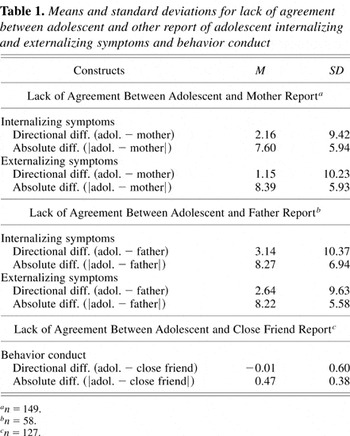
Means and standard deviations for lack of agreement between adolescent and other report of adolescent internalizing and externalizing symptoms and behavior conduct
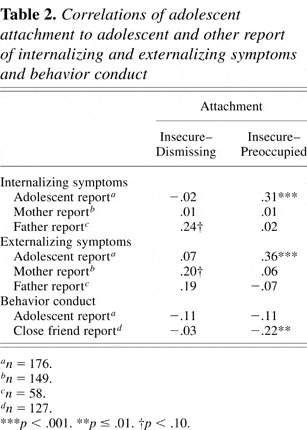
Correlations of adolescent attachment to adolescent and other report of internalizing and externalizing symptoms and behavior conduct
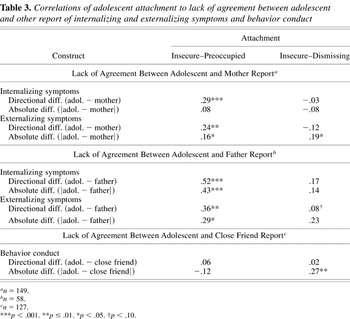
Correlations of adolescent attachment to lack of agreement between adolescent and other report of internalizing and externalizing symptoms and behavior conduct
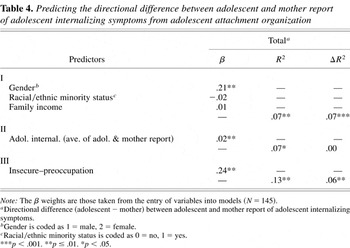
Predicting the directional difference between adolescent and mother report of adolescent internalizing symptoms from adolescent attachment organization
Predicting the directional difference between adolescent and mother report of adolescent externalizing symptoms from adolescent attachment organization
Predicting the directional difference between adolescent and father report of adolescent internalizing symptoms from adolescent attachment organization
Predicting the directional difference between adolescent and father report of adolescent externalizing symptoms from adolescent attachment organization
Predicting lack of agreement between adolescent and close friend report of adolescent behavior conduct from adolescent attachment organization
 You have
Access
- 54
- Cited by