The common North Atlantic starfish Asterias rubens L. (including American populations previously described as A. vulgaris Verrill, which is a junior synonym: see Clark & Downey, Reference Clark and Downey1992; Wares, Reference Wares2001) is a frequent prey item of gulls (Larus spp.), including the herring gull Larus argentatus Pont. (Dewar, Reference Dewar1937; Oldham, Reference Oldham1937; Spaans, Reference Spaans1971; Verbeek, Reference Verbeek1977a, Reference Verbeekb; Dare, Reference Dare1982; Sibly & McCleery, 1983), American herring gull Larus smithsonianus Coues (Menge, Reference Menge, Jangoux and Lawrence1982), lesser black-backed gull Larus fuscus L. (Verbeek, Reference Verbeek1977b), greater black-backed gull Larus marinus L. (Menge, Reference Menge, Jangoux and Lawrence1982) and common gull Larus canus L. (Oldham, Reference Oldham1937). A closely related starfish, Asterias forbesi Desor, is also taken by American herring gulls (Thomas & Thomas, Reference Thomas and Thomas1965). Indeed it has been hypothesized that gull predation might be a factor contributing to the absence of Asterias spp. from the intertidal zone of New England, USA (discussed by Menge, Reference Menge, Jangoux and Lawrence1982).
A particular method used by gulls when feeding on starfish appears to have been described first by Dewar (Reference Dewar1937). He reported that herring gulls consumed A. rubens by grabbing the base of one arm, shaking the animal violently until the arm separated from the rest of the body, then swallowing the detached arm base first. Gulls subsequently grabbed the starfish at the point where the arm had broken-off then swallowed the whole starfish. Dewar (Reference Dewar1937) interpreted this behaviour as being a method for ensuring the gull's gullet was not damaged by the spines of the starfish, which point towards the apex of the arm.
Similar behaviour was reported to me by two acquaintances. Mr A.D. Fisher, Glasgow Caledonian University, whilst visiting Otter Point, Mount Desert Island, Maine, USA in 1999, saw an American herring gull pull a specimen of A. rubens from a rock-pool, break it up by shaking it and swallow it piece by piece. Ms G. Joly, formerly of the Université Libre de Bruxelles, informed me that in 2001 at Knokke, Belgium, herring gulls fed on A. rubens in two ways, depending on the size of the starfish. With smaller starfish (arm length less than around 5 cm), the gull held one arm in its beak, then shook its head until the body broke away from the arm. The arm was swallowed and the gull then attempted to extract the pyloric caeca and gonads from the rest of the body. With larger starfish, the gulls pecked open the upper body wall directly to gain access to the soft internal organs.
It is beyond doubt, then, that at least some populations of gulls, especially herring gulls, feed on Asterias spp. by grasping one arm, shaking the animal until the body breaks away and swallowing the detached arm. This may or may not be repeated for other arms.
Exactly how does shaking bring about breakage of the arm? Asterias spp. have the capacity to autotomize (discard) arms that have been damaged or trapped. In contrast to certain other starfish, such as Luidia spp., that can effect detachment at any point along the length of an arm (Emson & Wilkie, Reference Emson and Wilkie1980), Asterias spp. have a restricted autotomy region at the base of each arm, so that autotomy always involves the loss of whole arms (Wilkie et al., Reference Wilkie, Griffiths, Glennie, De Ridder, Dubois and Jangoux1990; Wilkie, Reference Wilkie2001). This raises the possibility that, when gulls shake Asterias spp., they initiate the autotomy response, which shortens the time required to consume the starfish and shortens the time during which the prey is vulnerable to being stolen. To evaluate the likely role of autotomy in the consumption of starfish by gulls, starfish were shaken manually and the timing and pattern of breakage were recorded.
Two groups of A. rubens were used. These had different size-distributions, size being quantified as: R (the radius measured from the centre of the disc to the tip of the longest arm). Twenty-six animals were obtained by divers in June 2007 from a subtidal site at the Isle of Cumbrae, Firth of Clyde, Scotland (R = 55–90 mm; mean R = 74.38±9.39 mm). Thirty-nine animals were collected by the author in October 2008 from intertidal rock pools at Largo Bay, Fife, Scotland (R = 18–70 mm; mean R = 38.38±11.93 mm).
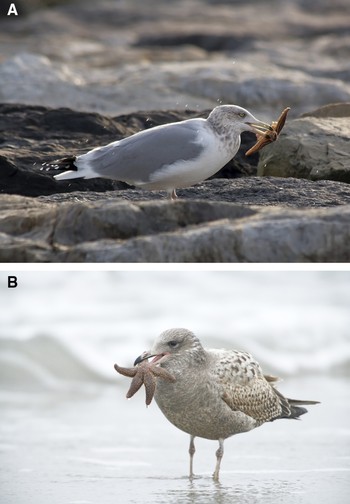
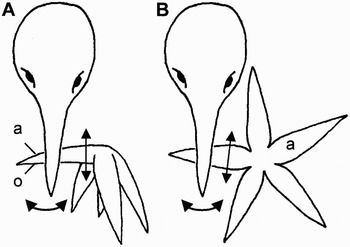
In the shaking experiments, one arm per animal was gripped by a spring-loaded Babco 76 mm Grip Clip™, which applied a standardized compressive force. The clip was placed transversely so that the jaws were in contact with the oral and aboral surfaces of the arm and the proximal edge of the jaws was located half-way along the length of the arm. The clip was then shaken manually in air at a constant frequency of two shakes per second. There being no information on the specific characteristics of head shaking employed by gulls when handling starfish, this frequency was chosen for its convenience and reproducibility. The detachment time (time from start of shaking to detachment of arm) was recorded to the nearest second with a stop-clock. An internet search for images of gulls with starfish in their beaks indicated (unsurprisingly) that the orientation of the beak with respect to the arm varies. Gulls grip Asterias spp. laterally (i.e. with the frontal planes of the beak and starfish orthogonal to each other), oro-aborally (‘dorso-ventrally’, i.e. with the frontal planes of the beak and starfish parallel to each other) (Figure 1), or in an orientation intermediate between these extremes. If the grip is lateral, head shaking would tend to bend the arm oro-aborally; if the grip is oro-aboral, head shaking would tend to bend the arm laterally (Figure 2). The effects of lateral and oro-aboral shaking were therefore compared. When the animals from the Firth of Clyde were tested, 5 of them were not shaken after attachment of the clip but were held stationary in air. The sequence of treatments was regularly changed to avoid any order effect. Statistical tests were conducted using GraphPad Prism Version 4.0a.
American herring gulls (Larus smithsonianus) holding starfish (Asterias forbesi). (A) Adult gull gripping starfish laterally; (B) immature gull gripping starfish oro-aborally (photographs taken in New Jersey, USA by Bob Mullen and Michael W. Masters respectively, and used with their permission).

Diagrammatic horizontal views (not to scale) of heads of gulls (beaks pointing towards ground) that are gripping starfish laterally (A) and oro-aborally (B). The double-headed arrows indicate the rotation of the gull's beak during head shaking and the direction of the rotational force to which the starfish arm is subjected. When an arm is gripped laterally, shaking tends to bend it oro-aborally; when gripped oro-aborally, shaking tends to bend it laterally. a, aboral (upper) surface of starfish; o, oral (lower) surface of starfish.

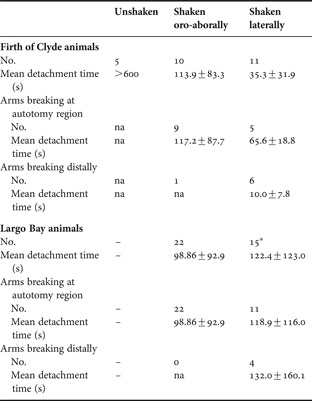
The results are summarized in Table 1. Shaking clearly precipitates arm detachment. Whereas all shaken Clyde animals showed arm breakage (detachment time 4–301 seconds, mean 72.7±72.5 seconds), none of the 5 unshaken Clyde animals had broken after 10 minutes, at which point the tests were terminated.
Summary of results. na, not applicable; –, no data; *, excludes two animals that had not broken after 10 minutes.

A total of 60 animals were subjected to shaking. In 58 animals this resulted in arm detachment (after 4–399 seconds); two laterally shaken Largo animals had not broken after 10 minutes. In 47 (81%) of the 58 detachments, the arm separated at the level of the basal autotomy region. Visual inspection confirmed that the autotomy mechanism had been involved in all cases of basal separation (the wound surface of autotomized arms having a characteristic ‘clean-cut’ appearance). This is conducive to the idea that, when gulls shake A. rubens and cause arm separation, autotomy is usually involved.
Of the 32 animals that were shaken oro-aborally, 31 (96.9%) detached arms at the autotomy region and one arm (3.1%) broke distally, i.e. at a level between the autotomy region and the position of the clip. Of the 26 animals that were shaken laterally and broke, 16 (61.5%) detached arms at the autotomy region and 10 (38.5%) at a level distal to the autotomy region. The greater proportion of arms breaking distal to the autotomy region with lateral than with oro-aboral shaking was highly significant (Fisher's exact test; two-tailed P = 0.001). Whilst this effect was shown in the two separate groups of animals, it was statistically significant in the Largo animals (two-tailed P = 0.02) but not in the Clyde animals (two-tailed P = 0.06). The association between lateral shaking and distal breakage may be explained as follows. Shaking imposes on the proximal part of the gripped arm centrifugal forces, which generate uniaxial tension, and torque forces, which tend to bend the arm. Due to its structure, particularly the repeated series of rib-like transverse ambulacral ossicles in the oral body wall (see Eylers, Reference Eylers1976), the arm of A. rubens can accommodate a wider range of flexion in the oro-aboral direction than laterally (i.e. the arm of A. rubens is adapted to bend more oro-aborally than laterally). This means that torque forces may subject those anatomical elements that set limits to arm flexibility to greater mechanical stress when the arm is shaken laterally than when it is shaken oro-aborally. Consequently, torque forces are more likely to generate stresses that exceed the breaking strength of arm structures, thereby causing mechanical failure, during lateral shaking than during oro-aboral shaking.
There was no significant difference between the mean detachment times of the oro-aborally and laterally shaken Largo animals, or between autotomizing and distally breaking arms in the laterally shaken Largo group (Kruskal–Wallis and Dunn's multiple comparison tests; P > 0.05). In contrast to this, in the Clyde animals the mean detachment time of the laterally shaken group was significantly lower (Kruskal–Wallis and Dunn's multiple comparison tests; P < 0.05) than that of the oro-aborally shaken group (which did not differ significantly from the Largo equivalent), mainly because the mean detachment time of laterally shaken arms breaking distally was less than a sixth that of arms detaching at the autotomy region (P < 0.01). The very short detachment times of these distally breaking arms may be a consequence of the larger size of the Clyde animals. In A. rubens the relationship between size (measured as R) and wet weight is initially exponential, so that larger animals are disproportionately heavier than smaller animals (personal unpublished data). Since the magnitude of the centrifugal and torque forces generated during shaking depends partly on the mass of the animal, the tissues of large animals are subjected to disproportionately higher forces than those of small animals. There is evidence that the breaking strength of arm tissues in A. rubens increases linearly with size (Marrs et al., Reference Marrs, Wilkie, Sköld, Maclaren and McKenzie2000). However, if shaking generates stresses that increase geometrically with size, then the tissues of larger animals would be subjected to relatively higher stresses and would therefore tend to fail more quickly than those of smaller animals.
Gulls employ a variety of techniques when feeding on starfish. By pecking through the body wall they may consume only the soft internal organs (G. Joly, personal communication); they may swallow starfish whole (Oldham, Reference Oldham1937); or they may break up starfish by shaking them then ingest some or all of the fragments (Dewar, Reference Dewar1937; A.D. Fisher, personal communication; G. Joly, personal communication). Dismembering starfish is potentially advantageous to gulls because it enables them: (1) to consume starfish that are too large to swallow whole, no matter the effort; and (2) to consume more rapidly starfish of an ‘intermediate’ size, which could be swallowed whole but with a struggle and therefore slowly (see e.g. Oldham, Reference Oldham1937). Reducing the time taken to consume starfish is desirable because gulls commonly steal food items, including A. rubens, from each other (Oldham, Reference Oldham1937; Verbeek, Reference Verbeek1977a, Reference Verbeekb). Starfish autotomy may therefore benefit gulls because it is usually the mechanism by which shaking leads to arm detachment, thus shortening the time required to handle some starfish. On the other hand, mechanical failure distal to the autotomy region may be a preferable outcome in certain circumstances. If size was the only variable distinguishing the two groups of starfish used in this investigation, it would appear that the most efficient way to dismember larger starfish is to shake them laterally, since this causes distal breakage more often than does oro-aboral shaking, and distal breakage occurs much more quickly than autotomy in these animals. This leads to the conjecture that some gulls learn to employ preferentially lateral shaking when they handle A. rubens, particularly larger specimens: it is well-known that gulls are adept at learning and modifying whatever skills are needed to deal with available prey species (Dewar, Reference Dewar1937; Schaffer, Reference Schaffer1971; Verbeek, Reference Verbeek1977a). However, since the two experimental groups came from widely separated populations (located on the west and east coasts of Scotland) occupying different habitats (sublittoral and littoral respectively), the differences in their behaviour could have been due more to physiological factors than size. For example, the two groups may have differed in terms of the mechanical properties of their arm structures or the neural parameters controlling the autotomy reflex.
It is believed that starfish autotomy evolved as a defensive strategy, one of its benefits being to increase the likelihood that the outcome of an encounter with a predator is sublethal (consumption of one or more arms) rather than lethal (consumption of entire body) (Lawrence, Reference Lawrence, Scalera-Liaci and Canicattì1992; Ramsay et al., Reference Ramsay, Turner, Vize and Richardson2000). The present investigation suggests that when gulls are the predators, autotomy may have the opposite effect and increase the likelihood that the consequence is lethal, thus negating the survival value of the autotomy response for starfish in such situations. The evidence for this is indirect and derived from laboratory experiments on starfish that mimicked only crudely events in nature. This evidence needs to be complemented with field observations on different populations of gulls to determine exactly how they handle starfish. It is hoped that this contribution will inspire such work and stimulate wider interest in a common but neglected predator–prey interaction.
ACKNOWLEDGEMENTS
I am grateful to Mr A.D. Fisher and Ms G. Joly for their observations on gull feeding behaviour, to Mr M.W. Masters and Mr R. Mullen for permission to use their photographs, to Professor P. Dubois, Université Libre de Bruxelles and Dr C.L. Mah, Smithsonian Institution National Museum of Natural History, for additional information, to the Specimen Supply Department, University Marine Biological Station, Millport, for providing animals, and to Mr H.W. Baker for accommodation and facilities at Lower Largo, Fife.